Are you tired of sky-high electricity bills every summer? You’re not alone. Millions of American homeowners are looking for smarter, greener ways to keep their homes cool and solar air conditioners are quickly becoming one of the most popular solutions.
In this guide, we’ll walk you through everything you need to know: how solar ACs work, which ones are worth buying in 2025, how they compare side by side, and answers to the questions real people are searching for on Google right now.
Whether you’re a first-time buyer or already have solar panels on your roof, this article will help you make a confident, informed decision. Lets deep dive into “Best Solar Air Conditioner for Home: The Ultimate USA Homeowner Guide”
READ MORE: Solar Powered Heat Pump Cost: USA Homeowner Guide to Savings
What Is a Solar Air Conditioner, and How Does It Work?
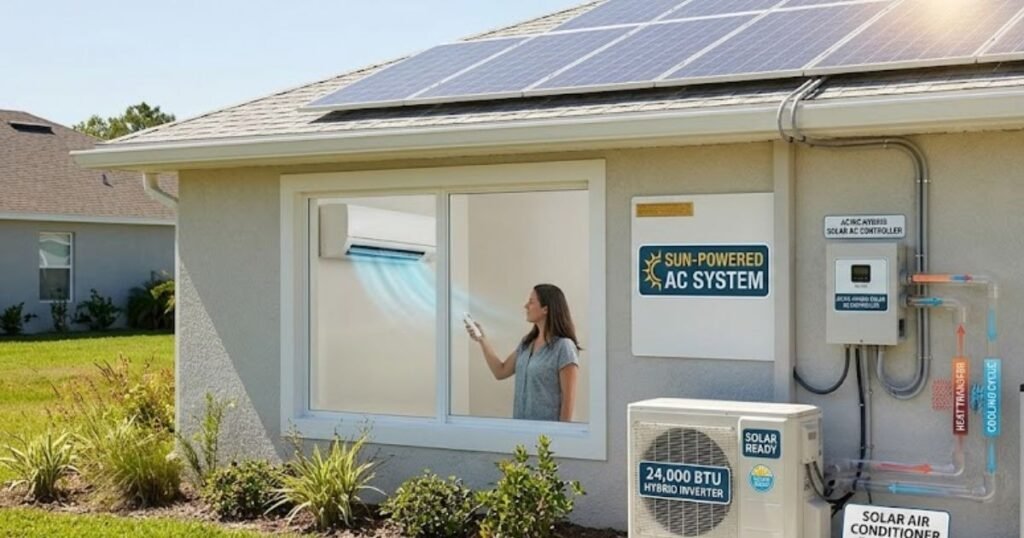
A solar air conditioner is exactly what it sounds like an air conditioning system that runs on energy from the sun. But there are a few different types, and understanding the difference matters before you spend your money.
The three main types are:
- DC Solar Air Conditioners — These run directly off solar panel power with no battery and no grid connection. They only cool when the sun is shining, making them best for cabins, off-grid homes, or daytime-only use.
- Hybrid Solar Air Conditioners — These can pull energy from solar panels, batteries, or the grid depending on what’s available. This is the most flexible option for full-time homeowners.
- AC-Powered Solar Air Conditioners — These work with your existing solar panel system and inverter, using whatever solar energy your home is generating at that moment.
For most American homeowners with or without an existing solar setup, hybrid systems offer the best balance of savings and reliability. You stay cool even on cloudy days or at night, but you’re drawing on free solar energy as much as possible.
Why More US Homeowners Are Switching to Solar AC?
Let’s be honest the upfront cost of a solar air conditioner can be higher than a traditional unit. So why are more people making the switch?
Here are the real reasons homeowners are going solar for their cooling needs:
- Monthly energy savings — A properly sized solar AC can cut your cooling costs by 50% to 90%, depending on your location and system setup. That adds up fast across a hot summer in states like Texas, Arizona, Florida, or California.
- Federal tax credits — Thanks to the Inflation Reduction Act, homeowners can still claim a 30% federal tax credit on solar energy equipment, including qualifying solar AC systems, through 2032.
- Reduced grid dependence — With utility rates climbing every year, locking in solar energy as your primary cooling source is a smart long-term hedge.
- Better for the environment — Solar cooling produces zero direct carbon emissions. If you care about your carbon footprint, this is a meaningful change you can make at home.
- Increased home value — Studies from Lawrence Berkeley National Laboratory show that solar installations consistently raise home resale value, often by $10,000–$20,000 or more.
- Quieter operation — Many solar inverter AC units operate more quietly than older conventional systems.
READ MORE: Best Portable Solar Power Generators Kit: Review, Comparison & Buying Guide
What to Look for Before You Buy a Solar Air Conditioner
Shopping for a solar AC isn’t quite the same as buying a regular window unit. Here are the key factors you should consider:
- Cooling Capacity (BTU/Ton) Match the unit’s BTU rating to your room or home size. A rough rule of thumb: 6,000–8,000 BTU for a small room, 12,000–18,000 BTU for a medium-sized area, and 24,000–60,000 BTU or more for whole-home systems.
- Home Size and Layout: Mini-splits are zoned systems. They are perfect for cooling specific spaces like master bedrooms, living rooms, home offices, or detached garages. If you want to cool an entire 3,000-square-foot house, you will need a multi-head system or multiple individual units.
- SEER Rating The Seasonal Energy Efficiency Ratio tells you how efficiently the unit cools. Look for a SEER rating of 16 or higher for good efficiency; 20+ is excellent.
- Compatibility with Solar Panels Some units require specific solar panel wattage. Check whether the system is plug-and-play or requires professional installation and a dedicated inverter.
- On-Grid vs. Off-Grid Capability Do you need the unit to work without grid power during outages? If so, look for a system with battery storage support.
- Brand Support and Warranty Solar AC is still a developing market. Stick with brands that offer at least a 5-year compressor warranty and have US-based customer support.
- Installation Requirements Some solar ACs are DIY-friendly mini-splits. Others require licensed HVAC contractors. Factor in installation cost when comparing prices.
5 Best Solar Air Conditioners for Home
After researching the market thoroughly, here are five solar air conditioner systems that consistently stand out for US homeowners.
1. Gree Flexx DC Inverter Solar-Ready Mini Split
Best for: Homeowners who already have a solar panel system
Gree is one of the world’s largest HVAC manufacturers, and the Flexx series is their flagship offering for solar-compatible cooling in the US residential market.
Key Specs:
- Available in 9,000 / 12,000 / 18,000 / 24,000 BTU
- SEER up to 38
- Works with existing grid-tied solar installations
- Variable-speed DC inverter compressor
- Heating and cooling capable (heat pump)
What We Like: The Gree Flexx stands out for its extraordinarily high SEER rating — up to 38, which is among the best in its class. That kind of efficiency means serious money saved when paired with solar. The DC inverter technology means it adjusts its speed to maintain the exact temperature you set, rather than cycling on and off like older systems.
Installation is straightforward for HVAC professionals, and the unit integrates seamlessly with any grid-tied solar array. Gree also has a solid US dealer network and a 7-year parts and compressor warranty through authorized dealers.
One Thing to Note: The Flexx is a grid-tied system, so it doesn’t function during a power outage unless you add battery backup. Also, it’s not a DIY install — you’ll need a licensed HVAC tech.
Approximate Price Range: $800–$1,600 for the unit; $1,500–$2,500 installed (varies by region)
Rating: 4.7 / 5
2. Midea U-Shaped Inverter Solar-Compatible Window AC
Best for: Renters and homeowners who want a budget-friendly, DIY solar AC setup
Midea’s U-Shaped window air conditioner has been a fan favorite for a few years now, and its inverter technology makes it one of the easiest units to pair with a small solar panel setup.
Key Specs:
- 8,000 / 10,000 / 12,000 BTU options
- SEER up to 15
- Works with portable solar generators (like Jackery or EcoFlow)
- Unique U-shaped design allows window to open
- Smart home compatible (Alexa, Google Assistant)
What We Like: The U-shape design is genuinely clever — you can still open and close your window with the unit installed, which most window ACs don’t allow. More importantly, its inverter compressor runs efficiently enough that homeowners have successfully powered it with a 200–400W portable solar panel setup and a battery station.
It’s one of the most accessible entry points into solar cooling. No HVAC contractor needed, no roof installation — just a window unit, a couple of solar panels, and a power station.
One Thing to Note: At SEER 15, it’s efficient but not exceptional. And at 8,000–12,000 BTU, it’s a room-level solution, not a whole-home one. Still, for the price and simplicity, it’s hard to beat.
Approximate Price Range: $350–$550 for the unit; solar panels and battery station separate
Rating: 4.4 / 5
3. SOLARAIR World DC48 Hybrid Solar Air Conditioner
Best for: Off-grid homeowners and those wanting a dedicated solar AC system
SOLARAIR World specializes in solar-specific air conditioning, and their DC48 series is built from the ground up to run on solar power no grid required.
Key Specs:
- 12,000 / 18,000 / 24,000 BTU
- SEER up to 22
- Operates on DC power directly from solar panels
- Optional battery backup compatibility
- Works in grid-tied, hybrid, or off-grid configurations
What We Like: This system is designed specifically for solar from the ground up. It can run directly from DC solar panels without an inverter, which eliminates conversion losses and makes it more efficient in pure solar mode. For off-grid cabins, tiny homes, or homesteads, this is one of the cleanest solutions available.
The unit also supports a hybrid configuration, where it draws from solar first and then falls back to grid or battery power. This gives you maximum solar utilization without losing reliability.
SOLARAIR provides solid US-based customer support, which is a meaningful plus in a market where many budget solar AC brands have minimal after-sales presence.
One Thing to Note: The upfront cost is higher than conventional mini-splits. And because it’s a specialized system, finding a local installer familiar with it may take some effort.
Approximate Price Range: $1,200–$2,200 for the unit; installation varies
Rating: 4.5 / 5
4. Pioneer Diamante Series Mini Split (Solar-Ready)
Best for: Homeowners wanting a reliable, mid-budget mini split that works with solar
Pioneer has been a well-respected name in the US mini-split market for years, and the Diamante series is their most efficient and feature-rich line, easily integrated with solar systems.
Key Specs:
- Available in 9,000 / 12,000 / 18,000 / 24,000 BTU
- SEER up to 25
- DC inverter compressor
- Works with any grid-tied or hybrid solar setup
- 5-year parts warranty, 7-year compressor warranty
What We Like: Pioneer makes it genuinely easy for homeowners to get into solar mini-split cooling. The Diamante line hits a sweet spot: high enough efficiency (SEER 25) to make solar pairing worthwhile, but priced more accessibly than premium brands. It also has a strong reputation for reliability over the long term.
Because it’s one of the more popular mini-split brands in the US, you’ll have an easier time finding local HVAC contractors familiar with the system, which can reduce installation headaches and cost.
The unit is also whisper-quiet at around 25 dB on the lowest setting — a genuinely nice quality-of-life improvement over traditional AC systems.
One Thing to Note: Like the Gree Flexx, this is a grid-tied system, so battery backup is needed for outage protection. It’s also not a DIY install.
Approximate Price Range: $700–$1,400 for the unit; $1,200–$2,200 installed
Rating: 4.6 / 5
5. Chigo Solar DC Inverter Air Conditioner (All-in-One Off-Grid)
Best for: Off-grid applications, tiny homes, and rural homeowners
Chigo is a Chinese HVAC manufacturer with a growing US presence, and their dedicated solar DC inverter AC line is specifically built for off-grid and rural applications where grid reliability is limited.
Key Specs:
- 9,000 / 12,000 / 18,000 BTU
- SEER up to 20
- Runs on solar panels + battery with no grid connection
- Built-in MPPT solar controller
- LED display with solar/battery status monitoring
What We Like: The built-in MPPT (Maximum Power Point Tracking) solar controller is what sets this unit apart at its price point. You don’t need a separate solar charge controller — everything is integrated. Plug in your solar panels, connect your battery bank, and you’re running.
The real-time display showing solar input and battery status is a genuinely useful feature that most units at this price point don’t offer. It makes managing and monitoring your off-grid setup much simpler.
For rural homeowners, hunters, or anyone with a property that doesn’t have grid power, this is a practical and relatively affordable way to get real air conditioning.
One Thing to Note: Chigo has a more limited US service network than brands like Pioneer or Gree. Make sure you’re comfortable with the warranty terms before purchasing, and buy from a reputable US-based dealer.
Approximate Price Range: $900–$1,500 for the unit; varies for installation
Rating: 4.2 / 5
READ MORE: Best Off-Grid Solar Kits in the USA: Complete Buyer’s Guide
Side-by-Side Comparison: 5 Best Solar Air Conditioners
| Feature | Gree Flexx | Midea U-Shape | SOLARAIR DC48 | Pioneer Diamante | Chigo Solar DC |
| Best For | Grid-tied solar homes | Renters / small rooms | Off-grid & hybrid | Mid-budget homeowners | Off-grid / rural |
| BTU Range | 9K–24K | 8K–12K | 12K–24K | 9K–24K | 9K–18K |
| SEER Rating | Up to 38 | Up to 15 | Up to 22 | Up to 25 | Up to 20 |
| Off-Grid Ready | No (grid-tied) | With battery station | Yes | No (grid-tied) | Yes |
| DIY Friendly | No | Yes | No | No | Partial |
| Built-in Solar Controller | No | No | No | No | Yes (MPPT) |
| Warranty | 7 years (compressor) | 1 year | 5 years | 7 years (compressor) | 3 years |
| Smart Home Compatible | Yes | Yes | No | Yes | No |
| Price Range (Unit Only) | $800–$1,600 | $350–$550 | $1,200–$2,200 | $700–$1,400 | $900–$1,500 |
| Overall Rating | 4.7/5 | 4.4/5 | 4.5/5 | 4.6/5 | 4.2/5 |
Quick takeaways from the comparison:
- If efficiency is your top priority and you already have solar panels, go with the Gree Flexx (SEER 38 is exceptional).
- If you’re renting or just want a low-cost entry into solar cooling, the Midea U-Shape paired with a portable power station is the simplest path.
- If you’re off-grid or want true energy independence, choose the SOLARAIR DC48 or the Chigo Solar DC.
- If you want a reliable, mid-range option from a brand with strong US installer support, the Pioneer Diamante is a safe, smart bet.
READ MORE: Home Battery Backup Without Solar: Best Options for U.S. Homeowners
How Much Can You Actually Save with a Solar Air Conditioner?
This is the question that matters most to most homeowners, so let’s look at some real numbers.
Average US household cooling cost: According to the US Energy Information Administration, air conditioning accounts for about 12% of US home energy expenditures averaging around $400–$700 per year in moderate climates and significantly more in hot states like Florida, Texas, and Arizona.
With a solar AC system:
- In a sun-rich state like Arizona or California, a properly sized solar AC running on a 1,500–2,000W solar panel array can cover 70–90% of its cooling energy needs from the sun.
- That translates to annual savings of $300–$600 or more on cooling alone.
- Over a 10-year period, that’s $3,000–$6,000 back in your pocket — before accounting for utility rate increases, which historically run 3–5% per year.
Add in the 30% federal tax credit, and the payback period on many solar AC systems falls to 4–7 years. After that, you’re essentially cooling your home for free.
Solar Air Conditioner Installation: What to Expect
Installing a solar air conditioner involves a few more steps than a standard AC unit, but it doesn’t have to be overwhelming.
Here’s a general overview of the process:
- Solar panel installation or assessment — If you don’t already have solar panels, you’ll need them. A small dedicated solar AC setup may only require 2–6 panels (400–600W each). If you’re adding onto an existing system, your solar installer will assess capacity.
- AC unit installation — For mini-split systems, a licensed HVAC contractor will mount the indoor air handler and outdoor compressor, run refrigerant lines, and make electrical connections.
- System integration — Your solar installer and HVAC contractor (sometimes the same company) will connect the AC system to your solar array and verify everything is working.
- Inspection and permitting — Most jurisdictions require permits for both solar and HVAC work. Your installer handles this, but factor in time for approval.
Total installation cost estimates:
- Small room setup (window AC + portable solar): $600–$1,200 all-in
- Single-room mini-split with dedicated solar panels: $3,000–$6,000
- Whole-home solar AC system: $8,000–$20,000+ depending on size
READ MORE: Solar Water Heater
Federal and State Incentives for Solar Air Conditioner
Before you finalize your budget, make sure you’re taking advantage of every incentive available to you.
- Federal Investment Tax Credit (ITC): 30% credit on the cost of solar panels and qualifying equipment, available through 2032 under the Inflation Reduction Act.
- State rebates: Many states offer additional rebates on solar equipment. California, New York, Massachusetts, and several others have active programs. Check the DSIRE database (dsireusa.org) for your state.
- Utility company rebates: Some utilities offer rebates for high-efficiency HVAC equipment. Call your utility provider and ask.
- PACE financing: Property Assessed Clean Energy programs in many states let you finance solar and energy efficiency upgrades through your property tax bill no out-of-pocket upfront cost.
5 Real Google Search FAQs
Can a solar air conditioner run at night?
Yes — but it depends on the type of system. A pure DC solar AC with no battery will not run at night because there’s no sunlight to generate power. However, a hybrid solar air conditioner connected to a battery storage system or the grid will run 24/7.
How many solar panels do I need to run an air conditioner?
This depends on the size of your AC unit. As a general guideline:
A 9,000 BTU mini-split needs approximately 600–900W of solar capacity (about 2–3 panels at 300W each)
A 12,000 BTU unit needs around 1,000–1,200W (3–4 panels)
An 18,000 BTU unit requires roughly 1,500–1,800W (5–6 panels)
A 24,000 BTU unit needs approximately 2,000–2,500W (6–8 panels)
Are solar air conditioners worth it?
For most homeowners in warm or hot climates, yes solar air conditioners are absolutely worth considering. The combination of rising utility rates, a 30% federal tax credit, improved technology, and lower panel costs has made the economics much more favorable than even a few years ago.
What is the difference between a solar AC and a regular AC?
A regular air conditioner runs entirely on grid electricity. A solar air conditioner is designed to use solar energy either completely (in off-grid systems) or partially (in hybrid/grid-tied systems) — as its power source.
Do solar air conditioners work during a power outage?
It depends on the system. Grid-tied solar AC systems those connected to the utility grid will not work during a power outage unless they have battery backup, due to safety regulations that require grid-tied solar systems to shut down when the grid goes down (to protect utility workers).
Final Thoughts: Is a Solar Air Conditioner Right for Your Home?
Solar air conditioners have moved well past the “experimental” stage. In 2025, they’re a mature, practical option for US homeowners who want to reduce their cooling costs, lower their carbon footprint, and gain more energy independence.
The key is matching the right system to your specific situation:
- Already have solar panels? A high-efficiency solar-compatible mini-split like the Gree Flexx or Pioneer Diamante is probably your fastest path to savings.
- Living off-grid or in a rural area? Look at dedicated solar DC systems like the SOLARAIR DC48 or Chigo Solar DC.
- Renting or want a simple, low-cost start? The Midea U-Shape with a portable solar generator is a surprisingly capable entry point.
Whatever you choose, take advantage of the 30% federal tax credit and any state incentives in your area. And if you’re not sure where to start, getting a quote from a local solar installer is usually free — and they can tell you exactly what your home’s solar cooling potential looks like.
Stay cool, save money, and make the most of the sunshine.
Disclaimer: Prices listed are approximate and subject to change. Always verify current pricing with authorized dealers. Consult a licensed HVAC contractor and solar installer for system sizing and installation recommendations specific to your home.