You spent all day setting up camp, wrangling the dog through a mud puddle, and now the sun’s going down and everyone wants a shower. There’s no spigot, no water tank on the wall, and no time to boil pots on a camp stove. This is exactly the situation a portable propane hot water heater was built to solve.
These compact, tankless appliances use a propane flame and a heat exchanger to heat water on demand, right where you need it, no installation, no waiting for a tank to recover. Homeowners use them for outdoor showers, pet washing, RV trips, cabin weekends, and short-term hot water during a renovation. Campers, overlanders, and off-grid cabin owners rely on them because they need real hot water without a fixed plumbing system.
In this guide, you will learn exactly how portable propane water heaters work, how to calculate your heating needs based on flow rate and incoming water temperature, critical propane safety guidelines, and an in-depth review of six of the top portable propane hot water heaters available today. Lets deep dive into “Best Portable Propane Hot Water Heater: Reviews, Cost & Comparison”
What Is a Portable Propane Hot Water Heater?
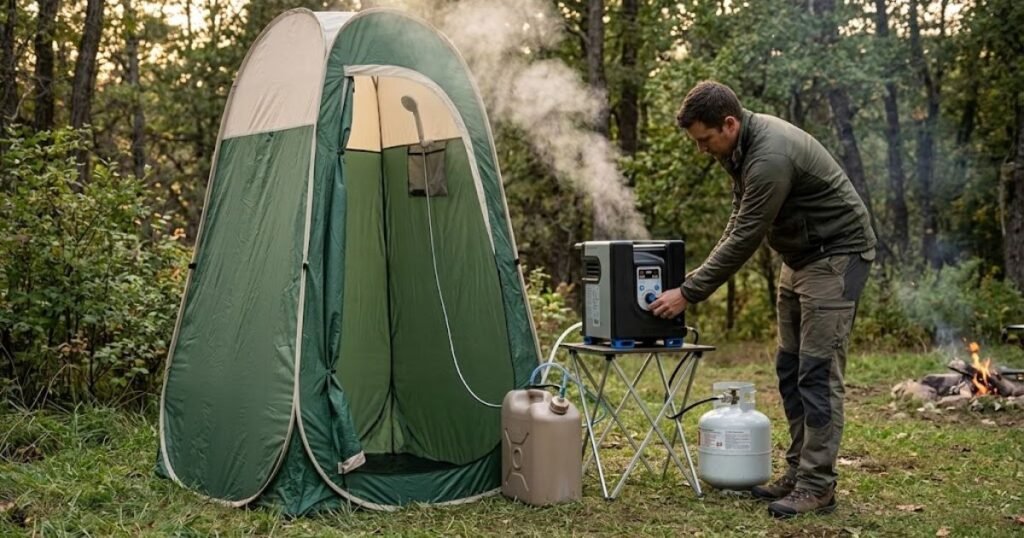
A portable propane hot water heater is a small, self-contained appliance that heats water instantly as it flows through the unit, rather than storing and reheating water in a tank. That’s what “tankless” or “on-demand” means: no reservoir sitting around, virtually no standby heat loss, and no waiting for a tank to refill.
The basic idea: propane burns inside the unit and heats a metal heat exchanger. A small 12V submersible pump draws water from a bucket, jug, or approved source and pushes it through that exchanger. Cold water absorbs heat almost instantly, then exits through a hose to a showerhead, spray nozzle, or faucet attachment. Adjust the flame or flow rate, and output temperature changes accordingly essentially a tiny, battery-powered, propane-fueled version of the tankless heaters bolted to a wall.
READ MORE: AO Smith vs. Rheem Water Heaters: Comparison & Expert Reviews
How Does a Portable Propane Water Heater Work?
Setup generally follows the same sequence, though exact steps vary by model, always check your manual first.
1. Connect the Water Source
Most units draw water from a bucket, collapsible container, garden hose, or freshwater tank using a submersible pump with an inlet filter. Some models can also connect to a pressurized hose if the manufacturer allows it.
2. Connect the Propane Supply
Attach the regulator that comes with your unit to a propane cylinder commonly a 1-lb disposable canister, though some larger units accept 20-lb tanks. Only use the manufacturer-specified regulator; mismatched parts can affect gas pressure and safety.
3. Power the Pump or Ignition System
Many current models run on a built-in rechargeable battery (often 4,000mAh) that powers the pump and electronic ignition. Others use replaceable batteries or plug into a 12V outlet, handy for RV use.
4. Water Passes Through the Heat Exchanger
Once you start the pump and ignite the burner, water routes through a metal heat exchanger above the flame, absorbing heat almost immediately why these units deliver hot water in seconds.
5. Adjust the Temperature and Water Flow
Output temperature depends on gas input, flow speed, and incoming water temperature together. Turning down flow (or turning up the flame) raises output temperature, and vice versa.
6. Hot Water Comes Through the Showerhead
Heated water exits through a hose to a showerhead, spray wand, or faucet nozzle. Many models include multiple spray patterns for showering versus rinsing gear or dishes.
READ MORE: Best Portable Solar Power Generators Kit: Review, Comparison & Buying Guide
6 Best Portable Propane Hot Water Heaters
1. CAMPLUX Nano 3 Ultra
The CAMPLUX Nano 3 Ultra is designed for true off-grid mobility, combining the propane burner, control electronics, and rechargeable water pump into a compact package built for quick field setup.
Heating Performance & Specifications
- BTU Rating: ~20,000 BTU/hr class
- Max Water Flow: Up to 0.8 GPM (3 L/min)
- Battery: Integrated 4,000mAh Rechargeable Lithium-Ion
- Battery Runtime: Up to 100 minutes of continuous pumping per charge
- Temperature Control: Digital thermostatic control with ±1°F adjustments
- Safety Features: 122°F high-temp shutoff, dry-run pump protection, tip-over safety switch, flame-failure device
- Propane Source: 1-lb disposable propane cylinders (adapters available for 20-lb tanks)
Hands-On Analysis
The Nano 3 Ultra stands out due to its thermostatic digital display, which allows you to dial in your desired output temperature rather than relying solely on trial-and-error gas knob adjustments. Its internal 4,000mAh battery powers the integrated pump for up to 100 minutes of continuous runtime—enough for 8 to 10 campsite showers before requiring a USB-C recharge.
The unit includes dry-run protection, automatically disabling the internal pump if water runs out to prevent motor burnout. The main limitation is its compact heat exchanger capacity: while it works exceptionally well with moderate summer water source temperatures (60°F–70°F), drawing ice-cold mountain creek water (40°F) will require turning down the flow control significantly to achieve comfortable shower temperatures.
- Best For: Solo campers, overlanders, and van-lifers wanting an all-in-one, battery-powered portable shower system.
- Pros:
- Self-contained design eliminates external wiring clutter.
- Precise digital temperature readout prevents accidental scalding.
- Comprehensive safety feature set (dry-run, tip-over, high-temp).
- Cons:
- Flow rate is tailored specifically for low-flow shower applications.
- Recharging internal battery requires access to USB-C or a portable power station.

2. BougeRV Portable Propane Water Heater
BougeRV’s entry into portable water heating focuses on high BTU efficiency, modern aesthetic housing, and robust weather-resistant construction for off-grid travel.
Heating Performance & Specifications
- BTU Rating: 20,500 BTU/hr maximum
- Max Water Flow: Up to 0.8 GPM (3 L/min)
- Battery: 4,000mAh Rechargeable Lithium-Ion
- Battery Runtime: Approximately 100 minutes
- Temperature Control: Digital display panel with manual gas/water flow dials
- Safety Features: 122°F high-temperature cutoff, flame-out protection, over-pressure protection
- Propane Source: 1-lb propane cylinder compatible
Hands-On Analysis
BougeRV engineered this unit for fast field assembly. It sports a high-efficiency 20,500 BTU burner assembly that delivers a rapid temperature rise within 5 seconds of turning on the shower wand switch. The digital screen clear displays current water temperature, battery health, and operational icons.
The pump system draws water effectively from a bucket or jerrycan, and the system automatically shuts down if water temperatures exceed 122°F. Users should note that BougeRV produces multiple power accessory configurations; verify whether your specific bundle includes the 20-lb propane hose adapter or stick to 1-lb green cylinders.
- Best For: Off-grid overlanders and RVers looking for a reliable, fast-heating portable shower with digital feedback.
- Pros:
- Strong 20,500 BTU output provides quick heating.
- Easy-to-read LED display shows battery and temperature metrics.
- Sturdy outer casing stands up to outdoor travel.
- Cons:
- Submersible pump can struggle if water source contains heavy sediment (requires inline mesh strainer cleaning).
- Accessories take up noticeable storage space in smaller vehicles.
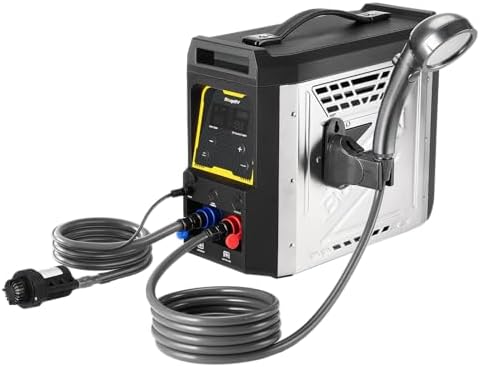
3. Hike Crew Propane Water Heater & Shower Pump
The Hike Crew system is a classic, widely recognized portable camping shower system engineered to operate off 1-lb propane tanks and 12V DC auxiliary power.
Heating Performance & Specifications
- BTU Rating: ~18,000 BTU class
- Max Water Flow: ~0.6–0.8 GPM
- Power Source: 12V DC power plug (car accessory outlet) or internal battery depending on sub-model variant
- Temperature Control: Stepless gas knob adjustment with digital temperature display
- Safety Features: Automatic 125°F safety shutoff, water flow sensor ignition, tip-over safety valve
- Propane Source: 1-lb disposable propane cylinders with supplied regulator
Hands-On Analysis
Hike Crew designed this appliance primarily for family camping and outdoor cleaning tasks. Operating the heater is simple: connect your 1-lb propane tank, drop the pump into a container of water, plug the power cable into your vehicle’s 12V outlet (or run on internal power if charged), and turn on the head switch.
The safety gas-shutoff mechanism triggers if water flow stops or if water temperatures reach 125°F. While its heating capacity is slightly lower than 20,000+ BTU units, it maintains steady water temperatures when fed by moderate groundwater sources. The included showerhead features multiple spray patterns and a convenient shut-off switch right on the handle.
- Best For: Weekend car campers and hunters wanting a straightforward, budget-conscious camp shower.
- Pros:
- Simple, intuitive knob controls.
- Reliable safety shutdown at 125°F.
- Showerhead switch conserves water during lathering.
- Cons:
- Requires careful handling of the 12V power cord in wet environments.
- Slower temperature rise when fed with very cold incoming water.
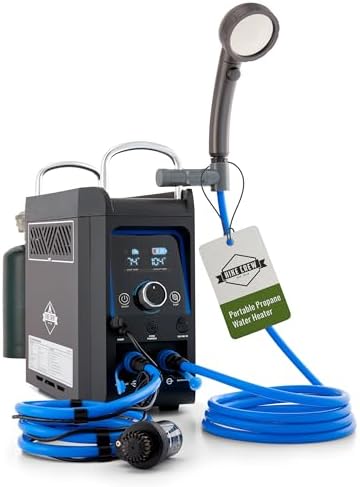
4. GASLAND G3MAX Portable Propane Water Heater
Unlike the all-in-one battery-pump units above, the GASLAND G3MAX is a high-capacity, higher-GPM portable tankless unit intended to be mounted to an outdoor wall, trailer exterior, or post and connected to a pressurized water supply or heavy-duty 12V RV pump.
Heating Performance & Specifications
- BTU Rating: ~38,000–44,000 BTU class (High-output compact series)
- Max Water Flow: Up to 1.5–1.58 GPM (6 L/min)
- Ignition Power: 2 D-Cell Batteries (no electrical outlet required)
- Temperature Control: Dual manual knobs (Gas control, Water flow control) with digital LED output screen
- Safety Features: Flame failure device, anti-freezing drain plug, high-water pressure protection, 167°F max limit protection
- Propane Source: 20-lb standard propane tank (includes low-pressure regulator hose)
Hands-On Analysis
The GASLAND G3MAX is built for applications requiring higher water volume and hotter temperatures—such as off-grid cabins, horse washing stalls, outdoor backyard showers, and temporary home emergency setups. Delivering up to 1.58 GPM, it produces double the water volume of small battery-powered camping showers.
Because it operates on 2 D-cell batteries for ignition and hooks directly to a 20-lb propane tank, it does not rely on internal lithium battery charging. However, it does not include an integrated water pump; it relies on pressurized tap water or an external 12V water pump (like a 3.0 GPM RV diaphragm pump).
- Best For: Cabins, outdoor pet/horse washing stations, and emergency home backup systems requiring strong water flow.
- Pros:
- High BTU rating yields rapid heating and higher flow capacity.
- Runs on standard D-cell batteries and a 20-lb propane tank.
- Can feed standard garden hoses or full-size showerheads.
- Cons:
- Not an all-in-one unit (requires separate water pump or pressurized hose).
- Larger and heavier than battery-powered handheld models.

5. Kohree Helios 20 Pro Portable Water Heater
The Kohree Helios 20 Pro is a complete all-in-one off-grid system, shipping with a storage bag, collapsible water bag, showerhead, pump, and charging hardware.
Heating Performance & Specifications
- BTU Rating: 20,000 BTU/hr
- Max Water Flow: Up to 0.8 GPM (3 L/min)
- Battery: 4,000mAh Rechargeable Lithium-Ion
- Battery Runtime: ~100 minutes of continuous operation
- Included Accessories: Submersible pump, showerhead wand, 1-lb gas regulator, USB charging cable, storage bag, collapsible water reservoir
- Safety Features: 122°F high-temp cut-off, dry-run protection, flameout shutoff
- Propane Source: 1-lb propane cylinders
Hands-On Analysis
Kohree designed the Helios 20 Pro as a complete kit for campers who don’t want to buy separate accessories. The package includes a collapsible water bag, allowing you to set up a complete hot shower station anywhere in under five minutes.
Its 20,000 BTU burner provides steady heating power, while the internal 4,000mAh battery keeps the pump running through multiple uses. The included storage bag keeps the hoses, regulator, pump, and main heater organized during transport. The primary concern is long-term hose durability under repeated folding, so users should store hoses without sharp bends.
- Best For: Campers and overlanders who want a complete, ready-to-use kit with storage accessories included.
- Pros:
- Comprehensive accessory kit includes a collapsible water basin and storage bag.
- Reliable 20,000 BTU output for quick temperature increases.
- Clean, organized packing setup.
- Cons:
- Storage bag can be a tight fit when re-packing hoses after use.
- Water bag must be set on clean ground to avoid punctures.

6. Hillhub Portable Propane Water Heater for Camping
The Hillhub portable water heater is engineered for rugged outdoor conditions, featuring IPX4 water resistance and a high-efficiency burner housing designed to withstand wind gusts.
Heating Performance & Specifications
- BTU Rating: 20,500 BTU/hr
- Max Water Flow: 0.58–0.8 GPM (2.2–3 L/min)
- Battery: 4,000mAh Lithium-Ion Rechargeable
- Battery Runtime: ~100 minutes
- Water Resistance: IPX4 certified weather protection
- Safety Features: Automatic 122°F thermal shut-off, tip-over safety switch, water flow sensor
- Propane Source: 1-lb propane cylinders
Hands-On Analysis
Out in the wilderness, weather can turn quickly. The Hillhub unit’s IPX4 rating ensures light rain or splashback from outdoor showering won’t short out the internal electronics. Delivering 20,500 BTU, it heats water quickly, while the 4,000mAh battery provides reliable off-grid pumping performance.
The showerhead wand includes multiple flow modes and an ergonomic pause button to preserve water during outdoor showers. Like all 1-lb propane appliances, operating it in freezing temperatures can cause pressure drops in small propane canisters, so keeping your gas cylinders warm before use is recommended.
- Best For: Overlanders and weather-hardy campers who need a water-resistant, durable outdoor shower setup.
- Pros:
- IPX4 rating guards internal electronics against water splashes.
- High-efficiency 20,500 BTU burner handles moderate wind well.
- Ergonomic showerhead control saves water.
- Cons:
- Small gas canisters can frost over during long, continuous hot showers in near-freezing weather.
- Requires clear water sources to keep the internal pump filter clean.

READ MORE: Home Battery Backup Without Solar: Best Options
Portable Propane Water Heater Comparison
| Product | Heat Output | Max Flow | Battery | Runtime | Temp Control | Pump | Best For |
| CAMPLUX Nano 3 Ultra | Not clearly specified in BTU (1-lb tank system) | Not clearly specified | 4,000mAh | ~100 min | ±1°F digital | Included submersible | Stable, precise temperature |
| BougeRV Portable Propane Water Heater | ~20,500 BTU | ~2.2–3 L/min | 4,000mAh (current version) | ~100 min | Digital, auto-adjusting | Included 12V | Flexible power sources |
| Hike Crew Propane Water Heater & Shower Pump | Not clearly specified | ~2.3 qt/min avg | Built-in (current version) | ~50 min | Manual dial + digital panel | Included | Casual, occasional trips |
| GASLAND G3MAX | 20,000 BTU | Not clearly specified | 4,000mAh | ~100 min | Digital, 122°F cutoff | Included | Pet washing & general use |
| Kohree Helios 20 Pro | 20,000 BTU | Not clearly specified | 4,000mAh | ~100 min | Electronic, 122°F cutoff | Included | Complete beginner kit |
| Hillhub Portable Propane Water Heater | ~20,500 BTU | ~2.2–3 L/min | 4,000mAh | ~100 min | ±1°F thermostatic | Included | Wet or windy conditions |
What Size Portable Propane Water Heater Do You Need?
Sizing comes down to three numbers: BTU (heating power), GPM (flow rate), and temperature rise (how many degrees you need to raise the incoming water). If your incoming water is 55°F and you want roughly 105°F shower water, the heater needs to deliver about a 50°F rise. A higher flow rate spreads that same heat output across more water, lowering the final temperature so a higher GPM rating isn’t automatically better if it can’t hit your target rise.
- Cold groundwater or stream water requires more heating capacity to reach a comfortable temperature than water that starts out lukewarm.
- One person, occasional use: A compact 1-lb-tank unit with modest flow is usually plenty.
- Family use or back-to-back showers: Look for higher BTU output and 20-lb tank compatibility to avoid running out mid-trip.
- Camping vs. backyard use: Camping favors light weight and battery power; backyard use can prioritize higher flow since weight matters less.
READ MORE: Portable Air Conditioner for Camping
What Should You Look for When Buying a Portable Propane Water Heater?
- BTU rating — Higher BTU generally heats more water, or heats it faster, but only alongside adequate flow and propane supply.
- Water flow rate — GPM determines shower pressure. Very high flow can outpace BTU output, resulting in lukewarm water.
- Temperature control — Digital, thermostatic controls (like ±1°F systems) hold steady output; manual dials need more adjustment.
- Propane tank compatibility — Confirm 1-lb, 20-lb, or both. Smaller tanks mean less weight but shorter runtime.
- Battery runtime — Rechargeable batteries (commonly 4,000mAh) power the pump, ignition, and display; check runtime and recharge time.
- Water pump — Matters most when drawing from a bucket rather than a pressurized line.
- Safety features — Flame-failure, overheat, dry-run, and tip-over protection, plus automatic shutoffs, add a safer margin of error.
- Portability — Weight, handle design, storage bag, and hose storage all affect whether it actually gets packed.
- Included accessories — An all-in-one kit saves you from sourcing compatible parts separately.
- Warranty and support — Matters more for a gas-burning appliance than a purely mechanical accessory.
Are Portable Propane Water Heaters Safe?
Yes, when used correctly outdoors and according to the manufacturer’s instructions. The biggest risks are carbon monoxide buildup, propane leaks, fire, and scalding water. Never operate an outdoor-rated portable propane water heater inside an enclosed space.
Safety note: Portable propane water heaters involve fuel combustion and should be used strictly according to the manufacturer’s instructions. Most portable models are designed for outdoor use. Never operate an outdoor-rated propane water heater in an enclosed space because of carbon monoxide and fire hazards.
Propane combustion consumes oxygen and produces carbon monoxide, an odorless gas that’s dangerous in confined spaces. Manufacturer documentation for portable models consistently emphasizes outdoor operation with open airflow. Keep the following in mind:
- Ventilation: Run the heater outdoors, away from tents, vehicles, and enclosed structures.
- Placement: Use a flat, stable surface, clear of combustible materials.
- Leak checks: Inspect connections before each use; a soapy-water test reveals bubbles at a leak point.
- Use the approved regulator only — substitutes can change gas pressure and defeat safety systems.
- Disconnect propane when storing the unit, and store cylinders upright, away from heat sources.
- Never modify the appliance or bypass a safety shutoff.
- Check water temperature before showering, especially for children, older adults, or anyone with limited mobility.
- Follow the manufacturer’s manual — shutoff temperatures and safety features vary between units.
None of this makes these appliances risky to own, treated like any other outdoor gas appliance (a grill or camp stove, for example), they’re a practical, widely used tool as long as you keep up basic combustion-safety habits.
READ MORE: Best Stand Up Air Conditioner Review, Comparison & BTU Sizing
Portable Propane Water Heater vs Electric Portable Water Heater
| Feature | Propane Portable Heater | Electric Portable Heater |
| Fuel | Propane | Electricity |
| Off-grid use | Excellent | Depends on power availability |
| Heating power | Generally strong | Varies by model |
| Setup | Gas connection + water source | Power source + water source |
| Ventilation | Required for combustion | Not required |
| Portability | Excellent | Varies |
| Outdoor shower use | Excellent | Depends on model |
| Running fuel | Propane canister | Battery or generator power |
Propane units generally win for true off-grid use, since cylinders are lightweight and widely available. Electric heaters avoid combustion and ventilation concerns, but their power is tied to available battery or generator capacity. Far from power hookups, propane tends to be more practical; where fuel storage is a concern, electric may fit better.
How to Set Up a Portable Propane Water Heater
- Read the manufacturer’s manual for your specific model.
- Place the unit outdoors on a flat, stable surface.
- Connect the approved water source to the pump inlet.
- Attach the shower hose or outlet fitting.
- Connect the approved propane regulator to your cylinder.
- Check all connections for leaks before ignition.
- Turn on the water pump per the manual’s sequence.
- Start the heater and allow it to ignite.
- Adjust temperature gradually rather than jumping to maximum heat.
- Confirm water temperature at the outlet before showering.
- Shut the unit down in the specified order.
- Disconnect and store the propane cylinder properly.
Treat this as a general outline, not a substitute for your unit’s manual — exact steps vary by model.
Portable Propane Water Heater Maintenance Tips
- Inspect propane hoses and connections regularly for wear or cracking.
- Check for gas leaks with a soapy-water test each season.
- Clean the water inlet filter to prevent pump strain and dry-run triggers.
- Keep air inlets and exhaust vents clear of debris.
- Drain residual water from the system after each use.
- Protect the unit from freezing temperatures, which can damage internal components.
- Dry the unit thoroughly before long-term storage.
- Disconnect the propane cylinder before storing the appliance.
- Inspect the showerhead and hose for clogs or damage.
- Recharge the battery periodically, even during off-season storage.
- Follow the maintenance schedule in your owner’s manual.
READ MORE: Carrier Heat Pump Reviews — Models, Costs, Pros & Cons
Pros and Cons of Portable Propane Hot Water Heaters
Pros
- Instant, on-demand hot water
- Excellent portability compared to tank-based systems
- Well-suited to off-grid and remote use
- No large storage tank required
- Great for outdoor showers and cleanup
- Useful across camping, RV, and cabin settings
- Strong heating capability relative to unit size
- Many models bundle pumps and shower accessories
Cons
- Requires propane as an ongoing fuel source
- Combustion means outdoor ventilation is mandatory
- Flow is limited on many compact models
- Battery charging adds a step some users forget
- Cold incoming water can noticeably reduce performance
- Requires consistent gas-safety habits
- Not automatically suitable for permanent home plumbing
- Storage and winterization need attention
Which Portable Propane Water Heater Is Best for You?
- Best for overall portability: CAMPLUX Nano 3 Ultra and GASLAND G3MAX — compact, lightweight, quick-connect setups.
- Best for camping showers: Kohree Helios 20 Pro — its complete kit, including a water bag, reduces separate purchases.
- Best for battery runtime: BougeRV (current version), GASLAND G3MAX, Kohree Helios 20 Pro, and Hillhub — all list roughly 100 minutes on a 4,000mAh battery.
- Best for included accessories: Kohree Helios 20 Pro — the most complete bundle of the six.
- Best for compact setup: Hike Crew — smaller footprint and simple digital panel for occasional campers.
- Best for wet or windy conditions: Hillhub — listed IPX4 water resistance stands out for rain, splashing, or humidity.
Frequently Asked Questions
How does a portable propane water heater work?
A pump draws water from a bucket, tank, or hose and pushes it through a heat exchanger warmed by a propane flame. Water heats almost instantly and exits through a hose to a showerhead with no storage tank involved.
Are portable propane water heaters safe to use?
Yes, when used outdoors per the manufacturer’s instructions. Main risks are carbon monoxide, propane leaks, fire, and scalding water managed through ventilation, leak checks, and built-in safety shutoffs.
Can you use a portable propane water heater for a shower?
Many models are built specifically for outdoor shower use and include a shower head, hose, and mounting bracket. Always follow your model’s specific setup and safety instructions.
How long does a propane tank last in a portable water heater?
Runtime depends on BTU demand, flow rate, desired temperature rise, cylinder size, and conditions like wind and temperature. There’s no single universal figure, so check your model’s documentation.
Can I use a portable propane water heater indoors?
Most are outdoor-use appliances and shouldn’t be used indoors, in a bathroom, garage, tent, or vehicle, unless that specific model is explicitly certified for indoor installation.
Final Verdict
A portable propane hot water heater is a practical purchase for anyone who regularly needs hot water away from a fixed plumbing system, campers, RV owners, overlanders, cabin owners, or homeowners with temporary hot-water needs during a renovation. Buying factors aren’t limited to BTU rating alone; water flow, temperature control, battery runtime, tank compatibility, and safety-feature depth all shape real-world performance just as much.
Among the six models here, the CAMPLUX Nano 3 Ultra and Kohree Helios 20 Pro stand out for precision and completeness, respectively, the BougeRV and Hillhub units offer strong flexibility for RV and wet-weather use, GASLAND’s G3MAX adds a pet-wash mode worth considering for dog owners, and the Hike Crew suits occasional, lower-intensity trips.


Pingback: Safe Portable Heaters: 6 Reviews & Essential Safety Tips - Plumbing Guider
Pingback: Best Baseboard Heater: The U.S. Homeowner’s Complete Guide - Plumbing Guider