For decades, American homeowners looking to protect their properties against unexpected electrical blackouts had only two realistic options: purchase a noisy, fossil-fuel-powered portable generator, or invest tens of thousands of dollars into a complete rooftop solar panel installation paired with a dedicated storage bank.
However, as the localized U.S. electrical infrastructure faces unprecedented pressure from increasingly volatile severe weather conditions, seasonal grid failures, and aging equipment, a new paradigm has rapidly emerged. Homeowners are now discovering that they can secure a robust, automated, and entirely emission-free home battery backup without solar panels.
This comprehensive guide is designed to deconstruct everything you need to know about implementing a battery backup for home without solar capabilities. Lets deep dive into “Home Battery Backup Without Solar: Best Options for U.S. Homeowners”
First-Time Buyer Note: If you are completely new to residential backup power, do not be intimidated by technical terms like kilowatt-hours (kWh) or pure sine wave inverters. Think of a modern home battery backup as a massive, intelligent version of the portable power bank you use to charge your smartphone—engineered to keep your actual household appliances running smoothly when the lights go out.
READ MORE: Solar Powered Heat Pump Cost: USA Homeowner Guide to Savings
What Is Home Battery Backup Without Solar?
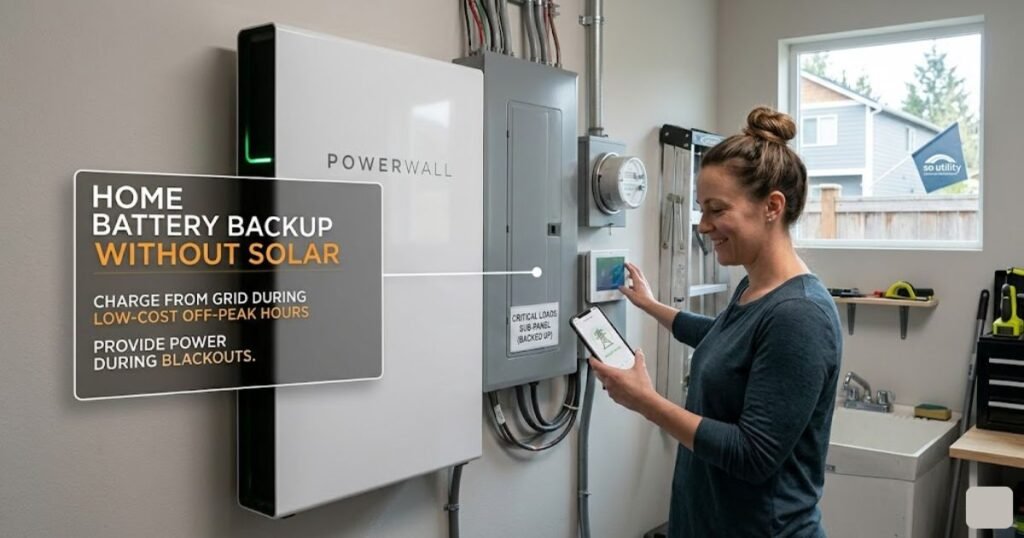
A home battery backup without solar is a battery system that can be charged from utility power and then used later during an outage or when you need portable electricity. In other words, it is home battery storage without solar that still gives you a backup source of power.
There are two common versions:
- Portable power stations, which are plug-and-play units you can move around the house.
- Battery banks or modular home batteries, which are more custom and usually part of a larger backup setup.
For homeowners, the biggest advantage is flexibility. You can use a battery as emergency home backup power without committing to roof panels, permits for solar arrays, or a large project right away.
How Home Battery Backup Works Without Solar
The basic process is simple: the battery charges when grid power is available, stores that electricity, and then supplies power when the grid goes down. Energy storage systems are designed to release stored energy when needed, which is exactly why they work so well for outages.
A portable power station usually works like this:
- Plug it into a wall outlet.
- Let it charge fully.
- Keep it ready for outage season.
- Unplug and power devices when needed.
A larger home battery system may charge from the grid and connect to selected circuits or a transfer setup, depending on the design. That type of system is often better for homeowners who want a more permanent battery backup system for home.
READ MORE: Solar Water Heater
Types of Home Battery Backup Without Solar
1) Portable power stations
These are all-in-one units with an inverter, battery, and outlets built in. They are the simplest choice for first-time buyers and often the best option for renters or homeowners who want flexibility.
2) Modular lithium battery banks
These are more like building blocks for custom systems. They often use LiFePO4 chemistry and are better for people who want a more permanent energy setup.
3) Whole-home battery systems
These are larger systems that can support more of the house, but they usually cost more and may require professional installation. Whole-home backup costs often reach the few-thousand-dollar range or higher depending on system size and installation complexity.
Top 6 Home Battery Backup Products Without Solar
1. Anker SOLIX C1000 Gen 2
Anker’s C1000 Gen 2 is one of the most appealing plug-and-play choices for homeowners because it combines 1,024Wh capacity, 2,000W output, 49-minute ultra-fast recharging, and 10 ms UPS backup. It is positioned as a compact, fast-charging everyday backup option.
- Best for: Fast-Charging Ultra-Portable Backup
- The Smart Take: An ultra-compact tactical backup with 1,056Wh capacity and 2,400W output. It completely recharges in under an hour via a standard wall outlet, making it perfect for sudden storm warnings.
- Pros: Durable $\text{LiFePO}_4$ cells (3,000+ cycles), excellent app control, tiny footprint.
- Cons: Native capacity is strictly short-term; requires separate expansion batteries for multi-day use.
- Homeowner-friendly take: Great for someone who wants a simple, dependable starter backup without installation headaches.
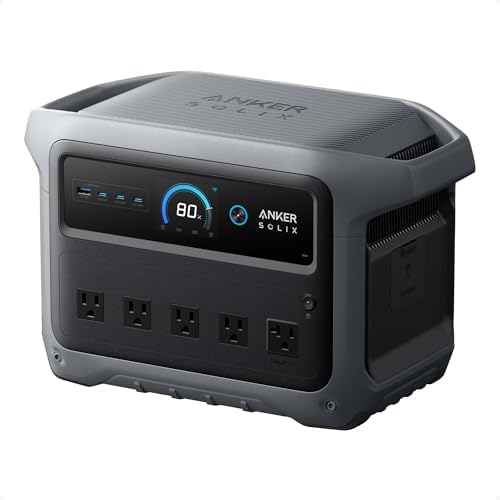
- 49 Min UltraFast Recharging: With upgraded HyperFlash tech, fully recharge at 1,600W—for outage prepping, camping trips,…
- 2,000W Output via 10 Ports: Delivers 2,000W (3,000W peak) and 1,024Wh capacity. Power up to 10 devices—ideal for emergen…
- Compact and Portable: Easily carry, store, and move from room to room, your RV, or even on beach and park outings. C1000…
2. Jackery Explorer 2000 v2
Jackery’s Explorer 2000 v2 offers 2,042Wh capacity, 2,200W rated output, and a sub-20 ms UPS switch, which makes it a strong fit for home backup needs. Jackery also lists it at around 39.5 lb, so it is portable but still substantial.
- Best for: High-Capacity Standard Appliance Backup
- The Smart Take: A heavy-duty, trusted workhorse balancing mobility with a generous 2,042Wh capacity and 2,200W inverter. Easily runs a fridge, freezer, and electronics through an overnight blackout.
- Pros: Crystal-clear LCD display, rugged build quality, surprisingly manageable weight.
- Cons: Lacks modular expansion; you cannot chain extra batteries to it later.
- Homeowner-friendly take: A solid balance of capacity and usability for outage preparedness.

- High-Capacity Power Solution: With 3 AC ports delivering a total output of 2200W and a massive 2042Wh capacity, the Jack…
- Smallest & Lightest 2kWh Power: Weighing just 39.5 lbs, the Jackery Explorer 2000 v2 weighs less than other bulky units,…
- Ultra-Fast & Versatile Charging: Power up and go — Charge the Explorer 2000 v2 from 0 to 80% in just 66 minutes with AC …
3. BLUETTI Elite 300
The BLUETTI Elite 300 is a high-capacity portable power station with 3,014.4Wh of battery capacity, 2,400W output, 4,800W surge power, and a 10 ms UPS switch. Official materials also describe it as compact for its class, with a 26.3 kg weight listing in one regional product page.
- Best for: High-Output Heavy-Duty Home Protection
- The Smart Take: Built for multi-person households needing massive power. It handles high-demand power tools, medical gear, and heavy appliance motor surges without breaking a sweat.
- Pros: Versatile port selection (high-amperage AC), excellent thermal management, highly reliable.
- Cons: Bulky and heavy; best kept on a rolling cart rather than carried up stairs.
- Homeowner-friendly take: Excellent when you want portable power that starts to feel much closer to a serious home backup tool.
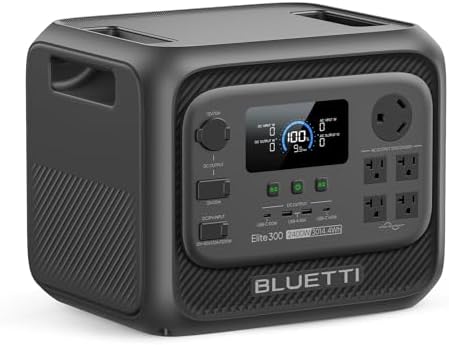
- [Compact 3kWh Power — Verified by Frost & Sullivan] – Elite 300 packs a full 3014Wh capacity into an ultra-compact desig…
- [RV-Ready with TT-30 Port & 12V/30A DC Output] – Designed for RV power systems, Elite 300 includes a TT-30 RV outlet and…
- [Reliable Home Backup Power for Outages] – Be prepared for unexpected power outages. With 3014Wh capacity and 2400W outp…
4. EcoFlow DELTA 2
EcoFlow’s DELTA 2 offers 1,024Wh capacity, 1,800W AC output, 2,200W with X-Boost, 7x faster AC charging, and expandable storage up to 3kWh with an extra battery. EcoFlow also lists 500W max solar input, even though this article focuses on non-solar use.
- Best for: Tech-Heavy Smart Homes & Expansion
- The Smart Take: A highly versatile, modular 1,024Wh unit that can expand up to 3,000Wh. Features X-Boost technology to run appliances up to 2,700W by smartly managing voltage.
- Pros: Affordable entry point with easy scalability, top-tier app telemetry, lightweight design.
- Cons: Internal cooling fans get loud when running high-wattage appliances in X-Boost mode.
- Homeowner-friendly take: A very practical option for people who want flexibility now and future growth later.

- 7 X Faster Charging. 0-80% in just 50 mins and 0-100% in 80 mins with AC input. That’s ideal when you need home backup p…
- Expandable Capacity from 1-3kWh. With the standalone portable power station sporting 1kWh, you can add on extra batterie…
- Power Almost Anything. Portable batteries have come a long way. Power all your appliances with 1800W output, that’s on p…
5. ECO-WORTHY 12V 280Ah (Metal Case)
The ECO-WORTHY 12V 280Ah LiFePO4 battery is more of a battery-bank building block than a ready-to-carry power station. The company lists 3,584Wh capacity, Bluetooth monitoring, low-temperature protection, and 200A continuous discharge capability.
- Best for: Custom DIY Systems & Long-Term Value
- The Smart Take: A raw, high-capacity industrial component yielding a massive 3,584Wh reservoir. Perfect for building a custom, high-capacity stationary backup vault in a garage or basement.
- Pros: Unbeatable cost-per-watt-hour value, rugged metal case, massive raw storage.
- Cons: Not plug-and-play. Requires DIY electrical knowledge and separate components (inverter, charger, wiring).
- Homeowner-friendly take: Best for someone who wants a more custom home battery system without solar panels and does not mind extra setup.
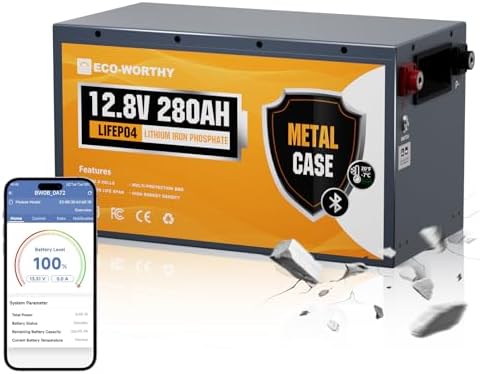
- Metal Case for Enhanced Fire Safety: The Eco Worthy 280AH Lithium Battery features a heavy-duty metal enclosure for supe…
- No Battery Box Required: Our 280AH Lifepo4 Battery features a rugged metal enclosure that provides strong protection and…
- Shock & Vibration Resistant: The reinforced metal shell of the 12V 280AH Battery, combined with internal cell holders, k…
6. Dyness 24V 100Ah
Dyness is a major energy storage company, and current marketplace listings for this 24V 100Ah battery describe 2,560Wh capacity, a 100A BMS, low-temperature protection, and support for series/parallel expansion. That makes it better suited to a custom battery bank than to casual, grab-and-go use.
- Best for: Rack-Mount Static Energy Expansion
- The Smart Take: A sleek, server-rack-ready 2,400Wh module designed to stack vertically. Ideal for building a clean, stationary 10kWh to 20kWh whole-house reservoir charged straight from the grid.
- Pros: Space-saving rack design, smart communication with hybrid inverters, clean power delivery.
- Cons: Completely non-portable; requires professional hardwiring and a separate 24V inverter-charger system.
- Homeowner-friendly take: A good fit if you want a stronger custom build rather than a simple portable unit.
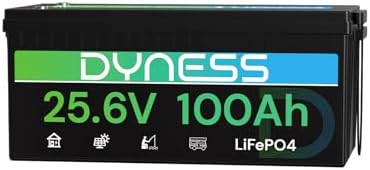
- 【Premium A+ Grade LiFePO4 Cells】Dyness 24V 100Ah LiFePO4 Battery built with A+ Grade lithium iron phosphate cells suppor…
- Compact Size & Moderate Weight: With dimensions of 8.11″D × 20.9″W × 8.54″H and an item weight of 42.6 pounds, this LiFe…
- [Extreme Cold Environments Battery Protection]Built-in 100A smart BMS safeguards against overcharge, over-discharge, ove…
READ MORE: Carrier Heat Pump Reviews (2026) — Models, Costs, Pros & Cons
Home Battery Backup Without Solar Comparison Table
| Product Name | Type | Capacity / Power Level | Best For | Portability | Setup Difficulty | Ideal Home Use | Main Strength | Main Limitation |
| Anker SOLIX C1000 Gen 2 | Portable power station | 1,024Wh / 2,000W | Fast, everyday backup | High | Easy | Lights, router, small appliances | Very fast recharging | Limited runtime vs larger units |
| Jackery Explorer 2000 v2 | Portable power station | 2,042Wh / 2,200W | Longer outages | Medium | Easy | Fridge, Wi-Fi, essentials | Strong balance of size and power | Heavier than compact units |
| BLUETTI Elite 300 | Portable power station | 3,014.4Wh / 2,400W | Bigger backup needs | Medium | Easy | More appliances, longer runtime | Highest portable capacity here | Higher cost and weight |
| EcoFlow DELTA 2 | Portable power station | 1,024Wh / 1,800W | Flexible starter backup | High | Easy | Daily essentials and short outages | Expandable later | Smaller base battery |
| ECO-WORTHY 12V 280Ah | Lithium battery bank | 3,584Wh / 200A discharge | DIY custom systems | Low | Hard | Built-in or custom backup setups | Strong battery capacity | Needs extra equipment |
| Dyness 24V 100Ah | Lithium battery bank | 2,560Wh / 100A BMS | Modular custom backup | Low | Hard | Scalable battery bank builds | Expandability | Not plug-and-play |
READ MORE: Gas Water Heater Replacement Cost (2026) — What Homeowners Pay & Why
How to Choose the Right Home Battery Backup Without Solar
The best choice depends on how much power you need and how hands-on you want to be. For most first-time buyers, a portable power station is the easiest path. For more advanced homeowners, a modular battery bank may offer better long-term flexibility.
A simple way to decide:
- Choose portable power if you want easy setup.
- Choose larger capacity if you need longer runtime.
- Choose expandability if you want to build later.
- Choose battery-bank style if you are comfortable with a custom system.
- Choose UPS features if you want near-instant switchover for electronics.
Benefits of Home Battery Backup Without Solar
The biggest benefit is simple: you get backup power without needing solar panels. That makes it easier to get started and easier to match the solution to your budget.
Other major benefits include:
- Fast setup for portable units.
- Quiet operation compared with fuel-powered generators.
- Indoor-friendly use for many small devices.
- Scalable options if you want to grow later.
- No solar dependency if your roof is shaded, small, or not suitable for panels.
For many families, a lithium battery backup for home is also easier to maintain than a generator because there is no fuel rotation, no exhaust, and fewer moving parts to worry about. That practical simplicity is a big reason these systems are becoming more popular.
READ MORE: Ultra Quietest Heat Pump for Your Home: Review, Comparison & Cost
Limitations of Home Battery Backup Without Solar
Battery backup is useful, but it is not magic. Capacity matters. A smaller battery may keep phones, lights, and internet running, but it may not power large appliances for very long. Larger systems cost more and may require more planning.
A few things to think about:
- Runtime depends on watt-hours and load.
- High-power appliances drain batteries quickly.
- Larger home systems can be expensive.
- Some batteries are portable, but not truly whole-house solutions.
- Custom battery systems may need an electrician or installer.
Best Uses for Home Battery Backup Without Solar
The best uses are usually the most practical ones. These systems are ideal for:
- Keeping a refrigerator cold during short outages.
- Powering internet, phones, and laptops.
- Running lamps, fans, and small appliances.
- Keeping a sump pump available for basement protection.
- Serving as backup for home office or study needs.
If you need to power a single critical area of the home, a portable unit can be enough. If you want broader coverage, a modular battery system may be better.
READ MORE: Best 10,000 BTU Portable Air Conditioner: Reviews & Comparison
Cost Breakdown
Investing in a home battery backup without solar involves clear, tiered financial bands. Understanding these realistic costs upfront prevents budget overruns and highlights the long-term value of your investment.
- Entry-Level Portable Backup (1,000Wh range): Expect to invest between $600 and $1,100. These units (like the Anker C1000 or EcoFlow DELTA 2) perfectly handle immediate essentials, medical devices, and communication networks.
- Mid-to-High Tier Portable Power Stations (2,000Wh+ range): These scale from $1,300 to $2,500 (like the Jackery Explorer 2000 v2). They provide the capacity required to comfortably sustain full-sized kitchen appliances and multiple electronics for 24+ hours.
- DIY Standalone Battery Systems: Purchasing raw components (like the ECO-WORTHY or Dyness units) costs roughly $400 to $900 per battery module. However, you must budget an additional $500 to $1,200 for high-quality external pure sine wave inverters, smart chargers, heavy-duty safety fuses, and copper cabling.
- Whole-Home Installed Systems: Large, permanent installations that wire directly into your home’s main panel range from $4,000 to $10,000+ depending on total capacity.
- Professional Electrician Costs: Tying a whole-home system into your breaker box via a critical-loads sub-panel or manual transfer switch typically costs $800 to $2,500 in professional labor and municipal permitting fees.
Home Battery Backup vs. Gas Generator
For decades, the classic fossil-fuel generator was the default choice for residential backup power. However, modern lithium battery storage completely redefines this dynamic across several critical operational categories:
| Feature/Metric | Home Battery Backup (Grid Charged) | Traditional Gas Generator |
| Operating Location | 100% Indoor Safe (Bedrooms, Closets, Living Rooms) | Strictly Outdoors Only (Must be 20+ feet away from windows) |
| Noise Level | Virtually Silent (Whisper-quiet cooling fans only) | Extremely Loud (55 to 75+ decibels of continuous engine roar) |
| Emissions & Fumes | Zero Emissions (Completely clean chemistry) | Produces highly toxic Carbon Monoxide (CO) exhaust fumes |
| Ongoing Maintenance | None (No oil, spark plugs, or fuel stabilizers to manage) | High (Frequent oil changes, carburetor cleaning, winterization) |
| Fuel Requirements | None (Charges effortlessly from your standard wall outlet) | Requires storing and handling volatile, highly flammable gasoline |
| Startup Speed | Instantaneous (Automated millisecond UPS transition) | Manual (Requires pulling a starter cord or pressing a cold-start switch) |
READ MORE: 8 Best DREO Smart Tower Fans 2026: Review & Comparison
Safety Tips
Safety matters with any backup power system. Ready.gov recommends installing smoke and carbon monoxide alarms with battery backup, and it warns against unsafe generator use indoors.
Use these simple habits:
- Keep batteries dry and follow the manufacturer’s charging guidance.
- Do not overload outlets or extension cords.
- Store backup power where kids cannot tamper with it.
- Test your battery before storm season.
- If you use a generator too, run it only outdoors and away from openings.
FAQs
Can you have home battery backup without solar panels?
Yes. A battery can charge from the grid and then provide power during an outage, so solar panels are not required.
What is the best battery backup for home without solar?
For many homeowners, a portable power station is the best starting point because it is simple to use. The Jackery Explorer 2000 v2 and Anker SOLIX C1000 Gen 2 are especially strong if you want plug-and-play backup for essentials.
How long will a home battery backup run during an outage?
Runtime depends on battery capacity and what you plug in. A small load like a router lasts much longer than a refrigerator or microwave, so larger batteries deliver more useful backup time.
Is a whole house battery backup without solar worth it?
It can be worth it if you want quiet, low-maintenance backup and can afford the higher upfront cost. Whole-home battery systems can cost several thousand dollars or more once installation is included.
Should I buy a battery backup system or a generator?
Choose a battery if you want simple, quieter backup for essentials. Choose a generator if you need long runtime and are prepared to store and manage fuel safely outdoors.
Final Recommendation Section
If you want the easiest path into best home battery backup without solar, start with a portable power station. For most homeowners, the best all-around choices here are the Jackery Explorer 2000 v2 for larger everyday backup and the Anker SOLIX C1000 Gen 2 for a smaller, faster-charging starter system.
If you want the most power in a portable format, the BLUETTI Elite 300 stands out. If you want a flexible, expandable setup, the EcoFlow DELTA 2 is a strong middle-ground option. For DIY or custom builds, the ECO-WORTHY 12V 280Ah and Dyness 24V 100Ah are better fits than portable stations.
The best rule is simple: buy for the outage you actually expect, not the biggest system you can imagine. A well-matched battery that reliably powers your essentials is usually the smartest investment.