As a seasoned HVAC technician who has spent over 15 years troubleshooting systems in freezing crawlspaces and tight basements, I can tell you that a sudden system failure often leads straight to one culprit: the furnace control board.
So let’s talk numbers first, because that’s usually what you’re here for. Furnace control board replacement cost typically runs $300 to $700, including the part and professional labor.
In this guide, I’ll walk you through exactly what drives that price, how costs break down by brand, when repair makes sense versus a full furnace replacement, and the mistakes I see homeowners make over and over that end up costing them more. Lets deep dive into “Furnace Control Board Replacement Cost: U.S. 2026 Guide”
What Is a Furnace Control Board?
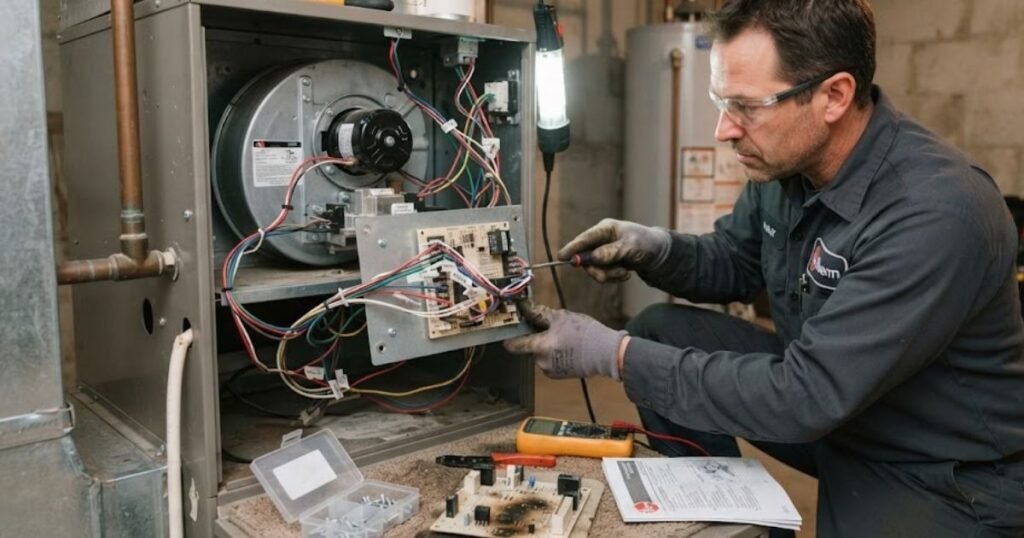
Think of the control board as your furnace’s brain and traffic cop rolled into one. It’s an electronic circuit board sometimes called the main control board, integrated furnace control (IFC), motherboard, or simply the PCB (printed circuit board) mounted inside the furnace cabinet, usually behind the lower access panel near the blower compartment.
Every time your thermostat calls for heat, the control board takes over and runs the whole show in the correct sequence:
- Ignition – It tells the igniter or pilot system when to fire and confirms ignition happened safely
- Blower operation – It times when the blower motor turns on and off, including the delay after burners shut down
- Safety switches – It monitors limit switches, pressure switches, and rollout switches to shut the system down if something’s unsafe
- Flame sensor – It reads the flame sensor signal to confirm combustion is happening and cuts gas flow if it isn’t
- Gas valve – It opens and closes the gas valve at the right moments in the heating cycle
- Thermostat communication – It receives the call for heat and, on newer systems, sends diagnostic data back
- Error codes – Most boards flash an LED code sequence when something goes wrong, which is your first clue during troubleshooting
READ MORE: Furnace Replacement Cost in USA
Average Furnace Control Board Replacement Cost
Here’s the breakdown homeowners actually want to see. These are national averages pulled from current U.S. HVAC pricing data your local number will shift based on region and furnace type, but this gives you a realistic baseline.
| Cost Component | Low-End Estimate | National Average | High-End Premium |
| Control Board Part Only | $50 | $175 | $450 |
| Labor (1 to 2 Hours) | $150 | $250 | $350 |
| Standard Diagnostic Fee | $75 | $100 | $200 |
| Emergency After-Hours Premium | $0 | $0 | $150 – $300 |
| Total Installed Cost | $275 | $525 | $1,000+ |
Cost Breakdown
To avoid surprises on your final invoice, it helps to look closely at where each dollar goes during a professional service call.
- OEM (Original Equipment Manufacturer) Boards ($150 – $450+): These are built specifically by brands like Carrier, Trane, or Lennox for their exact equipment models. They preserve your factory warranty, offer plug-and-play fitment, and are mandatory for premium, multi-stage, or communicating variable-speed systems.
- Universal Aftermarket Boards ($50 – $150): Companies like ICM Controls or White-Rodgers manufacture universal replacement boards. They work perfectly fine for older, standard single-stage furnaces, but they require a skilled technician to correctly set dip switches (tiny mechanical toggles that select timings and fan speeds) to match your furnace’s operating profiles.
- Labor and Diagnostics ($225 – $550): Most reputable HVAC firms charge a flat diagnostic fee ($75–$200) just to get a certified tech to your doorstep with a multi-meter to pinpoint the issue. Once the bad board is confirmed, labor runs between $75 and $150 per hour. Swapping a board cleanly, transferring up to 20 loose wires, and performing safety validation testing generally takes 1 to 2 hours.
READ MORE: Best ecobee Smart Thermostat Review: Essential vs Enhanced vs Premium
Furnace Control Board Replacement Cost by Furnace Brand
Brand matters more than most homeowners expect. Premium furnace brands tend to use proprietary boards that cost noticeably more than the boards found in budget-tier furnaces, largely because of parts availability and licensing.
| Brand | OEM Board Price Range | Typical Installed Cost |
| Carrier | $100 – $300 | $350 – $700 |
| Bryant | $100 – $280 | $350 – $680 |
| Trane | $120 – $320 | $400 – $750 |
| American Standard | $120 – $320 | $400 – $750 |
| Lennox | $130 – $350 | $450 – $800 |
| York | $80 – $220 | $325 – $625 |
| Heil | $80 – $220 | $325 – $625 |
| Goodman | $50 – $180 | $275 – $525 |
| Amana | $60 – $190 | $290 – $550 |
| Rheem | $60 – $200 | $300 – $575 |
Lennox, Trane, and Carrier generally sit at the top of the price range because their boards are more proprietary and, on higher-end models, integrate more diagnostic and communicating features. Goodman and Amana tend to run cheaper largely because their parts are widely stocked and their systems favor simpler, more universal-friendly board designs.
READ MORE: AO Smith vs. Rheem Water Heaters: Comparison & Expert Reviews
Factors That Affect Replacement Cost
A handful of variables swing your final bill more than anything else:
- Furnace age – Older furnaces may need discontinued boards sourced from specialty suppliers, which costs more and takes longer
- Brand – As shown above, proprietary boards from premium brands cost more than widely available universal-compatible parts
- Board type – Basic single-stage boards are cheap; integrated, multi-stage, or communicating boards cost significantly more
- Parts availability – A board in stock locally beats one that has to be special-ordered, which can add days and shipping costs
- Labor rates – Urban markets and areas with a high cost of living run higher hourly rates than rural regions
- Emergency service – Nights, weekends, and the dead of winter cold snaps almost always carry a premium
- Warranty coverage – A furnace still under manufacturer warranty may get the part covered, though labor is frequently still billed separately
- High-efficiency furnaces – Two-stage and variable-speed systems need more sophisticated boards with more sensors to manage
- Smart/communicating systems – Boards that pair with smart thermostats require extra programming time
- Geographic location – Regional labor costs and even local permit requirements can shift your total
Signs Your Furnace Control Board Is Bad
I’ve been called out on plenty of “dead furnace” jobs that turned out to be a $300 fix once we traced it back to the board. Watch for these symptoms:
Common Failure Symptoms and Their Root Causes
| Symptom Observed | What Is Likely Happening on the Board |
| The blower fan runs continuously but blows cold air. | A relay switch on the PCB has welded shut internally, keeping 120V power constantly sent to the fan motor. |
| Smell of burning plastic or visible smoke from the cabinet. | A capacitor has popped, or a high-voltage trace line on the underside of the board has overheated and melted. |
| The furnace short-cycles or shuts off randomly. | Micro-cracks in the board’s solder joints expand as the furnace warms up, breaking vital circuit connections. |
| The diagnostic LED light stays completely unlit. | The board is receiving 120V power from the switch but the onboard step-down transformer has blown, leaving the board dead. |
Safety Warning: A burnt smell, visible scorching, or repeated shutdowns can point to an electrical or gas safety issue, not just a worn-out part. Shut off power to the furnace and call a licensed technician rather than continuing to run the system.
READ MORE: Gas Water Heater Replacement Cost
Common Causes of Control Board Failure
Control boards don’t usually fail out of nowhere. In my experience, it’s almost always one of these:
- Power surges – Lightning strikes or grid fluctuations are a leading cause of fried boards
- Water damage – Condensate line leaks or nearby plumbing issues can drip directly onto the board
- Condensation – High-efficiency furnaces produce condensate that, if drainage is poor, can corrode board components
- Age – Ten to fifteen years of thermal cycling wears down solder joints and relays
- Loose wiring – Vibration over time loosens connections, causing intermittent faults that eventually kill the board
- Dirty filters – Restricted airflow forces the system to overheat, stressing the board and blower controls
- Overheating – Poor ventilation around the furnace cabinet shortens board life
- Voltage problems – Inconsistent household voltage puts ongoing stress on sensitive components
- Lightning – Direct or nearby strikes can overwhelm even surge-protected systems
Can You Repair a Furnace Control Board?
Sometimes, yes. A blown fuse on the board, a single failed relay, or a cracked solder joint can occasionally be repaired rather than replaced but this is specialty work, usually done by a board repair shop rather than in your home. If the board shows multiple failed components, visible burn damage, or has failed more than once, replacement is the more reliable path. In my experience, once a board has failed once from a surge or moisture exposure, a second failure isn’t far behind full replacement is almost always the smarter long-term call.
DIY vs. Professional Replacement
| Factor | DIY | Professional |
| Cost | $50 – $300 (part only) | $300 – $700 (installed) |
| Difficulty | Moderate to high | Handled routinely |
| Safety | Electrical shock and gas safety risk | Trained for high-voltage and gas systems |
| Warranty | May void furnace warranty | Often preserves warranty |
| Time | Hours, including troubleshooting | 20–60 minutes on-site |
| Risk of misdiagnosis | High without proper testing equipment | Low — proper diagnostic tools used |
Safety Warning: Furnace control boards sit next to high-voltage wiring, gas valves, and combustion components. A wiring mistake can cause electrical shock, and a gas connection error can create a carbon monoxide risk. If you’re not confident reading a wiring diagram and using a multimeter, this isn’t the repair to learn on.
If you’re a confident DIYer with electrical experience, replacing a control board is mechanically simple it’s largely a matter of transferring wires from the old board to the new one and matching dip switch settings. But I’d still recommend having a professional confirm the board is actually the problem first. I’ve seen homeowners replace a perfectly good board because the real issue was a failed transformer or a loose wire.
READ MORE: Best Tankless Water Heater — Top Picks, Costs & Buyer’s Guide
How Long Does Furnace Control Board Replacement Take?
- Diagnosis: 30–60 minutes, including voltage testing and reading error codes
- Installation: 20–30 minutes for the physical board swap
- Programming: 10–20 minutes if the board requires dip switch or software configuration
- Testing: 10–15 minutes to run a full heating cycle and confirm proper operation
Most standard jobs wrap up in under two hours total, including the diagnostic visit.
Is Replacing the Control Board Worth It?
This is the real question behind the repair. Here’s how I walk homeowners through it:
Repair the control board if:
- Your furnace is under 10 years old
- The heat exchanger is in good condition
- The blower motor and other major components are functioning well
- This is an isolated failure, not part of a pattern of breakdowns
Consider replacing the whole furnace if:
- The unit is over 15–20 years old
- You’ve had multiple major repairs in the past couple of years
- Efficiency has noticeably declined and utility bills are climbing
- Repair costs are creeping close to half the price of a new furnace
| Furnace Age | Recommendation |
| 0–10 years | Repair the board — furnace has plenty of life left |
| 10–15 years | Repair if this is the only issue; monitor for other problems |
| 15–20 years | Get a replacement quote before committing to repair |
| 20+ years | Full replacement is usually the better investment |
A simple rule I give clients: if the repair estimate is more than 30% to 50% of what a new furnace would cost, it’s worth getting a second opinion before spending the money.
READ MORE: Heat Pump vs. Furnace vs. Boiler: Cost & Efficiency Comparison
How to Save Money
- Get at least three quotes from licensed HVAC contractors before committing
- Keep up with annual preventative maintenance — it catches small issues before they become board failures
- Check whether your furnace is still under manufacturer warranty before paying for parts
- Schedule non-emergency repairs during the off-season, when contractors aren’t slammed
- Weigh OEM versus universal boards based on your furnace’s remaining lifespan
- Book an annual inspection to catch loose wiring or drainage issues early
- Install a whole-home surge protector to guard against the single biggest cause of board failure
Questions to Ask Before Hiring an HVAC Contractor
- Is the diagnostic fee applied toward the repair cost?
- Will you use an OEM part, a universal part, or do I have a choice?
- What’s the labor rate, and is it flat-rate or hourly?
- Is there a warranty on both the part and the labor?
- Are you licensed and insured in this state?
- How many years of experience do you have with my furnace brand?
- Can you provide a written, itemized estimate before starting?
- Will replacing this board void any remaining furnace warranty?
- What caused the board to fail, and how can I prevent it next time?
- Do you charge extra for emergency or after-hours service?
- How long will the repair take, start to finish?
- Do you carry the part on the truck, or will it need to be ordered?
- What’s your policy if the board isn’t actually the problem?
- Can you check my whole system while you’re here, not just the board?
- Do you offer any maintenance plans that include future inspections?
Common Furnace Control Board Mistakes Homeowners Make
- Replacing the thermostat first – A “dead” furnace often gets blamed on the thermostat when the board is the real issue
- Ignoring error codes – Those flashing lights are diagnostic gold; write down the sequence before calling for service
- DIY wiring mistakes – Mismatched wire terminals can damage a brand-new board instantly
- Buying the wrong board – Universal boards aren’t universal in every sense; model compatibility still matters
- Delaying repairs – A furnace running on a failing board can develop secondary damage to the blower or ignition system
- Ignoring maintenance – Dirty filters and poor airflow quietly shorten board life year after year
Common Mistake: I can’t count how many service calls started with “I already replaced the thermostat and it didn’t fix it.” Rule out the board with a proper diagnostic before spending money on other parts.
Preventing Future Control Board Failures
- Schedule annual professional tune-ups, ideally in early fall before heating season
- Replace or clean furnace filters every one to three months
- Install surge protection at the electrical panel or directly at the furnace
- Manage humidity around the furnace to reduce condensation exposure
- Keep the condensate drain line clear on high-efficiency systems
- Have wiring connections checked during routine maintenance visits
HVAC Expert Advice: If your furnace has failed a control board once already, ask your technician to check the condensate drain and confirm surge protection is in place before you finish the repair. Fixing the board without addressing the root cause is how homeowners end up paying for the same repair twice.
Furnace and Control Board Lifespan
| Component | Average Lifespan |
| Furnace control board | 10 – 15 years (up to 20 with good maintenance) |
| Gas furnace overall | 15 – 20 years |
| High-efficiency furnace | 15 – 25 years |
Final Verdict
For most U.S. homeowners, furnace control board replacement cost lands between $300 and $700 installed, with $500 being a realistic average to budget for. Repair makes the most financial sense when your furnace is under 10 to 15 years old and the board failure is an isolated issue. Once you’re looking at a furnace pushing 15 to 20 years, or you’re facing a second or third major repair, it’s worth getting a full replacement quote before spending more on the old system.
Whatever you decide, hire a licensed, insured HVAC contractor, get a written estimate, and don’t skip the diagnostic step. A control board is a fairly straightforward repair for the right technician but it’s also an easy part to misdiagnose or overpay for if you don’t know what fair pricing looks like.
Frequently Asked Questions
How much does a furnace control board replacement cost?
Most homeowners pay $300 to $700 for a professionally installed furnace control board, including the part and labor. The national average lands around $500, though premium or communicating boards can push costs higher.
Is it worth replacing a furnace control board?
Yes, if your furnace is under 10 to 15 years old and otherwise in good condition. Replacing the board restores normal operation at a fraction of the cost of a new furnace. If the unit is older or has had multiple repairs, compare the cost against a full replacement first.
Can I replace my furnace control board myself?
It’s mechanically possible for an experienced DIYer, but it involves high-voltage wiring and proximity to gas components. Misdiagnosis is also common without proper testing equipment, so most homeowners are better served hiring a licensed technician.
How long does a furnace control board last?
A furnace control board typically lasts 10 to 15 years, and up to 20 years under ideal conditions with regular maintenance and surge protection.
What causes a furnace control board to fail?
The most common causes are power surges, moisture or condensation exposure, general age-related wear, loose wiring connections, and overheating from restricted airflow due to dirty filters.
Costs and figures in this guide reflect current U.S. HVAC pricing trends and industry data as of 2026. Actual pricing varies by region, contractor, and furnace model — always get a written estimate from a licensed local HVAC professional before authorizing repair work.

