Transitioning to an electric vehicle (EV) is an exciting milestone for any American homeowner, bringing lower operating costs, reduced maintenance, and zero tailpipe emissions. However, the excitement can quickly turn into confusion when you look past the sleek wall connector on the showroom floor and examine your home’s utility infrastructure. Many first-time EV owners assume that installing a home charger is as simple as plugging in a heavy-duty appliance like a toaster or a microwave. In reality, a fast Level 2 home charging station draws a continuous, high-amperage electrical load that rivals central air conditioners or electric water heaters.
Because of this heavy energy demand, homeowners frequently wonder: Does every home require an electrical panel upgrade for an EV charger? Can a traditional 100-amp service safely support a modern Level 2 charger? What does an upgrade actually cost, and what smart alternatives exist if your panel cannot handle the extra electrical burden?
This comprehensive guide breaks down everything U.S. homeowners need to know about evaluating their electrical systems, understanding costs, navigating permits, and choosing the safest, most cost-effective path toward home EV charging. Lets deep dive into “Electrical Panel Upgrade for EV Charger: Costs & Requirements”
What Is an Electrical Panel Upgrade for an EV Charger?
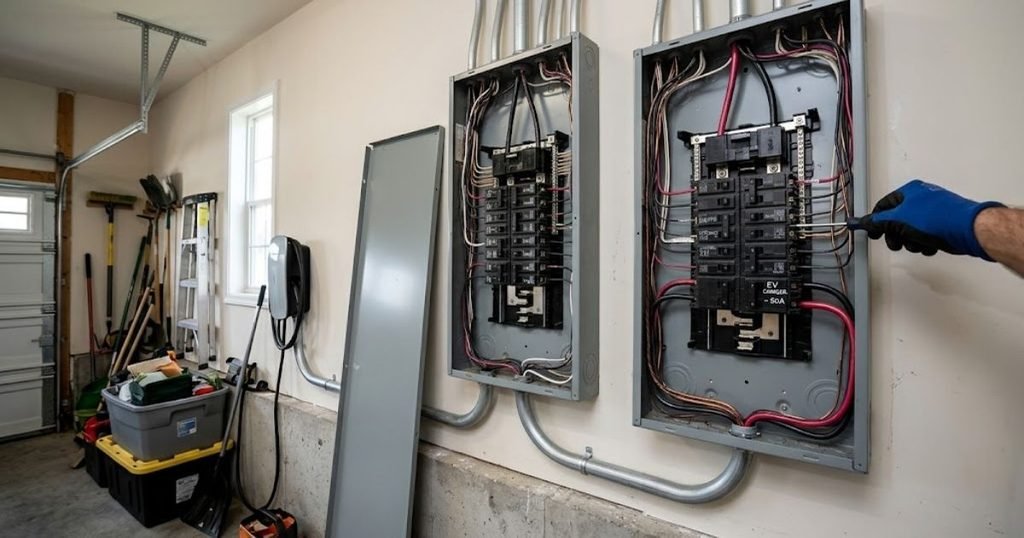
To understand why an electrical panel upgrade for an EV charger might be necessary, it helps to look at how residential electrical distribution works. Your home’s electrical panel (often called a breaker box or service panel) acts as the central hub for all electricity entering your house from the local utility grid.
- The Main Breaker: This safety switch controls and limits the total amount of electrical current that can flow into your home at any given time, typically rated at 100, 150, or 200 amps.
- Branch Circuits: Individual circuits run from the panel to various rooms, outlets, and fixed appliances throughout your house, each protected by its own circuit breaker.
- Dedicated Circuits: High-draw appliances such as electric ranges, HVAC compressors, clothes dryers, and EV chargers require a dedicated circuit, meaning no other outlets or lights share that specific line.
When you install a Level 2 EV charger, you are adding a heavy, continuous electrical load to your system. A panel upgrade involves replacing your existing breaker box with a modern panel that can accommodate more physical breakers or handle a higher total electrical capacity. It is important to distinguish between a panel replacement (swapping out an old, full, or damaged breaker box without changing the utility service capacity) and an electrical service upgrade (increasing the utility wire thickness, meter socket, and main breaker from 100 amps to 200 amps).
Crucially, a panel can look completely modern and have plenty of physical empty breaker spaces, yet still lack the actual electrical capacity required to safely power a new EV charger without overloading the service conductors.
READ MORE: Electrical Fuse Box vs. Circuit Breaker: Safety & Cost
Do You Need an Electrical Panel Upgrade for an EV Charger?
Not every home needs a panel upgrade, but determining your home’s eligibility requires a professional evaluation rather than guesswork. Homes built within the last 20 to 30 years often feature 200-amp services that can support a charger with little or no modification. Conversely, older homes with legacy electrical configurations frequently hit capacity walls.
Evaluating Your Existing Setup
- 60-Amp or 100-Amp Services: Common in homes built before the 1980s that rely primarily on gas heating and cooking. Adding a continuous 32-to-40-amp EV load to a 100-amp service often exceeds safe National Electrical Code (NEC) limits unless major appliances are managed.
- 150-Amp Services: Frequently found in mid-century homes or expanded properties. These may support moderate EV charging levels depending on concurrent household loads.
- 200-Amp Services: The modern standard for single-family homes. While they usually offer sufficient capacity, homes packed with all-electric heat pumps, tankless water heaters, and pool pumps can still max out a 200-amp panel.
- Full Panels with No Breaker Spaces: If your panel has zero physical slots left, an electrician may need to install a subpanel, rearrange existing breakers with tandem units (where permitted), or replace the panel entirely.
| Existing Electrical Setup | Potential Outcome |
| 100-amp service | May work with a lower-powered charger or load management system; professional assessment required. |
| 150-amp service | May support standard charging depending on the calculated whole-home electrical load. |
| 200-amp service | Often provides ample capacity, but a formal load calculation is still mandatory. |
| Full panel with limited spaces | May require panel modifications, space-saving tandem breakers, a subpanel, or full replacement. |
| Insufficient calculated capacity | May require an electrical service upgrade or an automated load-management device. |
100-Amp vs. 200-Amp Panel for EV Charging
Understanding the practical differences between 100-amp and 200-amp electrical systems helps clarify why electricians emphasize total capacity over simple convenience. A 100-amp panel supplies up to 24,000 watts of power at 240 volts, while a 200-amp panel doubles that capacity to 48,000 watts.
When you plug in an EV charger drawing 40 amps at 240 volts (9.6 kW), it consumes 40% of a 100-amp panel’s total theoretical capacity. When factoring in other simultaneous household demands such as an electric oven (8 kW), a clothes dryer (5 kW), and a refrigerator a 100-amp service easily experiences overloads during peak evening hours. Upgrading to a 200 amp panel upgrade for EV charging provides the headroom needed to run modern household appliances and fast-charge an EV simultaneously without tripping the main breaker.
An electrician evaluates your lifestyle, heating equipment (gas vs. electric heat pumps), cooking appliances, and future electrification plans (such as adding solar panels or home battery storage) before recommending whether a service upgrade is strictly necessary.
READ MORE: Electrical Breaker Box Installation: Costs & Permits
Electrical Requirements for a Level 2 EV Charger
Home EV charging is categorized into two primary types: Level 1 and Level 2. Level 1 uses a standard 120-volt household outlet and adds a sluggish 2 to 4 miles of range per hour. Level 2 charging utilizes a 240-volt circuit similar to what powers an electric clothes dryer or stove delivering anywhere from 12 to 37+ miles of range per hour, fully recharging most EV batteries overnight.
Technical Specifications for Level 2 Installation
- Amperage Ratings: Common Level 2 chargers operate at 16, 24, 32, 40, or 48 amps.
- The Continuous-Load Rule: Under the National Electrical Code (NEC), EV chargers are classified as continuous loads. This means they draw maximum current for three hours or more. Consequently, the circuit conductors and overcurrent protection must be rated for 125% of the charger’s maximum output. For example, a popular 40-amp continuous charging load requires a dedicated 50-amp branch circuit wired with properly sized copper cables (typically 6 AWG) and a 50-amp double-pole breaker.
- Hardwired vs. Plug-In: While plug-in units use a NEMA 14-50 or NEMA 6-50 heavy-duty outlet protected by a GFCI breaker, hardwired chargers are wired directly into a junction box. Hardwiring eliminates plug connection resistance, is frequently required by local code amendments for outdoor installations, and often allows maximum output up to 48 or 50 amps.
How to Determine Whether Your Electrical Panel Can Handle an EV Charger
Determining whether your electrical panel can support an EV charger is a technical process that cannot be solved by simply counting empty breaker slots or looking at appliance labels. Professional electricians follow a standardized assessment procedure:
- Service Identification: Verify the main breaker rating and inspect the physical condition of the service entrance conductors, meter base, and busbars.
- Charger Specification Review: Determine the exact amperage and kW output of the EV charger you intend to install.
- Appliance Inventory: Catalog all major fixed electrical appliances in the home, including HVAC systems, water heaters, ranges, dryers, and sub-pumps.
- Standard Load Calculation: Perform an official NEC standard or optional load calculation based on the square footage of the home and nameplate ratings to determine peak electrical demand.
- Physical Space Inspection: Check for available physical space on the busbar to accommodate a new double-pole 240-volt breaker.
- Load-Management Evaluation: Assess whether smart load-shunting devices can offset capacity limitations if the calculated load sits near the threshold.
- Permit & Code Verification: Cross-reference local utility requirements and the locally adopted edition of the National Electrical Code.
Electrical Panel Upgrade for EV Charger Cost in the USA
Understanding the financial investment required for home charging helps homeowners budget effectively. Costs vary widely depending on regional labor rates, home layout, equipment choices, and utility requirements.
Cost Component Breakdown
- Charger Hardware: Quality Level 2 smart chargers range from $350 to $700.
- Dedicated Circuit Installation: Running conduit and wiring from the panel to the parking location typically costs $500 to $1,200 for straightforward runs.
- Electrical Panel Replacement: If the panel is outdated (such as obsolete brands known for safety hazards like Zinsco or Federal Pacific) or lacks physical space, replacing the panel costs $1,500 to $3,000.
- Service Upgrade (100 to 200 Amps): Upgrading the utility service drop, meter socket, and main panel ranges from $2,500 to $5,000 including utility coordination.
- Permits and Inspections: Local municipal permit fees range from $50 to $200.
| Project Scope / Component | Indicative U.S. Cost Range | Primary Factors Affecting Price |
| EV Charger Unit (Hardware) | $350 – $700 | Brand, amperage rating, smart app features, cable length. |
| Dedicated Circuit & Labor | $500 – $1,500 | Distance from panel to parking spot, conduit run complexity, wall penetrations. |
| Electrical Panel Replacement | $1,500 – $3,000 | Panel brand, total circuit count, grounding updates, local labor rates. |
| Full Service Upgrade (100A to 200A) | $2,500 – $5,000 | Utility coordination fees, drop mast replacement, trenching requirements. |
| Permits & Municipal Inspections | $50 – $200 | Local municipal fee structures and plan review requirements. |
Example Hypothetical Homeowner Budget
Consider a homeowner living in a mid-sized U.S. suburb with an older 100-amp panel that cannot support a 40-amp charger. Their itemized contractor estimate might look like this:
- Level 2 Smart Charger Hardware: $499
- 200-Amp Electrical Service & Panel Upgrade: $2,800
- Dedicated 50-Amp Charger Circuit & Hardwiring: $650
- Local Electrical Permit & Inspection Fee: $125
- Total Estimated Project Cost: $4,074 (Note: This is a hypothetical illustration; actual contractor quotes vary based on site-specific conditions).
READ MORE: Electrical Wiring Installation: Costs, Types & How to Plan
Alternatives to Upgrading Your Electrical Panel
If a professional load calculation reveals that your electrical panel lacks the capacity for a high-powered Level 2 charger, and you wish to avoid the expense of a full service upgrade, several practical alternatives exist:
- Lower-Amperage Level 2 Charging: Configuring a smart charger to operate at a lower current (such as 16 or 24 amps instead of 40 or 48 amps) substantially reduces electrical demand while still providing plenty of overnight replenishment for most daily commuters.
- Smart Splitters and Energy Management Systems: Devices like smart splitters allow you to share an existing 240-volt circuit (such as a dryer outlet) with your EV charger. The device automatically pauses EV charging when the dryer is running, preventing any overload of the main service.
- Dynamic Load-Monitoring Units: Advanced home energy monitors measure whole-house electrical consumption in real-time and dynamically ramp down EV charging speeds whenever household demand spikes, ensuring total current draw never exceeds your main breaker limit.
| Alternative Solution | Key Advantages | Potential Limitations | Best Recommended For |
| Lower-Amperage Level 2 | Uses existing panel capacity; reduces installation costs. | Slower charging speeds overnight. | Low-to-moderate daily mileage drivers. |
| Smart Splitter (e.g., Dryer Sharing) | Avoids new panel wiring or panel upgrades entirely. | Requires vehicle parking near existing appliance circuits. | Homes with a garage-adjacent laundry room. |
| Dynamic Load-Management System | Protects main service while enabling fast chargers. | Higher equipment hardware cost. | Homes near capacity limits with high daily mileage needs. |
Smart Panels and Load Management for EV Charging
For homes with tight electrical capacity, smart electrical panels (such as Schneider Square D Energy Center or Span panels) represent a cutting-edge technological evolution. These digital breaker panels monitor and control individual circuits via smartphone apps.
When your home experiences peak electrical demand, a smart panel can automatically shed or throttle power to non-essential circuits or temporarily pause your EV charger. Once heavy appliances cycle off, the smart panel resumes maximum charging speed. While equipment and installation costs for smart panels are higher than traditional breaker boxes, they can successfully eliminate the need for costly utility service upgrades while providing unprecedented energy visibility.
Electrical Permits, Inspections, and Safety Requirements
Electrical work involving high-voltage circuits and service equipment is subject to strict building safety codes.
- Permits: In virtually all U.S. jurisdictions, installing a dedicated EV charger circuit or replacing an electrical panel requires pulling an electrical permit. Permits protect homeowners by ensuring the work is independently verified by a municipal inspector.
- Code Compliance: Installations must comply with the locally adopted edition of the National Electrical Code (NEC) and any state or municipal amendments. This includes strict rules regarding overcurrent protection, GFCI requirements for garage outlets, proper grounding, and weather-rated outdoor enclosures.
- Utility Coordination: If service conductors, meters, or main service drops must be replaced or upgraded, your licensed electrician must coordinate scheduled power disconnects and reconnects with your local electric utility provider.
Safety Warning: Working inside an energized electrical panel exposes homeowners to severe risks of electric shock, arc flash, and electrocution. Never attempt to open an electrical panel, install breakers, or perform high-current wiring yourself. Always hire a licensed, insured electrical contractor.
READ MORE: Outlet Installation: Costs, Types & When to Hire a Pro
How to Choose the Right Electrician for an EV Charger Panel Upgrade
Selecting a qualified contractor ensures your installation is safe, code-compliant, and durable. When interviewing electricians, ask the following screening questions:
- Are you fully licensed and insured to perform electrical work in this jurisdiction?
- Will you perform and document an official NEC load calculation before specifying equipment?
- Do you handle municipal permit acquisition and coordinate directly with the electric utility?
- Does your itemized estimate include all necessary grounding upgrades, drywall repairs, and panel labeling?
- What warranty do you offer on labor and installed hardware?
Always obtain at least two or three detailed, itemized written estimates rather than selecting a contractor based solely on the lowest advertised price.
How to Save Money on an EV Charger Electrical Upgrade
While electrical upgrades represent a significant investment, several strategies can help manage expenses:
- Match Charger Output to Driving Needs: If you drive 30 miles a day, a 24-amp or 32-amp charger is more than sufficient and places far less demand on your electrical panel than a maximum-output 48-amp unit.
- Minimize Distance: Locate your charger as close to the main electrical panel as possible. Long wire runs require expensive heavy-gauge copper conduit and increase labor time.
- Bundle Upgrades: If you are planning other home improvements such as adding solar panels, a heat pump, or a standby generator coordinate all electrical work into a single project to save on combined labor costs.
- Check Utility Rebates: Many electric utility companies across the United States offer generous cash rebates, special off-peak electricity rates, or bill credits for installing smart EV charging equipment.
Note on Federal Incentives: The federal Section 30C Alternative Fuel Vehicle Refueling Property tax credit expired for residential installations placed in service after June 30, 2026. Homeowners should verify current state grants and local municipal utility incentive programs, as rules and funding availability change frequently.
Common Mistakes to Avoid When Upgrading a Panel for EV Charging
- Assuming every home needs 200 amps: Many modern homes with gas appliances or conservative energy profiles can support an EV charger on existing 150-amp or robust 100-amp services after professional calculation.
- Counting empty breaker spaces as available capacity: Physical physical slots on a busbar do not equate to available electrical service amperage.
- Buying equipment prematurely: Purchasing a high-powered 48-amp charger before having an electrician evaluate your home’s actual load capacity often leads to unnecessary return shipping fees or forced panel upgrades.
- Skipping permits: Unpermitted electrical installations can complicate home insurance claims, violate local ordinances, and create severe safety liabilities.
- Hiring unlicensed handymen: Electrical work requires specialized technical knowledge of code requirements, torque specifications, and fault current protection.
Is an Electrical Panel Upgrade Worth It for an EV Charger?
Investing in an electrical panel upgrade or a dedicated Level 2 charging circuit is ultimately an investment in your home’s safety, convenience, and long-term resale value. While older homes may require upfront electrical work, upgrading your service infrastructure future-proofs your property for broader home electrification trends such as heat pumps, induction stoves, and solar battery backups.
If your evaluation shows that your current panel is at its limit, tackling the upgrade proactively ensures safe, reliable overnight charging without the constant worry of tripped breakers or electrical hazards. To get started, schedule a consultation with a licensed local electrician to perform a formal load calculation and provide an itemized estimate tailored to your home.
FAQs
Do I need to upgrade my electrical panel for an EV charger?
Not always. Upgrading depends on your home’s calculated electrical load, existing service capacity, and the charger’s amperage. While 200-amp panels usually support Level 2 chargers easily, 100-amp homes with heavy electrical loads may require a panel upgrade, subpanel, or smart load-management system. A licensed electrician must verify safe capacity first.
Can I install a Level 2 EV charger with a 100-amp electrical panel?
Yes. You can install a Level 2 charger on a 100-amp panel by selecting a lower-power charger setting (such as 16 or 24 amps), using a smart circuit splitter, or adding an energy-management system. A licensed electrician must perform an official load calculation to ensure code compliance.
How much does it cost to upgrade an electrical panel for an EV charger?
In the U.S., an electrical panel upgrade or service replacement typically costs $1,500 to $5,000. Adding a basic charger circuit costs 500–1,500, while upgrading from 100A to 200A service costs $2,500–$5,000+. Final pricing depends on local labor rates, wiring distance, permits, and utility service work.
Is a 200-amp electrical panel enough for a Level 2 EV charger?
A 200-amp panel generally provides plenty of capacity for a Level 2 charger. However, it is not a guarantee. Homes with high-draw appliances like electric heat pumps, tankless water heaters, or pool heaters can still reach load limits. An electrician should perform a quick calculation before installation.
Can I install an EV charger without upgrading my electrical panel?
Yes. You can avoid a full panel upgrade by choosing a lower-amperage Level 2 setting, installing an automated load-management system, using a smart splitter on an existing 240V appliance circuit, or using a standard Level 1 charger. An electrician can help select the safest approach for your home.
Electrical Safety Disclaimer
The information provided in this article is for educational and informational purposes only and does not constitute professional electrical engineering, architectural, or contracting advice. Residential electrical systems involve high voltages and pose severe risks of electrical shock, property damage, and fire. Homeowners should never attempt DIY electrical work on breaker panels or high-amperage circuits. Always consult a licensed, insured electrical contractor and verify all local building codes and utility requirements before beginning any electrical project.
Source List
- U.S. Department of Energy, Alternative Fuels Data Center — Charging Electric Vehicles at Home.
- U.S. Environmental Protection Agency (EPA) — Getting Started with Home EV Charging.
- ENERGY STAR — Make Your Home Electric Ready.
- Pacific Northwest National Laboratory, Building America Solution Center — Electric Vehicle Charging for Single-Family Homes.
- National Fire Protection Association (NFPA) — National Electrical Code (NEC).