Imagine stepping into your garage workshop on a Saturday morning, ready to install a professional-grade wood lathe, a heavy-duty plasma cutter, or a commercial milling machine. You plug the equipment into a standard wall outlet, flip the switch, and immediately trip a breaker or worse, watch the motor struggle, hum violently, and overheat. When you consult an electrician or review the equipment manual, you encounter a term that sounds like it belongs in a commercial manufacturing plant: three phase electric power.
For most American homeowners, electricity is something we take for granted. We flip a switch, lights turn on; we plug in a refrigerator, food stays cold. Standard American homes operate on single-phase electrical service, which effortlessly powers everyday appliances, lighting, and HVAC systems. However, as homeowners take on ambitious workshop projects, install geothermal heat pumps, or purchase specialty machinery, understanding how electricity is delivered becomes essential.
This comprehensive guide explores what three phase electric power is, how it compares to standard residential service, why commercial buildings rely on it, and whether your property could or should ever utilize it. Lets deep dive into “Understanding Three Phase Electric Power”
What Is Three Phase Electric Power?
At its core, three phase electric power is a method of alternating current (AC) electric power generation, transmission, and distribution. In a three-phase system, three distinct alternating currents flow through separate conductors, sharing a synchronized frequency (typically 60 Hz in the United States) but peaking at staggered intervals.
The Short Answer for Homeowners
If you are wondering whether you need to read the entire article to get the bottom line, here is the short answer: Most typical U.S. homes do not use or need three phase electric power. Standard residential properties operate on single-phase 120/240V service, which is entirely adequate for household appliances, lighting, and standard residential heating and cooling. Three-phase power is designed for industrial facilities, commercial buildings, and heavy machinery that require continuous, high-capacity power delivery without motor vibration or energy dips.
Why Commercial Facilities Rely on It
Commercial and industrial buildings house massive equipment elevators, commercial chillers, industrial conveyor belts, and large manufacturing motors. Operating these heavy loads on single-phase power would be inefficient, requiring oversized wiring and generating excessive heat. Three-phase electrical systems deliver steady, balanced power that can drive large electric motors smoothly and efficiently over long operating hours.
Why Typical U.S. Homes Use Single-Phase
Residential neighborhoods are designed around the electrical needs of individual families. Standard household loads refrigerators, LED lighting, televisions, computers, microwaves, and standard HVAC units draw moderate amounts of power that are easily handled by a 120/240V single-phase electrical service. Delivering three-phase power to every suburban residential street would require complex utility infrastructure upgrades, specialized transformers, and distinct wiring standards that are unnecessary for typical domestic energy consumption.
READ MORE: Temporary Power Pole: Cost, Requirements & Installation Guide
What Is Three Phase Electric Power?
To understand three-phase electricity without an engineering degree, it helps to examine how alternating current (AC) works.
The Meaning of an Electrical Phase
In electrical terms, a “phase” refers to an individual waveform of alternating voltage and current. In a standard single-phase residential circuit, you have a single alternating voltage wave that oscillates between positive and negative polarity 60 times every second (60 Hz).
Staggered Waveforms: The 120-Degree Separation
In a three-phase electrical system, the electric generator produces three separate AC voltage waveforms simultaneously. However, these three waves are mathematically offset from one another by 120 electrical degrees.
Imagine three runners sprinting around a circular track, spaced evenly at one-third intervals behind one another. As one runner crosses a specific marker, the next is one-third of the way behind, and the third is two-thirds behind. Because the peaks and valleys of the three voltage waves are staggered, at least one phase is always moving toward or delivering a high voltage level.
Visualizing the Analogy
Think of a multi-cylinder engine in an automobile:
- A single-phase power supply is like a single-cylinder engine. It produces power in distinct pulses, requiring a heavy flywheel to smooth out the gaps between power strokes.
- A three-phase power supply is like a smooth six-cylinder or eight-cylinder engine. The power impulses overlap seamlessly, delivering continuous, balanced torque without hesitation or vibration.
While this analogy helps visualize the smooth power delivery, remember that electricity involves invisible electromagnetic fields, alternating electron flow, and complex circuit physics rather than mechanical pistons.
From Power Plant to Transformer
The U.S. power grid relies heavily on three-phase generation and high-voltage transmission. Power plants generate three-phase electricity because it is the most efficient way to transmit massive amounts of electrical energy across hundreds of miles with minimal energy loss. Transformers step these voltages up for long-distance transmission and step them down as they approach neighborhoods. Even in residential areas where the final drop to a house is single-phase, the utility distribution lines running down the street are often part of a larger three-phase grid network.
How Does Three Power Work? Step-by-Step
Understanding the journey of electricity helps clarify how three-phase power operates from generation to consumption:
- Generation: Large utility generators utilize rotating magnetic fields and stator windings to produce three coordinated AC voltage waveforms simultaneously.
- Transmission & Transformation: Substations and transformers adjust voltage levels, stepping electricity up for long-distance transit and stepping it down for local distribution networks.
- Distribution: Utility lines carry electrical energy along neighborhood corridors. Depending on whether the service serves commercial zones or residential neighborhoods, the final distribution configuration is established at local pole-mounted or pad-mounted transformers.
- Building Electrical Service: The building’s main service equipment receives the voltage and phase configuration matching its design—whether that is a single-phase 120/240V panel or a three-phase 120/208V or 277/480V switchboard.
- Equipment Conversion: Connected electrical loads convert electrical energy into motion (motors), heat (resistance heating), cooling (refrigeration compressors), lighting, or electronic processing.
Conductors: Phase, Neutral, and Ground
A three-phase system typically utilizes three live phase conductors (often designated as Phases A, B, and C). Depending on the specific system configuration (such as Wye or Delta setups), it may also include a neutral conductor to return unbalanced current.
It is a common misconception that every three-phase installation requires a neutral wire. Many three-phase motor loads draw balanced current across all three phases and do not require a neutral conductor at all.
Furthermore, grounding conductors serve an entirely separate safety purpose. Grounding provides a safe, low-resistance path for fault currents to trip overcurrent protection devices (circuit breakers) in the event of an insulation failure or short circuit. Grounding must never be treated as interchangeable with a neutral conductor.
READ MORE: Rewiring a House: Costs, Process, Permits
Single-Phase vs. Three-Phase Power
To help homeowners compare the two systems at a glance, the following table outlines the key differences between single-phase and three-phase electrical services.
| Feature | Single-Phase Power | Three-Phase Power |
| Basic Configuration | Utilizes one primary alternating voltage waveform (plus a neutral in standard U.S. split-phase residential service). | Utilizes three distinct alternating voltage waveforms separated by 120 electrical degrees. |
| Typical U.S. Applications | Ordinary residential homes, apartments, small retail shops, and light commercial buildings. | Large commercial buildings, industrial plants, manufacturing facilities, and heavy-duty workshops. |
| Common Voltage Examples | 120/240V residential service (two hot legs and one neutral). | 120/208V and 277/480V in commercial and industrial settings. |
| Power Delivery | Power delivery fluctuates slightly as the AC waveform crosses zero twice per cycle, though split-phase mitigates this for 240V loads. | Power delivery remains constant and continuous because the three overlapping phases never drop to zero simultaneously. |
| Motor Applications | Powers standard residential appliance motors (refrigerators, washers, ceiling fans) using start capacitors or auxiliary windings. | Drives large commercial and industrial motors directly with high starting torque and smooth operation. |
| Equipment Requirements | Standard household appliances designed for single-phase 120V or 240V circuits. | Specialized machinery, commercial compressors, and industrial equipment built with three-phase motors. |
| Installation Complexity | Straightforward utility drop, standard residential meter base, and standard home electrical panel. | Requires specialized utility transformers, commercial-grade switchgear, and balanced load distribution. |
| Potential Installation Costs | Standard utility connection fees and typical residential service upgrade pricing (1,500–4,500 depending on scope). | Substantially higher utility extension fees, specialized equipment expenses, and commercial contractor labor rates. |
Understanding 120/240V Residential Service
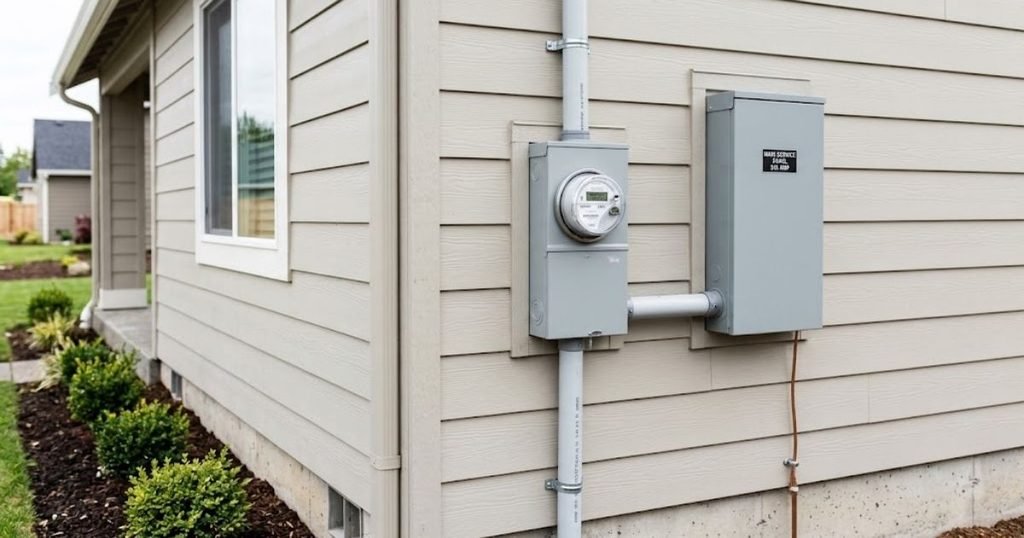
It is worth clarifying a common point of confusion: standard U.S. residential service is officially described as single-phase 120/240V split-phase power. Even though your main electrical panel has two “hot” breaker legs (giving you 240V when combined or 120V when measured against the neutral), it is derived from a single secondary transformer winding supplied by the utility. It is not true three-phase power.
Common Three-Phase Voltage Configurations in the USA
When exploring commercial properties or specialized installations, you will encounter distinct three-phase voltage systems. Not every building follows one universal configuration.
1. 120/208V Three-Phase Power
- Applications: Commonly found in commercial office buildings, retail strips, schools, and some large multi-family residential complexes or mixed-use properties.
- Line-to-Neutral vs. Line-to-Line: In this configuration, measuring from any single phase to the neutral wire yields 120V (ideal for standard office lighting and plug loads). Measuring between any two hot phase legs yields 208V (used for commercial equipment and larger HVAC units).
- Availability: Dependent entirely on local utility distribution infrastructure.
2. 277/480V Three-Phase Power
- Applications: Utilized in large commercial warehouses, manufacturing plants, heavy industrial facilities, and large commercial HVAC systems.
- Characteristics: Provides 277V phase-to-neutral (frequently used to power commercial fluorescent and LED lighting ballasts efficiently) and 480V phase-to-phase for heavy machinery and large pumps.
- Safety Warning: These higher voltages carry severe electrical hazards and can cause instant, catastrophic injury or death if handled improperly. Only qualified electricians should work on 480V systems.
3. 120/240V Residential Single-Phase Power
- Applications: The standard for almost all single-family American homes.
- Characteristics: Supports standard 120V receptacle and lighting circuits as well as heavy 240V residential appliances like electric ranges, clothes dryers, central air conditioners, and water heaters.
- Clarification: A 240V appliance (like an electric water heater or oven) does not require three-phase power; it operates perfectly on standard single-phase 240V residential service.
READ MORE: 400 Amp Service Panel: What U.S. Homeowners Need to Know
Advantages of Three Phase Electric Power
Three-phase electrical systems offer distinct engineering and operational advantages in compatible environments:
- Efficient Power Delivery: Three-phase systems transfer large blocks of electrical energy efficiently, making them indispensable for high-demand commercial loads.
- Smooth Motor Operation: Compatible three-phase motors start smoothly, run without vibration, and do not require complex external starting switches or capacitors.
- Suitability for Heavy Machinery: Large industrial pumps, compressors, hoists, and manufacturing tools operate at peak efficiency on three-phase supplies.
- Smaller Conductors: Under comparable design and power-transfer conditions, three-phase systems can transmit more power using proportionally smaller copper conductors than single-phase systems.
- Commercial HVAC Efficiency: Large commercial rooftop air conditioning and refrigeration units utilize three-phase compressors for greater mechanical longevity and balanced electrical draw.
- Distribution Flexibility: Appropriately engineered three-phase distribution systems can simultaneously serve high-demand three-phase equipment and standard single-phase lighting or receptacle loads.
Note: While these advantages make three-phase power essential for industry, they do not mean three-phase power is inherently cheaper, safer, or more efficient for everyday residential appliances.
Disadvantages and Limitations
Despite its clear benefits in commercial settings, three-phase power has significant drawbacks that explain why it is rarely brought into standard residential neighborhoods:
- High Installation and Upgrade Costs: Extending three-phase utility lines to a remote or purely residential property can incur exorbitant extension and connection fees from the electric utility.
- Limited Residential Availability: Most residential utility grids are built exclusively for single-phase distribution. Requesting three-phase service for a suburban home may be physically impossible or financially prohibitive.
- Utility Infrastructure Requirements: The local utility may need to install dedicated transformers, poles, or underground vaults specifically for the property.
- Design Complexity: Balancing loads across all three phases requires meticulous electrical engineering. An unbalanced three-phase system can cause equipment overheating and premature motor failure.
- Severe Safety Hazards: Higher voltages and continuous high-amperage availability increase the risk of severe arc flash and electrical shock.
- Protective Device Costs: Specialized three-phase circuit breakers, disconnects, magnetic motor starters, and switchgear are substantially more expensive than standard residential electrical hardware.
READ MORE: Whole House Surge Protector Cost in the USA
Do Homes in the USA Use Three-Phase Electric Power?
As established, the vast majority of standard single-family American homes receive 120/240V single-phase service. However, there are specific scenarios where residential or semi-residential properties interact with three-phase power:
- Large Residential Workshops: Homeowners operating heavy-duty industrial woodworking or metalworking machinery sometimes investigate three-phase service.
- Rural or Agricultural Properties: Large farmsteads often utilize three-phase power to operate heavy irrigation pumps, grain elevators, and large outbuilding machinery.
- Multi-Family and Mixed-Use Buildings: Apartment complexes, condominiums, and mixed-use commercial-residential buildings frequently utilize three-phase service to power central elevators, shared laundry facilities, and common-area HVAC systems.
- Converted Historic or Commercial Properties: Homes converted from former industrial or commercial buildings may retain legacy three-phase service drops.
A Large House Does Not Require Three-Phase
It is a common misconception that sprawling luxury homes with multiple HVAC zones, sub-zero refrigerators, and expansive wine cellars require three-phase power. A properly calculated single-phase residential service such as a 400-amp split-phase service or dual 200-amp panels can comfortably power massive residential electrical loads without requiring three-phase distribution.
Can You Convert a Home to Three-Phase Power?
If you are a homeowner determined to run genuine three-phase machinery at home, converting your property is a major undertaking. It is never a DIY project. Here is how the process generally unfolds:
- Identify Equipment Requirements: Review the exact voltage, amperage, and phase requirements listed on your machinery nameplates.
- Consult a Qualified Electrician: Have a licensed electrician perform a detailed load calculation and evaluate your existing electrical service.
- Contact Your Electric Utility: Reach out to your local electric utility provider to determine if three-phase distribution lines run near your property boundary and whether residential three-phase service is permitted.
- Obtain Cost Estimates: Request comprehensive written estimates covering utility line extension fees, transformer installation, service entrance upgrades, and main panel modifications.
- Permits and Inspections: Ensure all local municipal permits are pulled and that the installation complies strictly with the National Electrical Code (NEC) and local utility standards.
- Professional Installation: Authorized professionals must complete the utility coordination, panel installation, and final safety inspections.
Practical Alternatives to Service Conversion
Because upgrading a residential property to three-phase power can cost tens of thousands of dollars in utility fees, homeowners often explore more practical alternatives:
- Purchase Single-Phase Equivalents: Many tool and equipment manufacturers offer single-phase models designed specifically for residential workshop use.
- Phase Converters: A rotary phase converter or digital static phase converter takes standard single-phase 240V residential power and converts it into three-phase power to run a specific machine.
- Variable-Frequency Drives (VFDs): VFDs can control three-phase motors while operating on single-phase residential input power, offering adjustable speed control and smooth motor starting.
Crucial Warning: Installing a phase converter or VFD requires expert sizing. You must consult manufacturer instructions and a qualified electrician to ensure your motor type, starting current, and control circuits are fully compatible.
READ MORE: Why Does My Circuit Breaker Keep Tripping? Causes & Safe Fixes
How Much Does Three-Phase Power Installation Cost?
Because utility requirements vary wildly between a suburban lot in Ohio and a rural property in Texas, there is no universal flat rate for three-phase installations. Costs depend heavily on infrastructure proximity.
Cost Factor Breakdown
| Cost Factor | Why It Affects the Estimate | What Homeowners Should Ask Contractors |
| Utility Service Availability | If three-phase lines are blocks away, the utility will charge heavily for pole and transformer extensions. | “Has the local utility confirmed whether three-phase distribution is available at our property line?” |
| Transformer & Infrastructure | Dedicated three-phase transformers and metering equipment must be purchased and installed. | “Will the utility require us to fund a dedicated pad-mounted or pole transformer?” |
| Service Entrance & Metering | Commercial-grade meter sockets and service masts differ significantly from residential hardware. | “What specific meter enclosure and service entrance rating does our local utility require?” |
| Electrical Panel Modifications | Replacing a residential single-phase panel with a three-phase commercial panel and switchgear. | “Does our project require a complete main switchboard replacement or a dedicated subpanel?” |
| Wiring & Protective Devices | Three-phase circuits require 4-wire or 3-wire cabling, heavy-duty conduit, and rated motor disconnects. | “Are all proposed breakers, conductors, and disconnects rated for our specific load?” |
| Phase Conversion Equipment | Rotary converters or VFDs purchased as an alternative to utility service upgrades. | “Is a rotary phase converter or a VFD a more cost-effective solution for our machinery?” |
| Permits, Labor & Inspections | Licensed commercial electrician labor rates, municipal permits, and mandatory electrical inspections. | “Are all municipal permit fees and required utility inspection sign-offs included in your quote?” |
Always obtain at least three comparable written estimates from licensed electrical contractors. Be wary of initial low bids that omit utility connection fees or specialized equipment requirements.
How to Tell Whether Your Property Has Three-Phase Power
Before purchasing heavy equipment, verify your current electrical service safely:
- Review Electrical Documents: Check your original home inspection report, builder blueprints, or utility bills for references to service voltage (e.g., 120/240V single-phase vs. 120/208V three-phase).
- Contact Your Electric Utility: Call your local utility customer service department with your account number or meter number. They can pull up your exact service classification instantly.
- Consult a Licensed Electrician: Ask an experienced residential electrician to inspect your main service panel and meter base.
- Check Equipment Nameplates: Review the electrical specifications stamped on the metal nameplate of your heavy machinery.
Important Safety Warning
Never remove electrical panel covers, touch exposed bus bars, or attempt to test live wiring with a multimeter unless you are a trained electrical professional. Opening a live panel exposes you to lethal shock and arc flash hazards. Furthermore, do not assume a service phase based solely on the appearance of your breaker layout or the number of wires entering your home; visual identification can be deceiving.
Three-Phase Power Applications Around the Home
To clarify where phase requirements truly matter, the following table lists common high-demand equipment and their typical phase requirements:
| Application / Equipment | Typical Phase Requirement | Important Homeowner Notes |
| Residential HVAC & Central AC | Single-Phase (120/240V) | Almost all standard residential air conditioners, heat pumps, and furnaces operate on single-phase power. |
| Water Pumps & Well Systems | Single-Phase or Three-Phase | Standard residential well pumps use single-phase 240V motors. High-capacity agricultural or deep-well pumps may use three-phase. |
| Workshop Machinery (Lathes, Mills) | Single-Phase or Three-Phase | Smaller workshop tools run on 120V or 240V single-phase. Industrial-grade machinery often requires three-phase power or a phase converter. |
| Large Air Compressors | Single-Phase or Three-Phase | Smaller shop compressors run on 240V single-phase. Large 5+ horsepower industrial compressors frequently require three-phase service. |
| Commercial Kitchen Equipment | Three-Phase (Common in Commercial) | Commercial ranges, ovens, and dishwashers found in mixed-use or hospitality properties typically require three-phase power. |
| Multi-Family Building Equipment | Three-Phase | Elevators, shared booster pumps, and commercial laundry facilities in apartment buildings operate on three-phase systems. |
Always verify the exact phase and voltage requirements directly from the equipment manufacturer’s nameplate and installation manual before purchasing machinery.
READ MORE: Electrical Panel Upgrade for EV Charger: Costs & Requirements
Three-Phase Electric Power Safety
Electrical safety is paramount. Whether dealing with standard single-phase residential wiring or high-capacity commercial systems, electricity demands absolute respect.
- Never Work Energized: Homeowners must never attempt DIY electrical work on energized service entrance conductors, utility panels, or high-voltage circuits.
- Hire Qualified Professionals: Always hire a licensed, insured electrical contractor whose work complies with local building codes and the National Electrical Code (NFPA 70), published by the National Fire Protection Association (NFPA).
- Verify Component Compatibility: Ensure all overcurrent protection devices, disconnect switches, wiring insulation ratings, and grounding conductors match the equipment manufacturer’s specifications.
- Obtain Proper Permits: Never bypass municipal permitting and inspection processes. Inspections protect your family, your property, and your insurance validity.
- Recognize Warning Signs: If you notice burning smells, buzzing sounds from your panel, discolored outlets, warm switch plates, or repeated breaker trips, stop using the equipment immediately and call a licensed electrician.
- Keep Children and Unqualified Persons Away: Maintain clear, unobstructed access to electrical panels while ensuring children and untrained individuals never tamper with electrical equipment.
Organizations like the Electrical Safety Foundation International (ESFI) emphasize that home electrical systems should be inspected periodically by qualified professionals to prevent electrical fires and shock hazards.
FAQs
What is three phase electric power?
Three phase electric power is an alternating current electrical system that utilizes three separate voltage waveforms separated by 120 electrical degrees. It delivers continuous, balanced power without energy dips, making it the industry standard for commercial buildings, industrial machinery, and heavy-duty motor applications.
What is the difference between single-phase and three-phase power?
Single-phase power uses one primary alternating voltage wave (or split-phase 120/240V in U.S. homes) to power standard household appliances and lighting. Three-phase power uses three coordinated waveforms to deliver constant, higher-capacity power, making it ideal for large commercial motors and industrial equipment without excessive vibration or heat.
Do residential homes in the USA use three-phase power?
No. The vast majority of single-family American homes operate on standard 120/240V single-phase electrical service. Three-phase power is typically reserved for commercial buildings, industrial facilities, multi-family apartment complexes, and occasional specialized rural agricultural properties or large workshops.
Is three phase power more efficient than single phase power?
Yes, in terms of industrial power distribution and heavy motor operation, three-phase systems transfer electrical energy more efficiently and require smaller conductors for equivalent power loads. However, this does not translate to lower electric bills or greater efficiency for standard household appliances in a typical residential setting.
How much does it cost to install three phase power in a house?
Installing three-phase power in a standard residential home can cost anywhere from several thousand to tens of thousands of dollars. Total costs depend heavily on utility line extension fees, transformer installation, commercial meter sockets, panel upgrades, and electrician labor. Homeowners should always obtain written estimates from their local electric utility and licensed electrical contractors.
Conclusion
Understanding three phase electric power bridges the gap between everyday residential electricity and heavy industrial capability. While single-phase 120/240V service remains the gold standard for American homes, recognizing how three-phase systems operate empowers homeowners, property buyers, and DIY enthusiasts to make informed decisions when planning workshop upgrades, evaluating specialty machinery, or considering alternative power conversion equipment.
Before undertaking any major electrical service modification or purchasing heavy industrial equipment, always confirm your property’s electrical limitations with your local electric utility and consult a qualified, licensed electrical professional. Taking these proactive steps ensures safety, regulatory compliance, and reliable performance for years to come.
Sources and References
- U.S. Department of Energy (DOE): Electrical Science, Alternating Current Circuits, and Power Fundamentals.
- U.S. Energy Information Administration (EIA): Electricity Generation, Transmission, and Distribution Overviews.
- National Fire Protection Association (NFPA): NFPA 70: National Electrical Code (NEC) Standards for Electrical Safety and Installations.
- Electrical Safety Foundation International (ESFI): Residential Electrical Safety Guidelines and Homeowner Inspection Best Practices.
- Local Electric Utility Provider Documentation: Residential and Commercial Service Installation Guides, Tariffs, and Connection Requirements.