Garages and workshops tend to have big open volumes, high ceilings, concrete floors that pull heat right out of your feet, and at least one giant door that gets rolled open every time you need to grab something from the truck. Add in minimal insulation and drafty gaps around windows and framing, and even a powerful space heater can feel like it’s fighting a losing battle.
That’s why so many homeowners, mechanics, and woodworkers turn to a propane shop heater. Propane can deliver serious BTU output without asking your home’s electrical panel to carry the load, and many models still work during a power outage, a real advantage if you’re heating a detached garage or barn.
Picking the wrong type or the wrong size is the most common mistake shop owners make. This guide covers how propane shop heaters work, how to size one correctly, and how seven popular models stack up. Lets deep dive into “Best 7 Propane Shop Heater: Picks for Garages & Workshops”
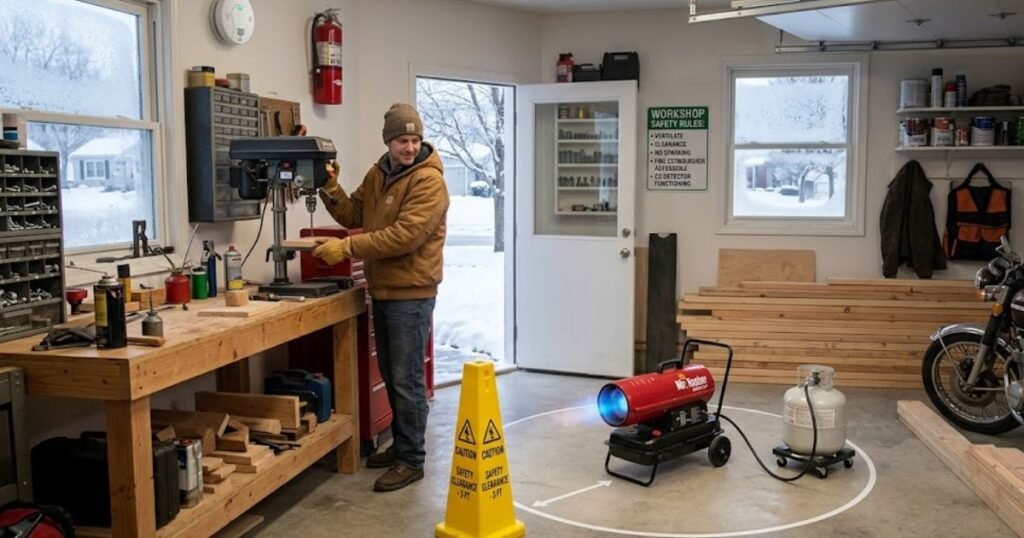
What Is a Propane Shop Heater?
A propane shop heater is a standalone or wall-mounted heating device designed to convert liquid propane into usable thermal energy to warm utility spaces. Unlike residential central furnaces that rely on complex ductwork, shop heaters deliver direct, localized heat right where you work.
How Fuel Converts to Heat
Propane is stored under pressure as a liquid in steel cylinders or large domestic bulk tanks. When the heater’s valve opens, the liquid vaporizes into gas, travels through a regulator to lower the pressure, and reaches the burner assembly. Once ignited either via a piezo spark, electronic igniter, or standing pilot the propane combusts cleanly, producing thermal energy measured in British Thermal Units (BTUs).
Key Components and Mechanics
- BTU Output: A measure of heating capacity. Shop propane heaters typically range from 6,000 BTUs for small portable units up to 50,000+ BTUs for heavy-duty workshop heaters.
- Heat Distribution: Depending on the design, heat is moved via convection (warming the air), radiant energy (warming surfaces directly), or forced air (using a fan to push heated air).
- Fuel Supply: Small units run on disposable 1-lb propane cylinders or standard 20-lb barbecue tanks. Larger units can be hard-plumbed into 100-lb cylinders or a 500-gallon exterior residential supply tank.
- Thermostatic Control: Many indoor-rated shop heaters feature integrated mechanical or digital thermostats, allowing the unit to cycle on and off automatically to maintain a target room temperature.
- Electrical Requirements: While many radiant and blue flame heaters require zero electricity to operate, high-output forced-air models require a standard 120V electrical outlet to power the internal blower fan.
READ MORE: Best 5 Natural Gas Heater for Home: Review, Comparison & Buying Guide
How Does a Propane Shop Heater Work?
At its core, a propane shop heater relies on a simple combustion process, but how that heat reaches your cold hands depends entirely on the design of the unit.
[Propane Tank] ──> [Regulator] ──> [Burner & Ignition] ──> [Heat Distribution]
- Fuel Delivery: Pressurized liquid propane flows from the tank, passes through a pressure regulator to establish a safe operating pressure, and feeds into the burner tube.
- Ignition: The fuel mixes with primary air and is ignited. Modern shop heaters utilize electronic spark ignition, piezo push-button systems, or standing pilots.
- Combustion & Thermal Conversion: The burning propane creates direct thermal heat. Complete propane combustion primarily yields carbon dioxide, water vapor, and heat.
- Heat Transfer:
- Convection units draw cold air in from the bottom, heat it across a burner flame, and release warm air out the top to naturally circulate around the room.
- Radiant units heat ceramic or metal tiles that glow red-orange, emitting infrared light waves that directly heat objects, tools, and people in their direct path.
- Forced-air units use a motor-driven fan positioned behind the burner ring to blast hot air across large open distances.
- Regulation: A thermostatic valve senses room temperature and throttles the gas valve down or shuts it off when the desired setting is reached.
Direct Combustion vs. Indoor Vent-Free Systems
It is vital to distinguish between heavy-duty jobsite heaters and indoor supplemental heaters. Direct-combustion open heaters (like open forced-air torpedoes) dump 100% of their combustion products straight into the space and require continuous fresh-air ventilation. Vent-free indoor-rated heaters utilize precision-engineered burners designed to achieve nearly 100% fuel efficiency, producing minimal emissions, and include critical safety cut-offs like Oxygen Depletion Sensors (ODS).
READ MORE: Dyna-Glo Heater Review: Best Models for Homes, Garages & Cabins
Types of Propane Shop Heaters
Selecting the right propane garage heater begins with choosing the correct heating technology for your building’s layout and workflow.
1. Forced-Air Propane Heaters
Forced-air propane shop heaters are built for rapid, high-volume heating. Featuring a tubular steel design with a powerful internal fan, these units blow massive quantities of hot air across large spaces.
- Best for: Large open workspaces, uninsulated pole barns, mechanics working in drafty bays, and temporary project heating.
- Key Characteristics: Extremely high BTU ratings (30,000 to 150,000+ BTUs), rapid temperature elevation, heavy-duty industrial builds.
- Considerations: Requires a 120V power outlet for the fan motor; creates operational fan noise; can kick up dust or wood shavings in fine woodworking shops. Manufacturers like Mr. Heater build their forced-air units as heavy-duty jobsite workhorses, equipping them with high-limit thermal switches, heavy-gauge steel housing, and integrated thermoelectric safety valves.
2. Vent-Free Propane Heaters
Vent-free heaters are designed to operate indoors without requiring a flue or chimney pipe installed through your roof or exterior wall. They convert virtually all the fuel into usable heat and are typically mounted permanently to a wall or used on floor feet.
- Best for: Enclosed residential garages, home workshops, hobby rooms, and supplemental heat in insulated shops.
- Key Characteristics: Offered in radiant or blue-flame styles; silent operation (no blower required, though optional fan kits exist); integrated thermostats; equipped with an Oxygen Depletion Sensor (ODS).
- Considerations: “Vent-free” does not mean install-anywhere. They release small amounts of water vapor into the air during combustion and are subject to strict local building codes and room-size limitations.
3. Radiant Propane Heaters
Radiant heaters work like the sun. Rather than trying to warm thousands of cubic feet of cold air, radiant panels emit infrared heat rays that travel in a straight line to warm solid objects—your concrete floor, workbench, tools, and body.
- Best for: Drafty garages, spot-heating a specific workbench area, or uninsulated shops where warm air easily escapes through cracks.
- Key Characteristics: Instant warmth upon ignition, silent performance, highly efficient for targeted heating zones.
4. Blue Flame Propane Heaters
Blue flame heaters are convection-based units. They produce a soft blue flame that heats the air inside the cabinet, causing warm air to rise out of the top vents and circulate naturally throughout the room.
- Best for: Fully insulated garages and shops where you want an even, uniform ambient air temperature throughout the entire space.
- Key Characteristics: Consistent, comfortable ambient warming; quiet operation; clean burning.
5. Portable Propane Heaters
Portable shop heaters prioritize mobility and self-containment. Ranging from small “Buddy” style heaters to rolling cabinet units, these allow you to bring heat exactly where you need it without running permanent gas lines.
- Best for: Small work areas, emergency back-up heating during power outages, mobile mechanics, and multi-zone projects.
- Key Characteristics: Integrated propane tank slots, fold-down handles, low-BTU outputs (4,000 to 18,000 BTUs), built-in tip-over switches, and ODS safety features.
How Many BTUs Do You Need for a Shop?
BTU sizing isn’t just square footage. Ceiling height, insulation, climate, number of exterior doors and how often they open, windows, air leakage, and your desired indoor temperature all factor in.
General BTU sizing guide (a rough starting point, not a heat-loss calculation):
| Shop Size | Rough BTU Range | Typical Application |
| 100–300 sq. ft. | 5,000–15,000 BTU | Small workspace |
| 300–500 sq. ft. | 10,000–20,000 BTU | Small garage/workshop |
| 500–800 sq. ft. | 15,000–30,000 BTU | Medium garage |
| 800–1,200 sq. ft. | 25,000–50,000 BTU | Large garage/shop |
| 1,200+ sq. ft. | 40,000+ BTU | Large or poorly insulated shop |
An insulated 1,000-square-foot garage can run comfortably on the low end of that range; an uninsulated metal building the same size may need double.
READ MORE: Best Salamander Heaters: Top Picks, Reviews & Comparison
Best 7 Propane Shop Heater: Picks for Garages & Workshops
Not all seven are equally suited to full-time shop duty. Some are built for garages and enclosed workshops; others are outdoor patios or portable heaters that happen to share a similar BTU number.
1. Mr. Heater 50,000 BTU Forced-Air Unit Heater — Propane or Natural Gas
Best for: Large, heavy-duty workshops, pole barns, and commercial-style garages needing rapid warm-up times.
Overview & Specifications
The Mr. Heater 50,000 BTU forced-air unit (often installed overhead or deployed on job sites depending on the specific model variation) is engineered to tackle large cubic-foot spaces. Delivering 50,000 BTUs of power, this class of unit heater utilizes an integrated electric blower motor to force large volumes of heated air across a wide workspace, rapidly breaking winter drafts.
- BTU Output: 50,000 BTU/hr
- Heating Method: Fan-forced air convection
- Fuel Type: Liquid Propane (or Natural Gas depending on conversion kit/exact model configuration)
- Coverage Area: Up to 1,250 sq. ft.
- Power Source: Propane for combustion; 120V AC outlet for fan motor
- Safety Features: High-limit thermal shutoff switch, thermoelectric safety valve, flame-out protection
Performance & Real-World Use
This unit excels at quickly driving down the chill in a cold shop. If you only turn your shop heat on when you plan to work, a forced-air unit like this is ideal because it circulates air rapidly, warming a cold slab space in under 30 minutes. However, the blower fan generates noticeable operational noise, similar to an industrial shop vac.
- Pros:
- Massive heating capacity for large spaces
- Rapid overall heat distribution
- Durable heavy-duty casing and proven safety cut-offs
- Cons:
- Requires a 120V power source for the fan
- Blower noise can be loud in smaller enclosed rooms
- Air movement can stir up fine sawdust in woodworking environments
- Who Should Buy: Mechanics, fabricators, and DIYers with large garages (800+ sq. ft.) who want fast heat on demand.

2. Mr. Heater 30,000 BTU Vent Free Blue Flame Dual Fuel Heater
Best for: Enclosed 2- to 3-car garages and insulated shops requiring clean, quiet, thermostatically controlled heat.
Overview & Specifications
The Mr. Heater 30,000 BTU Blue Flame heater is a popular option for residential garage installations. Designed as a supplemental indoor heat source, this model burns with a clean blue flame that heats the ambient air as it naturally rises through the top louvered grille. It features dual-fuel capability (factory ready for propane or natural gas), an integrated thermostat, and electronic ignition.
- BTU Output: 30,000 BTU/hr
- Heating Method: Convection (Blue Flame)
- Fuel Type: Dual Fuel (Liquid Propane or Natural Gas)
- Coverage Area: Up to 1,000 sq. ft. (under manufacturer test conditions)
- Mounting: Wall-mount bracket included; optional floor feet available
- Safety Features: Factory-integrated Oxygen Depletion Sensor (ODS), auto-shutoff valve
Performance & Real-World Use
Because it operates without a noisy blower fan, this unit runs silently. It warms the surrounding air steadily, creating a uniform blanket of ambient warmth throughout insulated garages. The onboard thermostat allows you to set a desired level, letting the heater cycle automatically to keep your shop above freezing all winter long.
- Pros:
- 100% fuel-efficient vent-free operation
- Completely silent (no fan required)
- Thermostatic temperature regulation cuts fuel waste
- Includes factory-installed low-oxygen safety shutoff (ODS)
- Cons:
- Takes longer to warm up an ice-cold, uninsulated room than a forced-air unit
- Local building codes in certain municipalities restrict vent-free installations in tight spaces
- Who Should Buy: Homeowners with insulated attached or detached 2- to 3-car garages wanting set-and-forget background heat.

3. Mr. Heater 18,000 BTU Vent Free Radiant Propane Heater
Best for: Small-to-medium workshops, single-bay garages, or targeted workbench spot heating.
Overview & Specifications
Utilizing ceramic tile burner surfaces, this 18,000 BTU radiant heater glows red-orange during operation, emitting direct infrared heat waves. It is designed for supplemental indoor heating in smaller footprints and provides instant warmth directly to the user standing in front of it.
- BTU Output: 18,000 BTU/hr
- Heating Method: Radiant (Infrared)
- Fuel Type: Liquid Propane
- Coverage Area: Up to 700 sq. ft.
- Safety Features: Integrated Oxygen Depletion Sensor (ODS), thermal cut-off
- Control: Variable heat setting knob / thermostatic control (model dependent)
Performance & Real-World Use
Unlike blue flame convection units that wait for room air to circulate, this radiant model delivers immediate warming feedback. If you are standing at your workbench, you will feel the radiant heat as soon as the ceramic tiles reach temperature. It is exceptionally well-suited for smaller spaces that suffer from minor drafts.
- Pros:
- Direct infrared heat warms you immediately, even if the air is still cool
- Quiet operation with zero electrical power required
- Compact footprint easy to wall-mount near a work station
- Cons:
- 18,000 BTUs is insufficient as a sole heat source for large 3-car shops
- Heat intensity drops off if you move out of the panel’s direct line of sight
- Who Should Buy: DIYers with small workshops, 1-car garages, or dedicated craft nooks who want fast direct heat.

4. Amazon Basics 46,000 BTU Portable Outdoor Propane Patio Heater
Best for: Open-door workspace perimeter heating, covered outdoor staging areas, and open-air shop aprons.
CRITICAL EDITORIAL & SAFETY WARNING:
This product is strictly an outdoor patio heater. It is NEVER approved for use inside an enclosed garage, workshop, or residential structure. It is included here solely for homeowners who work in open outdoor driveways or open-apron shop staging areas.
Overview & Specifications
This commercial-style mushroom patio heater features a stainless steel burner top beneath a wide aluminum reflector dome. Powered by a standard 20-lb propane tank concealed in its base, it projects radiant heat downward in a 360-degree circle.
- BTU Output: 46,000 BTU/hr
- Heating Method: Outdoor Radiant Reflection
- Fuel Type: Liquid Propane (20-lb cylinder stored in base)
- Environment: Strictly Outdoor Outdoor Use Only
- Safety Features: Anti-tilt automatic shutoff switch, safety shutoff valve
Performance & Real-World Use
When positioned outdoors on a driveway apron outside an open garage door for instance, when cutting large sheet goods or welding outside this heater creates a comfortable outdoor warmth zone. It is sturdy, mobile on built-in wheels, and easy to ignite via its piezo system.
- Pros:
- High 46,000 BTU radiant warmth outdoor throw
- Self-contained unit neatly hides a 20-lb propane tank in the base
- Integrated tilt-switch turns off gas if knocked over
- Cons:
- Strictly prohibited indoors; high carbon monoxide generation risk in enclosed spaces
- Heat output is heavily diminished by strong outdoor winds
- Who Should Buy: Homeowners doing carpentry, painting, or repairs outside on open driveways or patios.

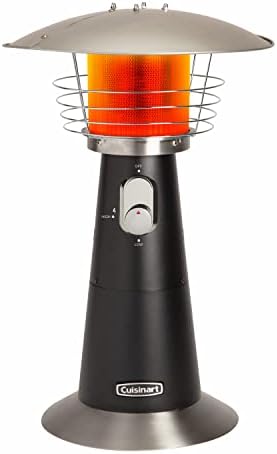
5. Cuisinart Tabletop Patio Heater (11,000 BTU, COH-500)
Best for: Outdoor workbench tabletops, patio work tables, and exterior seating areas.
CRITICAL EDITORIAL & SAFETY WARNING:
This unit is a compact outdoor tabletop heater. It is not a primary shop heater and must NEVER be operated inside an enclosed shop or garage.
Overview & Specifications
The Cuisinart COH-500 is a miniature, 24-inch tall outdoor patio heater designed to sit directly on an exterior work table. Powered by a small 1-lb disposable propane cylinder (or a 20-lb tank via an adapter hose), it delivers 11,000 BTUs of localized outdoor radiant heat.
- BTU Output: 11,000 BTU/hr
- Heating Method: Outdoor Radiant
- Fuel Type: 1-lb Propane Cylinder (or 20-lb tank with extension hose)
- Environment: Strictly Outdoor Outdoor Use Only
- Safety Features: Integrated anti-tilt safety switch, protective burner screen
Performance & Real-World Use
This unit provides direct, localized warmth within a 3-to-4-foot radius on an outdoor work table. If you are doing detail work on an outdoor staging table in cold weather, it keeps your hands warm without requiring a full-sized patio tower.
- Pros:
- Lightweight, highly portable tabletop footprint
- Includes crucial anti-tilt automatic safety shutoff
- Easy setup with readily available 1-lb propane canisters
- Cons:
- Low heat output unsuitable for ambient air heating
- Strictly prohibited inside enclosed spaces
- Who Should Buy: Hobbyists working at outdoor tables or outdoor project stations in late autumn.
6. VEVOR 6,000 to 18,000 BTU Propane Cabinet Heater
Best for: Small, well-ventilated workspaces, temporary utility heating, and highly mobile spot warming.
Overview & Specifications
Cabinet heaters are self-contained, mobile heating units that store a standard 20-lb propane tank directly inside the rear of the steel housing. Rolling on heavy-duty casters, the VEVOR Cabinet Heater offers three adjustable heat settings (typically 6,000, 12,000, and 18,000 BTUs) driving front-facing ceramic radiant tiles.
- BTU Output: Adjustable (6,000 / 12,000 / 18,000 BTU/hr)
- Heating Method: Radiant Ceramic
- Fuel Type: 20-lb Liquid Propane Cylinder (housed internally)
- Mobility: Built-in rolling caster wheels
- Safety Features: Tip-over safety switch, Low-Oxygen Sensor (ODS), flame-failure protection
Performance & Real-World Use
The primary advantage of a cabinet heater is self-contained mobility. Because the propane tank sits hidden inside the cabinet, there are no loose hoses or external tanks to trip over. You can roll it directly beside your project car or workbench. The step-variable controls make it easy to dial back the heat output as the space warms up.
- Pros:
- All-in-one design with internal tank storage and caster wheels
- Adjustable multi-stage BTU output saves fuel
- Equipped with essential tip-over and ODS safety features
- Cons:
- Consumes floor space inside smaller shops
- Not designed for permanent wall mounting
- Who Should Buy: DIYers who move between different work zones within a large, well-ventilated shop or garage.

7. Mr. Heater 9,000 BTU Portable Buddy Radiant Propane Heater
Best for: Ultra-portable spot heating, small 1-car sheds, emergency backup, and cold-weather job sites.
Overview & Specifications
The Mr. Heater Portable Buddy is a widely recognized portable propane heater in North America. Delivering up to 9,000 BTUs of radiant heat, it runs directly off a single 1-lb disposable propane cylinder or can connect to a 20-lb tank using an optional hose and fuel filter.
- BTU Output: Dual settings: 4,000 and 9,000 BTU/hr
- Heating Method: Radiant Ceramic
- Fuel Type: 1-lb Propane Canister (or 20-lb tank via approved hose)
- Coverage Area: Up to 225 sq. ft.
- Safety Features: Accidental tip-over safety switch, Oxygen Depletion Sensor (ODS)
Performance & Real-World Use
The Portable Buddy is built for personal spot heating. It warms up instantly, is incredibly lightweight, and features an ergonomic fold-down handle. While it lacks the thermal output required to bring a freezing 2-car garage to T-shirt temperatures, setting it on a stool right next to your work area provides immediate comfort.
- Pros:
- Lightweight, rugged, and portable
- Indoor-safe design featuring ODS and tip-over shutoff switches
- Operates off cheap 1-lb cylinders or larger tanks
- Cons:
- 9,000 BTUs is insufficient for whole-shop ambient heating
- 1-lb cylinders last only 1.5 to 3 hours on high setting
- Who Should Buy: Anyone needing compact, personal heat right at their feet or workbench, or emergency off-grid backup heat.

READ MORE: Best Greenhouse Heater Buying Guide: Best Winter Options for U.S. Gardeners
Comparison Table — 7 Propane Heaters
| Product | BTU Output | Heater Type | Fuel | Portability | Best For | Shop Suitability |
| Mr. Heater 50K Forced Air | 50,000 | Forced Air | LP/NG | Medium | Large shops | High |
| Mr. Heater 30K Blue Flame | 30,000 | Blue Flame | LP/NG | Low/Medium | Supplemental heating | Medium/High, where permitted |
| Mr. Heater 18K Radiant | 18,000 | Radiant | LP | Low/Medium | Small/medium spaces | Medium, where permitted |
| Amazon Basics 46K Patio | 46,000 | Patio | LP | Medium | Outdoor areas | Outdoor only |
| Cuisinart COH-500 | 11,000 | Tabletop | LP | High | Outdoor tables | Outdoor only |
| VEVOR 6K–18K Cabinet | 6,000–18,000 | Cabinet | LP | Medium | Small spaces | Depends on listing/approval |
| Mr. Heater Portable Buddy | 9,000 | Radiant | LP | High | Portable/backup heat | Limited |
Confirm exact current specifications before purchase — manufacturers periodically update ratings and listings.
Pros and Cons of Using a Propane Shop Heater
Pros: High heat output for the unit size, fast warm-up, portable options, useful where electrical capacity is limited, several heater styles for different spaces, strong performance in large open areas, and some models keep working during outages.
Cons: Ongoing propane costs, carbon monoxide risk if not properly ventilated or maintained, ventilation/clearance requirements that vary by model, propane storage rules, noise from forced-air units, added moisture from combustion in some applications, and installation restrictions tied to local codes.
READ MORE: Vevor Diesel Heater Buying Guide: Best Models, Comparison & Cost
Propane Shop Heater vs. Other Heating Options
| Option | Initial Cost | Operating Cost | Installation | Heating Speed | Portability | Best Use Case |
| Propane heater | Low–Medium | Depends on propane price | Simple to moderate | Fast | High on portable models | Garages, shops, temp heat |
| Electric heater | Low–Medium | Depends on electric rate | Simple | Varies | Moderate | Insulated spaces |
| Natural gas heater | Medium–High | Often stable utility rate | Requires gas line | Fast | Low (fixed) | Permanent shop heating |
| Wood stove | Medium | Depends on wood cost | Moderate–complex | Slow to build up | None | Rustic or off-grid shops |
| Mini-split heat pump | High | Efficient in mild climates | Professional install | Moderate | None | Insulated, year-round shops |
| Infrared electric heater | Low–Medium | Depends on electric rate | Simple | Fast (localized) | Moderate | Spot heating a workbench |
Is a Propane Heater Safe to Use in a Garage or Workshop?
Safety depends on the specific heater, its certification and listing, where it’s installed, ventilation, clearances, fuel storage, and your local codes.
- Carbon monoxide: Incomplete combustion can produce CO, a colorless, odorless gas. A properly sized, well-maintained, well-ventilated heater greatly reduces risk, but a CO alarm near the workspace adds an important extra layer.
- Combustible materials: Keep heaters away from gasoline, paint, solvents, sawdust, wood scraps, cardboard, aerosols, and rags.
- Propane cylinders: Follow the heater’s instructions for cylinder placement many vent-free models require cylinders to stay outdoors along with fire and building codes.
- Ventilation and clearance: Requirements vary significantly between a forced-air jobsite heater and a vent-free indoor unit; keep walls, ceilings, vehicles, shelving, and stored materials outside the clearances listed in the manual.
- Garage doors and vehicles: Watch for vehicle exhaust and fuel vapors as additional ignition and air-quality risks, and treat a CO alarm as a helpful backup not a substitute for correct installation and ventilation.
Safety disclaimer: Propane heaters involve combustion and should be installed and operated exactly as directed by the manufacturer. Always check local building, fire, fuel-gas, and ventilation requirements before using a propane heater in a garage, workshop, or other enclosed space. Never use an outdoor-rated patio heater indoors.
READ MORE: Best Modine Heater Review: Is the Modine Hot Dawg Worth It?
How Much Propane Does a Shop Heater Use?
A gallon of propane contains roughly 91,500 BTU, giving a simple estimate:
Fuel consumption ≈ Heater BTU ÷ 91,500
- 18,000 BTU heater: ≈ 0.20 gallons per hour
- 30,000 BTU heater: ≈ 0.33 gallons per hour
- 50,000 BTU heater: ≈ 0.55 gallons per hour
These are theoretical maximums, not guarantees — actual use depends on cycling, outdoor temperature, insulation, and heater efficiency.
How Long Will a Propane Tank Last?
Runtime depends on tank size, BTU setting, outdoor temperature, propane pressure, cycling, wind exposure, and how full the tank actually is.
| Cylinder Size | Approx. Propane | Rough Runtime at 30,000 BTU |
| 20-lb | ~4.7 gallons | ~14 hours |
| 30-lb | ~7 gallons | ~21 hours |
| 40-lb | ~9.4 gallons | ~28 hours |
| 100-lb | ~23.6 gallons | ~72 hours |
A heater cycling on a thermostat at low settings will stretch a tank well beyond these full-output estimates.
How to Choose the Best Propane Shop Heater
- Measure your space — length, width, ceiling height, square footage.
- Evaluate insulation — an insulated garage needs far less heat than an uninsulated one of the same size.
- Determine your heating goal — freeze protection, taking the chill off, or holding a steady 65–70°F.
- Choose the heating method — forced air for speed, radiant for a fixed spot, blue flame for even whole-room heat, cabinet or portable for smaller or occasional use.
- Consider fuel availability — disposable cylinders, portable tanks, or a stationary tank with delivery.
- Check electrical requirements, especially for forced-air models, and verify safety requirements — certification, clearances, ventilation, and local codes.
- Think about noise and portability — forced-air units run louder than radiant or blue-flame models, and portability matters if you’ll move between spaces.
Frequently Asked Questions
What is the best propane shop heater?
There isn’t one single “best” model — it depends on your space. For a large, uninsulated garage, a 50,000 BTU forced-air heater delivers the fastest, highest-volume heat. For a smaller, insulated workshop where you want steady supplemental warmth, a 30,000 BTU vent-free blue-flame heater is often a better fit.
How many BTUs do I need to heat a 1,000-square-foot shop?
As a rough planning range, a 1,000-square-foot shop typically needs 25,000–50,000 BTU, depending on insulation, ceiling height, climate, and how often doors are opened. A well-insulated space toward the lower end of that range may hold a comfortable temperature, while an uninsulated metal building the same size could need output at the higher end.
Can I use a propane heater in my garage?
Many propane heaters are designed for garage use, but not all of them and “vent-free” doesn’t automatically mean approved for your specific garage. Check the manufacturer’s listed applications, required clearances, minimum room size, and ventilation guidelines, and confirm your local building and fire codes allow the installation.
Is propane or electric heat cheaper for a workshop?
It depends on your local propane price, electricity rate, heater efficiency, runtime, and insulation. Propane heaters often deliver more heat faster for the equipment cost, which matters in large or poorly insulated spaces, while electric heaters can be cheaper to run in smaller, well-insulated areas depending on local utility rates.
How long will a 20-lb propane tank run a shop heater?
A standard 20-lb propane cylinder holds roughly 4.7 gallons of propane. Running a 30,000 BTU heater continuously at full output, that tank would last approximately 14 hours. A lower-output heater, or one cycling on and off with a thermostat, will stretch that same tank considerably further.
Final Verdict — Is a Propane Shop Heater Worth It?
For most garage owners, DIYers, and small-shop operators, a propane shop heater is a genuinely practical way to make a cold space usable especially where new electrical circuits would be expensive or backup heat during an outage matters. Large, open, or poorly insulated shops tend to do best with a high-BTU forced-air unit, while smaller or better-insulated spaces are often served just as well, and more quietly, by a vent-free blue-flame or radiant heater. Portable and cabinet-style units fill in for occasional use or tight budgets, while outdoor patio heaters should stay exactly where they belong — outside.
The highest BTU number isn’t automatically the best choice. The right propane shop heater is the one properly sized for your square footage and insulation, rated for your intended location, and installed according to the manufacturer’s instructions and your local codes. Get those details right, and propane heat can turn a cold garage into a workspace you can actually use through the winter.