Upgrading your home’s climate control is one of the quickest ways to improve everyday indoor comfort while shaving real dollars off your monthly utility bills. However, when you start shopping, you immediately run into three major brands dominating store shelves and online forums: ecobee, Honeywell Home, and Google Nest.
There is no single “perfect” smart thermostat for every house. The ideal choice depends entirely on your existing HVAC wiring, your household routine, and the smart devices you already use.
Below, we break down every technical specification, real-world feature, and purchasing consideration across all three brands. Lets deep dive into “Ecobee vs Honeywell vs Nest: Which Smart Thermostat Is Best?”
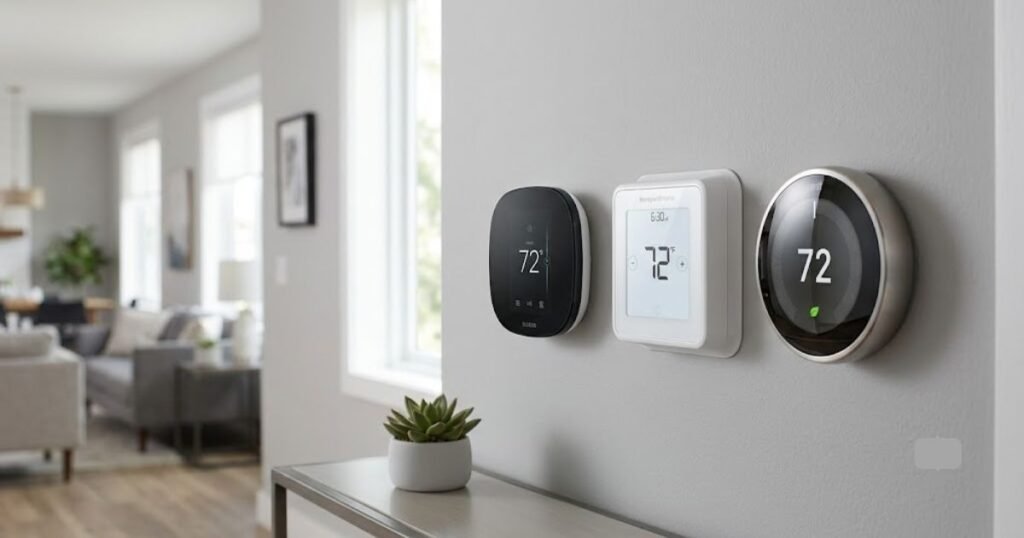
Quick Comparison: ecobee vs Honeywell vs Nest
| Feature | ecobee | Honeywell Home | Google Nest |
| Parent Company | Generac | Resideo Technologies | Alphabet (Google) |
| Best Known For | Remote room sensors, Apple HomeKit integration, deep voice control | Commercial-grade HVAC reliability, physical controls, pro-installer features | Sleek industrial design, self-learning schedules, Google ecosystem integration |
| Typical Price Range | $129 – $250 | $99 – $299 | $129 – $280 |
| Room Sensor Support | SmartSensor (occupancy + temp) | Remote Indoor Temperature Sensors | Nest Temperature Sensor (2nd Gen) |
| C-Wire Requirement | Required (includes Power Extender Kit PEK) | Required on most Wi-Fi models (C-wire adapter sold separately/included on select models) | Optional on basic Nest (power stealing); C-wire strongly recommended on Nest Learning |
| Heat Pump Support | Yes (Up to 2 or 3 stages dependent on model) | Yes (Up to 3 stages heat / 2 stages cool dependent on model) | Yes (Up to 3 stages heat / 2 stages cool on Learning models) |
| Multi-Stage HVAC | Up to 4-stage heat / 2-stage cool (Premium) | Up to 3-stage heat / 2-stage cool (T9/T10/X8S) | Up to 3-stage heat / 2-stage cool (Learning 4th Gen) |
| Wi-Fi Connectivity | 2.4 GHz & 5 GHz (select models) | 2.4 GHz | 2.4 GHz & 5 GHz (Learning 4th Gen) |
| Smart-Home Platforms | Alexa, Google Home, Apple Home, SmartThings, Home Assistant | Alexa, Google Home, Apple Home (select models), SmartThings | Google Home, Amazon Alexa, Apple Home (via Matter on 4th Gen) |
| Alexa Support | Native (Built-in voice on Premium / Skills on all) | Works via Alexa Skill | Works via Alexa Skill / Matter |
| Google Home Support | Native integration | Native integration | Deep native integration & Google Home app control |
| Apple Home Support | Native HomeKit on all current models | Native on T9/T10/X2S/X8S | Supported via Matter on Nest Learning 4th Gen |
| Matter Support | Yes (rolling out across core models) | Yes (X2S, X8S, and modern line) | Yes (Nest Thermostat 2020 & Nest Learning 4th Gen) |
| Energy Savings Tech | Smart Home/Away, Eco+, Time-of-Use pricing optimization | Geofencing, 7-day adaptive scheduling, Demand Response | Smart Schedule, Adaptive Eco, Soli Radar presence sensing |
| Mobile App | ecobee app (iOS / Android) | Resideo app (formerly Honeywell Home) | Google Home app |
| Voice Control | Built-in Siri/Alexa (Premium) or via external speaker | Via connected smart speakers | Via connected Google/Alexa smart speakers |
| Ease of DIY Setup | Excellent (In-app step-by-step video + PEK included) | Moderate to High (pro-style terminals on some units) | Excellent (Google Home app guided setup) |
| Best For | Smart home power users, Apple users, hot/cold room balancing | HVAC traditionalists, complex multi-stage reliability, wide budget range | Google ecosystem homes, hands-off schedule automation |
Note: Hardware specifications and wire terminal configurations vary by specific model. Always verify terminal jumper requirements against your home’s air handler wiring.
READ MORE: Thermostat Wiring Diagrams Explained: R, C, W, Y, G Guide
Top 3 ecobee Thermostats
1. ecobee Smart Thermostat Premium
The ecobee Smart Thermostat Premium stands as the brand’s flagship unit, constructed with a brushed zinc body and an edge-to-edge glass display.
- Approximate Price: $279.99
- Display/Interface: Full-color glass touchscreen with vibrant UI.
- HVAC Compatibility: Conventional up to 2H/2C, Heat Pump up to 4H/2C (including auxiliary/emergency heat).
- C-Wire Requirements: Requires C-wire; includes ecobee Power Extender Kit (PEK) in the box for homes lacking a C-wire.
- Heating/Cooling Stages: Multi-stage support (up to 4 heating stages when paired with dual-fuel/heat pump setups).
- Room Sensors: Includes 1 ecobee SmartSensor (supports up to 32 sensors).
- Smart-Home Ecosystems: Apple Home, Amazon Alexa, Google Home, SmartThings, IFTTT.
- Energy-Saving Features: Eco+ intelligence, time-of-use optimization, automated setback, demand-response utility compatibility.
- Special Features: Built-in Alexa and Siri voice assistant capabilities, integrated Indoor Air Quality (IAQ) monitor (VOCs, carbon dioxide estimation), radar occupancy sensor, built-in speaker.
- App Experience: Highly rated ecobee app with detailed historic runtime graphs and home energy reports.
- Pros:
- Complete indoor air quality monitoring built into the unit.
- Included SmartSensor helps balance hot and cold spots out of the box.
- Excellent Apple HomeKit and Siri voice pass-through support.
- Cons:
- Highest price point in ecobee’s lineup.
- Integrated speaker is fine for voice commands, but mediocre for music playback.
- Best For: Homeowners who want comprehensive smart-home features, air quality tracking, and room-sensor comfort management in a single hub.
- Who Should Avoid It: Budget-minded shoppers or those using simple 1-stage HVAC systems without need for extra smart sensors or voice assistants.
Verdict: The ecobee Smart Thermostat Premium remains the most featured, versatile smart thermostat on the market.

2. ecobee Smart Thermostat Enhanced
The ecobee Smart Thermostat Enhanced delivers the core climate-control capabilities of the Premium model at a accessible price point, dropping the air quality sensor and metal housing while keeping essential comfort features.
- Approximate Price: $199.99
- Display/Interface: Full-color glass touchscreen.
- HVAC Compatibility: Conventional up to 2H/2C, Heat Pump up to 3H/2C.
- C-Wire Requirements: Requires C-wire (Power Extender Kit included in box).
- Room Sensors: Fully compatible with ecobee SmartSensors (sold separately).
- Smart-Home Ecosystems: Apple Home, Amazon Alexa, Google Home, SmartThings.
- Energy-Saving Features: Full Eco+ suite, schedule learning, geofencing.
- Installation Difficulty: Simple DIY installation; average setup time is 25–45 minutes.
- Pros:
- Retains the premium-grade color touchscreen UI and radar occupancy detection.
- Includes Power Extender Kit for homes without a common wire.
- Native Apple HomeKit support.
- Cons:
- Does not include a SmartSensor in the box (must buy separately).
- Lacks the indoor air quality sensor and built-in speaker found on the Premium model.
- Best For: Homeowners who want ecobee’s ecosystem control and Eco+ software features without paying extra for voice assistants or air quality monitors.
- Who Should Avoid It: Buyers who want out-of-the-box room sensor tracking without purchasing add-ons.
Verdict: The sweet spot in ecobee’s lineup for reliability and ecosystem integration.
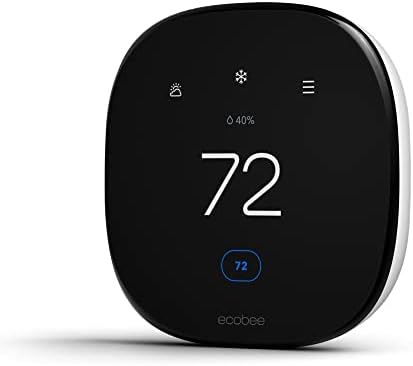
3. ecobee Smart Thermostat Essential
Unveiled to expand ecobee’s line, the Smart Thermostat Essential serves as an entry point, replacing legacy models like the ecobee3 Lite.
- Approximate Price: $129.99
- Display/Interface: Color touchscreen display in a compact form factor.
- HVAC Compatibility: Conventional 1H/1C or 2H/1C, Heat Pump up to 2H/1C.
- C-Wire Requirements: Requires C-wire or PEK.
- Room Sensors: Supports ecobee SmartSensors (optional add-on).
- Smart-Home Ecosystems: Amazon Alexa, Apple HomeKit, Google Home.
- Energy-Saving Features: Basic Eco+ optimizations, Home Energy Reports, brownout/grid resiliency adjustments.
- Pros:
- Low cost for a full-color touchscreen from a top brand.
- Supports Apple HomeKit, Alexa, and Google Assistant natively.
- Works with optional SmartSensors for room prioritization.
- Cons:
- No built-in radar for instant physical occupancy sensing (relies on schedule/app).
- No built-in speaker, microphone, or IAQ monitor.
- Best For: Budget-conscious homeowners, rental property owners, or apartments seeking essential smart control.
- Who Should Avoid It: Homeowners with complex 3-stage or 4-stage heating equipment.
Verdict: A budget smart thermostat that retains wide smart-home platform compatibility.

READ MORE: Step-by-Step DIY Smart Thermostat Installation Guide
Top 3 Honeywell Home Thermostats
1. Honeywell Home X8S Smart Thermostat
The Honeywell Home X8S is a high-tech residential offering from Resideo, featuring a large 5-inch diagonal display and smart-home security visual integration.
- Approximate Price: $249.99 – $279.99
- Display/Interface: 5-inch customizable color touchscreen.
- HVAC Compatibility: Up to 3H/2C Heat Pump or 2H/2C Conventional.
- C-Wire Requirements: C-wire required.
- Room Sensors: Works with Honeywell Wireless Indoor Temperature Sensors.
- Smart-Home Platforms: Amazon Alexa, Google Home, Apple Home, Matter certified.
- Special Features: Video doorbell feed integration (select First Alert/Resideo doorbells), outdoor air quality, weather forecasting, customized screen themes.
- App Experience: Resideo App.
- Pros:
- Large 5-inch screen displays detailed HVAC status and doorbell feeds.
- Matter certification ensures broad multi-platform compatibility.
- High equipment terminal reliability for complex HVAC systems.
- Cons:
- Larger wall footprint than round thermostats.
- Resideo app user interface is less polished than Apple Home or Google Home natively.
- Best For: Homeowners who prefer a large, informative wall display, use Resideo security ecosystems, or want Matter support.
- Who Should Avoid It: Homeowners seeking a minimalist, low-profile wall appearance.
Verdict: A capable high-end thermostat that doubles as an entry doorway monitor.
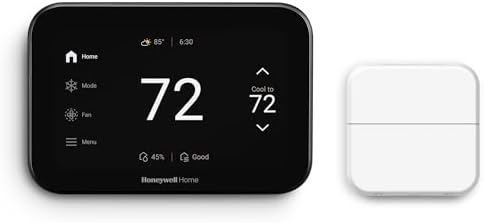
2. Honeywell Home T9 Smart Thermostat (with Sensor)
The T9 is a popular option in Honeywell’s consumer line, built around temperature and humidity management using wireless room sensors.
- Approximate Price: $179.99 – $199.99 (bundled with sensor)
- Display/Interface: Simple, clean rectangular touchscreen LCD.
- HVAC Compatibility: Up to 3H/2C Heat Pump, 2H/2C Conventional.
- C-Wire Requirements: C-wire required (C-wire power adapter often bundled).
- Room Sensors: Includes 1 Honeywell Wireless Smart Room Sensor (200-ft range, tracking temperature and humidity).
- Smart-Home Platforms: Amazon Alexa, Google Assistant, Apple HomeKit, SmartThings.
- App Experience: Resideo App.
- Pros:
- Long sensor signal range (up to 200 feet through walls).
- Reliable geofencing and room prioritization features.
- Easy-to-read layout for users who prefer standard digital thermostats.
- Cons:
- Remote sensors lack motion/occupancy tracking compared to ecobee SmartSensors.
- Touchscreen interface can feel utilitarian.
- Best For: Larger homes where thermostat signal range to remote bedrooms is a top priority.
- Who Should Avoid It: Users looking for sleek glass designs or automated AI learning algorithms.
Verdict: A practical workhorse thermostat for multi-room temperature balancing.
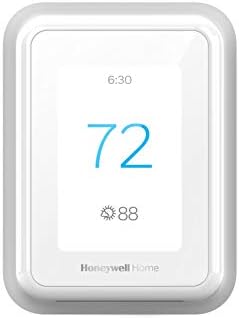
3. Honeywell Home X2S Smart Thermostat
The Honeywell Home X2S is a budget-friendly Wi-Fi unit designed to provide simple smart thermostat access without bloated feature sets.
- Approximate Price: $89.99 – $109.99
- Display/Interface: Compact monochrome backlit LCD display with side touch/button controls.
- HVAC Compatibility: Standard 1H/1C or 2H/1C systems.
- C-Wire Requirements: Requires C-wire.
- Room Sensors: No remote sensor support.
- Smart-Home Platforms: Matter certified; works with Alexa, Google Home, and Apple Home.
- Pros:
- Extremely affordable entry price.
- Matter support allows cross-platform smart home routines.
- Straightforward button/screen layout is familiar for guest rooms or non-tech-savvy users.
- Cons:
- Basic, low-resolution screen.
- No remote room sensor integration.
- Best For: Rental units, budget retrofits, or simple 1-stage furnace/AC setups.
- Who Should Avoid It: Homeowners needing multi-stage heat pump controls or remote room prioritization.
Verdict: An economical smart thermostat backed by traditional HVAC reliability.

READ MORE: Best Energy Star Smart Thermostats: Reviews, Comparison, and Buying Guide
Top 3 Google Nest Thermostats
1. Google Nest Learning Thermostat (4th Generation)
Google’s Nest Learning Thermostat (4th Gen) features a borderless, domed glass face, a 60% larger display, and an updated stainless steel rotating dial.
- Approximate Price: $279.99
- Display/Interface: Large borderless LCD screen with custom dynamic clock/weather faces (“Dynamic Farsight”).
- HVAC Compatibility: High compatibility (up to 3H/2C Heat Pump or conventional multi-stage).
- C-Wire Requirements: Can run without C-wire on some systems via power-stealing, but a C-wire or Nest Power Connector is strongly recommended for reliability.
- Room Sensors: Includes 1 Nest Temperature Sensor (2nd Gen) in the box.
- Smart-Home Ecosystems: Google Home (native), Matter protocol (enables Apple Home, Amazon Alexa, SmartThings).
- Special Features: Soli radar motion/presence tracking, Smart Schedule, System Health Monitor, Natural Heating/Cooling pre-conditioning.
- Pros:
- Premium wall aesthetics with borderless glass and metal dial.
- Matter support allows native exposure to Apple Home and Alexa for the first time on a Nest Learning unit.
- Bundled 2nd-gen temperature sensor adds immediate room balancing value.
- Cons:
- Highest retail price among major mainstream thermostats.
- Does not feature a touchscreen (controlled via outer dial and side swipes).
- Auto-learning schedule can sometimes create frustrating unexpected changes if not monitored.
- Best For: Homeowners looking for top-tier design, Google Home integration, and Matter cross-platform flexibility.
- Who Should Avoid It: Buyers on a strict budget or those who insist on touchscreen interface controls.
Verdict: A design-forward, highly intelligent thermostat—provided your budget supports it.

2. Google Nest Thermostat (Standard / 2020 Model)
The standard Google Nest Thermostat is a streamlined unit built around a mirrored display face and side touch-strip controls.
- Approximate Price: $129.99
- Display/Interface: Mirrored display with side capacitive touch strip (no rotating dial).
- HVAC Compatibility: Basic 1H/1C or 2H/1C setups.
- C-Wire Requirements: Employs power-stealing technology, but frequently requires the Nest Power Connector on modern HVAC control boards.
- Room Sensors: Not compatible with remote Nest Temperature Sensors.
- Smart-Home Ecosystems: Google Home app, Matter certified (works with Apple Home/Alexa).
- Energy Savings: Quick Schedule, Savings Finder, Soli presence detection.
- Pros:
- Low cost for an official Nest product.
- Sleek mirrored face matches minimalist modern home decor.
- Native Matter support out of the box.
- Cons:
- Lacks auto-learning algorithms (requires traditional static schedules).
- No remote room sensor support whatsoever.
- Plastic construction feels lighter than Learning models.
- Best For: Budget buyers who want Google Home app integration and basic scheduling without paying for auto-learning algorithms.
- Who Should Avoid It: Homes with uneven room temperatures that require remote sensors.
Verdict: A good entry point into the Google Home ecosystem, though limited in expansion.

3. Google Nest Learning Thermostat (3rd Generation)
While superseded by the 4th Gen model, the 3rd Gen Nest Learning Thermostat remains installed in millions of U.S. homes and is widely available across secondary retail channels.
- Approximate Price: $199.99 – $249.99 (varies by retailer stock)
- Display/Interface: Classic high-res circular LCD with physical rotating metal dial ring.
- HVAC Compatibility: Up to 3H/2C Heat Pump / Conventional systems.
- C-Wire Requirements: Power-stealing supported, but C-wire recommended for older systems.
- Room Sensors: Supports 1st-Gen Nest Temperature Sensors (sold separately).
- Smart-Home Ecosystems: Google Home, Amazon Alexa (No native HomeKit or Matter support).
- Pros:
- Proven 10+ year hardware track record.
- Iconic rotating dial interface.
- Cons:
- Lacks Matter protocol support.
- Display is smaller with thicker bezels compared to 4th Gen.
- Best For: Homeowners replacing an existing 3rd Gen or finding deep discount pricing on existing stock.
- Who Should Avoid It: Apple Home users who need direct native system integration without home bridges.
Verdict: An iconic classic that has largely yielded its premium place to the 4th Generation.

READ MORE: Sensi Smart Thermostat Review & Comparison
ecobee vs Honeywell vs Nest — Comparison of All 9 Thermostats
| Brand | Model | Approx. Price | Room Sensors | C-Wire Required? | Heat Pump Support | HVAC Stages | Smart Home Ecosystems | Best For |
| ecobee | Smart Thermostat Premium | $249 | Included (SmartSensor) | Yes (PEK included) | Up to 4H/2C | 4H / 2C | Apple, Alexa, Google, SmartThings | Comprehensive feature set, IAQ monitoring, voice controls |
| ecobee | Smart Thermostat Enhanced | $189 | Supported (Optional) | Yes (PEK included) | Up to 3H/2C | 2H / 2C | Apple, Alexa, Google, SmartThings | Mid-range ecosystem balance & full Eco+ software |
| ecobee | Smart Thermostat Essential | $129 | Supported (Optional) | Yes (PEK included) | Up to 2H/1C | 2H / 1C | Apple, Alexa, Google | Budget buyers wanting ecobee software reliability |
| Honeywell | Home X8S | $249 | Supported | Yes | Up to 3H/2C | 3H / 2C | Alexa, Google, Apple, Matter | Large touch screen UI & doorbell camera integration |
| Honeywell | Home T9 | $199 | Included | Yes (Adapter bundled) | Up to 3H/2C | 3H / 2C | Alexa, Google, Apple, SmartThings | Multi-room balancing across long wireless distances |
| Honeywell | Home X2S | $99 | No | Yes | Up to 2H/1C | 2H / 1C | Alexa, Google, Apple, Matter | Low-cost Matter compatibility & basic operation |
| Nest | Learning Thermostat (4th Gen) | $279 | Included (2nd Gen Sensor) | Recommended (Power stealing optional) | Up to 3H/2C | 3H / 2C | Google Home, Matter (Apple/Alexa) | Premium design, Google integration, auto-learning |
| Nest | Thermostat (2020 Standard) | $129 | No | Recommended (Power stealing optional) | Up to 2H/1C | 2H / 1C | Google Home, Matter | Basic Google integration & minimalist mirrored look |
| Nest | Learning Thermostat (3rd Gen) | $199 | Supported (1st Gen Sensor) | Recommended (Power stealing optional) | Up to 3H/2C | 3H / 2C | Google Home, Alexa | Legacy replacement or classic dial design |
In plain English: ecobee dominates software intelligence and room occupancy tracking out of the box. Honeywell Home dominates hardware longevity and long-range sensor communication across larger floor plans. Google Nest dominates aesthetics, hands-off automation algorithms, and tight integration with Google Assistant hardware.
ecobee vs Honeywell vs Nest for Different HVAC Systems
Thermostat marketing materials make installation sound universally simple, but HVAC equipment varies dramatically from home to home. Matching your equipment configuration to terminal controls prevents damage to control boards or heat pump compressors.
Central Air Conditioning
Standard electric cooling setups use predictable low-voltage terminal wires (typically R, Y for cooling, G for fan, and C for power). All models from ecobee, Honeywell, and Nest perform seamlessly with conventional central air conditioning.
Gas Furnace + Central AC
This common U.S. configuration relies on W for gas heat ignition, Y for AC compressor engagement, G for air handler blower fan, and R for 24V power. All three brands handle this setup effortlessly. ecobee and Honeywell allow manual control over fan delay times, allowing warm air to flush through ducts after the gas burner turns off.
Heat Pump Systems
Heat pumps provide both heating and cooling by reversing refrigerant flow using an O/B reversing valve wire.
- Nest: Handles reversing valve logic natively in software, prompting during setup whether your O/B valve energizes in Heating (B) or Cooling (O) mode (most U.S. units energize in cooling).
- ecobee & Honeywell: Offer deep configuration menus allowing custom changeover delay timers, preventing heat pump short-cycling during rapid weather swings.
Multi-Stage HVAC Systems
If your home features 2-stage cooling (Y1/Y2) or multi-stage heating (W1/W2/W3), entry-level models like the standard Nest Thermostat or Honeywell X2S are insufficient. You must choose upper-tier models:
- ecobee Smart Thermostat Premium (up to 4H/2C)
- Honeywell Home T9 / X8S (up to 3H/2C)
- Google Nest Learning Thermostat 4th Gen (up to 3H/2C)
Dual-Fuel Systems
Dual-fuel setups combine an electric heat pump with a backup gas/oil furnace. When outdoor temperatures plunge below freezing, the system switches from the heat pump to fossil-fuel heat.
- Honeywell Home & ecobee: Include software lockout controls that switch fuel sources based on live internet weather data or outdoor temperature sensors, protecting heat pump compressors from freezing over.
- Nest Learning Thermostats: Call this feature “Heat Pump Balance,” allowing users to choose whether to prioritize comfort (firing the furnace sooner) or energy savings.
Older HVAC Systems
Homes with 1970s–1990s heating systems often feature simple 2-wire (R and W) heat-only furnace setups or non-standard wire labeling. ecobee includes explicit adapter hardware (PEK) inside the box to bridge legacy setups. Honeywell provides detailed wiring diagrams for legacy systems.
Warning: High-voltage line systems (120V/240V electric baseboard heaters) are completely incompatible with ecobee, Honeywell Home Wi-Fi, and Google Nest thermostats without installing an external low-voltage relay transformer relay box.
Homes Without a C-Wire
If your wall terminal lacks a blue or black C-wire (24V Common wire), smart thermostats cannot draw continuous power without specialized adapters or power harvesting techniques.
Homes With Multiple Zones
Zoned HVAC systems use motorized duct dampers controlled by a central zone control board (e.g., Honeywell Hz322 or Hz432 boards). All three thermostat brands work with zone boards, provided each zone thermostat bay receives its own steady 24V Common power feed.
Always check terminal labels inside your air handler and test with a multimeter if wire colors do not match standard terminal letters.
READ MORE: Best Programmable Thermostats | Top Rated Reviews
Which Is Better for Energy Savings?
Every brand promises utility bill reductions, but actual energy savings depend on climate zones, building insulation levels, existing schedule habits, and utility rate structures.
Scheduling and Adaptive Learning
- Google Nest: The Nest Learning 4th Gen automatically creates schedules based on manual adjustments made throughout your first week of usage. If you turn down the heat every night at 10:00 PM, Nest recognizes the trend and builds it into the schedule.
- ecobee & Honeywell: Rely primarily on structured, guided app schedules combined with occupancy sensor overrides. ecobee’s Eco+ algorithm analyzes schedule data and adjusts temperatures slightly when electricity costs peak.
Occupancy and Geofencing
- ecobee: Combines smartphone geofencing (triggering Away mode when your phone leaves a set radius) with physical radar/PIR occupancy detection on the thermostat display and SmartSensors. If you stay home on a workday, ecobee notices movement and cancels Away mode.
- Google Nest: Uses Soli radar and phone location via the Google Home app to switch between Home and Away Eco modes smoothly.
- Honeywell Home: Relies heavily on smartphone geofencing through the Resideo app.
Utility Demand-Response Programs
According to independent field evaluations by ENERGY STAR and third-party utility studies, smart thermostats typically deliver 8% to 12% savings on heating costs and 10% to 15% savings on cooling costs. However, savings vary based on household discipline and HVAC mechanical efficiency.
Which Thermostat Has the Best Room Sensors?
In multi-story homes, a single central hallway thermostat often fails to maintain balance across all rooms. Upstairs bedrooms trap hot air during summer nights, while main-level thermostats report comfortable conditions.
How Remote Sensors Work
Remote sensors communicate wirelessly with the base thermostat, transmitting local ambient temperature readings. The thermostat software calculates a running average across selected sensors or switches control priority exclusively to specific rooms based on scheduled routines.
Brand Sensor Comparison
- ecobee SmartSensor: Uses sub-GHz wireless signals to transmit both temperature and occupancy/motion. If you enter your upstairs home office, ecobee detects your presence and factors that room’s temperature into the climate calculation. Supports up to 32 sensors per thermostat.
- Honeywell Wireless Sensor: Focuses on long-range temperature and humidity transmission (up to 200 feet line-of-sight). Excellent for large structures or homes with thick plaster/brick walls, though lacking built-in motion-activated occupancy switching.
- Nest Temperature Sensor (2nd Gen): Transmits temperature data over low-power Thread wireless. Users can set schedule blocks prioritizing specific sensors (e.g., prioritize the nursery from 8:00 PM to 6:00 AM). However, Nest sensors do not include motion occupancy detection.
Which Is Best Without a C-Wire?
The C-wire (Common wire) delivers constant 24V AC electrical current from the furnace transformer to the smart thermostat’s internal Wi-Fi chip, backlit color screen, and microprocessors. Without a dedicated C-wire, modern thermostats must find alternative ways to maintain continuous power.
- ecobee Solution (Power Extender Kit – PEK): Included free in the box with ecobee models. Installed inside the HVAC cabinet near the control board, the PEK splits four existing wires (R, W, Y, G) to create a functional common power feed without running new wiring through home walls. It is reliable and avoids power fluctuations.
- Nest Solution (Power Stealing vs. Nest Power Connector): Standard Nest thermostats attempt “power stealing”—harvesting trace electricity from the heating or cooling circuit when equipment is resting. While this works on simple systems, it can cause relay chatter, false equipment engagement, or rapid battery drain on modern HVAC boards. To solve this, Google sells the Nest Power Connector, an add-on module similar to ecobee’s PEK.
- Honeywell Solution: Most Wi-Fi Honeywell Home units explicitly require a physical C-wire. Honeywell bundles wire adapters with models like the T9 or sells an external 24V power adapter plug kit.
Smart-Home Compatibility
Integrating your thermostat with broader smart-home routines allows automated triggers, like setting temperatures when you lock your front door or using voice commands from any room.
- Apple Home / HomeKit Households: ecobee is the preferred choice for Apple environments. Every current ecobee model supports Apple Home natively without extra bridges. The Premium model even acts as a Siri voice endpoint. Nest Learning 4th Gen supports Apple Home via Matter, but ecobee offers deeper native Apple ecosystem controls.
- Google Home Households: Google Nest provides native integration, allowing direct management within the Google Home app and broadcast alerts across Nest speakers/displays.
- Amazon Alexa Households: All three brands feature solid Alexa integrations. ecobee Smart Thermostat Premium stands out by building an Alexa smart speaker directly into the thermostat housing.
- Matter Standard: Matter support ensures cross-platform longevity. Nest Learning 4th Gen, Nest Thermostat (2020), Honeywell X2S, and Honeywell X8S are native Matter devices, allowing direct connections across platforms.
ecobee vs Honeywell vs Nest: App and User Experience
- ecobee App: Excellent option for data-minded users. Provides detailed historic runtime charts, indoor relative humidity tracking, individual sensor temperature reports, and customized schedule blocks.
- Resideo (Honeywell) App: Functional and stable, though utilitarian. Focuses on quick access to setpoints, simple geofencing toggles, and multi-location management for vacation properties or rental portfolios.
- Google Home App: Consolidates thermostat adjustments into Google’s unified smart-home interface. Quick and accessible for temperature tweaks, though lacking the granular historic logging data provided by ecobee.
ecobee vs Honeywell vs Nest — Which One Should You Buy?
- Best Overall Feature Set: ecobee Smart Thermostat Premium
- Best for Google Home: Google Nest Learning Thermostat (4th Gen)
- Best Traditional HVAC: Honeywell Home T9 or X8S
- Best Room-by-Room Comfort: ecobee Smart Thermostat Premium or Enhanced
- Best Without C-Wire: ecobee (includes PEK in the box)
- Best Heat Pump Control: ecobee Smart Thermostat Premium
- Best Budget Option: Honeywell Home X2S or ecobee Essential
- Best Apple Home Setup: ecobee Smart Thermostat Premium or Enhanced
- Best Hands-Off Automation: Google Nest Learning Thermostat (4th Gen)
What to Check Before Buying a Smart Thermostat
Before finalizing your purchase, work through this practical pre-purchase checklist:
- [ ] Check Existing Wiring: Remove your current thermostat faceplate and count the wires connected to terminal letters.
- [ ] Identify the C-Wire: Confirm if you have a active blue, black, or extra Common wire attached to the C terminal.
- [ ] Identify Heating Type: Determine whether you have natural gas, oil, electric resistance, or a heat pump system.
- [ ] Count System Stages: Note whether you have 1-stage or multi-stage heating/cooling equipment (Y1, Y2, W1, W2).
- [ ] Evaluate Hot/Cold Spots: Determine if specific rooms require wireless remote sensor prioritization.
- [ ] Select Primary Ecosystem: Choose based on your preferred platform (Apple Home, Google Home, or Amazon Alexa).
- [ ] Check Manufacturer Compatibility Tools: Run your terminal letters through the online compatibility checker provided by ecobee, Honeywell, or Nest before purchasing.
Frequently Asked Questions
Is ecobee better than Nest?
ecobee is generally better for homeowners who want room-by-room occupancy sensing, comprehensive air quality tracking, native Apple HomeKit support, and precise schedule control. Nest is often preferred by users seeking automated schedule learning, borderless glass design, and seamless Google Home ecosystem integration.
Is Honeywell better than ecobee?
Honeywell is often preferred by traditional HVAC contractors due to its hardware reliability across multi-stage systems and long-range temperature sensors. However, ecobee offers more advanced smart-home integrations, built-in voice assistants, integrated occupancy sensing, and polished mobile app analytics.
What is the best smart thermostat for a home?
The ecobee Smart Thermostat Premium is widely considered the best overall smart thermostat in 2026 due to its included room sensor, built-in air quality monitor, broad ecosystem support, and consistent reliability. However, the Google Nest Learning 4th Gen is an excellent alternative for Google-centric homes, while Honeywell Home units are ideal for traditional HVAC setups.
Do ecobee, Honeywell, and Nest thermostats need a C-wire?
While requirements vary by model, a C-wire is recommended across all three brands for reliable performance. ecobee includes a Power Extender Kit (PEK) in the box to handle setups without a C-wire. Nest supports power-stealing on select models but recommends the Nest Power Connector for modern systems. Honeywell Wi-Fi models typically require a C-wire or adapter kit.
Which thermostat saves the most energy, ecobee, Nest, or Honeywell?
All three brands deliver similar potential energy savings typically 8% to 15% on heating and cooling bills when configured properly. Nest relies on automated learning algorithms to lower consumption, ecobee uses its Eco+ software and occupancy sensors to eliminate unnecessary runtime, and Honeywell uses precise geofencing.
Final Verdict
Choosing between ecobee, Honeywell Home, and Google Nest ultimately comes down to matching the thermostat to your home’s HVAC wiring and smart home preferences.
- Choose ecobee if you want room-by-room comfort, motion-based occupancy tracking, Apple HomeKit support, and complete smart-home flexibility.
- Choose Honeywell Home if you prioritize traditional HVAC reliability, straightforward controls, long-range remote room temperature sensing, or broad price flexibility.
- Choose Google Nest if you want hands-off schedule automation, premium wall aesthetics, and native integration within the Google Home ecosystem.
Before buying, inspect your existing thermostat wiring, confirm whether you have a C-wire, and use the manufacturer’s online compatibility tool. Selecting a thermostat tailored to your HVAC system guarantees reliable year-round indoor comfort and long-term energy savings.

