A hot water recirculating pump is designed to eliminate or drastically reduce that frustrating waiting period. Instead of allowing hot water to sit in your supply pipes where it gradually cools down into cold water, a recirculation system keeps hot water moving through your plumbing loop or loop alternative, ensuring warm water is ready near your fixtures almost immediately.
Not every home requires the same setup. The best system for your property depends on your plumbing layout, water heater type (tank or tankless), distance to your farthest fixtures, whether you have a dedicated return line, and how you choose to control the pump. This guide breaks down everything you need to know to choose, install, and optimize the right system for your home. Lets deep dive into “Hot Water Recirculating Pump: Cost, Comparison & Review”
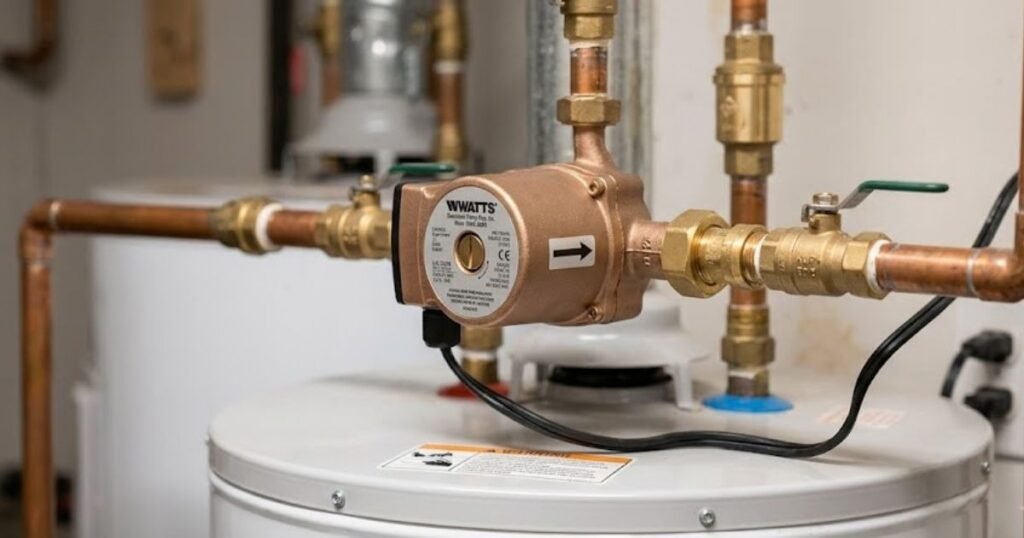
What Is a Hot Water Recirculating Pump?
A hot water recirculating pump is a compact electric pump installed along your domestic hot water plumbing network. Unlike your main water line or well pump, which pushes fresh water into your house from an outside utility or supply, a recirculation pump simply moves water that is already inside your pipes back to the water heater.
It is important to clarify that the pump does not actually heat the water itself. Instead, it creates continuous or scheduled movement within the pipes so that cooled standing water is pushed back into the water heater to be reheated rather than dumped down your drain.
A recirculating pump can help with:
- Long, frustrating waits for hot water at distant sinks and showers
- Substantial water wasted while waiting for tap water to warm up
- Distant bathrooms or multi-story floor plans located far from the mechanical room
- Large single-family homes with extended plumbing runs
- Optimizing hot water delivery in certain tankless water-heater installations
READ MORE: Grundfos Circulation Pump: Cost, Comparison, Install & Troubleshooting
How Does a Hot Water Recirculating Pump Work?
The fundamental concept behind domestic hot water recirculation is straightforward, though the actual physical mechanics depend on your home’s layout.
- Water is heated: Your tank or tankless water heater warms water to your set temperature (typically 120°F in residential applications).
- Water travels through the hot-water supply line: As hot water travels toward your faucets, unused water left in the pipe between uses gradually loses heat through the pipe walls, cooling down to ambient room temperature.
- The recirculation pump moves the cooled water: When activated via timer, temperature sensor, motion sensor, or continuous switch the pump draws this cooled standing water out of the hot supply pipe.
- The water is reheated: The pump pushes the lukewarm water back into the water heater through a dedicated return pipe or a crossover valve hooked to your existing cold water pipe.
- Hot water becomes available faster: Fresh hot water immediately fills the supply pipe behind the outgoing cooled water, giving you near-instant hot water when you open the tap.
How Much Water Can a Recirculating Pump Save?
The amount of water a recirculation system saves varies widely based on your home’s specific layout and your household habits. Key factors influencing your total savings include:
- Pipe length and diameter: A standard 3/4-inch copper or PEX pipe holds roughly 2.5 gallons of water per 100 feet. A 1/2-inch pipe holds roughly 1.2 gallons per 100 feet.
- Faucet flow rate: Standard modern showerheads discharge roughly 1.5 to 2.5 gallons per minute (GPM).
- Waiting time and frequency: A household where four people wait 90 seconds for hot water twice a day wastes significantly more water than a two-person home with short plumbing runs.
- Household size: Homes with multiple occupants running parallel showers and kitchen taps experience compounded wait times and higher volume loss.
According to ENERGY STAR, demand-controlled hot water recirculation systems are recognized as an effective strategy to eliminate the thermal and volumetric waste associated with running taps while waiting for hot water.
The Critical Trade-Off: Water Savings vs. Energy Consumption
While a hot water pump saves thousands of gallons of water annually, saving water does not automatically mean saving overall energy or money.
Continuous recirculation systems that run 24 hours a day lose thermal energy through uninsulated pipes into structural wall cavities, floor joists, or basements. As a result, your water heater must fire up more often to maintain tank temperature. Balancing water conservation with pipe heat loss is the most important factor when choosing and configuring your system.
READ MORE: How to Increase Hot Water Pressure in the Whole House
Types of Hot Water Recirculating Systems
Recirculation systems fall into four major categories based on plumbing layout and operational design.
1. Dedicated Return-Line System
A dedicated return-line system utilizes a separate, dedicated pipe that runs from the farthest fixture back to the water heater, forming a closed loop.
- How it works: Hot water travels down the main supply line to fixtures. Unused water loops into the dedicated return pipe and flows directly back into the bottom of the water heater tank.
- Advantages: Superior performance, high durability, zero impact on cold water supply line temperature, and long pump lifespans.
- Disadvantages: Highly invasive and costly to retrofit in existing homes unless walls are already open during a major renovation.
- Best applications: New home construction, major remodels, or homes where a dedicated return line was pre-installed during initial construction.
2. Crossover or Comfort-Valve System
A crossover system uses your home’s existing cold water supply line as a temporary return pathway back to the water heater, eliminating the need to tear open walls for new piping.
- How it works: A small thermostatic crossover valve is installed under the sink farthest from the water heater. When water in the hot line cools below a specific setpoint (e.g., 95°F), the valve opens, allowing cooled water to bleed into the cold water line. Once hot water reaches the valve, it closes automatically.
- Advantages: Extremely cost-effective, straightforward retrofit process, no extra piping required through walls.
- Disadvantages: Can make cold tap water lukewarm for a few seconds when turned on immediately after a cycle.
- Best applications: Existing multi-story or spread-out homes where adding a new pipe is cost-prohibitive.
3. Under-Sink Recirculation System
Under-sink systems mount the pump assembly directly beneath the point-of-use fixture rather than in the utility room next to the water heater.
- How it works: The pump sits beneath the most problematic fixture (e.g., the primary bathroom sink) and pushes standing hot-line water back through a crossover valve into the cold line.
- Advantages: Excellent localized solution, ideal for homes without easily accessible utility rooms or basement access.
- Best applications: Specific isolated bathrooms or kitchens that suffer from extreme wait times while the rest of the home functions adequately.
4. Demand-Controlled Recirculation
Demand-controlled systems operate only when a homeowner explicitly requests hot water, rather than running continuously or on a blind mechanical clock.
- Activation methods: Push buttons located in bathrooms, wireless keyfobs, motion sensors, or smart home app controls.
- Why it excels: By operating only when needed (running for 30–60 seconds before you step into the shower), demand systems eliminate thermal loss through supply pipes while delivering hot water precisely when requested.
Dedicated Return Line vs. Crossover System
| Feature | Dedicated Return Line | Crossover System |
| Installation Difficulty | High (in existing structures) | Low to Moderate |
| Retrofit Friendliness | Poor (requires wall access) | Excellent |
| Cold-Water Impact | None | Temporary lukewarm cold water |
| Performance | Maximum, true instant delivery | High, near-instant delivery |
| Plumbing Modifications | Major (requires dedicated loop) | Minor (under-sink valve addition) |
| Best For | New builds & open-wall remodels | Existing homes without return lines |
| Cost Considerations | Higher upfront labor costs | Lower overall equipment & labor cost |
How to Choose the Right Hot Water Recirculating Pump
When comparing pump models, evaluate these fundamental technical criteria:
- Pump Flow Rate (GPM): Residential recirculation loops require low flow rates typically between 0.5 and 3.0 gallons per minute (GPM). Choosing an excessively high GPM pump can cause copper pipe erosion over time and unnecessary noise.
- Head Pressure: Measured in feet of head, this represents the pump’s ability to push water against gravity and pipe friction. Multi-story homes require higher head ratings than single-story structures.
- Voltage & Electrical Requirements: Standard U.S. models use 115V/120V household current with standard three-prong plugs. Always check electrical requirements prior to installation.
- Pump Material: Choose stainless steel or bronze pump housings for potable drinking water systems. Cast iron pumps are strictly designed for closed-loop hydronic space heating and will rust in domestic water lines.
- Control Mechanisms: Look for built-in mechanical timers, adjustable aquastats (thermostatic controls), or smart learning modules to prevent continuous 24/7 running.
- Water Heater Compatibility: Ensure the pump model is certified for your specific water heater system—particularly if you have a tankless unit, which requires a minimum flow threshold to ignite the burner.
READ MORE: AO Smith vs. Rheem Water Heaters: Comparison & Expert Reviews
5 Best Hot Water Recirculating Pumps
Note: Product specifications, flow capacities, power draw, warranties, and availability fluctuate over time. Always verify the manufacturer’s current documentation and installation manuals prior to purchasing.
1. Grundfos GRU-595916 Recirculating Hot Water Pump
A classic benchmark in residential retrofits, the Grundfos GRU-595916 is designed for tank water heaters lacking a dedicated return line.
- Design & Application: Installed directly on the discharge outlet of a conventional tank water heater. Uses a thermal bypass crossover valve under the farthest sink.
- Controls: Features an integrated 24-hour programmable mechanical timer ring, allowing users to schedule operational windows in 15-minute increments.
- Performance: Provides reliable flow designed specifically for single-family residential plumbing runs.
- Pros: Proven long-term track record, quiet operation, simple mechanical timer configuration.
- Cons: Mechanical timer pins can reset during power outages unless backed up by a smart outlet; crossover configuration can cause temporary lukewarm cold water at under-sink tap.
- Verdict: Excellent standard retrofit option for traditional tank water heaters without dedicated return lines.

2. Grundfos 98420224 UP 10-16 A PM BU/LC Comfort PM AutoAdapt
This high-efficiency unit is engineered for homeowners who want automated, energy-conscious operation without manual timer setup.
- Design & Application: Features an ultra-low wattage permanent magnet motor designed for dedicated return lines or specific manufacturer-approved loops.
- AutoAdapt Technology: The pump observes household hot water usage patterns over a two-week period and builds a personalized operational schedule, automatically turning on right before your typical usage times.
- Controls: AutoAdapt mode, temperature-based control, and continuous mode options.
- Pros: Extremely low power consumption, intelligent self-learning software adapts to changing household routines, smooth and quiet operation.
- Cons: Higher upfront equipment cost; self-learning feature works best with consistent daily routines.
- Verdict: The top premium choice for homes with dedicated return lines seeking smart performance and low energy overhead.

3. APCOM UT1 Hot Water Recirculation Pump
The APCOM UT1 is a straightforward, budget-conscious recirculation pump built for standard residential water heater setups.
- Design & Application: A compact pump assembly designed to mount directly to tank water heater outlets in standard crossover or dedicated loop setups.
- Controls: Includes an integrated analog timer with ON/OFF/TIMER selector switches for customizable scheduling.
- Pros: Budget-friendly entry point, straightforward installation layout, solid overall performance for standard residential layouts.
- Cons: Analog timer lacks multi-day programming; plastic component fittings require careful hand-tightening during installation to avoid over-torquing.
- Verdict: A practical option for price-conscious homeowners seeking simple, reliable hot water performance.

4. AIDPATH 10.1 GPM Smart Hot Water Circulation Pump
Designed with modern smart-home connectivity and high flow potential, this model appeals to tech-forward homeowners.
- Design & Application: Compact digital pump incorporating variable power modes and smart app connectivity.
- Controls: App-based control, customizable digital timers, and variable speed settings.
- Performance: Advertised maximum flow capacity up to 10.1 GPM under zero head pressure conditions.
- Important Note on Flow Rates: While 10.1 GPM represents the advertised maximum unrestricted flow rate, actual flow in a residential recirculation system will be much lower due to pipe friction, head pressure, and valve restrictions. Residential systems generally operate smoothly between 1 and 3 GPM.
- Pros: Flexible smart controls, multiple speed modes, clear digital display panel.
- Cons: Requires stable Wi-Fi near the water heater for app features; broad feature set may be overly complex for basic installations.
- Verdict: A feature-rich choice for tech-savvy homeowners wanting remote app management and digital adjustment.

5. ZeroPone Hot Water Recirculating Pump 120W
A high-power entry designed for robust residential application requirements.
- Design & Application: Features a 120W motor housing constructed from corrosion-resistant materials suitable for domestic drinking water loops.
- Controls: Multi-position manual speed switch mounted on the terminal box.
- Performance: Higher power consumption rating intended to tackle installations with longer piping runs or higher head pressure requirements.
- Important Note on Wattage: A higher wattage rating does not automatically mean a pump is superior. Higher power consumption can lead to unnecessary energy usage and elevated pipe wear if mismatched to standard residential plumbing loops.
- Pros: Strong head pressure capability for larger floor plans, durable housing construction, multi-speed selection.
- Cons: Draws more electricity than high-efficiency ECM units; manual control requires an external smart plug or timer for efficient operation.
- Verdict: A solid option for multi-story floor plans with high friction loss or long piping loops where higher head pressure is required.

READ MORE: Carrier Heat Pump Reviews — Models, Costs, Pros & Cons
Hot Water Recirculating Pump Comparison
Specifications reflect verified product documentation. Always confirm voltage, dimensions, and compatibility with the manufacturer before purchasing.
| Product | Pump Type | Power / Wattage | Flow / Head Performance | Controls Included | Best For | Installation Complexity | Key Advantage | Main Drawback |
| Grundfos GRU-595916 | Crossover Retrofit | Approx. 85W | Standard Residential | Integrated 24-hr Mechanical Timer | Tank systems without return line | Low to Moderate | Proven market reliability & simple setup | Mechanical timer can lose time in power outages |
| Grundfos Comfort PM AutoAdapt | Dedicated / Inline | Ultra-low (Approx. 5–8W) | High-Efficiency Residential | AutoAdapt Smart Learning & Temp Control | Dedicated return line setups | Moderate | Adapts automatically to daily habits; low power use | Higher upfront purchase price |
| APCOM UT1 | Tank Outlet Mount | Verify with Manufacturer | Standard Residential | Integrated Timer Switch | Budget-conscious tank retrofits | Low to Moderate | Accessible price point for DIYers | Basic timer features |
| AIDPATH Smart Pump | Smart / Multi-Speed | Variable (Verify Specs) | Up to 10.1 GPM Max (Unrestricted) | App Control, Digital Timer, Speed Modes | Tech-focused smart homes | Moderate | Smartphone scheduling & variable speed | Depends on home Wi-Fi signal strength |
| ZeroPone 120W | High-Head Inline | 120W | High Pressure Capability | Manual 3-Speed Selector | Larger homes with high head pressure | Moderate | Strong pumping capacity for long piping runs | Higher electrical power draw |
Does a Hot Water Recirculating Pump Increase Your Energy Bill?
Yes, a hot water recirculating pump will impact your utility bills, but the exact increase depends largely on how you control the system. Energy costs stem from two distinct sources:
Total Operating Energy = [Pump Motor Electricity] + [Water Heater Re-Heating Energy (Pipe Heat Loss)]
- Direct Electrical Consumption: The electricity used to turn the pump motor. Most modern residential pumps draw between 5 and 45 watts costing roughly $2 to $15 per year in electricity depending on usage hours and local kilowatt-hour (kWh) rates.
- Thermal Heat Loss (The Bigger Expense): As hot water continuously flows through copper or PEX pipes running through uninsulated floor joists or wall frames, heat naturally dissipates into the surrounding air. Your water heater must burn extra gas or draw additional electricity to reheat this returning cooler water.
Continuous vs. Timer vs. Demand Operation
- Continuous Operation (24/7): The pump runs constantly. This generates instant hot water at all times but incurs high thermal loss and elevated utility bills.
- Timer-Controlled Operation: You set the pump to run only during peak household hours (e.g., 6:00 AM – 9:00 AM and 5:00 PM – 10:00 PM). This limits thermal loss strictly to active household hours.
- Demand / Smart Operation: The system turns on only when triggered by a button, motion sensor, smart switch, or adaptive algorithm. This delivers near-instant hot water while keeping overall thermal loss extremely low.
READ MORE: Gas vs Electric Water Heater Running Costs
Hot Water Recirculating Pump Cost in the USA
Pricing varies based on system complexity, plumbing accessibility, and regional labor rates across the U.S.
- Basic DIY Crossover Kit (Pump Only): $200 – $400
- Professional Crossover Retrofit (Parts + Labor): $500 – $1,100
- Dedicated Return-Line System (Existing Return Line Available): $600 – $1,300
- Full Dedicated Line Installation (Including New Pipe Run through Walls): $1,500 – $3,500+
- Smart / Demand-Controlled System Setup: $400 – $1,200
Key Cost Drivers
- Plumbing Accessibility: Open basements and crawlspaces lower installation costs compared to slab foundations or closed drywall ceiling spaces.
- Electrical Needs: Adding a standard 120V GFCI outlet near the water heater adds $150–$350 in electrician fees if one is not already present.
- Permits & Codes: Local building code requirements or inspection fees vary by municipality.
Hot Water Recirculating Pump Installation
Below is a high-level overview of a typical crossover recirculation pump installation. Always refer to your specific manufacturer installation instructions and local plumbing/electrical codes.
- Identify plumbing configuration: Determine whether your home has a dedicated return line or if you will be using a crossover valve under the farthest sink.
- Locate and prepare the water heater: Turn off the circuit breaker or gas supply to the water heater. Shut off the main water supply valve and relieve plumbing pressure by opening a faucet.
- Mount the pump: For crossover systems, mount the pump directly onto the hot water discharge pipe above the water heater using appropriate teflon tape and union fittings. For dedicated return lines, mount the pump on the return pipe near the tank inlet.
- Install check valves: Ensure a spring-loaded check valve is installed on the return line to prevent cold water from backing up into the hot supply line.
- Install the under-sink crossover valve (if applicable): Under the farthest sink from the water heater, disconnect the flexible supply risers and install the thermostatic bypass valve between the hot and cold angle stops.
- Purge air from lines: Slowly turn the main water supply back on. Open all fixtures to bleed trapped air out of the plumbing lines. Purging all air is critical to prevent pump noise and cavitation damage.
- Connect electrical power: Plug the pump into a standard, grounded 120V GFCI outlet.
- Configure control settings: Set the timer pins, program the digital schedule, or sync your smart app.
- Inspect for leaks: Check all threaded connections, compression fittings, and valve joints for leaks.
- Verify hot water delivery: Test the farthest tap to confirm that hot water arrives within seconds.
Benefits of a Hot Water Recirculating Pump
- Faster Hot Water: Reduces wait times from several minutes down to mere seconds, even at distant third-floor fixtures.
- Less Water Waste: Prevents hundreds to thousands of gallons of drinkable domestic water from going directly into the municipal sewer or septic system each year.
- Better Daily Convenience: Enhances household comfort during busy morning routines, dishwashing, and laundry operations.
- Essential for Large Homes: Resolves structural plumbing delays inherent in sprawling ranch homes or multi-story floor plans with extended pipe runs.
- Improved Accessibility: Eliminates prolonged standing at sinks or showers for elderly family members or those with mobility challenges.
- Potential Utility Bill Savings: Depending on local municipal rates, reducing total water usage and sewer discharge fees can yield noticeable savings on water bills, though offset slightly by energy usage.
Disadvantages of Hot Water Recirculating Pumps
- Upfront Costs: Equipment, valves, fittings, and professional plumbing/electrical labor require upfront capital investment.
- Electricity Consumption: The pump motor consumes electricity, though high-efficiency electronically commutated motor (ECM) designs minimize this cost.
- Thermal Heat Loss: Continuously circulating uninsulated lines act like small radiant heaters behind your drywall, bleeding thermal energy and forcing your water heater to fire up more often.
- Maintenance & Moving Parts: Pumps, check valves, and thermostatic crossover components can degrade over time due to mineral scaling or hard water.
- Potential Pump Noise: Improperly mounted or oversized pumps can transmit vibration noise through floor joists or copper piping.
- Warm Cold Water: Crossover setups can briefly discharge warm water out of cold taps when first turned on.
READ MORE: Tankless Water Heater vs Tank Water Heater: Which Is Better?
Can You Install a Hot Water Recirculating Pump Yourself?
When DIY Is Reasonable
A confident homeowner with basic plumbing experience can often install a crossover retrofit kit using basic hand tools (wrenches, teflon tape, bucket). Crossover kits generally use flexible supply lines and pre-assembled threaded adapters, requiring no pipe soldering or wall modification.
When to Hire a Licensed Professional
You should call a licensed plumber and/or electrician if:
- A new dedicated return line must be installed through existing drywall, floors, or framing.
- Your mechanical room lacks a nearby 120V GFCI outlet (requiring a licensed electrician).
- You are connecting the pump to a high-efficiency tankless water heater that requires complex control wiring or flow-switch integration.
- Your home uses rigid copper piping that requires cutting, deburring, and soldering (sweating) or specialized crimping tools.
Hot Water Recirculating Pump Maintenance
Perform basic maintenance annually to extend system life and prevent unexpected failures:
- Check for slow leaks: Inspect pump casing seals, union joints, and under-sink crossover valves for moisture or mineral corrosion.
- Listen for pump noise: A humming or grinding sound often indicates trapped air (cavitation) or a worn internal impeller.
- Inspect pipe insulation: Ensure high-density foam pipe insulation installed on hot water lines remains secure.
- Verify control settings: Check timer clocks twice a year during daylight saving time transitions to ensure schedules match actual household routines.
- Flush system annually: Flush your water heater tank according to manufacturer guidelines to keep sediment scale from clogging internal pump impellers and check valves.
Common Hot Water Recirculating Pump Problems
1. Pump Runs, But Water Is Not Getting Hot
- Air locked in the housing: Trapped air bubbles block water movement. Purge the pump casing using the bleed screw or open the farthest fixture on high flow.
- Faulty check valve: A failed or stuck check valve allows cold water to route backward into hot supply lines.
- Closed bypass valve: The thermostatic under-sink valve may be clogged with scale sediment, preventing crossover flow.
2. The Pump Is Noisy (Humming or Grinding)
- Air cavitation: Air pocketed inside the pump housing causes vibration. Bleed all air out of the system.
- Oversized pump: Excessive flow velocity creates turbulence and vibration along copper pipe walls.
- Structural vibration: The pump housing may be resting directly against drywall or wooden framing, amplifying motor hum throughout the home. Install rubber isolation mounts.
3. Cold Water Faucets Dispense Warm Water
- Normal crossover behavior: In crossover systems, a brief 3-to-5-second surge of warm water from the cold tap is normal right after a recirculation cycle.
- Failed crossover valve: If cold water remains continuously hot, the thermostatic element in the crossover valve may be stuck in the open position and require replacement.
4. The Pump Keeps Running Continuously
- Incorrect timer override: Ensure the manual override switch is set to “TIMER” or “AUTO” rather than “ON.”
- Faulty aquastat sensor: A malfunctioning temperature sensor fails to signal the pump to turn off once hot water reaches the set point.
How to Make a Recirculating Pump More Energy Efficient
- Add Pipe Insulation: Wrap exposed hot supply lines and return pipes with high-R-value foam pipe insulation to drastically reduce standby thermal heat loss.
- Use Smart Controls or Timers: Program operational schedules strictly around peak household usage hours rather than running 24/7.
- Set Aquastat Cut-Off Temperatures Appropriately: Adjust thermostatic shut-off controls so the pump stops once lines reach 100°F–105°F rather than over-circulating hotter water.
- Opt for Demand Controls: Transition to push-button, motion-sensor, or smart-plug control so the pump runs strictly on demand.
Hot Water Recirculating Pump vs. Waiting for Hot Water
| Factor | Traditional System (Waiting) | Recirculating System |
| Hot-Water Wait Time | Long (30 to 180+ seconds) | Short (1 to 10 seconds) |
| Water Waste | High (Thousands of gallons/yr) | Extremely Low |
| Upfront Equipment Cost | $0 | $200 – $1,000+ |
| Energy Impact | Lower overall thermal heat loss | Moderate (depends on timer & insulation) |
| Daily Convenience | Low | Very High |
| Maintenance Needs | None | Low (Annual visual & leak checks) |
| Best For | Compact floor plans / short runs | Large homes / long plumbing runs |
READ MORE: Bosch On Demand Water Heater | Cost, Review & Comparison
Hot Water Recirculating Pump vs. Tankless Water Heater
A tankless water heater and a hot water recirculating pump perform entirely different functions:
- Tankless Water Heater: Replaces a tank heater to generate continuous hot water on demand. However, cold standing water in the supply pipes must still be purged before hot water reaches distant faucets.
- Recirculation Pump: Eliminates cold standing water inside the pipes so hot water arrives quickly when you turn on the tap.
Combining a tankless water heater with a compatible recirculation pump gives you both endless hot water and rapid delivery at distant fixtures.
Is a Recirculating Pump Good for a Tankless Water Heater?
Yes, but you must ensure explicit compatibility:
- Built-in Recirculation: Many modern premium tankless units (such as specific models from Rinnai, Navien, or Noritz) include built-in recirculation pumps and internal control logic.
- Activation Thresholds: Tankless water heaters require a minimum flow rate (typically 0.4 to 0.5 GPM) to trigger the gas burner. External pumps must deliver sufficient flow and pressure to activate the heater.
- Short Cycling Risk: Improperly configured pumps can cause a tankless heater to ignite and shut off repeatedly in short bursts, leading to premature component wear. Always follow the tankless manufacturer’s specific recirculation guidelines.
How Long Does a Hot Water Recirculating Pump Last?
Under normal operating conditions, a quality residential hot water recirculating pump typically lasts 10 to 15 years. Factors affecting lifespan include:
- Water Quality: Hard water with high mineral concentration accelerates scale buildup on internal impellers.
- Operating Hours: Pumps controlled by demand switches or timers last significantly longer than units operated continuously 24 hours a day.
- Installation Quality: Operating a pump with trapped air (dry running) can permanently damage internal seals within a short period.
Do You Really Need a Hot Water Recirculating Pump?
You Likely Need One If:
- You regularly wait over 60 seconds for hot water to reach your shower or kitchen sink.
- Your home is large, spread out, or multi-story with long distance between the water heater and bathrooms.
- You pay high municipal water and sewer rates and want to eliminate water waste.
You Likely Do Not Need One If:
- Hot water reaches your furthest tap within 15–20 seconds.
- Your floor plan is compact with central plumbing stacks.
- You prefer to avoid additional equipment installations and minor maintenance requirements.
Are Hot Water Recirculating Pumps Worth It?
A hot water recirculating pump is generally worth the investment if:
- You wait more than 45–60 seconds for hot water to reach your primary shower or kitchen sink.
- Your home features long pipe runs (over 50 feet from the water heater).
- You live in an area with high water utility rates or severe drought restrictions.
- You are on a private septic system and want to reduce wastewater volume entering the drainfield.
- You prioritize daily personal convenience over minor equipment setup costs.
It may not be worth the investment if:
- Your farthest bathroom gets hot water within 15–20 seconds.
- Your floor plan is compact with central plumbing stacks located right above the water heater.
- You live in a rental property where invasive plumbing or electrical retrofits are restricted.
Frequently Asked Questions
How does a hot water recirculating pump work?
A hot water recirculating pump moves standing, cooled water inside your hot water supply lines back to your water heater—either through a dedicated return pipe or an under-sink crossover valve into your cold water line. This ensures hot water is sitting near your taps when opened.
Are hot water recirculating pumps worth it?
Yes, for homes with long plumbing runs, multi-story layouts, or high water utility costs, a recirculating pump is worth the investment. It eliminates frustrating wait times and saves thousands of gallons of wasted water per year, though operating energy trade-offs should be managed using timers or smart controls.
Does a hot water recirculating pump use a lot of electricity?
The pump motor itself uses very little electricity (typically 5 to 45 watts, costing roughly $2 to $15 per year). The larger energy consideration comes from the water heater running more frequently to replace thermal heat lost through uninsulated pipes during continuous circulation cycles.
How much does it cost to install a hot water recirculating pump?
A basic DIY crossover pump kit costs between $200 and $400 for parts. Professional plumbing installation for a crossover system generally ranges from $500 to $1,100. Complex installations requiring new dedicated return lines or electrical upgrades can cost between $1,500 and $3,500+.
Can you install a recirculating pump on a tankless water heater?
Yes, but the pump and plumbing loop must meet the tankless manufacturer’s specific requirements. The pump must provide enough flow rate (GPM) to trigger the tankless flow switch without causing short-cycling damage to the heating unit.
Final Verdict
A hot water recirculating pump is one of those home improvements that provides an immediate, tangible upgrade to daily comfort. Eliminating cold morning shower waits and stopping gallons of clean water from going down the drain makes a noticeable difference in any household.