We have all been there: you stand at the kitchen sink or in the shower, hand outstretched, waiting. You watch gallons of perfectly good water spiral down the drain while you wait for the temperature to shift from icy cold to comfortably warm. In many American homes, this “wait time” isn’t just a minor annoyance, it is a significant waste of time, money, and one of our most precious natural resources.
If you have started researching ways to get “instant” hot water or improve the efficiency of your home’s heating system, you have likely come across the Grundfos name. As a global leader in pumping solutions, Grundfos has become the gold standard for homeowners looking to upgrade their plumbing and HVAC systems.
In this comprehensive guide, we will break down everything you need to know about Grundfos circulator pumps. From understanding how they work to analyzing costs, installation, and troubleshooting, this guide is designed to help you decide if a Grundfos pump is the right investment for your home. Lets deep dive into “Grundfos Circulation Pump: Cost, Comparison, Install & Troubleshooting”
READ MORE: Weil‑McLain Boiler Reviews (2026) — Models, Costs, Pros & Cons
What Is a Grundfos Circulation Pump?
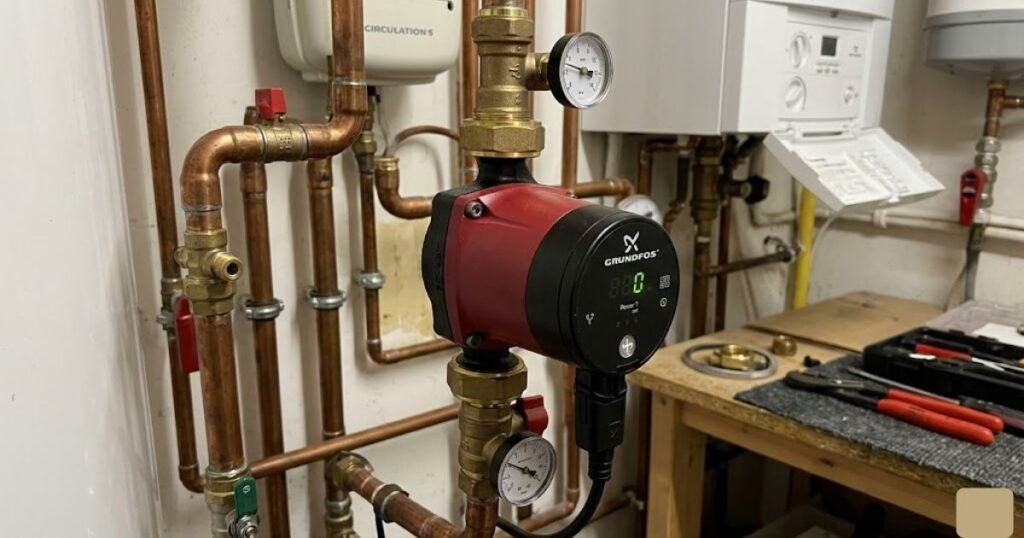
At its most basic level, a Grundfos circulation pump is a small but powerful device installed in your plumbing or heating system to keep water moving. Unlike your main well pump or city water pressure that pushes water out of your taps, a circulation pump is designed to move water through a closed-loop or a specific circuit.
Why Grundfos?
Grundfos is a Danish company that has dominated the pump industry for decades. They are known for “wet rotor” technology, where the motor and pump form an integral unit without a mechanical shaft seal. This design makes them incredibly quiet, leak-resistant, and virtually maintenance-free qualities every homeowner appreciates.
Circulation vs. Recirculation
While the terms are often used interchangeably, there is a slight distinction:
- Circulation Pumps: Often used in hydronic (water-based) heating systems to move hot water through radiators or underfloor heating pipes.
- Recirculation Pumps: Specifically designed for domestic hot water. They ensure that hot water is always “touring” your pipes so it’s available the moment you open a faucet.
How a Grundfos Circulation Pump Works
To understand the magic of a hot water circulation pump, you first have to understand the problem with standard plumbing.
In a typical home, once you turn off the hot water tap, the water remaining in the pipes sits there and cools down. When you turn the tap back on later, you have to flush out all that cooled water before the “new” hot water from the heater can reach you.
The Working Process
- The Loop: The pump creates a loop between your water heater and your furthest fixture.
- Constant Movement: The pump gently pushes the water back to the heater.
- The Heat Check: As the water in the pipes cools, the pump (often triggered by a sensor or timer) pulls the cooled water back to the heater and replaces it with fresh hot water.
- Instant Gratification: Because the hot water is always moving through the pipes near your faucets, the “wait time” is reduced from minutes to mere seconds.
Smart Controls
Modern Grundfos models, like the Grundfos Comfort series, don’t just run 24/7. They use AUTOADAPT technology, timers, or temperature sensors. The pump “learns” your family’s schedule. If you usually shower at 7:00 AM, the pump ensures the water is hot and ready at 6:50 AM, then shuts off when you leave for work to save electricity.
READ MORE: Air to Air Heat Pump vs Air to Water: Differences, Costs, and Best Uses
4 Best Grundfos Circulation Pump Review:
1. Grundfos 52722512 (3-Speed, 1/6 HP)
This is the “heavy lifter” of the group. With a 1/6 Horsepower motor, it offers significantly more “oomph” than your standard residential circulator.
- The Vibe: Best for larger residential systems or light commercial use where you need to move a lot of water through high-resistance piping.
- Key Feature: The 3-speed settings allow you to fine-tune the flow so you don’t over-pressurize your pipes.

- 1/6 horsepower
- Flow Range: 0- 33 GPM, Head Range: 0- 29-Feet
- Motors: 2 Pole, Single Phase, 115-Volt
2. Grundfos 59896155 (UP15-42F SuperBrute)
The UP15-42F is a classic choice for closed-loop hydronic heating. At 1/25 HP, it’s efficient and runs almost silently.
- The Vibe: It’s the “set it and forget it” pump. Reliable, low power consumption, and specifically designed for systems where the water stays inside the pipes (closed-loop).
- Note: The “F” stands for flanged, meaning it bolts onto your piping.

- Sturdy cast iron housing
- Flow range: 0- 15.5 US gpm, head range from 1 to 15-feet
- 2 pole, single phase, 115-volt motors
3. Grundfos 59896341 (UPS15-58FC Super Brute)
You listed this twice because it’s arguably the most popular circulator pump on the planet. It’s the Swiss Army Knife of the plumbing world.
- The Vibe: If you aren’t 100% sure which pump you need for a heating system, this is usually the answer.
- Why it wins: The 3-speed versatility means it can replace a dozen other single-speed models. It’s the industry standard for hydronic heating for a reason.

- Ceramic shaft and radical bearings
- Carbon axial bearing
- Stainless steel rotor can and bearing plate
4. Grundfos UP15-18B5 (59896114) Bronze Pump
This one is fundamentally different from the others because it is an Open System circulator with a Bronze body.
- The Vibe: Designed specifically for potable (drinking) water. Because fresh water contains oxygen that would rust the cast iron pumps mentioned above, you need this bronze version to prevent corrosion.
- The Hookup: Features 1/2″ Sweat Ends, meaning you’ll be soldering this directly onto your copper pipes. Perfect for domestic hot water recirculation loops.

- Built-in motor protection for long life Multiple accessories for a variety of applications Whisper-quiet operation for s…
- Model Number: 59896114
- Item Package Dimensions: 15.24″ L x 19.05″ W x 19.05″ H
Summary Table
| Model | Material | Best Use Case | Key Strength |
| 52722512 | Cast Iron | Large heating systems | High Power (1/6 HP) |
| UP15-42F | Cast Iron | Standard hydronic heating | Energy efficiency |
| UPS15-58FC | Cast Iron | Universal heating replacement | 3-Speed versatility |
| UP15-18B5 | Bronze | Domestic Hot Water | Corrosion resistance |

- Cast Iron Pump
- 1/25 HP, Flow: 0-17 GPM, Head Range: 0-19. 5 Ft.
- Max System Pressure: 145 PSI
Benefits of Grundfos Circulation Pump
Investing in a Grundfos circulator pump offers more than just a luxury experience. It provides tangible benefits that impact your lifestyle and your wallet.
- Eliminate the Wait: The most immediate benefit is comfort. No more shivering in the bathroom waiting for the shower to warm up.
- Massive Water Savings: The average family of four can waste up to 12,000 gallons of water per year just waiting for it to get hot. A recirculation pump stops this waste immediately.
- Energy Efficiency: Grundfos is a pioneer in energy-efficient circulation pumps. Many of their modern permanent magnet motors use less electricity than a common 25-watt light bulb.
- Reduced Sewage Costs: If you pay for water and sewer based on usage, reducing your “down the drain” waste will lower your monthly utility bills.
- Quiet Operation: Grundfos pumps are famous for being whisper-quiet. You won’t hear them humming through the walls or floors.
- Property Value: High-efficiency plumbing upgrades are a great selling point for modern, eco-conscious homebuyers.
READ MORE: Carrier Heat Pump Reviews (2026) — Models, Costs, Pros & Cons
Common Types of Grundfos Circulation Pumps
Not every home needs the same type of pump. Grundfos offers several series tailored to specific needs.
1. Grundfos UP/UPS Series
These are the “workhorses.” They are classic, reliable pumps often used in radiant heating or basic hot water loops. The UPS models usually feature three speed settings, allowing you to manually adjust the flow to match your home’s requirements.
2. Grundfos Comfort (UP 15-10)
This series is specifically designed for domestic hot water recirculation.
- The Basic Model: Runs continuously or on a manual timer.
- The AUTOADAPT Model: The smartest version. It monitors your hot water usage for two weeks and creates a custom schedule for your home.
3. Grundfos Alpha Series
The Alpha is the premium choice for home heating (hydronic) systems. It features a digital display showing power consumption and flow rate. It is incredibly efficient and can automatically adjust its performance based on whether your radiator valves are open or closed.
4. Under-Sink Bypass Models
For homes without a “dedicated return line” (a third pipe specifically for returning water to the heater), Grundfos offers kits that include a bypass valve. This valve is installed under your furthest sink, allowing the pump to use the existing cold water line to send water back to the heater.
Grundfos Circulation Pump Cost Analysis: What to Expect
When budgeting for a Grundfos pump installation, you need to consider the hardware and the labor.
Pump Price Range
- Basic UP/UPS Models: $150 – $300
- Comfort Series (Smart/Timer): $250 – $450
- Alpha Series (High-Efficiency Heating): $350 – $600
Installation Costs
If you hire a professional plumber in the USA, labor costs typically range from $200 to $600, depending on your location and the complexity of your plumbing.
- Simple Swap: If you are replacing an old pump, it might take an hour ($150–$200).
- New Install (Bypass Valve): Installing a pump at the heater and a valve under the sink usually takes 2-3 hours ($300–$450).
- New Dedicated Loop: If you are having a plumber run a brand-new return line through your crawlspace or attic, costs can exceed $1,000.
Total Project Cost
Most homeowners spend between $450 and $950 for a complete, professionally installed hot water recirculation system.
READ MORE: AO Smith vs. Rheem Water Heaters: 2026 Comparison & Expert Reviews
Grundfos Circulation Pumps Installation Guide: A Simplified Overview
While we always recommend hiring a licensed plumber to ensure your installation meets local codes, many DIY-savvy homeowners tackle the installation of a hot water recirculation pump.
Basic Steps for a Recirculation Pump (At the Water Heater)
- Shut Off Everything: Turn off the power (or gas) to your water heater and shut off the main water supply.
- Drain the Lines: Open the lowest faucet in the house to drain the remaining water.
- Disconnect the Outlet: Disconnect the hot water discharge pipe from the top of your water heater.
- Install the Pump: Mount the Grundfos pump onto the hot water outlet. Ensure the arrow on the pump housing points in the direction of water flow (away from the heater).
- Reconnect Piping: Reattach your home’s hot water line to the pump’s outlet.
- Under-Sink Valve (If needed): If you don’t have a return line, install the bypass valve under the sink furthest from the heater. Connect the hot and cold supply lines to the valve.
- Check for Leaks: Turn the water back on slowly and check every connection.
- Purge Air: Run your faucets until the “sputtering” stops.
- Power Up: Plug the pump into a GFI outlet and turn your water heater back on.
Note: Always check local building codes. Some municipalities require a check valve or specific electrical permits for pump installations.
READ MORE: Best Bosch Heat Pump Air Conditioner: Review, Comparison & Buying Guide
How to Use Your Pump Properly for Maximum Savings
A circulation pump for the home is “set and forget,” but a few tweaks can maximize your ROI.
- Use the Timer: If your pump has a manual timer, set it to run only during peak hours (e.g., 6:00 AM – 9:00 AM and 5:00 PM – 10:00 PM). Running it at 3:00 AM when everyone is asleep is just wasting electricity.
- The AUTOADAPT Advantage: If you have a smart Grundfos model, let it do the work. It will naturally adjust to your changing habits, like sleeping in on weekends.
- Insulate Your Pipes: To get the most out of your pump, add foam insulation to your hot water pipes. This keeps the heat in the water as it circulates, meaning the pump has to work less to maintain temperature.
- Temperature Settings: If your pump has a thermostat, set it to roughly 105°F–115°F. You want the water to be warm, but circulating scalding hot water 24/7 will lead to higher energy bills.
Grundfos Circulation Pumps Troubleshooting: Common Issues and Fixes
Even the best engineering can encounter hiccups. Here is how to handle common Grundfos pump troubleshooting scenarios.
| Issue | Potential Cause | Homeowner Fix | When to Call a Pro |
| Noisy/Gurgling | Air trapped in the pump. | Loosen the “bleed screw” on the front (if applicable) to let air out. | If noise sounds like “marbles” (bearing failure). |
| Pump Not Turning On | No power or tripped GFI. | Check the outlet and circuit breaker. Ensure the timer is in the “ON” position. | If the motor is hot to the touch but not spinning. |
| No Hot Water Improvement | Bypass valve is clogged or pump is too small. | Check the screens in the under-sink valve. Ensure the pump speed is on “High.” | If the pump runs but water stays cold. |
| Leaking at Connections | Loose fittings or worn gaskets. | Gently tighten the union nuts with a wrench. | If water is leaking from the motor housing. |
| Vibration | Improper mounting. | Ensure the pump is supported and not hanging solely by the pipes. | If vibration persists after securing pipes. |
READ MORE: Best Cold Climate Heat Pump Review 2026: Top Picks & Buying Guide
Grundfos Circulation Pumps Maintenance Tips
Grundfos pumps are “wet rotor” designs, meaning the water they pump actually lubricates the internal parts. Because of this, they require very little maintenance. However, you should:
- Inspect Yearly: Look for signs of “crusting” or white mineral buildup around the joints, which indicates a slow leak.
- Exercise the Pump: If you turn the pump off during a long vacation, it may “seize” due to mineral buildup. Upon returning, ensure it spins freely.
- Check the Timer: Power outages can sometimes reset manual timers. Periodically check that the clock matches the actual time.
- Monitor Performance: If you notice it’s taking 30 seconds longer for hot water than it used to, your bypass valve or internal check valve might need a quick cleaning.
Circulation Pumps Comparison Table: Grundfos vs Taco vs Wilo vs Bell & Gossett
How does Grundfos stack up against other brands like Taco or Wilo?
| Feature | Grundfos | Taco | Wilo | Bell & Gossett |
| Best For | Smart Features & Efficiency | Ease of DIY Install | Heavy Duty / Commercial | Industrial Durability |
| Energy Efficiency | Industry Leading | High | Excellent | Moderate |
| Noise Level | Extremely Quiet | Very Quiet | Quiet | Moderate |
| Smart Tech | AUTOADAPT (Superior) | SmartPlug (Good) | Stratos Tech | Standard Controls |
| Price Range | $200 – $600 | $150 – $450 | $250 – $700 | $300 – $800 |
| Strength | Reliability & Intelligence | Broad US availability | German engineering | Robust construction |
| Drawback | Higher upfront cost | Fewer “AI” features | Harder to find in US | Often “overkill” for homes |
READ MORE: Fujitsu Heat Pump Reviews (2026): Models, Costs & Real-World Pros & Cons
Who Should Buy a Grundfos Circulation Pump?
Is this upgrade right for you? You are an ideal candidate if:
- You have a “Large Footprint” Home: If your water heater is in the garage and your master bathroom is on the second floor at the opposite end of the house.
- You are on a Drought-Prone Area: If you live in states like California, Arizona, or Texas, saving 12,000 gallons of water is a matter of civic responsibility as much as personal savings.
- You have a Large Family: Morning rushes are stressful enough. Having instant hot water for back-to-back showers is a game-changer.
- You use Radiant Floor Heating: Grundfos Alpha pumps are essentially mandatory for getting the best performance out of a modern hydronic floor system.
- You Value Longevity: If you want to install a pump once and not think about it for the next 10–15 years.
Grundfos Circulation Pumps Buying Tips:
Before you hit “Add to Cart,” keep these three things in mind:
- Check Your Pipe Size: Most residential lines are 3/4″ or 1/2″. Ensure the pump flanges or unions match your existing plumbing.
- Check for a Return Line: If you don’t have a dedicated return line, you must buy a kit that includes a bypass valve (like the Grundfos Comfort PM series with the valve).
- Look for the “Check Valve”: Many Grundfos pumps come with an internal check valve to prevent “backflow” (where cold water gets into your hot lines). If the model you want doesn’t have one, you’ll need to buy it separately.
Final Verdict
A Grundfos circulation pump is one of those rare home improvements that pays you back in three different ways: it saves you money on utilities, it protects the environment by conserving water, and it adds a daily touch of luxury to your life.
While the upfront Grundfos pump cost might be slightly higher than some budget brands, the combination of whisper-quiet operation, “set-it-and-forget-it” reliability, and intelligent AUTOADAPT technology makes it the most cost-effective choice in the long run. Whether you are tired of waiting for your morning shower or looking to slash your water waste, Grundfos offers a professional-grade solution for the modern American home.
FAQ Section
What does a Grundfos circulation pump do?
It circulates water through your home’s plumbing or heating pipes. In a hot water system, it ensures that hot water is always present near your faucets, eliminating the wait time and preventing water waste.
How much does a Grundfos circulation pump cost?
The pump itself typically costs between $200 and $600. When you include professional installation, most homeowners spend between $450 and $950 total.
Is a Grundfos circulation pump worth it for a home?
Yes. For most families, the pump pays for itself through reduced water and sewage bills within 3 to 5 years. Beyond the money, the convenience of “instant” hot water significantly improves daily comfort.
How long does a Grundfos circulation pump last?
A well-maintained Grundfos pump typically lasts 10 to 15 years. Because they use the water they pump for lubrication, they have very few moving parts that wear out over time.
Why is my Grundfos circulation pump not working?
Common reasons include a tripped circuit breaker, air trapped in the pump housing (causing an airlock), or a seized motor due to mineral buildup. Most of these issues can be resolved through basic troubleshooting like bleeding the air or checking the power supply.