Whether you are trying to take the chill out of a drafty basement, looking to warm up a detached workshop, or seeking a reliable heat source that continues working even when a winter storm knocks out the local electrical grid, a high-quality indoor natural gas heater can be a total game-changer. These compact, hard-working appliances deliver immediate, intense warmth exactly where you need it most, allowing you to turn down your main home thermostat and save substantial money through zone heating.
In this comprehensive homeowner guide, we will break down exactly how these space heaters work, look closely at the different heating styles available, outline critical safety guidelines, and review the top models on the market today so you can find the perfect fit for your household. Lets deep dive into “Best 5 Natural Gas Heater for Home: Review, Comparison & Buying Guide”
READ MORE: Dyna-Glo Heater Review: Best Models for Homes, Garages & Cabins
What Is a Natural Gas Heater for Home?
At its most fundamental level, a natural gas space heater is a self-contained appliance designed to burn utility-supplied natural gas to generate localized heat. Unlike a central furnace that blows hot air through dozens of yards of dusty ductwork, a space heater sits directly inside or adjacent to the room it is heating, converting fuel directly into usable warmth with virtually zero distribution loss.
When you turn on the heater, gas flows through a safety valve into a burner assembly, where it is ignited by either a mechanical piezo spark or a battery-powered electronic ignition. As the clean-burning natural gas combusts, it produces heat that is distributed into your living space via one of two primary methods: convection or radiation.
The Mechanics of Heat: Understanding Your Options
Choosing the right type of heat delivery makes a massive difference in how comfortable your room will feel. When shopping for the best natural gas heater for home, you will generally encounter four distinct technology labels:
1. Convection Heaters:
These units work by heating the air directly around them. As the air warms, it expands, becomes lighter, and naturally rises toward the ceiling. Cooler air is drawn in from the floor to take its place, creating a continuous, looping circulation pattern known as a convection current. Convection models excel at raising the overall temperature of an entire enclosed room uniformly, making them great for spaces where people are moving around.
2. Radiant Heaters:
Think of radiant heat like the warmth of the sun on a crisp autumn day. Instead of heating the air, radiant heaters use gas to heat internal ceramic plaques until they glow white-hot. These plaques emit infrared light waves that travel silently through the air until they strike an object, a wall, or a human body. The moment those waves touch you, you feel instant warmth, even if the surrounding air is still cool.
3. Infrared Heaters:
This is simply another term for a radiant heater. Because infrared energy bypasses the air entirely and warms physical surfaces directly, it is incredibly efficient for drafty rooms, spaces with high ceilings, or uninsulated areas where warm air would immediately escape through walls or windows.
4. Blue-Flame Heaters:
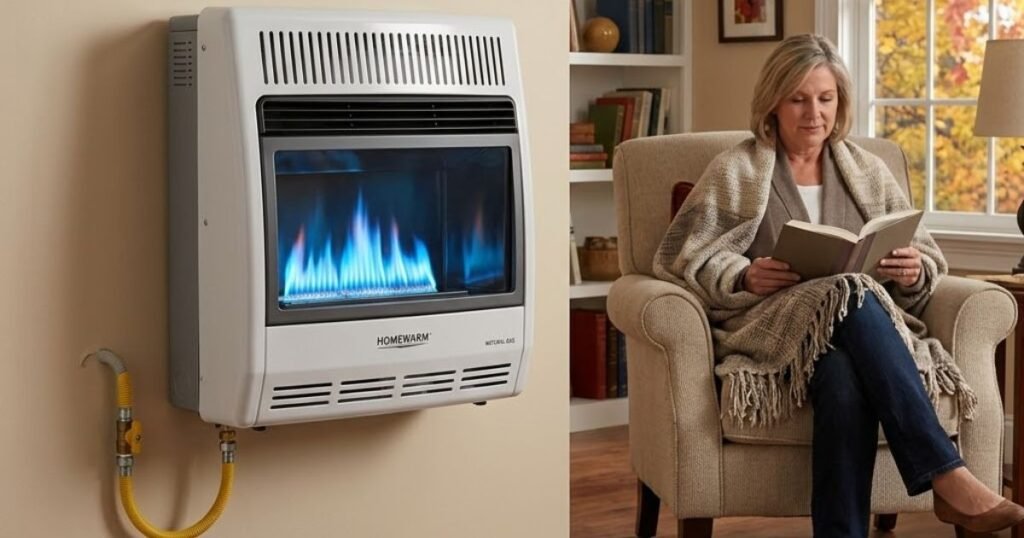
A variation of convection heating, these units feature a visible blue flame that burns inside the cabinet. They heat the air directly and circulate it throughout the room. Blue-flame models are generally ideal for insulated spaces because they rely on warming the ambient air mass rather than projecting directional heat waves.
The Rise of the Vent-Free Gas Heater
As you browse your options, you will frequently notice the term vent-free gas heater (also called an unvented heater). Traditional gas appliances require a dedicated chimney, flue, or pipe drilled through an exterior wall to exhaust combustion byproducts outside.
A vent-free model, by contrast, is engineered to burn natural gas at a near-perfect efficiency rate of 99.9%. Because the combustion is so clean, these units do not require an external vent or chimney. All the heat generated stays inside your home, rather than escaping up a pipe. This makes them significantly easier and cheaper to install, making them an attractive option for DIY enthusiasts, seniors looking to avoid major home renovations, and families seeking a straightforward heating upgrade.
READ MORE: EdenPURE Heaters Review 2026 — Prices & Comparison
Benefits of Using a Natural Gas Heater at Home
Investing in a dedicated gas heater for house or zone heating offers major advantages over electric units or central systems. Here is why U.S. homeowners make the switch:
- 4x the Heating Power: Standard electric space heaters are capped by 120-volt outlets at roughly 5,120 BTUs. A natural gas heater for home use effortlessly delivers 10,000 to 20,000 BTUs, heating your room almost instantly.
- Blackout-Proof Warmth: When winter storms knock out the power grid, electric heat pumps and central furnaces go dead. Many vent-free gas heaters use mechanical or battery ignitions, running 100% grid-independent to keep your family safe.
- Lower Energy Bills: Natural gas is historically much cheaper than electricity. By dropping your central thermostat to 60°F and using an energy-efficient gas heater to target just the room you are using, you can slash monthly heating costs.
- No Chimney Required: Because vent-free models don’t need a chimney flue or ductwork, they are incredibly easy to install anywhere. They are perfect for basements, uninsulated garages, workshops, and cabins.
5 Best Natural Gas Heaters for Home
To help you cut through the marketing jargon, we have analyzed and reviewed five of the most popular, reliable, and highly rated natural gas heating units available for U.S. homeowners. These models represent a fantastic mix of sizes, heating technologies, and price points.
1. ProCom 10,000 BTU Wall or Floor-Mount Indoor Natural Gas Vent-Free Convection Heater
This ultra-compact unit is the definitive best choice for smaller rooms, home offices, or anyone who wants a straightforward, reliable source of light supplemental heat without an overwhelming footprint. Because it uses convection technology, it slowly and evenly raises the temperature of the air throughout the space without blasting harsh directional heat. It requires absolutely no electrical hookup, features a simple manual low/high knob, and includes a built-in oxygen depletion safety sensor for complete peace of mind.
- Key Specifications:
- BTU Output: 10,000 BTUs
- Heating Style: Convection (Blue-Flame style air circulation)
- Coverage Area: Up to 500 sq. ft.
- Electricity Required: No
2. Dyna-Glo 12,000 BTU Wall-Mount Indoor Natural Gas Vent-Free Radiant Heater
If you prefer the sensation of sun-like, immediate warmth rather than waiting for air to circulate, this radiant model from Dyna-Glo is an exceptional pick for small-to-medium spaces. It features a built-in thermostat control dial, allowing the heater to automatically cycle on and off to maintain your preferred comfort level rather than requiring manual adjustments. It comes with a solid 1-year limited warranty and mounts securely to your wall, keeping floor space completely clear.
- Key Specifications:
- BTU Output: 12,000 BTUs
- Heating Style: Radiant / Infrared Plaques
- Coverage Area: Up to 300 sq. ft.
- Electricity Required: No
3. Dyna-Glo 18,000 BTU Wall-Mount Indoor Natural Gas Vent-Free Radiant Heater
This model is the perfect middle-ground option for homeowners who need a serious boost in heating capacity but do not want to leap to a massive, bulky appliance. Packing 18,000 BTUs of radiant power, it instantly warms physical objects and people within its line of sight. The built-in thermostat lets you set your ideal temperature range, and its completely battery-free and cord-free design ensures it will provide uncompromised warmth during major power outages.
- Key Specifications:
- BTU Output: 18,000 BTUs
- Heating Style: Radiant / Infrared Plaques
- Coverage Area: Up to 700 sq. ft.
- Electricity Required: No
4. Dyna-Glo 20,000 BTU Wall or Floor-Mount Indoor Natural Gas Vent-Free Convection Heater
Widely regarded as one of the most balanced, versatile, and high-performing all-around choices on the market, this 20,000 BTU giant is built to anchor larger rooms, open-concept living areas, or chilly basements. It operates via convection, spreading warmth across broad floor plans up to 700 square feet. It comes ready for floor use with base feet or can be mounted directly to a wall. While it works perfectly without electricity, it supports an optional fan accessory (sold separately) if you eventually want to blast air even faster across the room.
- Key Specifications:
- BTU Output: 20,000 BTUs
- Heating Style: Convection
- Coverage Area: Up to 700 sq. ft.
- Electricity Required: No (Optional fan accessory uses standard 120V)
5. ProCom 18,000 BTU Wall or Floor-Mount Indoor Natural Gas Vent-Free Radiant Heater
For homeowners seeking a high-capacity zone heater capable of cutting through the deep chill of wide, uninsulated, or drafty areas, this ProCom radiant unit is a stellar investment. Utilizing three heavy-duty ceramic infrared plaques, it throws an impressive amount of direct heat across rooms up to 950 square feet under optimal conditions. It balances high-output performance with a space-saving design that can rest safely on the included floor legs or attach cleanly to your drywall.
- Key Specifications:
- BTU Output: 18,000 BTUs
- Heating Style: Radiant / Infrared
- Coverage Area: Up to 950 sq. ft.
- Electricity Required: No
READ MORE: Best Salamander Heaters of: Top Picks, Reviews & Comparison
Comparison Table of the 5 Best Natural Gas Heaters
To make your shopping process as seamless as possible, we have compiled the vital specifications of these top five models into a clean, easy-to-scan comparison layout. All “Best For” designations represent our targeted editorial recommendations based on real-world capabilities.
| Product Name | BTU Output | Heating Style | Coverage Area | Key Feature | Best For (Editorial Recommendation) | Overall Pick Rating |
| ProCom 10K BTU | 10,000 | Convection | Up to 500 sq. ft. | No electricity needed, ultra-compact design | Small rooms, tiny home offices, or light supplemental zone heat | Best Budget & Small Space Pick |
| Dyna-Glo 12K BTU | 12,000 | Radiant | Up to 300 sq. ft. | Built-in thermostat, radiant infrared plaques | Small-to-medium rooms where steady, automated warmth matters | Best Thermostatic Control for Small Rooms |
| Dyna-Glo 18K BTU | 18,000 | Radiant | Up to 700 sq. ft. | High-performance infrared panels, wall-mount | Homeowners wanting stronger radiant warmth without a huge footprint | Best Mid-Sized Radiant Heater |
| Dyna-Glo 20K BTU | 20,000 | Convection | Up to 700 sq. ft. | Dual mounting options, supports optional blower fan | Large living rooms, basement suites, and open-concept floor plans | Top Overall Value & Balanced Choice |
| ProCom 18K BTU | 18,000 | Radiant | Up to 950 sq. ft. | Heavy-duty ceramic tiles, broad heat projection | Wide areas, drafty spaces, and fast zone heating | Best for Wide, Drafty Spaces |
READ MORE: Best Portable Heaters
How to Choose the Right Natural Gas Heater for Your Home
Purchasing a natural gas heater for home use involves evaluating several crucial technical and physical factors. Choosing blindly can lead to a unit that either leaves your room freezing or overwhelms the space with too much heat. Here is a practical, step-by-step breakdown of how to choose the right model for your specific living situation.
Calculating BTU Output and Room Size
BTU stands for British Thermal Unit, which is the standard measurement of heating energy. As a general baseline rule of thumb for standard insulated homes with average 8-foot ceilings, you will need roughly 20 to 40 BTUs of heating power per square foot of space.
- Small Rooms (150–300 sq. ft.): Look for a unit rated between 6,000 and 12,000 BTUs.
- Medium Rooms (300–600 sq. ft.): A heater pulling 10,000 to 18,000 BTUs will hit the sweet spot.
- Large Rooms (600–1,000 sq. ft.): Step up to a heavy-duty 20,000 to 30,000 BTU unit.
Pro Tip: Do not simply buy the largest heater available thinking it will perform better. An oversized vent-free heater will warm a small room so quickly that it will constantly cycle off, preventing the room from maintaining a stable, comfortable equilibrium and potentially causing a heavy buildup of ambient moisture.
Placement: Wall-Mounted vs. Floor-Mounted
Deciding how your heater will sit in your home impacts both room flow and safety:
- Wall-Mounted Gas Heater: These units screw directly into wall studs using specialized brackets. This keeps the heater completely elevated off your floorboards, making it an excellent layout for households with curious toddlers, roaming pets, or seniors who want to eliminate tripping hazards.
- Floor-Mounted Heaters: These utilize sturdy plastic or metal base legs that rest flat on the ground. They give you a tiny bit more placement flexibility if you ever need to service the gas line behind the unit, but they do require dedicated floor real estate and must be positioned away from foot traffic.
Radiant vs. Convection Heat Dynamics
As established earlier, ask yourself how you want to feel the warmth. If you spend most of your time sitting directly in front of the heater in a fixed spot (like a favorite armchair or at a basement workbench), a radiant model will provide deep, immediate, personal comfort. If you want the entire room to feel like a standard centrally heated space where the actual air temperature is uniformly elevated, choose a convection model.
Thermostat Control vs. Manual Adjustments
Basic space heaters feature simple manual control valves (typically labeled Off, Pilot, Low, Medium, High). You have to manually walk over and turn the knob up or down when you get too hot or cold. Upgrading to a model with an integrated mechanical or digital thermostat allows the appliance to sample the room’s air temperature and automatically modulate the flame size or cycle the burner on and off to maintain an exact comfort level completely hands-free.
Ignition Mechanics
Most standard indoor gas space heaters rely on a Piezo ignition, which creates a mechanical spark when you firmly depress a button (similar to a standard backyard gas grill). It requires absolutely zero outside power. Other premium models feature battery-powered electronic ignitions that generate a rapid, continuous stream of sparks at the push of a button, making lighting the pilot light a bit easier for individuals with limited hand strength or arthritis.
Checking Local Codes and Installation Rules
Before hitting the buy button, it is absolutely essential to check your specific state and local municipal building codes. While vent-free gas appliances are entirely legal across the vast majority of the United States, they are strictly banned or carry narrow operational restrictions in certain jurisdictions (such as the state of California, portions of Texas, or inside narrow bedrooms and bathrooms in specific cities). Always verify your local regulations before finalizing your purchase.
READ MORE: Best Heater for Large Room: Top Picks, Reviews & Comparison
Safety Tips Every Homeowner Should Know
Modern indoor gas heaters are highly safe home heating options when used correctly. Here is a fast, smart breakdown of the core safety essentials and official guidelines:
- Built-In ODS Protection: Every reputable indoor natural gas heater includes an Oxygen Depletion Sensor (ODS). If room oxygen drops below a safe level (from 20.9% down to ~18%), the ODS instantly cuts the gas supply before carbon monoxide can build up.
- Federal Ventilation Rules: The CPSC and EPA advise keeping rooms well-ventilated, ensuring correct unit sizing, and avoiding using unvented heaters as a primary, continuous heat source.
- Fresh Air Factor: Unvented heaters need air to burn cleanly. Ensure your room meets the manufacturer’s size requirements, and crack a window slightly if your home is tightly sealed.
- Daylight Use Only: Never leave the heater running while you sleep or when you are out of the house. Treat it strictly as a supplemental daytime heat source.
- The 3-Foot Rule: Keep a strict 3-foot clearance zone around the heater. Keep curtains, blankets, furniture, and paper well away from the hot front grille.
Critical Safety Checklist
- Professional Install: Always hire a licensed gas plumber to run and pressure-test your lines.
- CO Alarms: Place a dedicated carbon monoxide detector with battery backup in the same room.
- Dust Control: Use compressed air annually to blow dust and pet hair out of the pilot assembly.
- Soap Test: Never use a flame to check for gas leaks; brush soapy water over joints and look for bubbles.
Best Rooms and Uses for a Natural Gas Heater
A natural gas space heater is a highly specialized tool. While it excels in many configurations, understanding its ideal home geography ensures you get maximum utility out of your investment.
- Living Rooms and Family Dens: This is the absolute premier environment for a supplemental zone heater. Because your family spends the vast majority of their awake hours gathered here, warming this room while lowering your central thermostat yields the highest possible financial return on your utility bills.
- Basements: Basements are notoriously difficult for central HVAC systems to heat evenly due to subterranean concrete walls and the natural reality that heat rises. A wall-mounted gas heater can easily cut through the damp, heavy cold of a finished basement suite.
- Garages and Dedicated Workshops: Trying to work on DIY projects, woodworking, or vehicles in an uninsulated garage during January can be miserable. A high-output radiant heater throws instant warmth directly onto your tools and body, turning a freezing garage into a year-round workspace.
- Vacation Cabins: For rustic cabins or off-grid properties that feature an active utility natural gas or connected propane tank hookup, a non-electric space heater provides a bulletproof way to rapidly bring the building up to a livable temperature the moment you arrive for a winter weekend.
READ MORE: Gas Heater for Home Not Working? Causes, Fixes & Pro Tips
Pros and Cons of Indoor Natural Gas Heaters
To wrap your head around whether this technology aligns with your household lifestyle, let’s look at a straightforward summary of the key advantages and potential drawbacks.
The Pros (Advantages)
- Drastically Lower Running Costs: Natural gas is historically much cheaper than electricity per BTU across most U.S. markets, making these highly energy-efficient gas heater systems.
- True Grid Independence: Unvented, non-electric models will keep your living space warm and safe during severe winter power outages.
- Zero Thermal Distribution Loss: By delivering heat directly into the target room without ductwork, 100% of the energy you pay for stays in the room.
- Simple, Low-Cost Installation: Vent-free models do not require cutting major chimney holes through your roof or exterior siding.
- Long Appliance Lifespan: With no complicated mechanical compressors, heavy blowers, or delicate circuit boards to burn out, a basic gas space heater can easily last for decades with basic care.
The Cons (Drawbacks)
- Inherent Moisture Production: Water vapor is a natural byproduct of clean gas combustion. If run continuously in an exceptionally tight room, it can cause condensation to form on windows.
- Strict Regional and Local Regulations: Certain states or individual cities entirely prohibit unvented units or restrict them from being installed in bedrooms.
- Requires an Active Natural Gas Line: If your home is fully electric and does not already have a utility gas meter or a dedicated outdoor propane tank, the cost of running a brand-new gas line from the street can be prohibitive.
- Manual Maintenance Required: You must proactively keep the internal burner free of house dust, lint, and pet hair to ensure the fuel burns perfectly clean.
Frequently Asked Questions
What size natural gas heater do I need for my home?
To find the right size, multiply your room’s length by its width to get the square footage. Multiply that by 20 for a well-insulated space, or up to 40 for a drafty room. This gives you the required BTUs. For example, a 400-square-foot room needs roughly 10,000 to 12,000 BTUs.
Are natural gas heaters safe to use indoors?
Yes, modern units are highly safe when operated properly. U.S. models feature an Oxygen Depletion Sensor (ODS) that shuts off the gas if oxygen levels dip. For maximum safety, always hire a professional for installation, keep a 3-foot clearance from objects, and install a reliable carbon monoxide detector nearby.
Do natural gas heaters use electricity?
Many top vent-free models require zero electricity. They use mechanical piezo igniters and millivolt thermostats to heat your home completely grid-free, making them perfect for power outages. Some units support optional electric blower fans to spread heat faster, but the core heating element will still work fine without power.
What is the difference between radiant and convection natural gas heaters?
Radiant (infrared) heaters emit direct warmth that instantly heats physical objects and people in their direct line of sight, bypassing the air. Convection heaters warm the ambient air itself, creating a continuous circulation loop that evenly and gradually elevates the overall temperature throughout the entire enclosed room.
Can a natural gas heater lower my heating bill?
Yes, using “zone heating” can cut costs dramatically. By using an efficient heater in your main living space, you can lower your central furnace thermostat to 60°F. Warming only the room you are actively using saves a massive amount of energy compared to heating an entire empty house all night.
Final Verdict: Which Natural Gas Heater Wins?
Finding the absolute best natural gas heater for home use ultimately comes down to matching your specific square footage with your preferred heat style.
- If you are looking to heat a small home office, bedroom where allowed, or compact spare room, the ProCom 10,000 BTU Convection Heater is a phenomenal, space-saving, and highly budget-friendly choice.
- For medium-sized family rooms where you want hands-free, automated comfort that stays perfectly level all evening, the Dyna-Glo 12,000 or 18,000 BTU Radiant Heaters with integrated thermostatic dials deliver incredible performance and deep, comforting warmth.
- If you need to conquer a wide, open-concept floor plan, a cold concrete basement, or a drafty double garage, the Dyna-Glo 20,000 BTU Convection Heater represents the absolute pinnacle of all-around value, heating capacity, and structural versatility.
By investing in a high-quality, modern natural gas space heater, you are securing a highly cost-effective heating strategy, protecting your household against unexpected power grid failures, and creating a warm, welcoming environment for your family all winter long. Always prioritize professional installation, respect your local building codes, and look forward to a cozy, energy-efficient winter season!