A gas heater for home not working can turn a normal winter day into a stressful one fast. One moment your house feels comfortable, and the next you are dealing with cold rooms, weak airflow, or a furnace that will not start at all. For families, seniors, and first-time homeowners, that kind of problem can feel overwhelming.
The good news is that not every heating issue means a major repair. Sometimes the cause is simple, like a thermostat setting, a dirty filter, or a tripped breaker. Other times, the problem is more serious and should be handled by a licensed HVAC technician.
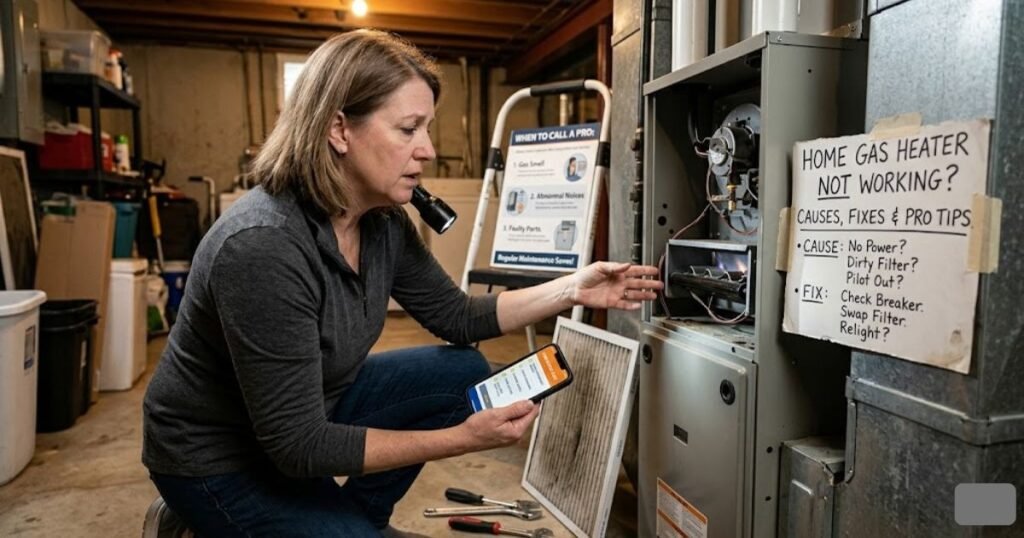
This guide walks you through the most common causes of a gas heater for home not working, the safest checks to do first, simple troubleshooting steps, and the warning signs that mean it is time to call in a professional. Lets deep dive into “Gas Heater for Home Not Working? Causes, Fixes & Pro Tips”
READ MORE: Gas Water Heater Replacement Cost (2026) — What Homeowners Pay & Why
Why a Gas Heater for Home May Stop Working
Modern gas furnaces and heating systems are highly efficient, but they are also complex machines. They rely on a precise balance of electricity, gas flow, air circulation, and safety switches to keep your home warm. If even one of these elements is out of sync, the entire system will shut itself down as a protective measure.
Understanding the common culprits behind a furnace not working can demystify the equipment in your basement, attic, or utility closet. Here are the ten most common reasons your system might be failing.
1. Thermostat Issues
Think of your thermostat as the brain of your entire heating system. If the brain isn’t sending the correct signals, the body won’t move. Thermostats can fail for simple reasons: dead batteries, loose wiring, incorrect settings, or internal dust buildup. If a digital thermostat screen is blank, the heater has no way of knowing that your home is dropping to freezing temperatures.
2. Power Disruptions
Even though the heater uses gas, it still needs electricity for the controls, blower, and ignition system. A tripped breaker or switched-off furnace power switch can stop the system completely.
3. Clogged and Dirty Air Filters
A clogged filter can restrict airflow, make the system overheat, and cause the heater to shut down early or blow weak air.
4. Pilot Light or Ignition Failure
Older gas heaters rely on a small, continuously burning flame called a standing pilot light to ignite the main burners. Newer systems use electronic igniters (like a hot surface igniter or an intermittent pilot) to spark the flame when heat is requested. If you are experiencing a gas heater pilot light problem or a cracked electronic igniter, the gas will never ignite.
5. Gas Supply Interruptions
Your heater needs a steady, uninterrupted stream of natural gas or propane to create a flame. If the main gas valve to your home was accidentally shut off, or if the individual gas cock on the furnace line is closed, your unit cannot ignite.
6. Blocked Intake or Exhaust Vents
High-efficiency modern furnaces vent their exhaust gasses out through plastic PVC pipes that run through the side of your house rather than up a traditional chimney. These intake and exhaust pipes can easily become blocked by bird nests, leaves, ice, or drifting snow. When the system detects that dangerous exhaust gasses cannot escape, a safety pressure switch will stop the furnace from running to prevent carbon monoxide poisoning.
7. Faulty Safety Switches
Your heating system is packed with safety switches designed to protect your household. The furnace door switch, for instance, cuts off all power if the main access panel isn’t completely secure. Rollout switches detect if flames are escaping the combustion chamber, and pressure switches check for proper venting. If these switches wear out or detect a genuine safety hazard, they will prevent operation.
8. Worn Blower Motor Components
The blower motor is the muscle of your HVAC system. It spins a large fan wheel to pull cool air out of your rooms, force it across the hot furnace heat exchanger, and push it back into your living space. If the motor’s capacitor fails, or if the motor windings burn out, you might hear a low humming sound, but no air will move through your vents.
9. Dirty or Blocked Burners
Over time, the metal burners that release the gas flames can accumulate dust, rust flakes, and carbon soot. When burners get dirty, they cannot mix gas and air properly, leading to incomplete combustion. This often manifests as a heater that struggles to stay lit, makes a popping noise when starting, or shuts down within seconds of ignition because the flame sensor cannot read a clean flame.
10. Damaged Outdoor Components
If your home relies on a hybrid heat pump system (where an outdoor unit works alongside an indoor gas furnace), physical damage to the outdoor coil can cause indoor heating problems. Freezing sleet, heavy snow buildup, or a thick layer of autumn leaves can choke the outdoor unit, forcing your system to struggle or fail to transition over to emergency gas heat smoothly.
READ MORE: Why Is My Gas Water Heater Pilot Light Yellow? Causes & Fixes
First Things to Check When Your Gas Heater Is Not Working
Before you start pulling out tools or calling for local gas heater repair, run through this quick, low-stress checklist. Many homeowners successfully resolve their heating issues right at this stage without spending a dime.
- Check that the thermostat is set to Heat
- Make sure the temperature is set above the current room temperature
- Replace thermostat batteries if needed
- Confirm the furnace or heater has power
- Check the circuit breaker in your electrical panel
- Make sure the gas valve is open
- Inspect the air filter for dirt or clogging
- Look for error lights or codes on the unit
- Listen for clicking, humming, rattling, or repeated starting sounds
- Make sure vents and registers are not blocked by furniture, rugs, or dust
These checks may sound basic, but they solve a surprising number of home gas heater troubleshooting problems.
Safe DIY Troubleshooting Steps
If your initial checklist points to a specific minor issue, you can safely attempt these basic maintenance tasks. Remember, DIY furnace care is all about knowing your personal limits and putting safety first.
Swap Out the Thermostat Batteries
If your digital thermostat uses batteries, a low charge can cause it to lose connection with the furnace or send erratic signals. Pop the thermostat faceplate off its wall bracket most styles slide upward or snap forward cleanly. Replace the old batteries with fresh, high-quality alkaline batteries (typically AA or AAA). Avoid rechargeable batteries, as they often don’t provide the stable voltage required by sensitive modern wall units.
Change Your Forced-Air Filter Correctly
If your air filter is filthy, replace it using this safe sequence:
- Turn your thermostat to the OFF position so the system doesn’t try to kick on while you are working.
- Locate the filter slot between the cold air return duct and the main furnace cabinet.
- Slide out the dirty filter and notice which way the printed arrows on the cardboard frame are pointing. Those arrows show the direction of airflow they should always point toward the furnace engine, not away from it.
- Slide your new filter in, making sure the arrows match the correct direction. Secure any access doors tightly.
READ MORE: Best Tankless (Non-condensing) Gas Water Heater Reviews & Comparison
Clear Obstructions from Outside Exhaust Vents
Put on your coat and walk to the side of your home where your furnace exhaust pipes exit. Ensure there isn’t a pile of snow drifted over the pipes, heavy autumn leaves sucked into the intake screen, or ice icicles forming over the opening. Carefully clear any debris away from the pipe openings. Ensure you never spray water or stick objects deeply inside the pipes while cleaning them.
Clean a Dirty Flame Sensor (For Experienced DIYers)
If your heater turns on, ignites a beautiful blue flame, but instantly shuts off after 2 to 5 seconds, you likely have a dirty flame sensor. This is a small, thin, curved metal rod located right in the path of the burner flames. Over time, a microscopic layer of white silica and carbon buildup coats the rod, preventing it from conducting electricity to prove a flame is present.
To clean it safely:
- Turn off the electrical breaker powering the furnace.
- Shut off the gas valve leading into the unit.
- Remove the upper access panel of the furnace.
- Locate the flame sensor (usually held in place by a single hex screw on the opposite side of the electronic igniter).
- Remove the screw, gently pull the sensor out, and use a small piece of light emery cloth or clean steel wool to gently rub the metal rod. You aren’t trying to grind the metal down; you are simply scraping away the invisible white coating until the metal looks bright and clean.
- Wipe it with a dry paper towel, reinstall it, screw it back down, replace the door panel, and restore power and gas.
Relight a Standing Pilot Light Safely
If you have an older furnace with a permanent standing pilot light that has blown out due to a draft, look at the inside of your furnace door panel for a detailed sticker containing step-by-step instructions.
The process generally looks like this:
- Turn your thermostat down low so the system won’t try to activate fully.
- Locate the gas valve control knob inside the unit (it will have markings for ON, OFF, and PILOT).
- Turn the knob to the OFF position and wait a full 5 to 10 minutes. This is critical to let any unburnt gas safely dissipate into the air.
- Turn the knob to the PILOT position.
- Press down firmly on the knob (or hold down the separate red pilot button next to it). This manually forces a tiny amount of gas to flow directly to the pilot burner assembly.
- While holding the button down, use a long grill lighter to light the pilot burner.
- Continue holding the button down for 30 to 60 seconds after the flame lights. This gives the thermocouple (the thin metal temperature probe next to the flame) time to heat up. Once hot, the thermocouple opens an internal safety valve keeping the gas flowing.
- Slowly release the knob. If the flame stays lit, turn the main knob from PILOT to the ON position. Your furnace is now ready to run.
CRUCIAL HOMEOWNER SAFETY REMINDER: If you smell a strong gas odor resembling rotten eggs or sulfur anywhere near your heating equipment, do not attempt any DIY troubleshooting. Do not flip any light switches, do not unplug appliances, and do not try to shut off the gas valve inside. These actions can create a tiny electrical spark capable of igniting gas vapor. Gather your family and pets, exit the house immediately into the fresh air, and call 911 or your local gas utility provider from your cell phone once you are safely away from the property.
READ MORE: Best Salamander Heaters of 2026: Top Picks, Reviews & Comparison
When the Problem Is More Serious
Some heating problems are signs that the system needs professional attention.
Call a professional if you notice:
- The heater shuts down again and again
- The furnace will not start after basic checks
- There is a strong gas smell
- The pilot flame is weak, yellow, or keeps going out
- You hear loud banging, rattling, or scraping
- The furnace runs but does not heat the house properly
- There is smoke, soot, or burning odor that seems unusual
- Error codes keep returning after you reset the system
These symptoms can point to combustion issues, gas supply trouble, electrical faults, or airflow problems that need trained diagnosis. This is especially important for HVAC repair for homeowners because gas appliances should never be guessed at.
Common Gas Heater Problems and What They Mean
To help you quickly diagnose your indoor heating problems, let’s map out specific operational symptoms to their highly probable technical causes. This will give you confidence when discussing the issue with a repair technician.
| What You Observe (The Symptom) | What is Likely Happening Inside (The Cause) | What Needs to Be Done (The Solution) |
| Heater will not start at all; total silence. | No electrical power or wrong thermostat settings. | Check circuit breaker, ensure furnace switch is ON, replace thermostat batteries. |
| Heater starts up, but blows cold air continuously. | Burners are failing to ignite; system is running fan to clear air. | Check gas supply line, clean the flame sensor, inspect electronic igniter for cracks. |
| Heater turns on and off way too often (Short-cycling). | The unit is overheating internally due to restricted airflow. | Replace a clogged air filter immediately, ensure supply vents aren’t blocked. |
| Pilot light lights up but goes out immediately when releasing knob. | The safety thermocouple is broken or bent away from the flame. | Adjust thermocouple alignment or replace a worn-out thermocouple rod. |
| Loud, sharp clicking sounds without ignition. | Electronic spark igniter trying to lift flame, but no gas is present. | Confirm main gas valves are fully open; check for utility line interruptions. |
| Airflow out of the vents feels incredibly weak. | Blower fan running slow, loose fan belt, or severe duct leaks. | Call a professional to test blower motor capacitor or seal duct drops. |
| System runs endlessly but home never reaches set temp. | Unit is undersized, outdoor temperatures are extreme, or leaky ducts. | Schedule an energy audit, check duct insulation, inspect structural home sealing. |
READ MORE: EdenPURE Heaters Review 2026 — Prices & Comparison
How to Stay Safe While Troubleshooting
Safety matters more than speed when you are dealing with a gas appliance.
Follow these safety rules:
- Turn off the system before inspecting accessible parts
- Never force panels, valves, or wires open
- Keep children and pets away from the furnace area
- Do not ignore a gas odor
- Use the owner’s manual as your guide
- Do not keep resetting a breaker that trips repeatedly
- Call emergency services if you believe there is a serious gas leak
A home heating issue is one thing. A suspected gas leak is something else entirely.
Repair vs. Replace: What Homeowners Should Consider
When a major component like a blower motor, gas valve, or heat exchanger fails, you will inevitably face a difficult financial decision: Should I spend money on a gas heater repair, or is it finally time to invest in a brand-new heating system?
To make an informed choice that fits your long-term family budget and comfort needs, weigh these critical evaluation factors.
The Age of Your Heating System
A properly maintained, high-quality gas furnace typically has an operational lifespan of 15 to 20 years. If your system is under 10 years old, it is generally highly economical to invest in repairs, as the rest of the internal machinery still has plenty of reliable life ahead. However, if your heater is hitting the 15-year mark or beyond, major component failures are often warning signs that the system is entering a phase of cascading breakdown, making replacement a smarter financial move.
The $5,000 Rule of Thumb
HVAC professionals frequently advise homeowners to use a simple math equation to guide their choices: Multiply the exact cost of the proposed repair by the precise age of the furnace. If the resulting number is greater than $5,000, you should strongly lean toward replacing the system.
Example: A $600 repair on a 6-year-old furnace equals $3,600. (Repair it!). A $700 repair on a 16-year-old furnace equals $11,200. (Replace it!).
Frequency of Breakdowns and Reliability
Think about how often you’ve had to call an HVAC technician over the last two winters. If your system requires recurring repairs just to limp through the cold season, those individual repair invoices will quickly add up to the cost of a down payment on a modern, reliable system. A heating system should provide total peace of mind—if you are constantly worried about the unit breaking down during a historic blizzard, the intangible value of reliability is worth prioritizing.
Immediate and Long-Term Energy Efficiency
Furnace heating efficiency is measured using a metric called AFUE (Annual Fuel Utilization Efficiency). Older gas heaters built 15 to 20 years ago typically carry an AFUE rating of roughly 60% to 70%, meaning that up to 40% of the gas you buy is entirely wasted as exhaust heat escaping up your chimney.
Modern high-efficiency condensing gas furnaces boast AFUE ratings up to 98%. Upgrading an old unit can instantly slash your monthly winter gas utility bills by 30% or more, allowing the new equipment to partially pay for itself over time.
READ MORE: Best Convector Heater Review: 2026 Best Models & Comparison
How to Prevent Future Heater Problems
Regular care can prevent many winter heating headaches.
Maintenance tips
- Schedule annual maintenance before cold weather
- Replace air filters regularly
- Keep vents, returns, and registers clean
- Test the thermostat before winter starts
- Inspect the furnace area for dust, clutter, or leaks
- Keep the area around the heater clear
- Listen for new noises and do not ignore them
- Make sure the exhaust and intake areas stay unobstructed
Routine care helps reduce indoor heating problems and gives you a better chance of catching small issues before they become big ones.
Conclusion
When you discover your gas heater for home not working, it is undeniably a stressful, inconvenient experience. However, armed with the foundational knowledge of how your system operates and a structured, safe approach to basic home gas heater troubleshooting, you can handle the situation with total confidence.
Always start with the absolute basics: verify your electrical power switches, confirm your thermostat settings, inspect your air filter, and check your external PVC vent exits. Many heating problems can be solved in minutes with these zero-cost steps.
But most importantly, always respect the boundaries of safety. If your system displays complex internal issues such as a persistent yellow burner flame, repeated short-cycling loops, unusual mechanical noises, or the distinct odor of a natural gas leak remember that calling a licensed HVAC professional isn’t a failure. It is the smartest, safest, and most responsible choice you can make to protect your budget, your property, and your loved ones.
Frequently Asked Questions (FAQs)
Why is my gas heater for home not working?
Common reasons include thermostat issues, a tripped breaker, a dirty filter, gas supply problems, or ignition failure. Start with basic checks before calling a technician.
Why is my gas heater blowing cold air?
The burner may not be lighting, the pilot light may be out, or the system may be overheating and shutting off the heat. A dirty filter can also affect airflow.
What should I check first when my furnace stops working?
Check the thermostat settings, the power switch, the breaker, and the air filter. These are the most common first steps in home gas heater troubleshooting.
How do I know if my gas heater pilot light is out?
If your heater has a pilot light, you may notice no flame or no heat from the unit. Some systems also show an error code or fail to ignite. Follow the manual carefully.
When should I call a technician for a gas heater problem?
Call a technician if the heater keeps shutting off, blows cold air after basic checks, makes loud noises, shows repeated error codes, or gives off a gas smell. Safety should come first.