When winter settles across the United States, keeping your family warm becomes the single most important job your house has to do. For millions of homeowners, especially those in the Northeast, Midwest, and older historic neighborhoods nationwide, the ultimate solution to bone-chilling cold isn’t a blast of dry air from a furnace. It’s the deep, steady, and enveloping warmth of a hydronic heating system. At the heart of these systems sits the unsung hero of residential comfort: the home heating boiler.
Choosing a new natural gas boiler for home heating is one of the most significant investments you will make in your property. It’s a decision that impacts your monthly utility bills, your family’s daily comfort, and your home’s long-term resale value for the next fifteen to thirty years.
Let’s pull back the curtain on home hydronic heating. We will explore exactly how these systems function, analyze the core factors you must consider before buying, review the absolute best options available on the market today, and provide the practical, real-world advice you need to make an investment you’ll be happy with for decades to come. Lets deep dive into “Best Natural Gas Boilers for Home Heating: Review & Comparison”
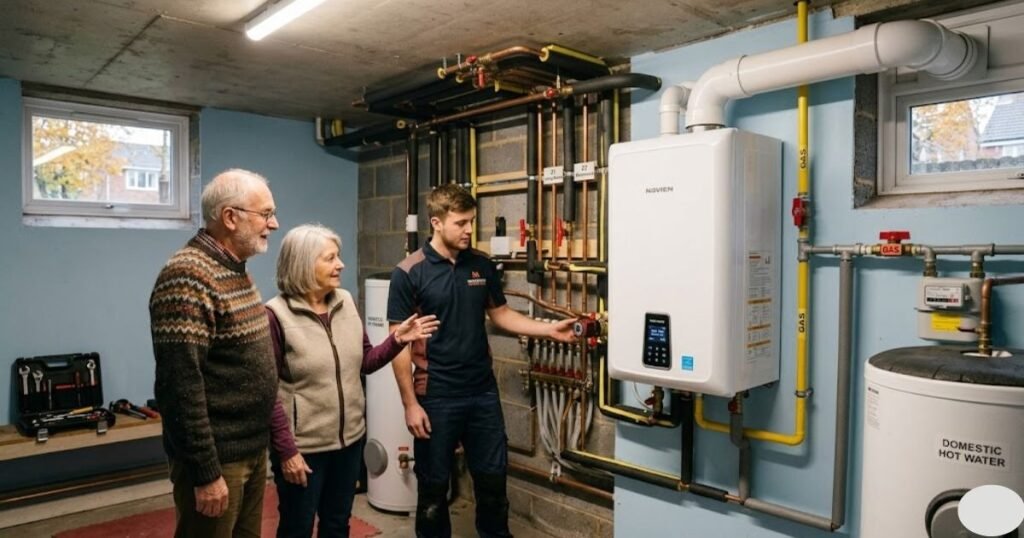
What Is a Natural Gas Boiler?
A natural gas boiler is a heating appliance that uses natural gas to heat water. The heated water is then distributed throughout the home through radiators, baseboard heaters, radiant floor systems, or hydronic heating systems.
Unlike forced-air furnaces that blow heated air through ducts, boilers provide radiant or hydronic heat, which many homeowners find more comfortable and consistent.
How a Natural Gas Boiler Works
The process is relatively simple:
- Natural gas fuels the burner.
- The burner heats water inside the boiler.
- Heated water travels through pipes.
- Radiators or heating zones distribute warmth throughout the home.
- Cooled water returns to the boiler to be reheated.
This cycle continues until the desired indoor temperature is reached.
READ MORE: Weil‑McLain Boiler Reviews (2026) — Models, Costs, Pros & Cons
Types of Natural Gas Boilers
Before shopping, it’s important to understand the major categories.
1. Condensing Boilers
Condensing boilers capture additional heat from exhaust gases that would otherwise be wasted.
Advantages:
- Higher efficiency
- Lower utility bills
- Reduced emissions
- Energy Star eligibility in many cases
2. Non-Condensing Boilers
These traditional models cost less upfront but generally operate at lower efficiency levels.
Advantages:
- Simpler design
- Lower purchase cost
- Suitable for some older heating systems
3. Combi Boilers
Combination boilers provide:
- Home heating
- Domestic hot water
Benefits:
- Space-saving design
- No separate water heater needed
- Ideal for smaller homes
4. System Boilers
System boilers focus primarily on home heating and typically work with separate hot-water storage tanks.
READ MORE: Best Convector Heater Review: 2026 Best Models & Comparison
Why Homeowners Choose Natural Gas Boilers
There are several reasons natural gas boilers remain popular in residential heating.
1. Energy efficiency
Modern high-efficiency gas boiler models are designed to waste less fuel. Condensing boilers, in particular, are made to capture extra heat from exhaust gases before they leave the system. That can lead to better performance and lower fuel use.
2. Reliable whole-home heating
Boilers are known for steady heat delivery. Once the system is properly sized and installed, it can provide dependable warmth throughout the home, even in colder climates.
3. Quiet operation
Many homeowners appreciate that boilers are usually quieter than some forced-air systems. There is no noisy blower pushing air through ductwork, which can make the home feel calmer and more comfortable.
4. Space-saving options
Wall-mounted boilers take up less room than some older floor-standing systems. That makes them useful for homes with limited utility space, basements, or mechanical closets.
5. Long-term comfort
A well-chosen residential gas boiler can last for many years with proper maintenance. Homeowners who value stability and comfort often see boilers as a worthwhile investment.
Advantages at a Glance
- Radiant Heat Comfort: Provides consistent warmth with no dry air drafts or blowing dust.
- Precise Zone Customization: Allows you to set independent room thermostats for tailored comfort throughout the house.
- Ultra-Quiet Mechanicals: Operates via silent fluid circulation instead of noisy air vents.
- Ultra-Compact Footprints: Saves valuable floor space with sleek, space-saving wall-mount options.
READ MORE: Best ecobee Smart Thermostat Review: Essential vs Enhanced vs Premium
How to Choose the Best Natural Gas Boiler
Shopping for a residential gas boiler doesn’t have to be overwhelming. By focusing on a few core criteria, you can easily collaborate with an HVAC pro to find the perfect match.
Here is your quick roadmap to buying smart:
1. Home Size & BTU Output:
Don’t guess the size. An oversized boiler will “short-cycle” (constantly turn on and off), wasting fuel and wearing out parts, while an undersized unit won’t keep you warm. Have a contractor run a formal heat-loss calculation (Manual J) to find your exact BTU needs.
2. AFUE Rating (Efficiency):
Look for the Annual Fuel Utilization Efficiency percentage. Standard units (80%–85% AFUE) are durable, budget-friendly upfront, but lose more heat up the chimney. High-efficiency units (90%–98% AFUE) trap trapped heat to squeeze maximum warmth out of every dollar, saving you massive amounts on monthly bills.
3. Condensing vs. Non-Condensing:
This dictates your home’s venting. Non-condensing systems blast hot exhaust naturally out a traditional chimney. Condensing systems cool the exhaust so much it liquefies, requiring a simple, low-cost PVC pipe routed through a side wall (plus a dedicated drain line).
4. Floor-Standing vs. Wall-Mounted:
Floor models are heavy, robust cast-iron machines that are highly tolerant of older, dirtier plumbing layouts. Wall-mounted units are lightweight, ultra-compact marvels that free up floor space entirely but require cleaner water quality.
5. Heating-Only vs. Combi Systems:
Heating-only boilers solely handle your radiators or baseboards, meaning you still need a separate water heater. Combination (Combi) boilers pull double duty—heating your home and providing endless, on-demand hot water from a single compact cabinet.
6. Warranty & Local Support:
Look for a 5-to-10-year parts warranty and a 15-year or lifetime heat exchanger warranty. Most importantly, pick a brand that local technicians actually stock and service so you aren’t left stranded during a winter breakdown.
READ MORE: Best Salamander Heaters of 2026: Top Picks, Reviews & Comparison
The 5 Best Natural Gas Boilers for Home Heating
To help you narrow down your search, we have conducted an extensive analysis of the residential heating market to select five of the top natural gas boiler units currently available for U.S. homeowners. These models represent the absolute pinnacle of engineering, efficiency, and real-world reliability across a wide range of home sizes and installation conditions.
1. Bosch Greenstar Series
The Vibe & Overview
Bosch brings German automotive-grade engineering directly into mechanical rooms. The Greenstar series has earned an industry-wide reputation for ultra-quiet, rock-solid baseline performance. Rather than chasing flashy touchscreen displays or experimental software, Bosch focuses on thermal stability and bulletproof components that heating technicians have known and trusted for over a decade.
The Hard Specs Table
| Metric | Specification |
| AFUE | 95% to 96.1% |
| BTU Input | 57,000 to 151,600 BTU/hr |
| Dimensions | 33.5″ H x 17.3″ W x 13.9″ D |
| Fuel Type | Natural Gas / Propane (LPG) |
Pros & Cons
- Pros:
- Whisper-quiet operation (under 33 decibels for smaller models) due to a heavily insulated heavy-duty chassis.
- Advanced aluminum-silicon alloy heating block resists thermal shock and minimizes internal scale buildup.
- Excellent high-altitude flexibility, delivering full rated output up to 7,000 feet without requiring field de-rating.
- Cons:
- Aluminum-silicon heat exchangers require strict system fluid maintenance, demanding a neutral loop pH to prevent internal pitting.
- The analog-style control interface (Heatronic III) feels slightly dated compared to modern smartphone-integrated suites.
Deep-Dive Engineering
The Greenstar utilizes a cast aluminum-silicon (Al-Si) alloy heat exchanger designed for incredibly rapid heat transfer across an extra-large surface area. Its modulation capabilities rely on a fully modulating gas valve and a variable-speed fan assembly. While it features a standard 5:1 turndown ratio, the internal algorithm acts as an anti-cycling tool, smoothly ramping the burner down to match a home’s steady baseline heat load without turning off entirely.
Best Application Scenario
Best for high-altitude mountain properties and retrofits where whisper-quiet operation in a utility closet near living quarters is non-negotiable.
READ MORE: Carrier Heat Pump Reviews (2026) — Models, Costs, Pros & Cons
2. Navien NHB-150H
The Vibe & Overview
Navien is the high-efficiency disruptor that forced traditional American hydronic brands to modernize. The NHB series has a stellar reputation as a mechanical chameleon, beloved by modern installers for its hyper-reactive electronics, incredibly flexible venting options, and tiny wall-hung profile. It is the go-to choice for tech-forward, high-efficiency installations.
The Hard Specs Table
| Metric | Specification |
| AFUE | 95% |
| BTU Input | 10,000 to 150,000 BTU/hr |
| Dimensions | 24.0″ H x 17.0″ W x 13.0″ D |
| Fuel Type | Natural Gas / Propane (LPG conversion kit included) |
Pros & Cons
- Pros:
- Industry-leading 15:1 turndown ratio completely eliminates energy-wasting short-cycling in small heating loops.
- Ultra-compact, lightweight design frees up critical square footage in tight basements or closets.
- Allows for highly cost-effective 2-inch Schedule 40 PVC venting setups for lengths up to 60 feet.
- Cons:
- The narrow internal water pathways require installing a magnetic dirt separator to prevent sediment clogs.
- The expansive digital programming interface can overwhelm users looking for simple, manual control adjustments.
Deep-Dive Engineering
The NHB-150H is powered by dual, integrated stainless steel heat exchangers that maximize condensation by pulling every available unit of latent heat from the flue gases. Its defining engineering feat is the integrated gas-air premix system, which achieves a massive 15:1 turndown modulation. The burner can scale down to just 10,000 BTU/hr, allowing it to efficiently heat a single tiny zone (like a bathroom floor loop) without cycling the system on and off.
Best Application Scenario
Best for modern zoned homes featuring multiple independent radiant floor loops or heavily segmented baseboard configurations.
READ MORE: Central Heat Pump Installation Cost: 2026 Homeowner Price Guide
3. Weil-McLain Ultra Gas Series 4 (Ultra 155)
The Vibe & Overview
Weil-McLain is the historic heavyweight of North American hydronics. The Ultra Gas Series 4 carries an uncompromising reputation as a commercial-grade workhorse built for residential applications. While it is noticeably heavier and beefier than modern imports, it is fiercely defended by traditional service technicians who value heavy structural mass and decades of proven domestic parts support.
The Hard Specs Table
| Metric | Specification |
| AFUE | 94% |
| BTU Input | 155,000 BTU/hr |
| Dimensions | 43.1″ H x 22.8″ W x 19.9″ D |
| Fuel Type | Natural Gas / Propane (LP conversion available) |
Pros & Cons
- Pros:
- A specialized nano-coated cast aluminum block offers exceptional structural longevity against acidic flue gases.
- A massive internal water volume easily absorbs sudden temperature swings in high-volume older heating piping.
- The intuitive U-Control interface provides simple, clear multi-zone management without requiring secondary controls.
- Cons:
- At 94% AFUE, it sits slightly below the 95%+ efficiency benchmarks of its newer fire-tube competitors.
- The large, floor-standing footprint demands significantly more physical space in your mechanical room.
Deep-Dive Engineering
The Ultra Gas utilizes a mono-block cast aluminum heat exchanger styled with a robust pin-fin design. These metallic pins create high turbulence in the escaping flue gases, forcing maximum heat extraction. Its modulation system pairs a variable-speed combustion blower with a negative-regulation gas valve, delivering an approximate 5:1 modulation capability that prioritizes steady, heavy-duty thermal output over micro-adjustments.
Best Application Scenario
Best for large historic homes transitioning from old, cast-iron systems to high-efficiency equipment without re-piping the entire property.
READ MORE: Ultra Quietest Heat Pump for Your Home: Review, Comparison & Cost
4. Lochinvar KNIGHT WHB110L
The Vibe & Overview
Lochinvar represents premium, high-tech hydronic innovation. The KNIGHT series occupies an elite tier among mechanical contractors, widely regarded as the “luxury sports car” of residential boilers. Its reputation centers on an advanced SMART SYSTEM control platform and an uncompromising internal layout that makes it the premier choice for custom engineered smart homes.
The Hard Specs Table
| Metric | Specification |
| AFUE | 95% |
| BTU Input | 11,000 to 110,000 BTU/hr |
| Dimensions | 31.1″ H x 19.0″ W x 18.8″ D |
| Fuel Type | Natural Gas / Propane (LPG models available) |
Pros & Cons
- Pros:
- A vertical fire-tube stainless steel heat exchanger provides incredible resistance to system debris and scale.
- The integrated SMART SYSTEM control panel natively handles cascading setups for up to 8 boilers simultaneously.
- Features a built-in variable-speed ECM circulation pump that dynamically lowers household electricity usage.
- Cons:
- Carries a significantly higher initial purchase price compared to entry-level high-efficiency condensing units.
- Requires precision installation and an authorized contractor with a combustion analyzer to validate the warranty.
Deep-Dive Engineering
The KNIGHT WHB110L deploys an advanced vertical stainless steel fire-tube heat exchanger. In this design, the system water surrounds a network of heavy-duty tubes containing the hot combustion gases, providing a low internal pressure drop and making it exceptionally tolerant of system dirt. It features a precise 10:1 turndown modulation ratio, enabling the boiler to track outdoor reset temperatures perfectly while adjusting water flow rates via its intelligent ECM pump.
Best Application Scenario
Best for high-end custom homes featuring integrated automation, multi-temperature loops (e.g., mixing baseboards and radiant slabs), or snow-melt systems.
5. Peerless PureFire Residential (PF-110)
The Vibe & Overview
Peerless treats HVAC equipment like an honest tool: it needs to be accessible, durable, and easy to repair. The PureFire series has built its reputation on being a practical, technician-friendly option that avoids unnecessary software gimmicks. It delivers excellent, steady condensing efficiency in a straightforward package that budget-conscious homeowners appreciate.
The Hard Specs Table
| Metric | Specification |
| AFUE | 95% |
| BTU Input | 19,000 to 110,000 BTU/hr |
| Dimensions | 29.5″ H x 17.3″ W x 19.0″ D |
| Fuel Type | Natural Gas / Propane (LPG conversion available) |
Pros & Cons
- Pros:
- Built with a marine-grade, ASME-certified stainless steel heat exchanger for supreme corrosion defense.
- An exceptionally roomy internal cabinet layout permits easy visual inspections and rapid component service access.
- An eco-friendly, low-NOx premix burner assembly easily clears the strictest regional air quality mandates.
- Cons:
- The 5.8:1 modulation range is significantly narrower than modern ultra-modulating competitors.
- The outer casing is purely utilitarian and industrial, prioritizing function over sleek, modern aesthetics.
Deep-Dive Engineering
The PureFire is built around an ASME-rated, continuously coiled stainless steel tube heat exchanger. The coil geometry is oriented to allow gravity-assisted self-cleaning as condensation washes down the smooth metal surfaces. Its modulation relies on an electronic pre-mix combustion system with a 5.8:1 turndown ratio, tracking changing target temperatures by constantly monitoring outdoor air sensor data inputs.
Best Application Scenario
Best for value-focused homeowners seeking a reliable, heavy-duty transition into high-efficiency hydronics without paying a premium for complex software.
READ MORE: Best 5 Natural Gas Heater for Home: Review, Comparison & Buying Guide
Natural Gas Boilers Comparison Table
To help you visually contrast these five top-tier systems at a glance, we have compiled their key specifications and optimal deployment scenarios into a clean, homeowner-friendly matrix.
| Model | Type | Efficiency | Best For |
| Bosch Greenstar | Condensing | Up to 95% | Overall performance |
| Navien NHB-150H | Condensing | High efficiency | Small utility spaces |
| Weil-McLain Ultra Series 4 | Condensing | Up to 94% | Long-term reliability |
| Lochinvar KNIGHT | Condensing | High efficiency | Advanced users |
| Peerless PureFire | Condensing | Up to 95% | Value buyers |
What Does a New Natural Gas Boiler Cost?
Boiler pricing varies significantly.
Typical Equipment Costs
- Entry-level models: $3,000–$5,000
- Mid-range systems: $5,000–$8,000
- Premium boilers: $8,000–$12,000+
Installation Costs
Professional installation often adds:
- $3,000–$8,000+
- Depending on location and system complexity
Total project costs commonly range from:
$6,000 to $15,000 or more
READ MORE: Best 10,000 BTU Portable Air Conditioner: Reviews & Comparison
Natural Gas Boiler Installation & Safety: Why Pro Installation is Non-Negotiable
YouTube is great for learning how to tile a backsplash, but a natural gas boiler is a completely different beast. It sits at the dangerous intersection of high-voltage electricity, explosive gas, scaling water pressure, and toxic exhaust. Skipping a certified pro to save a few bucks can lead to catastrophic consequences:
- Explosive Gas Leaks: Flawed pipe threading or poor pressure tuning can create silent, volatile hazards in your basement.
- Lethal Carbon Monoxide (CO): Micro-gaps or improper sloping in plastic vent pipes can cause deadly, odorless carbon monoxide to backdraft into your living spaces.
- Severe Water Damage: Hydronic systems handle extreme pressure. A faulty valve or poorly calculated setup can result in sudden pipe blowouts and rot-inducing structural leaks.
The Professional Blueprint
A certified HVAC technician doesn’t just hang the unit; they protect your investment by installing critical secondary equipment that ensures code compliance and system longevity:
- Expansion Tanks & Air Separators: To manage natural water expansion and remove noisy, corrosive air pockets from your plumbing.
- Condensate Neutralizers: To safely buffer the highly acidic wastewater produced by high-efficiency units before it eats through your home’s drain pipes.
- Flue-Gas Calibration: Utilizing digital combustion analyzers to adjust the gas valve for maximum safety and peak efficiency.
The 4-Step Professional Timeline
- Step 1: Manual J Load Calc (Pre-Purchase) Your contractor evaluates your home’s square footage, insulation depths, and window efficiencies to calculate its unique heat loss, establishing the exact BTU size you need.
- Step 2: Mounts & Near-Boiler Piping (Phase 1) The tech securely wall-mounts or sets the unit, then replumbs the immediate area using primary-secondary piping headers to isolate and protect water flow.
- Step 3: Gas & Sealed Venting (Phase 2) Heavy-duty gas lines are safely tied in and tested for pressure drops, while dual-pipe PVC or polypropylene runs are routed directly outdoors following strict structural clearance codes.
- Step 4: Commissioning & Safety Testing (Final Step) The system is filled and completely purged of pocketed air. The burner is ignited, and a calibrated digital analyzer verifies safe CO/CO2 exhaust thresholds for ultimate peace of mind.
READ MORE: Best MRCOOL Mini Split Air Conditioners and Heat Pumps: Review & Comparison
Natural Gas Boiler Maintenance Tips
Routine maintenance helps maximize efficiency and lifespan.
1. Annual Professional Service
Schedule yearly inspections to:
- Clean burners
- Check venting
- Inspect heat exchangers
- Verify safety controls
2. Monitor Water Pressure
Abnormal pressure may indicate system problems.
3. Bleed Radiators When Needed
Removing trapped air helps maintain efficient heating.
4. Watch for Warning Signs
Call a technician if you notice:
- Strange noises
- Leaks
- Reduced heating performance
- Unusual energy bill increases
Frequently Asked Questions
What is the best natural gas boiler for home heating?
The Bosch Greenstar is often considered one of the best overall choices due to its high efficiency, flexible installation options, and excellent reputation for reliability.
Are condensing natural gas boilers worth it?
Yes. Condensing boilers typically achieve efficiency ratings above 90%, helping homeowners reduce energy consumption and heating costs over time.
How long does a natural gas boiler last?
Most quality boilers last between 15 and 25 years when properly maintained, though some systems exceed that lifespan.
What size boiler do I need for my house?
The correct size depends on square footage, insulation levels, climate, window efficiency, and heating demand. A professional load calculation provides the most accurate recommendation.
Is a wall-mounted gas boiler better than a floor-standing boiler?
Neither is universally better. Wall-mounted models save space and often provide higher efficiency, while floor-standing units may be preferable for larger homes and certain heating systems.
Conclusion
Finding the best natural gas boiler for home heating involves balancing efficiency, reliability, installation requirements, and long-term operating costs. Modern condensing boilers offer impressive performance and can significantly reduce energy consumption compared with older systems.
For homeowners seeking the best overall combination of efficiency and comfort, the Bosch Greenstar remains a leading choice. Those wanting a compact wall-mounted solution may prefer the Navien NHB-150H, while buyers focused on reliability should strongly consider the Weil-McLain Ultra Series 4. Lochinvar’s KNIGHT series delivers premium features, and the Peerless PureFire offers outstanding value.