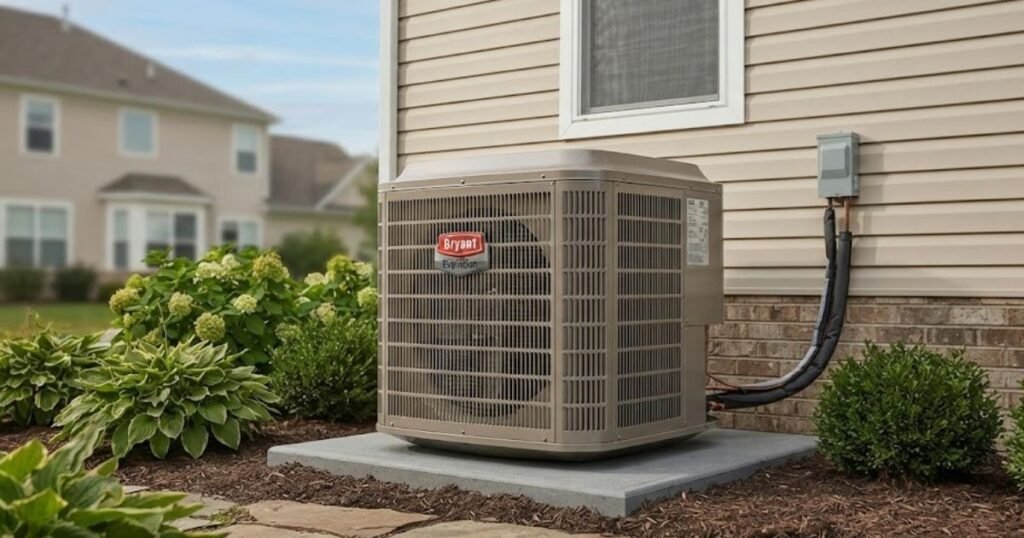
I’ve installed and serviced Bryant equipment for years, and the Evolution Series is where Bryant puts its most advanced engineering: variable-speed compressors, smart controls, and efficiency ratings that rival any premium brand on the market. But “premium” also means a bigger price tag, and that’s where a lot of homeowners get stuck.
In this guide, I’ll walk you through what the Bryant Evolution heat pump actually is, how the different models compare, what it really costs installed, how it performs in cold climates, and whether it’s the right call for your home. Lets deep dive into “Bryant Evolution Heat Pump Review (2026): Features, Comparison & Cost”
READ MORE: Carrier Heat Pump Reviews — Models, Costs, Pros & Cons
What Is the Bryant Evolution Heat Pump?
The Evolution Series sits at the top of Bryant’s product lineup, above the mid-tier Preferred Series and the budget-friendly Legacy Series. It’s built around variable-speed inverter technology, which means the compressor doesn’t just switch on and off like a traditional system. Instead, it ramps up and down to match your home’s exact heating or cooling load.
That matters more than most homeowners realize. A traditional single-stage system blasts full power, shuts off, and repeats, which causes temperature swings and humidity problems. A variable-speed Evolution unit runs longer at lower speeds, which keeps temperatures steadier and pulls more moisture out of the air during summer.
Here’s what defines the Evolution System:
- Variable-speed inverter compressor that adjusts output continuously rather than cycling on/off
- Evolution Connex smart control for zoning, scheduling, and remote diagnostics
- Hybrid Heat compatibility, meaning the heat pump can pair with a gas furnace so the system automatically picks whichever heat source is more cost-effective at a given outdoor temperature
- Smart home integration through Wi-Fi and mobile app monitoring
- Quiet, compact cabinet design with sound-dampening features
If you’ve researched Bryant heat pump reviews, you’ve likely seen the Evolution Extreme name repeatedly. That’s Bryant’s flagship subline within Evolution, built specifically for extreme temperature performance and the highest efficiency ratings the brand offers.
Bryant Evolution Heat Pump Models Comparison
Bryant currently sells three main variable-speed models under the Evolution Extreme name, plus the broader Evolution and Preferred tiers below them. Here’s how the Extreme lineup breaks down.
| Model | Cooling Efficiency | Heating Efficiency | Best For |
| Evolution Extreme 293VAN | Up to 23 SEER2 / 13.5 EER2 | Up to 10.5 HSPF2 | Homeowners wanting Bryant’s top efficiency tier |
| Evolution Extreme Cold Climate 291VAN | Up to 21 SEER2 | Cold-climate-tuned heating curve | Northern climates with long, harsh winters |
| Evolution Extreme 290VAN | Up to 20 SEER2 / 11.5 EER2 | Up to 9.5 HSPF2 | Balanced performance at a lower price point than the 293VAN |
A quick note on efficiency numbers: SEER2 and HSPF2 ratings are always listed as “up to,” because the actual certified rating depends on which indoor coil or air handler the outdoor unit is matched with. Two homes with the same outdoor condenser can land on different efficiency numbers depending on what’s paired with it. Always ask your installer for the AHRI-certified match rating for your specific system, not just the marketing number on the box.
For homeowners in milder climates who don’t need the top-tier efficiency, Bryant’s Preferred Series variable-speed models (up to 19 SEER2) are worth a look too they cost less and still deliver strong comfort control.
Expert tip: Don’t assume bigger numbers automatically mean a better fit. A 5-ton Evolution Extreme in a 1,600-square-foot home will short-cycle and actually perform worse than a properly sized 2.5-ton unit. Sizing matters more than the spec sheet.
READ MORE: Goodman Heat Pump Review | Efficiency, Cost, Pros & Cons
Bryant Evolution Heat Pump Key Features
The Evolution Extreme’s feature set is what separates it from entry-level heat pumps. Here’s what you’re actually paying for:
- True variable-speed operation — the compressor modulates output rather than cycling fully on and off, which smooths out temperature swings
- Quiet operation — low-speed sound levels as low as roughly 53–55 dB on the 293VAN, with a Quiet Mode setting homeowners can adjust from the wall control
- ENERGY STAR certification on qualifying sizes and matched systems
- Advanced defrost technology that only triggers a defrost cycle when the coil actually needs it, instead of running on a fixed timer — this alone reduces unnecessary heating interruptions in winter
- Enhanced humidity control, capable of removing significantly more moisture than a standard single-stage system during low-speed operation
- Bluetooth connectivity on select models for service diagnostics
- Compact, weather-protected cabinet with baked-on paint coverage designed to resist corrosion
- Evolution Connex smart control for zoning, scheduling, and system health alerts
- Zoned comfort compatibility, allowing different rooms or floors to be conditioned independently
Expert tip: The defrost technology is genuinely one of the most underrated upgrades in this lineup. Older heat pumps run defrost cycles on a timer whether the coil needs it or not, which wastes energy and blows cold air into the house. Demand-based defrost only kicks in when frost is actually detected.
Bryant Evolution Heat Pump Energy Efficiency
Understanding the alphabet soup of ratings helps you compare heat pumps accurately instead of relying on a salesperson’s pitch.
- SEER2 measures cooling efficiency over a season under the newer 2023 testing standard. Higher is better.
- EER2 measures cooling efficiency at a single, fixed outdoor temperature — useful for judging performance during a heat wave.
- HSPF2 measures heating efficiency over a season. Higher numbers mean lower heating costs.
The Evolution Extreme 293VAN’s up to 23 SEER2 and 10.5 HSPF2 ratings put it near the top of the residential heat pump market. In practical terms, upgrading from an older 10–13 SEER system to a variable-speed Evolution unit commonly cuts cooling energy use by 30–50%, though your actual savings depend on your climate, insulation, ductwork condition, and local electricity rates.
A note on rebates: The federal Section 25C Energy Efficient Home Improvement Credit, which previously offered up to $2,000 for qualifying heat pumps, expired on December 31, 2025, under the One Big Beautiful Bill Act. If your Evolution system is installed in 2026 or later, it does not qualify for that federal credit. Don’t let a dealer tell you otherwise verify directly with your tax preparer.
What’s still available in most areas:
- State and utility rebate programs, which vary widely by location and household income
- HEEHRA (High-Efficiency Electric Home Rebate Act) programs, income-based and rolled out state by state
- Manufacturer and dealer financing promotions, which change seasonally
Check the DSIRE database (Database of State Incentives for Renewables & Efficiency) or your local utility’s website before you sign a contract — some of these programs pay out thousands and are easy to miss.
READ MORE: Furnace Replacement Cost in USA
Bryant Evolution Heat Pump Cost
This is usually the first question homeowners actually care about. Bryant heat pump cost varies by tonnage, model, home layout, and region, but here’s a realistic breakdown for the Evolution Extreme lineup installed in a typical single-family home.
| Cost Component | Typical Range |
| Equipment only (outdoor unit) | $4,500 – $8,500 |
| Matched indoor coil/air handler | $1,500 – $3,500 |
| Standard installation labor | $2,500 – $5,000 |
| Total installed cost (typical home) | $8,000 – $16,000 |
| Evolution Connex smart thermostat upgrade | $400 – $800 |
| Electrical panel upgrade (if needed) | $1,500 – $4,000 |
| Ductwork repair or modification | $1,500 – $5,000+ |
What actually moves the price:
- Home size and tonnage. Larger homes need bigger systems, and bigger systems cost more.
- Existing ductwork condition. Leaky, undersized, or missing ducts add cost fast.
- Electrical capacity. Older homes sometimes need a panel upgrade to support a heat pump plus backup heat strips.
- Regional labor rates. Installation in a major metro area typically runs higher than in a rural market.
- Cold-climate backup heat. Homes that need auxiliary electric heat kits or a hybrid gas furnace pairing add to the total.
Expert tip: Get at least two itemized quotes, and make sure both include a Manual J load calculation. A quote that’s a few thousand dollars cheaper but skips proper sizing can cost you more in comfort problems and repairs down the road.
Bryant Evolution Heat Pump Installation Guide
A heat pump is only as good as its installation. Here’s the process a qualified Bryant dealer should follow:
- Manual J load calculation — this determines the correct system size for your home based on square footage, insulation, window count, and climate zone, not just a guess based on your old unit’s tonnage.
- Matching indoor and outdoor components — the outdoor condenser needs to be paired with a compatible indoor coil or air handler to hit the advertised SEER2/HSPF2 ratings.
- Electrical assessment — confirming your panel can support the new equipment.
- Permitting — most municipalities require a permit for HVAC replacement; a reputable installer pulls this automatically.
- Installation — typically completed in one to three days depending on complexity.
- Commissioning — the installer verifies refrigerant charge, airflow, and control settings before handing off the system.
Installation checklist for homeowners:
- Confirm the contractor performs a Manual J calculation (not a rule-of-thumb estimate)
- Ask for the AHRI certificate showing the matched system’s actual efficiency rating
- Verify the contractor is a licensed, factory-authorized Bryant dealer
- Confirm who registers the warranty and by what deadline
- Get the labor warranty terms in writing
READ MORE: Ultra Quietest Heat Pump for Your Home: Review, Comparison & Cost
Bryant Evolution Connex Smart Thermostat
The Evolution Connex control is the brain of the system, and it’s a meaningful upgrade over a basic thermostat. Key functions include:
- Smart scheduling based on your daily routine
- Remote monitoring and control through the Bryant mobile app
- System diagnostics that alert you (and your dealer) to potential issues before they become breakdowns
- Humidity management, letting you set target humidity levels independently of temperature
- Energy usage reports that show run times and help you spot inefficiencies
- Zoning support for multi-zone homes
It integrates with the variable-speed compressor to fine-tune performance in real time, which is part of why Evolution systems run quieter and more evenly than fixed-speed setups.
Bryant Evolution Heat Pump Heating Performance in Cold Weather
This is where a lot of older heat pump myths need correcting. Heat pumps used to struggle badly below freezing, but modern variable-speed cold-climate models have closed that gap significantly.
The 293VAN is rated for heating operation down to roughly -13°F outdoor ambient temperature, and the Evolution Extreme Cold Climate 291VAN is specifically tuned for even harsher winter conditions. The variable-speed compressor actually helps here it ramps up capacity as outdoor temperatures drop, rather than just running flat-out and losing efficiency.
Demand-based defrost cycles also matter more in cold climates. Instead of defrosting on a fixed timer regardless of conditions, the system only defrosts when frost buildup is actually detected, which reduces how often the unit blows cool air indoors during winter.
For homes in the coldest parts of the country, Hybrid Heat pairing with a gas furnace is worth serious consideration. The system automatically switches to gas heat below whatever outdoor temperature makes it more cost-effective than running the heat pump, giving you efficiency in mild weather and reliable backup when it’s brutally cold.
READ MORE: Best Swimming Pool Heat Pump: Review, Comparison, and Buying Tips
Bryant Evolution Heat Pump Noise Levels
Variable-speed technology is a big part of why premium heat pumps run quieter than older single-stage units — low-speed operation simply doesn’t need to work as hard.
| Brand / Model | Approximate Low-Speed Sound Level |
| Bryant Evolution Extreme 293VAN | ~53–55 dB |
| Carrier Infinity (Greenspeed) | ~51–56 dB |
| Trane XV Series | ~55–58 dB |
| Lennox Signature Series | ~54–59 dB |
| Rheem Prestige | ~58–65 dB |
These figures represent typical low-speed or “quiet mode” operation reported by manufacturers and installers; full-capacity sound levels run higher for every brand listed here. For context, 55 dB is roughly the sound of a quiet conversation, while 65+ dB starts to feel noticeably present, especially if the unit sits near a bedroom window or patio.
Bryant Evolution Heat Pump Reviews
I’m not going to hand you a fake star rating pulled from nowhere. Instead, here’s what shows up consistently in homeowner feedback and installer experience with Evolution systems.
What homeowners tend to like:
- Noticeably quieter operation compared to their old system, especially at night
- More even indoor temperatures, with fewer hot/cold spots between rooms
- Better humidity control during summer, which several owners describe as making the house feel cooler at the same thermostat setting
- The mobile app and remote monitoring, particularly for tracking energy use
What homeowners commonly bring up as drawbacks:
- The higher upfront cost compared to a standard single-stage system
- Confusion over rebate eligibility, especially now that the federal tax credit has lapsed
- A learning curve with the Evolution Connex app for less tech-comfortable users
- The need for a properly trained dealer — installer skill has an outsized impact on how well these systems perform
The pattern I see most often in the field: homeowners who get a correctly sized, professionally commissioned Evolution system are consistently satisfied. Homeowners who get an oversized or poorly matched system are the ones who end up frustrated, and that’s rarely the equipment’s fault.
READ MORE: Solar Powered Heat Pump Cost: USA Homeowner Guide to Savings
Bryant Evolution Heat Pump Pros and Cons
| Pros | Cons |
| Up to 23 SEER2 efficiency on flagship models | Higher upfront cost than mid-tier Bryant lines |
| Quiet variable-speed operation | Federal tax credit no longer available for 2026 installs |
| Strong humidity control | Requires a skilled installer to perform as advertised |
| Hybrid Heat compatible with gas furnaces | Smart features add complexity for some users |
| Smart diagnostics via Evolution Connex | Parts availability tied to Bryant/Carrier dealer network |
| 10-year parts warranty with registration | Labor warranty depends on the contractor, not Bryant directly |
Bryant Evolution vs Competitors
| Brand / Line | Peak Efficiency | Compressor Warranty | Relative Price | Notable Strength |
| Bryant Evolution Extreme | Up to 23 SEER2 | 10-year parts (registered) | $$ | Carrier-level engineering at a lower price point |
| Carrier Infinity | 19–24+ SEER2 | 10-year parts standard | $$$ | Widest dealer network, Greenspeed cold-climate tech |
| Trane XV Series | Up to 22 SEER2 | Up to 12-year compressor (registered) | $$$ | Reputation for rugged durability |
| Lennox Signature Series | Among the highest SEER2 ceilings in residential HVAC | Limited lifetime compressor (registered) | $$$$ | Class-leading peak efficiency |
| Rheem Prestige | Up to 20 SEER2 | 10-year parts (registered) | $$ | Strong value, simpler serviceable parts |
| Bosch IDS Premium | Cold-climate ducted performance | 10-year parts (registered) | $$$ | Purpose-built cold-climate ducted systems |
Since Bryant is manufactured by Carrier Global Corporation, the Evolution Series shares core engineering compressors, controls, and cabinet design with Carrier’s Infinity line. The practical difference usually comes down to dealer network size and price, with Bryant typically running somewhat less expensive than an equivalent Carrier system for very similar hardware.
READ MORE: Best Ductless Mini Split Air Conditioner: Review, Comparison, Cost & Buying Guide
Bryant Evolution Heat Pump Warranty
Bryant’s warranty structure has a few moving parts worth understanding before you sign a contract:
- Standard parts warranty: Typically 10 years if the system is registered within 90 days of installation. If you miss that window, coverage generally drops to 5 years.
- Red Shield Unit Replacement Warranty: Select Evolution System products qualify for a 10-year unit replacement warranty (also contingent on 90-day registration) that provides a one-time full unit swap if a major component like the compressor fails due to a defect.
- Labor warranty: This is set by your installing contractor, not Bryant corporate. Some dealers include 1–2 years of labor coverage standard and sell extended labor plans separately — always ask specifically what’s included.
- California and Quebec residents: May receive enhanced warranty terms automatically, since registration-based conditions aren’t permitted in those jurisdictions.
Expert tip: Registration is the single most commonly missed step in this entire process. Confirm in writing that your installer will register the equipment, and follow up yourself within 90 days to be safe.
Bryant Evolution Heat Pump Maintenance Tips
Keeping an Evolution system running efficiently isn’t complicated, but skipping basic maintenance is the fastest way to shorten its lifespan.
- Replace or clean air filters every 1–3 months, more often with pets or allergies
- Keep the outdoor unit clear of leaves, snow, and debris on all sides
- Schedule a professional tune-up annually, ideally in spring before cooling season
- Have a technician check refrigerant charge if you notice reduced performance
- Keep the Evolution Connex software updated through the app
- Clean the outdoor coil periodically to maintain airflow and efficiency
| Maintenance Task | Frequency |
| Filter check/replacement | Every 1–3 months |
| Outdoor unit debris clearing | Monthly (more in fall/winter) |
| Professional tune-up | Annually |
| Coil cleaning | Annually (professional service) |
| Refrigerant/electrical inspection | Annually |
| Thermostat firmware check | As updates release |
READ MORE: Best ecobee Smart Thermostat Review: Essential vs Enhanced vs Premium
Bryant Evolution Heat Pump Common Problems
Even well-built systems run into issues. Here’s what tends to show up with Evolution heat pumps, and what usually fixes it:
- Ice buildup on the outdoor coil — often normal in winter but should clear during defrost cycles; persistent ice can indicate a refrigerant or airflow issue and needs a technician.
- Reduced airflow — almost always a dirty filter or blocked return vent; check this first before calling for service.
- Thermostat settings confusion — some homeowners accidentally disable Hybrid Heat switching or set aggressive schedules that fight the variable-speed logic; a quick settings review with your installer usually resolves it.
- Refrigerant leaks — rare in a properly installed system but require professional diagnosis and repair; never attempt to “top off” refrigerant yourself.
- Sensor faults or error codes — the Evolution Connex control will display a diagnostic code; write it down and report it to your dealer rather than resetting the system repeatedly.
Is Bryant Evolution Heat Pump Worth It?
The honest answer: it depends on your home and priorities.
- Small to mid-size homes: A properly sized Evolution Extreme delivers excellent comfort and quiet operation without excessive upfront cost, especially the 290VAN.
- Large homes: The variable-speed technology and zoning compatibility genuinely shine here, since a single-stage system struggles more in bigger, multi-zone layouts.
- Cold climates: The 291VAN Cold Climate model or a Hybrid Heat setup with a gas furnace backup make sense if you regularly see sustained sub-freezing temperatures.
- Warm climates: The 293VAN’s high SEER2/EER2 ratings and superior humidity control are especially valuable where cooling dominates your energy bill.
- Energy-conscious homeowners: The efficiency gains are real, particularly if you’re replacing a system older than 12–15 years.
- Long-term homeowners: If you plan to stay in the home 10+ years, the efficiency and reduced wear from variable-speed operation help justify the higher upfront cost.
- Luxury or larger custom homes: The advanced humidity control, zoning, and smart diagnostics fit well with whole-home comfort systems.
Where it’s a tougher sell: if you’re planning to sell within a few years, or your existing ductwork and electrical infrastructure would need major (and expensive) upgrades to support it, a mid-tier Preferred Series system might deliver better value for your situation.
Bryant Evolution Heat Pump Expert Buying Tips
A few things I tell every homeowner before they commit to an Evolution system:
- Don’t buy based on the SEER2 number alone — ask for the AHRI-certified rating for your specific matched system.
- Get a written, itemized quote that separates equipment, labor, electrical, and ductwork costs.
- Ask your installer directly how many Evolution systems they’ve commissioned, not just sold.
- If you’re in a cold climate, seriously consider Hybrid Heat pairing rather than relying solely on electric backup heat strips, which are expensive to run.
- Register your warranty the day installation finishes — don’t wait.
Final Verdict
The Bryant Evolution Heat Pump earns its spot at the top of Bryant’s lineup. Variable-speed operation, strong SEER2/HSPF2 ratings, genuinely quiet performance, and Hybrid Heat flexibility make it a smart long-term investment for homeowners who want consistent comfort and lower energy bills.
Its main weakness isn’t the equipment it’s cost and installation quality. This is not a system where you want the cheapest bid; a mediocre installer can turn a great heat pump into a mediocre system. Combine that with the fact that the federal tax credit has expired for 2026, and the total cost math deserves careful attention before you sign.
Frequently Asked Questions
Is the Bryant Evolution heat pump worth the money?
For most homeowners planning to stay in their home for several years, yes. The variable-speed technology delivers real comfort improvements, steadier temperatures, better humidity control, and quieter operation plus meaningful energy savings over an older system.
How much does a Bryant Evolution heat pump cost to install?
Most homeowners pay between $8,000 and $16,000 installed for a typical single-family home, depending on tonnage, ductwork condition, and regional labor rates. Add $1,500–$5,000 more if electrical panel upgrades or significant duct modifications are needed.
How long does a Bryant Evolution heat pump last?
With proper installation and annual maintenance, most Evolution systems last 15–20 years. Lifespan depends heavily on climate severity, maintenance consistency, and whether the system was correctly sized during installation.
Is Bryant Evolution better than Carrier Infinity?
They share the same parent company and much of the same core engineering, so performance is very similar. Carrier Infinity generally has a wider dealer network, while Bryant Evolution typically costs somewhat less for comparable equipment.
Does the Bryant Evolution heat pump work in very cold climates?
Yes, particularly the Evolution Extreme Cold Climate 291VAN, which is tuned for sustained sub-freezing performance, and the 293VAN, rated for heating operation down to roughly -13°F.