Every homeowner relies on their heating, ventilation, and air conditioning system to maintain a comfortable indoor climate year-round. However, when you notice a persistent musty smell when the air conditioner or furnace starts, or spot dark or suspicious spots around air vents, concern naturally sets in. You might also observe moisture or condensation near your ductwork, leading to lingering worries about whether mold could be growing inside inaccessible ducts where you cannot see it. This uncertainty often leaves homeowners wondering whether routine cleaning, major repairs, or full duct replacement are necessary.
It is important to understand right away that musty odors and dark stains can have several causes such as ordinary household dust, accumulated soot, or routine humidity and do not automatically confirm mold inside the ductwork. This comprehensive guide will help you identify warning signs, uncover moisture sources, understand proper remediation steps, and learn how to keep your home comfortable and safe. Lets deep dive into “Mold in HVAC Ductwork: Signs, Causes, and Solutions”
What Is Mold in HVAC Ductwork?
Mold is a type of fungus that reproduces by releasing microscopic spores into the air. When these spores land on damp organic surfaces, they can grow and multiply. Inside a residential HVAC system, mold can develop whenever three essential ingredients are present: moisture, suitable organic material (like dust, pet dander, or paper insulation fibers), and stable temperatures.
To understand how mold affects your system, it helps to distinguish between mold growing on smooth duct surfaces versus mold colonizing internal HVAC components. Mold may develop on cooling coils, condensate drain pans, duct insulation, and nearby building materials. However, a common misconception among homeowners is that the presence of everyday dust inside a vent proves the system contains mold. Dust is composed of skin cells, fabric fibers, and soil particles, and its presence is entirely normal in any active air distribution network. Furthermore, visual discoloration inside a duct should never be automatically identified as a specific species, such as toxic black mold, without laboratory testing.
The construction material of your ductwork also dictates how cleaning and remediation are handled:
- Sheet-Metal Ducts: Non-porous sheet metal resists mold growth on its smooth surface, though dust and organic debris resting on the metal can still support mold if moisture is present. Metal is relatively straightforward to clean.
- Flexible Ducts: Flexible ducts feature a plastic or foil outer sleeve wrapped around a wire helix, often with an inner fiberglass layer. If moisture penetrates the inner core, cleaning can be difficult or impossible, frequently requiring replacement.
- Fiberglass Duct Board and Internally Insulated Ducts: These materials contain porous fiberglass surfaces. When moisture enters porous insulation, mold roots deeply into the fibers, meaning cleaning is ineffective and replacement is usually required.
READ MORE: Cost to Install HVAC Ductwork
Signs of Mold in HVAC Ductwork
Recognizing the early indicators of contamination helps you address minor moisture issues before they escalate into major problems. Here are the primary warning signs to watch for in your home:
1. A Persistent Musty or Earthy Odor
One of the most frequent complaints is a stale, damp, or musty smell from air vents whenever the blower fan turns on. While this odor often points toward microbial growth or stagnant water in the drain pan, it can also stem from dirty air filters or general humidity trapped in living spaces.
2. Visible Suspicious Growth
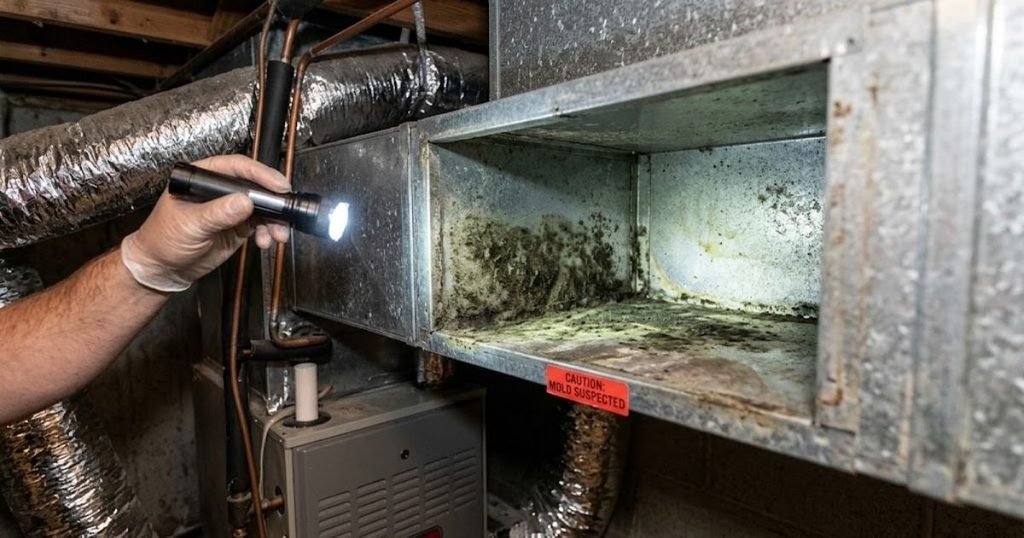
If you notice green, white, black, or grey patches inside accessible supply registers or on components near the air handler, it warrants closer inspection. However, remember that not every dark smudge or dust accumulation is mold.
3. Repeated Condensation Around Vents
Water droplets forming persistently on metal supply registers during peak summer cooling cycles indicate high humidity or inadequate insulation, which frequently creates the damp conditions mold needs to thrive.
4. Water Stains and Damp Insulation
Stained ceilings or walls near duct runs, wet fiberglass wrap in the attic or crawl space, and evidence of past roof or plumbing leaks signal that moisture has compromised the surrounding environment.
5. Persistent Moisture Around the Air Handler
Standing water in the condensate drain pan or dampness around the indoor furnace unit means the system is failing to drain properly, dramatically increasing humidity inside the cabinet.
6. Homeowner Inspection Checklist
To evaluate whether your system requires a professional look, ask yourself:
- Is there a continuous musty odor when the HVAC runs?
- Are there visible damp spots or water stains near vents or duct joints?
- Does the indoor air handler show signs of standing water or poor drainage?
- Has the home recently experienced a plumbing leak, roof leak, or high humidity episode?
If you answered yes to multiple questions, further investigation is warranted.
READ MORE: Affordable HVAC Installation Near Me USA
What Causes Mold to Grow in HVAC Ductwork?
Mold does not grow spontaneously; it requires a moisture problem. Identifying and correcting the root cause is just as important as cleaning up existing growth.
1. Condensation on Cold Ducts
In hot, humid U.S. climates, uninsulated metal ducts running through unconditioned spaces like attics or crawl spaces can become very cold when air conditioning runs. When warm, humid air contacts these cold metal surfaces, condensation forms. Over time, dust settling on these damp areas feeds mold growth. Corrective action: Ensure all supply ducts in unconditioned spaces are properly sealed and insulated.
2. Clogged or Improperly Draining AC Condensate Systems
Air conditioning coils pull significant moisture out of indoor air. This water drips into a drain pan and flows through a PVC pipe outside. If algae, slime, or debris clogs this drain line, water backs up, overflows the pan, and saturates nearby flooring, drywall, or insulation. Corrective action: Flush condensate lines regularly with vinegar or warm water and service your cooling system annually.
3. Leaking Ductwork
When supply or return ducts develop cracks, loose joints, or disconnected sections in unconditioned areas, negative or positive pressure can draw humid air into the system or cause conditioned air to escape, triggering condensation on duct walls. Corrective action: Seal duct joints with mastic paste or UL-181 approved foil tape.
4. Damaged or Missing Duct Insulation
Insulation wrapping around metal ducts prevents temperature differentials that cause sweating. If insulation is torn, compressed, or missing, localized condensation occurs. Corrective action: Repair or replace damaged duct wrap and insulation.
5. High Indoor Humidity
Indoor relative humidity consistently exceeding 60% provides an ideal environment for mold throughout the home, including inside duct systems. Corrective action: Use whole-house or portable dehumidifiers to maintain indoor humidity between 30% and 50%.
6. Water Leaks and Flooding
Roof leaks, plumbing breaks, or localized flooding that wets ductwork or insulation creates severe contamination risks. Corrective action: Fix plumbing and structural leaks immediately and discard water-logged porous materials.
7. Poor HVAC Maintenance or Improper System Sizing
An oversized air conditioner cools the home too quickly without running long enough to properly dehumidify the air. This leaves moisture lingering in the duct network. Corrective action: Ensure proper HVAC sizing (Manual J calculation) during replacement and change filters monthly.
Is Mold in Air Ducts Dangerous?
It is natural for homeowners to worry about health risks when discovering mold, but it is important to evaluate the issue in a balanced, evidence-based manner.
Mold exposure may trigger allergic reactions, nasal congestion, throat irritation, coughing, or eye irritation in sensitive individuals. People with asthma, chronic respiratory conditions, compromised immune systems, or severe allergies require extra caution and should minimize exposure to airborne spores. However, individual health effects vary widely depending on personal sensitivity and the concentration of spores present.
Importantly, a musty odor or the presence of mold does not establish a specific medical diagnosis. If you or a family member experience persistent respiratory symptoms, consult a qualified medical professional rather than assuming your HVAC system is the sole culprit. Avoid alarming claims that all mold exposure causes toxic illness or that routine duct cleaning will automatically cure asthma and allergies. Maintaining a balanced perspective ensures you take sensible precautions without falling prey to exaggerated fears.
READ MORE: American Standard HVAC Systems: Complete Buyer’s Guide
How to Check for Mold in HVAC Ductwork
While comprehensive internal inspection of a complex duct system requires specialized tools, homeowners can safely perform a preliminary visual check. Follow these steps:
- Turn off the HVAC system before inspecting accessible areas when contamination is suspected. This prevents spores from circulating through your living space.
- Visually examine accessible supply and return registers by removing vent covers for a close look at the immediate duct opening.
- Look for moisture, staining, and mold-like growth around accessible duct collars and boots.
- Check visible duct surfaces and accessible insulation using a flashlight, without cutting into ducts or disturbing suspicious material.
- Inspect the indoor air handler area for standing water in the drain pan, sluggish drainage, or damp cabinet walls.
- Look for possible water leaks and condensation near the furnace or air conditioner closet, basement, or crawl space.
- Document visible concerns with photographs so you can share clear details with a qualified professional.
Keep in mind that homeowners cannot inspect every part of a concealed duct system from the vents alone. Visible evidence, moisture history, and professional evaluation are far more useful than indiscriminate air testing. Professional mold sampling or laboratory analysis may be helpful in specific dispute or health-monitoring scenarios, but it is not automatically necessary in every home.
Safety Note: If mold is suspected inside the HVAC system, do not run the system. U.S. Environmental Protection Agency (EPA) guidance warns that operating a contaminated system may spread mold spores and contaminated debris throughout the building.
How to Remove Mold From HVAC Ductwork
The appropriate solution for cleaning or remediating mold depends heavily on the extent of contamination, the specific duct material, and whether the underlying moisture source has been fully corrected.
When Professional Mold Remediation Is Appropriate
Call a qualified HVAC or mold remediation professional when:
- Mold-like growth is suspected deep inside inaccessible ductwork.
- Contamination affects the air handler, blower motor, or cooling coils.
- Fiberglass duct insulation or duct board is wet, stained, or visibly moldy.
- The home has experienced extensive water damage, flooding, or sewage backup.
- The mold problem repeatedly returns after previous cleaning attempts.
- You cannot safely access or inspect the affected area.
Cleaning Hard-Surface Ducts
Substantial visible mold growth in accessible sheet-metal ducts warrants professional cleaning and assessment. Technicians use specialized rotary brushes, negative-air vacuums, and HEPA-filtered equipment to scour contaminants from the metal without tearing the ductwork.
Replacing Contaminated Duct Insulation
Wet or moldy fiberglass duct liner, flexible duct cores, and porous acoustic insulation cannot be effectively cleaned because mold roots into porous fibers. Qualified contractors must remove and replace these contaminated sections.
Cleaning HVAC Components
Effective remediation requires cleaning cooling coils, condensate pans, and blower wheels alongside the duct network. Cleaning only the ducts while leaving a moldy coil untouched guarantees the problem will return.
Should You Use Bleach, Mold Sprays, or Chemical Biocides?
Homeowners should never indiscriminately spray household bleach, disinfectants, or chemical mold-killers into air ducts. EPA guidance emphasizes that chemical biocides can release harmful fumes into living spaces, and many products are not approved for use inside ductwork. Chemical applications are never a substitute for physical cleaning and moisture correction.
Should You Replace the Entire Duct System?
Complete duct replacement is rarely necessary unless the system is severely collapsed, rusted, or heavily contaminated throughout with porous mold growth. Targeted repairs, insulation replacement, and professional cleaning usually resolve most localized issues.
READ MORE: Carrier Heat Pump Reviews — Models, Costs, Pros & Cons
How Much Does HVAC Mold Removal Cost?
Understanding expected costs helps U.S. homeowners budget appropriately for inspection, cleaning, and remediation projects. Costs vary based on home size, geographic region, extent of contamination, and accessibility.
Main Cost Factors
- Size and Accessibility: Larger homes with extensive duct networks require more labor hours and equipment setup.
- Severity of Contamination: Surface dust with mild mildew is cheaper to address than heavy structural mold colonies.
- Duct Material: Sheet metal is easier to clean, whereas porous flex ducts or duct board require replacement.
- Component Cleaning: Servicing coils, blowers, and drain pans adds to the total project scope.
- Moisture Repairs: Fixing leaking roofs, plumbing, or broken condensate lines incurs separate repair expenses.
HVAC and Mold Remediation Cost Reference Table
| Service | Typical Cost Range | Factors Affecting Price | Source & Year |
| HVAC or Mold Inspection | $200 – $800 | Inspection scope, lab testing, and attic/crawl space accessibility | Angi / HomeAdvisor (2026) |
| Air Duct Cleaning | $271 – $509 | Home size, total square footage of ducts, and vent count | Angi (2026) |
| Localized Mold Remediation | $1,100 – $3,400 | Extent of contamination, containment setup, and labor | HomeAdvisor (2026) |
| Duct Insulation Replacement | $500 – $2,000 | Material type, linear footage, and labor accessibility | Industry Averages (2026) |
| Full HVAC Mold Remediation | $3,000 – $10,000 | System complexity, coil cleaning, and extensive duct replacement | HomeAdvisor / CWF (2026) |
Note: Prices represent approximate U.S. averages and vary by region. Always obtain at least three itemized written estimates from licensed contractors before proceeding with major remediation projects.
How to Prevent Mold in HVAC Ductwork
Preventing mold growth is far easier and less costly than remediating an established colony. Implement these proven strategies to protect your home:
- Fix Water Leaks Promptly: Address roof leaks, plumbing drips, and window seepage within 24 to 48 hours.
- Maintain Condensate Systems: Inspect and flush your AC condensate drain line and pan seasonally to prevent standing water.
- Control Indoor Humidity: Keep relative humidity between 30% and 50% using air conditioners or dehumidifiers.
- Replace HVAC Filters Regularly: Change standard filters every 1 to 3 months to reduce organic dust buildup on coils and ducts.
- Inspect Duct Insulation: Periodically check accessible attic and crawl space duct wrap for tears, sagging, or moisture.
- Seal and Insulate Ducts: Ensure all joints in unconditioned areas are sealed with mastic and properly insulated.
- Ensure Proper System Sizing: Work with qualified technicians to install correctly sized HVAC equipment that adequately dehumidifies your home.
- Use Exhaust Fans: Run bathroom and kitchen exhaust fans during and after high-moisture activities.
- Dry Water-Damaged Materials: Dry out damp building materials quickly rather than painting over water stains.
Routine maintenance stops moisture problems before they start, meaning most households do not require frequent or aggressive duct cleaning.
READ MORE: Portable Heat Pump With AC: Best Portable AC and Heating
DIY Cleaning vs. Professional HVAC Mold Removal
| Feature | DIY Vent Cleaning & Maintenance | Professional HVAC Mold Remediation |
| Appropriate Scope | Cleaning removable vent covers and replacing standard air filters. | Deep duct contamination, coil cleaning, and mold removal. |
| Equipment & Access | Household vacuum, damp cloth, screwdriver, and standard ladder. | Negative-air machines, HEPA vacuums, rotary brushes, and PPE. |
| Safety Considerations | Minimal risk if limited to surface dust and vent grills. | High-level protection against airborne spores and biohazards. |
| Risk of Spreading | Moderate risk if improper sweeping dislodges spores into rooms. | Minimized risk through professional containment and negative pressure. |
| Duct Material Suitability | Suitable only for metal vent covers and non-porous surface dust. | Required for flexible ducts, porous insulation, and internal coils. |
| When to Choose | Routine household dusting and preventative filter changes. | Confirmed mold growth, musty odors, or water-damaged ductwork. |
Homeowners can safely clean removable supply registers or wipe down accessible surface dust. However, you should never dismantle HVAC equipment, disturb extensive mold growth, cut into insulated ducts, or apply chemicals inside inaccessible ductwork. Always distinguish routine vent dusting from professional contamination remediation.
When Should You Call an HVAC Professional?
Knowing when to step back and call an expert protects both your home and your health. Contact a licensed HVAC technician or certified mold remediator if you encounter:
- Persistent musty odors tied directly to heating or cooling operation.
- Visible mold colonies inside duct openings or on cooling coils.
- Recurring condensation or standing water around your indoor air handler.
- Wet, sagging, or deteriorating duct insulation.
- Mold that returns shortly after previous cleaning attempts.
- Extensive water damage affecting multiple rooms or HVAC components.
Questions to Ask a Contractor
When interviewing remediation professionals, protect your investment by asking:
- What specific evidence indicates mold is present in our system?
- Which exact duct sections and HVAC components are affected?
- What underlying moisture problem caused this growth?
- Can the affected materials be cleaned effectively, or do they require replacement?
- Will your proposed work plan correct the root moisture source?
- Are chemical treatments proposed, and are they approved for our specific duct material?
- What is included in your written, itemized estimate?
- What post-remediation verification or documentation will you provide?
Be wary of high-pressure sales tactics, scaremongering about “toxic black mold” species without lab verification, and contractors recommending expensive treatments without showing you tangible proof.
FAQs
How do I know if there is mold in my HVAC ductwork?
Common warning signs include a persistent musty smell when the system runs, visible discoloration around air vents, and chronic condensation. Because much of the duct network is hidden behind walls and in ceilings, a definitive diagnosis often requires a visual inspection of accessible registers or an assessment by a qualified HVAC professional.
Can mold in air ducts make you sick?
Mold exposure can trigger allergic reactions, sneezing, coughing, and eye irritation, particularly in individuals with asthma or compromised immune systems. However, reactions vary widely by person. A musty odor does not automatically mean you will become ill, but anyone experiencing persistent respiratory symptoms should consult a healthcare provider.
How do you get rid of mold in HVAC ductwork?
Eliminating mold requires finding and fixing the moisture source, physically cleaning hard surfaces with HEPA equipment, and replacing porous materials like wet fiberglass insulation. Because HVAC systems distribute air throughout the house, professional remediation is strongly recommended to avoid spreading spores during the cleaning process.
How much does it cost to remove mold from air ducts?
Professional mold remediation for HVAC systems typically ranges from $3,000 to $10,000, depending on the extent of contamination, accessibility, and whether duct replacement or coil cleaning is required. Standard air duct cleaning costs much less (271–509), but true remediation involving mold removal requires specialized containment and labor.
Should I run my AC if I suspect mold in the air ducts?
No. According to EPA guidelines, if you suspect or know that your HVAC system is contaminated with mold, you should turn off the system immediately. Running the equipment can circulate spores and contaminated debris into your living spaces, worsening indoor air quality and spreading the growth.
Conclusion
Managing mold in HVAC ductwork comes down to understanding that moisture is the primary condition enabling mold to thrive. A musty odor or dark stain alone does not automatically prove that your ducts are heavily contaminated, but it does warrant a closer look. The correct remediation approach depends entirely on the affected components and duct materials, with porous insulation often requiring replacement rather than cleaning. Fixing roof leaks, plumbing drips, condensation issues, and condensate drain clogs is essential to prevent future recurrence. When contamination is suspected inside inaccessible parts of your HVAC system, partnering with a qualified professional ensures the job is done safely and effectively. Inspect your visible vents, control indoor humidity, and reach out to a trusted expert whenever you need peace of mind.
Source References
- U.S. Environmental Protection Agency (EPA): Mold Remediation in Schools and Commercial Buildings and Should You Have the Air Ducts in Your Home Cleaned?
- Centers for Disease Control and Prevention (CDC): Basic Facts about Mold and Dampness.
- National Air Duct Cleaners Association (NADCA): Standard for Assessment, Cleaning, and Restoration of HVAC Systems.
- Angi & HomeAdvisor: Air Duct Cleaning Cost Guide (2026 Data) and Mold Remediation Cost Guide (2026 Data).