More U.S. homeowners are turning away from traditional storage tanks and investing in an A. O. Smith gas water heater to enjoy endless hot water, lower utility bills, and valuable floor space savings. However, navigating the vast array of tankless options can feel overwhelming. With numerous configurations ranging from high-capacity outdoor condensing units to indoor models equipped with built-in recirculation pumps and revolutionary scale-prevention technology, choosing the right system requires careful evaluation of your home’s specific demands.
The ideal water heater for your household depends heavily on simultaneous hot-water usage, incoming groundwater temperatures, local fuel availability (natural gas versus propane), venting pathways, installation budgets, and ongoing maintenance preferences.
This comprehensive guide evaluates five prominent A. O. Smith gas tankless water heaters, breaking down their engineering, performance characteristics, advantages, and limitations to help you make an informed investment. Lets deep dive into “A. O. Smith Gas Water Heater Review: 5 Tankless Models Compared”
What Is an A. O. Smith Gas Water Heater?
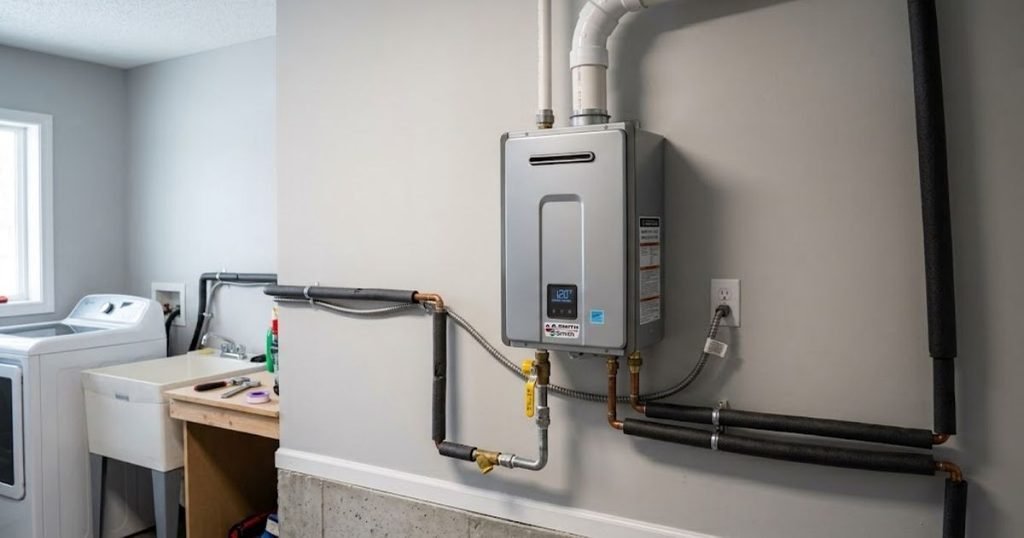
A. O. Smith is a legacy manufacturer in North American residential and commercial water heating, known for producing robust, commercial-grade equipment tailored for residential durability. Unlike traditional tank water heaters that continuously store and heat 40 to 50 gallons of water around the clock leading to standby energy losses, a tankless gas water heater operates on demand.
When a hot-water tap, shower, or appliance is turned on, internal flow sensors detect the water movement and ignite powerful gas burners. Cold water passes through a high-efficiency heat exchanger, absorbing thermal energy rapidly and delivering heated water continuously. The system roles can be broken down into key mechanical components:
- Gas Burners & Modulating Valves: Adjust gas consumption dynamically to match the exact flow rate and temperature rise required.
- Primary and Secondary Heat Exchangers: Copper primary heat exchangers transfer heat rapidly, while secondary stainless steel condensing heat exchangers extract latent heat from exhaust gases before venting.
- Flow Sensors & Electronic Controls: Regulate ignition, monitor water flow rates, and provide diagnostic error codes to simplify troubleshooting.
While tankless systems provide continuous hot water when properly sized, their maximum flow rate remains strictly limited by their BTU input capacity and incoming water temperature. Understanding the difference between manufacturer specifications and real-world performance is vital.
Furthermore, homeowners must verify fuel compatibility. Most units are manufactured for natural gas (NG) but can often be converted to liquid propane (LP) using manufacturer-approved conversion kits. Proper gas-pipe sizing, gas pressure verification, and approved venting pathways are mandatory for safe, code-compliant operation.
READ MORE: AO Smith vs. Rheem Water Heaters:Comparison & Expert Reviews
Key Features to Consider Before Buying
1. Maximum Flow Rate and Temperature Rise
Gallons per minute (GPM) determines how many plumbing fixtures a water heater can support simultaneously. However, a unit’s advertised maximum flow rate (such as 10 GPM) is not a fixed output. It depends entirely on the temperature rise, the difference between your incoming groundwater temperature and your desired output temperature (typically 120°F). In northern U.S. states where winter groundwater plunges to 40°F, a water heater must work significantly harder to raise water temperature by 80°F, reducing its effective GPM output compared to southern states where groundwater starts at 65°F.
2. Condensing vs. Non-Condensing Technology
Tankless water heaters fall into two primary efficiency categories:
- Condensing Units: Capture residual heat from exhaust combustion gases by routing them through a secondary stainless steel heat exchanger. This pushes Uniform Energy Factor (UEF) ratings up to 0.93–0.95, making them highly efficient. They typically utilize durable, cost-effective PVC, CPVC, or polypropylene venting and require a condensate drain.
- Non-Condensing Units: Exhaust hotter combustion gases directly outdoors. They generally feature slightly lower UEF ratings (around 0.81–0.82) and require specialized stainless steel Category III venting or dedicated concentric venting systems.
3. Indoor vs. Outdoor Installation
Choosing where to install your A. O. Smith gas water heater depends on climate, available space, and venting routes.
- Indoor Models: Protected from freezing temperatures and outdoor debris, but require dedicated intake and exhaust venting penetrations through walls or roofs.
- Outdoor Models: Eliminate the need for complex indoor venting and save interior utility space. However, they require freeze-protection mechanisms and are restricted to climates where ambient winter temperatures do not risk severe freezing, or where robust auxiliary freeze-protection kits are installed.
4. Built-In Recirculation
Waiting for hot water to travel through long pipe runs wastes gallons of water down the drain. Advanced models feature integrated recirculation pumps that circulate hot water through a dedicated return line or cold-water supply line. While this drastically reduces wait times at distant fixtures, homeowners must weigh pump electrical consumption, potential standby heat loss through pipes, and plumbing layout compatibility.
5. X3 Scale-Prevention Technology
Hard water contains dissolved minerals like calcium and magnesium that precipitate out under heat, forming scale on heat exchangers. Scale restricts water flow, reduces efficiency, and triggers error codes. A. O. Smith’s proprietary X3 scale-prevention technology inhibits mineral buildup, significantly extending heat exchanger longevity and eliminating traditional annual descaling requirements on equipped models. However, X3 technology does not render a unit entirely immune to extreme water conditions, and standard filtration recommendations should still be reviewed.
6. Warranty, Service, and Parts Availability
A. O. Smith backs its residential tankless gas water heaters with robust warranty coverage, typically offering a 15-year limited warranty on heat exchangers and 5-year coverage on parts. Homeowners must ensure units are professionally installed, registered, and operated within manufacturer guidelines to maintain warranty validity. Local plumbing contractor familiarity with A. O. Smith parts and diagnostics is also a valuable asset for long-term ownership.
READ MORE: Best Rheem Tankless Gas Water Heater: Review, Cost & Comparison
Detailed Reviews of 5 A. O. Smith Gas Water Heaters
1. A. O. Smith ProLine XE ATO-540H-N — Natural Gas Tankless Water Heater
Product Overview
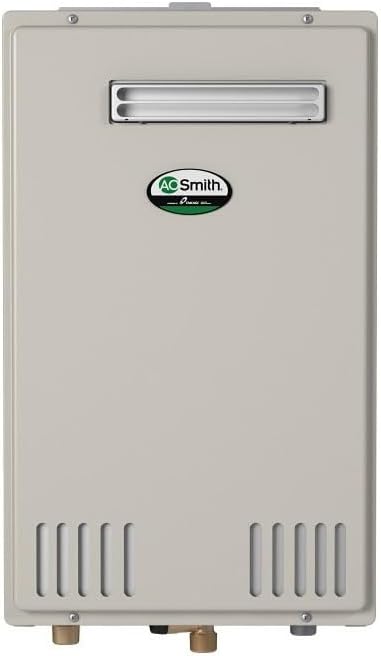
The A. O. Smith ProLine XE ATO-540H-N is a high-capacity, outdoor-mounted condensing gas tankless water heater designed to deliver continuous hot water for demanding residential applications. Built to commercial-grade standards, this unit combines heavy-duty copper primary heat exchangers with stainless steel secondary condensing recovery.
Main Specifications and Verified Features
- Installation Type: Outdoor wall-mounted.
- Fuel Type: Natural Gas (NG).
- BTU Input: 15,000 to 199,000 BTU/hr.
- Maximum Flow Rate: Up to 10.0 GPM.
- Energy Efficiency: UEF up to 0.95 (Energy Star certified).
- Venting/Electrical: Outdoor placement requires no exhaust venting; operates on standard 120V electrical supply with internal freeze protection.
- Warranty: 15-year limited heat exchanger warranty, 5-year parts warranty.
Performance and Household Suitability
With a massive 199,000 BTU input and 10 GPM ceiling, the ATO-540H-N easily supports large multi-bath homes running multiple showers and appliances simultaneously, provided the incoming water temperature allows adequate temperature rise.
Advantages
- Eliminates the need for costly indoor wall or roof venting penetrations.
- High thermal efficiency (0.95 UEF) minimizes gas utility consumption.
- Commercial-grade copper heat exchanger provides rapid thermal transfer.
- Built-in freeze protection system helps safeguard against cold snaps.
Potential Drawbacks or Installation Considerations
- Outdoor placement exposes the unit to weather elements and restricts installation to suitable climates or frost-protected outdoor enclosures.
- Requires a robust 3/4-inch gas supply line and adequate gas pressure.
Best-For Recommendation
Homeowners seeking a high-capacity outdoor tankless system who possess a reliable natural gas connection and a climate-compatible exterior installation location.
Final Review Verdict
The ATO-540H-N is an exceptional, space-saving outdoor powerhouse for large homes, delivering commercial-grade reliability and top-tier condensing efficiency.

2. A. O. Smith ATI-540P-N — 10 GPM, 199,000 BTU Indoor Natural Gas Model
Product Overview
The A. O. Smith ATI-540P-N is a premier indoor condensing natural gas tankless water heater distinguished by its factory-integrated recirculation pump. Engineered for homeowners who demand both high output and rapid hot-water delivery at distant plumbing fixtures, this model merges high efficiency with advanced operational controls.
Main Specifications and Verified Features
- Installation Type: Indoor wall-mounted.
- Fuel Type: Natural Gas (NG).
- BTU Input: Up to 199,000 BTU/hr.
- Maximum Flow Rate: Up to 10 GPM (9.5–10 GPM rated).
- Energy Efficiency: UEF 0.95 (Energy Star certified).
- Venting/Electrical: Power direct vent compatible with PVC, CPVC, or ABS pipe; 120V electrical connection required for unit and integrated pump.
- Warranty: 15-year heat exchanger, 5-year parts.
Performance and Household Suitability
The onboard recirculation pump keeps hot water primed throughout household plumbing lines. This eliminates the frustrating wait times common in sprawling ranch homes or multi-story residences while maintaining a 10 GPM peak capacity for heavy hot-water demand.
Advantages
- Integrated recirculation pump reduces water waste and wait times at taps.
- Exceptional 0.95 UEF efficiency lowers annual energy expenditures.
- Onboard digital controls and advanced diagnostics simplify user management.
- Easy-link capability allows linking up to 4 units without extra accessories.
Potential Drawbacks or Installation Considerations
- Requires dedicated recirculation return plumbing or proper cold-line bypass configuration.
- Indoor installation mandates precise venting installation and condensate drainage.
Best-For Recommendation
Homeowners desiring high hot-water capacity and built-in recirculation convenience who have indoor utility space and compatible plumbing infrastructure.
Final Review Verdict
The ATI-540P-N is a top-tier indoor solution that marries endless high-flow hot water with luxury-grade instant delivery convenience.

3. A. O. Smith ATI-510CX3 — 10 GPM, 199,000 BTU Natural Gas or Propane Model
Product Overview
The A. O. Smith ATI-510CX3 is a high-performance indoor tankless water heater featuring proprietary X3 scale-prevention technology. Designed to tackle hard-water challenges head-on, this non-condensing unit utilizes concentric venting and delivers robust 10 GPM flow rates.
Main Specifications and Verified Features
- Installation Type: Indoor wall-mounted.
- Fuel Type: Natural Gas or Liquid Propane (field convertible).
- BTU Input: Up to 199,000 BTU/hr.
- Maximum Flow Rate: Up to 10.0 GPM.
- Energy Efficiency: UEF 0.82 (Non-condensing).
- Special Features: X3 Scale Prevention Technology, APNC35 concentric vent system.
- Warranty: Standard manufacturer residential warranty terms apply.
Performance and Household Suitability
Delivering up to 10 GPM, the ATI-510CX3 easily satisfies large family hot-water demands. Its standout attribute is the X3 scale-prevention system, which inhibits mineral crystallization, protecting performance in regions with hard municipal or well water.
Advantages
- X3 technology significantly reduces mineral scale accumulation.
- High 10 GPM output supports simultaneous multi-fixture use.
- Field convertible between natural gas and propane.
- Concentric venting streamlines single-penetration installation.
Potential Drawbacks or Installation Considerations
- Non-condensing design operates at slightly lower efficiency (0.82 UEF) than condensing counterparts.
- Concentric venting components must match manufacturer specifications.
Best-For Recommendation
Homeowners in hard-water areas who need high-capacity indoor hot water and want to minimize scale-related maintenance overhead.
Final Review Verdict
The ATI-510CX3 offers a compelling blend of high output and innovative scale resistance, making it an excellent choice for hard-water households.

4. A. O. Smith ATI-310CX3 — 8 GPM, 190,000 BTU Indoor Model
Product Overview
The A. O. Smith ProLine XE ATI-310CX3 is an indoor, non-condensing tankless gas water heater engineered to balance robust performance with sensible capacity sizing. Equipped with X3 scale-prevention technology, it provides an efficient, space-saving hot-water solution for mid-to-large households.
Main Specifications and Verified Features
- Installation Type: Indoor wall-mounted.
- Fuel Type: Natural Gas or Propane (conversion kit included).
- BTU Input: 190,000 BTU/hr.
- Maximum Flow Rate: Up to 8.0 GPM.
- Energy Efficiency: UEF 0.81.
- Special Features: X3 Scale Prevention Technology, integrated digital controls.
- Weight & Dimensions: ~51 lbs; 13.75″ W x 20.5″ H.
Performance and Household Suitability
With an 8 GPM maximum flow rate, the ATI-310CX3 is ideally suited for homes with two to three bathrooms operating simultaneously. It avoids oversizing while delivering reliable, continuous hot water.
Advantages
- X3 technology eliminates traditional annual descaling procedures.
- Compact wall-mounted footprint frees up valuable utility room space.
- Includes propane conversion kit for fuel flexibility.
- Lower BTU input requirement (190,000) can sometimes ease gas-line sizing constraints compared to 199,000 BTU units.
Potential Drawbacks or Installation Considerations
- 8 GPM flow rate may be stretched thin in very large homes running multiple high-flow showers and appliances simultaneously.
- Non-condensing efficiency (0.81 UEF) trails condensing models.
Best-For Recommendation
Homeowners seeking a high-quality, mid-capacity indoor tankless system with built-in scale defense for a standard 2-to-3 bath home.
Final Review Verdict
The ATI-310CX3 strikes an optimal balance between capacity, space-saving design, and low-maintenance scale prevention.

5. A. O. Smith ATO-140H — 6.6 GPM, 120,000 BTU Outdoor Natural Gas Model
Product Overview
Note on Model Designation & Verification: Official manufacturer documentation and authorized U.S. plumbing distributors categorize this outdoor condensing series as the ATO-140H (available in Natural Gas ATO-140H-N and Propane ATO-140H-P variants) delivering up to 6.6 GPM and 120,000 BTU input. The A. O. Smith ATO-140H is a compact, highly efficient outdoor condensing tankless water heater designed for smaller residential layouts.
Main Specifications and Verified Features
- Installation Type: Outdoor wall-mounted (outdoor only).
- Fuel Type: Natural Gas (ATO-140H-N) or Propane (ATO-140H-P).
- BTU Input: 15,000 to 120,000 BTU/hr.
- Maximum Flow Rate: Up to 6.6 GPM.
- Energy Efficiency: Condensing technology achieving up to 0.91–0.93 UEF (Energy Star certified).
- Venting/Electrical: No external venting required (outdoor placement); operates on 120V electrical supply with internal freeze protection.
- Warranty: 15-year limited heat exchanger warranty, 5-year parts warranty.
Performance and Household Suitability
Delivering a continuous maximum flow of 6.6 GPM, the ATO-140H is tailored for 1-to-2 bathroom homes or smaller households with moderate hot-water demands. Its condensing design ensures high energy efficiency without requiring the massive gas-line capacity of 199,000 BTU units.
Advantages
- Compact, lightweight outdoor profile (approximately 44 lbs) simplifies mounting.
- High condensing efficiency (up to 0.93 UEF) reduces operating costs.
- Lower 120,000 BTU input can often operate on standard 1/2-inch gas lines depending on length and existing home piping.
- Eliminates indoor exhaust venting requirements.
Potential Drawbacks or Installation Considerations
- 6.6 GPM maximum flow rate is inadequate for large families running multiple simultaneous showers and appliances.
- Restricted to outdoor installation in frost-compatible climates.
Best-For Recommendation
Homeowners with smaller households (1-2 baths) seeking an efficient, space-saving outdoor gas tankless water heater with modest gas-supply requirements.
Final Review Verdict
The ATO-140H provides reliable, high-efficiency condensing performance in a smaller package, making it ideal for modest residential water-heating demands.
READ MORE: Stiebel Eltron Water Heater Review: Is It Worth the Cost?
Comparison Table — All 5 A. O. Smith Gas Water Heaters
| Model | Installation | Fuel | Maximum BTU Input | Advertised Max Flow | Flow at Temp Rise (50°F Rise) | Efficiency (UEF) | Key Feature | Installation Considerations | Best For |
| ATO-540H-N | Outdoor | Natural Gas | 199,000 BTU | 10.0 GPM | ~6.5–7.0 GPM | 0.95 | High-capacity outdoor condensing | Outdoor placement, 3/4″ gas line | Large homes in mild climates wanting outdoor units |
| ATI-540P-N | Indoor | Natural Gas | 199,000 BTU | 10.0 GPM | ~6.5–7.0 GPM | 0.95 | Integrated recirculation pump | Recirculation plumbing, indoor venting, 120V power | Homes wanting instant hot water & high capacity |
| ATI-510CX3 | Indoor | NG / Propane (Convertible) | 199,000 BTU | 10.0 GPM | ~6.5 GPM | 0.82 | X3 Scale Prevention Technology | Concentric venting, non-condensing design | Hard-water homes needing high output |
| ATI-310CX3 | Indoor | NG / Propane (Kit Included) | 190,000 BTU | 8.0 GPM | ~5.5–6.0 GPM | 0.81 | X3 Scale Prevention Technology | Indoor venting, 120V power | Mid-sized households wanting scale defense |
| ATO-140H | Outdoor | Natural Gas / Propane | 120,000 BTU | 6.6 GPM | ~4.4 GPM | 0.91–0.93 | Compact condensing outdoor unit | Outdoor installation climate limits, 1/2″ or 3/4″ gas | Smaller 1–2 bath homes with moderate demand |
Which A. O. Smith Gas Water Heater Is Best for Your Home?
Best for High Hot-Water Demand
For large families running multiple showers, dishwashers, and washing machines simultaneously, high-capacity condensing models are essential. The A. O. Smith ProLine XE ATO-540H-N excels if you prefer an outdoor installation that keeps equipment out of the house, while its indoor counterpart or the ATI-540P-N serves homes needing indoor placement.
Best for Recirculation Convenience
If your bathrooms are situated far from your utility room and you want to minimize water waste, the A. O. Smith ATI-540P-N is the standout choice thanks to its factory-integrated recirculation pump. It ensures warm water is readily available when you turn on the tap, provided your plumbing layout supports recirculation.
Best for Scale-Prevention Features
Homes burdened by hard water will benefit significantly from the A. O. Smith ATI-510CX3 or ATI-310CX3. Featuring X3 scale-prevention technology, these units inhibit mineral crystallization, safeguarding performance and reducing annual maintenance burdens.
Best for Moderate Demand
For smaller families, couples, or compact homes where peak hot-water demand rarely exceeds two fixtures at once, the A. O. Smith ATI-310CX3 (8 GPM) or the compact outdoor ATO-140H (6.6 GPM) deliver efficient, appropriately sized performance without excess energy consumption.
Best for Outdoor Installation
Homeowners living in regions with mild winters who want to reclaim interior utility closet space can choose between the high-capacity ATO-540H-N and the smaller ATO-140H, subject to local weather and freeze-protection guidelines.
READ MORE: Best Rinnai Tankless Water Heater Reviews — Models, Specs & Prices
How Much Does an A. O. Smith Gas Tankless Water Heater Cost?
When budgeting for an A. O. Smith gas tankless water heater, it is crucial to distinguish between raw equipment purchase price and total installed cost. Tankless upgrades frequently involve more labor and infrastructural adjustments than simply swapping an old tank heater.
- Equipment Purchase Price: A. O. Smith residential gas tankless units generally retail between $900 and $1,800, depending on whether you choose a mid-capacity non-condensing unit or a high-output condensing model with recirculation or X3 technology.
- Professional Installation Labor: Licensed plumbing labor typically ranges from $1,000 to $2,500, reflecting the complexity of mounting, plumbing modifications, electrical connections, and code compliance.
- Gas-Line Upgrades: Traditional tank heaters often operate on 1/2-inch gas lines, whereas high-output tankless units (like 199,000 BTU models) frequently require upgraded 3/4-inch gas piping to deliver sufficient fuel volume under peak load. This can add $300 to $1,000 depending on pipe length and routing.
- Venting and Combustion Air: Indoor units require specialized PVC, CPVC, polypropylene, or concentric stainless steel venting kits and wall/roof penetrations ($200 to $600).
- Condensing Drainage & Neutralizers: Condensing units produce acidic condensate water that requires proper PVC drainage routing and often a condensate neutralizer kit ($150 to $300).
- Water-Line Modifications & Isolation Valves: Installing service isolation valves (mandatory for future maintenance and flushing) along with water-line rerouting typically runs $200 to $400.
- Permits and Inspections: Local municipal plumbing and gas permits generally cost $75 to $250.
Cost Estimate Scope: Based on recent U.S. residential contractor pricing data (mid-2026), total installed costs for an A. O. Smith gas tankless water heater typically range from $2,500 to $5,000+, heavily influenced by whether your home requires gas-line upgrades, complex venting, or electrical work. Always obtain multiple written quotes from licensed local contractors.
Installation Requirements and Safety Considerations
Installing a gas tankless water heater is not a DIY project. It involves combustible fuel gases, electrical power, and pressurized water systems. Installations must be performed by a qualified professional in strict accordance with manufacturer instructions, the National Fuel Gas Code (ANSI Z223.1/NFPA 54), local plumbing codes, and state permit requirements.
- Gas Supply & Pressure: Ensure gas piping is adequately sized and capable of supplying required BTU inputs at proper operating pressures (both static and dynamic manifold pressure).
- Venting Clearances: Indoor units must use manufacturer-approved venting materials, maintaining strict exterior termination clearances away from windows, doors, soffit vents, and air intakes to prevent exhaust recirculation.
- Outdoor Placement: Outdoor models must be installed in open-air locations free from overhangs or enclosed alcoves that could trap combustion gases. Freeze protection in cold weather is critical.
- Combustion Safety & Carbon Monoxide: Because gas appliances produce carbon monoxide (CO), working CO detectors must be installed and tested on every level of the home outside sleeping areas.
- Electrical & Condensate Requirements: Units require a dedicated 120V GFCI electrical outlet. Condensing models require code-compliant condensate drainage.
- Water Quality & Pressure: Install pressure-reducing valves if incoming water pressure exceeds 150 PSI, and incorporate full-port isolation valves for servicing.
Emergency Safety Note: If you ever smell raw gas (a distinct sulfur or rotten-egg odor), immediately evacuate the building, leave all electrical switches and appliances untouched, and contact your local gas utility provider or emergency services from a safe location. Never attempt to diagnose or repair gas leaks yourself.
READ MORE: Best 5 High Efficiency Condensing Boiler: Review, Cost & Comparison
Maintenance Tips to Help an A. O. Smith Gas Water Heater Last
While tankless water heaters require less daily attention than traditional storage tanks, routine preventive maintenance is vital to ensure peak efficiency and long service life.
- Follow the Manufacturer Schedule: Review the specific model’s owner manual for recommended service intervals and operational guidelines.
- Annual Professional Inspection: Have a licensed technician inspect the burner assembly, igniter, flame sensor, venting integrity, and gas connections annually.
- Flush and Descale (When Applicable): In homes without X3 scale-prevention technology, annual flushing using food-grade white vinegar and a portable descaling pump is necessary to remove mineral scale from the heat exchanger. Even with X3 models, periodic visual checks are recommended.
- Inspect Air Intakes and Vent Terminations: Ensure outdoor air intakes and exhaust cowlings remain unobstructed by leaves, nests, snow, or debris.
- Monitor Error Codes: Modern A. O. Smith digital control panels display error codes when anomalies occur. Document codes and consult your manual or a technician promptly.
- Maintain Condensate Traps: Verify that condensate drains flow freely and neutralizers are inspected or replaced annually.
- Keep Service Records: Maintain a file of installation records, annual service receipts, and warranty documentation to safeguard your 15-year heat exchanger warranty.
Common A. O. Smith Gas Water Heater Problems
Homeowners occasionally encounter operational hiccups. Understanding common symptoms helps you communicate effectively with a service technician:
- No Hot Water: Often caused by a tripped electrical breaker, a closed gas valve, an unplugged unit, or a failure of the flow sensor to detect water movement.
- Water Temperature Fluctuations: Frequently triggered by “cold water sandwiching” (rapid tap cycling) or crossover mixing in plumbing valves.
- Insufficient Flow under Multiple Fixtures: Indicates that total water demand exceeds the unit’s maximum GPM output at your local temperature rise.
- Ignition Failure or Error Codes: Blocked gas supply, dirty flame sensors, or venting obstructions can trigger lockout error codes on the digital display.
- Mineral Scale Reduction: Reduced flow or lukewarm water in non-X3 models usually points to heat exchanger scale buildup requiring a flush.
- Freezing Issues on Outdoor Units: Severe winter temperatures can freeze internal plumbing if freeze-protection power is interrupted or insulation is inadequate.
- Unusual Odors or Gas Smells: Any suspected gas leak requires immediate evacuation and professional utility intervention.
Note: Homeowners should limit troubleshooting to checking error codes, power supplies, and external settings. Never attempt to adjust gas valves, modify burners, or bypass safety interlocks.
Pros and Cons of A. O. Smith Gas Tankless Water Heaters
Potential Advantages
- Endless Hot Water: Delivers a continuous stream of heated water within the unit’s capacity rating.
- Space-Saving Wall-Mount Design: Compact profile reclaims floor space previously occupied by bulky storage tanks.
- High Efficiency: Condensing models achieve up to 0.95 UEF, reducing standby energy waste.
- Advanced Features: Options include integrated recirculation pumps and X3 scale-prevention technology.
- Commercial-Grade Build Quality: Heavy-duty copper and stainless steel heat exchangers are built for residential longevity.
Potential Drawbacks
- Higher Upfront Investment: Equipment and complex installation costs exceed standard tank replacements.
- Flow Limitations: Simultaneous high-demand fixtures can exceed maximum GPM output if the unit is undersized.
- Infrastructure Upgrades: May require costly gas-line, electrical, or venting modifications.
- Maintenance Requirements: Non-X3 models demand regular descaling; all units require professional annual checkups.
- Electricity Dependency: Requires continuous electrical power (120V) to operate electronic ignition, controls, and fans.
Frequently Asked Questions
Is an A. O. Smith gas tankless water heater worth buying?
An A. O. Smith gas tankless water heater is generally worth buying for homeowners seeking lower energy bills, endless hot water, and a compact wall-mounted footprint. However, their value depends on your home’s existing gas-line capacity, venting pathways, upfront installation budget, and local contractor support.
How long does an A. O. Smith gas tankless water heater last?
A. O. Smith gas tankless water heaters are engineered to last between 15 and 20 years—significantly longer than traditional storage tank heaters, which typically average 8 to 12 years. Actual lifespan depends heavily on incoming water quality, adherence to regular maintenance schedules (such as descaling), local climate conditions, and correct professional installation.
What is the difference between the A. O. Smith ATI-540P-N and ATI-510CX3?
The ATI-540P-N is a high-efficiency condensing unit (0.95 UEF) featuring a factory-integrated recirculation pump for instant hot-water delivery. In contrast, the ATI-510CX3 is a non-condensing unit (0.82 UEF) utilizing concentric venting and proprietary X3 scale-prevention technology to eliminate annual descaling. They cater to different priorities: recirculation convenience versus hard-water scale defense.
Is a 10 GPM A. O. Smith tankless water heater enough for a large family?
A 10 GPM model is generally sufficient for a large family, provided it is sized correctly for your geographic region’s groundwater temperature. Because maximum flow decreases as temperature rise increases, running three high-flow showers and a dishwasher simultaneously in freezing northern climates can test even a 10 GPM unit’s limits.
How much does it cost to install an A. O. Smith gas tankless water heater?
Total installed costs typically range from $2,500 to 5,000+.Thisincludestheequipmentpurchaseprice(900–$1,800) plus professional plumbing labor, potential gas-line upsizing, specialized venting, electrical connections, condensate drainage, and local municipal permits. Exact costs vary significantly based on your home’s pre-existing infrastructure.
Final Verdict
Selecting the right A. O. Smith gas water heater comes down to matching your household’s unique hot-water consumption pattern with the correct equipment category. If you manage a large home and prefer outdoor placement, the high-capacity ATO-540H-N is a stellar condensing choice.
For homeowners plagued by long pipe runs, the recirculation-equipped ATI-540P-N provides unmatched delivery speed. If hard-water scale is your primary concern, the X3-equipped ATI-510CX3 and ATI-310CX3 models offer outstanding low-maintenance defense, while compact options like the ATO-140H serve smaller 1–2 bath homes efficiently.
Sources and Verification Notes
- A. O. Smith Official Product Literature & Specifications: Consulted official U.S. residential gas tankless specification sheets, product catalogs, and installation manuals retrieved via hotwater.com and authorized plumbing distributor documentation (Hajoca Corporation, Ferguson Home, SupplyHouse, and AF Supply) for models ATO-540H-N, ATI-540P-N, ATI-510CX3, ATI-310CX3, and ATO-140H / ATO-140H-P series.
- U.S. Department of Energy (DOE) & ENERGY STAR: Referenced efficiency metrics, Uniform Energy Factor (UEF) testing standards, and condensing technology principles for residential gas water heating.
- Industry Plumbing Standards: National Fuel Gas Code (ANSI Z223.1/NFPA 54) guidelines for safe gas-line sizing, combustion air, and venting clearances.
- Pricing and Installation References: Aggregated U.S. residential plumbing contractor cost estimates and distributor pricing as of mid-2026 for equipment, labor, venting, and gas-line upgrades.