Water heating accounts for nearly 18% of the average American home’s energy consumption, making it one of the largest utility expenses in the household. If you are staring down an aging electric tank that is leaking, struggling to keep up with back-to-back family showers, or simply driving up your monthly electricity bill, you are likely looking for a smarter upgrade. Traditional resistance water heaters consume massive amounts of electricity just to keep water hot around the clock. Enter the GE heat pump water heater a modern hybrid appliance designed to drastically cut energy use by pulling heat directly from the surrounding air.
Homeowners frequently explore these systems to lower utility bills, gain precise smartphone control, fit specific household capacities, and capitalize on federal tax credits and local utility incentives. However, choosing the right unit depends heavily on your household size, available garage or basement space, electrical wiring, and local climate. This guide reviews three leading models, breaks down total ownership costs, outlines installation requirements, and helps you select the ideal system for your home. Lets deep dive into “GE Heat Pump Water Heater: Reviews, Costs & Comparison”
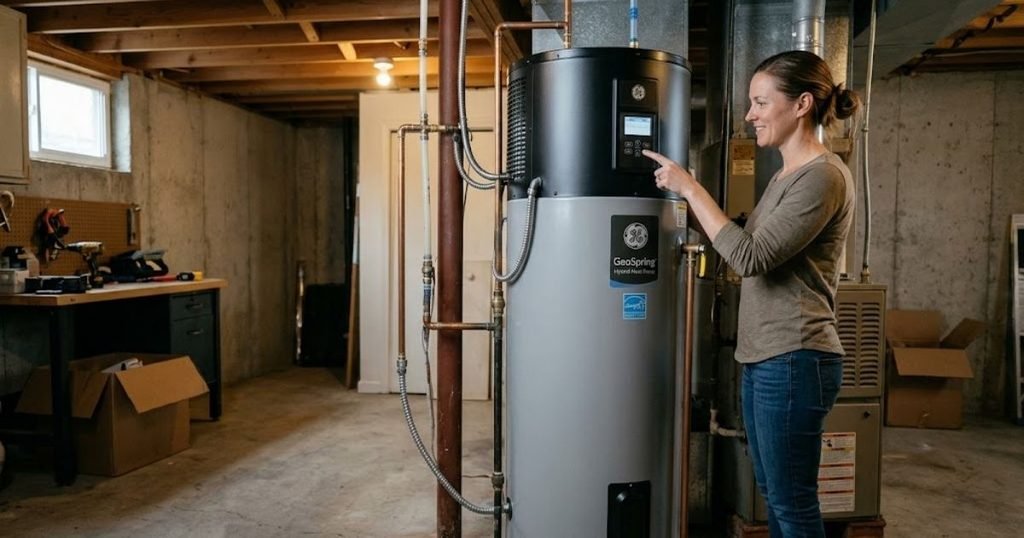
What Is a GE Heat Pump Water Heater?
To understand why a GE heat pump water heater performs so differently from a conventional electric tank, it helps to look at the underlying technology. Traditional electric water heaters use internal electric resistance heating elements to warm water directly, which demands a heavy continuous electrical draw. A heat pump water heater, by contrast, operates on the same thermodynamic principles as a household refrigerator or air conditioner just in reverse.
An integrated heat pump module located on top of the tank pulls ambient air through an evaporator coil, using a compressor and eco-friendly refrigerant to absorb heat from the surrounding air. That thermal energy is transferred into the water stored in the tank. Because moving existing heat requires far less electricity than generating heat from scratch through resistance coils, these hybrid units can achieve exceptional efficiency.
READ MORE: Carrier Heat Pump Reviews— Models, Costs, Pros & Cons
What Makes GE Profile GEOSPRING Different?
The current generation of GE Profile GEOSPRING smart hybrid water heaters represents a major leap forward from older GE-branded GeoSpring models manufactured prior to 2017. The modern lineup introduces several advanced engineering features:
- Hybrid Heat Pump Technology: Combines high-efficiency heat pump operation with traditional electric backup elements for maximum recovery speed during peak demand.
- FlexCAPACITY Technology: Features an integrated electronic mixing valve that precisely blends hot and cold water at the point of exit, delivering significantly more usable hot water without requiring a larger physical tank.
- SmartHQ App Connectivity: Built-in Wi-Fi allows homeowners to monitor daily energy usage, adjust operating modes, and receive alerts from anywhere via smartphone.
- Wireless Leak Detection and Auto Shutoff: Includes wireless sensors that detect moisture on the floor and immediately trigger an automatic water shutoff valve to prevent catastrophic flooding.
- Sensing Anode Rod: Advanced diagnostic technology monitors the condition of the sacrificial anode rod and alerts you when replacement is necessary, extending tank longevity.
- Dynamic Demand Response: EcoPort certification allows the water heater to communicate with local utility providers to optimize heating schedules when electricity rates are lowest.
- ENERGY STAR® Certification: Engineered to exceed federal energy efficiency standards, providing up to 4.7x more efficiency than standard electric resistance tanks.
Note: Features vary by specific model and configuration. Not every unit includes every optional accessory out of the box.
GE Heat Pump Water Heater: Reviews, Costs & Comparison
1. GE Profile GEOSPRING 50-Gallon 240V FlexCAPACITY — PH50S10BPY
Overview and Key Features
The GE Profile GEOSPRING 50-Gallon 240V FlexCAPACITY (Model: PH50S10BPY) is engineered for small-to-medium households seeking high energy savings without sacrificing hot-water availability.
- Nominal Storage Capacity: 50 Gallons
- Electrical Requirements: 208/240V, 30-amp dedicated circuit
- Uniform Energy Factor (UEF): 4.3
- First-Hour Rating (FHR): 77 Gallons
- Dimensions: 68.25 inches to top of water connections, 24 inches in diameter
- Warranty: Limited 10-year tank and parts; limited 1-year entire appliance
- Smart & Safety Features: Built-in Wi-Fi (SmartHQ), wireless leak sensor with automatic shutoff, and integrated service diagnostics.
Performance and Energy Efficiency
Operating at a high UEF of 4.3, this model uses roughly 1,154 kWh per year under standard Department of Energy test conditions. The inclusion of FlexCAPACITY technology utilizes an electronic mixing valve that heats water to a higher internal temperature and blends it with cold water at the outlet. This allows the 50-gallon tank to deliver up to 77 gallons in the first hour, performing comparably to a much larger conventional tank. Five operational modes (Hybrid, Heat Pump, High Demand/Boost, Standard Electric, and Vacation) let homeowners customize performance.
Pros and Cons
- Pros: Exceptional energy efficiency (up to 4.7x standard electric models); whisper-quiet operation as low as 41 dBA; advanced smartphone monitoring; included wireless leak detector.
- Cons: Higher upfront purchase price than standard electric tanks; requires adequate ambient room size (at least 700 cubic feet) for proper airflow.
Who Should Buy It?
This model is ideal for households of 2 to 4 people with moderate simultaneous hot-water usage, such as a single family bathroom and laundry routine running at different times.
READ MORE: Goodman Heat Pump Review | Efficiency, Cost, Pros & Cons
2. GE Profile GEOSPRING 65-Gallon 240V FlexCAPACITY — PH65S10BPY
Overview and Key Features
Stepping up in capacity, the GE Profile GEOSPRING 65-Gallon 240V FlexCAPACITY (Model: PH65S10BPY) balances higher volume storage with advanced hybrid efficiency.
- Nominal Storage Capacity: 65 Gallons
- Electrical Requirements: 208/240V, 30-amp dedicated circuit
- Uniform Energy Factor (UEF): 4.3
- First-Hour Rating (FHR): 87 Gallons
- Dimensions: 67.125 inches high, 27 inches in diameter
- Warranty: Limited 10-year tank and parts; limited 1-year entire appliance
- Smart Connectivity: SmartHQ app integration, remote diagnostics, and wireless leak sensor with auto shutoff.
Performance and Energy Efficiency
The 65-gallon configuration is tailored for busier households that frequently run multiple appliances or experience back-to-back showers. Despite its larger physical footprint and wider 27-inch diameter, it maintains an impressive 4.3 UEF rating and consumes approximately 1,154 kWh annually under standard test guidelines. The FlexCAPACITY electronic mixing valve allows the unit to deliver 87 gallons of hot water in the first hour, functioning effectively like a traditional 100-gallon water heater. A variable-speed compressor automatically adjusts output based on ambient temperature conditions.
Pros and Cons
- Pros: Substantial hot-water delivery for medium-to-large families; variable-speed compressor optimizes efficiency in varying climates; low operating noise (41 dBA).
- Cons: Requires a 27-inch footprint which demands more floor space than standard 24-inch tanks; higher initial equipment investment.
Who Should Buy It?
This model suits families of 3 to 5 people with overlapping hot-water demands who need reliable recovery without jumping to an 80-gallon system.
3. GE Profile GEOSPRING 80-Gallon 240V FlexCAPACITY — PH80S10BPY
Overview and Key Features
Designed for large households and luxury residential applications, the GE Profile GEOSPRING 80-Gallon 240V FlexCAPACITY (Model: PH80S10BPY) represents the pinnacle of GE’s hybrid water heating lineup.
- Nominal Storage Capacity: 80 Gallons
- Electrical Requirements: 208/240V, 30-amp dedicated circuit
- Uniform Energy Factor (UEF): High-efficiency rating with an annual energy consumption of approximately 1,127 kWh/year
- First-Hour Rating (FHR): 101 Gallons
- Dimensions: 76.375 inches high to water connections, 27 inches in diameter
- Warranty: Limited 10-year tank and parts; limited 1-year entire appliance
- Smart & Safety Features: Built-in Wi-Fi, wireless leak sensor with automatic shutoff, and EcoPort demand-response certification.
Performance and Energy Efficiency
The PH80S10BPY delivers massive hot-water volume, boasting an incredible first-hour delivery rating of 101 gallons. Thanks to its FlexCAPACITY mixing valve, it can perform like a 125-gallon conventional tank, easily servicing large families, multi-bath homes, or large soaking tubs. Despite its immense output, its energy consumption remains remarkably low at roughly 1,127 kWh per year, allowing large households to cut hundreds of dollars off annual utility bills compared to standard electric resistance models.
Pros and Cons
- Pros: Massive hot-water capacity and first-hour delivery; excellent energy efficiency for an 80-gallon platform; comprehensive smart controls and leak protection.
- Cons: Very tall (over 76 inches) and heavy (331 lbs net weight), requiring adequate ceiling clearance and careful installation planning.
Who Should Buy It?
Best for large families (5+ people), homes with multiple master suites, or households with high-flow jetted tubs where hot-water depletion is a constant concern.
READ MORE: American Standard Heat Pump: Models, Costs & Buying Guide
Comparison Table: Three Best GE Heat Pump Water Heaters
| Feature | 50-Gallon FlexCAPACITY | 65-Gallon FlexCAPACITY | 80-Gallon FlexCAPACITY |
| Exact Model Number | PH50S10BPY | PH65S10BPY | PH80S10BPY |
| Nominal Tank Capacity | 50 Gallons | 65 Gallons | 80 Gallons |
| Uniform Energy Factor (UEF) | 4.3 | 4.3 | High Efficiency (~4.3 class) |
| First-Hour Rating | 77 Gallons | 87 Gallons | 101 Gallons |
| Voltage & Electrical | 240V, 30A Circuit | 240V, 30A Circuit | 240V, 30A Circuit |
| Physical Dimensions | 68.25″ H x 24″ W | 67.125″ H x 27″ W | 76.375″ H x 27″ W |
| FlexCAPACITY Valve | Yes (Acts like 80 gal) | Yes (Acts like 100 gal) | Yes (Acts like 125 gal) |
| SmartHQ Connectivity | Built-in Wi-Fi | Built-in Wi-Fi | Built-in Wi-Fi |
| Leak Detection & Shutoff | Included Sensor | Included Sensor | Included Sensor |
| ENERGY STAR Certified | Yes | Yes | Yes |
| Warranty (Tank/Parts) | 10-Year Limited | 10-Year Limited | 10-Year Limited |
| Best Suited For | 2–4 Person Households | 3–5 Person Households | Large Families / High Demand |
| Main Buying Consideration | Standard space & moderate demand | Wider footprint, higher volume | Tall ceiling clearance & heavy use |
Note: Retail pricing varies depending on local plumbing supply houses, big-box home improvement stores, and regional dealer promotions. Equipment-only prices typically range from $2,500 to $3,500.
Quick Buying Recommendation
- Choose the 50-Gallon (PH50S10BPY) if you have a standard utility closet or 24-inch footprint constraint and a family of up to four.
- Choose the 65-Gallon (PH65S10BPY) if your household regularly experiences overlapping showers and you have space for a 27-inch wide tank.
- Choose the 80-Gallon (PH80S10BPY) if you have high simultaneous water demands, luxury soaking tubs, and sufficient vertical clearance (over 76 inches).
READ MORE: Trane Heat Pump Review — Comparison, Pros, Cons & Costs
GE Heat Pump Water Heater Cost:
Purchase Price
As of current U.S. market conditions, retail pricing for GE Profile GEOSPRING hybrid units generally spans from $2,500 to $3,500 for the equipment alone, depending on the tank capacity and retail supplier.
Installation Cost
Professional installation is strongly recommended for heat pump water heaters due to electrical requirements, weight, and condensate drainage. Total professional installation costs typically range from $800 to $2,000, which accounts for:
- Safe removal and disposal of the old water heater.
- Potential electrical circuit or breaker adjustments.
- Installation of a condensate drain line or condensate pump.
- New water shutoff valves, thermal expansion tanks, and dielectric unions.
- Local plumbing permits and code inspections.
Electricity Consumption and Operating Costs
A major selling point of a GE heat pump water heater is its low operational cost. While a standard electric resistance tank consumes around 4,000 to 4,500 kWh annually, a GE hybrid unit often consumes only 1,100 to 1,200 kWh per year.
To estimate your annual operating cost:
EstimatedAnnualCost=AnnualkWhConsumptionLocalElectricityRateperkWh
For example, using an annual consumption of 1,154 kWh at a national average electricity rate of $0.16 per kWh, the estimated annual operating cost is roughly $184.64, compared to over $600 for a standard electric resistance tank. Actual savings depend on household size, incoming groundwater temperature, ambient room heat, and local utility tariffs.
Rebates, Tax Credits, and Incentives
Homeowners can significantly offset upfront expenses through federal and local programs:
- Federal Tax Credits: Under the Energy Efficient Home Improvement Credit (Section 25C), qualifying ENERGY STAR certified heat pump water heaters can be eligible for a federal tax credit covering up to 30% of project costs (up to $2,000).
- State and Utility Rebates: Many local electric utilities and state energy offices offer instant rebates ranging from $300 to $900 for upgrading to high-efficiency hybrid water heaters. Always verify program guidelines and contractor licensing requirements before purchasing.
Benefits and Drawbacks of GE Heat Pump Water Heaters
Benefits
- Drastic Energy Savings: Uses up to 4.7x less electricity than traditional electric resistance tanks.
- Smart Monitoring: SmartHQ app provides real-time alerts, leak notifications, and energy tracking.
- FlexCAPACITY Output: Mixing valves provide greater usable hot-water delivery without upsizing the physical tank.
- Quiet Performance: Operates as low as 41 dBA, ensuring minimal disruption.
- Incentive Eligibility: Qualifies for lucrative federal tax credits and utility rebates.
Drawbacks
- Higher Upfront Investment: Higher equipment cost than basic electric models.
- Space and Airflow Demands: Requires unconditioned indoor space with adequate cubic volume (minimum 700 cubic feet) to extract heat.
- Cooling and Dehumidification Effect: Because the unit extracts heat from surrounding air, it slightly cools and dehumidifies the immediate room—ideal for hot basements, but potentially chilly in unheated winter garages.
- Slower Recovery in Pure Heat Pump Mode: When operating strictly on heat pump mode, recovery times are slower than when electric resistance backup elements are engaged.
READ MORE: Bryant Evolution Heat Pump Review: Features, Comparison & Cost
GE Heat Pump Water Heater vs. Traditional Electric Water Heater
| Feature | GE Heat Pump Water Heater | Traditional Electric Water Heater |
| Purchase Cost | Higher (2,500–3,500) | Lower (800–1,500) |
| Installation Requirements | 240V 30A circuit, condensate drain, airflow space | Standard 240V circuit, straightforward swap |
| Energy Efficiency | Ultra-high (UEF ~4.3) | Standard (UEF ~0.90–0.95) |
| Annual Electricity Use | ~1,100–1,150 kWh | ~4,000–4,500 kWh |
| Hot-Water Recovery | Moderate (relies on hybrid/boost modes) | Fast (uses dual resistance elements) |
| Operating Noise | Low compressor/fan hum (~41 dBA) | Silent |
| Space Requirements | Requires open room volume (>700 cu. ft.) | Fits standard compact closets |
| Long-Term Operating Cost | Very low (150–250/year) | High ($600+/year) |
| Best Use Scenario | Placed in basements/garages with moderate climate | Tight indoor closets with zero airflow |
Installation Requirements: What Homeowners Should Know
Proper installation is critical for the efficiency and lifespan of a GE heat pump water heater. Keep these technical site requirements in mind:
- Room Volume and Airflow: Because the unit extracts heat from ambient air, it must be installed in a space with a volume of at least 700 cubic feet (e.g., a 10′ x 10′ x 7′ room). If placed in a smaller closet, louvered doors providing at least 240 square inches of ventilation are required.
- Electrical Service: 240V models require a dedicated 30-amp circuit. Ensure your electrical panel has the necessary capacity before ordering.
- Condensate Management: Heat pump operation naturally generates moisture condensation from the air. A dedicated condensate drain line or condensate pump must be installed to route water safely to a floor drain or laundry sink.
- Clearances: Maintain manufacturer-specified service clearances around the top air filter and side access panels.
Maintenance, Common Problems, and Troubleshooting
Routine maintenance keeps your water heater running smoothly for years:
- Air Filter Cleaning: Inspect and clean the top-mounted air filter regularly (every few months) to prevent dust buildup from choking airflow.
- Condensate Line Checks: Ensure the condensate drain line remains clear and free of algae or sediment clogs.
- Anode Rod Inspection: Monitor the electronic sensing anode rod alerts on your SmartHQ app and schedule replacement when indicated.
- Understanding Normal Sounds: A low fan hum and compressor click during startup are normal. However, loud grinding noises, persistent error codes, or visible water leaks warrant immediate professional service. Never attempt to service sealed refrigerant lines or electrical wiring yourself.
Warranty and Long-Term Ownership
GE Profile GEOSPRING models come with a robust manufacturer’s limited warranty, typically featuring 10-year coverage on the tank and internal parts, alongside a 1-year limited warranty on the entire appliance. To maintain warranty validity, register your product promptly through the SmartHQ app, retain your original purchase receipt, and ensure installation is performed in accordance with local plumbing and electrical codes.
How to Choose the Right GE Heat Pump Water Heater
Use this 10-point checklist when narrowing down your choice:
- Household Size: Match peak occupant count to the unit’s capacity.
- Simultaneous Demand: Evaluate how many showers or appliances run at once.
- First-Hour Rating: Check FHR specifications to ensure peak-hour comfort.
- Energy Efficiency: Review UEF ratings for long-term savings.
- Installation Space: Measure room volume, ceiling height, and door clearances.
- Electrical Infrastructure: Confirm 240V 30A dedicated circuit availability.
- Budget: Balance upfront equipment and installation costs against utility savings.
- Smart Features: Utilize Wi-Fi monitoring and leak detection.
- Rebates: Check local utility websites for instant point-of-purchase discounts.
- Warranty & Support: Verify authorized dealer and installer networks in your area.
FAQs
Is a GE heat pump water heater worth the money?
Yes. While the initial purchase price is higher than a standard electric tank, the staggering reduction in electricity consumption saving up to $550 annually typically repays the price difference within 2 to 4 years, especially when combined with federal tax credits and utility rebates.
How much does a GE heat pump water heater cost with installation?
Total project costs generally range from $3,300 to $5,500, combining equipment pricing ($2,500–$3,500) with professional plumbing and electrical installation labor (800–2,000), depending on site modifications and local labor rates.
How much electricity does a GE heat pump water heater use?
These units typically consume between 1,100 and 1,200 kWh per year in hybrid mode, which is roughly 70% to 75% less energy than a traditional electric resistance water heater.
What is the difference between the GE GeoSpring 50-gallon, 65-gallon, and 80-gallon models?
The primary differences lie in physical dimensions, nominal water storage volume, and first-hour delivery ratings (77 gallons for the 50-gal, 87 gallons for the 65-gal, and 101 gallons for the 80-gal). All three utilize advanced FlexCAPACITY mixing valves and SmartHQ connectivity.
Does a GE heat pump water heater qualify for rebates or tax credits?
Yes. ENERGY STAR certified GE hybrid models qualify for the federal Energy Efficient Home Improvement Credit (Section 25C) of up to $2,000, plus additional regional utility rebates often worth hundreds of dollars.
Conclusion: Which GE Heat Pump Water Heater Is Best?
Selecting the right GE heat pump water heater comes down to balancing your household’s daily hot-water demand, available installation space, and long-term energy goals. Whether you choose the compact 50-gallon PH50S10BPY for a smaller family, the versatile 65-gallon PH65S10BPY for moderate multitasking, or the high-capacity 80-gallon PH80S10BPY for a bustling household, transitioning to a hybrid heat pump system delivers unmatched efficiency and lower utility bills.
Before making a purchase, verify your electrical setup, review ceiling clearances, collect written contractor estimates, and check current federal and local energy incentives. Evaluate your hot-water usage today and consult a qualified plumbing professional to take the first step toward lower energy costs.
Research and Fact-Checking Sources
- GE Appliances Official Product Specifications & Owner Manuals: Model PH50S10BPY, PH65S10BPY, and PH80S10BPY technical data sheets, installation guides, and warranty documentation.
- ENERGY STAR Product Finder: Official heat pump water heater efficiency metrics and UEF standards.
- U.S. Department of Energy (DOE): Residential water heating efficiency guidelines and energy-saving principles.
- IRS Energy Efficient Home Improvement Credit Guidelines: Section 25C tax credit criteria for qualifying heat pump water heaters.