Choosing a residential heating system is one of the most significant investments a homeowner can make. When researching high-efficiency hydronic heating equipment, the Lochinvar boiler name frequently surfaces among heating professionals, mechanical contractors, and energy-conscious homeowners. Known primarily for robust commercial heating systems, Lochinvar brings advanced engineering, modulating technology, and stainless-steel heat exchangers into residential applications.
This guide examines the Lochinvar brand, breaks down its core residential product lines, reviews five specific model configurations, explores costs and efficiency, and provides a practical homeowner checklist to help you make an informed decision. Lets deep dive into “Lochinvar Boiler Review: Best Models, Prices & Buying Guide”
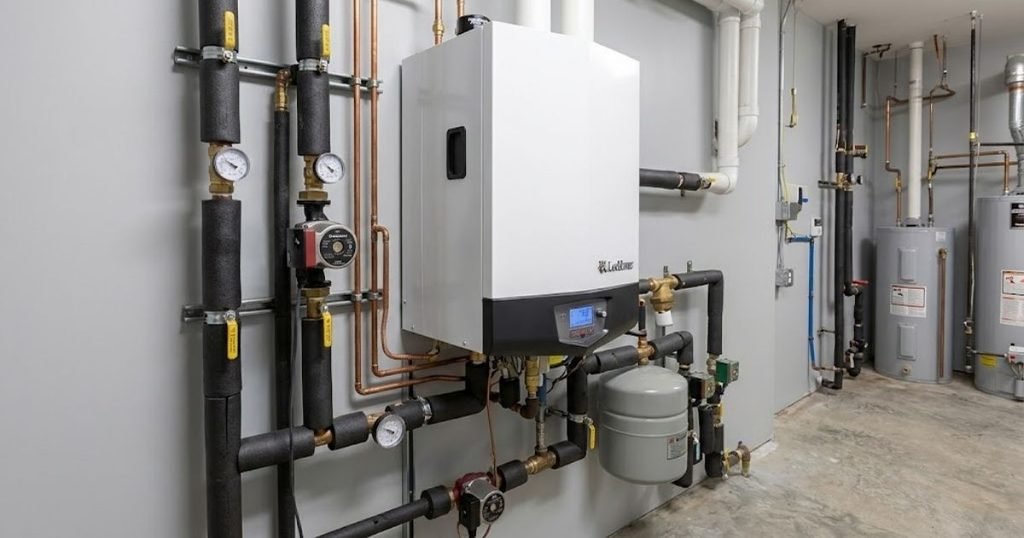
What Is a Lochinvar Boiler?
A boiler is a closed-vessel appliance designed to heat water or in some specialized systems, generate steam and circulate it throughout a home via hydronic distribution systems. These systems deliver warmth through cast-iron or panel radiators, copper-finned baseboard convectors, or embedded radiant-floor tubing.
Boilers Versus Furnaces
Unlike forced-air furnaces that heat and blow air through ductwork, hydronic boilers transfer heat directly through water, which retains heat exceptionally well. This creates a steady, even radiant warmth that many homeowners find more comfortable than forced-air heating, which can create temperature fluctuations and circulate airborne dust and allergens.
READ MORE: Weil‑McLain Boiler Reviews — Models, Costs, Pros & Cons
How Gas-Fired Condensing Boilers Work
Modern residential Lochinvar units are high-efficiency gas-fired condensing boilers. Traditional older boilers vented high-temperature exhaust gases straight up the chimney, wasting significant thermal energy. Condensing boilers, by contrast, feature secondary heat exchangers that extract extra latent heat from combustion gases before they escape. As these gases cool down inside the heat exchanger, water vapor condenses into liquid water. This condensed moisture is safely collected and routed to a floor drain or condensate neutralizer, allowing the unit to achieve exceptional thermal efficiency.
Heating-Only Versus Combi Boilers
Homeowners must choose between two primary operational designs:
- Heating-Only Boilers: Designed exclusively to supply hot water for space-heating loops. When combined with a separate indirect water heater, they supply domestic hot water via a dedicated storage tank.
- Combination (Combi) Boilers: Single, compact appliances that integrate both space heating and instantaneous domestic hot water production into one cabinet, eliminating the need for a separate water heater.
Residential Versus Commercial Equipment
While Lochinvar has built an elite reputation in large-scale commercial and industrial buildings, its residential product lines are specifically engineered for single-family homes and multi-family residential applications. Commercial units feature much larger input capacities and multi-boiler staging controls, whereas residential models scale down cleanly to fit residential mechanical rooms, standard gas lines, and typical electrical feeds.
Lochinvar Boiler Series Explained
Lochinvar structures its residential product catalog around two flagship product families: the KNIGHT series and the NOBLE series.
1. KNIGHT Series
The KNIGHT series represents Lochinvar’s premier residential heating boiler line. Available in both wall-mounted and floor-standing configurations, KNIGHT units are engineered for high-performance hydronic heating.
They feature durable stainless-steel fire-tube heat exchangers designed to resist corrosion and thermal stress, advanced modulating burners that adjust firing rates to match exact heating demands, and sophisticated on-board control systems. KNIGHT boilers are strictly heating-only units, making them ideal when paired with dedicated indirect water heaters or existing domestic water tanks.
3. NOBLE Series
The NOBLE series is designed to deliver high-efficiency condensing performance in a more streamlined, budget-conscious package. The NOBLE line includes both heating-only models (such as the NKB series) and wall-mounted combi models (such as the NKC series). NOBLE units utilize advanced stainless-steel heat exchangers and user-friendly digital control interfaces, making them popular for residential replacements where space-saving wall mounting and integrated domestic hot water are high priorities.
4. Other Lochinvar Boilers
Lochinvar manufactures massive commercial water heaters and large hydronic boilers (such as the CREST and ARMADA lines). These commercial appliances are engineered for apartment complexes, hotels, and industrial facilities. They are generally oversized, excessively complex, and building-code-prohibitive for standard single-family residential homes.
READ MORE: Electric Boiler Cost— Real Prices, Installation & Buying Guide
Five Best Lochinvar Boiler Models Reviewed
To help homeowners navigate the brand’s residential offerings, we examine five specific Lochinvar model configurations. These models represent popular choices across different installation requirements, heating capacities, and system designs.
1. Lochinvar KNIGHT Wall-Mount Boiler — WHB110N
- Best-For Recommendation: Energy-conscious homeowners with moderate heating loads who want a premium, wall-mounted heating-only boiler to save floor space.
- Boiler Type and Mounting: Gas-fired condensing, heating-only, wall-mounted fire-tube boiler.
- Rated Input Capacity and Verified AFUE: 110,000 BTU/h input rating with a published 95% Annual Fuel Utilization Efficiency (AFUE).
- Fuel Compatibility: Natural gas, with field-conversion kits available for liquefied petroleum (LP) propane.
- Key Features and Controls: Equipped with Lochinvar’s proprietary SMART SYSTEM operating control, multi-color touchscreen interface, modulating burner with a high turndown ratio, stainless-steel fire-tube heat exchanger, and an internal ECM (Electronically Commutated Motor) variable-speed boiler pump.
- Installation and System Considerations: Wall mounting requires secure structural backing (such as wood framing or concrete walls), dedicated 120V electrical supply, PVC/CPVC or polypropylene direct-venting pathways, condensate drainage, and hydronic piping matched to system flow rates.
- Main Advantages: Excellent space-saving footprint, high thermal efficiency, precise temperature modulation, and advanced outdoor reset capability.
- Potential Disadvantages or Limitations: Does not produce domestic hot water independently; requires a separate indirect tank or standalone water heater.
- Expected Maintenance Considerations: Requires annual professional combustion tuning, heat exchanger inspection, condensate trap cleaning, and igniter checks.
- Who Should Consider It: Homeowners replacing an older mid-efficiency wall or floor boiler in a medium-sized home who want top-tier modulating controls.
- Who Should Look at Another Option: Homes requiring domestic hot water integration without space for an indirect water heater tank.
2. Lochinvar KNIGHT Floor-Mount Boiler — KHB110N
- Best-For Recommendation: Homeowners who prefer a floor-standing appliance layout due to mechanical room design or weight-bearing wall limitations.
- Boiler Type and Mounting: Gas-fired condensing, heating-only, floor-standing fire-tube boiler.
- Rated Input Capacity and Verified AFUE: 110,000 BTU/h input rating and 95% AFUE.
- Fuel Compatibility: Natural gas and LP propane convertible.
- Key Features and Controls: SMART SYSTEM digital touch control, robust stainless-steel heat exchanger, wide-modulation burner, and integrated variable-speed circulator pump.
- Installation and System Considerations: Designed to sit securely on a level mechanical room floor. Requires proper clearance for service access, dedicated venting, gas supply sizing, and proper hydronic air elimination.
- Main Advantages: Eliminates the need for wall-reinforcement framing; ideal for basements or utility closets where floor space is readily available.
- Potential Disadvantages or Limitations: Occupies permanent floor space; slightly larger physical footprint than wall-hung alternatives.
- Expected Maintenance Considerations: Annual professional servicing, burner inspection, flame sensor cleaning, and safety control testing.
- Who Should Consider It: Homeowners with traditional basement utility rooms who prefer floor-mounted equipment for ease of servicing and robust structural stability.
- Who Should Look at Another Option: Homeowners with tight utility closets where wall-mounting is necessary to preserve floor storage space.
3. Lochinvar NOBLE Fire-Tube Heating Boiler — NKB150N
- Best-For Recommendation: Homeowners with larger heating loads who prefer a dedicated heating-only boiler paired with a separate high-capacity indirect water heater.
- Boiler Type and Mounting: Gas-fired condensing, heating-only, wall-mounted fire-tube boiler.
- Rated Input Capacity and Verified AFUE: 150,000 BTU/h input rating with a 95% AFUE rating.
- Fuel Compatibility: Natural gas or propane.
- Key Features and Controls: SMART CONTROL interface, stainless-steel condensing heat exchanger, modulating combustion system, and outdoor reset functionality.
- Installation and System Considerations: Higher input capacity demands careful verification of gas pipe sizing and combustion-air supply. Requires proper venting configuration and connection to existing hydronic distribution loops.
- Main Advantages: Provides robust heating output for larger homes while separating space heating from domestic hot water, ensuring abundant hot water capacity when paired with an indirect tank.
- Potential Disadvantages or Limitations: 150,000 BTU/h input is excessive for small or well-insulated homes; oversizing can lead to short-cycling.
- Expected Maintenance Considerations: Standard annual professional tune-up, vent terminal inspection, and condensate trap maintenance.
- Who Should Consider It: Owners of larger residences with high heating demands and heavy domestic hot-water usage who prefer a modular system setup.
- Who Should Look at Another Option: Small homes where a lower input capacity model prevents short-cycling and unnecessary equipment cost.
READ MORE: Best 5 High Efficiency Condensing Boiler: Review, Cost & Comparison
4. Lochinvar NOBLE Wall-Mount Combi Boiler — NKC150N
- Best-For Recommendation: Homeowners wanting a streamlined, single-unit solution for both home heating and domestic hot water without a separate water heater tank.
- Boiler Type and Mounting: Gas-fired condensing, combination (combi) boiler, wall-mounted.
- Rated Input Capacity and Verified AFUE: 150,000 BTU/h heating input rating with 95% AFUE, featuring an instantaneous domestic hot-water heat exchanger.
- Fuel Compatibility: Natural gas and propane.
- Key Features and Controls: Integrated brazed plate heat exchanger for domestic hot water, dedicated flow meter, modulating burner, and digital control panel.
- Installation and System Considerations: Requires precise incoming water pressure, adequate gas line sizing, dedicated venting, and careful management of simultaneous space heating and domestic hot-water demands.
- Main Advantages: Tremendous space savings by combining space heating and domestic hot water into one compact wall-hung cabinet; eliminates standby heat loss from storage tanks.
- Potential Disadvantages or Limitations: Instantaneous flow rates have physical limits; running multiple high-flow hot water fixtures simultaneously can stretch domestic hot-water delivery capacity.
- Expected Maintenance Considerations: Annual service, scale flushing of the domestic hot water plate heat exchanger in hard-water areas, and combustion testing.
- Who Should Consider It: Smaller to medium-sized households looking to reclaim mechanical room space by eliminating a standalone water heater.
- Who Should Look at Another Option: Large families with simultaneous high-volume hot-water habits (e.g., multiple showers running at once) who are better suited to a boiler with an indirect storage tank.
5. Lochinvar KNIGHT Wall-Mount Boiler — WHB199N
- Best-For Recommendation: Large residential properties or homes in harsh winter climates with a verified high heating load requiring maximum thermal input.
- Boiler Type and Mounting: Gas-fired condensing, heating-only, wall-mounted fire-tube boiler.
- Rated Input Capacity and Verified AFUE: 199,000 BTU/h input rating and 95% AFUE.
- Fuel Compatibility: Natural gas or propane conversion.
- Key Features and Controls: Advanced SMART SYSTEM multi-color touchscreen, high-turndown modulation, heavy-duty stainless-steel heat exchanger, and internal variable-speed circulator.
- Installation and System Considerations: Demands strict attention to gas supply line diameter, electrical circuit capacity, heavy-duty wall anchoring, and specialized venting runs.
- Main Advantages: Delivers exceptional heating power for expansive homes without stepping up to commercial-grade equipment classes.
- Potential Disadvantages or Limitations: High capacity requires precise heat-loss calculations; installing this unit in an undersized home will severely compromise efficiency and equipment longevity.
- Expected Maintenance Considerations: Routine annual cleaning, combustion analysis, safety lockout testing, and system water quality monitoring.
- Who Should Consider It: Owners of large, sprawling homes or older, poorly insulated properties with verified high BTU heating requirements.
- Who Should Look at Another Option: Average-sized modern homes where a 199k BTU input would be drastically oversized.
READ MORE: Boiler Leaking Water: Causes, Fixes, Costs & When to Call a Pro
Lochinvar Boiler Comparison Table
| Model | Boiler Type | Input Capacity | Published AFUE | Mounting | Best Suited For | Important Consideration |
| KNIGHT WHB110N | Heating-Only | 110,000 BTU/h | 95% | Wall-Mount | Medium homes, space savings | Requires separate domestic water heater |
| KNIGHT KHB110N | Heating-Only | 110,000 BTU/h | 95% | Floor-Mount | Basements, solid floor setups | Occupies floor space |
| NOBLE NKB150N | Heating-Only | 150,000 BTU/h | 95% | Wall-Mount | Larger homes, indirect tank pairings | Verify heating load to avoid oversizing |
| NOBLE NKC150N | Combi | 150,000 BTU/h | 95% | Wall-Mount | Space-saving domestic hot water + heat | Check simultaneous hot-water flow limits |
| KNIGHT WHB199N | Heating-Only | 199,000 BTU/h | 95% | Wall-Mount | Large homes, severe cold climates | Must be sized via professional load calc |
Note: Published AFUE figures and input capacities reflect manufacturer-certified ratings. Always confirm exact model specifications and local code compliance with your licensed HVAC contractor before purchasing.
How Much Does a Lochinvar Boiler Cost?
When budgeting for a boiler replacement, it is crucial to separate the equipment purchase price from the total installed cost. Purchasing the boiler unit alone typically ranges from $3,000 to $6,000+ depending on the series and BTU capacity. However, a boiler cannot operate out of a box; professional installation, specialized piping, and code compliance dictate the final investment.
Major Cost Factors
- Boiler Model and Capacity: Higher BTU inputs and premium KNIGHT series units carry higher equipment costs than entry-level NOBLE models.
- Removal and Disposal: Safely disconnecting, draining, and hauling away an old, heavy cast-iron boiler requires labor and disposal fees.
- Venting and Combustion-Air Upgrades: Condensing boilers require specialized PVC, CPVC, or stainless-steel venting routed through sidewalls or roofs, replacing old masonry chimneys.
- Gas-Line and Electrical Work: Upgrading gas pipe diameters or electrical circuits to meet modern electronic ignition and pump demands.
- Condensate Management: Installing drain lines and, where required by local plumbing codes, a condensate neutralizer to protect sewer pipes from acidic water.
- Hydronic Piping and Accessories: New expansion tanks, air separators, circulator pumps, mixing valves, and zone valves.
- Domestic Hot Water Integration: The added cost of an indirect storage tank (for heating-only boilers) or plumbing connections for a combi unit.
- Permits and Local Labor Rates: Municipal building permits, electrical/plumbing inspections, and regional contractor labor pricing.
Total installed costs for a complete Lochinvar boiler replacement generally range between $6,500 and $12,000+, depending on the complexity of the mechanical room overhaul. Homeowners should always request itemized written estimates from at least three licensed local HVAC contractors to compare scope of work, warranty offerings, and labor guarantees.
Is a Lochinvar Boiler Energy-Efficient?
Understanding boiler efficiency starts with AFUE (Annual Fuel Utilization Efficiency), which measures how much fuel is converted into usable heat over an average heating season. A 95% AFUE rating means that for every dollar spent on fuel, 95 cents is converted into home heating energy, while 5 cents escapes through venting.
High-Efficiency Condensing Performance
Lochinvar’s residential lineup achieves high efficiency through condensing technology. However, achieving peak efficiency in the real world depends on several operating conditions:
- Return-Water Temperature: Condensing boilers capture maximum heat only when water returning from the home’s radiators or baseboards is cool enough (typically below 130°F) to cause water vapor in exhaust gases to condense.
- Outdoor Reset Controls: These sensors monitor outdoor weather and adjust boiler water temperature automatically, ensuring the boiler runs at the lowest effective temperature rather than firing at maximum heat unnecessarily.
- System Balancing and Insulation: Proper home insulation, air sealing, thermostatic balancing, and regular annual maintenance ensure the boiler operates at peak design efficiency.
While upgrading to a 95% AFUE Lochinvar boiler from an aging 60% AFUE cast-iron unit yields substantial energy savings, exact utility bill reductions vary based on local fuel rates, winter weather severity, home construction, and household thermostat habits.
Lochinvar Boiler Pros and Cons
Evaluating both the advantages and potential limitations of Lochinvar equipment provides a balanced perspective for your purchasing decision.
Potential Advantages
- High Efficiency: 95% AFUE ratings on residential condensing models reduce wasted fuel.
- Modulating Burners: High turndown ratios allow boilers to scale their output down to match mild weather, preventing short-cycling.
- Stainless-Steel Heat Exchangers: Durable construction resists corrosive acidic condensate and thermal fatigue.
- Versatile Configurations: Both wall-mounted and floor-standing options, alongside heating-only and combi models.
- Advanced Diagnostics: SMART SYSTEM controls offer clear digital displays, troubleshooting codes, and smart thermostat integration.
Potential Disadvantages
- Higher Upfront Investment: Premium modulating technology and stainless-steel construction involve higher initial equipment and installation costs than basic non-condensing units.
- Strict Installation Requirements: Requires precise venting, electrical supply, and water quality management.
- Condensate Management: Must be paired with proper drainage and potentially neutralizers.
- Maintenance Demands: Advanced electronics and combustion systems require annual professional servicing to maintain peak reliability.
- Dealer Network Dependence: Access to replacement parts and specialized troubleshooting depends on having a local contractor familiar with Lochinvar controls.
How to Choose the Right Lochinvar Boiler for Your Home
Selecting the ideal boiler requires a methodical approach rather than guesswork. Use this practical homeowner checklist:
- Request a Heat-Loss Calculation: Never size a boiler solely by square footage or by matching the BTU rating of your old unit. Ask a professional contractor to perform a Manual J heat-loss calculation.
- Evaluate Your Distribution System: Confirm whether your home uses cast-iron radiators, baseboard convectors, or radiant flooring, as operating temperature requirements differ.
- Choose Domestic Hot Water Style: Decide between a heating-only boiler paired with an indirect tank or an all-in-one combi unit based on household water usage.
- Verify Fuel Supply: Ensure your natural gas meter or propane tank can supply the required peak BTU input.
- Check Installation Space: Assess wall strength for wall-mounted units, ensuring proper clearances, combustion-air supply, and service access.
- Compare Efficiency Ratings: Review verified AFUE ratings and inquire about utility rebate eligibility in your state.
- Select Controls: Determine if outdoor reset sensors, Wi-Fi thermostats, or multi-zone controls are beneficial for your household.
- Review Warranty Terms: Read the manufacturer’s warranty documentation and understand registration prerequisites.
- Verify Installer Credentials: Hire a licensed, insured HVAC professional with specific hydronic heating and condensing boiler experience.
- Plan for Long-Term Service: Establish a relationship with a local contractor who provides ongoing maintenance and parts support.
Lochinvar Boiler Installation and Maintenance
Proper installation and routine upkeep are vital for safety, efficiency, and equipment longevity.
The Professional Installation Process
Installing a high-efficiency condensing boiler is a complex technical project that should never be attempted as a DIY project. A certified technician will:
- Inspect the existing boiler, piping, and venting infrastructure.
- Perform a rigorous heat-loss and building load analysis.
- Verify gas line sizing, electrical circuits, and combustion-air pathways.
- Mount, pipe, wire, and vent the new Lochinvar appliance in accordance with local mechanical and plumbing codes.
- Commission the system, testing gas pressures, combustion efficiency, safety limit switches, and circulator pump operation.
- Walk the homeowner through basic operation, safety shutoffs, and maintenance schedules.
Homeowner Maintenance Guidance
- Schedule Annual Professional Service: Have a qualified technician inspect, clean, and tune your boiler every year before the heating season begins.
- Keep Surrounding Areas Clear: Maintain a clean, unobstructed perimeter around the boiler, ensuring no flammable materials, paint cans, or storage boxes block airflow or service access.
- Perform Visual Checks: Routinely check the condensate drain, pressure gauge, and venting pipes for any leaks, obstructions, or error codes.
- Monitor Water Pressure: Hydronic systems require stable pressure (typically between 12 and 15 PSI when cold). Consult your manual before adding water via the feed valve if pressure drops.
- Never Tamper With Safety Controls: Do not attempt to adjust gas valves, remove combustion chamber covers, or bypass electrical safety interlocks yourself.
Common Lochinvar Boiler Problems and Troubleshooting
While Lochinvar boilers are engineered for dependable operation, mechanical systems occasionally encounter issues.
Common Symptoms and Potential Causes
- Boiler Not Heating: May be caused by a tripped circuit breaker, incorrect thermostat settings, a closed gas valve, or a circulation pump failure.
- Low System Pressure: Often results from a leak in the hydronic piping, faulty expansion tank, or air trapped in the system.
- Uneven Heating: Frequently caused by air-bound radiators, unbalanced flow valves, or malfunctioning zone valves.
- Unusual Noises (Bumping or Gurgling): Usually indicates air trapped in the heat exchanger or low system water flow (boiling/scaling).
- Repeated Lockouts or Error Codes: The digital control board locks out the burner for safety if it detects ignition failure, flame loss, blocked venting, or high limit switch trips.
- Combi Hot-Water Fluctuations: Inconsistent domestic hot water can stem from exceeding the maximum flow rate or scale buildup on the plate heat exchanger.
- Condensate Drainage Backups: Clogged condensate traps or blocked drain tubes will trigger a safety switch shutdown to prevent water damage inside the unit.
Safe Preliminary Checks
Homeowners should limit troubleshooting to safe, basic steps:
- Verify that the household thermostat is set correctly and calling for heat.
- Check circuit breakers to ensure power to the boiler has not tripped.
- Note any alphanumeric fault codes displayed on the SMART SYSTEM screen and report them to your service technician.
Safety Warning: If you smell gas, immediately evacuate the building and contact your local gas utility or emergency services from a safe distance. If a carbon monoxide alarm sounds, move outside into fresh air immediately and call 911. Never attempt internal gas valve, electrical wiring, or combustion adjustments yourself.
Lochinvar Boiler Warranty and Customer Support
Lochinvar backs its residential boilers with competitive manufacturer warranties, though coverage terms vary by component and model series.
Understanding Your Warranty
- Heat-Exchanger Coverage: Typically features a multi-year limited warranty (often up to 10 or 12 years, depending on the exact model) covering the stainless-steel heat exchanger against defects in materials and workmanship.
- Parts Warranty: Standard component parts (such as controls, valves, and blowers) generally carry a separate limited warranty period (frequently 5 years).
- Registration Requirements: Many manufacturers require online product registration within a specified timeframe (typically 60 to 90 days of installation) to activate full warranty periods. Unregistered units often default to a shorter baseline warranty.
- Exclusion Covenants: Warranties typically exclude labor costs, damage resulting from improper installation, lack of maintenance, poor water quality (scaling/corrosion), freezing, or acts of nature.
Homeowners should review the exact warranty document provided with their specific model and consult the official Lochinvar website for precise terms, claim procedures, and authorized service guidelines.
Frequently Asked Questions
Are Lochinvar boilers any good?
Lochinvar boilers are widely respected in the HVAC industry for their advanced modulating controls, durable stainless-steel heat exchangers, and high thermal efficiency. Evaluating whether they are “good” for your home depends on matching the correct model series to your heating load, ensuring professional installation, and maintaining local service and parts support.
How much does a Lochinvar boiler cost installed?
A complete Lochinvar boiler installation typically costs between $6,500 and $12,000+. Total investment varies based on the selected model, labor rates in your region, venting modifications, gas-line adjustments, and whether you are adding an indirect water heater or upgrading hydronic piping.
What is the difference between Lochinvar KNIGHT and NOBLE boilers?
The KNIGHT series is Lochinvar’s premier heating-only line, featuring advanced touchscreen controls, high turndown ratios, and robust commercial-grade engineering scaled for large homes. The NOBLE series is a streamlined, cost-effective alternative available in both heating-only and wall-mounted combi configurations.
How long does a Lochinvar boiler last?
A well-maintained Lochinvar residential boiler typically has an expected service life of 15 to 20 years. Actual longevity depends heavily on installation quality, system water purity, operating frequency, adherence to annual maintenance schedules, and timely repair of worn components.
Is a Lochinvar combi boiler better than a regular boiler?
A combi boiler (like the NOBLE NKC) saves valuable mechanical room space by combining space heating and instant domestic hot water into one appliance. However, a regular heating-only boiler paired with an indirect water heater tank is often better for larger households with simultaneous high-volume hot water demands.
Final Verdict
Lochinvar boilers represent a top-tier investment for U.S. homeowners seeking advanced hydronic heating efficiency, precise temperature modulation, and durable stainless-steel construction.
- For wall-mounted heating-only needs: The KNIGHT WHB110N or WHB199N offer exceptional modulation and control features when paired with an indirect tank.
- For floor-standing mechanical rooms: The KNIGHT KHB110N provides the same robust heating performance in a traditional floor layout.
- For integrated space heating and domestic hot water: The NOBLE NKC150N combi boiler delivers space-saving convenience, provided household hot-water flow demands match its instantaneous capacity.
- For dedicated heating with separate hot water storage: The NOBLE NKB150N offers high-efficiency heating capacity for larger residences.
Disclaimer
This article is for informational and educational purposes only. Equipment specifications, pricing, local building codes, utility rebates, and warranty terms are subject to change. Always consult a licensed, qualified HVAC professional and review official manufacturer documentation before purchasing or installing residential heating equipment.
Sources Consulted
- Lochinvar Official Website & Residential Product Literature: Product specifications, technical data sheets, and installation manuals for KNIGHT (WHB and KHB series) and NOBLE (NKB and NKC series) boilers. (Available via Lochinvar Residential Boilers).
- Air-Conditioning, Heating, and Refrigeration Institute (AHRI): Certified residential boiler efficiency ratings and directory data.
- ENERGY STAR: U.S. Environmental Protection Agency energy-efficiency guidelines for residential boilers.
- U.S. Department of Energy (DOE): Residential heating systems guidance, energy conservation tips, and heating efficiency resources.