Discovering a puddle of water around your boiler can be an alarming experience for any homeowner, especially in the dead of winter when your heating system is running non-stop. A boiler leaking water is one of the most common residential heating issues, but it is not something you should ever ignore.
While a tiny, occasional drip might simply come from a loose fitting or an aging valve, a significant leak can indicate a serious system failure, excessive pressure, or a cracked internal component. Because a hydronic heating system uses water to transfer heat throughout your home, any loss of that water means your system has to work harder, run less efficiently, and risk catastrophic damage. Lets deep dive into “Boiler Leaking Water: Causes, Fixes, Costs & When to Call a Pro”
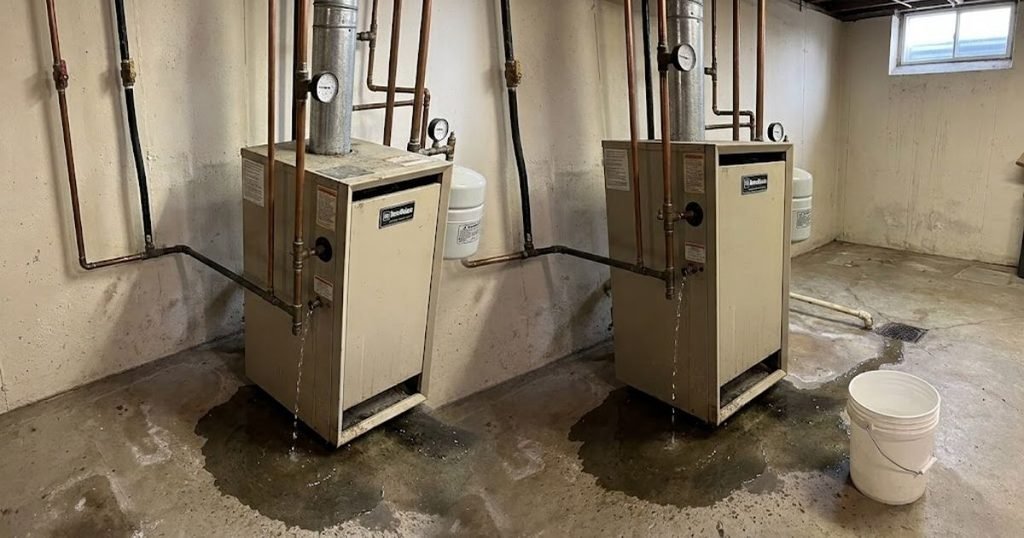
Why Is My Boiler Leaking Water?
Before you start worrying about needing a brand-new heating system, it is helpful to understand the basic mechanics. A boiler is a closed-loop system. It heats water and pumps it through the radiators, baseboards, or radiant tubing in your home. Because water expands as it gets hot, the system operates under constant pressure.
When you see a boiler leaking water, it usually means that a seal has broken, a safety valve has triggered due to high pressure, a component has corroded, or a drainage line is blocked. Common causes include:
- Loose or damaged pipe connections
- Leaking valves (especially older gate valves or ball valves)
- Pressure relief valve problems
- Excessive system pressure
- Failed or waterlogged expansion tank
- Corrosion inside the boiler body
- Cracked heat exchanger
- Leaking circulator pump
- Faulty automatic air vent
- Condensate drain or trap problems on high-efficiency condensing boilers
- Corroded fittings or aging components
- Frozen or blocked condensate piping
- Improper installation or deferred maintenance
Keep in mind that water is tricky. The visible puddle on your floor might not be directly underneath the failed component. Water can travel along pipes, drip down structural panels, or seep across flat surfaces before it finally pools.
READ MORE: Weil‑McLain Boiler Reviews — Models, Costs, Pros & Cons
Common Causes of a Boiler Leaking Water
To figure out what is going on, you need to look at the specific components of your heating system. Here is a breakdown of the most frequent culprits behind a leaking heating system.
1. Leaking Pressure Relief Valve
The pressure relief valve (PRV) is one of the most critical safety devices on your boiler. Its entire job is to release water if the pressure inside the boiler climbs too high, preventing the tank from rupturing. If you see your boiler leaking water from the pressure relief valve (usually a brass valve with a small discharge pipe pointing toward the floor), it is doing its job.
Water may discharge from the PRV due to excessive system pressure, a sudden temperature spike, or simply because the valve itself is old, faulty, and failing to hold back normal operating pressure. Safety Warning: Never cap, plug, disable, or bypass a pressure relief device. According to the U.S. Department of Energy (DOE), maintaining properly functioning pressure-relief and safety controls is essential for the safe operation of any hydronic heating system. Plugging this valve can turn your boiler into a literal bomb.
2. Boiler Pressure Is Too High
In residential homes, most hot water boilers operate at a pressure between 12 and 20 PSI (pounds per square inch). If the boiler pressure is too high, the system will actively try to protect itself by bleeding off water.
Why does pressure rise? As your boiler heats the water, the water expands. In a closed hydronic system, this thermal expansion needs somewhere to go. If the mechanisms designed to handle that expansion fail, the pressure gauge will spike, and the relief valve will spit out hot water. Do not assume there is one universal pressure number for every home; you should always consult your boiler manufacturer’s specifications and check the system gauge to see where your normal operating pressure should sit.
3. Failed or Waterlogged Expansion Tank
The expansion tank is the component that absorbs the excess pressure when your heating water expands. Older systems use large steel tanks strapped to the ceiling, while modern systems use smaller, bell-shaped tanks (often gray or green) located near the boiler.
Inside a modern expansion tank is a rubber bladder or diaphragm. One side holds system water; the other side holds pressurized air. If the bladder tears, or if the air charge is lost, the tank becomes “waterlogged.” Symptoms that point toward an expansion tank problem include:
- Boiler pressure rising significantly when the system heats up.
- Pressure dropping drastically after the system cools down.
- The relief valve repeatedly discharging water.
- The boiler losing pressure and locking out.
- Water pooling directly around the expansion tank or its threaded connection.
Because checking the air charge requires isolating the tank from system pressure, expansion-tank diagnosis and charging should generally be handled by a qualified HVAC technician.
4. Leaking Boiler Pipe or Fitting
Because boilers undergo extreme temperature fluctuations heating up to 180°F and then cooling down the metal pipes and fittings constantly expand and contract. Over the years, this thermal expansion can take a toll.
Your boiler leaking water from a pipe is often the result of loose fittings, degraded thread sealant, aging rubber gaskets, or a poor initial installation. You can usually identify a connection leak visually by looking for slow drips, hard water stains, or green/white mineral crust on the copper or brass fittings. Look closely at the joints where pipes meet the boiler body. While it is safe to look, you should not attempt to tighten heavily corroded pipes yourself, as you risk snapping the pipe and flooding your basement.
5. Corroded Boiler or Heat Exchanger
Over time, oxygen in the boiler water can react with the cast iron or steel components, causing rust and internal corrosion. This is especially true if you have poor water quality or if you have a slow leak that constantly introduces fresh, oxygen-rich makeup water into the system.
If the boiler body itself or the heat exchanger (the part that transfers the burner’s heat to the water) cracks or rusts through, water will leak directly out of the bottom of the unit. Unfortunately, if you have an internal boiler leak caused by widespread corrosion or a cracked heat exchanger, a simple repair is usually out of the question. In most cases, severe internal corrosion means you will need to replace the boiler entirely.
6. Leaking Circulator Pump
The circulator pump is the mechanical motor that pushes the hot water out of the boiler and through the pipes in your home. These pumps use mechanical seals to keep the water inside the volute (the pump housing) while allowing the motor shaft to spin.
Over time, these seals wear out. Common signs of a pump leak include water dripping directly from the pump housing, heavily corroded pump flanges, a squealing or grinding noise, and a boiler leaking water when heating. Because the circulator pump is wired with standard 120V electricity, a water leak in this area is a significant shock hazard. Use caution and avoid touching the pump if it is wet.
7. Condensate Drain or Trap Problem
If you have a modern, high-efficiency condensing boiler (typically mounted on the wall and vented with PVC pipe), your system operates differently than an old cast-iron model. Condensing boilers extract so much heat from the exhaust gases that the exhaust turns into a liquid acidic condensate. This is completely normal, and the boiler uses a condensate trap and drain pipe to route this liquid to a floor drain or condensate pump.
However, if the condensate drain gets blocked with debris, the trap cracks, or the condensate pipe freezes during a severe cold snap, the water will back up and leak out of the boiler casing. The U.S. Department of Energy notes that high-efficiency systems produce condensate that requires appropriate drainage. Managing this condensate safely is vital to keep the boiler running without locking out.
8. Automatic Air Vent Is Leaking
Hydronic systems do not like trapped air. Air causes gurgling noises and prevents heat from reaching your radiators. To combat this, most boilers feature an automatic air vent a small brass device resembling a tire valve or a tiny brass canister on the top of the boiler piping.
Inside the vent is a small float mechanism. It drops to let air out and floats up to seal the water in. Over time, dirt and mineral scale can foul the float mechanism, causing the automatic air vent to spit water or develop a continuous slow leak. While you can sometimes close the small cap on top of the vent to stop the immediate leak, a leaking air vent generally requires professional replacement.
READ MORE: Best 5 High Efficiency Condensing Boiler: Review, Cost & Comparison
Where Is the Water Coming From?
Locating the exact source of the leak is half the battle. Use this troubleshooting table to help identify what component might be failing. Remember that location alone does not always identify the source, as water can travel.
| Where You See Water | Possible Cause | What It May Mean | Recommended Action |
| Under the boiler | Cracked heat exchanger, internal corrosion, or traveling drip. | The boiler body itself may have failed, or water is running down the pipes. | Inspect upper pipes safely. Call a pro if water is coming from inside the casing. |
| Around the pressure relief valve (PRV) | High system pressure, waterlogged expansion tank, or a weak PRV. | The system is protecting itself from over-pressurization. | Check the pressure gauge. Do not plug the valve. Call a professional. |
| Near the expansion tank | Failed tank bladder, loose connection, or corroded threads. | The tank is no longer absorbing thermal expansion properly. | Tap the tank gently; if it sounds completely solid (no hollow sound), call a pro. |
| Around a circulator pump | Worn pump seals or loose flange gaskets. | The mechanical seals on the pump have degraded over time. | Keep away from electrical wires. Have a pro replace the pump or seals. |
| At a pipe connection | Loose fitting, degraded thread sealant, or thermal expansion wear. | A mechanical joint has loosened. Mineral crust is usually visible. | Place a bucket underneath. Avoid tightening heavily corroded pipes yourself. |
| Around the condensate drain (High-Efficiency) | Blocked condensate line, cracked trap, or frozen pipe. | The acidic runoff from the exhaust is backing up into the unit. | Check the PVC drain line for clogs or ice if safely accessible. |
| Inside/behind the boiler casing | Internal component failure, leaking burner matrix, or heat exchanger crack. | A major internal failure has occurred. | Shut off the boiler and call an emergency HVAC technician immediately. |
READ MORE: Why Boiler Pressure Drops: Causes & Fixes
Is a Leaking Boiler Dangerous?
The short answer is: It can be.
Because a boiler integrates water, extreme heat, pressure, electricity, and combustible gas (or oil), a leak is never something to take lightly. The level of danger depends entirely on the nature of the leak.
- Small occasional drip: A slow drip from a pipe fitting isn’t an immediate emergency, but it still needs investigation. Over time, a slow drip causes rust, rots wood floors, and causes the automatic water feeder to constantly add fresh water to the system, which accelerates internal boiler corrosion.
- Continuous leak: A steady stream of water means a component has failed. You should arrange service promptly to prevent severe water damage and system shutdown.
- Rapid water leak: If water is actively flooding out, the system needs to be shut down. You run the risk of catastrophic property damage.
- Leak combined with gas smell: DANGER. If you smell rotten eggs or natural gas near the leaking boiler, leave the area immediately. Do not flip light switches or attempt repairs. Call your gas utility company or 911 from a safe location.
- Leak near electrical components: Water dripping onto the circulator pump, zone valves, or the boiler’s main control board creates a severe electrical shock and fire hazard.
- Boiler overheating or abnormal pressure: If the pressure gauge is pegged at the maximum, the temperature is soaring, and the relief valve is blasting steam or hot water, shut the system off immediately.
Important Safety Rule: Do not provide your own unsafe workarounds. Never open combustion chambers, manipulate gas controls, bypass safety devices, or attempt to repair internal combustion components yourself.
What Should I Do If My Boiler Is Leaking Water?
If you walk into your basement or utility room and find a puddle, follow this immediate-response checklist to keep your home and family safe.
- Stay clear of hot water or steam. Boiler water can reach 180°F to 200°F. Do not walk through the puddle if it is actively steaming or near electrical wiring.
- Identify the flow rate. Is it a slow, manageable drip, or a major, rapid flow of water?
- Check the boiler pressure gauge. Look at the gauge on the front of the boiler (if it can be safely viewed without touching wet components). Normal is usually 12-20 PSI. If it is over 30 PSI, the system is over-pressurized.
- Look for obvious sources. Safely inspect visible accessible pipes, the pressure relief valve, and the bottom of the boiler casing.
- Catch the drip. If it is a small, accessible drip from a pipe fitting, place a bucket, container, or towel under it to prevent property damage.
- Shut down if necessary. If the leak is severe, spraying onto electronics, or dropping boiler pressure to zero, follow your boiler manufacturer’s shutdown instructions. This usually involves flipping the emergency boiler switch (often a red switch at the top of the stairs or near the unit) and turning off the cold-water feed valve.
- Call for help. Contact a qualified boiler or HVAC professional for persistent, significant, or internal leaks.
- Leave if you smell gas. As mentioned above, a gas odor requires immediate evacuation.
Make it strictly clear to yourself: you should not remove boiler covers or access internal combustion components simply to hunt for a leak.
READ MORE: Best Bosch Boiler Review: Greenstar Models Rated
Can I Fix a Leaking Boiler Myself?
Many homeowners want to know if they can save money with a DIY repair. The honest answer is that while you can safely diagnose and manage some minor issues, the vast majority of boiler repairs require a licensed professional. A boiler is a complex heating appliance involving hot water, pressure, electricity, and potentially combustible fuel. Improper repairs can create serious risks, including carbon monoxide poisoning, floods, or explosions.
Things Homeowners May Safely Check
- Visible water source: Using a flashlight to trace a drip back to a specific pipe.
- Boiler pressure gauge: Reading the gauge to see if pressure is abnormally high or low.
- Accessible pipe connections: Placing a bucket under a dripping joint.
- Condensate drain condition: Clearing obvious debris or unthawing a frozen PVC drain line on a condensing boiler.
- Manufacturer error codes: Checking the digital display on modern boilers and referencing the owner’s manual.
Repairs Better Left to a Professional
- Pressure relief valve replacement: Requires draining the system and ensuring the new valve meets exact pressure/BTU safety specs.
- Expansion tank diagnosis/charging/replacement: Requires isolating pressure and ensuring the system is properly bled of air afterward.
- Heat exchanger repair: Highly technical; often requires complete system replacement.
- Gas burner work: Extreme risk of carbon monoxide or fire if handled improperly.
- Electrical repairs: Replacing control boards, zone valves, or circulator pumps requires dealing with live voltage.
- Internal boiler repairs: Any leak coming from inside the insulated jacket.
- Major pipe replacement: Cutting and soldering copper pipes connected to the heating manifold.
How Much Does It Cost to Repair a Leaking Boiler?
Repair prices vary widely across the U.S. based on your location, boiler type (cast iron vs. high-efficiency condensing), fuel type, boiler age, and the exact part required. Labor rates, accessibility of the unit, and whether you need emergency after-hours service will also impact your final bill.
Below is a table of estimated U.S. cost ranges. Keep in mind that these are approximate ranges, not guaranteed quotes, and a significant portion of the cost involves the labor required to drain and refill the system.
| Repair | Typical Cost Range | Difficulty | DIY or Professional? |
| Minor fitting/connection repair | $150 – $300 | Low–Moderate | Professional recommended |
| Relief valve replacement | $150 – $400 | Moderate | Professional |
| Expansion tank replacement | $200 – $550 | Moderate | Professional |
| Circulator pump repair/replacement | $400 – $800 | Moderate | Professional |
| Condensate drain repair | $100 – $250 | Low–Moderate | Depends (Some clearing is DIY) |
| Heat exchanger repair/replacement | $1,000 – $2,500+ | High | Professional |
| Major boiler replacement | $4,000 – $10,000+ | Very High | Professional |
Note: If the repair requires draining the entire heating system, the HVAC technician must spend significant time bleeding air out of the radiators afterward, which increases labor costs.
REDA MORE: Heat Pump vs. Furnace vs. Boiler: Cost & Efficiency Comparison
Boiler Repair vs. Boiler Replacement
If your boiler is leaking water underneath or from the main tank, you will quickly face a difficult decision: Should you pay for a repair, or is it time for a total replacement? You should not automatically replace a boiler just because it has a leak, but you also don’t want to throw good money at a dying system.
Repair may make sense when:
- The boiler is relatively young (under 10-12 years old).
- The leak comes from an easily replaceable external component (like an expansion tank, PRV, or circulator pump).
- The internal heat exchanger is fully intact.
- The boiler has a documented history of routine maintenance.
- The repair cost is reasonable compared to the price of a new unit.
- The system otherwise operates reliably and heats your home efficiently.
Replacement may make sense when:
- The boiler is very old (15 to 25+ years).
- The heat exchanger is cracked or the boiler body is severely rusted and leaking water from the bottom.
- Corrosion is widespread throughout the internal components.
- You are experiencing frequent breakdowns and repairs.
- Replacement parts for your specific model are obsolete or difficult to obtain.
- The repair cost approaches 50% of the value of a new system.
- Energy efficiency and utility costs have become major concerns, making a modern high-efficiency upgrade appealing.
How to Prevent Boiler Leaks
The best way to deal with a boiler leaking water is to prevent it from happening in the first place. Proactive maintenance extends the life of your heating system and keeps small issues from becoming late-night emergencies.
- Annual professional inspection: Have a pro look at your system before the winter heating season begins.
- Monitoring system pressure: Glance at your pressure gauge once a month to ensure it is sitting in the normal range (usually 12-20 PSI).
- Checking visible fittings: Periodically look at the pipes and valves around the boiler for early signs of mineral crust or hard water stains.
- Maintaining the expansion tank: A technician can check the air charge in the tank annually.
- Keeping condensate drains clear: For high-efficiency units, ensure the PVC drain lines are free of debris and protected from freezing.
- Addressing small leaks quickly: Do not ignore a slow drip. Small drips lead to external corrosion and introduce fresh, oxygenated water into the system, causing internal rust.
- Maintaining proper water chemistry: In some systems, specialized boiler water treatments are required to prevent internal scaling and corrosion. Follow your manufacturer’s guidelines.
REDA MORE: Combi Boiler Replacement Cost: Full USA Pricing Guide
How Often Should a Boiler Be Serviced?
Annual maintenance is universally recommended for residential boiler systems by manufacturers and energy organizations alike. While you should always check your specific owner’s manual, a yearly tune-up ensures the system runs safely and efficiently.
During a standard annual service visit, a professional will typically inspect the heat exchanger, the burner and combustion system, the venting and flue, and all critical safety controls (like the low-water cutoff). They will test the pressure-relief equipment, verify the expansion tank charge, check the circulator pump, clear the condensate system, and look closely at pipes and fittings for signs of corrosion. This annual check is the absolute best defense against unexpected winter leaks.
When Should You Call a Boiler Professional?
If you are ever in doubt, pick up the phone. You should immediately seek professional HVAC service when:
- Water is leaking continuously from the boiler or surrounding pipes.
- A small leak is steadily getting worse over time.
- The boiler pressure repeatedly rises too high or falls to zero.
- The pressure relief valve is actively discharging water or steam.
- The boiler shuts down repeatedly (locking out).
- You find water pooling inside the metal boiler cabinet.
- There are heavy signs of rust and corrosion on the heat exchanger.
- The boiler makes unusual banging, whistling, or gurgling noises.
- You notice any wet electrical components.
- You cannot identify the source of the visible water puddle.
Most importantly, if there is a gas smell or steam escaping unexpectedly, evacuate and call for emergency help.
Boiler Leaking Water vs. Boiler Condensation
It is important to understand the difference between an actual system leak and normal boiler condensation.
If you own a modern, high-efficiency condensing boiler, condensation is a designed feature. These boilers pull so much heat from the exhaust that water vapor condenses into liquid form inside the unit. This acidic liquid is then safely routed out through a condensate drain pipe. If you see water dripping from the end of this dedicated PVC pipe into a floor drain, that is perfectly normal operation.
However, water dripping from copper pipe fittings, brass valves, the circulator pump, or the bottom of a traditional cast-iron boiler is never normal condensation. Location and timing are your best clues. Condensate only flows through specific PVC drains when the burner is running. A constant drip from a metal joint, regardless of whether the boiler is firing, is a true leak. Do not automatically assume every drop of water is harmless condensation.
Frequently Asked Questions
Why is my boiler leaking water underneath?
If your boiler is leaking water from the bottom, it usually indicates a serious issue such as a cracked heat exchanger, severe internal corrosion, or a failed seal inside the boiler body. It can also be caused by water traveling down the pipes from a leak higher up on the unit. Leaks underneath the unit often require professional assessment and may lead to a boiler replacement if the main tank is compromised.
Is it safe to use a boiler that is leaking water?
It depends on the leak. A very slow, occasional drip from a pipe fitting might allow you to keep the heat on temporarily while waiting for a repair. However, if the leak is rapid, coming from the pressure relief valve, pooling near electrical components, or causing system pressure to drop, it is absolutely not safe. You should shut the boiler down to prevent severe damage or safety hazards.
How do I stop my boiler from leaking water?
To temporarily stop a leak, you must turn off the power to the boiler and shut off the cold-water feed valve that supplies water to the system. This will prevent the boiler from taking on more water and continuing to flood. However, to permanently stop the leak, you will need to have a professional identify the failed component whether it is an expansion tank, valve, or pipe and replace it.
How much does it cost to fix a leaking boiler?
The cost to fix a leaking boiler varies based on the failed component. Minor repairs, like fixing a condensate drain or replacing a basic fitting, generally cost between $100 and $300. Replacing major external parts like the expansion tank or circulator pump usually ranges from $200 to $800. If the internal heat exchanger is cracked, repairs can exceed $1,500 to $2,500, often making a full boiler replacement a smarter financial choice.
Can a leaking boiler be repaired, or does it need to be replaced?
Many leaking boilers can be easily repaired. If the leak is coming from an external part like a circulator pump, pressure relief valve, expansion tank, or pipe fitting, a professional can replace that part and restore the system. However, if the leak originates from a crack in the internal heat exchanger or widespread internal rusting, the boiler will almost certainly need to be fully replaced.
Final Thoughts
A boiler leaking water is a clear distress signal from your heating system. It should never be ignored, even if the leak appears to be just a tiny drip. Small drips inevitably lead to bigger failures, rust, and water damage over time. The correct and safest solution depends entirely on the source of the water, the behavior of your system pressure, the age of your boiler, and the specific type of equipment in your home.
By familiarizing yourself with the components like the pressure relief valve, the expansion tank, and the circulator pump you can accurately identify visible symptoms and relay that information to your technician. Remember, you should avoid unsafe DIY repairs; hydronic systems operate under pressure and use high-voltage electricity and combustible fuels.
If you discover a puddle, safely check your pressure gauge, attempt to spot the source without removing internal panels, and take immediate action. If you cannot confidently and safely manage the issue, do not hesitate. Contact a qualified local boiler and HVAC professional immediately to protect your home and keep your family warm and safe this winter.
Sources & References for U.S. Homeowners:
- U.S. Department of Energy (DOE): Guidance on Hydronic Heating Systems, maintenance, and safety controls.
- ENERGY STAR: Boiler efficiency, maintenance practices, and replacement guidelines.
- Standard Manufacturer Safety Guidelines: General best practices for residential hydronic pressure relief equipment and expansion tank maintenance.