Imagine remodeling your kitchen, upgrading an electrical panel in a mid-century home, or simply replacing a worn-out outlet in your bathroom. As you review modern electrical requirements or talk with a contractor, you quickly encounter two acronyms that sound remarkably similar: GFCI and AFCI.
To the untrained eye, these devices look like standard circuit breakers or specialized wall receptacles with small buttons labeled “Test” and “Reset.” However, assuming they perform the same function is a common and potentially dangerous misconception.
Electrical safety in a modern American home involves far more than simply preventing circuit overloads or blown fuses. Different electrical hazards require entirely different protective technologies. Understanding the distinction between these devices is essential for anyone planning a home renovation, buying a first home, or upgrading an aging electrical system. Lets deep dive into “GFCI vs. AFCI: Differences, Uses, Costs, and Safety”
What Is a GFCI?
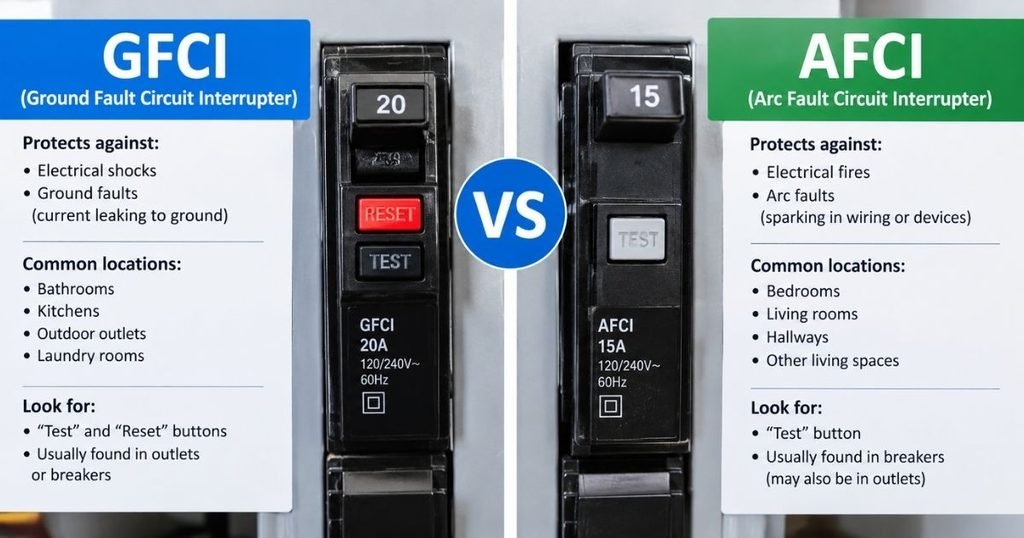
A Ground-Fault Circuit Interrupter (GFCI) is a life-saving safety device designed specifically to protect humans from electrical shock.
How a Ground Fault Occurs
Normally, electricity flows through a predictable loop: it travels from your electrical panel along the “hot” wire to an appliance or lamp, and returns via the “neutral” wire. A ground fault happens when that electricity escapes its intended pathway and finds an unintended, alternative route to the ground.
This unintended path often includes a human body, a damp floor, or metal plumbing pipes. When electricity passes through a person on its way to the ground, the result can range from a painful jolt to severe injury or fatal electrocution.
Why Water and Faulty Wiring Increase Risk
Water is an exceptional conductor of electricity. When electrical appliances such as hair dryers, toasters, or power tools come into contact with water, or when internal insulation degrades inside a damaged appliance cord, electricity can easily bridge the gap. A GFCI monitors the balance of electrical current flowing through the circuit.
The device constantly measures the amount of current traveling outward on the hot wire and returning on the neutral wire. In a healthy circuit, these two amounts are identical.
However, if even a tiny imbalance occurs as little as 4 to 6 milliamperes of current leaking away the GFCI detects the discrepancy instantly. Within a fraction of a second, the internal mechanism trips, cutting off the flow of electricity and preventing a dangerous shock.
READ MORE: Cost to Install GFCI Outlet: Pricing Guide
Where Are GFCI Outlets Commonly Used?
Because water drastically increases the risk of ground faults, GFCIs are required in wet or damp areas throughout residential properties. Common locations include:
- Bathrooms
- Kitchens (specifically for countertop receptacles and near sinks)
- Garages and accessory structures
- Outdoor receptacles and patios
- Unfinished basements and crawl spaces
- Laundry areas and utility rooms
- Wet bar sinks and pool equipment areas
Note: Exact installation requirements depend on the edition of the National Electrical Code (NEC) adopted by your state or local municipality, as well as specific installation conditions and local amendments.
GFCI Outlet vs. GFCI Circuit Breaker
Homeowners often wonder whether they should install a GFCI receptacle or a GFCI circuit breaker.
- GFCI Receptacles: These are installed directly in the wall box where an ordinary outlet would go. They protect that specific outlet and can also be wired to protect “downstream” standard outlets on the same circuit. They feature visible “Test” and “Reset” buttons right on the faceplate.
- GFCI Circuit Breakers: These are installed directly inside your main electrical service panel. A single GFCI breaker protects the entire branch circuit wiring from the panel all the way to the final outlet.
Homeowners should never assume that a single GFCI outlet protects every room or outlet in the house. Protection scope depends entirely on how the wiring was configured during installation.
What Is an AFCI?
An Arc-Fault Circuit Interrupter (AFCI) is an advanced safety device designed primarily to prevent electrical fires by detecting hazardous electrical arcing before it can ignite surrounding building materials.
How Dangerous Arcing Occurs
Electrical arcing occurs when electricity leaps across a gap between loose, damaged, or corroded electrical connections. Think of it like a miniature lightning bolt inside your wall or appliance cord.
Common causes of dangerous arcing include:
- Punctured electrical cables behind drywall (such as from a stray picture-hanging nail)
- Damaged insulation on aging wires
- Loose terminal screws inside electrical boxes
- Overheated extension cords or pinched lamp wires behind heavy furniture
- Rodent damage chewing through wire jackets
Unlike a standard overload, which trips a breaker because too many appliances are plugged in, an arc fault can generate intense, localized heat—often exceeding 5,000 degrees Fahrenheit—while drawing normal amounts of current. Traditional circuit breakers often fail to detect these erratic, high-heat arcs, allowing fires to smolder inside walls undetected until it is too late.
How an AFCI Detects Faults
An AFCI is a sophisticated electronic device. It constantly monitors the electrical waveform on a circuit, analyzing the unique high-frequency signatures and current patterns associated with hazardous arcing. When the internal microprocessor recognizes the distinct signature of a dangerous arc fault, it trips the circuit within milliseconds, interrupting power and stopping the heat source before a fire can ignite.
Where Is AFCI Protection Commonly Required?
AFCI requirements have expanded significantly across successive editions of the National Electrical Code to protect living spaces where people sleep, relax, and spend the majority of their time. Common residential applications include:
- Bedrooms
- Living rooms and family rooms
- Dining rooms and parlors
- Hallways and entryways
- Closets and lofts
- Kitchens and laundry areas (under recent modern code editions)
It is important to understand that AFCI mandates have evolved over time. One blanket list does not apply universally to every existing home across the United States. Older homes built decades ago were constructed under different code standards and are generally not required to undergo retroactive complete rewiring simply because building codes have been updated for new construction.
READ MORE: Why Does My Circuit Breaker Keep Tripping? Causes & Safe Fixes
AFCI Outlet vs. AFCI Circuit Breaker
Similar to GFCIs, AFCI protection can be implemented via two primary device types:
- AFCI Circuit Breakers: Panel-mounted breakers are the industry standard for branch-circuit protection. They protect the entire circuit run, including the wiring inside the walls and every connected outlet.
- AFCI Receptacles: First-outlet AFCI receptacles can be installed at the initial box of a branch circuit to provide system-recognized arc-fault protection for downstream wiring and receptacles, provided they are installed according to manufacturer specifications and local code allowances.
GFCI vs. AFCI: Key Differences at a Glance
To easily keep these two critical safety devices straight, review the comparison table below:
| Feature | GFCI (Ground-Fault Circuit Interrupter) | AFCI (Arc-Fault Circuit Interrupter) |
| Full Name | Ground-Fault Circuit Interrupter | Arc-Fault Circuit Interrupter |
| Main Purpose | Protection against electrical shock from ground faults | Protection against electrical fires caused by hazardous arcing |
| Hazard Detected | Ground-fault current imbalance between hot and neutral wires | Erratic electrical signatures and high-frequency characteristics associated with arcing faults |
| Common Applications | Bathrooms, kitchens, garages, outdoor outlets, and other wet/damp code-specified locations | Bedrooms, living spaces, kitchens, laundry areas, and general living spaces |
| Typical Device Forms | Receptacle or circuit breaker | Receptacle or circuit breaker |
| Reset Location | Directly on the device face or at the electrical panel | Directly on the device or at the electrical panel |
| Replaces the Other Type? | No | No |
| Combined Protection Available? | Yes, in listed dual-function products | Yes, in listed dual-function products |
Why They Are Not Interchangeable
The most vital takeaway for homeowners is that GFCI and AFCI protection address two entirely different hazards.
A GFCI does not detect arcing faults, and an AFCI does not protect you from a shock if you touch a live wire while standing in water. Installing an AFCI does not make a bathroom outlet safe from ground-fault shocks, and installing a GFCI does not protect your bedroom walls from hidden wiring fires caused by a frayed lamp cord.
READ MORE: Understanding Three Phase Electric Power
Can a Circuit Need Both GFCI and AFCI Protection?
Yes. In many modern residential remodeling and new construction projects, specific circuits require both ground-fault and arc-fault protection.
Consider a modern kitchen renovation. Kitchen countertop receptacle circuits require GFCI protection because of the proximity to sinks and potential water exposure. At the same time, modern electrical codes require kitchen branch circuits to have AFCI protection to guard against electrical fires originating from appliances, toasters, refrigerators, and hidden wall cables.
Rather than installing separate devices in series which can lead to complicated troubleshooting and nuisance tripping electricians often rely on an advanced solution.
What Is a Dual-Function AFCI/GFCI Breaker?
A dual-function breaker combines both arc-fault and ground-fault protection into a single, compact unit installed right inside your electrical panel.
- Benefits: Provides comprehensive protection against both shocks and fires on a single circuit while reducing device clutter.
- Space and Compatibility: These breakers take up the same physical slot as a standard breaker, but your electrical panel must be physically compatible with the specific manufacturer’s listed dual-function breakers (e.g., Square D, Siemens, Eaton, or General Electric).
- Professional Verification: Selecting the correct breaker requires matching the panel brand, bus bar configuration, and amperage rating. An electrical professional should always verify installation requirements to ensure code compliance and product listing validity.
GFCI vs. AFCI Code Requirements in the United States
Electrical safety regulations in the United States are guided by the National Electrical Code (NEC), a model code published by the National Fire Protection Association (NFPA) and updated on a three-year cycle. However, the NEC does not automatically become law overnight.
Each state, county, or municipality reviews the model code and decides whether to adopt it as written, modify it through local amendments, or remain on an older edition. When planning upgrades, homeowners must distinguish between:
- The Latest Published NEC Edition (such as the 2026 NEC).
- The Local Code Edition actually enforced by your municipal building department.
- Local Amendments that may add or relax specific provisions.
It is a common myth that homeowners are legally required to rip out their entire electrical system and upgrade every older outlet or breaker whenever a new NEC edition is published. Generally, code requirements apply strictly to new construction, major renovations, newly added circuits, or substantial electrical alterations.
If you are planning significant electrical work, always consult your local Authority Having Jurisdiction (AHJ) , typically your city or county building inspection department to confirm whether permits, inspections, and specific protective devices are required for your project.
READ MORE: Adding Electrical Sub Panel: Cost & Requirements
How to Tell Whether Your Home Has GFCI or AFCI Protection
Before buying replacement parts or hiring a contractor, you may want to check what kind of protection your home currently has. Here are safe, practical ways to inspect your system without risking your safety:
- Look for Test and Reset Buttons on Outlets: GFCI receptacles are easily identified by the rectangular “TEST” and “RESET” buttons molded into their plastic faceplates. If you see these on kitchen or bathroom outlets, you have local GFCI protection.
- Inspect Your Electrical Panel Labels: Open the outer door of your breaker box. Look at the circuit directory or inspect the physical breakers themselves. Breakers equipped with AFCI, GFCI, or dual-function capabilities usually feature a small test button and an indicator flag or label on the toggle switch.
- Understand Upstream Protection: Remember that a standard-looking receptacle may still be protected if it is wired “downstream” from a GFCI outlet or a panel-mounted safety breaker.
- Never Remove Panel Covers: Homeowners should never remove deadfront panel covers, unscrew breaker enclosures, or touch exposed internal electrical components. Panel inspections involving exposed wiring must be left strictly to qualified professionals.
Appearance alone cannot confirm whether an entire circuit is fully or properly protected. When in doubt, verification requires professional testing equipment.
How to Test GFCI and AFCI Devices Safely
Both GFCIs and AFCIs are sophisticated electronic devices with internal components that can wear out or fail over time. Regular testing ensures they are functioning properly. Homeowners should always follow the device manufacturer’s testing instructions.
Testing GFCI Devices
- Plug a small nightlight or lamp into the receptacle to verify that power is currently flowing (the light should turn on).
- Press the TEST button on the face of the GFCI receptacle or breaker. The button should click, and the connected lamp should turn off instantly, proving that power has been interrupted.
- Press the RESET button firmly. The lamp should turn back on. If the device does not trip when tested, or if it fails to reset, the unit is compromised and must be replaced immediately.
Testing AFCI Devices
- Locate the correct AFCI breaker in your electrical panel.
- Press the built-in TEST button on the breaker switch.
- The breaker handle should trip to the “Tripped” or middle position, and power to that circuit should cut off.
- Flip the breaker completely to the “OFF” position, then back to “ON” to reset it.
Manufacturer guidelines often recommend testing these devices monthly. However, never open electrical panels, bypass safety mechanisms, or repeatedly force a breaker to reset if it continuously trips.
Common Reasons GFCI and AFCI Devices Trip
When a safety device trips, it is usually doing its job. However, figuring out why it tripped can sometimes feel frustrating.
- Moisture or Leakage Current (GFCI): Water seepage in outdoor boxes, condensation in garage outlets, or steam in bathrooms can cause minor current leakage, prompting a GFCI to trip.
- Damaged Cords or Defective Appliances (GFCI/AFCI): A frayed toaster cord, a cracked hair dryer heating element, or a damaged vacuum cleaner wire can create dangerous shorts or arcing.
- Loose Terminal Connections (AFCI): Over time, thermal expansion and contraction can loosen wire connections behind outlet boxes or inside panel terminals, generating heat and triggering arc-fault trips.
- Nuisance Trips: Occasionally, older electronic equipment, heavy motor-driven appliances, or improper wiring shared between neutral paths can cause false trips.
If a device trips, unplug any recently connected equipment and try resetting it once. If the device trips again immediately, leave it off. Unplug affected equipment and contact a qualified electrician to diagnose the underlying wiring issue. Never defeat, bypass, or replace a protective safety device with an ordinary standard breaker simply to stop nuisance tripping.
READ MORE: SEU Cable Guide: Sizes, Uses, Benefits & Buying Tips
GFCI vs. AFCI Installation Cost
Electrical upgrade costs vary widely based on your geographic region, labor rates, the condition of your existing wiring, panel compatibility, permits, and job complexity.
Approximate Cost Categories
- GFCI Receptacle Replacement: Generally ranges from $150 to $300 per outlet when performed by a professional electrician, factoring in labor and travel fees. (DIY material cost for a single outlet is around $15 to $25).
- GFCI Circuit Breaker: Typically costs $150 to $350 per breaker installed, depending on panel brand and labor rates.
- AFCI Circuit Breaker: Generally ranges from $175 to $400 per breaker installed, as AFCI breakers contain complex microprocessors and are more expensive than standard breakers.
- Dual-Function AFCI/GFCI Breaker: Usually ranges from $200 to $450 per unit installed.
- Panel Upgrades / Troubleshooting: If your older electrical panel cannot accept modern safety breakers, a subpanel or a full electrical service upgrade may be required, ranging from $2,500 to $4,500+.
| Project Type | Main Cost Factors | What Homeowners Should Ask an Electrician |
| GFCI Outlet Upgrade | Accessibility, box size, downstream wiring condition, labor rates | “Does this single receptacle protect downstream outlets on this circuit?” |
| AFCI Breaker Installation | Panel brand compatibility, age of existing panel, permit fees | “Is my current electrical panel compatible with modern AFCI breakers, or do I need a panel upgrade?” |
| Dual-Function Breaker Upgrade | Circuit load, wiring configuration, inspection requirements | “Would a dual-function breaker solve code requirements for both shock and fire protection here?” |
Note: The figures above are approximate estimates for informational purposes and do not constitute guaranteed quotes or national pricing standards.
Common GFCI and AFCI Mistakes Homeowners Should Avoid
- Assuming GFCI and AFCI are interchangeable: Believing one covers both hazards leaves your home vulnerable to unaddressed risks.
- Believing standard breakers provide safety protection: Standard thermal-magnetic breakers protect against overloads and short circuits only—they do not protect against ground-fault shocks or low-current arcing faults.
- Assuming every outlet needs its own device: Failing to realize that one strategically placed GFCI or breaker can protect multiple downstream receptacles.
- Assuming every test button means the same thing: Assuming an outlet test button guarantees fire arc protection.
- Installing incompatible breakers: Attempting to force a breaker brand into a mismatched electrical panel creates serious fire and safety hazards.
- Ignoring repeated trips: Repeatedly resetting a tripping breaker without investigating the root cause.
- Replacing devices without checking local codes: Ignoring current NEC requirements or local amendments during remodeling projects.
- Attempting live electrical work: Working on energized wires or panels without proper professional training, safety gear, and qualifications.
Safer Alternative: For every electrical installation or troubleshooting challenge, rely on structured testing, verify product compatibility, and partner with licensed electrical professionals.
When Should You Call a Licensed Electrician?
While homeowners can safely test existing GFCIs and AFCIs using their built-in test buttons, electrical installation and panel work require specialized knowledge and licensing. Call a qualified electrician immediately if you encounter:
- The need to install or replace panel-mounted AFCI, GFCI, or dual-function breakers.
- An aging, obsolete electrical panel (such as outdated brands known for safety recalls).
- Major room additions, kitchen remodels, or finished basement wiring projects.
- Persistent, repeated breaker trips that resist simple troubleshooting.
- Warning signs of electrical failure: burning smells, buzzing sounds, discolored or scorch-marked outlets, warm switch plates, or flickering lights.
If you ever notice smoke, sparks, or an active electrical fire, evacuate the home immediately and call 911.
Frequently Asked Questions
What is the main difference between GFCI and AFCI?
The primary difference lies in the hazard each device targets. A GFCI (Ground-Fault Circuit Interrupter) protects people against severe electrical shock by cutting power when current leaks along an unintended path, such as through water or a human body. An AFCI (Arc-Fault Circuit Interrupter) protects property against electrical fires by detecting dangerous, erratic electrical arcing in damaged wires or cords.
Do I need both GFCI and AFCI protection in my home?
Yes, certain areas and circuits in modern homes require both forms of protection. For instance, kitchen countertop circuits require GFCI protection due to water proximity and AFCI protection to prevent appliance- and wiring-induced fires. Whether both are required depends on your local building code, the room’s function, and the NEC edition adopted by your local jurisdiction.
Is an AFCI outlet the same as a GFCI outlet?
No. Although both can be installed in wall boxes and feature test buttons, they serve completely different safety functions. A GFCI monitors current imbalance to prevent shocks, while an AFCI monitors high-frequency electrical signatures to prevent fires. Installing one does not provide the protection of the other unless you use a specialized dual-function device.
Can I replace a regular breaker with a GFCI or AFCI breaker myself?
Working inside an electrical service panel exposes you to live, uninsulated bus bars carrying lethal voltage. Because panel compatibility, torque specifications, and code compliance are critical, replacing breakers inside a main panel should always be performed by a licensed, qualified electrician.
Why does my GFCI or AFCI breaker keep tripping?
Frequent tripping indicates that the device is detecting an active hazard or abnormality, such as moisture in an outdoor box, a damaged appliance cord, a pinched wire inside a wall, or loose terminal connections. Do not bypass the device or repeatedly reset it; unplug affected devices and contact an electrician to diagnose the root cause safely.
Final Verdict
Electrical safety is not a one-size-fits-all proposition. Protecting your family and property requires understanding that GFCI protection safeguards human life against devastating electric shocks, while AFCI protection guards your home against hidden electrical fires.
Key takeaways to remember:
- GFCIs prevent shocks in wet and damp locations like bathrooms, kitchens, and outdoor spaces.
- AFCIs prevent fires by detecting dangerous arcing in bedrooms, living areas, and general circuits.
- Modern codes increasingly require both protections, sometimes combined into convenient dual-function breakers.
- Code requirements vary by location, local adoption editions, and project scope.
Take time to test your existing devices monthly, review your local electrical code requirements when planning renovations, and always consult a qualified, licensed electrician for panel work and complex electrical upgrades.
Source List
- National Fire Protection Association (NFPA): National Electrical Code (NEC) standards and adoption guidelines.
- Electrical Safety Foundation International (ESFI): Residential GFCI and AFCI safety recommendations and educational resources.
- U.S. Consumer Product Safety Commission (CPSC): Consumer guidance on electrical fire prevention and shock safety.
- Electrical Equipment Manufacturers: Product specifications, installation instructions, and testing protocols for residential circuit protection devices.
Electrical Safety Disclaimer
This article is intended for informational and educational purposes only and does not constitute professional electrical engineering or contracting advice. Electrical work carries inherent risks of severe injury or death. Homeowners should not attempt to work inside energized electrical panels or perform complex wiring modifications. Always consult a qualified, licensed electrician and verify local code requirements with your municipal building department before undertaking electrical projects.