Knowing how to turn off water main valve quickly and safely is arguably the single most important plumbing skill a homeowner can possess. Whether you are dealing with a sudden emergency plumbing shutoff, preparing for a major bathroom renovation, or heading out of town for a long winter vacation, mastering the art of shutting down your home’s water supply can save you from catastrophic repair bills and endless stress.
In this comprehensive guide, we will walk you through everything you need to know about your home’s main water supply system. As an experienced residential plumbing professional, I will show you how to locate your valve, identify its type, operate it correctly without damaging your plumbing, and know when it is time to call in a licensed professional. Lets deep dive into “How to Turn Off Water Main Valve: A Step-by-Step Guide”
What Is a Main Water Shutoff Valve?
Before diving into the operational steps, it helps to understand what this critical piece of plumbing equipment actually does. The main water shutoff valve is the master control gate for all water entering your residential property. When municipal water travels from city mains or a private well pump toward your house, it passes through this primary valve before branching off to supply your kitchen sink, showers, toilets, washing machine, and water heater.
Unlike individual fixture shutoff valves which are small, localized valves located directly under sinks or behind toilets the main water shutoff valve controls the entire house at once. If you need to replace a kitchen faucet, you can simply use the under-sink shutoff valves. However, if a pipe bursts inside a wall, a supply line snaps off under pressure, or your water heater begins leaking uncontrollably, closing individual valves is useless. You need an emergency plumbing shutoff that halts the entire flow instantly.
| Valve Type | What It Controls |
| Main water shutoff valve | Water supply to the entire house |
| Sink shutoff valve | Water supply to a particular sink |
| Toilet shutoff valve | Water supply to a single toilet |
| Water heater shutoff valve | Water supply exclusively to the water heater tank |
| Washing machine shutoff valve | Water supply to the washing machine hoses |
Understanding this hierarchy helps explain why every adult member of your household should know where the main valve is and how to operate it long before an emergency strikes.
READ MORE: Professional Water Leak Detection Services: Costs & Guide
Where Is the Main Water Shutoff Valve Located?
One of the most common questions homeowners ask is, “Where is the main water shut off valve located?” The honest answer is that it depends entirely on your geographical location, the age of your home, its architectural style, and local climate conditions. Because plumbing installation practices vary widely across the United States, valves can be found in several different areas:
- The Basement: In cold-weather northern states with full basements, the main water line almost always enters through the front foundation wall facing the street. The shutoff valve is typically located within a few feet of where the pipe pierces the foundation, sitting roughly three to five feet off the ground.
- The Crawl Space: In homes built over crawl spaces, look near the perimeter wall closest to the municipal street or water meter. You may need a flashlight and protective clothing to access it safely.
- The Garage: In warmer southern climates where freezing temperatures are rare, the main water shutoff valve is frequently located on an exterior garage wall, often near the water heater or pressure-reducing valve (PRV).
- The Utility Room or Mechanical Closet: Many modern homes group the water heater, furnace, and main water entry point together in a dedicated utility room or hallway closet.
- Outside Near the Foundation: In mild climates without basements or crawl spaces, the valve may be housed inside an underground utility box (sometimes called a meter box or valve box) buried flush with the lawn or flower beds near the front foundation wall.
- Near the Water Meter: In many suburban neighborhoods, the homeowner’s primary shutoff valve sits directly adjacent to the water meter, either indoors or in an outdoor utility vault.
To identify your incoming water line, look for a thick metal pipe (copper or galvanized steel) or rigid blue/black PEX piping emerging straight out of the ground or foundation wall. It will usually have a pressure gauge, a water meter, or a backflow preventer attached nearby.
Different Types of Main Water Shutoff Valves
Not all residential water valves are built the same. When figuring out how to shut off main water supply, you must first recognize the specific mechanical design of your valve. Here are the three most common types found in US homes:
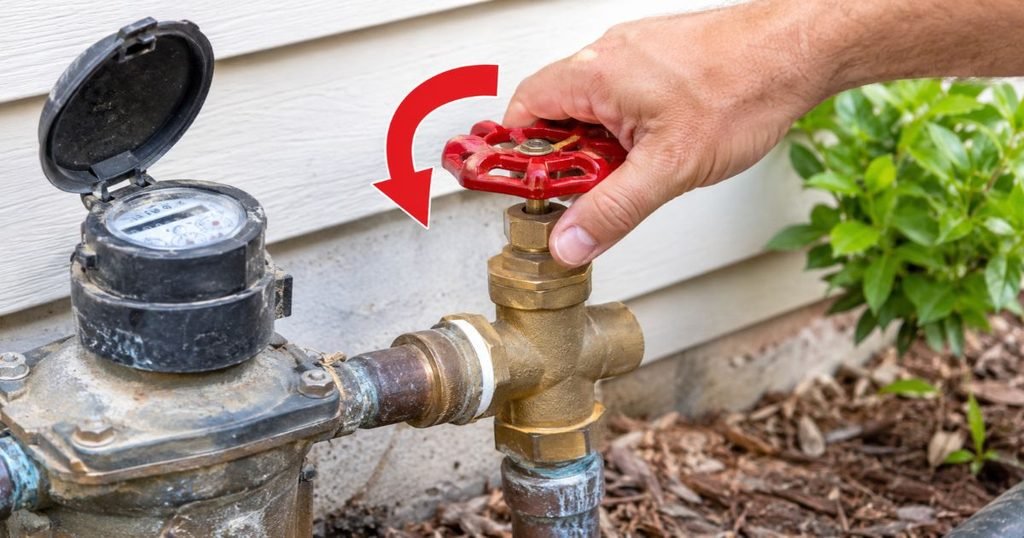
A. Gate Valve (Round Wheel Handle)
Gate valves are traditional plumbing fixtures found in millions of older American homes.
- How to recognize it: They feature a distinct round, spoked metal wheel handle that looks similar to an outdoor garden hose spigot handle.
- How its internal mechanism works: Inside the pipe, a solid brass or bronze wedge (the “gate”) moves up and down on a threaded stem. When you turn the wheel, the gate lowers to block the water flow or rises to open the channel.
- Operation note: Gate valves require multiple full rotations (often three to five full turns) to move from fully open to fully closed.
- Closing direction: Like standard screws, gate valves close when turned clockwise (to the right).
B. Ball Valve (Lever Handle)
Ball valves are the modern industry standard for residential plumbing because of their reliability, durability, and ease of use.
- How to identify it: They feature a flat metal lever handle rather than a round wheel.
- How its internal mechanism works: Inside the valve body sits a solid metal ball with a hollow hole drilled right through the center. When the handle is aligned with the pipe, water flows freely through the hole. When turned, the solid part of the ball blocks the pipe entirely.
- Operation note: Ball valves operate on a quick quarter-turn (90-degree) mechanism.
- Recognizing positions: When the lever handle is parallel to the water pipe, the valve is open. When the lever is turned so that it sits perpendicular (forming a “T” shape across the pipe), the valve is closed.
C. Older or Corroded Shutoff Valves
In older homes, valves may suffer from decades of neglect, mineral scaling, or corrosion.
- Signs of corrosion: White, green, or powdery rust buildup around the packing nut and body; mineral crust sealing the threads.
- Handling issues: Stiff, rigid handles that refuse to budge; slight weeping or leakage around the valve stem when nudged.
- Critical warning: Never force an old, corroded valve with heavy wrenches, hammers, or cheater bars. Forcing a stuck gate valve can snap the internal brass stem or crack the valve body, turning a minor maintenance check into a catastrophic total main line break.
| Valve Appearance | Operating Method | Typical Application |
| Round wheel handle | Multiple clockwise turns | Older homes, main lines, hose bibs |
| Flat lever handle | 90-degree quarter turn | Modern homes, main lines, water heaters |
| Corroded wheel/lever | Requires caution or replacement | Unmaintained older properties |
READ MORE: Gas Water Heater Troubleshooting: Common Problems and Fixes
How to Turn Off Water Main Valve: Step-by-Step Instructions
When an emergency strikes or maintenance beckons, you need a clear, reliable action plan. Follow these numbered steps to execute a safe emergency plumbing shutoff in your home.
Step 1: Locate Your Main Water Shutoff Valve
Head directly to the primary entry point where municipal service enters your home—typically the basement foundation wall, garage utility wall, or crawl space perimeter. Clear away any boxes, storage bins, or shelving blocking access so you can work comfortably.
Step 2: Identify the Valve Type
Examine the valve carefully. Determine whether you are dealing with a traditional multi-turn round gate valve or a modern quarter-turn lever ball valve. This dictates how much movement is required to shut off the water to your house.
Step 3: Turn Off a Gate Valve
If your home is equipped with a round wheel gate valve:
- Grip the round metal wheel firmly with your hand.
- Begin turning the wheel clockwise (to the right).
- Continue turning smoothly until you feel firm resistance and the wheel stops moving completely.
- Do not overtighten or wrench it down with pliers; closing it firmly by hand is sufficient to seat the internal gate.
Step 4: Turn Off a Ball Valve
If your home features a modern lever-style ball valve:
- Locate the flat metal lever handle.
- Rotate the handle approximately one-quarter turn (90 degrees) in either direction.
- Stop when the lever is positioned completely perpendicular (at a 90-degree right angle) to the water pipe.
Step 5: Verify That the Water Is Off
Never assume the valve worked just because you turned the handle. You must verify that the main water shutoff valve location has successfully severed the supply:
- Walk to the nearest lower-level sink (such as a laundry room or basement utility sink).
- Open both the hot and cold faucet handles fully.
- Observe the flow: water will sputter and drain out for a few seconds as residual pressure bleeds off, but the stream should quickly die down to a complete drip-free stop.
- Test a second fixture on an upper floor to ensure the entire house system is isolated.
Step 6: Relieve Remaining Water Pressure When Appropriate
Even after the main valve is fully closed, pressurized water remains trapped inside your home’s vertical and horizontal supply pipes. Opening multiple faucets on the lowest and highest levels of your home helps drain this trapped water, reducing pressure on compromised pipes before a plumber begins repairs.
How to Turn Off Water at the Water Meter
Sometimes, a home’s primary indoor shutoff valve is rusted solid, broken, or completely inaccessible behind finished basement drywall. In these rare scenarios, homeowners must look outward toward the street and learn how to turn off water at the water meter.
Residential water meters are typically housed inside an underground concrete or plastic box located near the property line, near the sidewalk, or close to the front curb. Inside the meter box, you will find the municipal water meter along with two distinct valves:
- The Utility-Side Valve: Located on the street side of the meter, this valve is strictly owned, operated, and maintained by the municipal water department.
- The Customer-Side Valve: Located on the house side of the meter, this valve controls the service line feeding your private property.
Important Safety Warning: Do not assume every water meter valve is designed for homeowner operation. Many municipal water utilities strictly prohibit homeowners from tampering with meter-side equipment, and some meters require specialized pentagonal meter keys or curb stop wrenches to operate. If your indoor main shutoff valve is broken, your safest and most legal course of action is to call your local water utility or a licensed plumber to shut off the water at the street safely.
READ MORE: How to Plumb a Shower Valve (Step-by-Step DIY Guide)
When Should You Turn Off the Main Water Valve?
Knowing how to shut off water to your house is empowering, but knowing when to execute that shutdown is equally vital. You should shut off your home’s main water supply in the following scenarios:
- Burst or Leaking Pipes: If freezing temperatures or shifting soil causes a copper or PEX pipe to rupture, cutting the main supply stops indoor flooding immediately.
- Major Plumbing Leaks: Significant joint failures under sinks, behind walls, or beneath floorboards.
- Water Heater Tank Failures: If your water heater rusts through and begins flooding the garage or utility room floor.
- Plumbing Renovations: Anytime you install a new shower valve, reconfigure bathroom supply lines, or replace toilets and sinks.
- Extended Vacations: When leaving your home unoccupied for weeks during winter or summer travel, shutting off the water prevents catastrophic slow leaks from turning into disaster while you are away.
- Frozen Pipe Emergencies: If pipes begin frosting over or showing early signs of splitting during severe cold snaps.
- Washing Machine Hose Blowouts: When old rubber washing machine supply lines rupture and flood the laundry area.
If a leak is isolated entirely to a single toilet tank or bathroom faucet and you can easily access that fixture’s local shutoff valve under the bowl or sink, use that instead. There is no need to shut down the entire house for a minor localized repair.
What to Do After Turning Off the Main Water Supply
Once you have successfully executed an emergency plumbing shutoff, take a deep breath and focus on damage control and safety:
- Inspect the Affected Area: Locate the source of the leak and assess the scale of the water damage.
- Prioritize Electrical Safety: Never walk into standing water in a basement or utility room if electrical outlets, extension cords, extension strips, or appliances (like washing machines or water heaters) are submerged. Shut off the main circuit breaker to that area if it is safe to reach.
- Contain Standing Water: Use buckets, towels, a wet/dry shop vacuum, or a submersible utility pump to remove standing water before it ruins subflooring or baseboards.
- Move Valuables: Quickly relocate rugs, furniture, electronics, and sentimental items away from wet zones.
- Call a Licensed Plumber: Unless you are an experienced DIYer with proper soldering or PEX crimping tools, call a professional plumber to repair the broken pipe or failed fixture.
- Document Damage: Take clear photographs and videos of the water damage before cleanup for your homeowner’s insurance claim.
How to Turn the Main Water Valve Back On
Once plumbing repairs are fully completed and inspected, you can restore water to your home. Doing this incorrectly can cause devastating pressure shocks (water hammer) that burst fresh solder joints. Follow these steps on how to turn water back on after shutting it off:
- Verify Repairs Are Complete: Ensure your plumber has finished all pipe repairs, glued joints have cured properly, and all tools are cleared away.
- Close All Fixtures: Make sure every faucet, shower, and washing machine valve in the house is turned firmly to the “off” position. This prevents water from spraying uncontrolled indoors as pressure returns.
- Reopen the Valve Very Slowly:
- If you have a gate valve, turn the round handle counterclockwise (to the left) slowly.
- If you have a ball valve, rotate the lever handle slowly back toward a position parallel to the pipe.
- Crucial Rule: Open the valve only halfway at first. Listen to the pipes fill slowly with water over 30 to 60 seconds before opening the valve the rest of the way.
- Bleed Trapped Air: Slowly open the highest faucet in your home (such as an upstairs bathroom sink) to let trapped air escape. The faucet will sputter and spit air for a moment before running smooth. Repeat this for all other faucets in the house.
- Inspect for Leaks: Walk through your home and inspect all repaired joints, water heater connections, and fixture supply lines to ensure everything is dry and secure.
READ MORE: Shower Head Leaking From Head: Causes & Fixes
What If the Main Water Shutoff Valve Won’t Turn?
It is every homeowner’s nightmare: an emergency is unfolding, you reach the main valve, and the handle is frozen solid. Here is how to handle stubborn valves:
- Mineral Buildup & Rusted Handles: Older brass valves often accumulate calcium and lime deposits around the packing nut. Spraying a small amount of penetrating lubricant (such as WD-40 or PB Blaster) around the stem and letting it sit for 10 minutes can loosen minor corrosion.
- Using Proper Leverage: If a ball valve lever is stiff, you can use a pair of channel-lock pliers for gentle leverage, ensuring you push or pull in line with the handle design.
- When to Stop: Never use blowtorches, hammers, cheater pipes, or extreme brute force on residential valves. If a valve refuses to turn after gentle lubrication, stop immediately. Call your local water utility to shut off water at the street, and hire a licensed plumber to replace the faulty indoor valve with a modern ball valve.
How Much Does It Cost to Replace a Main Water Shutoff Valve?
If your main shutoff valve is leaking around the stem, stuck open, or completely broken, replacing it is a necessary investment. While prices vary depending on your geographic region, local plumber labor rates, pipe material (copper, PEX, galvanized steel, or PVC), and how accessible the valve is behind walls or in tight crawl spaces, homeowners typically pay anywhere from $150 to $450 for professional replacement.
Emergency after-hours plumbing calls or jobs requiring the local water utility to excavate or shut off water at the street curb can drive total costs higher. Always request a clear, upfront estimate from a licensed local plumber before authorizing repair work.
DIY vs. Calling a Professional Plumber
| Task | Suitable for DIY? | Requires Professional Plumber? |
| Locating and labeling the main valve | Yes | No |
| Operating a working, accessible valve | Yes | No |
| Emergency plumbing shutoff | Yes | No |
| Replacing a damaged or stuck valve | No (unless experienced with plumbing/soldering) | Yes |
| Repairing corroded or leaking main pipes | No | Yes |
| Working on municipal water meter equipment | No | Yes / Utility Provider |
| Handling complex multi-zone or fire sprinkler systems | No | Yes |
When in doubt, always prioritize safety and property protection by contacting a licensed professional.
READ MORE: How to Fix a Leaking Electric Water Heater Pressure Relief Valve?
Common Plumbing Terminology
- Main Water Line: The primary pipe delivering pressurized water from the municipal main or well pump into your home.
- Gate Valve: An older style valve utilizing a threaded internal wedge and round wheel handle to restrict or allow water flow.
- Ball Valve: A modern, highly reliable valve using a perforated internal metal ball and a 90-degree lever handle.
- Water Meter: A utility device measuring total household water consumption, usually located near the property boundary or inside a basement utility room.
- Water Hammer: A hydraulic shock wave caused by sudden changes in water velocity, often heard as a loud banging noise in pipes when faucets snap shut.
- Residual Water: Leftover water trapped inside horizontal and vertical supply lines after the main supply valve is closed.
Frequently Asked Questions
Which way do you turn the main water shutoff valve to turn it off?
To turn off your home’s main water valve, you generally turn traditional round gate valves clockwise (to the right) until they come to a complete stop. For modern lever-style ball valves, you rotate the handle 90 degrees (a quarter-turn) so that the lever sits perpendicular (forming a “T” shape) across the water pipe.
Where is the main water shutoff valve usually located in a house?
In northern states with basements, the main water shutoff valve is typically located on the front foundation wall facing the street, about three to five feet off the ground. In southern or slab-foundation homes, you will often find it in the garage near the water heater, inside an exterior utility closet, or underground in a protective valve box near the front property boundary.
Can I turn off my home’s main water valve myself?
Yes, absolutely. Every homeowner should know how to operate their main water shutoff valve during plumbing emergencies. Working valves require no special tools—you simply turn a lever or wheel by hand. However, if your valve is heavily corroded, stuck, or located on the municipal side of the water meter, you should avoid forcing it and contact a licensed plumber or your local water utility
How do I know if my main water valve is completely off?
After turning the valve to the closed position, walk to the lowest sink in your house (such as a basement laundry tub or ground-floor bathroom) and open both the hot and cold faucet handles fully. Water will sputter and drain out briefly as residual pipe pressure bleeds away, but the stream should quickly stop entirely. If water continues running steadily, the valve is either not fully closed or worn out.
Is it safe to leave the main water valve off for a long time?
Yes, it is entirely safe to leave your main water valve shut off for extended periods, making it an essential practice when leaving your home vacant for winter vacations or prolonged travel. Leaving the water off eliminates the risk of catastrophic pipe bursts, appliance hose failures, or slow fixture leaks while you are away, giving you total peace of mind.
Conclusion
Mastering how to turn off water main valve operations is a foundational milestone of responsible homeownership. Taking ten minutes today to locate your valve, identify its mechanical style, and ensure it operates smoothly can be the difference between a minor plumbing repair and a devastating, thousands-of-dollar indoor flood tomorrow. Take control of your home’s plumbing system today: locate your main valve, label it clearly, and ensure everyone in your household knows how to use it in an emergency.
Sources:
- American Water Works Association (AWWA) Residential Plumbing Guidelines
- San Francisco Public Utilities Commission (SFPUC) Emergency Shutoff Resources
- Sacramento Suburban Water District Homeowner Maintenance Manuals
- Licensed Residential Plumbing Industry Best Practices
Homeowner Safety Disclaimer:This article is provided for general informational and educational purposes only and does not constitute professional plumbing, engineering, or legal advice. Plumbing systems vary widely by age, region, and construction style. If you encounter stuck, corroded, or damaged plumbing components, or if you are uncomfortable performing basic maintenance, always consult a licensed, insured professional residential plumber.

