However, even the most reliable engineered heating systems can experience operational hiccups over time. When your morning shower turns suddenly icy, or an unfamiliar error code starts blinking on your controller, it can throw your entire household routine into chaos. Dealing with Rinnai tankless water heater problems can feel frustrating, especially if you are new to the world of tankless technology.
Common issues range from simple operational quirks such as low water flow triggering minimum activation thresholds to more complex mechanical challenges like mineral scaling in the heat exchanger, ignition failures, unexpected shutdowns, and water leaks. The good news is that many everyday issues stem from basic external factors or routine maintenance needs that you can easily understand or safely check yourself. Others, however, require the expertise of a licensed plumbing professional.
In this comprehensive guide, we will break down the most common Rinnai tankless water heater problems, explore their root causes, provide safe step-by-step troubleshooting advice, review realistic repair costs, and help you determine when it is time to call in a pro. Lets deep dive into ‘Rinnai Tankless Water Heater Problems: Common Issues & Fixes”
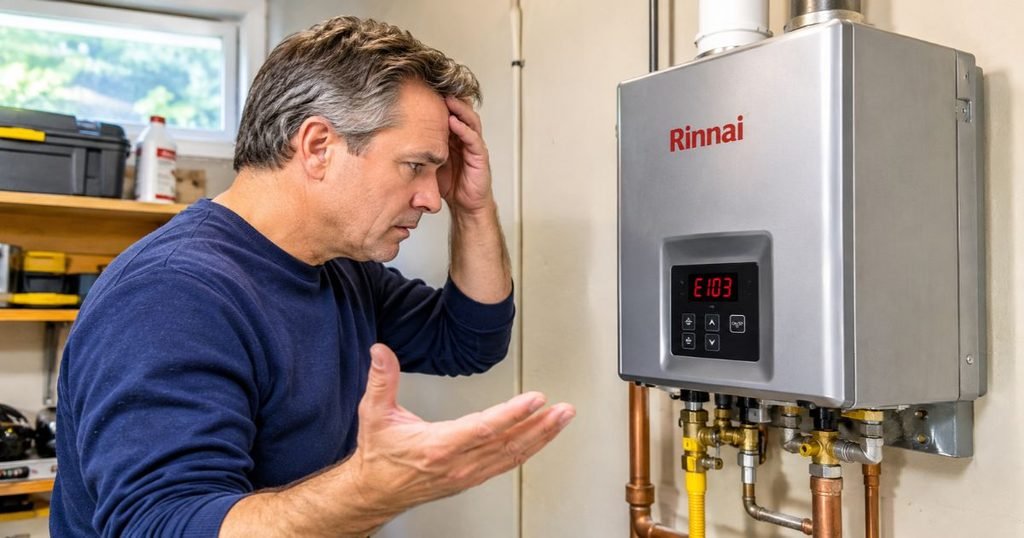
What Are the Most Common Rinnai Tankless Water Heater Problems?
1. Rinnai Tankless Water Heater Has No Hot Water
When you turn on the hot water tap and get nothing but freezing water, it is easy to panic. Unlike traditional tank water heaters that hold a reserve, a tankless unit must actively detect water flow, ignite its burners, and transfer heat instantly.
Common Causes:
- Gas Supply Interruptions: If your gas meter valve was bumped, the gas line has air in it following service, or the gas control valve is closed, the unit cannot fire.
- Electrical Power Problems: Rinnai tankless units require standard 120V electrical power to operate their internal computer boards, fans, and igniters. A tripped circuit breaker or blown fuse will shut down the entire system.
- Ignition Failure: If the unit attempts to light the burners multiple times but fails, safety protocols lock out the gas valve, resulting in no hot water.
- Insufficient Water Flow: Tankless water heaters have a built-in flow sensor. If your household water flow falls below the unit’s minimum activation threshold (typically around 0.4 to 0.5 gallons per minute depending on the model), the unit will not turn on.
- Blocked Water Inlet Filters: Over time, sediment and debris can clog the cold-water inlet filter screen, severely choking water flow into the unit.
Safe Homeowner Checks: Check your home’s electrical panel to ensure the breaker dedicated to the water heater hasn’t tripped. Verify that the gas supply valve is fully open and parallel to the gas line. Inspect the digital controller or display panel for any flashing error codes. If the display is completely blank, you are likely dealing with a power supply issue. If basic external checks look normal but hot water is absent, professional diagnosis is required.
READ MORE: Gas Water Heater Troubleshooting: Common Problems and Fixes
2. Rinnai Water Heater Produces Cold Water During a Shower
Nothing ruins a relaxing shower faster than a sudden blast of icy water halfway through. This frustrating phenomenon usually occurs when the demand on the system exceeds its capability or when flow sensors misinterpret water movement.
Common Causes:
- Minimum Flow Rate Problems: If someone opens a faucet only halfway, the water flow may drop below the activation threshold, causing the heater to shut off mid-shower.
- Water Pressure Fluctuations: Pressure drops from municipal supply lines or shared household plumbing can disrupt steady flow.
- Multiple Fixtures Running Simultaneously: A standard residential tankless water heater is sized for a specific maximum flow rate at a given temperature rise. If someone runs the dishwasher, washing machine, and a shower at the same time, the unit may become overwhelmed, delivering lukewarm or cold water.
- Improperly Sized Water Heaters: If your household recently added bathrooms or high-flow showerheads, your Rinnai unit may simply be undersized for your peak hot water demand.
- Cold-Water Mixing or Crossover: A failing single-handle faucet mixing valve or a recirculating loop issue can allow cold water to bleed into the hot water line.
- Dirty Inlet Filters: Restricted water flow across the internal flow sensor can cause erratic burner operation.
3. Rinnai Tankless Water Heater Temperature Fluctuates
Are you experiencing annoying temperature swings where the water oscillates between comfortably hot and uncomfortably cold while you are in the shower?
Common Causes:
- The “Cold-Water Sandwich” Effect: This classic tankless quirk happens when you turn the hot water on, turn it off briefly to lather up, and turn it back on. The residual hot water in the pipes is pushed out, followed immediately by a slug of cold water sitting in the heat exchanger because the burners momentarily shut off and reignite.
- Mineral Deposits Inside the Heat Exchanger: Scale buildup acts as an insulating barrier between the burner flame and the water tubing, causing erratic heat transfer.
- Low or Inconsistent Water Flow: Faucet aerators clogged with mineral scale can restrict flow enough to cause the unit to cycle on and off rapidly.
- Plumbing Crossover Issues: A defective check valve or mixing valve elsewhere in the house can introduce cold water into the hot water distribution piping.
Practical Troubleshooting Suggestions: Clean all aerators and showerhead screens to ensure steady, unobstructed water flow. If you live in an area with hard water, check when your heat exchanger was last flushed. Consistent temperature fluctuations often point to internal scale accumulation that requires a thorough descaling service.
4. Rinnai Tankless Water Heater Keeps Shutting Off
If your Rinnai unit fires up initially but shuts down unexpectedly during operation, it is usually responding to a built-in safety protection feature designed to prevent damage or hazardous conditions.
Common Causes:
- Overheating Protection: If internal temperatures exceed safe operating limits, safety sensors shut down the unit. This is often caused by restricted water flow or heavy scale buildup inside the heat exchanger.
- Blocked Air Intake or Exhaust: Tankless water heaters need a precise balance of intake air and exhaust venting. If leaves, nests, debris, or ice block the exterior vent terminal, pressure switches will trip and shut down combustion.
- Gas Supply Restrictions: Undersized gas lines or failing regulators can cause gas pressure to drop when the burner fires, leading to flame failure.
- Scale Buildup: Heavy mineral scaling causes localized overheating on the heat exchanger fins, tripping high-limit switches.
- Electrical Interruptions: Loose wiring harnesses or unstable household voltage can cause the internal control board to reset mid-cycle.
Understanding the difference is key: a temporary shutdown due to a safety switch or blocked vent requires immediate inspection, whereas recurring random shutdowns indicate an underlying equipment malfunction that needs professional attention.
READ MORE: Why Is My Water Heater Whistling? Causes & Fixes
5. Rinnai Tankless Water Heater Error Codes
Rinnai tankless water heaters are equipped with advanced self-diagnostic microprocessors. When an operating anomaly occurs, the unit halts operation and displays a numerical error code on its digital controller or remote monitor. These codes are invaluable diagnostic tools, but they must always be interpreted according to the specific Rinnai series and model you own.
| Error Code | General Description | Recommended Action |
| 03 | Power interruption during bath fill on applicable models | Follow the model-specific reset procedure |
| 10 | Air supply or exhaust blockage on applicable models | Have venting and condensate components inspected |
| 11 | Ignition failure | Check external gas supply conditions; call a technician if unresolved |
| 12 | Flame failure | Professional diagnosis of gas supply and combustion system |
| 14 | Overheat-related safety fault on applicable models | Stop operation and request professional inspection |
| 16 | High outgoing water temperature on applicable models | Professional inspection |
| 55 | Service indicator on certain models | Check the maintenance requirements in the manual |
| LC | Scale buildup indicator on applicable models | Arrange appropriate flushing and service |
Note: Error-code meanings and troubleshooting procedures vary significantly by Rinnai series (such as the Sensei SE or SE+ series versus older non-condensing units). Never present this table as a universal code list for every Rinnai water heater ever manufactured.
6. Rinnai Tankless Water Heater Is Leaking Water
Finding a puddle beneath your wall-mounted Rinnai unit can be alarming. Fortunately, not every leak means the primary heat exchanger has failed.
Common Causes:
- Loose Plumbing Connections: Inlet water, outlet hot water, or gas unions can loosen over time due to thermal expansion and contraction.
- Damaged O-Rings or Seals: Rubber seals inside internal water connections can degrade or dry out.
- Pressure Relief Valve Discharge: If your home’s water pressure is too high or thermal expansion creates excessive pressure spikes, the temperature and pressure (T&P) relief valve will safely discharge water.
- Condensate Drainage Problems: High-efficiency condensing Rinnai models produce acidic condensate water. If the internal condensate trap or external drain line clogs, water will back up and spill out of the housing.
- Freeze-Related Pipe Damage: If exposed pipes freeze and crack during severe winter weather, water will spray when thawed.
- Heat Exchanger Leaks: A corroded or cracked heat exchanger (often caused by extreme scale buildup or chemical corrosion) represents a major structural failure.
Homeowner Guidance: If you spot water leaking, locate the cold-water shutoff valve directly above the unit and turn it clockwise to stop the water flow. Inspect whether the leak is coming from an external plumbing fitting, the condensate line, or internal components. For internal leaks or heat exchanger failures, contact a licensed plumber immediately. Do not attempt to solder or patch internal components yourself.
7. Rinnai Water Heater Makes Strange Noises
Tankless water heaters are generally quiet appliances, typically producing a soft hum from the internal fan and a gentle rushing sound when water flows. When unusual noises develop, pay close attention.
Common Causes:
- Rumbling and Popping: Often referred to as “kettling,” this booming or popping sound is caused by boiling water trapped beneath layers of hard mineral scale inside the heat exchanger tubes.
- Humming or Vibrations: Can be caused by water hammer, loose wall-mounting brackets, or an unbalanced internal combustion fan.
- Whistling: Usually originates from restricted water flow through partially closed valves, clogged inlet filters, or mineral buildup inside plumbing connections.
- Fan-Related Noises: A grinding or screeching sound from the combustion blower fan indicates bearing wear or debris trapped in the fan housing.
While a brief fan run-on after hot water use is completely normal, loud rumbling, violent vibrations, or grinding noises indicate mechanical wear or heavy scale accumulation that requires professional service.
READ MORE: How to Flush a Tankless Water Heater (Step-by-Step Guide)
8. Rinnai Tankless Water Heater Is Not Igniting
When you open a hot water tap, you should hear a faint clicking sound as the electronic igniter fires, followed almost instantly by the steady roar of the burners. If the unit fails to ignite, hot water production stops entirely.
Common Causes:
- Gas Supply Interruption: Main gas valve closed, or utility service disruption.
- Gas Valve Problems: The internal gas solenoid valve failing to open upon electrical command from the control board.
- Ignition Electrode Issues: Carbon buildup, soot, or a cracked ceramic insulator on the spark electrode preventing a clean electrical spark.
- Flame Sensor Problems: A dirty or oxidized flame rod failing to detect the burner flame, prompting the safety system to cut the gas supply.
- Blocked Ventilation: Intake or exhaust blockage preventing proper combustion airflow.
- Electrical Supply Problems: Defective control board or loose wiring connections.
Safety Note: Ignition and combustion repairs involve gas lines, electrical circuits, and combustion chambers. These components must always be handled by qualified, licensed professionals. Never attempt DIY gas valve or burner repairs.
9. Rinnai Tankless Water Heater Has Low Water Pressure or Flow
Sometimes the issue isn’t the water heater’s ability to heat, but rather a frustrating reduction in water pressure coming out of your hot water faucets.
Common Causes:
- Clogged Inlet Water Filters: The most common culprit in Rinnai units. The cold-water inlet filter catches sand, rust flakes, and debris from municipal or well water systems, restricting flow over time.
- Sediment and Mineral Accumulation: Scale buildup inside the heat exchanger coils narrows the internal water pathways, reducing flow volume and pressure.
- Plumbing Restrictions: Corroded galvanized pipes or partially closed shut-off valves in the home’s distribution network.
- Low Municipal Water Pressure: External supply issues from your local water utility.
- Low-Flow Fixtures: Older or calcified aerators on household faucets and showerheads.
Safe Homeowner Checks: Unscrew and inspect the aerators on your sinks. If water flow is low only on hot water taps, the Rinnai’s cold-water inlet filter is likely clogged. Cleaning this filter is one of the few routine maintenance tasks suitable for experienced homeowners.
10. Rinnai Tankless Water Heater Freezes in Winter
Winter freezes pose a serious threat to tankless water heaters installed in unconditioned garages, outdoor exterior walls, or utility closets subject to freezing temperatures.
Common Causes:
- Frozen External Pipes: Uninsulated water supply or discharge pipes freezing solid.
- Power Interruptions: Rinnai tankless units have built-in electric freeze protection heaters, but these heaters only function when the unit is plugged into a live electrical outlet. During a winter power outage, freeze protection is lost entirely.
- Gas Supply Interruptions: If the gas supply fails during freezing weather, the unit cannot generate heat to protect itself.
- Improper Outdoor Installation: Installing an outdoor model without proper weather enclosures or pipe heat tape in sub-freezing climates.
Always remember that built-in freeze protection protects the internal components of the water heater itself, but it does not automatically protect connected copper or PEX plumbing lines and external valves. In freezing regions, proper pipe insulation and professional installation are essential.
READ MORE: How Often to Flush a Water Heater
Rinnai Tankless Water Heater Troubleshooting: What Can Homeowners Do?
When your Rinnai water heater acts up, it helps to follow a structured, safe troubleshooting checklist before picking up the phone.
Basic Homeowner Checks:
- Check Electrical Power: Verify that the unit’s power cord is securely plugged into a live 120V GFCI outlet and that the circuit breaker is fully engaged.
- Check the External Gas Supply: Confirm that the gas supply valve is open and that other gas appliances (like your stove or furnace) are operating normally.
- Confirm Water Supply: Ensure the cold-water supply valve to the water heater is fully open.
- Check the Displayed Error Code: Note the exact error code blinking on the digital controller. Consult your specific owner’s manual to understand what the code indicates.
- Inspect Accessible Vent Openings: Visually inspect exterior intake and exhaust vent caps from a safe distance to ensure no leaves, bird nests, snow, or debris are blocking airflow. Do not dismantle venting pipes.
- Evaluate Hot Water Demand: Determine if multiple high-flow fixtures were running simultaneously, overloading the unit’s capacity.
- Look for Visible Water Leaks: Check around the base of the unit, plumbing unions, and condensate drain lines for signs of active leaking.
- Consult the Owner’s Manual: Always refer to the model-specific documentation provided by Rinnai for authorized troubleshooting steps.
Crucial Safety Boundary: Homeowners can safely check power supplies, view error codes, inspect external venting visually, and clean accessible inlet filters. However, you must never dismantle gas components, modify internal wiring, bypass safety switches, adjust gas manifold pressures, or perform internal combustion repairs. Leave those tasks to licensed professionals.
Rinnai Tankless Water Heater Reset: When and How to Do It
Many homeowners wonder how to reset a Rinnai tankless water heater when an error code appears.
Why and When to Reset:
A reset clears temporary electronic glitches caused by power surges, brief gas pressure drops, or transient sensor readings. If the underlying mechanical or environmental issue has been resolved (such as clearing a blocked vent or restoring gas pressure), resetting the unit allows normal operation to resume.
How to Reset (Model-Specific):
- On digital controllers equipped with an On/Off button: Simply press the On/Off button on the monitor twice to clear the error code and restart the unit.
- Power Cycle Method: Unplug the water heater from the electrical outlet (or turn off the dedicated circuit breaker), wait 30 to 60 seconds, and plug it back in (or switch the breaker back on).
Important Warning:
Repeatedly resetting a Rinnai heater that keeps throwing the same error code is not a proper repair. If an error code like 11 (ignition failure) or 14 (overheating) returns immediately after a reset, it means a physical problem exists within the system. Forcing the unit to run repeatedly can cause severe equipment damage or create dangerous operating conditions. If an error persists after one reset, contact Rinnai customer support or a licensed technician.
Rinnai Tankless Water Heater Maintenance Problems
Neglecting routine maintenance is the #1 cause of premature failure in tankless water heaters. Unlike storage tank water heaters that are easily replaced when neglected, tankless units feature intricate internal copper heat exchangers with narrow waterways that are highly sensitive to mineral scaling and debris.
Key Maintenance Requirements:
- Heat Author / Heat Exchanger Flushing: Mineral scale (calcium and magnesium) precipitates out of hard water when heated, clinging to the interior of the heat exchanger. In hard water areas across the US, annual flushing with food-grade white vinegar using a descaling kit is mandatory.
- Cleaning the Inlet Water Filter: Periodic removal and rinsing of the cold-water inlet filter prevents sediment starvation.
- Inspecting Condensate Drainage: Condensing models must have clear, unobstructed condensate lines and functional neutralizing kits to prevent acidic water backup.
- Checking Air Intake and Exhaust: Ensuring combustion airflow remains completely free of dust, lint, and outdoor obstructions.
- Inspecting Plumbing and Gas Connections: Checking for minor weeping joints or corrosion.
Homes with hard water (high mineral content) often require heat exchanger flushing every 6 to 12 months, whereas homes with soft water can sometimes extend maintenance intervals to 12 to 24 months, following manufacturer instructions.
READ MORE: How to Flush a Rheem Tankless Water Heater: Step-by-Step Guide
How Much Does It Cost to Repair a Rinnai Tankless Water Heater?
When a part fails or professional intervention is needed, understanding typical US repair costs helps homeowners budget effectively.
| Repair Type | Estimated Cost Range | Notes |
| Diagnostic or service call | $100 – $250 | Covers technician travel and initial diagnosis |
| Water filter cleaning | $75 – $150 | Often bundled with maintenance service |
| Tankless water heater flushing | $150 – $350 | Varies based on regional labor rates and scale severity |
| Ignition-related repair | $150 – $400 | Includes electrode replacement or igniter assembly |
| Sensor replacement | $150 – $300 | Includes thermistors or flow sensors |
| Fan replacement | $250 – $550 | Combustion blower motor replacement |
| Gas valve replacement | $350 – $750 | Includes gas manifold assembly and safety checks |
| Heat exchanger replacement | $800 – $1,800+ | Major repair; often close to unit replacement cost if out of warranty |
Pricing Context (2026 US Market Data): Actual repair prices depend heavily on your geographic location, local contractor labor rates, unit model, accessibility (e.g., attic installations vs. garage walls), and the complexity of the repair. Parts costs typically account for 30% to 50% of the total bill, with labor making up the rest.
When Should You Call a Professional
Knowing when to step back and call a qualified plumbing or HVAC professional protects your home, your family, and your investment. Stop DIY troubleshooting and call a pro immediately if you encounter any of the following warning signs:
- Repeated Ignition Failure: If the unit refuses to stay lit or throws recurring error codes (like Code 11 or 12).
- Persistent Error Codes: Codes that return immediately after a standard power reset.
- Gas Odor: If you smell natural gas or propane near the unit or gas line.
- Water Leaking from the Appliance: Internal leaks or heat exchanger weeping.
- Electrical Burning Smells: Indicating wiring faults or control board failure.
- Blocked Exhaust or Suspected Combustion Problems: Improper venting can lead to carbon monoxide risks.
- Repeated Overheating Warnings: Indicating restricted flow or severe internal scaling.
- Suspected Heat Exchanger Damage.
EMERGENCY GAS LEAK PROTOCOL:
If you smell gas or suspect a gas leak, leave the building immediately. Do not turn lights on or off, do not use cell phones inside the building, do not operate appliances or switches that could cause a spark, and contact your local gas utility provider or emergency services from a safe location outdoors.
Rinnai Tankless Water Heater Problems vs. Normal Operation
Homeowners frequently mistake normal tankless water heater operational behaviors for equipment malfunctions. The comparison below helps clarify what is completely normal versus what requires investigation:
| Symptom / Behavior | Is it Normal? | Explanation |
| Short delay before hot water reaches a distant faucet | Yes | Tankless units take a few seconds to ignite and heat water, and the water must travel through your plumbing pipes from the heater to the fixture. |
| The internal fan continues running briefly after water use stops | Yes | The blower fan runs post-purge to exhaust residual combustion gases safely out of the heat exchanger. |
| White vapor or steam visible from the outdoor exhaust in cold weather | Yes | This is natural water vapor condensation resulting from high-efficiency combustion in cold ambient air. |
| The unit remains completely cool and idle when not heating water | Yes | Unlike tank water heaters that idle and heat water continuously, tankless units consume zero standby energy when faucets are closed. |
| A brief temperature fluctuation during low-flow activation | Sometimes | If water flow hovers right around the minimum activation threshold, the burner may cycle, causing a slight temperature dip. |
Understanding these normal operational characteristics helps you avoid unnecessary service calls while ensuring that persistent or truly unusual symptoms are investigated promptly.
READ MORE: How to Winterize an Outdoor Tankless Water Heater
How to Prevent Common Rinnai Tankless Water Heater Problems
Preventative care goes a long way toward extending the lifespan and reliability of your Rinnai tankless water heater:
- Schedule Regular Maintenance: Have a qualified technician inspect and service your unit annually.
- Flush the Heat Exchanger: Follow manufacturer recommendations and local water hardness guidelines to flush mineral scale regularly.
- Monitor Water Quality: Consider installing a whole-house water softener if your municipal or well water has high hardness levels (grains per gallon).
- Clean the Inlet Water Filter: Periodically inspect and rinse the cold-water inlet filter screen.
- Keep Vents Clear: Ensure outdoor intake and exhaust terminals remain unobstructed by landscaping, snow, or building materials.
- Protect Against Freezing: Insulate exposed exterior pipes and ensure freeze protection features remain plugged into live power.
- Do Not Ignore Error Codes: Address minor error codes early before they escalate into major component failures.
- Follow Instructions: Always operate and maintain the unit strictly according to Rinnai’s official installation and operation manuals.
- Keep Maintenance Records: Maintain a binder or digital log of all professional service visits, flushing dates, and parts replacements.
Frequently Asked Questions
Why is my Rinnai tankless water heater not producing hot water?
No hot water typically stems from a tripped circuit breaker, closed gas supply valve, power outage, or a locked-out ignition failure. Check your electrical panel, verify the gas line valve is open, and inspect the digital control display for error codes. If basics check out, a professional diagnosis is required.
Why does my Rinnai tankless water heater keep shutting off?
Frequent shutdowns usually indicate a safety feature tripping due to restricted water flow, severe scale buildup inside the heat exchanger, blocked intake/exhaust venting, or unstable gas pressure. Inspect your inlet filter and check for error codes before calling a licensed plumbing professional.
How do I reset a Rinnai tankless water heater?
You can reset most Rinnai models by pressing the On/Off button on the digital control monitor twice. Alternatively, unplug the unit from its electrical outlet or flip the dedicated circuit breaker off for 60 seconds, then restore power. Do not repeatedly reset units experiencing recurring error codes.
What does code 11 mean on a Rinnai tankless water heater?
Error code 11 indicates an ignition failure. This means the unit attempted to light its burners multiple times but failed to detect a stable flame. Common causes include closed gas valves, air in the gas line, dirty igniter electrodes, or gas supply pressure issues.
How often should you flush a Rinnai tankless water heater?
You should flush your Rinnai tankless water heater at least once a year. If you live in an area with hard water containing high mineral levels, you may need to flush the heat exchanger every 6 months to prevent scale buildup and maintain peak operating efficiency.
Conclusion
Rinnai tankless water heaters represent some of the most efficient, durable, and reliable water heating systems available to American homeowners today. However, like any hardworking mechanical appliance, they are susceptible to operational issues over time—from temporary low-flow shutdowns and mineral scaling to ignition faults and error codes.
By understanding the common causes behind these issues, performing safe external checks, and adhering to strict maintenance schedules like annual heat exchanger flushing, you can keep your system running smoothly for years to come. Remember that while basic checks and filter cleaning are homeowner-friendly, any work involving gas lines, electrical wiring, or internal combustion components must always be left to a qualified, licensed plumbing or HVAC professional. When in doubt, prioritize safety, consult your official Rinnai manual, and professional assistance is just a phone call away.
Sources and Disclaimer
- Sources:
- Rinnai America Corporation – Official Residential Product Manuals and Technical Guides.
- Rinnai USA Official Website & Customer Support FAQs.
- U.S. Department of Energy (DOE) – Energy Saver Guidelines for Tankless Water Heaters.
- ENERGY STAR® – Water Heater Product Criteria and Efficiency Standards.
- Qualified Plumbing and HVAC Industry Service Standards.
Disclaimer: This article is intended for informational and educational purposes only. Rinnai water heater models, error codes, specifications, and maintenance requirements vary by series and manufacturing year. Gas appliances, electrical circuits, and plumbing systems involve inherent safety risks. Always consult your specific product manual, adhere to local plumbing and building codes, and hire a licensed professional for all gas, electrical, and internal component repairs.

