If you’re a U.S. homeowner deciding whether to replace, upgrade, or install central heating for the first time, this guide is for you. Central heating is one of the biggest home systems decisions you’ll make: it affects your comfort, monthly bills, home value, and even what contractors you call. This article walks you through the main system types (furnaces, boilers, heat pumps), what efficiency ratings mean, realistic installed cost ranges (with sources), operating-cost examples, eight practical decision factors, a tidy comparison table, maintenance tips, incentives to check, a contractor checklist, and recommended next steps.
The goal: help you choose the right system for your house and budget not with jargon, but with clear questions you can ask contractors, simple math to estimate running costs, and reliable price ranges so you can budget confidently.
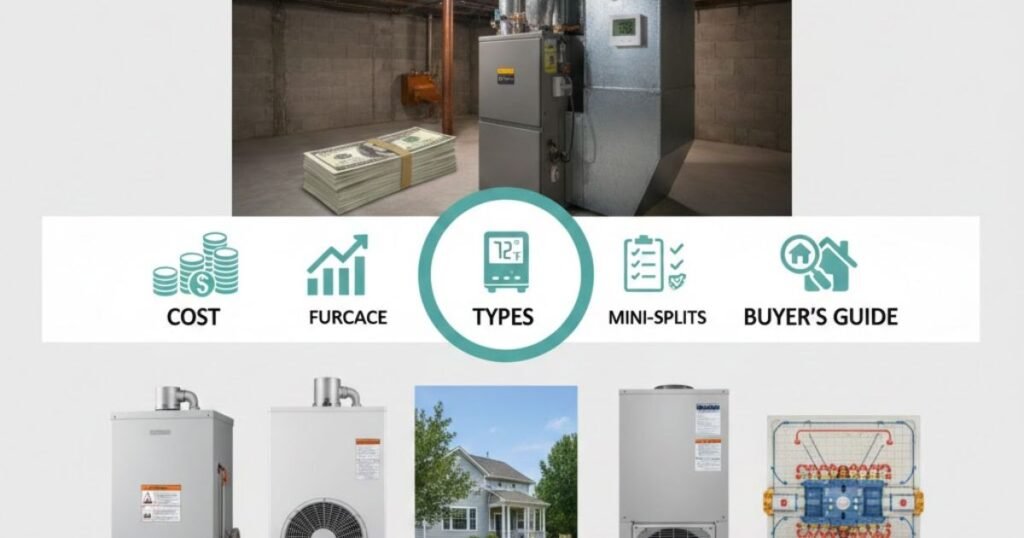
What is central heating?
“Central heating” describes any system that produces heat in a single central location and distributes it around a home. The two most common distribution methods are:
- Forced-air systems: A furnace (gas, oil, or electric) heats air, and a blower distributes it through ductwork and vents. Many U.S. homes use this approach because it combines heating and cooling via the same ducts when paired with an air conditioner or heat pump.
- Hydronic systems: A boiler heats water (or makes steam) and sends hot water through radiators, baseboards, or in-floor radiant loops. Hydronic systems tend to feel “softer” and are common in older homes and new radiant installations.
Other central options include air-source heat pumps (which move heat instead of burning fuel) and ground-source (geothermal) heat pumps. Modern systems are often hybrid for instance, an air-source heat pump backed up by a gas furnace for the coldest days.
Key performance metrics you’ll see: AFUE for combustion furnaces/boilers (how much fuel becomes heat), HSPF/SEER for heat pumps (heating/cooling seasonal performance), and COP for instantaneous efficiency at a moment. Higher numbers = better efficiency (and usually higher upfront cost). For most homeowners, balancing upfront cost with projected operating savings is the practical way to decide.
Types of central heating systems
Below are the major system types, how they work, where they excel, and what to watch for.
1. Gas furnace (central forced-air)
How it works: Natural gas is combusted in a furnace; heat exchanger warms air; blower pushes warm air through ducts.
Why homeowners pick it: Widely available where natural gas service exists; strong heat output in cold climates; lower upfront cost than some alternatives.
What to watch: AFUE ratings matter. Budget mid-efficiency (80–90% AFUE) vs high-efficiency (95–98% AFUE) the latter costs more up front but lowers gas bills. Also consider proper duct sealing and sizing; leaky ducts can wipe out efficiency gains. Typical installed cost ranges vary widely by size, installation complexity, and local labor.
2. Electric furnace / resistance heat
How it works: Electric heating elements warm air; blower distributes it via ducts.
Why homeowners pick it: Simple, reliable, low upfront equipment cost in some cases; useful where gas isn’t available.
What to watch: Operating costs are generally higher than gas when electricity prices are high. However, if your electricity comes from a low-carbon supplier or you own solar panels, electric heat may make more sense.
READ MORE: Furnace Heaters
3. Boiler (hot-water or steam hydronic)
How it works: A boiler heats water or creates steam that circulates through radiators, baseboard convectors, or radiant floor loops.
Why homeowners pick it: Even heat feel; excellent for radiant flooring and older radiator-equipped homes. Boilers can use natural gas, oil, or electricity.
What to watch: Hydronic piping or radiator retrofits can be costly if you don’t already have them. High-efficiency condensing boilers (90%+ AFUE) cost more but can reduce fuel bills. Typical installed boiler costs cluster in mid-range figures.
READ MORE: New Boilers Buying Guide for Homes and Businesses
4. Air-source heat pump (central split or ducted)
How it works: Moves heat between outdoors and indoors using refrigerant; in heating mode it extracts outdoor heat and delivers it inside.
Why homeowners pick it: Efficient electric heating (can be 2–3x the efficiency of electric resistance), also provides cooling. Great path for electrification and decarbonization.
What to watch: Performance declines with extreme cold cold-climate models and dual-fuel setups (heat pump + backup furnace) are available. Costs vary: single-zone mini-splits are cheaper; full-home ducted or multi-head systems cost more. Incentives for heat pumps in recent years change effective cost.
READ MORE: Air Source Heat Pumps
5. Ground-source (geothermal) heat pump
How it works: Uses stable underground temperatures via buried loops to provide heating and cooling with very high efficiency.
Why homeowners pick it: Lowest operating cost per unit of heat and long equipment life.
What to watch: Very high upfront cost (borehole drilling or excavation), and site-specific feasibility. Good when you plan to stay in the house a long time and want the best long-term operating cost.
READ MORE: Geothermal Heat Pump Buying Guide
6. Ductless mini-split (when used as “central” replacement)
How it works: One outdoor unit connects to multiple indoor heads; no ducts required.
Why homeowners pick it: Great for homes without ducts, zoned comfort control, high efficiency.
What to watch: For whole-home central replacement you’ll need multiple heads and higher equipment cost; aesthetic placement of heads matters.
READ MORE: Ductless Heat Pump
Efficiency metrics
- AFUE (Annual Fuel Utilization Efficiency): Percent of fuel converted to heat over a season. A 95% AFUE furnace converts 95% of fuel to heat. New minimums in many regions are ~80% AFUE, but high-efficiency units reach 95–98%.
- HSPF (Heating Seasonal Performance Factor): For heat pumps; higher = better winter heating efficiency.
- SEER (Seasonal Energy Efficiency Ratio): For cooling; useful if system also cools.
- COP (Coefficient of Performance): Instantaneous ratio of heat output to electrical input (e.g., COP 3 = 3 units heat per 1 unit electricity).
Real U.S. installed cost ranges
Below are practical installed cost ranges you’ll see on real market sites. Local labor, required ductwork or piping, fuel hookups, permitting, and the specific brand/model strongly change the final price.
- Gas furnace (installed): Typical installed ranges are roughly $3,800–$12,000 (unit + install; higher for high-efficiency or complex installs). HomeAdvisor and similar home services sites show mid-range furnace installation costs in the low-to-mid thousands and top-tier systems approaching $10–12k in some markets.
- Boiler (hot-water / steam): Average installed figures are around $3,600–$8,500 with many sources quoting averages near $5,900; high-efficiency or more complex systems can exceed this.
- Air-source heat pump: Wide range depending on single-zone mini-splits vs full-home ducted systems. Typical homeowner-installed ranges seen in market guides are $4,000–$12,000 for many air-source systems (some sources show averages about $6k for common installations), while larger or more complex installations (or electrification retrofits) push toward $15k or more.
- Central HVAC replacement (unit + ducts): Whole-home replacement (furnace + A/C + ducts if needed) commonly runs $5,000–$12,500 (typical averages around $7,500), though large homes or duct replacement can raise that significantly.
- Full central heating system (new install): Estimates for a complete central heating installation vary $2,600–$20,500 depending on system type, new ductwork/piping, and scope (average ~ $8,200 reported by aggregate home-cost sites).
Note: these are national-level ranges; local labor and permit costs can move the final number significantly. When budgeting, always request multiple quotes and ask contractors to itemize equipment, labor, ductwork, permits, and disposal.
Comparison table
| System type | Typical installed cost (USA) — range (fill & cite) | Lifespan (yrs) | Typical efficiency metric | Best for |
| Gas furnace | $3,800–$12,000 (unit + install; depends on size/AFUE). | 15–25 | AFUE (80–98%+) | Homes with natural gas hookups |
| Boiler (hot-water/steam) | $3,600–$8,500 (average ≈ $5,900). | 15–30 | AFUE (high-efficiency models 90%+) | Radiant / radiator homes; hydronic systems |
| Air-source heat pump | $4,000–$15,000+ (wide range: single-zone mini-splits to full-home systems; many averages near $6,000). | 15–20 | HSPF / SEER (varies) | Mild climates; electrification projects |
| Central HVAC replacement (unit + ducts) | $5,000–$12,500 (typical total HVAC replacement avg ≈ $7,500). | depends | N/A | Whole-home replacements |
| Full central heating system (new install) | $2,600–$20,500 (very broad; average cited ≈ $8,200). | varies | varies | New builds or major retrofit |
(Price citations above link to home-cost market guides; use them to start local quote conversations.)
Pros & cons by system
Below are short bulleted pros and cons for each major system to make side-by-side decisions fast.
Gas furnace
Pros:
- Strong heating power in cold climates.
- Usually lower upfront cost than geothermal and some heat-pump installs.
- Familiar technology for most contractors.
Cons:
- Burns fossil fuel carbon emissions unless paired with offsets/renewables.
- High-efficiency units and proper ductwork add to cost.
- Can have higher maintenance (combustion safety checks, venting).
Electric furnace
Pros:
- Simple, compact, and low maintenance.
- No combustion means no carbon monoxide risk on site.
Cons:
- Electric resistance heat can be expensive to run where electricity rates are high.
- Not as efficient as heat pumps in terms of energy used vs heat delivered.
Boiler (hot-water/steam)
Pros:
- Comfortable, even heat great for radiant floors and historic homes.
- Long service life when well maintained.
Cons:
- Retrofit costs can be large if you don’t already have piping/radiators.
- Repairs and replacement parts can be pricier and require specialists.
Air-source heat pump
Pros:
- Highly efficient electric heating (lower operating costs vs electric resistance).
- Dual-purpose (heating + cooling) — good for electrification goals.
- Eligible for many incentives in recent incentive programs.
Cons:
- Performance in extreme cold varies; may need backup heat or cold-climate model.
- Upfront cost can be higher than basic gas furnaces, depending on system scope.
Ground-source (geothermal)
Pros:
- Best long-term operating cost and stable performance year-round.
- Long equipment life and excellent efficiency.
Cons:
- Very high upfront installation cost and site-specific feasibility.
- Requires excavation or drilling.
Ductless mini-splits (whole-home)
Pros:
- Excellent for homes without ducts; zoned control; high efficiency.
- Lower installation disruption compared to duct retrofits.
Cons:
- Multiple indoor heads for whole-home systems can be costly and change room aesthetics.
How to choose: 8 practical homeowner decision factors
Use these eight factors as a decision checklist:
- Climate — If you live where winter temperatures routinely drop very low, gas furnaces or high-performance cold-climate heat pumps (or dual-fuel systems) are sensible. Mild climates favor heat pumps. (See EIA spot forecasts for region-specific fuel-price sensitivity.)
- Fuel availability & cost — Do you have natural gas, propane, or only electricity? Fuel availability heavily steers your options and operating cost outlook.
- Ductwork — If ducts are in good shape, a furnace or centralized heat pump may be easiest. If you don’t have ducts, weigh ductless mini-splits or the cost to install ducts (which can be thousands).
- Home size & layout — Large open homes sometimes benefit from hydronic systems or multiple heat-pump zones; smaller homes can often be served by single equipment.
- Upfront vs operating cost — Decide whether you can pay more up front to save on fuel bills (high-efficiency furnaces, heat pumps, or geothermal) or need the lower initial cost now.
- Insulation & envelope — Better insulation, windows, and air sealing reduce required system size and lower operating costs. Consider doing weatherization first if your house is leaky.
- Incentives & future-proofing — Federal and many state incentives favor heat pumps and high-efficiency equipment; check local programs when planning.
- Longevity & maintenance — Some systems last longer (well-maintained boilers, geothermal) and others are cheaper to service. Factor expected lifespan into your lifecycle cost math.
Operating costs & lifecycle
You’ll pay two things over time: fuel/electricity to run the system and maintenance/repairs. Here’s a simple approach to estimate annual heating cost:
- Estimate annual heat need (in therms, gallons of fuel, or kWh) Many homeowners use their previous heating bills as a baseline. The EIA and state utility data can give average bills for your area.
- Apply system efficiency — If your home requires 50 million BTU of heat in a year:
- A 90% AFUE gas furnace needs ~55.6 million BTU of gas (50 ÷ 0.90).
- A heat pump with a seasonal COP equivalent of 3 (or HSPF-based conversion) delivers 3 units of heat per 1 kWh — so you divide the heat need (converted to kWh) by COP.
Quick example (illustrative):
- Annual heat need: 50 million BTU ≈ 14,650 kWh.
- Gas furnace at 90% AFUE: Gas required ≈ 55.6 MMBTU — convert to therms or gallons depending on fuel price; multiply by local gas rate to get annual cost.
- Heat pump (seasonal COP ~3): Electricity consumption ≈ 4,883 kWh (14,650 ÷ 3). Multiply by your local electricity rate ($/kWh) to get annual cost.
Remember: actual savings depend on local fuel/electric prices. The EIA and state utilities publish average residential prices you can use.
Maintenance & lifecycle:
- Furnace: Annual tune-up; filters every 1–3 months; lifespan 15–25 years.
- Boiler: Annual service; flush/inspect; can last 15–30 years.
- Heat pump: Twice-yearly checks (heating & cooling seasons); lifespan 15–20 years. Budget for periodic refrigerant/controls servicing.
A lifecycle cost comparison should include purchase price, expected annual fuel/electricity cost, maintenance, and expected equipment life. If you plan to live in the house a long time, higher-efficiency equipment often pays back.
Installation checklist & questions to ask contractors
Use this checklist when getting quotes:
Pre-quote items
- Ask the contractor to perform a Manual J load calculation (not just “system size by house square footage”). This ensures correct equipment sizing.
- Request proof of license, insurance, and local permits the contractor will pull.
Questions to ask in quotes
- Itemize costs: equipment, labor, ductwork/pipe, permits, disposal, thermostat, and any required electrical/gas upgrades.
- Show expected AFUE / HSPF / SEER ratings for quoted models.
- Ask: “Will you perform a duct leakage test/airflow test?” and “Can you show the Manual J output?”
- Warranty details: manufacturer vs installer warranty, and length/what’s covered.
- Start/finish dates, cleanup, and whether subcontractors are used.
Permits & inspection
- Confirm who pulls permits and schedules inspections. Never skip required permits; they protect resale value and safety.
Thermostat & controls
- Consider upgraded thermostats: programmable or smart thermostats can add savings. Ask about compatibility with the proposed system.
Final acceptance
- Ask for a start-up walk-through and operational demo, plus documentation of the system (model numbers, serials, warranty cards).
Financing, incentives & rebates
Federal and many state/local programs offer credits and rebates that can change the effective cost.
Federal tax credits (example): The Energy Efficient Home Improvement Credit and related heat-pump credits have been extended in recent years to encourage electrification and efficiency; certain limits apply to heat pumps and high-efficiency boilers. Check the IRS pages and EnergyStar guidance for current program caps and eligible equipment.
Typical rebate types you may find locally:
- Instant point-of-sale rebates from utilities or contractors that reduce upfront cost.
- Mail-in rebates requiring proof of purchase/installation.
- Tax credits claimed on annual tax returns (may have caps by equipment type).
- Low-interest financing or on-bill financing from some utilities.
Practical steps:
- Visit federal IRS guidance for Energy Efficient Home Improvement Credit details and limits.
- Check your state energy office and local utility website for active rebates and eligibility many utilities have heat-pump programs with substantial rebates.
- Ask your contractor to include known local rebates in the quote (some contractors apply an instant rebate and pass the rest to you).
Caveat: Incentives change frequently. Treat incentives as a bonus to the economics, but make baseline decisions assuming you’ll pay the upfront cost unless a confirmed rebate is part of the signed contract.
Maintenance & troubleshooting
Annual service: Schedule a professional tune-up before the heating season. For combustion systems, a safety inspection (venting, combustion, CO sensors) is essential.
DIY maintenance (monthly–yearly):
- Replace/clean air filters every 1–3 months (or as recommended).
- Keep outdoor heat pump/condenser clear of debris and snow.
- Bleed hydronic systems if you notice cold spots in radiators.
- Check for unusual noises, odors, or drops in performance.
Signs of failing system:
- Uneven heating across the house.
- Rising energy bills without lifestyle change.
- Frequent cycling on/off, strange smells, or visible leaks.
- Pilot light issues (for older furnaces/boilers) or repeated ignition failures.
When to call a pro: If you smell gas, detect carbon monoxide alarm activation, see refrigerant leaks, or face a major leak stop using the system and call a qualified technician.
Usability checklist (quick, printable)
- Manual J load calculation completed? ☐
- Itemized quote (equipment + labor + ducts/piping) received? ☐
- Equipment efficiency ratings listed (AFUE/HSPF/SEER/COP)? ☐
- Contractor license & insurance verified? ☐
- Warranties documented (manufacturer & installer)? ☐
- Permits & inspections: who handles? ☐
- Rebates/tax credits identified & applied? ☐
- Ductwork/air sealing assessment completed? ☐
- Thermostat & controls compatibility confirmed? ☐
- Start-up demo & paperwork at system completion agreed? ☐
5 FAQs
How much does central heating installation cost?
Typical U.S. installed costs range widely depending on system type and scope from about $2,600 for a small central install to over $20,000 for large or complex jobs; many common installs fall in the $4,000–12,000 window. Always get multiple itemized quotes.
What’s the difference between a furnace and a boiler?
Furnaces heat and distribute warm air through ducts; boilers heat water/steam and circulate it through radiators or underfloor piping. Boilers often provide gentler, radiant heat; furnaces are common in ducted homes.
Are heat pumps better than furnaces?
It depends on climate and electricity prices. Heat pumps are typically more efficient (lower operating costs) in mild climates and when electricity is reasonably priced; high-efficiency furnaces may be better in very cold climates or where natural gas is cheap. Also consider incentives for heat pumps in many regions.
How long do central heating systems last?
Typical lifespans: furnaces 15–25 years, boilers 15–30 years, heat pumps 15–20 years, geothermal often longer. Regular maintenance extends life.
What rebates or tax credits are available for new heating systems?
Federal tax credits and many state/utility rebates have been available for energy-efficient equipment (including heat pumps and high-efficiency boilers). Check the IRS Energy Efficient Home Improvement Credit and local utility programs for current details, since programs and caps change.
Conclusion
Central heating choices come down to house characteristics, fuel availability, budget trade-offs (upfront vs operating), and local incentives. If you’re uncertain, prioritize getting a Manual J load calculation and at least three itemized quotes (don’t sign the first one). Ask each contractor about efficiency numbers, warranties, permit handling, and known rebates they’ll apply. If long-term operating cost is important and your electricity price is reasonable (or you have solar), prioritize heat pumps; if you rely on natural gas or live in very cold climates, a high-efficiency furnace or hybrid system may be smarter.