This is a long, practical guide for U.S. homeowners deciding whether to install or replace a heating/cooling system with a heat pump. Below you’ll find realistic price ranges (low → typical → high), what adds to the bill, side-by-side comparisons (mini-split, ducted/central, cold-climate, geothermal), incentives that lower out-of-pocket cost, simple payback examples, and a short contractor checklist so you know how to hire safely. Wherever I quote numbers, I’ve tied them to recent marketplace data and federal guidance so you can trust the ranges shown.
Key quick sources used for prices and incentives: EnergySage (marketplace quotes), HomeAdvisor, Angi, EnergySage geothermal guide, and IRS/EnergyStar pages on tax credits.
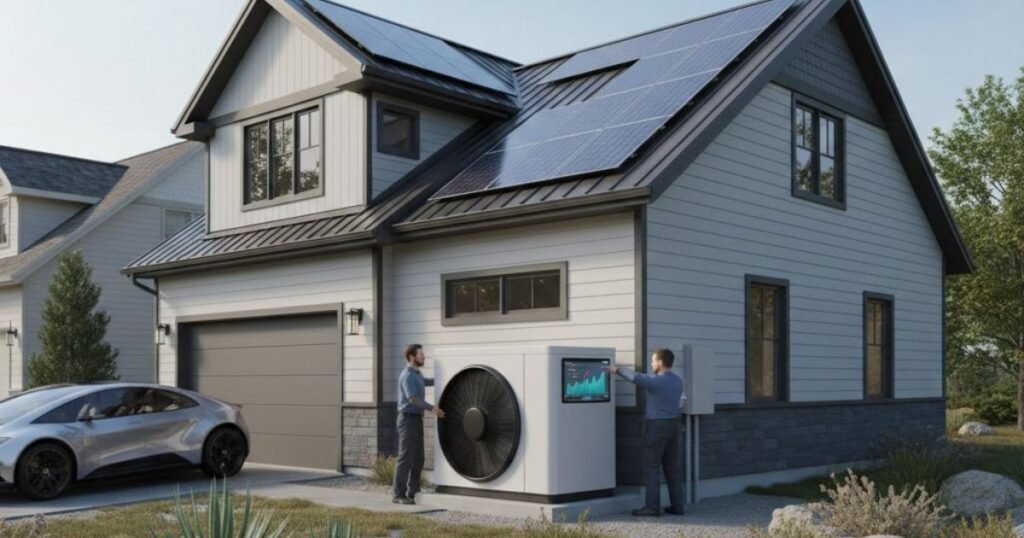
Types of heat pumps (what they are, how they differ)
1. Air-source, central/ducted (standard heat pump)
These replace a furnace + AC in homes with existing ductwork. The outdoor unit connects to an indoor air handler; distribution uses your ducts. Pros: familiar to HVAC contractors, replaces two systems with one, often the most cost-effective whole-house swap where ducts are in good shape. Cons: duct losses can reduce efficiency if ducts are leaky/old. Typical lifespan: 15–20 years. Market examples and averages feed into the $4k–$12k typical band for ducted installs.
2. Ductless mini-split (single-zone or multi-zone)
A small outdoor compressor connects to one or more indoor wall/ceiling heads. Great for homes without ducts, room additions, basements, or targeted zoning. Single-zone installs can be relatively low cost; multi-zone whole-house setups can be expensive because each indoor head and additional line-set adds cost. EnergySage marketplace quotes show multi-zone averages at about $19,556 (2025). Lifespan ~15–20 years.
3. Cold-climate / high-efficiency air-source heat pumps
These are air-source models engineered to deliver reliable heat at low outdoor temps (improved compressors, larger heat exchangers). Equipment cost is higher than base models, and installers need cold-climate experience. Expect $6,000–$15,000+ installed depending on configuration. Good option if you live in a cold region but want an air-source solution.
4. Geothermal (ground-source) heat pumps
Circulate fluid through buried ground loops (horizontal or vertical) and use the earth’s stable temperature. These are the most efficient option (best long-term operating costs), but land, drilling, and loop installation add large upfront costs. Typical installed range: $15,000–$40,000+ depending on loop type and soil/landwork. Lifespan can be 20+ years for the ground loop and 20+ for equipment.
Which to choose? If you have good ducts and want a single-contractor swap, central air-source is usually cheapest. If you lack ducts or want zoned comfort, mini-splits fit but watch the cost per added indoor head. If you plan to stay 15+ years and want peak efficiency, geothermal is worth strong consideration.
Cost breakdown: equipment + labor + extras + permits
A realistic installed price is the sum of: equipment + basic installation labor + extras (ductwork, electrical upgrades, line sets, concrete pads), old equipment removal, permits, and sometimes site-specific adders (trenching, drilling, structural work).
Below is a component list with typical price drivers and ballpark ranges (use the marketplace and contractor sources above for the totals).
1. Equipment (unit only)
- Small single-zone mini-split indoor + outdoor: $800–$3,000 (unit only for basic heads).
- Multi-zone mini-split outdoor + multiple heads: $5,000–$15,000+ depending on number of heads and efficiency. EnergySage marketplace quotes show multi-zone averages around $19,556 installed (after state/local incentives).
- Central air-source outdoor unit + indoor coil/air handler: $2,000–$6,000 for most residential models (higher for cold-climate / high-SEER equipment).
- Geothermal heat pump unit (equipment only) can be $6,000–$20,000+ — but the real cost driver is the loop field.
2. Labor / installation
- HVAC labor rates vary by market typical tech labor costs $75–$125/hour (HomeAdvisor estimates HVAC labor as a major driver). A simple swap can be a day or two; complex installs (multi-zone or geothermal) take longer and involve specialty crews. HomeAdvisor / Angi report typical installed heat pump projects often fall into the $4,000–$7,000 range for many straightforward air-source installs.
3. Ductwork & distribution
- If ducts are in good shape: little or no cost.
- If ducts need sealing, resizing, or new runs: add $1,000–$5,000+ depending on scale. Duct losses quickly erode efficiency, so factoring in sealing/repair is important.
4. Electrical upgrades
- New heat pumps sometimes require 220/240V hookup or a dedicated circuit; older homes with 100A panels may need an upgrade: $1,000–$3,500 typical if a panel upgrade is required.
5. Line sets, refrigerant, mounts & pads
- Line sets for mini-splits and central units: $200–$1,200 depending on length and complexity. Multi-zone systems multiply this cost. Condenser pad, vibration mounts, and basic labor often included in quotes.
6. Permits & inspections
- Expect $100–$500 in typical permitting fees (more in some cities).
7. Removal of old equipment & disposal
- $100–$1,000 depending on complexity (furnace removal, refrigerant recovery).
8. Geothermal loop installation (if chosen)
- Horizontal loops (need yard space): $5,000–$15,000.
- Vertical loops (drilling): $15,000–$30,000+ dependent on depth and geology. This is why geothermal totals commonly sit in the $15,000–$40,000+ range.
Putting it together: sample installed bands (with sources)
- Low-end / simple single-zone or basic ducted swap: $4,000–$7,000 (HomeAdvisor/Angi typical lower averages for straightforward air-source installs).
- Typical whole-home installs (mixed climates): $8,000–$20,000 — many whole-house air-source installs cluster here. EnergySage marketplace cites a national average around $16,500 (after state/local incentives).
- Multi-zone ductless mini-split whole-house or complex retrofits: $12,000–$30,000+ (EnergySage reported multi-zone average $19,556).
- Geothermal / major ground-loop projects: $15,000–$40,000+.
Why two homeowners can get wildly different quotes: contractor markups, brand/efficiency selected (SEER/HSPF ratings), whether the quote covers duct repairs or electrical upgrades, and whether the seller included local rebates/tax credits in the showcased “after incentive” figure.
READ MORE: 3-Ton Heat Pump: Cost, Sizing & Best Models
Comparison table — cost, best-for, lifespan, pros/cons
| Heat Pump Type | Typical Installed Cost (U.S.) | Best for | Typical Lifespan | Pros | Cons |
| Small single-zone ductless mini-split | $2,000–$6,000 (unit+install) | Room additions, condos | 15–20 yrs | No ducts; zoned comfort | Limited to a room or two |
| Multi-zone ductless mini-split | $6,000–$20,000+ (multi-zone) | Whole-house without ducts | 15–20 yrs | Zoned control, efficient | Higher installed cost for many zones; more line sets. |
| Central air-source heat pump (ducted) | $4,000–$12,000 (typical) | Homes with ducts | 15–20 yrs | Replaces furnace+AC, familiar tech | Duct losses; needs right sizing. |
| Cold-climate / high-efficiency ASHP | $6,000–$15,000+ | Colder climates needing reliable heat | 15–20 yrs | Works better in cold climates | Higher equipment cost; installer expertise matters. |
| Geothermal (ground-source) | $15,000–$40,000+ | Long-term owners, larger budgets | 20–25+ yrs | Best efficiency & stable performance | Very high upfront cost; drilling/groundworks. |
Table sources: EnergySage marketplace & geothermal guide; HomeAdvisor/Angi typical install data.
Sizing & how it affects price (tons, BTU, Manual J)
Heat pump cost scales with capacity. Contractors size systems in tons (1 ton = 12,000 BTU/hr). A typical U.S. single-family home might need 2–4 tons depending on climate, insulation, and square footage.
Why correct sizing matters
- Oversizing: higher upfront cost, more short cycling (reduced dehumidification, premature wear).
- Undersizing: fails to meet comfort in extreme temps and may require supplemental heat.
- Correct sizing requires a Manual J load calculation (the industry-standard heat/cool load estimate). Getting a Manual J typically adds $200–$600 to the quote but prevents costly mistakes.
How capacity affects price
- Unit cost rises with tonnage; a 1.5-ton mini-split is cheaper than a 3-ton multi-zone system. Geothermal pricing is often quoted per ton (sometimes $4,000–$8,000/ton installed depending on loop type). Efficiency ratings (SEER for cooling, HSPF for heating) also change equipment price—higher SEER/HSPF costs more upfront but reduces operating costs.
Always insist on a Manual J (or equivalent) and a written explanation of why the quoted capacity matches your home if an installer quotes a one-size-fits-all tonnage without calculations, that’s a red flag.
READ MORE: Central Heating: Cost, Types & Buyer’s Guide for U.S. Homeowners
Regional & home-specific price variations
Costs vary by state and metro area because labor rates, permitting, local supply dynamics, and climate differ. For example, EnergySage notes whole-home quotes average roughly $10,000 in Florida but $25,000 in parts of New York (after local incentives), which helps explain the $4,000–$25,000+ national spread. High labor markets (Northeast, parts of the West Coast) push installed prices upward; rural areas with fewer qualified installers can also see higher travel or scheduling premiums.
Other home-specific factors that drive cost: attic or crawlspace access, need for structural work for exterior units, proximity of indoor/outdoor equipment (affects line set length), and whether you’re replacing fossil fuel equipment that needs an electrical upgrade (e.g., switching from gas furnace to all-electric heat pump may require panel upgrades).
If you live in a state with strong heat-pump rebate programs (e.g., some Pacific Northwest utilities, New York, Massachusetts), those local rebates lower the effective installed cost. See next section for federal/state incentives.
Incentives, rebates & federal tax credits (how they reduce out-of-pocket cost)
Incentives can materially change your out-of-pocket expense. Two important federal resources:
1. Energy Efficient Home Improvement Credit (IRS / 25C / 2023–2025 rules)
The federal credit framework for heat pumps has been updated in recent years. The IRS and related EnergyStar pages show homeowners could claim tax credits that often reduce costs by a fixed amount or a percentage, and special credit rules apply specifically to heat pump systems (check the IRS Energy Efficient Home Improvement Credit page for eligibility and amounts). As of the most recent guidance through 2025, some heat pump installations qualify for credits (and the heat pump component had separate annual limits in certain years). Always check the latest IRS rules at filing time because credit amounts and qualifying rules are time-limited and change with legislation.
2. State / utility / local rebates
Many states and utilities add rebates or point-of-sale incentives. For example, some Washington state programs and local utilities offer rebate stacks and additional funding to reduce homeowner costs. Local energy-efficiency programs frequently change, so check your utility and state energy office. A local news/utility example (Washington) shows multiple program layers (utility rebates + IRA tax credits) that can add up to substantial help.
Net example: If your installed cost is $16,500 (EnergySage average) and you qualify for, say, $2,000 in federal credits plus a $1,000 utility rebate, your net cost becomes $13,500. EnergySage often reports “after state/local incentives” figures (for example, their $16,500 average is shown after such incentives), while some contractor quotes may show pre-incentive prices compare apples to apples when you evaluate quotes.
Action: before signing, ask your installer which incentives they apply in-quote, whether they can file point-of-sale rebates, and insist on a pre/post-incentive line item so you can compare.
Financing & payback math — 3 worked examples
Below are three conservative examples. Assumptions: annual heating cost savings vs prior system are conservative; energy prices vary by region these are illustrative. Use the formula:
Payback years = (Installed cost − incentives) ÷ annual net energy savings
Also include simple annual savings assumptions drawn from DOE/EnergySage estimates: typical homeowner switching to a heat pump can save $300–$650/year (median ranges); savings versus electric resistance heating may be much higher (up to ~50–75% less electricity use).
Assumptions for all examples: utility savings estimate is net (heating + cooling changes), conservative (not including fuel price inflation or future energy price increases). Federal credit assumed hypothetical $2,000 (actual depends on year & eligibility). Always verify current credits.
Low-cost example (single-zone / small room replacement)
- Installed cost: $5,000
- Incentives (utility + small tax credit): $1,000 → net cost $4,000
- Annual energy savings vs electric baseboard: $600/year
- Payback: $4,000 ÷ $600 ≈ 6.7 years
Typical whole-house example (EnergySage average)
- Installed cost: $16,500 (marketplace average).
- Incentives (federal/local combined): $3,000 → net $13,500
- Annual energy savings: $500/year (conservative median)
- Payback: $13,500 ÷ $500 = 27 years — note: this long nominal payback reflects conservative savings and assumes current energy prices; many homeowners see shorter paybacks once fuel switching (gas → electric) or higher savings are used. Use local energy rates to refine.
High-upfront geothermal example
- Installed cost: $30,000 (within geothermal band $15k–$40k+).
- Incentives (larger tax credits / program help—varies): $5,000 → net $25,000
- Annual energy savings vs furnace + A/C: $1,200/year (higher efficiency)
- Payback: $25,000 ÷ $1,200 ≈ 20.8 years
Notes: Payback calculus is sensitive to assumptions: your fuel type (electric vs gas vs oil), local rates, whether you add solar (combines well with heat pumps), and non-monetary benefits (comfort, air quality, carbon reduction). Financing (0% offers, green loans) can improve monthly cashflow; many utilities and lenders offer heat-pump financing.
READ MORE: Wall Heaters: The Homeowner’s Complete Guide to Buying, Installing & Troubleshooting
When to DIY vs hire a pro — and a contractor checklist
Short answer: HVAC and electrical work for heat pumps is generally not a DIY project unless you’re a licensed HVAC/electric professional. Refrigerant handling, brazing line sets, vacuuming charge lines, and safe electrical connections require tools, training, and the right certifications (EPA 608 for refrigerants at a minimum). Mini-split indoor head mounting or basic level tasks can be DIY-friendly, but the system commissioning should be done by a certified pro.
Contractor checklist (what to ask / require):
- License & insurance: ask for HVAC license and proof of general liability & workers’ comp.
- Manual J / load calc: insist on a Manual J or equivalent written sizing calc. Don’t accept rule-of-thumb sizing.
- Experience with chosen tech: ask for mini-split or geothermal references (depending on your choice).
- Written quote & scope: line-item equipment, labor, permits, electrical work, and what’s excluded. Request pre- and post-incentive pricing.
- Warranties: equipment warranty (manufacturer) and workmanship/service warranty (contractor). Get durations in writing.
- Rebates/tax credits: ask whether they will fill out paperwork or provide documents you need; ask if their price is pre- or post-incentive.
- References / recent installs: ask for recent jobs in your area and call at least one reference.
Red flags: vague sizing claims, very low bids with no details, unwillingness to provide references or proof of insurance, or quoted timelines that are unrealistically short for complex work.
Common installation mistakes & how to avoid them
- Wrong sizing (oversize/undersize): insist on Manual J.
- Ignoring ducts: installing a high-efficiency unit on leaky, undersized ducts wastes the efficiency gain budget for duct sealing if needed.
- Poor refrigerant charge or poor commissioning: a mischarged system performs worse than an older, properly installed system. Confirm the installer performs a proper charge and airflow test.
- Skipping electrical upgrades: unexpected panel upgrades during installation can blow budgets ask about panel capacity early.
- Buying only on price: very low bids often hide adders; get at least 3 quotes and compare scope. (I’ll repeat that in the conclusion.)
Maintenance, lifespan & warranty expectations
- Typical lifespans: air-source and mini-splits: ~15–20 years; geothermal equipment and loops: 20+ (ground loops often last 50+ years).
- Maintenance items: annual or bi-annual tune-ups, outdoor coil cleaning, filter replacement for indoor units, checking refrigerant charge and airflow. Regular maintenance keeps efficiency high and avoids premature failures.
- Warranties: manufacturer warranties vary (5–12 years on compressors for many brands; extended warranties may be purchasable). Also check whether the installer provides a workmanship warranty. Keep paperwork for tax credit/incentive documentation.
Real pricing examples / short case studies
- Single-room mini-split (example) — homeowner adds a bedroom system only: installed cost $4,200 (unit+installation), saved $600/year on electric heat; quick payback for targeted comfort. This aligns with lower single-zone examples cited by contractor aggregators.
- Whole-house ducted air-source swap (marketplace average example) — EnergySage Marketplace showed typical whole-house quotes averaging $16,500 (after state/local incentives) in 2025 for a full home conversion; many of these midmarket installs included panel checks, duct sealing suggestions, and moderate upgrades. Use that as a real marketplace benchmark when comparing quotes.
- Multi-zone ductless retrofit — EnergySage marketplace quotes for multi-zone ductless systems averaged $19,556 (2025). A real homeowner who wanted whole-house ductless replaced multiple zones and paid toward the top of the range because of complexity and number of indoor heads. If you’re quoted similar numbers, ensure the quote explains cost per indoor head and line-set runs.
(If you’re evaluating geothermal, expect many quotes to be unique because drilling and loop design are site-specific; typical installed bands remain $15,000–$40,000+.)
READ MORE: Gas Water Heater Replacement Cost (2026) — What Homeowners Pay & Why
Quick price summary
- National installed cost range (simple → complex): roughly $4,000 to $25,000+ depending on system type, zones, ductwork and site work. Use the low end for simpler single-zone or straightforward air-source retrofits; the high end for multi-zone ductless installs, homes needing ductwork changes, or extensive site work.
- EnergySage 2025 marketplace average (useful “higher-end average” example): ~$16,500 after state/local incentives (this reflects whole-home marketplace quotes).
- Ductless (multi-zone) mini-split average (2025 marketplace quotes): $19,556 (EnergySage). Multi-zone mini-splits can be expensive once you add 3–6 indoor heads and more line sets.
- Geothermal (ground-source) typical range: $15,000–$40,000+ — much higher upfront, but best long-term efficiency.
- Lower/“simpler install” averages: Home-service sites show many air-source installs in the $4,000–$7,000 neighborhood useful as realistic low-end examples for basic replacements.
Why numbers differ: sources use different quote pools (real marketplace quotes vs. aggregated contractor estimates), include/exclude rebates and tax credits, and reflect different system mixes (single-zone vs whole-house, new construction vs retrofit).
Conclusion
Heat pump installation costs vary widely from roughly $4,000 for simple single-zone or basic swaps, to $15,000–$40,000+ for geothermal and complex multi-zone retrofits with an EnergySage marketplace average around $16,500 and multi-zone mini-split averages around $19,556 (2025). HomeAdvisor and Angi show many straightforward air-source installs in the $4,000–$7,000 range, which is useful context when you see a low bid.
5 FAQs for Heat Pump Installation Cost
How much does a heat pump installation cost?
Typical installed costs range from $4,000 to $25,000+ depending on system type and complexity. A 2025 marketplace average often cited is about $16,500 for whole-home installs; simple air-source swaps can be near the low end, while complex multi-zone or geothermal jobs push toward the high end.
What is the cost to install a mini-split heat pump?
Single-zone mini-splits commonly run $2,000–$6,000 (unit + install). Multi-zone ductless systems for whole-house use are typically $6,000–$20,000+ marketplace quotes for multi-zone installs have averaged around $19,556 in recent data.
How much does geothermal heat pump installation cost?
Geothermal (ground-source) systems usually fall in the $15,000–$40,000+ range because of loop field drilling/trenching costs. They have higher upfront cost but the best long-term efficiency and lower operating bills.
Will rebates and tax credits reduce my heat pump installation price?
Yes — federal tax credits, state incentives, and utility rebates can substantially lower your out-of-pocket cost. Always get a pre/post-incentive line-item in contractor quotes and confirm which credits (federal and local) you qualify for before signing.
How many years until a heat pump pays for itself (payback)?
Use: Payback = (Installed cost − incentives) ÷ annual energy savings. Example ranges from the guide: a small install netting $4,000 with $600/yr savings → ~6.7 years; a typical whole-house net $13,500 with $500/yr → 27 years; geothermal net $25,000 with $1,200/yr → ~20.8 years. Your actual payback depends on local energy prices, fuel switch (gas → electric), and available incentives.