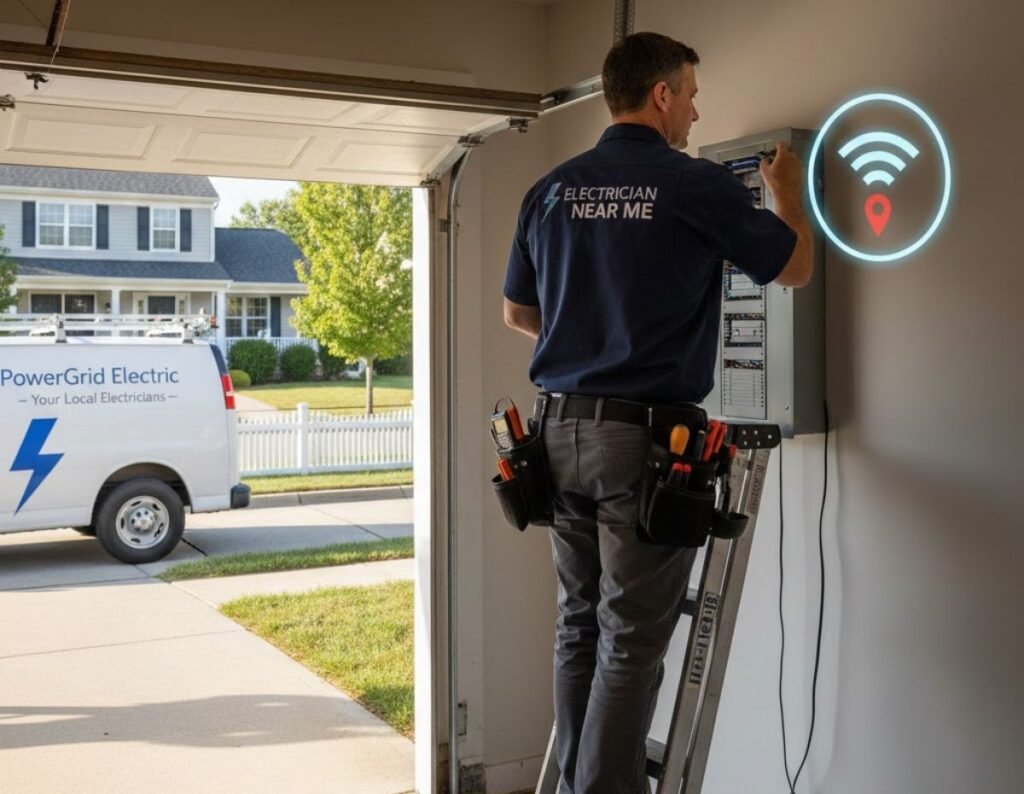
In an age where smart homes, security systems, high-speed internet, and data networks dominate both residential and commercial spaces, there’s a rising demand for experts who specialize not in high-power wiring, but in low-voltage systems. That’s where the Low Voltage Electrician comes in.
A Low Voltage Electrician works with the wiring and systems that carry low-voltage electricity usually for data, communication, security, and control systems rather than heavy-duty power for appliances or machinery. Their role is critical, but often behind the scenes.
Whether you’re a person considering a career as a low-voltage electrician, an employer looking to hire one, or simply curious about what the job entails this article aims to give you a full, clear picture.
What Is a Low Voltage Electrician?
A Low Voltage Electrician (also often called “voice-data-video (VDV) electrician” or “low-voltage technician”) is a specialist who installs, maintains, and repairs electrical systems that operate at low voltage typically systems that don’t power heavy appliances, but instead handle communication, security, data, and control functions.
According to guidelines used in the U.S., “low voltage” in this context often means systems operating at or below roughly 49 volts for distribution systems.
Key Responsibilities of a Low Voltage Electrician
So, what does a typical day look like? Low voltage electricians wear many hats, blending electrical know-how with IT expertise. Here’s a breakdown of their core duties:
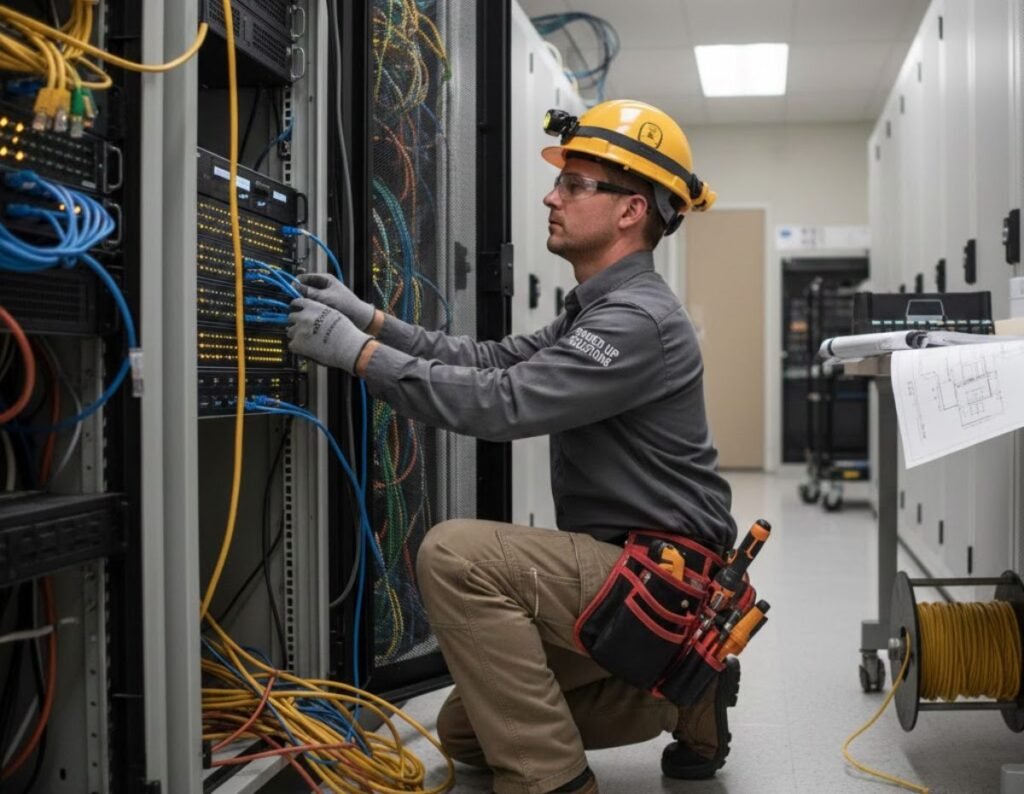
- Installing Cabling and Wiring: Running Ethernet cables, coaxial lines, and fiber optics through walls, ceilings, and conduits to connect devices.
- Setting Up Systems: Configuring security cameras, fire alarms, access control panels, and intercoms for homes, businesses, or public spaces.
- Troubleshooting and Repairs: Diagnosing issues like signal interference or faulty connections using tools like multimeters and cable testers.
- Integration with Smart Tech: Linking systems to apps or networks, ensuring everything from thermostats to lighting controls works harmoniously.
- Compliance and Safety Checks: Adhering to codes like the National Electrical Code (NEC) and performing tests to verify system integrity.
These tasks vary by setting. In residential jobs, you might wire a new home entertainment system. In commercial environments, it’s about scaling up for office networks or retail surveillance. Industrial gigs could involve low voltage controls for machinery sensors.
One thing’s for sure: this isn’t a desk job. You’ll be on-site, climbing ladders, crawling in tight spaces, and collaborating with contractors. It’s physical but rewarding, especially when you see a complex system come to life.
Why Choose a Career as a Low Voltage Electrician in the USA?
The appeal is multifaceted. First, job security: With the digital boom, demand is skyrocketing. The BLS projects 9% growth for electricians overall from 2024 to 2034, faster than average, and low voltage niches are even hotter due to tech advancements.
Second, work-life balance: Many roles offer regular hours, though emergencies like network outages might call for overtime. Union jobs, common in this field, often come with strong benefits.
Third, variety: No two days are the same. You could be in a bustling city like New York installing high-end AV in a luxury condo or in rural Texas setting up broadband for a farm.
Finally, entry barriers aren’t insurmountable. While some states require full electrician licensing, others have specific low voltage certifications, making it accessible for motivated beginners.
READ MORE: City Electric Supply
Low Voltage vs. Traditional Electrician: What’s the Difference?
It’s common to confuse a “regular electrician” with a “low-voltage electrician,” but there are important distinctions.
| Aspect | Low Voltage Electrician | Traditional / High-Voltage Electrician |
| Voltage range | Typically low-voltage circuits — e.g., up to ~49 V (for data/communication systems) or other low-voltage ranges as defined by standards. | Works with higher-voltage circuits: mains power, appliances, heavy-duty equipment (120V, 240V, etc.) |
| Primary scope of work | Data cabling, network wiring, CCTV, security systems, fire alarms, home automation, intercoms — often signal/communication/control systems. | Power wiring: lights, outlets, HVAC wiring, heavy equipment, high-current circuits, distribution wiring for appliances and industrial loads. |
| Tools, cables, components | Ethernet cables (Cat5e/Cat6), fiber optics, coaxial cables, alarm panels, surveillance cameras, access-control hardware, low-voltage transformers, data racks, patch panels. | Conduit, thicker gauge wires, breakers, electrical panels, heavy-duty outlets, high-voltage fixtures, wiring for heavy loads. |
| Focus & skillset | Precision, knowledge of communications/data standards, ability to plan cable layouts, network wiring, security system design/installation, testing data and signal circuits. Also documentation, code-compliance, coordination with IT/communication teams. | Focus on power distribution, load calculations, wiring safety, compliance with high-voltage codes, heavy wiring, general electrical infrastructure, often mechanical and appliance wiring. |
| Typical workplaces | Offices, commercial buildings, residential homes (especially smart-homes), IT data centers, security installations, schools/hospitals for data/communication setup. | Homes (power systems), industrial plants, manufacturing facilities, construction sites, heavy-equipment installations, large-scale building wiring. |
| Training / Licensing | Often voice-data-video (VDV) specialization; may require specific low-voltage or communication wiring credentials depending on state. | Usually generic electrician license (apprentice → journeyperson → master), training in power wiring, code compliance for higher-voltage systems. |
Essential Skills for Success
Technical prowess is key, but soft skills matter too. Here’s what sets top low voltage electricians apart:
- Technical Knowledge: Understanding voltage, current, resistance, and digital protocols like TCP/IP.
- Problem-Solving: Quick thinking to fix intermittent signals or compatibility issues.
- Attention to Detail: Precise wiring prevents costly errors.
- Physical Fitness: Handling tools, lifting, and working in awkward positions.
- Communication: Explaining tech to non-experts, like clients or teams.
- Adaptability: Keeping up with tech like 5G or AI-driven security.
Tools of the trade include wire strippers, crimpers, tone generators, and advanced gear like optical time-domain reflectometers (OTDRs) for fiber testing.
Career Advancement Opportunities
Once established, growth abounds. Move from installer to foreman, supervising crews. Or specialize—become a expert in audiovisual (AV) systems or cybersecurity integration.
Entrepreneurial types can start their own low voltage contracting business, bidding on projects via sites like Thumbtack or government contracts.
Higher education, like an associate’s in electrical engineering, opens doors to design roles or management. Salaries rise with expertise: Seniors can earn 20-30% more.
Union membership via IBEW offers pathways to benefits like pensions and advanced training.
READ MORE: Mr Sparky Electric
Salary Expectations for Low Voltage Electricians in the USA
Compensation is competitive. The average annual salary for low voltage electricians hovers around $50,000 to $60,000, per sources like ZipRecruiter and Glassdoor. Hourly rates range from $25 to $30, with overtime boosting earnings.
Factors influencing pay:
- Location: Higher in tech hubs like California ($60k+) vs. Midwest ($45k).
- Experience: Entry-level starts at $40k; veterans top $70k.
- Specialization: AV or fiber optic pros earn more.
- Employer: Unions or large firms pay better than small shops.
Benefits often include health insurance, 401(k)s, and tool allowances. Compared to general electricians (median $62,350 per BLS), low voltage roles might pay slightly less but offer less risk.
Job Outlook and Market Trends
The future looks bright. BLS forecasts 9% growth for electricians through 2034, adding about 50,000 jobs. Low voltage demand surges with trends like remote work, smart cities, and renewable energy integrations (e.g., solar panel controls).
Challenges include automation in some installations, but human expertise for custom work remains irreplaceable. Regions like the Southwest and Northeast see the most openings due to construction booms.
Advantages and Challenges of Being a Low Voltage Electrician
Advantages
- High demand — As buildings, homes, and businesses modernize with networking, security, and automation needs, demand for low-voltage skills grows.
- Relatively lower physical risk compared to high-voltage electrical work (though safety remains important).
- Specialized skillset — Covers a broad range: data wiring, security, fiber optics, alarms, network cabling, smart systems which can make the professional quite versatile and valuable.
- Multiple job settings — Residential, commercial, industrial, public buildings, even specialty sectors (transportation, shipyards, etc.).
- Potential for growth — With experience and additional training, can move into supervisory roles or specialize in complex systems or building automation.
Challenges
- Need for precision & attention to detail — Small mistakes in wiring, labeling, or installation can cause system failures or security vulnerabilities.
- Up-to-date technical knowledge — As technologies evolve (fiber optics, smart-home protocols, security systems, data networking), electricians must keep learning.
- Physical demands — Running cables, installing conduits, working in ceilings, walls, sometimes tight or elevated spaces.
- Variability of work and pay — Projects may come in bursts (especially in contracting), and pay may vary by region or experience level.
- Regulatory compliance and licensing — Depending on state and system (e.g., fire alarms, security), may require certifications or adherence to strict codes.
READ MORE: Frontier Electric
Low Voltage vs. High Voltage Electricians: A Comparison
To clarify the differences, here’s a handy comparison table:
| Aspect | Low Voltage Electrician | High Voltage Electrician |
| Voltage Range | Under 50 volts | Over 1,000 volts (up to thousands) |
| Primary Systems | Data networks, security, AV, alarms | Power distribution, transformers, grids |
| Risk Level | Low (minimal shock/fire hazard) | High (potentially fatal) |
| Education/Training | Vocational certs, 2-4 year apprenticeship | Full electrician license, 4-5 years training |
| Licensing | State-specific low voltage or general | Full electrical contractor license required |
| Average Salary | $50,000 – $60,000 annually | $65,000 – $80,000 annually |
| Job Outlook | Strong growth in tech sectors | Steady, with focus on infrastructure |
| Work Environment | Indoor, offices/homes; less physical strain | Outdoor/industrial; more hazardous |
This table highlights why low voltage appeals to those seeking tech-focused, safer roles.
Pros and Cons of Being a Low Voltage Electrician
Like any career, it has ups and downs. Pros:
- High Demand: Job stability in a tech-driven economy.
- Variety: Diverse projects keep things exciting.
- Good Pay for Trade: No college debt, solid earnings.
- Flexibility: Opportunities for freelance or travel.
Cons:
- Physical Demands: Crawling, lifting can wear on the body.
- Irregular Hours: On-call for emergencies.
- State Variations: Navigating different licenses can be tricky.
- Tech Evolution: Constant learning to stay current.
Overall, the pros outweigh the cons for many, especially with the satisfaction of solving real-world problems.
Why Low Voltage Systems Are Increasingly Important
Several trends contribute to rising demand for low-voltage electricians:
- Smart buildings / smart homes — As homes and offices adopt smart automation (smart lighting, security cameras, access control, IoT sensors, networked entertainment, smart HVAC control), low-voltage wiring becomes essential.
- High-speed data and networking needs — Modern businesses, data centers, offices, schools, hospitals all need robust structured cabling, fiber optics, networking, and connectivity infrastructure.
- Security and surveillance — CCTV, access control, fire alarms, alarm systems — increasingly installed even in small buildings — all rely on low-voltage work.
- Retrofits and upgrades — Older buildings being modernized often need updated data or security wiring; replacing analog systems with digital, networked systems requires low-voltage expertise.
- Regulatory and code compliance — Modern building codes and safety standards increasingly require professionally installed low-voltage systems (especially for fire alarms, emergencies, security).
READ MORE: Electric Company Near Me
Real-World Scenarios Where Low Voltage Electricians Make a Difference
- Smart-home installations: A homeowner wants integrated security cameras, alarm system, smart lighting, and high-speed internet — a low-voltage electrician designs and wires all systems, connects data and power, sets up alarm and CCTV, configures networking.
- Office building wiring: A commercial office needs structured cabling (ethernet), VoIP phones, security cameras, card-access system, fire alarms — low-voltage electrician handles all wiring, terminations, testing, and ensures compliance.
- Renovation of an older building: An old office is converted to modern use; existing high-voltage wiring is fine, but new network infrastructure, security, and data systems must be installed — low-voltage electrician brings building up to modern standards.
- Data center or server-room setup: For a data center, reliable structured cabling, fiber optics, redundant network wiring, secure access control, surveillance — low-voltage electricians manage critical wiring and system installation.
- Multi-family housing / apartment complex: Security systems, intercoms, CCTV, shared internet/intranet, building automation — low-voltage wiring helps deliver services to many tenants efficiently.
These scenarios illustrate how low-voltage electrical work though often unseen forms the backbone of modern connectivity, security, and automation in buildings.
How to Get Started: Becoming a Low Voltage Electrician in USA
If you’re considering entering the field, here’s a general roadmap:
- Get foundational education — high-school diploma (minimum) plus vocational/technical training focused on low-voltage wiring, communications wiring, or voice-data-video (VDV) systems.
- Enroll in an apprenticeship or entry-level program — many low-voltage electricians start as apprentices or under more experienced electricians/technicians to learn wiring, standards, installation, testing.
- Gain hands-on experience — do a variety of installations: data cabling, fiber optics, security systems, CCTV, networking, alarm systems, etc. Real-world work helps you build skill and confidence.
- Learn codes, standards, regulations — understand national/regional electrical codes (e.g., part of the National Fire Protection Association (NFPA) and NEC, or other relevant codes) related to low-voltage wiring, fire/security wiring, building safety, etc.
- Get certified/licensed (if required) — depending on state or job (e.g., fire-alarm installation, security systems), you may need specific certifications or licensing; check local regulations.
- Develop complementary skills — documentation, project planning, client communication, understanding of networking/data standards, troubleshooting, system design these add value beyond basic wiring.
- Stay updated — technology changes fast: fiber optics, smart-home systems, IoT, new security protocols, building automation staying educated, training, and adapting helps maintain your relevance and expertise.
FAQs About Low Voltage Electricians
- What do low voltage electricians do?
Low voltage electricians install, maintain, and repair systems like security alarms, data cabling, fire detection, and audiovisual setups. They ensure safe, efficient connections for modern tech without handling high-power electricity.
- How do you become a low voltage electrician in the USA?
Start with a high school diploma, pursue vocational training or an apprenticeship (2-4 years), earn certifications like BICSI, and get state-specific licensing. Hands-on experience is key, and requirements vary by location.
- Do you need a license to work as a low voltage electrician in the USA?
It depends on the state. Some require a full electrician license, while others have dedicated low voltage certifications. Always check local regulations many mandate exams, experience, and renewals.
- What is the difference between a low voltage technician and an electrician?
Low voltage technicians focus on under-50-volt systems like networks and alarms, with less risk. Traditional electricians handle higher voltages for power supply, often requiring more rigorous licensing.
- Is low voltage a good long-term career? Yes! With 9% projected growth and rising tech needs, it offers stability, good pay (around $50k-$60k), and advancement opportunities. It’s less hazardous than high voltage work and aligns with future trends like smart homes.
Conclusion:
In summary, being a low voltage electrician in the USA means stepping into a dynamic, essential role at the intersection of electricity and technology. With solid training, certifications, and a knack for problem-solving, you can build a fulfilling career with competitive pay and growth potential. If you thrive on hands-on work and staying ahead of tech curves, this could be your calling.