For millions of U.S. homeowners, upgrading to a Rheem 50 gallon electric water heater offers a dependable, balanced solution designed to meet the rigorous daily demands of a modern household without requiring complex natural gas lines or venting.
Choosing the right water heater requires weighing several core factors: your household’s daily hot-water consumption, available installation space in your utility closet or garage, existing electrical panel capacity, long-term energy efficiency, and total upfront replacement costs. Because Rheem manufactures multiple distinct product lines within its 50-gallon electric category ranging from reliable entry-level standard models to feature-rich smart units with built-in leak detection, homeowners must carefully verify exact model specifications and part numbers before making a purchase.
This comprehensive guide breaks down everything you need to know about Rheem 50-gallon electric water heaters. We will examine how they work, compare popular models, review technical specifications, analyze real-world operating costs, walk through professional installation steps, outline common troubleshooting techniques, and help you determine whether this capacity and brand are the right fit for your home. Lets deep dive into “Rheem 50 Gallon Electric Water Heater: Specs, Cost & Reviews”
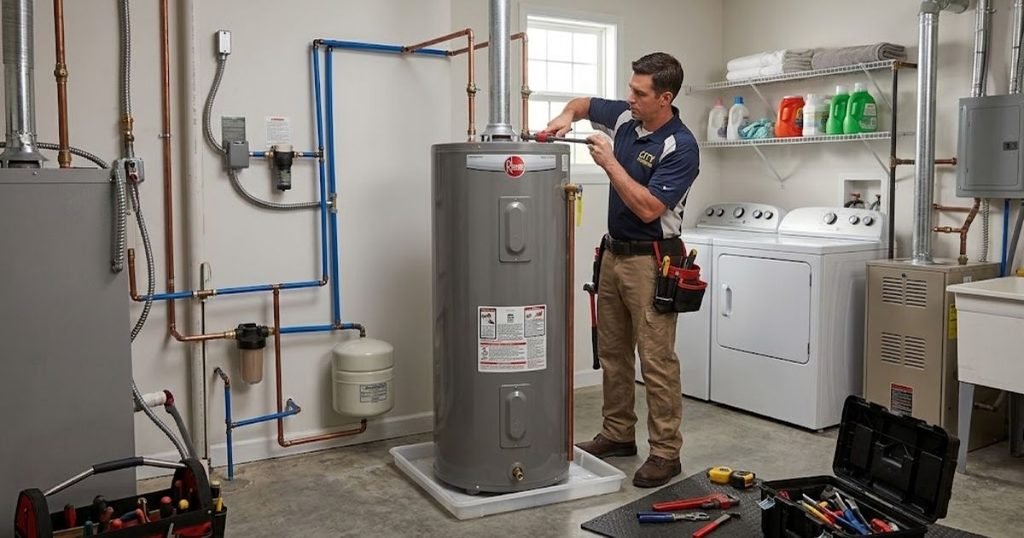
What Is a Rheem 50 Gallon Electric Water Heater?
At its core, a conventional electric storage water heater functions much like an insulated thermal battery. Cold water enters near the bottom of the tank through a dip tube, where it is heated by electric resistance elements and stored until needed. When you turn on a hot water faucet, hot water rises to the top of the tank and exits through the hot water outlet pipe.
Understanding the primary internal components helps clarify how these units operate:
- The Insulated Storage Tank: Typically constructed from heavy-gauge steel lined with glass enamel to resist corrosion, surrounded by thick foam insulation to minimize standby heat loss.
- Upper and Lower Electric Heating Elements: Most standard residential electric units feature two 4500-watt or 5500-watt resistance elements (working in non-simultaneous cycles) that heat the water.
- Thermostats and Temperature Controls: Dual thermostats monitor and regulate water temperature independently for the upper and lower sections of the tank, ensuring consistent heat.
- The Anode Rod: A sacrificial metal rod (often magnesium or aluminum) suspended inside the tank that attracts corrosive minerals in the water, sacrificing itself to protect the steel tank walls from rusting.
- Temperature and Pressure (T&P) Relief Valve: A critical safety device designed to automatically open and discharge water if internal tank pressure or temperature exceeds safe operational limits.
It is important to understand that a 50-gallon nominal tank capacity does not automatically deliver 50 continuous gallons of hot water at the tap before the water begins to cool. As hot water is drawn out, incoming cold water enters the tank and mixes with the remaining hot water. Factors such as incoming groundwater temperature, thermostat set point, element wattage, and household flow rates all dictate your actual usable hot water supply.
Furthermore, conventional electric resistance water heaters should not be confused with Rheem hybrid heat-pump water heaters. While both may hold 50 gallons of water, hybrid models extract heat from the surrounding ambient air using a refrigeration compressor, offering dramatically higher energy efficiency but requiring different clearance space, electrical connections, and condensate drainage.
READ MORE: Cheapest 50-Gallon Electric Water Heater
Popular Rheem 50 Gallon Electric Water Heater Models
Rheem offers several distinct product families in the 50-gallon electric category, catering to different budgets, warranty expectations, and technological preferences. Below is a comparison of three common residential models found across U.S. plumbing suppliers and home improvement retailers:
| Feature | Rheem Performance Standard (Tall) | Rheem Performance Plus (Medium) | Rheem Performance Platinum Gladiator |
| Exact Model Number | XE50T06ST45U1 | XE50M09EL45U1 | XE50T12CG45U0 |
| Nominal Tank Capacity | 50 Gallons | 50 Gallons | 50 Gallons |
| Tank Dimensions (Approx.) | ~59″ H x 20-1/4″ D | ~48″ H x 22-1/4″ D | ~58-3/8″ H x 20-1/4″ D |
| Voltage and Wattage | 240V / Dual 4500W | 240V / Dual 4500W | 240V / Dual 4500W |
| Energy Efficiency (UEF) | ~0.93 UEF | ~0.93 UEF | ~0.92 – 0.93 UEF |
| Warranty Coverage | 6-Year Limited Tank & Parts | 9-Year Limited Tank & Parts | 12-Year Tank/Parts + 3-Year Labor |
| Smart Features | None (Standard mechanical/digital) | LED Diagnostic System | Built-in EcoNet WiFi, Leak Detection, Auto Shut-off |
| Best Suited For | Budget-conscious standard replacements | Homeowners seeking extended warranty protection | Tech-savvy buyers wanting leak prevention and remote monitoring |
Note: Product specifications, exact model numbers, and features can vary by regional distribution and retailer. Always verify nameplate data and manufacturer documentation prior to purchase.
Rheem 50 Gallon Electric Water Heater Specifications
Evaluating technical specifications ensures your chosen water heater fits your physical space and electrical infrastructure.
Tank Capacity and Dimensions
Rheem 50-gallon electric water heaters are generally manufactured in two physical configurations: Tall and Medium (or Short).
- Tall models typically measure around 58 to 60 inches in height with a diameter of approximately 20 to 22 inches. They require adequate vertical clearance and floor space.
- Medium/Short models are shorter (around 48 inches) but wider (roughly 22 to 24 inches in diameter), making them ideal for crawlspaces, tight utility closets, or under stairwells where vertical height is restricted.
Always account for local plumbing code requirements, including earthquake strapping (in seismic zones), drain pans, and clearance for servicing the elements and T&P relief valve discharge piping.
Voltage, Wattage, and Circuit Requirements
Standard residential Rheem electric water heaters operate on standard 240-volt AC, single-phase electrical service. Most standard units utilize dual 4500-watt heating elements wired non-simultaneously (meaning only one element heats at a time to prevent overloading the circuit). Higher-performance models may offer 5500-watt elements.
A typical 4500-watt electric water heater requires a dedicated 30-amp circuit breaker paired with heavy-gauge copper wiring (typically 10 AWG). Never assume existing electrical wiring is adequate when upgrading wattage or replacing an old unit without professional verification.
First-Hour Rating and Recovery Rate
The First-Hour Rating (FHR) indicates how many gallons of hot water the heater can supply during a busy first hour of heavy use, starting with a fully heated tank. For Rheem 50-gallon electric models, FHR typically ranges between 55 and 63 gallons, depending on element wattage and tank design.
The Recovery Rate measures how many gallons the unit can heat by 90°F per hour. Standard 4500-watt models typically deliver a recovery rate of approximately 21 gallons per hour (GPH) at a 90°F temperature rise, while 5500-watt models boost recovery to around 25 GPH.
Energy Efficiency
Efficiency is measured via the Uniform Energy Factor (UEF) established by the U.S. Department of Energy (DOE). Standard Rheem electric resistance models generally achieve a UEF between 0.90 and 0.93, reflecting efficient foam tank insulation and optimized internal baffling that minimizes standby heat loss.
READ MORE: 40 vs 50 Gallon Water Heater: Which Size Is Best for Your Home?
How Much Does a Rheem 50 Gallon Electric Water Heater Cost?
Total replacement costs encompass more than just the sticker price of the appliance. Homeowners must factor in professional labor, materials, and necessary code upgrades.
| Cost Component | Estimated Price Range | Description |
| Water Heater Unit Only | $550 – $1,050 | Varies by series (Standard vs. Performance Plus vs. Gladiator smart models). |
| Professional Installation Labor | $500 – $1,200 | Varies by region, plumbing accessibility, and contractor rates. |
| Old Unit Removal & Disposal | $75 – $200 | Hauling away and recycling the heavy, depleted old tank. |
| Fittings, Valves & Connectors | $50 – $150 | Dielectric unions, flexible water connectors, ball valves, and T&P drain lines. |
| Code Upgrades (Thermal Expansion Tank, Drain Pan) | $150 – $300 | Required by many modern municipal plumbing codes for safety and pressure control. |
| Permit & Inspection Fees | $50 – $150 | Local municipal fees where required by building authorities. |
| Total Estimated Replacement Cost | $1,375 – $3,050+ | Complete turnkey professional replacement range. |
Note: Prices reflect average U.S. retail and contractor rates. Costs fluctuate based on geographic location, emergency service dispatch fees, and whether electrical panel modifications are necessary.
READ MORE: Best 80-Gallon Electric Water Heaters | Reviews & Deals
Is a Rheem 50 Gallon Electric Water Heater Big Enough for Your Home?
Sizing a water heater correctly prevents daily frustration. A 50-gallon electric water heater is generally considered the industry standard for medium to large households consisting of 3 to 5 people.
However, capacity suitability depends on lifestyle habits rather than headcounts alone:
- Shower Habits: If multiple family members take long, sequential showers or utilize high-flow showerheads (greater than 2.5 gallons per minute), a standard 50-gallon electric tank may experience temporary hot water depletion during peak morning routines.
- Simultaneous Appliance Use: Running a dishwasher and a washing machine using hot water simultaneously places heavy demands on the tank.
- Groundwater Temperature: Homes in northern U.S. states experience much colder incoming winter groundwater (sometimes 40°F to 50°F), requiring the water heater to work harder and longer to reach target temperatures compared to southern homes with warmer incoming water.
For households with extreme hot-water demands, larger 65-to-80-gallon tanks or hybrid heat-pump systems are often worth considering.
Pros and Cons of a Rheem 50 Gallon Electric Water Heater
Every plumbing appliance has distinct advantages and trade-offs.
Potential Advantages:
- No On-Site Combustion: Standard electric resistance models do not require natural gas lines, propane tanks, or dedicated metal/PVC venting flues, simplifying placement flexibility.
- Familiar Technology: Traditional storage tank design is widely understood and easily serviced by licensed plumbers across the United States.
- Broad Product Tiers: Rheem offers tiered options ranging from budget-friendly builder models to premium smart-connected units with extended warranties.
- Straightforward Replacement: When replacing an existing electric tank with identical dimensions, the swap is typically efficient and clean.
Potential Disadvantages:
- Electricity Operating Costs: Operating purely on electrical resistance can result in higher monthly utility bills compared to gas or hybrid heat-pump alternatives.
- Finite Recovery Times: Heavy consecutive usage can deplete the tank, requiring waiting periods for the elements to reheat water.
- Physical Footprint: A 50-gallon vertical cylinder demands substantial vertical clearance and floor space.
- Electrical Limitations: Upgrading to higher-wattage elements may require thicker wiring or a higher-rated circuit breaker.
READ MORE: Best 40 Gallon Water Heater Buying Guide: Top Picks, Prices & Comparison
Rheem 50 Gallon Electric Water Heater Energy Usage and Operating Cost
Electric water heating represents one of the largest energy expenditures in a typical American home. To understand operating costs, it helps to distinguish between element wattage and actual daily electricity consumption.
A 4500-watt element consumes 4.5 kilowatt-hours (kWh) of electricity for every hour it is actively energized. However, elements cycle on and off based on water usage and standby losses rather than running continuously 24/7.
How to Estimate Operating Cost:
EstimatedMonthlyCost=MonthlykWhConsumedLocalElectricityRateperkWh
For example, if an average household uses approximately 400 kWh per month heating water, and the local utility rate is $0.15 per kWh:
$$400 \text{ kWh} \times \$0.15 = \$60.00 \text{ per month}$$
Actual operating expenses vary based on household hot-water consumption, thermostat settings (recommended at 120°F for safety and efficiency), incoming water temperature, and tank insulation quality.
Rheem 50 Gallon Electric Water Heater Installation
Replacing a water heater involves heavy lifting, water pressure, and 240-volt electricity. While handy DIYers sometimes attempt installation, hiring a licensed professional plumber is strongly recommended to ensure safety and code compliance.
Main Stages of Professional Installation:
- Model & Space Verification: Confirming the replacement unit matches physical clearance dimensions and electrical ratings.
- Shut-Off & Isolation: Shutting off the main water supply and turning off the dedicated 240V circuit breaker at the electrical panel.
- Draining the Old Tank: Connecting a garden hose to the drain valve and completely emptying the old tank before disconnection.
- Tank Removal: Disconnecting plumbing lines, electrical wiring, and safely removing the old heavy tank.
- Setting Up the New Unit: Positioning the new Rheem 50-gallon tank on a sturdy platform or drain pan, installing dielectric unions, seismic straps, and a thermal expansion tank if required by local code.
- Purging Air (CRITICAL STEP): The tank must be completely filled with water and all air purged from the plumbing lines before turning the electrical power back on. Energizing heating elements in a dry or partially filled tank will immediately burn out the elements, ruining the unit instantly.
- Testing & Leak Check: Restoring power, testing thermostat operation, and inspecting all fittings for leaks.
Common Rheem 50 Gallon Electric Water Heater Problems
Even reliable appliances occasionally experience issues. Here are common symptoms and troubleshooting starting points:
No Hot Water
- Possible Causes: Tripped circuit breaker, tripped high-temperature reset button on the thermostat, failed upper heating element, or faulty thermostat.
- Action: Check the main electrical breaker panel. If the breaker tripped, reset it once. If it trips repeatedly, call a professional. Never touch live electrical terminals without testing power with a multimeter.
Not Enough Hot Water
- Possible Causes: Heavy family usage exceeding tank capacity, incorrect thermostat setting, sediment accumulation, or a burned-out lower heating element.
- Action: Verify thermostat settings (typically set to 120°F). If only lukewarm water is available, the lower heating element may have failed.
Water Takes Too Long to Reheat
- Possible Causes: Extremely cold incoming winter water, heavy simultaneous draw, or scaling/sediment buildup insulating the lower element.
- Action: Flush the tank to remove mineral sediment.
Leaking Water Heater
- Possible Causes: Loose plumbing fittings, faulty T&P relief valve discharge, condensation, or a cracked internal tank.
- Action: Inspect the source. If water originates from the tank body itself (indicating a ruptured inner glass lining), the water heater cannot be repaired and must be replaced immediately.
Strange Noises or Discolored Water
- Possible Causes: Battering rumbling or popping noises are typically caused by boiling water trapped beneath mineral sediment accumulation at the bottom of the tank. Discolored water often points to a degrading anode rod or internal pipe corrosion.
READ MORE: AO Smith vs. Rheem Water Heaters: Comparison & Expert Reviews
Maintenance Tips to Extend Water Heater Life
Proactive maintenance protects your investment and maximizes appliance longevity:
- Review the Manual: Always adhere to the specific maintenance schedule outlined in your Rheem owner’s manual.
- Periodic Inspections: Inspect the tank exterior, fittings, and T&P relief valve monthly for signs of weeping or corrosion.
- Sediment Flushing: Flush a few gallons of water through the drain valve annually (or semi-annually in hard-water regions) to clear mineral debris.
- Anode Rod Checks: Inspect the sacrificial anode rod every 2 to 3 years. If the core wire is exposed, replace the rod to prevent premature tank rusting.
- Test the T&P Valve: Manually lift the test lever on the relief valve periodically to ensure the valve mechanism operates freely.
Rheem 50 Gallon Electric Water Heater Warranty
Rheem stands behind its products with tiered limited warranties depending on the specific product series:
- Standard Models (e.g., Performance 6-Year): Cover tank leaks and component parts for 6 years from the date of purchase.
- Performance Plus Models: Typically offer 9-year limited tank and parts coverage.
- Performance Platinum / Gladiator Models: Provide up to 12-year limited tank and parts coverage, frequently including a 3-year full in-home labor warranty.
Important Note: Warranties generally require online product registration within a specified window (typically 90 days of installation) and presuppose professional installation in compliance with local codes. Labor costs for part replacements are excluded unless specified in premium tiers.
Rheem 50 Gallon Electric Water Heater vs. Gas Water Heater
| Feature | Rheem 50-Gallon Electric | Rheem 50-Gallon Gas (Natural Gas) |
| Upfront Equipment Cost | Generally lower to moderate | Comparable to slightly higher |
| Installation Requirements | 240V electrical circuit, water lines | Gas supply line, chimney/power vent flue |
| Recovery Speed | Slower (standard 21–25 GPH) | Faster recovery rates (higher BTU input) |
| Energy Operating Expense | Higher in regions with expensive electricity | Generally lower operating cost in most U.S. markets |
| Venting Needs | None required | Requires dedicated atmospheric or power venting |
Choosing between electric and gas depends entirely on your home’s pre-existing infrastructure. Converting from electric to gas (or vice versa) involves expensive utility line additions that rarely offset operating cost differences in the short term.
Is the Rheem 50 Gallon Electric Water Heater Worth Buying?
For homeowners with existing 240-volt electrical service who need a dependable, readily available hot water solution for a 3-to-5-person household, a Rheem 50 gallon electric water heater is an excellent, reliable investment.
If you are operating on a strict budget and want straightforward reliability, standard Performance models offer robust performance. If you value peace of mind against catastrophic leaks, models equipped with integrated smart diagnostics, Wi-Fi connectivity, and automatic water shutoff valves (such as the Gladiator series) provide state-of-the-art protection that easily justifies the modest upgrade cost.
Frequently Asked Questions
How much does a Rheem 50 gallon electric water heater cost?
The standalone purchase price for a Rheem 50-gallon electric water heater typically ranges from $550 to over $1,000 depending on whether you choose a standard 6-year model or a feature-rich smart model. Total installed cost including professional plumbing labor, old unit disposal, and code-required expansion tanks generally totals between $1,375 and $3,050.
How long does a Rheem 50 gallon electric water heater take to heat up?
Heating a completely cold 50-gallon tank of water from scratch typically takes approximately 60 to 90 minutes with standard dual 4500-watt heating elements. Recovery times vary based on incoming groundwater temperature and whether the unit uses 4500W or 5500W elements.
Is a Rheem 50 gallon electric water heater enough for a family of four?
Yes, a 50-gallon electric water heater is specifically engineered to support households of 3 to 5 people under normal usage conditions. However, families with heavy simultaneous hot-water habits, large soaking bathtubs, or high-flow shower fixtures may benefit from managing shower schedules or exploring higher-capacity options.
What size breaker does a Rheem 50 gallon electric water heater need?
Standard residential Rheem 50-gallon electric water heaters equipped with 4500-watt or 5500-watt elements require a dedicated 30-amp circuit breaker paired with appropriate 10-gauge copper wiring. Always verify exact electrical requirements on the unit’s rating plate and local electrical codes before installation.
How long does a Rheem 50 gallon electric water heater last?
The average lifespan of a residential electric water heater ranges from 8 to 12 years. Actual longevity depends heavily on water hardness, routine maintenance (such as flushing sediment and inspecting anode rods), installation quality, and operating intensity.