There’s no single “correct” price here. Your final bill depends on how long your sewer line is, how deep it sits, what it’s made of, how easy it is to access, and whether your contractor uses traditional excavation or trenchless technology. Before anyone signs a contract, a professional sewer camera inspection should confirm what’s actually wrong and how much pipe truly needs to be replaced.
This guide breaks down realistic 2026 pricing, explains what drives costs up or down, and gives you the questions to ask before you approve any sewer work. Lets deep dive into “Sewer Line Replacement Cost: 2026 Pricing Guide”
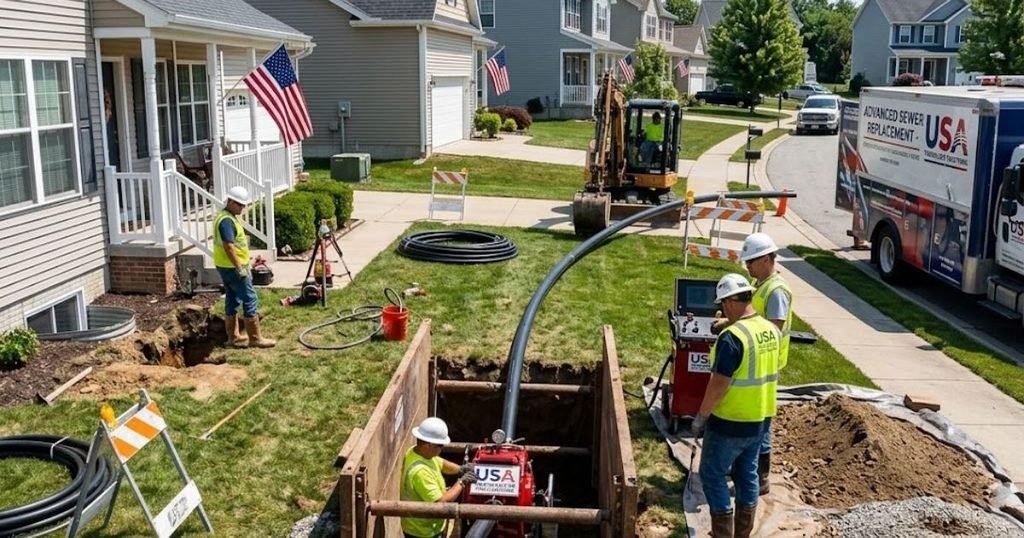
How Much Does Sewer Line Replacement Cost in 2026?
Sewer projects range from simple, shallow repairs near the surface to high-complexity replacements beneath thick concrete or public right-of-ways. Below is a breakdown of typical 2026 cost ranges for residential sewer projects in the United States.
| Sewer Line Project | Typical 2026 Cost Range | Average Cost |
| Sewer Camera Inspection | $100 – $750 | $350 |
| Minor / Spot Sewer Repair | $1,000 – $4,500 | $2,500 |
| Traditional Sewer Replacement (Open Trench) | $3,000 – $15,000+ | $7,500 |
| Trenchless Pipe Lining (CIPP) | $4,000 – $20,000+ | $9,000 |
| Trenchless Pipe Bursting | $5,000 – $20,000+ | $9,500 |
| Difficult / Deep Sewer Replacement | $15,000 – $25,000+ | $18,500 |
| Landscaping Restoration | $500 – $5,000+ | $2,000 |
| Driveway / Concrete Restoration | $1,000 – $8,500+ | $3,500 |
Note: The figures listed above serve as realistic national planning ranges rather than guaranteed fixed prices. Online estimates differ significantly because contractor pricing accounts for varying regional overhead, local permit fees, machine access constraints, and site-specific restoration needs.
READ MORE: Pipe Bursting vs. Pipe Lining Costs: Which Trenchless Option Is Best for Your Home?
Sewer Line Replacement Cost Per Linear Foot
Contractors often price sewer work by the linear foot because it’s the most direct way to account for pipe length, materials, and labor. A reasonable 2026 planning range is $50 to $250 per linear foot, with the low end reflecting easy-access trenchless work in soft soil and the high end reflecting deep excavation, rocky soil, or work under hardscaping.
Here’s roughly what that looks like at different pipe lengths:
- 30-foot line: approximately $1,500–$7,500
- 50-foot line: approximately $2,500–$12,500
- 75-foot line: approximately $3,750–$18,750
- 100-foot line: approximately $5,000–$25,000
Important caveat: multiplying a per-foot rate by your pipe’s length won’t give you the final invoice. Permits, inspections, excavation setup, traffic control, disposal, and restoration are often billed separately, on top of the linear-foot pipe cost. Two homes with identical 50-foot sewer lines can end up with very different totals once one needs a permit for street work and the other doesn’t.
What Factors Affect Sewer Line Replacement Cost?
1. Sewer Line Length
The longer the lateral, the more pipe, labor, and excavation are involved and the more restoration work follows. Length alone is one of the biggest cost drivers on any sewer line replacement estimate.
2. Pipe Depth
A sewer line sitting 3 feet down is far cheaper to reach than one buried 8 to 10 feet deep. Deeper excavation requires more labor, more shoring for safety, and often more equipment time, which adds up quickly.
3. Pipe Material
Common residential sewer pipe materials include:
- Cast iron — durable but prone to corrosion and cracking with age
- Clay — common in older homes, vulnerable to root intrusion and cracking
- Orangeburg — a bitumen-fiber pipe used mid-20th century, notorious for deforming and failing
- PVC — modern standard, resistant to roots and corrosion
- ABS — another modern plastic option, durable in most residential settings
Older materials like clay and Orangeburg are more likely to justify full replacement rather than a spot repair, simply because the surrounding pipe is often just as degraded as the failure point.
4. Location of the Sewer Line
Where your line runs matters. A sewer line under an open lawn is straightforward to excavate. The same line under a driveway, sidewalk, patio, concrete slab, mature tree, or public street adds demolition, restoration, and sometimes permitting costs that can significantly raise the total.
5. Soil Conditions
Rocky, compacted, unstable, or waterlogged soil slows down excavation and can require extra equipment, dewatering, or shoring all of which increase labor time and cost.
6. Accessibility
If heavy equipment can’t get close to the work area because of fences, tight side yards, or landscaping crews may need to dig more by hand, which takes longer and costs more.
7. Local Labor Rates
Sewer replacement in a high-cost metro area can cost substantially more than the same scope of work in a lower-cost region, simply because of differences in plumber and excavation labor rates.
8. Permits and Inspections
Most municipalities require a permit for sewer line replacement, and work that extends into the street or public right-of-way often requires additional permits and inspections from the local public works department. Requirements vary significantly by city and county.
READ MORE: Emergency Sewer Backup: Immediate Steps, Real Costs, and Pro Solutions
Traditional Sewer Line Replacement vs. Trenchless Replacement
| Feature | Traditional Excavation | Trenchless |
| Excavation | Extensive | Minimal |
| Yard damage | Usually significant | Usually limited |
| Restoration | Often expensive | Usually lower |
| Equipment | Excavator/backhoe | Specialized trenchless equipment |
| Best for | Severely damaged/collapsed lines | Structurally intact or accessible lines |
| Typical cost | Lower base installation cost | Higher installation cost, less restoration |
| Property disruption | High | Lower |
A common misconception is that trenchless sewer line replacement is automatically the cheaper option. It isn’t. Trenchless methods often carry a higher installation price than traditional digging, but they can save money overall by avoiding the cost of tearing up and repairing a driveway, lawn, or sidewalk. Whether trenchless comes out ahead financially depends entirely on how much restoration your project would otherwise require.
What Is Trenchless Sewer Line Replacement?
Trenchless technology replaces or rehabilitates a sewer line with minimal digging typically just a couple of small access pits instead of a long open trench.
Pipe Bursting
In pipe bursting, a bursting head is pulled through the old pipe, cracking it outward while simultaneously pulling a new pipe into place along the same path.
- Advantages: minimal excavation, can upsize pipe diameter, works well for badly deteriorated pipe.
- Disadvantages: requires access pits at each end, may not be suitable if nearby utilities are too close to the old pipe’s path.
- When it works: when the pipe’s alignment is still usable even though the pipe itself is failing.
- When it may not: if the line has severe offsets, bellies, or collapsed sections that would prevent the new pipe from following the old path safely.
Pipe Lining / CIPP (Cured-in-Place Pipe)
A resin-saturated liner is inserted into the existing pipe and inflated against the pipe walls, then cured (often with heat or UV light) to form a new pipe within the old one.
- How it works: the liner seals cracks, joints, and small root-intrusion points without removing the host pipe.
- Requirement: the host pipe needs enough structural integrity to support the liner a fully collapsed pipe generally isn’t a candidate.
- Advantages: very little digging, faster turnaround, no seams.
- Limitations: not appropriate for collapsed, severely offset, or significantly undersized pipe.
Because trenchless project scopes vary so much pipe bursting versus lining, access difficulty, pipe diameter published 2026 cost guides show a broad range for trenchless work rather than one fixed number.
Sewer Line Repair vs. Replacement: Which Do You Need?
Not every sewer problem calls for full replacement. A camera inspection often reveals that a targeted repair will solve the issue.
| Repair May Make Sense | Replacement May Make Sense |
| One isolated crack | Multiple damaged sections |
| Small localized break | Severely deteriorated pipe |
| Minor root intrusion | Extensive root intrusion |
| Limited damage | Collapsed pipe |
| Structurally sound pipe | Repeated failures |
| Short-term issue | Old pipe nearing end of service life |
A sewer camera inspection is the tool that separates these two paths. Published 2026 estimates commonly put camera inspection costs in the $100–$750 range, depending on the provider, line length, and whether locating equipment is used. That’s a small investment compared to committing to a full replacement you may not actually need.
READ MORE: CCTV Drain Inspection to Find Underground Sewer Blockage — Costs, Process & Fixes
Signs You May Need Sewer Line Replacement
Watch for these warning signs, though keep in mind that one symptom alone doesn’t automatically mean you need a full replacement:
- Frequent sewer backups
- Multiple slow drains throughout the house at once
- Sewage odors indoors or in the yard
- Gurgling toilets
- Sewage pooling in the yard
- Unusually green or wet patches of grass
- Sinkholes or ground depressions near the sewer line’s path
- Repeated need for drain cleaning or snaking
- Visible tree-root intrusion
- Sewage backing up into tubs or showers
- Old clay, cast-iron, or Orangeburg pipe
- Camera inspection showing major cracks, collapse, separation, or severe deterioration
Additional Costs to Budget For
Sewer Camera Inspection
This should typically happen before any replacement work is approved, so you know exactly what you’re paying to fix.
Permits
Local permitting rules vary by city and county, and this cost is often separate from the plumbing invoice itself.
Excavation
Trenching, equipment rental or operation, and site prep are core cost components of traditional replacement.
Landscaping
Restoring grass, topsoil, shrubs, flower beds, or tree-related work after excavation can add anywhere from a few hundred to several thousand dollars.
Driveway and Concrete Repair
If your sewer line runs beneath a driveway or slab, demolition and repouring can substantially increase your total project cost.
Sidewalk and Street Work
If the connection point sits in the public right-of-way, expect additional permitting, inspection, and restoration requirements from your municipality.
Emergency Service
After-hours or emergency sewer work such as responding to an active backup often carries additional service charges.
Cleanup and Disposal
Removing old pipe, excavated soil, and any contaminated material is a real cost that some quotes bundle in and others list separately.
READ MORE: Tree roots in sewer line — removal & repair cost
Does Homeowners Insurance Cover Sewer Line Replacement?
This is one of the most misunderstood parts of sewer line replacement. In general, standard homeowners insurance policies are not designed to cover gradual deterioration, wear and tear, or aging pipe the most common reasons sewer lines eventually need replacement. Sudden, accidental damage may be treated differently than a pipe that simply failed from age.
Coverage can also depend on the cause:
- Tree-root damage — coverage varies by policy and cause
- Sewer backups — often require a separate sewer backup endorsement
- Service line failures — some insurers offer optional service-line coverage endorsements specifically for underground utility lines
Rather than assuming you’re covered, call your insurance company and ask specifically about service line coverage and sewer backup coverage on your policy. Also check who’s actually responsible for the failed section that can depend on whether it’s inside the home, on your private property, at the utility connection, or within the public right-of-way. Ownership rules differ by municipality, so your local water or sewer utility can clarify where your responsibility ends.
How Much Does It Cost to Replace a Sewer Line Under a Driveway?
Sewer line replacement under concrete or asphalt tends to run higher than open-yard work because of the extra steps involved:
- Concrete or asphalt removal
- Excavation beneath the slab
- Pipe replacement
- Backfilling and proper compaction
- Repaving or concrete replacement
Because of these added steps, many homeowners in this situation look closely at trenchless pipe bursting or lining when the pipe’s condition allows it since avoiding driveway demolition can offset trenchless technology’s higher base price.
READ MORE: What is Sewer Gas in Kitchen Plumbing?
How Much Does It Cost to Replace a Sewer Line in the Yard?
Open-lawn excavation is generally the most straightforward and least expensive scenario, but costs rise when the line runs beneath mature trees, established landscaping, retaining walls, fences, or irrigation systems that need to be protected, removed, or rebuilt.
How Long Does Sewer Line Replacement Take?
Many straightforward sewer replacement projects are completed within one to a few days. More complex excavations, deep lines, long runs, or work requiring street permits can take longer.
- Traditional excavation: typically 1–3 days for the dig and pipe install, plus additional time for restoration
- Pipe bursting: often completed in a single day for the pipe-replacement portion itself
- Pipe lining: frequently the fastest option, sometimes completed in a day
Weather, permit processing, inspection scheduling, and conflicts with other buried utilities can all extend the timeline regardless of method.
Can You Replace a Sewer Line Yourself?
Realistically, no full sewer line replacement is generally not a beginner DIY project. It typically involves deep excavation, working around other underground utilities, exposure to raw sewage, structural safety concerns, precise pipe slope requirements, correct pipe connections, and compliance with local plumbing codes, permits, and inspections.
What homeowners can reasonably do themselves is a basic visual check for obvious signs of trouble, or arranging a professional camera inspection to understand what’s going on underground. The actual replacement work should go to a licensed, qualified contractor.
How to Save Money on Sewer Line Replacement
- Get at least 2–3 itemized estimates before choosing a contractor.
- Ask for the sewer camera footage or written inspection report.
- Ask directly whether repair is a realistic option before approving full replacement.
- Compare traditional excavation against trenchless pricing for your specific situation.
- Confirm exactly what restoration work is included in the quote.
- Verify who is pulling permits and scheduling inspections.
- Ask whether the contractor handles utility locating before digging.
- Avoid choosing a contractor based on the lowest number alone.
- Ask about warranty terms on both labor and materials.
- Get the full scope of work in writing before signing anything.
A trustworthy quote should clearly spell out pipe length, pipe material, replacement method, excavation scope, labor, permits, restoration, cleanup, and warranty, not just a single lump-sum number.
READ MORE: How Much Does It Cost to Replace a Garbage Disposal?
Questions to Ask a Sewer Line Replacement Contractor
- Did you perform a sewer camera inspection?
- Where exactly is the damaged section located?
- How many feet of pipe actually need replacement?
- What pipe material will you install?
- Why do you recommend replacement instead of repair?
- Is trenchless replacement possible for my line?
- Is pipe bursting appropriate here?
- Is pipe lining appropriate here?
- Are permits included in the quoted price?
- Who handles required inspections?
- Is landscaping restoration included?
- Is driveway or concrete repair included?
- What warranty comes with the work?
- Are there any charges that could show up later that aren’t in this quote?
How to Compare Sewer Line Replacement Estimates
Homeowners often compare quotes on price alone, but scope matters just as much. Imagine three quotes for the same job:
- Quote A: $6,500 — pipe and labor only, no permits or restoration
- Quote B: $9,800 — pipe, labor, permits, and basic backfill included
- Quote C: $11,200 — pipe, labor, permits, full landscaping restoration, and a warranty
Quote A looks cheapest on paper, but once you add permits and restoration yourself, the real total could exceed Quote C. Always compare full scope, not just the bottom-line number.
Apples-to-apples quote checklist:
- Same pipe material specified?
- Same replacement method (traditional vs. trenchless)?
- Permits included or separate?
- Restoration included or separate?
- Warranty terms comparable?
- Timeline and start date comparable?
Frequently Asked Questions
How much does it cost to replace a sewer line?
Most homeowners pay between $3,000 and $12,000 for a typical sewer line replacement in 2026, though more complex jobs involving deep excavation, long pipe runs, or extensive restoration can reach $20,000–$25,000 or more.
How much does sewer line replacement cost per foot?
A realistic 2026 planning range is $50 to $250 per linear foot. The low end generally applies to easily accessed, shallow lines using trenchless methods, while the high end reflects deep excavation, rocky soil, or lines running under driveways or concrete.
Is it cheaper to repair or replace a sewer line?
Spot repair is typically cheaper upfront and makes sense when damage is isolated, such as a single crack or localized root intrusion in an otherwise sound pipe. Replacement becomes the better long-term value when a line has multiple damaged sections, is severely deteriorated, has collapsed, or keeps failing repeatedly.
Is trenchless sewer line replacement worth the extra cost?
It depends on how much restoration your project would otherwise require. Trenchless methods often carry a higher installation price than traditional digging, but they can save money overall by avoiding driveway, sidewalk, or landscaping restoration.
Does homeowners insurance pay for sewer line replacement?
It depends on the cause of the damage and your specific policy. Standard homeowners insurance generally does not cover gradual deterioration or ordinary wear and tear, which are the most common reasons sewer lines fail. Some sudden, accidental damage may be covered, and separate endorsements for service line coverage or sewer backup coverage are sometimes available.
Final Verdict:
There’s no single universal price for sewer line replacement. Your actual cost depends on pipe length, depth, material, accessibility, soil conditions, local labor rates, and whether traditional or trenchless methods are used. Before approving any major work, get a professional camera inspection so you know whether you’re actually looking at a repair, pipe lining, pipe bursting, or full excavation and replacement.
When budgeting, look beyond the base installation price and factor in permits, inspections, and restoration these can shift which option is truly the better value. Get at least two or three itemized estimates, compare scope rather than just the bottom-line number, and don’t delay addressing a confirmed sewer problem, since backups and leaks tend to cause additional, more expensive property damage the longer they go unaddressed.


Pingback: Sewer Line Camera Inspection Cost (Cost Guide 2026) - Plumbing Guider