The state select water heater line often branded under the State, ProLine, or Select names has long been a staple in American homes. Whether you’re a first-time homeowner or a seasoned DIYer, choosing between State and heavy hitters like Rheem or A.O. Smith can feel like a toss-up.
In this 2026 guide, we’re breaking down everything you need to know about State Select models. We’ll compare them against the top four competitors, look at real-world pricing, and help you decide exactly which size and fuel type will keep your family in hot water without breaking the bank. Lets deep dive into ‘State Select Water Heater Review & Comparison (2026)”
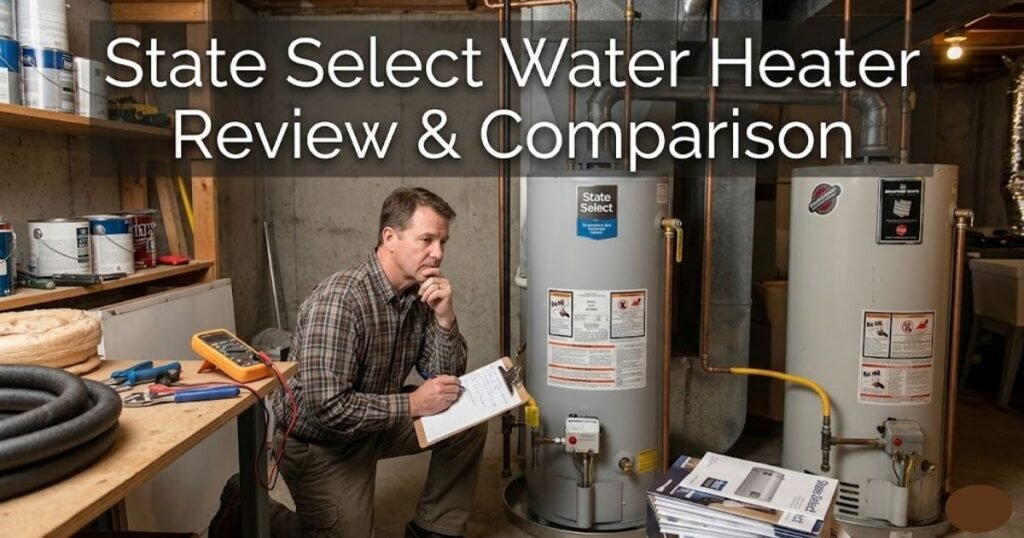
Quick verdict: who should buy a State Select?
The State Select series is the “Old Reliable” of the water heater world. It is best for homeowners who prioritize straightforward design and proven durability over “smart” bells and whistles.
If you want a tank that a local plumber can easily service, with parts that are widely available at any supply house, the State Select (specifically the ProLine series) is an excellent mid-range choice. It’s perfect for the 3–4 person household that needs a standard 50-gallon tank without the premium “boutique” price tag.
How State Select works — tech & specs homeowners care about
When shopping for a state select water heater, you’ll notice they focus heavily on “ProLine” engineering. State is actually a sister brand to A.O. Smith, meaning they share much of the same high-end manufacturing technology. Here are the technical specs that actually matter for your daily comfort.
Tank Size and First-Hour Rating (FHR)
Tank size (usually 40, 50, or 60 gallons) tells you how much water the tank holds. However, the First-Hour Rating (FHR) is more important. This number tells you how many gallons of hot water the unit can deliver in the first hour of a heavy-demand period (like everyone showering before work).
- A typical State Select 50-gallon electric model offers an FHR of approximately 57 to 62 gallons.
- Gas models usually have a higher FHR (often 70+ gallons) because gas heats water faster than electric elements.
UEF and Energy Efficiency
In 2026, the Department of Energy (DOE) uses the Uniform Energy Factor (UEF) to rate efficiency. The higher the UEF, the more efficient the unit.
- Standard Electric: UEF usually sits around 0.92–0.93.
- Standard Gas: UEF is typically around 0.64–0.70.
- Hybrid (Heat Pump): These can reach a UEF of 3.0 or higher, though State focuses more on traditional storage models.
Recovery Rate
This is the “refill” speed. If you drain the tank, how fast can the unit heat a fresh batch? State Select gas models excel here, often recovering 40+ gallons per hour, whereas electric models are slower, usually recovering about 20–25 gallons per hour.
Warranty
State ProLine electric 50-gal commonly carries a 6-year limited tank/parts warranty (check the exact SKU label).
READ MORE: AO Smith vs. Rheem Water Heaters: 2026 Comparison & Expert Reviews
2026 Water Heater Comparison Table (50-Gallon Models)
The following data represents current manufacturer specifications and retail market pricing as of March 2026.
| Brand / Model Example | Fuel Type | Tank Size | First-Hour Rating (FHR) | Warranty (Tank/Parts) | Typical Retail Price (US) |
| State Select (Select® EN6-50-DORS) | Electric / Gas | 50 gal | ~57 (Electric) / ~78 (Gas) | 6-Year Ltd | $700 – $850 |
| Rheem (Performance XE50) | Electric / Gas / Hybrid | 50 gal | 57 – 81 gal | 6, 9, or 12-Year | See Price |
| A.O. Smith (Signature 100 50-gal) | Gas / Electric / Hybrid | 50 gal | 75 – 81 gal | 6 – 12 Year | See Price |
| Bradford White (RE250T6) | Electric / Gas | 50 gal | ~60+ (Electric) | 6 – 10 Year | See Price |
| Whirlpool (ES50R12-45D) | Electric / Gas | 50 gal | ~55 – 60 gal | 6 – 12 Year | $450 – $825 |
Note on Pricing: Prices are estimated based on major retailers like Home Depot, Lowe’s, and SupplyHouse. Contractor-grade units (like Bradford White) often include “trade-only” pricing which may be higher when purchased through a licensed plumber.
Water Heater Brands Pros & Cons
State Select (ProLine)
- Pros: Extremely straightforward design; parts are “universal,” making repairs easy; excellent availability of “Tall” and “Short” models for tight closets.
- Cons: Not always stocked at big-box retailers (often found at plumbing supply houses); fewer high-tech/Wi-Fi options compared to Rheem.
Rheem
- Pros: Massive variety from budget units to ultra-efficient Hybrid Heat Pumps; widely available at Home Depot; many models include LeakGuard™ auto-shutoff valves.
- Cons: Higher-end models can be very expensive; some users find their proprietary sensors can be finicky.
A.O. Smith
- Pros: Strong professional reputation; their “Signature” line at Lowe’s offers great consumer warranties (up to 12 years).
- Cons: Some models are exclusive to certain retailers or contractors, making price-shopping difficult.
Bradford White
- Pros: True “Contractor Grade” units; built in the USA; widely considered the most durable tank by professional plumbers.
- Cons: You generally cannot buy these at a retail store; you must buy through a plumber, which increases the total project cost.
Whirlpool
- Pros: Great “value” brand; often the lowest upfront cost for a 50-gallon tank; recognizable name with decent customer support.
- Cons: Model availability has fluctuated recently; tanks are sometimes viewed as slightly less durable than State or Bradford White.
How to Choose the Right Size Water Heater and Fuel Type for Your Home
Buying the wrong size is the #1 mistake homeowners make. A tank that is too small means cold showers; a tank that is too large means you are paying to heat water you never use.
The Capacity Calculator
Use this simple guide to determine your needs:
- 1–2 People: 30–40 Gallon Tank.
- 3–4 People: 50 Gallon Tank (The Industry Standard).
- 5+ People: 60–75 Gallon Tank (Or a Tankless solution).
Choosing Your Fuel Source
- Electric: Cheapest to buy upfront. However, electric rates are often higher than gas, and the “recovery time” is slow. Best for small households or homes without gas lines.
- Natural Gas / Propane: Faster heating and usually cheaper to operate monthly. It requires a vent/chimney, which adds to installation complexity.
- Hybrid (Heat Pump): Uses electricity to pull heat from the surrounding air. It costs 3x more upfront (around $1,800+) but can save you $300+ per year on utilities. Best for warm climates or large basements.
When to go Tankless?
Consider tankless if you have a large family that takes back-to-back showers, or if you are extremely limited on space. Just be prepared: a tankless “on-demand” system can cost $3,000–$5,000 to install due to the need for upgraded gas lines and venting.
READ MORE: Titan Water Heater Review 2026 | Efficiency, Cost, Pros & Real User Experience
State Select Water Heater Installation & Maintenance Cost
The price on the sticker is only half the story. To get a state select water heater (or any brand) up and running, you need to budget for the “Total Installed Cost.”
2026 Cost Breakdown:
- The Unit: $500 – $1,200 (Standard 50-gal tank).
- Labor: $400 – $1,000. Simple swap-outs are cheaper; moving the heater to a new location is expensive.
- Permits & Inspections: $50 – $200 (Depending on your city/county).
- Disposal Fee: $50 – $100 to haul away the old, heavy, rusted tank.
Total Budget Range: $1,100 – $2,500.
Installer tips
- Get 2–3 written quotes from licensed plumbers. Confirm permit, disposal, and labor warranty details.
- Ask installers whether they will inspect anode rod at service and whether they offer to flush the tank during service (good preventive maintenance).
- For gas units, confirm venting meets code and that the flue is sized correctly for the selected BTU rating. If the installer recommends upsizing the gas line or adding a draft diverter, ask for the written reason and permit plan.
- Always ask your plumber if the quote includes a new expansion tank and a pressure-reducing valve. In many states, these are now required by code and can add $150 to the bill.
READ MORE: Best Rinnai Tankless Water Heater Reviews — Models, Specs & Prices
State Select Water Heater When to Repair vs. Replace
Is your water heater truly “dead,” or does it just need a $20 part?
Symptoms of a Repairable Unit:
- Pilot light won’t stay lit: Usually a bad thermocouple ($15–$30).
- Water is too hot/cold: Likely a faulty thermostat or a burnt-out electric element ($20–$50).
- Slow recovery: Often just sediment buildup. A professional “flush and fill” can fix this.
Symptoms of a Necessary Replacement:
- The “Puddle”: If water is leaking from the bottom of the tank itself, the inner liner has cracked. It cannot be fixed. Replace it immediately before it floods your home.
- Age: If your unit is 10+ years old, you are on “borrowed time.”
- Rumbling/Popping: This is the sound of sediment “boiling” at the bottom. While you can flush it, heavy sediment usually means the tank is nearing the end of its life.
- Rusty Water: This indicates the internal anode rod has failed and the tank is corroding from the inside out.
Final Verdict
The state select water heater remains one of the best “bang-for-your-buck” options in 2026. It doesn’t try to be a computer; it just tries to be a great water heater. If you want a reliable 50-gallon tank and have a local plumber you trust, a State Select/ProLine model will likely serve you well for the next decade.
READ MORE: 40 Gallon Water Heater Buying Guide
What is a State Select water heater and is it any good?
State Select (part of the State/ProLine family) is a reliable, mid-tier manufacturer owned by A.O. Smith. They are highly regarded by professionals for their simplicity and ease of repair. They are an excellent “no-frills” choice for standard residential hot water.
How long does a State Select water heater last?
Most State Select storage tanks last 8 to 12 years. You can extend this lifespan by “flushing” the tank annually to remove sediment and checking the sacrificial anode rod every 3 years. Replacing a $40 anode rod can often add 5 years to the tank’s life.
Should I buy gas, electric, or hybrid (heat-pump) for a 50-gallon model?
If you have a gas line, gas is usually the best balance of performance and cost. Electric is best for low-usage homes or where gas isn’t available. Hybrid is the winner for long-term savings, especially in warmer climates where the heat pump can work efficiently year-round.
How much does installation add to the price of a new 50-gal water heater?
Expect to pay between $400 and $1,200 for professional installation. This varies based on your local labor rates, whether you need new venting, and if your home requires a permit/inspection to meet 2026 building codes.
Is it worth buying a more expensive brand like Rheem or Bradford White over State?
It depends on your goals. Buy Rheem if you want smart-home integration (Wi-Fi alerts). Buy Bradford White if you want the absolute highest durability “contractor-grade” build. Buy State Select if you want a reliable, standard tank that is easy to maintain without paying for “luxury” features.
Sources & Price Verification
- State Water Heaters: ProLine® Master Spec Sheets (Verified March 2026).
- Rheem Manufacturing: Performance Series Product Catalog (Verified March 2026).
- A.O. Smith: Signature Series Retail Pricing – Lowe’s Home Improvement (Mar 2026).
- Home Depot: Rheem Performance Electric/Gas current listings (Mar 2026).
- SupplyHouse: State Select/ProLine Trade Price Lists (Mar 2026).
- U.S. Dept of Energy: EnergyStar Water Heater Efficiency Guidelines (2026 Edition).
Author
Reviewed by J.J. Sterling, Licensed Master Plumber. With over 15 years of field experience installing residential and commercial water heating systems, J.R. specializes in energy-efficient retrofits and plumbing code compliance. He has personally installed hundreds of units across the Midwest.