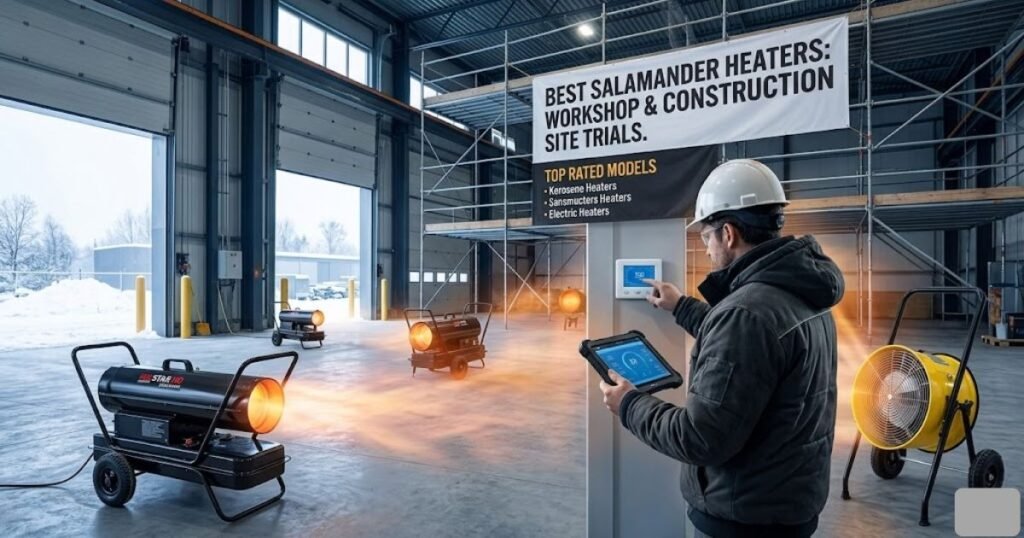
A salamander heater is a powerful portable heater often used to warm garages, workshops, barns, construction spaces, sheds, and other large areas that need fast heat. Many homeowners in the USA use these heaters during cold weather when they need quick, strong warmth in places where a regular home heater is not enough.
These heaters are popular because they can heat large spaces fast, move from one job to another, and come in different fuel types such as kerosene, propane, and electric. That said, not every salamander heater is made for every space. Some are better for indoor supplemental heat, while others are better for ventilated work areas or temporary use.
In this guide, you will find simple product reviews, a side-by-side comparison table, buying tips, and common questions to help you choose the right salamander heater for your needs. Lets deep dive into “Best Salamander Heaters of 2026: Top Picks, Reviews & Comparison”
READ MORE: Weil‑McLain Boiler Reviews (2026) — Models, Costs, Pros & Cons
What Exactly Is a Salamander Heater?
The term “salamander heater” is actually a bit of a nickname. Technically, they are forced-air torpedo heaters. They get the “salamander” moniker from the mythical lizard that was said to be able to live in and even extinguish fire.
Unlike your standard space heater that sits quietly in the corner of a bedroom, a salamander is designed for heavy-duty performance. It uses a powerful fan to blow air across a heating element (fueled by propane, kerosene, or electricity), throwing a massive amount of heat over a large distance.
These heaters are commonly used for:
- Garages
- Workshops
- Barns
- Sheds
- Construction areas
- Warehouses
- Outdoor covered spaces
- Emergency heating in large, drafty areas
Why US Folks Love Them
- Instant Heat: There is no “warm-up” period. You flip the switch, and the temperature rises immediately.
- Portability: Most are designed with handles or wheels, allowing you to move the heat exactly where you need it.
- Cost-Efficiency: For large, uninsulated spaces, it is often much cheaper to run a salamander than to try and use the home’s central HVAC system.
READ MORE: Viessmann Boiler Review 2026 | Efficiency, Models, Pros & Cons
Salamander Heaters Fuel Types: Which One is Right for You?
Before we get to the reviews, you need to decide which “flavor” of heat you need. Each has its pros and cons for the average homeowner.
1. Kerosene Salamander Heaters (Multi-Fuel)
Kerosene heaters are the classic choice. They are incredibly powerful and often “multi-fuel,” meaning they can run on Diesel #1, Diesel #2, or Jet-A fuel in a pinch.
- Pros: Highest heat output; fuel is easy to transport in jugs.
- Cons: Can have a slight “fuel smell” upon start-up/shut-down; requires a 120V outlet to run the fan.
2. Salamander Heaters Propane (LP)
Propane heaters are cleaner-burning than kerosene and are often preferred for indoor-adjacent spaces like semi-finished garages.
- Pros: Virtually no smell; very simple to operate; propane tanks are available at most gas stations.
- Cons: Requires a propane tank (usually 20lb to 100lb) and a 120V outlet for the fan.
3. Salamander Heaters Electric
Electric salamanders are the “set it and forget it” option. They don’t require fuel, meaning no fumes and no combustion.
- Pros: 100% clean; no carbon monoxide risk; quietest operation.
- Cons: Requires heavy-duty wiring (usually a 240V outlet, similar to a dryer or stove); generally produces less “raw” heat than fuel-based units.
Top 6 Salamander Heaters Reviewed for 2026
We’ve analyzed the specs, user feedback, and real-world performance of the top contenders. Here is the breakdown of the best salamander heaters for homeowners.
1. Dyna-Glo Workhorse KFA180WH (140K or 180K BTU)
The Dyna-Glo Workhorse is exactly what the name suggests. It is a dual-output kerosene heater that allows you to toggle between 140,000 and 180,000 BTUs. This is a huge advantage because you can blast the heat to get the room up to temp, then drop it down to save fuel.
- Best For: Large workshops, barns, and massive construction projects (up to 4,200 sq. ft.).
- Key Features: It features a built-in thermostat, a fuel gauge (which you’ll definitely need), and an air pressure gauge to ensure the pump is working at peak efficiency.
- The Verdict: If you have a massive space and need a “forever” heater, this is the one. It’s rugged, multi-fuel compatible, and the digital diagnostics make troubleshooting easy.

READ MORE: Electric Boiler Cost (2026) — Real Prices, Installation & Buying Guide
2. VEVOR Kerosene Forced Air Heater (Model ZB-K215)
VEVOR has quickly become a favorite for homeowners who want industrial power without the industrial price tag. The ZB-K215 is a beast, pushing out 215,000 BTUs.
- Best For: Budget-conscious homeowners with very large, high-ceiling spaces.
- Key Features: It has a massive 13.2-gallon fuel tank, giving you about 7.5 hours of continuous runtime at full blast. It also includes an easy-to-read thermostat.
- The Verdict: This is one of the most powerful units on our list. It’s a bit louder than some others, but for the price-to-BTU ratio, it is nearly impossible to beat.

- Heating for Wide Workspace: This forced-air kerosene heater delivers 215,000 BTUs of heat, instantly warming up spaces l…
- Thermostatic Energy Efficiency: The kerosene heater features a thermostat knob and room temperature display (adjustable …
- Supports Kerosene and Diesel: This heater accommodates both kerosene and diesel fuels, but only one type should be used …
3. Mr. Heater 125,000 BTU Forced Air Propane Heater (F271390)
Mr. Heater is the gold standard for portable propane heat. The F271390 is a 125,000 BTU unit that is remarkably simple. It doesn’t have the bells and whistles of a digital screen, but it works every single time you click the igniter.
- Best For: Homeowners who prefer propane and want a reliable, “no-fuss” heater for a standard 2- or 3-car garage.
- Key Features: High-limit safety switches and a thermoelectric safety valve to shut off gas if the flame goes out. It comes with a 10ft hose and regulator.
- The Verdict: This is the most “user-friendly” unit for someone who doesn’t want to mess with kerosene jugs. It’s clean, efficient, and very portable at just 22 lbs.

- Nullify
- Imported
- Quiet Burner Technology-50% Quieter than a standard propane heater
4. DR. INFRARED HEATER DR-PS11024
The DR-PS11024 is the outlier on this list because it is 100% electric. Rated at 10,000 watts, it produces about 34,130 BTUs of clean, dry heat.
- Best For: Finished garages or basements where you cannot have any exhaust fumes.
- Key Features: It’s a 240V unit, meaning you’ll need a dedicated circuit. It includes a remote control and a thermostat that ranges from 40° to 100°F.
- The Verdict: If you have the electrical capacity, this is the “nicest” heater to live with. No smell, no noise from a fuel pump, and no fire hazard. However, it won’t heat up a space as fast as the kerosene monsters.

- Clean, instant, odor-free heat. Mounting type: Floor Mount
- 240-Volt, Single Phase, 10,000-Watt ; Required 55-Amp Circuit Breaker
- Heavy-duty steel Frame; safety guards on both INTAKE and output ends
READ MORE: Biomass Boiler Review: Is It Worth It for Homeowners?
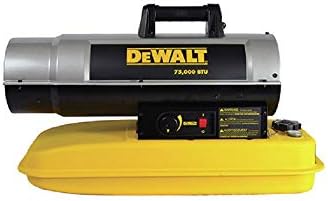
5. DEWALT DXH75KT Kerosene Heater (75K BTU)
DeWalt brings its legendary “jobsite-tough” engineering to the DXH75KT. At 75,000 BTUs, it is designed for smaller spaces but built to survive a fall off a truck.
- Best For: Standard residential garages (up to 1,750 sq. ft.) where durability is the top priority.
- Key Features: The “split upper shell” design is a game-changer for maintenance—it makes cleaning the internal components incredibly easy. It also features glove-friendly controls.
- The Verdict: It’s smaller, but it’s high-quality. If you want a heater that will last 10+ winters of heavy use, the DeWalt is worth the premium.
- Recessed Controls
- Typical uses Work shops, Barns, Job sites, Home Remodeling
- CSA certified
6. InoKraft Maxheat MH125 (125,000 BTU Propane)
InoKraft is a newer player that is making waves with “smart” features. The MH125 is a propane heater that emphasizes control.
- Best For: DIYers who want precise temperature control in their workspace.
- Key Features: It has an “Auto” mode where it cycles on and off to maintain a specific temperature (25°F to 95°F), which is rare for propane forced-air heaters.
- The Verdict: It’s stylish and surprisingly quiet. The automatic temperature control is a huge fuel-saver and keeps the room from getting too hot, which is a common complaint with salamanders.
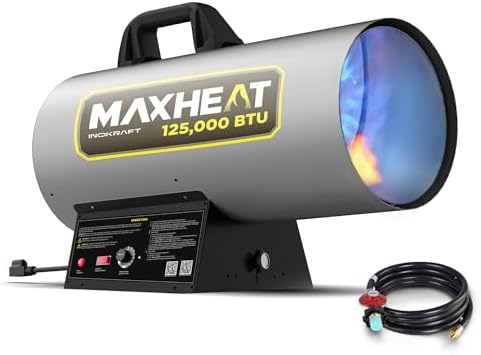
- Smart 25-95°F Auto On/OFF Control: This forced air heater provides 125000 BTUs while heating an area up to 3200 sq. ft. …
- Fast Heating: Heavy-Duty Forced Air Fan, Significantly Raises Temperature in 5 Minutes. The fan-forced design distribute…
- Multi-Protection Safety Features: Ensure the area is well-ventilated to achieve economical, efficient, and clean burning…
Salamander Heaters Comparison Table:
| Product Model | Fuel Type | BTU Output | Heating Area (Approx) | Power Source (for Fan) | Key Advantage |
| Dyna-Glo KFA180WH | Kerosene/Multi | 140K – 180K | 4,200 sq. ft. | 120V Plug | Variable Heat Output |
| VEVOR ZB-K215 | Kerosene/Diesel | 215,000 | 5,000+ sq. ft. | 120V Plug | Best Value Power |
| Mr. Heater F271390 | Propane | 125,000 | 3,000 sq. ft. | 120V Plug | Ultra-Reliable |
| Dr. Infrared DR-PS11024 | Electric | 34,130 | 1,000 sq. ft. | 240V Hardwire | Zero Fumes |
| DEWALT DXH75KT | Kerosene/Multi | 75,000 | 1,750 sq. ft. | 120V Plug | Rugged & Easy Maint. |
| InoKraft Maxheat MH125 | Propane | 125,000 | 3,200 sq. ft. | 120V Plug | Smart Temp Control |
READ MORE: Best Modine Heater Review: Is the Modine Hot Dawg Worth It?
Best Use Cases by Product
Here is a simple way to think about these heaters:
- Best for maximum heat: Dyna-Glo Workhorse KFA180WH
- Best value-style kerosene option: VEVOR ZB-K215
- Best propane pick: Mr. Heater F271390
- Best electric infrared alternative: DR. INFRARED HEATER DR-PS11024
- Best balanced kerosene option: DEWALT DXH75KT
- Best propane alternative: InoKraft Maxheat MH125
Safety First: Don’t Skip This Section!
Because fuel-burning salamander heaters involve actual combustion, safety isn’t just a suggestion—it’s a requirement.
1. Ventilation is Non-Negotiable
If you are using a kerosene or propane heater, you must have a source of fresh air. Combustion consumes oxygen and releases carbon monoxide (CO).
- The Rule of Thumb: Crack a garage door at least 2-3 inches or open a window on the opposite side of the room to create a cross-breeze.
2. Clearance from Combustibles
These heaters aren’t called “torpedoes” for nothing. They shoot a literal flame inside the tube.
- Maintain 3 feet of clearance on the sides.
- Maintain 6-10 feet of clearance in the “hot zone” directly in front of the nozzle. Never point it at a car, a pile of lumber, or a gas can.
3. Use a CO Detector
If you’re using a salamander heater in a workspace, spend the $20 to get a battery-operated Carbon Monoxide detector. It’s a small price to pay for total peace of mind.
READ MORE: Best Greenhouse Heater Buying Guide: Best Winter Options for U.S. Gardeners
How to Calculate the Salamander Heaters BTUs You Need
A common mistake is buying a heater that is too big (which wastes fuel and makes the room uncomfortable) or too small (which never gets the job done).
Use this simple formula for a rough estimate:
- Calculate Volume: Length x Width x Ceiling Height = Cubic Feet.
- Check Insulation:
- Good Insulation: Multiply Cubic Feet by 0.5.
- No Insulation (Drafty): Multiply Cubic Feet by 2.0.
- The Result: This gives you the approximate BTUs needed to raise the temp significantly.
Example: A typical 2-car garage (20x20x10) is 4,000 cubic feet. If it’s uninsulated, you’ll want around 80,000 BTUs to stay toasty.
Salamander Heaters Maintenance Tips for Longevity
- Dust is the Enemy: In a workshop, sawdust can clog the air intake. Every few weeks, use an air compressor to blow out the dust from the back of the unit.
- Fresh Fuel: Kerosene can degrade over time and absorb moisture. Never use fuel left over from last winter. Always start the season with fresh fuel to prevent the “smell” and clogged nozzles.
- Spark Plug Care: Fuel-based heaters have a spark plug or igniter. If your heater is clicking but not catching, it usually just needs the spark plug cleaned with a wire brush.
Frequently Asked Questions
Can I use a salamander heater in my house?
No. Industrial salamander heaters (propane and kerosene) are for well-ventilated outdoor or semi-outdoor spaces like garages, barns, and construction sites. They produce carbon monoxide, which can be fatal in an enclosed living space. Only the Electric models (like the Dr. Infrared) are safe for indoor residential use.
Why does my kerosene heater smell like jet fuel?
A slight smell at start-up and shut-down is normal. However, if it smells constantly, you are likely using low-quality fuel or your air pressure needs adjustment. Always use K-1 Grade Kerosene for the cleanest burn.
How much propane does a 125,000 BTU heater use?
A 125,000 BTU heater will typically run for about 11-12 hours on a 40lb propane tank on a medium setting. On a standard 20lb “grill” tank, you’ll only get about 3-5 hours, which is why larger tanks are recommended.
Are electric salamander heaters cheaper to run than propane?
Generally, no. In most parts of the USA, the cost of the electricity required to produce 100,000 BTUs is higher than the cost of the propane or kerosene required for the same output. Electric is chosen for cleanliness, not for cost savings.
Can I leave my salamander heater running overnight?
Absolutely not. You should never leave a combustion heater unattended while sleeping. They are designed for “attended” use. If you need overnight heat, look into a permanently installed, vented natural gas heater or a hardwired electric unit.
Final Thoughts:
Choosing a salamander heater comes down to your space and your fuel preference.
- If you want the ultimate power for a massive barn, go with the Dyna-Glo or the VEVOR.
- If you want a clean, simple experience for a standard garage, the Mr. Heater or InoKraft propane units are your best bet.
- If you’re a professional who needs a unit that can survive the back of a truck, stick with DeWalt.
- If you want fume-free warmth for a home gym or basement workshop, the Dr. Infrared is the clear winner.
Winter is coming—don’t let your projects freeze! Pick the right heater, vent your space properly, and get back to work.


Pingback: Gas Heater for Home Not Working? Causes, Fixes & Pro Tips - Plumbing Guider