If you heat your home with a hydronic boiler, you might be overlooking one of the most efficient, durable ways to generate domestic hot water: an indirect water heater. Instead of relying on a standalone water heater with its own gas burner or electric elements, an indirect system hooks directly into your home’s main boiler.
For U.S. homeowners with gas, oil, or propane boilers, an indirect tank offers exceptionally fast hot-water recovery rates and lower long-term operating costs. However, it isn’t a one-size-fits-all product. Understanding how these systems integrate with your boiler, what they cost to install, and how to size them properly will help you decide if an indirect water heater is the right upgrade for your home. Lets deep dive into “Indirect Water Heater: How It Works, Benefits & 5 Best Models”
What Is an Indirect Water Heater?
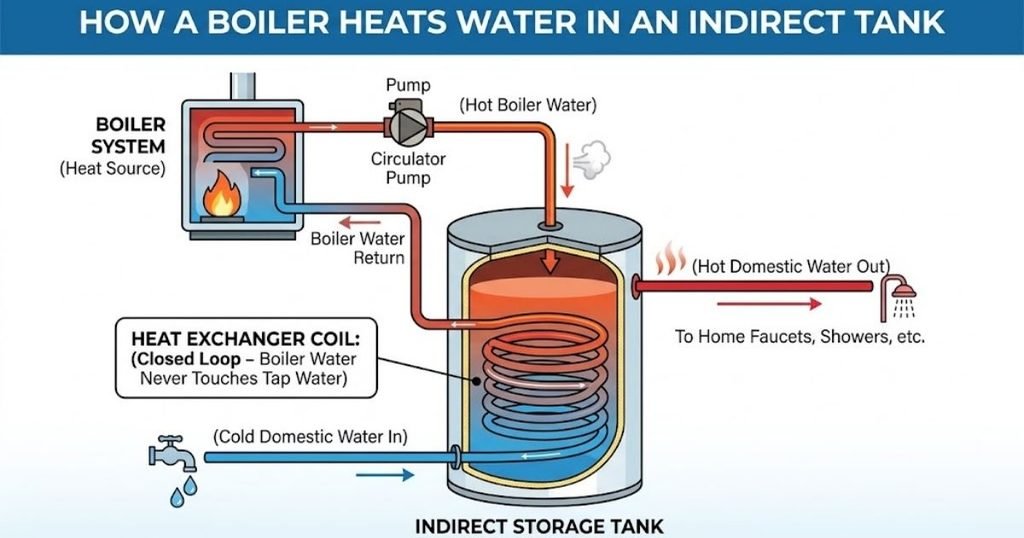
An indirect water heater (often called an indirect-fired water heater or indirect storage tank) is a heavy-duty domestic hot water tank that operates without its own internal fuel source. Unlike conventional gas units with fireboxes underneath or standard electric units with internal heating rods, an indirect tank relies entirely on heat supplied by an external hydronic or steam boiler.
To understand the mechanics, it helps to look at the individual components that make up an indirect water heating system:
- Outer Storage Tank: An insulated jacket designed to hold potable (drinking) water under normal household pressure (typically 40–60 PSI).
- Internal Heat Exchanger: Usually a coiled metal pipe (or a tank-within-a-tank design) submerged inside the domestic water.
- Boiler Loop (Hydronic Circuit): The closed-loop piping that carries hot water from the boiler to the indirect tank’s heat exchanger and back again.
- Domestic Water Circuit: The potable water side, featuring a cold-water inlet at the bottom and a hot-water outlet at the top.
- Aquastat / Temperature Control: A thermostat mounted on the tank that monitors domestic water temperature and signals the boiler when heat is needed.
- Circulator Pump / Zone Valve: A dedicated pump or motorized valve that directs hot boiler water through the indirect tank’s heat exchanger loop when the aquastat calls for heat.
The Separation Principle: Potable vs. Boiler Water
A critical technical concept for homeowners to understand is that boiler water and domestic tap water never mix.
Boiler water flows inside a closed loop containing anti-corrosion additives, rust, or chemical treatment compounds. Domestic water is the clean, potable water you drink and shower in. The heat exchanger acts as a physical thermal barrier: heat passes freely through the metal walls of the coil into the surrounding domestic water, but the fluids themselves remain strictly isolated.
This dual-fluid separation ensures full compliance with local plumbing codes while giving your domestic water access to the immense heating power of your home’s central boiler.
READ MORE: Best 5 Navien Combi Boiler: Review, Comparison & Cost
How Does an Indirect Water Heater Work?
The operational cycle of an indirect water heater is straightforward, automated, and governed by hydronic controls. Here is step-by-step how the system supplies continuous hot water to your home:
- Temperature Drop Detected: As your household uses hot water for showers, dishes, or laundry, cold municipal or well water enters the bottom of the indirect tank. The internal aquastat detects that the stored water temperature has dropped below your setpoint (typically 120°F to 140°F).
- Priority Signal Sent: The aquastat closes an electrical contact, sending a “call for heat” signal to the boiler control panel. In most modern systems, the indirect tank is wired with Domestic Hot Water (DHW) Priority, meaning the control temporarily pauses space heating to divert full boiler output to water heating.
- Boiler Fires & Pump Activates: The boiler ignites (or ramps up if it’s a modulating unit), and a dedicated indirect circulator pump starts moving high-temperature boiler water (usually 160°F–180°F) into the tank’s heat exchanger coil.
- Heat Transfer: As hot boiler water rushes through the internal coil, heat energy rapidly transfers across the metal wall into the cooler domestic water stored in the tank.
- Thermal Stratification: Natural convection causes the newly heated domestic water to rise toward the top of the tank, where the hot water outlet pipe draws from.
- Delivery to Fixtures: When you open a faucet, municipal pressure pushes this hot water out of the top of the tank and directly to your fixtures.
- Setpoint Reached & System Shutdown: Once the domestic water reaches the desired temperature, the aquastat opens its circuit. The boiler shuts down or returns to space heating mode, and the indirect circulator pump stops.
Because central home boilers generally output between 80,000 and 150,000+ BTU/hr far exceeding the heat output of standard 40,000 BTU gas water heaters or 15,000 BTU electric tanks an indirect tank recovers lost heat exceptionally fast.
READ MORE: Weil‑McLain Boiler Reviews — Models, Costs, Pros & Cons
Indirect Water Heater vs. Conventional Water Heater
To evaluate whether an indirect setup makes financial and operational sense, compare it side-by-side with standalone conventional gas and electric storage water heaters.
| Feature / Metric | Indirect Water Heater | Conventional Gas Tank | Conventional Electric Tank |
| Primary Heat Source | External Boiler (Gas, Oil, Propane) | Internal Atmospheric/Power Vent Gas Burner | Internal Electric Resistance Elements |
| Requires Existing Boiler? | Yes | No | No |
| Storage Tank Present? | Yes | Yes | Yes |
| Dedicated Water Heater Venting? | No (Uses boiler’s exhaust vent) | Yes (Flue pipe or PVC power vent) | No |
| Recovery Rate Speed | Very Fast (40–100+ GPH) | Moderate (30–45 GPH) | Slow to Moderate (18–25 GPH) |
| Standby Heat Loss | Extremely Low (2″+ foam insulation) | Moderate (Flue loss up center of tank) | Low to Moderate |
| Mechanical Complexity | Low (No burner, igniter, or flue inside tank) | Moderate (Gas valve, thermocouple, burner) | Low (Thermostats and elements) |
| Upfront Installed Cost | Higher ($2,800 – $5,500+) | Moderate ($1,500 – $3,000) | Lower ($1,200 – $2,500) |
| Expected Equipment Lifespan | 15–30 Years (especially Stainless/Composite) | 8–12 Years | 8–12 Years |
Note: Performance, recovery specs, and installed costs vary depending on local labor rates, boiler output capacity, and specific equipment series.
Indirect Water Heater vs. Tankless Water Heater
| Feature / Aspect | Indirect Storage Tank | Standalone Tankless Water Heater |
| Core Operation | Stores 30–120 gallons of pre-heated hot water using energy from an existing boiler. | Heats water instantly on demand using a high-BTU gas burner. |
| Hot-Water Capacity & Flow | Delivers high peak flow rates at maximum pipe capacity. Easily handles simultaneous heavy demand (e.g., multiple showers, appliances, 100-gal soaking tub). | Provides unlimited continuous hot water, but is capped by a maximum Gallon-Per-Minute (GPM) flow rate. |
| Performance Under Heavy Load | Maintains pressure and temperature during large simultaneous morning or household draws. | Can hit flow restrictions in cold weather or during simultaneous draws, causing pressure or temperature drops. |
| Venting & Gas Line Requirements | Requires no dedicated gas line or independent exhaust venting; connects directly to existing boiler system. | Requires high-capacity gas lines (often 3/4-inch delivering up to 199,000 BTU/hr) and new Category IV or PVC sidewall flues. |
| System Complexity | Simple mechanics with no internal burners, electronic valves, or active flame zones inside the tank. | Highly complex, featuring microprocessors, internal flow sensors, micro-passages, and dedicated burners. |
| Maintenance Needs | Simple maintenance routine with significantly fewer points of failure. | Requires annual descaling and flushing to prevent scale buildup in narrow heat exchanger passages. |
READ MORE: Best 5 High Efficiency Condensing Boiler: Review, Cost & Comparison
Benefits of an Indirect Water Heater
Switching to an indirect water heating system provides distinct operational and economic advantages for boiler-heated homes:
- Rapid Thermal Recovery: Because the tank draws thermal power directly from a high-BTU central boiler, it reheats stored water much faster than a standard gas or electric tank.
- Lower Operating Costs: Space-heating boilers are engineered for high thermal efficiency (often 85% to 95%+ AFUE). By leveraging this existing heat source, you heat domestic water at the boiler’s higher efficiency rate rather than relying on a less efficient, standalone tank burner.
- Elimination of Redundant Flues & Gas Lines: You don’t need to punch additional holes in your roof or exterior wall for a second gas appliance chimney, eliminating extra penetration points and potential draft leaks.
- Exceptional Longevity: Premium indirect water heaters feature tanks made of heavy-gauge 316L stainless steel, composite materials, or heavy glass lining. Without a direct flame scorching the bottom of the steel shell, thermal stress is reduced, giving quality indirect tanks realistic lifespans of 15 to 25+ years.
- Minimal Standby Loss: Leading indirect tanks are encased in 2 to 3 inches of CFC-free polyurethane foam insulation, losing as little as 0.2°F to 0.5°F of stored heat per hour during idle periods.
- Seamless Integration with High-Efficiency Boilers: Modern condensing boilers automatically modulate their output. When paired with an indirect tank, the system can dynamically adjust heat delivery to match exact hot water demand.
Disadvantages of an Indirect Water Heater
Despite their advantages, indirect water heaters are not appropriate for every home or budget:
- Requires a Functioning Hydronic Boiler: If your home uses a forced-air furnace, heat pump, or electric baseboard heaters, installing an indirect tank is impractical because you would need to buy and install a complete boiler system first.
- Higher Upfront Equipment & Installation Cost: The initial investment for an indirect tank, circulator pump, expansion tank, mixing valves, and professional hydronic piping exceeds the cost of swapping out a standard home center water heater.
- Summer Boiler Operation: Your heating boiler must run year-round to maintain domestic hot water. While short summer firing cycles cause minimal wear on modern boilers, some homeowners dislike running their primary heating equipment during warm months.
- Mechanical Room Footprint: An indirect tank requires floor space near your boiler. In tight utility closets, routing 1-inch or 1-1/4-inch hydronic copper pipes alongside domestic lines can be challenging.
- Dependency on Primary Heating Plant: If your central boiler experiences a mechanical failure, ignition lock-out, or fuel supply disruption, you temporarily lose both space heating and domestic hot water until the boiler is repaired.
READ MORE: Heat Pump vs. Furnace vs. Boiler: Cost & Efficiency Comparison
How Efficient Is an Indirect Water Heater?
When evaluating efficiency, remember that an indirect tank has no Energy Factor (EF) or Uniform Energy Factor (UEF) rating of its own.
Unlike a standalone appliance, an indirect tank is a passive storage vessel and heat transfer component. Its overall efficiency depends on three factors:
Total DHW System Efficiency = Boiler Efficiency (AFUE) – Tank Standby Losses – Piping Heat Loss
1. Boiler Efficiency (AFUE)
If your indirect tank is piped to a high-efficiency condensing gas boiler rated at 95% AFUE (Annual Fuel Utilization Efficiency), your domestic hot water is generated at roughly that same high thermal efficiency. Conversely, pairing an indirect tank with an older 78% AFUE cast-iron oil boiler results in lower operational efficiency.
2. Standby Heat Loss
High-end indirect tanks lose less than 1/2 degree Fahrenheit per hour thanks to thick, blown foam insulation jackets. This makes standby loss virtually negligible compared to standard atmospheric gas water heaters, which continuously lose heat up their open central chimneys.
3. Piping Insulation and Parasitic Electrical Draw
Properly insulating the supply and return lines between the boiler and the indirect tank minimizes standby pipe loss. The only secondary energy consumed by the system is the small electrical draw (typically 40 to 90 Watts) required to run the low-wattage circulator pump during recovery cycles.
DOE & Standards Context: The U.S. Department of Energy (DOE) and building code bodies regulate indirect water heaters under hydronic storage standards (such as AHRI performance test standard 1050). Because their performance is bound to the driving boiler, they are evaluated based on first-hour delivery rating and thermal loss rather than standalone UEF labels.
5 Best Indirect Water Heaters for 2026
When choosing an indirect water heater, look closely at tank materials, heat exchanger surface area, recovery rates, and manufacturer warranties. The five models below represent top industry options across different design categories.
Product 1: Bradford White PowerStor Series
Bradford White’s PowerStor Series is a dependable indirect option in North America, widely favored by professional plumbing and heating contractors. Built using deep-drawn steel shells coated with Bradford White’s proprietary Vitraglas lining, these tanks combine reliable strength with strong corrosion resistance.
The PowerStor series incorporates a large-diameter stainless steel heat exchanger coil submerged deep in the tank. It also features the Hydrojet Total Performance System, an inlet tube designed to create turbulent water flow that reduces sediment buildup at the bottom of the vessel.
- Available Sizes: 30, 40, 50, 65, 80, and 120-gallon capacities.
- Heat Exchanger: Single-wall submerged stainless steel coil (PowerStor2 series offers double-wall heat exchangers to satisfy strict local plumbing codes requiring dual separation).
- Performance: High first-hour delivery rates when paired with a boiler delivering 100,000+ BTU/hr. (e.g., 50-gallon model can yield 180+ GPH first-hour ratings depending on boiler water supply temperature).
- Warranty: 6-year limited tank and component warranty (optional extensions available through installing contractors).
- Pros:
- Strong build quality supported by a established contractor distribution network.
- Hydrojet system actively reduces scale and sediment accumulation.
- Multiple capacity options ranging from compact 30-gallon to commercial 120-gallon units.
- Cons:
- Glass-lined steel design requires periodic inspection and eventual replacement of the sacrificial anode rod.
- Heavier dry weight compared to all-stainless alternatives makes handling trickier in tight basements.
- Best For: Homeowners seeking a proven indirect tank backed by strong professional contractor support and built-in sediment resistance.
READ MORE: Tankless Water Heater vs. Combi Boiler: Which Is Right for You?
Product 2: HTP SuperStor Series (Current Generation Line)
HTP (formerly Heat Transfer Products) helped pioneer the stainless-steel indirect market. While older legacy “SuperStor Ultra” units are now retired, HTP’s current generation SuperStor line continues that legacy with updated manufacturing techniques and improved insulation jackets.
Built with a heavy-duty 316L stainless steel tank shell and a high-draw internal stainless steel heating coil, current SuperStor indirects eliminate the need for a sacrificial anode rod. This means no internal rod maintenance or chemical breakdown smells caused by hard water reacting with magnesium anodes.
- Available Sizes: 30, 45, 60, 80, and 119-gallon configurations.
- Heat Exchanger: High-output corrugated stainless steel internal coil maximizing surface thermal exchange area.
- Performance: Exceptional recovery performance. A 45-gallon unit paired with a 116,000 BTU boiler source can produce upwards of 200 Gallons Per Hour of continuous recovery at a 90°F temperature rise.
- Warranty: Standard 7-year to limited lifetime residential tank warranty (subject to manufacturer registration requirements).
- Pros:
- Passivated 316L stainless steel tank resists corrosion without requiring an anode rod.
- Lightweight construction compared to glass-lined steel tanks makes installation easier.
- Low standby heat losses driven by high-density injected polyurethane foam insulation.
- Cons:
- Requires strict adherence to water quality guidelines (chloride limits) to preserve stainless steel warranty coverage.
- Higher initial equipment price than standard entry-level glass-lined models.
- Best For: Homeowners who want a long-lasting stainless steel tank that eliminates anode rod maintenance.
Product 3: Amtrol BoilerMate Series
Amtrol’s BoilerMate line has been a fixture in New England and Mid-Atlantic hydronic heating markets for decades. Modern BoilerMate units are available with corrosion-proof molded composite inner tanks or traditional high-grade glass-lined steel vessels, giving installers flexible options for different water conditions.
The hallmark of the BoilerMate design is its high-efficiency top-mounted heat exchanger module and integrated mechanical dial or digital Smart Control aquastat option. This layout allows for straightforward service access from the top of the unit without having to drain the entire domestic water tank.
- Available Sizes: Primarily standard residential 41-gallon and 80-gallon capacities (along with select commercial configurations).
- Heat Exchanger: Heavy-duty finned or smooth-wall copper or stainless steel heat exchanger inserts.
- Performance: Engineered for high peak output; capable of delivering first-hour rates from 140 to over 220 GPH depending on boiler input capacity and model selection.
- Warranty: 6-year to 10-year limited residential warranty options depending on specific model construction.
- Pros:
- Composite tank shells are completely immune to rust and aggressive well-water corrosion.
- Top-mounted control interfaces simplify wiring and temperature adjustments.
- Compact footprint fits well into older, low-clearance utility spaces.
- Cons:
- Fewer mid-tier size choices compared to competitors offering 35, 50, and 65-gallon steps.
- List prices reflect premium construction; contractor quotes vary significantly by region.
- Best For: Homes with aggressive, corrosive, or low-pH well water where traditional metal tanks face elevated rust risks.
READ MORE: Combi Boiler Installation Cost: USA Homeowner Pricing Guide
Product 4: Weil-McLain Aqua Plus Series 2
Weil-McLain is one of North America’s premier boiler manufacturers, so it is no surprise that their Aqua Plus Series 2 indirect water heater pairs seamlessly with both cast-iron and high-efficiency condensing boilers.
The Aqua Plus Series 2 features 316L stainless steel tank shells and welded internal coils, wrapped in a high-impact polymer outer jacket that resists dents and scratches during transport. It ships standard with a factory-installed digital electronic temperature control that gives homeowners precise setpoint control and diagnostic readings.
- Available Sizes: Models range from ~30-gallon to ~110-gallon nominal domestic storage volumes.
- Heat Exchanger: Single-pass welded 316L stainless steel coil designed for minimal pressure drop on the boiler side.
- Performance: Excellent thermal efficiency. High-output heat transfer coils allow full utilization of modern modulating-condensing boiler capacities up to 150,000+ BTU/hr.
- Warranty: Limited lifetime residential tank warranty.
- Pros:
- Seamless mechanical integration with Weil-McLain boiler wiring harnesses and priority controls.
- Durable high-impact plastic outer jacket protects internal foam insulation from physical damage.
- Factory-included electronic digital thermostat delivers accurate temperature management.
- Cons:
- Commands a premium price point.
- Requires clean water parameters (low chlorine/chloride) to maintain stainless steel structural integrity over time.
- Best For: Homeowners installing a modern Weil-McLain boiler system who want matching equipment backed by a comprehensive limited lifetime warranty.
Product 5: Triangle Tube Smart 316 Series
Triangle Tube takes a distinct engineering approach with its Smart 316 Series indirect water heater, utilizing a “Tank-in-Tank” design rather than an internal coiled pipe.
In this setup, an inner 316L stainless steel tank holding domestic water is suspended inside an outer carbon-steel tank that holds boiler water. When the boiler fires, hot water surrounds the entire outer surface of the inner domestic tank. This yields an exceptionally large heat transfer surface area up to 1.5 to 2 times greater than a conventional coiled tube resulting in fast recovery rates and self-descaling operation (as the inner tank flexes slightly under water pressure changes, shedding hard water scale).
- Available Sizes: Smart 30, 40, 50, 60, 80, and 100/120 models.
- Heat Exchanger: Full corrugated “Tank-in-Tank” heat-transfer surface.
- Performance: Outstanding continuous output. Published first-hour recovery capabilities range from 140 GPH on smaller models to over 500+ GPH on high-capacity models matched to large boilers.
- Warranty: Limited lifetime residential warranty.
- Pros:
- Tank-in-tank design yields rapid heat transfer and short boiler firing cycles.
- Self-descaling inner tank movement resists hard water scale buildup over time.
- Extremely low standby heat losses (less than 0.35°F per hour drop).
- Cons:
- Unique design leads to higher upfront equipment costs.
- Outer boiler-water jacket requires proper hydronic air elimination during installation to prevent air pockets.
- Best For: High-demand households with large soaking tubs or multi-head custom showers that require maximum continuous hot water output.
READ MORE: AO Smith vs. Rheem Water Heaters: Comparison & Expert Reviews
Comparison Table — 5 Best Indirect Water Heaters
| Feature / Model | Bradford White PowerStor | HTP SuperStor Current | Amtrol BoilerMate | Weil-McLain Aqua Plus Series 2 | Triangle Tube Smart 316 |
| Tank / Heat Exchanger Design | Glass-Lined Steel w/ Stainless Coil | 316L Stainless w/ Corrugated Coil | Composite or Glass-Lined Shell | 316L Stainless Shell & Coil | 316L Stainless “Tank-in-Tank” Design |
| Available Nominal Capacities | 30, 40, 50, 65, 80, 120 Gal | 30, 45, 60, 80, 119 Gal | 41, 80 Gal | ~30, 45, 60, 80, 110 Gal | 30, 40, 50, 60, 80, 100/120 Gal |
| First-Hour Recovery Potential | High (150 – 220+ GPH) | Very High (160 – 240+ GPH) | High (140 – 210 GPH) | Very High (150 – 250+ GPH) | Ultra-High (180 – 500+ GPH) |
| Anode Rod Required? | Yes (Sacrificial Anode) | No | No (Composite) / Model Dep. | No | No |
| Residential Tank Warranty | 6-Year Limited | Limited Lifetime / 7-Yr | 6 to 10-Year Limited | Limited Lifetime | Limited Lifetime |
| Best For… | Overall Contractor Support & Reliability | Value in All-Stainless Construction | Aggressive / Low-pH Well Water | Match to Weil-McLain Boilers | Maximum Peak Flow & Fast Recovery |
| Overall Rating Category | Best Overall Value | Best Stainless Option | Best Corrosion Proof | Best System Integration | Best Peak Performance |
Note: All recovery rates depend on boiler BTU output, boiler supply water temperature (e.g., 180°F vs 160°F), and incoming cold domestic water temperatures.
How Much Does an Indirect Water Heater Cost?
The total investment required to install an indirect water heater involves two distinct costs: equipment purchasing costs and professional hydronic installation labor/materials.
Cost Factors Breakdown
- Equipment Purchase ($1,200 – $2,800): The raw cost of the tank, aquastat, and shipping. Basic glass-lined 40-gallon tanks land near the lower end, while heavy 80-gallon stainless steel or tank-in-tank models land at the higher end.
- Dedicated Circulator Pump or Zone Valve ($150 – $350): An inline circulator pump (e.g., Taco, Grundfos, or Wilo) or a motorized zone valve needed to direct boiler water to the tank.
- Hydronic & Potable Plumbing Fittings ($300 – $700): Copper piping (typically 3/4-inch to 1-1/4-inch), brass shut-off valves, drain valves, backflow preventers, and a potable expansion tank.
- Thermostatic Mixing Valve ($120 – $250): A anti-scald valve installed on the domestic hot water outlet. This safety device blends cold water into the hot supply stream, allowing you to store tank water safely at 140°F (to prevent Legionella bacteria growth) while delivering a safe 120°F water temperature to home taps.
- Electrical & Control Wiring ($150 – $400): Wiring the aquastat to the boiler’s zone controller or priority relay panel.
- Labor & Local Permits ($1,000 – $2,500+): Hydronic heating labor rates vary by region. Metro markets in the Northeast, Midwest, and Pacific Northwest generally command higher hourly labor rates than rural areas.
How to Size an Indirect Water Heater
Sizing an indirect water heater differs from sizing a standard electric tank. With electric water heaters, you rely almost entirely on physical storage volume because the slow recovery rate cannot keep up with real-time use. With an indirect water heater, boiler BTU output and heat exchanger recovery capacity are just as important as tank size.
- Core Sizing Equation: Storage Volume (Gallons) + Boiler Recovery Rate (GPH) = Peak Draw Protection
- High Efficiency Performance: A 40-gallon indirect tank paired with a 120,000 BTU boiler delivers more hot water in the first hour than a 75-gallon standalone electric water heater.
Key Factors to Calculate Before Purchasing
- Peak Hour Demand (Gallons): Determine the maximum amount of hot water your family uses during its busiest hour of the day (usually morning shower routines).
- Number of Bathrooms & High-Flow Fixtures: A deep garden soaking tub or a custom tile shower with multiple body jets requires a larger storage volume (60–80+ gallons) regardless of recovery speed.
- Available Boiler Output: Verify your boiler’s net heating capacity in BTU/hr. If your boiler only outputs 50,000 BTU/hr, it cannot drive ultra-fast heat exchanger recovery, meaning you must compensate with a larger storage tank volume.
READ MORE: Carrier Heat Pump Reviews — Models, Costs, Pros & Cons
What Size Indirect Water Heater Do I Need?
Use the starting guidelines below to select an appropriate initial tank capacity based on household size and fixture profile.
| Household Size | Bathroom Count | Typical Hot Water Demands | Recommended Tank Starting Point |
| 1 – 2 People | 1 – 1.5 Baths | Standard showers, dishwashing, routine laundry | 30 – 40 Gallons |
| 3 – 4 People | 2 – 2.5 Baths | Back-to-back showers, dishwasher, clothes washer | 40 – 50 Gallons |
| 4 – 6 People | 3 + Baths | Simultaneous showers, large bathtubs, frequent laundry | 50 – 80 Gallons |
| Large Family / Custom Demand | 4 + Baths | Oversized soaking tubs, multi-head body jets, high peak draw | 80 – 120 Gallons |
Important: These figures serve as an initial starting point. Always consult a licensed HVAC or plumbing professional to perform a complete hydronic heat load and domestic hot water calculation before finalizing equipment orders.
Installation Requirements for an Indirect Water Heater
Installing an indirect water heater involves connecting both potable plumbing circuits and closed-loop hydronic heating lines. To ensure safe operation, reliable performance, and local code compliance, the system requires several core components:
- Dedicated Boiler Loop: High-temperature boiler supply and return copper pipes routed directly from the boiler header to the indirect heat exchanger ports.
- Dedicated Circulator Pump or Zone Valve: Managed by a switching relay board to establish domestic hot water priority over space heating zones.
- Potable Expansion Tank: Required on the cold water inlet line to absorb thermal expansion as water heats up inside a closed plumbing system.
- Temperature & Pressure (T&P) Relief Valve: A safety valve rated for 150 PSI and 210°F, piped down to within 6 inches of the floor (or a dedicated drain) to prevent over-pressurization.
- Thermostatic Anti-Scald Mixing Valve: Blends 140°F stored tank water down to a safe 120°F at the outlet, preventing accidental burns while protecting against bacterial growth in storage.
- Isolation and Drain Valves: Ball valves installed on supply, return, and domestic water lines so the system can be serviced or drained without shutting down the entire home’s water supply.
Safety Notice: Installation must conform to local plumbing, mechanical, and electrical codes as well as manufacturer instructions. Boiler-side piping involves pressurized high-temperature water and complex control wiring; installation should be performed by qualified, licensed trade professionals.
Can an Indirect Water Heater Work With a Combi Boiler?
A combination (“combi”) boiler is a single compact wall-hung unit designed to handle both home space heating and on-demand domestic hot water through an internal plate heat exchanger.
In most homes, a combi boiler handles domestic hot water without needing an external storage tank. However, adding an indirect storage tank to a combi boiler can make sense in specific situations:
- Extremely High Peak Demand: If you install a garden soaking tub or have multiple family members showering at the exact same time, a combi boiler’s immediate GPM flow rate might be exceeded. Adding an external indirect tank provides stored volume to comfortably handle high peak water draws.
- Elimination of “Cold Water Sandwich” Effects: A cold water sandwich occurs when a tankless or combi unit momentarily delivers a slug of cold water during intermittent on/off faucet use. Piping an indirect tank downstream eliminates this issue completely by serving as a pre-heated thermal buffer.
If your household hot water demands are moderate, a standalone combi boiler is usually sufficient. If you have a large home with heavy peak usage, pairing a dedicated heating boiler with an indirect storage tank is generally the superior approach.
Can You Use an Indirect Water Heater With a Condensing Boiler?
Yes. In fact, pairing an indirect water heater with a modern high-efficiency condensing boiler is one of the most efficient home heating configurations available today.
Maximizing Efficiency with Modulating Condensing Units
To get the most out of this setup, the system controls must be designed thoughtfully:
- Flue Gas Condensing: Condensing boilers extract latent heat from water vapor in flue gases, but only when return water entering the boiler is cooler than approximately 130°F.
- DHW Priority Firing: When an indirect tank calls for heat, boiler controls often ramp up supply temperatures to 160°F–180°F to ensure rapid tank recovery. During this active domestic recovery cycle, the boiler briefly operates outside its condensing efficiency zone.
- Optimized Modulation: Once the storage tank reaches setpoint, the boiler control shifts back to outdoor reset mode for space heating, lowering supply temperatures and returning to high-efficiency condensing operation.
Because domestic hot water heating accounts for only a fraction of total annual boiler operation compared to long winter space-heating cycles, the overall seasonal efficiency of a condensing boiler paired with an indirect tank remains exceptionally high.
Indirect Water Heater Maintenance
While indirect water heaters are remarkably durable, routine preventive maintenance preserves efficiency and prevents unexpected component failures:
Key Maintenance Tasks
- Anode Rod Inspection (Glass-Lined Tanks Only): Glass-lined steel indirect tanks feature a sacrificial anode rod (magnesium or aluminum) that attracts corrosive elements in the water. Inspect the rod every 2 to 3 years and replace it when more than 50% of its outer core is consumed. (Note: 316L stainless steel and composite tanks do not use anode rods.)
- T&P Valve Testing: Annually lift the test lever on the Temperature and Pressure relief valve to ensure the internal seat moves freely and discharges water properly.
- Sediment Flushing: Open the lower drain valve once a year to flush out accumulated sediment or mineral scale flakes from the bottom of the vessel.
- Expansion Tank Verification: Check the air pre-charge pressure inside the potable expansion tank annually using a tire pressure gauge (with domestic water pressure relieved) to ensure the internal rubber bladder has not ruptured.
- Circulator & Control Checks: Inspect the boiler loop circulator pump for flange leaks or unusual motor noise, and verify that the aquastat correctly triggers domestic hot water priority on the main boiler board.
Is an Indirect Water Heater Worth It?
| Decision | Ideal Scenario & Key Indicators | Alternative Options / Notes |
| YES (Worth It) | • Home currently uses a hydronic gas, oil, or propane boiler. • High household water demand or large soaking tubs requiring high flow rates. • Seeking long equipment lifespan (15–20+ years). • Looking to eliminate secondary flue vents or extra gas lines. | Pays off over its service life due to fast thermal recovery rates, longer equipment lifespan, and no need for a separate exhaust flue. |
| NO (Not Worth It) | • Home uses a forced-air furnace, electric heat pump, or resistance baseboards. • Existing boiler is ancient or near total failure. • Seeking the lowest upfront equipment cost. • Looking for a quick DIY swap-out. | Impractical because you would need to install a complete boiler system first. Standalone heat pump water heaters or high-efficiency gas units are bet |
Frequently Asked Questions
What is an indirect water heater and how does it work?
An indirect water heater is a insulated hot water storage tank that connects to a central hydronic boiler rather than using its own gas burner or electric heating elements. Boiler water flows through an isolated internal heat exchanger coil inside the tank, transferring heat to the surrounding domestic tap water without mixing the fluids.
Is an indirect water heater better than a tankless water heater?
Neither technology is universally better; An indirect water heater is usually superior for homes with an existing heating boiler because it handles high peak water draws without requiring dedicated new chimney flues or upsized gas lines. A standalone tankless water heater offers unlimited continuous hot water in a wall-mounted footprint, but it requires high-BTU gas supply lines and independent exterior venting.
How long does an indirect water heater last?
An indirect water heater typically lasts 15 to 25+ years, roughly double the service life of a conventional gas or electric storage water heater. Because indirect tanks have no internal fireboxes or scorching electric elements, thermal stress on the vessel is significantly reduced.
How much does it cost to install an indirect water heater?
The total installed cost for an indirect water heater generally ranges between $2,800 and $6,300. Equipment-only prices typically fall between $1,200 and $2,800, while professional labor, hydronic piping, circulator pumps, mixing valves, and electrical control wiring add $1,500 to $3,500+.
What size indirect water heater do I need for a family of four?
A typical family of four living in a 2 to 3-bathroom home usually needs a 40 to 60-gallon indirect water heater paired with a standard heating boiler. If your boiler outputs 100,000+ BTU/hr, a 40 or 50-gallon indirect unit can easily supply continuous hot water for back-to-back morning showers.
Final Verdict
An indirect water heater is one of the most reliable and efficient ways to generate domestic hot water if your home relies on central hydronic heating. By using your boiler as a single, high-efficiency heat source, you eliminate extra exhaust flues, speed up hot water recovery times, and gain a storage vessel built to last for decades.
When planning your upgrade, consult a licensed plumbing and heating contractor. They will evaluate your boiler’s BTU output, test your local water chemistry, and select the right indirect water heater size for your home.