Running out of hot water in the middle of a cold shower is one of those household frustrations you only need to experience once to remember forever. If you are standing in front of an aging, leaking water heater or planning an upgrade for a growing family you are likely facing a core question: should you buy a 40-gallon or a 50-gallon water heater?
Choosing the right storage tank size is about balance. Pick a tank that is too small, and your family will constantly fight over who gets to shower first. Pick a tank that is too large, and you may end up paying for extra storage space and standby energy you rarely use.
In this comprehensive guide, we will break down the practical differences between 40-gallon and 50-gallon water heaters. You will learn how to estimate your real hot-water needs, compare gas and electric models, understand operating and installation costs, and decide whether upgrading to a larger tank makes sense for your home. Lets deep dive into “40 vs 50 Gallon Water Heater: Which Size Is Best for Your Home?”
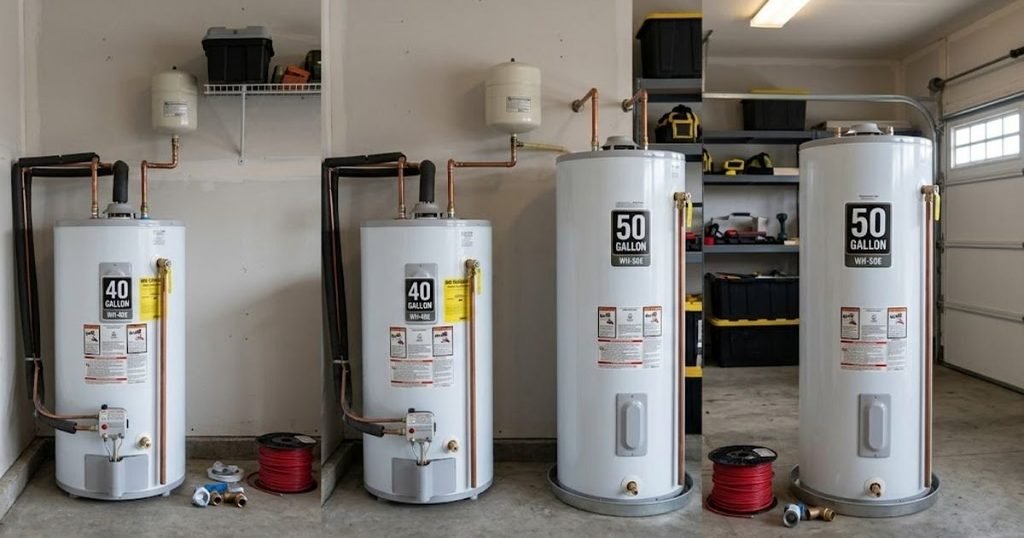
40 vs 50 Gallon Water Heater at a Glance
Before diving deep into technical specifications, here is a high-level comparison showing how 40-gallon and 50-gallon storage water heaters stack up against each other in typical American homes.
| Feature | 40-Gallon Water Heater | 50-Gallon Water Heater |
| Typical Household Size | 1 to 3 people | 3 to 5 people |
| Storage Capacity | ~36–40 gallons actual usable liquid | ~45–50 gallons actual usable liquid |
| Hot-Water Availability | Moderate reserve; ideal for sequential use | Larger reserve; better handles simultaneous use |
| Recovery Considerations | Reheats full tank volume slightly faster (model dependent) | Takes longer to heat total volume, but holds more upfront |
| Purchase Cost (Equipment) | Typically lower upfront equipment price | Moderate upfront equipment price (usually $100–$300 more) |
| Operating Cost | Often slightly lower standby heat loss | Slightly higher standby heat loss (varies by UEF rating) |
| Space Required | Compact footprint; fits tighter closets/alcoves | Taller and wider; requires larger physical clearance |
| Best For | Small families, couples, condos, smaller homes | Growing families, homes with multiple bathrooms |
| Main Advantage | Fits smaller spaces and costs less up front | Provides peace of mind during heavy morning routines |
| Main Drawback | Risk of running out during back-to-back showers | Takes up more floor space and costs slightly more to install |
Note: Performance varies based on whether the unit is gas, electric, or hybrid heat pump, as well as specific burner or heating element ratings.
READ MORE: AO Smith vs. Rheem Water Heaters: Comparison & Expert Reviews
What Does “40-Gallon” or “50-Gallon” Actually Mean?
When you walk into a home improvement store or review a plumber’s quote, water heaters are labeled by their storage capacity, such as 40 gallons or 50 gallons. However, these numbers represent nominal tank size the internal volume of the storage vessel rather than the exact amount of piping-hot water available at your faucet at any given second.
Nominal vs. Actual Usable Capacity
Due to manufacturing tolerances and safety standards, a “40-gallon” tank might hold roughly 36 to 38 gallons of water, while a “50-gallon” tank holds closer to 45 to 48 gallons. Furthermore, as cold water enters the bottom of the tank to replace hot water being drawn from the top, the incoming cold stream gradually dilutes the remaining hot water. Consequently, you do not get 100% of the tank volume at maximum temperature during continuous usage.
First Hour Rating (FHR): The True Measure of Performance
To solve the confusion of simple gallon numbers, the U.S. Department of Energy (DOE) and ENERGY STAR guidelines rely on a standardized metric called First Hour Rating (FHR).
First Hour Rating (FHR) is the total number of gallons of hot water a storage water heater can supply during its first hour of operation, starting with a fully heated tank of water.
FHR combines two factors:
- The stored hot water ready to use inside the tank.
- The amount of new hot water the heater can generate within that first hour as cold water enters.
Because FHR measures total delivery capability, a high-efficiency 40-gallon gas unit with a powerful burner might deliver an FHR of 68 gallons, while a standard 50-gallon electric unit with slower heating elements might only offer an FHR of 60 gallons.
When shopping for a replacement unit, always locate the Energy Guide label on the tank. Pay close attention to the FHR number rather than relying solely on the gallon capacity printed on the box.
READ MORE: Best 40 Gallon Water Heater Buying Guide: Top Picks, Prices & Comparison
40 Gallon vs 50 Gallon Water Heater — What’s the Real Difference?
Beyond raw storage numbers, the choice between a 40-gallon and 50-gallon water heater comes down to three operational factors: storage capacity, recovery rate, and hot-water availability during peak demand hours.
1. Storage Capacity
The 50-gallon water heater holds roughly 10 to 12 more gallons of reserve hot water than a 40-gallon unit. In real-world terms, that extra capacity provides a buffer. It equates to roughly one additional standard shower or running a couple of sink loads of dishes before the tank temperature begins to drop noticeably.
2. Recovery Rate
Recovery rate refers to how quickly a water heater can heat cold incoming water up to the desired thermostat setting (typically set to 120°F). Recovery performance depends heavily on:
- Fuel Source: Natural gas and propane burners heat water considerably faster than standard electric heating elements.
- Input Rating: Measured in BTUs for gas or Watts for electric. Higher input ratings mean faster recovery.
- Incoming Water Temperature: Ground water in Northern states during winter can be as cold as 40°F, requiring far more energy and time to heat than 70°F groundwater in Southern states.
- Thermostat Set Point: Higher target temperatures require longer heating cycles.
3. Hot-Water Availability in Daily Life
Where that extra 10 gallons truly matters is during simultaneous or compressed household demand.
Consider a typical suburban morning routine. If Person A is taking a shower while Person B is running the kitchen dishwasher, a 40-gallon tank is under immediate stress. If Person C steps into the shower immediately afterward, a 40-gallon tank may run out of hot water midway through that third event. A 50-gallon unit cushions this demand spike, giving the heating elements or gas burner more breathing room to recover without delivering a cold surprise to the bather.
How Many People Can a 40-Gallon Water Heater Serve?
A 40-gallon storage water heater has long been the standard baseline for many American homes. However, its effectiveness depends entirely on how many people live in the home and when they use hot water.
1 to 2 People (Ideal Fit)
For single homeowners, couples, or empty-nesters living in a one- or two-bathroom home, a 40-gallon water heater is almost always sufficient. Even if both residents take showers back-to-back, a standard 40-gallon tank provides plenty of volume without running dry.
3 People (Moderate Fit)
A 3-person household can live comfortably with a 40-gallon unit if usage is slightly staggered. For example, if one person showers in the evening and two shower in the morning, or if laundry is run separately from shower times, hot water will rarely be an issue.
4 People (Strained Fit)
In a household of four, a 40-gallon tank will function reliably only if everyone is mindful of water usage. If four people try to take back-to-back 10-minute showers every morning between 7:00 AM and 7:45 AM, the last person in line will likely get lukewarm water unless the heater is a high-recovery gas model.
READ MORE: Cheapest 50-Gallon Electric Water Heater
How Many People Can a 50-Gallon Water Heater Serve?
A 50-gallon water heater is the workhorse size for average-sized American families. It provides the extra volume needed to navigate overlapping morning schedules, laundry days, and dishwashing cycles.
3 to 4 People (Ideal Fit)
For a family of three or four with two full bathrooms, a 50-gallon tank is generally the sweet spot. It allows multiple showers to occur close together while running a load of clothes in the washing machine without causing dramatic temperature drops.
5 People (Moderate Fit)
A 5-person household can make a 50-gallon tank work, provided the unit has a solid First Hour Rating and high-efficiency heating capability. However, if multiple family members prefer long showers or if the home features a large soaking tub, a 50-gallon unit may still reach its limits during peak morning hours.
High-Demand Scenarios
A 50-gallon tank is also recommended for smaller households (2 to 3 people) if the home features:
- A deep garden soaking tub or Roman tub (which can swallow 50+ gallons in a single fill).
- High-flow showerheads (2.5 gallons per minute or higher).
- Multiple teenagers who take frequent, lengthy showers.
40 vs 50 Gallon Electric Water Heater
Electric storage water heaters are widely installed across the U.S. due to their lower upfront equipment costs, clean operation, and simpler venting requirements (they require no gas lines or chimneys). However, electric models recover heat more slowly than gas models.
How Electric Heating Works
Electric water heaters use upper and lower electrical resistance elements (typically 4,500 Watts each) submerged directly in the water. In standard configurations, these elements take turns heating the water rather than running simultaneously, which caps how fast the tank can recover once emptied.
| Factor | 40-Gallon Electric | 50-Gallon Electric |
| Typical Household | 1 to 3 people | 3 to 4 people |
| Recovery Rate | ~18–22 gallons/hour at 90°F rise | ~18–22 gallons/hour at 90°F rise |
| Upfront Equipment Cost | Moderate | Slightly higher ($100–$250 extra) |
| Electrical Requirements | 240V / 30-amp dedicated circuit | 240V / 30-amp dedicated circuit |
| Space Footprint | Fits smaller utility closets | Taller/wider; check door widths |
| Best For | Low to moderate simultaneous demand | Average family demand, routine morning showers |
| Main Advantage | Lower purchase price, compact size | Higher initial hot-water volume reserve |
| Main Drawback | Slow recovery once fully depleted | Slow recovery rate once fully depleted |
Because electric recovery rates are identical between standard 40-gallon and 50-gallon units (both usually rely on the same 4,500-Watt elements), the primary difference is pure reserve volume. A 50-gallon electric tank gives you 10 extra gallons upfront to survive a morning rush, but once depleted, both sizes take roughly the same amount of time per gallon to heat back up.
READ MORE: Best 30 Gallon Water Heater: Top Picks, Comparison
40 vs 50 Gallon Gas Water Heater
Gas water heaters (natural gas or liquid propane) use a burner located underneath the tank to heat the water. Combustion gases rise through a central flue pipe inside the tank, transferring heat to the surrounding water.
Why Gas Recovers Faster
Gas burners heat water much faster than electric elements. A standard residential gas burner produces between 36,000 and 40,000 BTUs of heat per hour (or higher for high-recovery models). This allows gas units to deliver significantly higher First Hour Ratings.
| Factor | 40-Gallon Gas | 50-Gallon Gas |
| Typical Household | 2 to 4 people | 4 to 5+ people |
| Recovery Rate | ~38–42 gallons/hour at 90°F rise | ~40–45+ gallons/hour at 90°F rise |
| Venting Needs | Atmospheric vent or Direct/Power vent | Atmospheric vent or Direct/Power vent |
| Upfront Equipment Cost | Slightly higher than basic electric | Moderate ($150–$300 more than 40-gal gas) |
| Operating Cost | Often lower than electric (regionally dependent) | Slightly higher fuel usage if demand is higher |
| Best For | Moderate families needing fast turnaround | Larger families, simultaneous morning showers |
| Main Advantage | Reheats rapidly between usages | Exceptional combined reserve and recovery |
| Main Drawback | Requires gas line and exhaust venting | Requires proper vent pipe diameter sizing |
A well-performing 40-gallon gas water heater can often out-deliver a 50-gallon electric water heater in continuous hot-water generation because its fast burner continuously replenishes hot water as you use it.
40 vs 50 Gallon Water Heater Cost
When assessing the overall cost of a water heater, you must consider two separate components: the cost of purchasing the tank (equipment cost) and the cost of having it professionally installed.
Unit Cost (Equipment Only)
On retail store shelves, the base price difference between a 40-gallon and a 50-gallon unit of the same brand, fuel type, and warranty tier is relatively small, typically ranging between $100 and $300.
- 40-Gallon Units: Basic electric models generally start around $500 to $800, while basic gas models range from $600 to $1,000 depending on venting type.
- 50-Gallon Units: Basic electric models generally start around $650 to $950, while standard gas models range from $750 to $1,300.
High-efficiency units, hybrid heat pumps, power-vented gas models, and long-warranty tanks will sit at higher price points across both size categories.
Installation Cost Factors
Installation costs can vary significantly based on your home’s layout, local labor rates, and code requirements. Total professional replacement costs combining the new water heater, labor, permits, and accessories often fall into the following ranges:
- Standard 40-Gallon Replacement: Roughly $1,200 to $2,400 total installed.
- Standard 50-Gallon Replacement: Roughly $1,400 to $2,800 total installed.
Note: These ranges serve as general estimates. Quotes in high-cost-of-living metro areas or complex installation sites can be higher.
Key factors that increase installation costs include:
- Upgrading Tank Size (40 to 50 Gallons): If the larger tank does not easily fit into the existing space, your plumber may need to re-route copper water pipes, adjust gas lines, or move nearby drainage pipes.
- Thermal Expansion Tank Installation: Modern plumbing codes require a thermal expansion tank on closed water systems. If your old setup lacks one, adding it adds to parts and labor.
- Venting Upgrades (Gas Models): Upgrading to a larger gas unit may require increasing the diameter of the metal exhaust vent pipe to meet safety codes.
- Electrical Circuit Adjustments: Ensuring wiring, breakers, and disconnect switches meet local building codes.
- Safety Accessories: Installing concrete equipment pads, water shut-off valves, or drain pans with discharge lines.
READ MORE: Best 80-Gallon Electric Water Heaters | Reviews & Deals
Is a 50-Gallon Water Heater More Energy Efficient Than a 40-Gallon?
Not necessarily. You cannot assume a smaller water heater is automatically more energy-efficient than a larger one, nor can you assume the reverse.
An energy rating depends on the unit’s mechanical design, insulation quality, fuel source, and operational technology:
- A high-efficiency 50-gallon model (such as an ENERGY STAR-rated hybrid heat pump or condensing gas unit) can be vastly more efficient than a standard, budget-grade 40-gallon tank.
- A standard 40-gallon model with an older UEF rating might burn more fuel annually than a premium, modern 50-gallon model with extra foam insulation and advanced flue baffling.
When evaluating energy efficiency, ignore the gallon volume for a moment and look directly at the Energy Guide label affixed to the unit. Compare the UEF rating and the Estimated Yearly Energy Cost listed on the label for precise comparisons between models.
40 vs 50 Gallon Water Heater Recovery Time
Recovery time is the duration a water heater needs to raise a full tank of cold water back up to the set operating temperature after the stored hot water has been completely drained.
- 40-Gal Electric: 60 to 80 minutes
- 50-Gal Electric: 75 to 100 minutes
- 40-Gal Gas: 30 to 45 minutes
- 50-Gal Gas: 40 to 50 minutes
Why Fuel Type Controls Recovery
As illustrated above, gas units recover almost twice as fast as electric resistance units:
- Electric Units: A standard 40-gallon electric heater takes roughly 60 to 80 minutes to fully recover from cold. A 50-gallon electric heater takes about 75 to 100 minutes to recover the full tank, because the 4,500-Watt heating elements must work through 10 additional gallons of cold water.
- Gas Units: A 40-gallon gas heater can often recover in 30 to 45 minutes, while a 50-gallon gas heater takes about 40 to 50 minutes.
Seasonal Groundwater Effects
Recovery time varies significantly depending on where you live and the time of year. In cold winter climates, incoming municipal tap water can plunge to near freezing. Heating 50 gallons of 40°F water to 120°F requires substantially more thermal energy and time than heating 70°F summer water.
Always consult the manufacturer’s technical specification sheet for recovery metrics calculated at a standard 90°F temperature rise to get an accurate comparison.
40 vs 50 Gallon Water Heater Dimensions and Space
One of the most frequent mistakes homeowners make when purchasing a replacement water heater is selecting a unit that physically will not fit through the door or into the mechanical closet.
While dimensions vary by manufacturer and model type (tall vs. short/lowboy configurations), here are typical physical size comparisons:
- Standard 40-Gallon Tall Tank: ~18 to 20 inches in diameter; ~48 to 62 inches in height.
- Standard 50-Gallon Tall Tank: ~20 to 22 inches in diameter; ~55 to 66 inches in height.
Modern energy efficiency regulations require thicker insulation around the internal tank shell. As a result, modern water heaters are often 2 to 3 inches wider and taller than older water heaters of the exact same gallon capacity installed 15 or 20 years ago.
Pre-Purchase Checklist for Space and Dimensions
Before purchasing any replacement water heater, complete this physical measurement checklist:
- Measure Available Floor Space: Ensure the installation area has adequate diameter clearance, accounting for drain pans and safety clearances.
- Measure Doorways and Hallways: Verify the path from your garage, front door, or basement stairs to the utility closet is wide enough to haul the new unit through.
- Check Height Clearance: Measure from the floor to overhead pipes, floor joists, or low ceiling beams. Gas units require vertical clearance for draft hoods and venting.
- Inspect Plumbing Connections: Check whether existing hot and cold water lines can align easily with the top connections of the new, potentially taller tank.
- Confirm Electrical / Gas Hookups: Verify that gas lines or electrical conduits do not block physical access or require expensive re-routing.
- Verify Venting Requirements: Ensure proper clearance around flues and power-vent ducting.
- Check Local Code Requirements: Confirm required clearances from surrounding walls and requirements for drain pans, seismic straps, or elevated platforms.
READ MORE: Electric Water Heater Replacement Cost
40 vs 50 Gallon Water Heater — Pros and Cons
To help summarize the main trade-offs, here is a breakdown of the benefits and disadvantages of each capacity size.
40-Gallon Water Heater Pros
- Lower Upfront Cost: Purchase prices are typically lower than equivalent 50-gallon units.
- Compact Footprint: Easier to maneuver into tight utility closets, under-stair alcoves, or low-ceiling basements.
- Slightly Faster Full-Tank Recovery: Depleting a 40-gallon tank takes slightly less total continuous time to heat back up than a larger 50-gallon volume.
- Sufficient for Small Households: Provides plenty of hot water for 1 to 3 people without wasted space.
40-Gallon Water Heater Cons
- Limited Reserve Volume: Higher risk of running out of hot water when multiple fixtures are used at the same time.
- Not Ideal for Growing Families: May require replacement or behavioral changes if your household size increases.
- Strained by Large Fixtures: Can struggle to fill deep soaking tubs or high-flow garden tubs in a single cycle.
50-Gallon Water Heater Pros
- Generous Hot-Water Reserve: Comfortably handles overlapping showers, dishwashing, and laundry cycles.
- Great Fit for Average Families: Provides adequate supply for typical 3- to 5-person households.
- Peace of Mind: Reduces household arguments over morning shower scheduling.
- Better Handles Peak Usage: Helps cushion against sudden spikes in hot-water demand.
50-Gallon Water Heater Cons
- Higher Upfront Equipment Cost: Usually costs $100 to $300 more to purchase than a comparable 40-gallon unit.
- Larger Physical Dimensions: May not fit into tight utility spaces designed for older, smaller tanks.
- Slightly Higher Standby Loss: Holds a larger volume of warm water, resulting in minor additional standby heat loss over time.
READ MORE: Tankless Water Heater vs Tank Water Heater: Which Is Better?
40 vs 50 Gallon Water Heater — Which Is Better for a Family?
To see how these differences play out in real life, consider how different household profiles handle hot-water supply choices.
Scenario 1: One or Two Adults in a Townhome
- Setup: 2 adults, 2 full bathrooms, standard washing machine, no soaking tub.
- Verdict: A 40-gallon water heater is typically ideal. Unless both adults take long showers simultaneously while running appliances, a 40-gallon tank easily meets daily demands while saving space and money.
Scenario 2: Two Adults and One Young Child
- Setup: 3 family members, staggered morning routines, standard daily appliance usage.
- Verdict: A 40-gallon gas heater (with rapid recovery) or a 50-gallon electric heater works well here. If the family plans to have more children or add guest rooms, choosing a 50-gallon model now offers helpful future-proofing.
Scenario 3: Family of Four with Teenagers
- Setup: 2 adults, 2 teenagers, morning rush hour with back-to-back showers and daily laundry.
- Verdict: A 50-gallon water heater is the strongly recommended baseline. A 40-gallon unit will likely leave the last person taking a cold shower. Look for a 50-gallon model with a high First Hour Rating (FHR).
Scenario 4: Home with a Deep Soaking Tub
- Setup: Any household size with a master bathroom featuring a 55-to-70-gallon soaking tub.
- Verdict: A standard 50-gallon unit (or larger) is essential. A 40-gallon water heater will empty entirely before the tub is filled, leaving you with a half-full, lukewarm bath.
How to Choose Between a 40 and 50 Gallon Water Heater
To make an informed choice for your home, follow this step-by-step decision framework:
Step 1: Count Household Members and Fixtures
List the maximum number of people living in the house who use hot water during peak hours, along with the total number of bathrooms.
Step 2: Calculate Peak-Hour Demand
Estimate how many gallons of hot water your home consumes during its busiest single hour of the day (usually morning routines).
- Average shower: ~10 to 15 gallons of hot water (when mixed with cold).
- Dishwasher load: ~4 to 6 gallons.
- Clothes washer load: ~7 to 15 gallons (if using warm/hot cycles).
Step 3: Check the First Hour Rating (FHR)
Look for a water heater whose FHR on the Energy Guide label equals or exceeds your calculated peak-hour demand.
Step 4: Verify Available Fuel Type
Confirm whether your replacement must be gas (natural gas or propane) or electric. Remember that gas units recover significantly faster than standard electric units.
Step 5: Compare Energy Efficiency (UEF)
Check the UEF rating to ensure low ongoing operational costs. Consider upgrading to a hybrid heat pump water heater if you use electric power and want maximum energy efficiency.
Step 6: Measure Installation Dimensions
Verify height, width, doorway clearance, and overhead space before placing an order.
Step 7: Evaluate Warranty Tiers
Compare warranty coverage (typically 6, 9, or 12 years). Longer warranties often feature higher-grade heating elements or thicker anode rods that protect against corrosion.
Step 8: Assess Installation Complexity
Consult with a licensed professional plumber to check for necessary venting adjustments, expansion tank additions, or code compliance upgrades.
Step 9: Get Comprehensive Quotes
Obtain local quotes that include equipment purchase, delivery, installation labor, permitting fees, and old unit disposal.
Step 10: Confirm Local Codes & Rebates
Check local municipal building codes and inquire about utility rebates. Many local utilities offer cashback incentives for high-efficiency or hybrid heat pump models.
Common Mistakes When Choosing Between 40 and 50 Gallons
Avoid these common pitfalls when shopping for a replacement water heater:
- Choosing Based Only on Household Size: Assuming a 4-person family always needs a 50-gallon unit without evaluating actual usage habits or staggered schedules.
- Ignoring the First Hour Rating (FHR): Looking only at tank capacity while missing how fast the unit actually heats and delivers water.
- Comparing Tank Capacity Without Checking Efficiency: Buying a cheaper, low-efficiency 50-gallon tank that consumes far more energy than necessary over its lifespan.
- Ignoring Physical Dimensions: Ordering a replacement unit without measuring doors, hallways, and utility closets first.
- Forgetting Installation and Upgrade Costs: Failing to budget for piping adjustments, venting modifications, expansion tanks, or permits.
- Assuming Gas and Electric Perform the Same: Expecting an electric water heater to recover at the same speed as a gas model of equal gallon size.
- Buying the Largest Available Tank Without Checking Demand: Oversizing the tank unnecessarily, leading to extra equipment expenses and higher standby energy loss.
- Overlooking Anode Rod and Tank Warranty: Choosing the cheapest model available without considering how long the unit will resist internal corrosion.
- Skipping Local Building Code Requirements: Installing a unit without required safety accessories, such as thermal expansion tanks, drain pans, or proper safety relief valves.
- Assuming All 50-Gallon Water Heaters Perform Identically: Treating all 50-gallon models as equal, regardless of burner BTU output, element wattage, or insulation quality.
40 vs 50 Gallon Water Heater: Quick Decision Guide
Use this simple decision matrix to help narrow down your choice:
| If your situation is… | Consider… | Primary Reason |
| 1 to 2 people with moderate demand | 40-gallon tank | Lower purchase price; compact footprint easily satisfies low demand. |
| Small home with very limited closet space | 40-gallon tank | Smaller dimensions allow placement in tight utility alcoves. |
| 3 to 4 people with overlapping morning routines | 50-gallon tank | Extra reserve cushion prevents running out of hot water during back-to-back showers. |
| Frequent simultaneous appliance and shower use | 50-gallon tank (or high FHR unit) | Delivers higher immediate volume when multiple fixtures draw water at once. |
| Current 40-gallon tank runs out of hot water frequently | 50-gallon tank | Provides immediate reserve expansion to resolve supply shortages. |
| Very high hot-water demand (large soaking tubs) | High-recovery gas 50-gallon or alternative | Standard 40-gallon tanks cannot fill large soaking tubs in a single draw. |
| Tight installation space, but high hot-water demand | High-recovery 40-gallon gas model | Combines compact tank dimensions with faster burner recovery. |
Frequently Asked Questions
Is a 40 gallon water heater enough for a family of 4?
A 40-gallon water heater can be enough for a family of four, but only under specific conditions. If your family takes staggered showers, uses low-flow showerheads, and avoids running appliances like the dishwasher or washing machine during shower times, a 40-gallon unit can manage.
Is a 50 gallon water heater worth the extra cost?
For many families, a 50-gallon water heater is well worth the extra cost. The purchase price difference between a 40-gallon and 50-gallon tank of the same model line is typically only $100 to $300. That modest upfront investment provides roughly 25% more stored hot water reserve, significantly reducing the chances of cold showers during peak usage.
What is the difference between a 40 gallon and 50 gallon water heater?
Physically, 50-gallon models are typically 2 to 4 inches taller and 1 to 2 inches wider. While both sizes can feature similar energy efficiency ratings (UEF), a 50-gallon model provides a higher First Hour Rating (FHR), allowing it to supply more hot water during heavy usage hours. Gas models in both sizes recover water temperature much faster than electric resistance models.
Is a 40 or 50 gallon water heater better for a 3-bedroom house?
Selecting a water heater depends more on the number of occupants and their daily habits than the number of bedrooms. A 3-bedroom house occupied by two adults will perform wonderfully with a 40-gallon water heater. However, if that same 3-bedroom house is home to a family of four with two full bathrooms, a 50-gallon unit is usually the better option.
How much does it cost to replace a 40 or 50 gallon water heater?
Total replacement costs including equipment, labor, permits, and fittings typically range from $1,200 to $2,400 for a standard 40-gallon tank and $1,400 to $2,800 for a standard 50-gallon tank. Equipment costs alone vary by brand, fuel type, and efficiency rating.