For growing families, multi-generation households, or homes with multiple bathrooms running simultaneously, hot water capacity is not just a convenience, it is an absolute necessity for daily comfort. If you find your household constantly playing hot-water roulette, upgrading to a 60 gallon water heater (or a comparable high-capacity model in the 55-to-66-gallon range) might be the permanent solution you need.
Choosing the right water heater requires balancing household size, daily water consumption habits, energy efficiency, available installation space, and long-term operating costs. Selecting a unit that is too small leaves your family shivering, while buying an oversized tank wastes valuable energy keeping unused water hot around the clock.
This comprehensive guide is designed for U.S. homeowners navigating a water heater replacement or a new installation. We will break down how these large-capacity tanks operate, how to determine if this size fits your household, compare the top models on the market, analyze installation costs, and help you make a confident, cost-effective purchasing decision. Lets deep dive into ’60 Gallon Water Heater: Best Models, Prices, and Comparison”
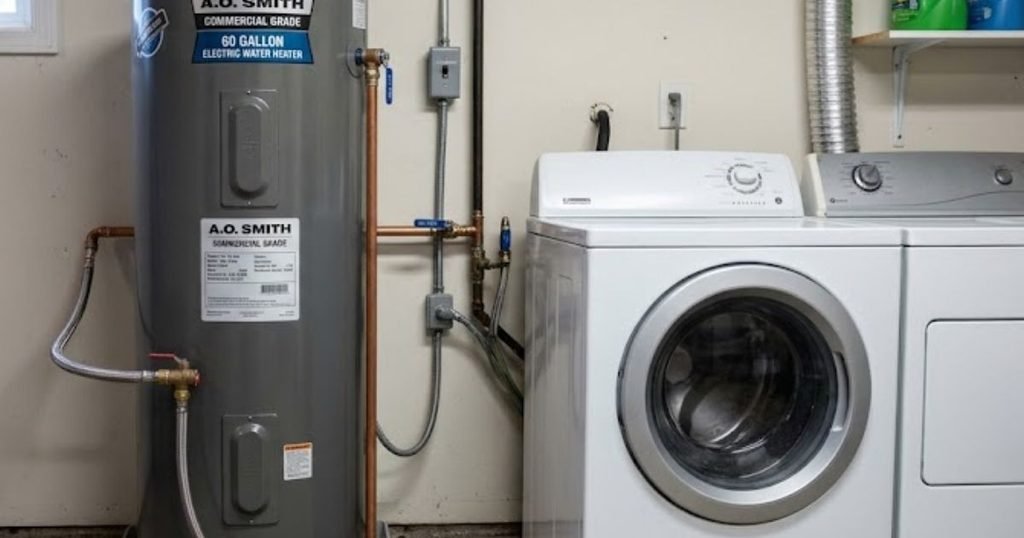
What Is a 60 Gallon Water Heater?
A 60 gallon water heater is a large-capacity storage tank water heater designed to supply a steady, abundant volume of domestic hot water for residential properties. Unlike tankless systems that heat water on demand, storage water heaters maintain a massive reservoir of heated water at a set temperature typically between 120°F and 140°F ready for instant deployment whenever a faucet, shower, or appliance is turned on.
Understanding Nominal Capacity vs. Usable Hot Water
A common point of confusion for homeowners is the difference between a tank’s nominal capacity (the total volume of water the tank physically holds) and its usable hot-water output.
- When hot water is drawn out of the top of the tank, incoming cold water enters through a dip tube at the bottom, mixing slightly with the remaining hot water.
- As a result, a 60-gallon tank typically delivers about 70% to 90% of its total capacity as usable hot water before the temperature begins to drop noticeably.
- Performance is also heavily influenced by your thermostat setting, incoming groundwater temperature (which is significantly colder in northern U.S. winter climates than in southern states), and the recovery rate—how fast the unit can reheat incoming cold water.
Core Heating Technologies
Large-capacity residential water heaters generally fall into three main technological categories:
- Standard Electric Resistance: Uses upper and lower electric heating elements to warm the water. They are reliable and straightforward to install but consume more electricity.
- Natural Gas / Propane: Uses a gas burner beneath the tank or electronic ignition systems, offering faster recovery rates and lower operating costs in regions where natural gas is affordable.
- Hybrid Heat Pump: Draws ambient heat from the surrounding air and transfers it into the water tank via a built-in heat pump compressor. While they carry a higher upfront purchase price, they deliver unmatched energy efficiency and massive long-term utility savings.
Note on Sizing: Manufacturers frequently size large electric and hybrid units at 55, 65, or 66 gallons rather than an exact 60 gallons due to strict federal efficiency standards and DOE testing protocols. Throughout this guide, when we refer to a 60 gallon water heater, we include these closely matched high-capacity residential options.
READ MORE: Rheem 50 Gallon Electric Water Heater: Specs, Cost & Reviews
Is a 60 Gallon Water Heater Right for Your Home?
Determining whether a 60-gallon storage tank is correct for your household requires looking beyond simple occupant counts and examining your peak-hour hot-water demand.
Ideal Household Situations
- Families of 4 to 6 Occupants: Households with multiple teenagers or active family members who take back-to-back showers will easily exhaust standard 40- or 50-gallon tanks.
- Homes with 3 or More Bathrooms: When multiple bathrooms are in active use simultaneously such as two showers running while a dishwasher or washing machine operates a larger capacity prevents sudden temperature drops.
- Luxury Fixtures: Homes featuring large Roman soaking tubs, oversized multi-head shower systems, or jetted tubs require immense volume that standard tanks simply cannot support.
- Simultaneously Heavy Appliance Usage: Households that frequently run hot-water laundry cycles while family members are showering benefit immensely from the deep reserves of a 60-gallon-class unit.
When to Choose Smaller or Alternative Options
If your household consists of only one or two occupants, a 60-gallon tank is generally unnecessary and counterproductive. Keeping 60 gallons of water hot continuously in a small home wastes standby energy. In those instances, a 40- or 50-gallon unit or an appropriately sized tankless system is a much more practical choice.
| Household Situation | What to Consider |
| One or two occupants | Compare 40- and 50-gallon options before upsizing to avoid wasted standby energy. |
| Three or four occupants | Compare actual peak-hour demand with the manufacturer’s First-Hour Rating (FHR). |
| Five or more occupants | Consider a 60- or larger-capacity tank (or hybrid unit) if concurrent morning demand is high. |
| Multiple bathrooms used simultaneously | Prioritize FHR and rapid recovery performance over nominal tank volume alone. |
| High hot-water demand & luxury tubs | Compare larger storage tanks, hybrid models, and multi-unit or high-flow tankless alternatives. |
Types of 60 Gallon Water Heaters
Standard Electric Water Heaters
Conventional electric storage units rely on dual electric resistance elements. They are exceptionally common because almost every home has electrical service, making replacement straightforward if the electrical circuit is rated for the amperage. However, because electric resistance heating requires significant electricity to raise water temperature, operating costs can be higher than gas or hybrid counterparts.
Gas Water Heaters
Natural gas and propane water heaters utilize combustion burners to heat water quickly. They boast faster recovery rates than standard electric models, meaning they can replenish hot water much quicker during heavy-use periods. They require proper atmospheric or power-venting systems, a gas supply line, and adequate combustion air clearance.
Hybrid Heat Pump Water Heaters
Hybrid heat pumps represent the gold standard in modern residential water heater technology. By pulling heat from the surrounding utility room air and compressing it to heat the water, these units can reduce water-heating electricity consumption by up to 70% compared to standard electric models. They require adequate room air volume (usually around 700 to 1,000 cubic feet of unconditioned space) or ducting kits, and they produce a low hum similar to a refrigerator while running.
Propane Water Heaters
For homes located in rural or suburban areas without municipal natural gas lines, propane-fueled large-capacity tanks offer rapid recovery and strong performance, provided local propane delivery and fuel rates are favorable.
READ MORE: Best 40 Gallon Water Heater Buying Guide: Top Picks, Prices & Comparison
Best 5 Water Heaters to Consider Instead of Shopping by Gallon Size Alone
When shopping for a 60 gallon water heater or its nearest equivalent, looking at specific engineering, efficiency ratings, and real-world reliability ensures you make a sound investment. Below are five top-tier residential models representing the best available options across hybrid heat pump, gas, and electric categories.
1 — A. O. Smith Voltex MAX 66-Gallon Hybrid Heat Pump Water Heater
- Best for: Energy-conscious homeowners seeking maximum electric savings and substantial hot-water volume.
- Actual tank capacity: 66 gallons.
- Fuel or technology: Hybrid Heat Pump (Electric / Ambient Heat).
- Efficiency: Verified Uniform Energy Factor (UEF) approx. 3.75 – 4.02 (varies slightly by operating mode).
- First-hour rating: Approx. 75 to 80 gallons.
- Dimensions and installation requirements: Approx. 63 inches tall, 27 inches in diameter. Requires 240V electrical supply, condensate drain line, and sufficient room airflow (approx. 700 cu. ft.).
- Warranty: 10-year limited tank and parts warranty.
- Estimated purchase price: $2,200 – $2,600 (equipment only).
- Advantages: Exceptional energy savings, intelligent touch-pad controls with multiple operating modes (Efficiency, Hybrid, Electric, Vacation), and built-in leak detection/shut-off valve on select MAX models.
- Disadvantages: Higher upfront purchase cost; taller and wider footprint than standard electric tanks; fan noise during heat pump operation.
- Installation considerations: Requires dedicated 240V circuit and a reliable method to discharge condensate water (such as a floor drain or condensate pump).
- Final Verdict: An outstanding top-tier choice for large families wanting to slash monthly utility bills, provided the installation space has adequate air volume.
2 — Rheem ProTerra 65-Gallon Hybrid Heat Pump Water Heater
- Best for: Families needing heavy-duty hot water delivery paired with industry-leading smart home integration.
- Actual tank capacity: 65 gallons.
- Fuel or technology: Hybrid Heat Pump.
- Efficiency: Verified UEF up to 3.75 – 3.85.
- First-hour rating: Approx. 78 gallons.
- Dimensions and installation requirements: Approx. 63.5 inches tall, 25.25 inches in diameter. Requires 240V electrical connection, condensate line, and unconditioned space airflow.
- Warranty: 10-year tank and parts warranty.
- Estimated purchase price: $2,100 – $2,500 (equipment only).
- Advantages: EcoNet Wi-Fi technology allows remote monitoring, leak detection alerts, and scheduling via smartphone; highly rated recovery performance; significant utility rebate eligibility.
- Disadvantages: Upfront investment is steep; requires professional installation and proper electrical clearance.
- Installation considerations: Check ceiling height and doorway clearances in tight utility closets before delivery.
- Final Verdict: One of the most popular hybrid water heaters on the market, ideal for tech-savvy homeowners prioritizing smart diagnostics and elite energy efficiency.
3 — Bradford White AeroTherm 65-Gallon Heat Pump Water Heater
- Best for: Homeowners who prefer professional contractor-grade durability and robust commercial-grade construction.
- Actual tank capacity: 65 gallons.
- Fuel or technology: Hybrid Heat Pump.
- Efficiency: Verified UEF approx. 3.50 – 3.70.
- First-hour rating: Approx. 74 gallons.
- Dimensions and installation requirements: Approx. 63 inches tall, 26 inches diameter. Requires 240V electrical service and condensate drainage.
- Warranty: 10-year limited tank warranty, 6-year parts warranty (extendable with registration).
- Estimated purchase price: $2,200 – $2,700 (installed through wholesale plumbing distributors/contractors).
- Advantages: Built with professional-grade components designed for longevity; quiet operation modes; excellent diagnostic capabilities.
- Disadvantages: Primarily sold through licensed plumbing contractors rather than big-box retail stores, which can limit DIY purchase options.
- Installation considerations: Best installed by a professional plumber familiar with Bradford White specifications and local code requirements.
- Final Verdict: An exceptional contractor-grade choice for buyers who value plumbing-grade durability and professional installation support.
4 — A. O. Smith Signature Select 50-Gallon High-Performance Gas Water Heater
- Best for: Households with natural gas access looking for fast recovery speeds without the high upfront cost of a hybrid unit.
- Actual tank capacity: 50 gallons (High-output burner performance comparable to larger standard units).
- Fuel or technology: Natural Gas (Atmospheric or Power Vent).
- Efficiency: Verified UEF approx. 0.60 – 0.70 (standard gas efficiency).
- First-hour rating: Approx. 81 gallons (due to high BTU input and rapid gas recovery).
- Dimensions and installation requirements: Approx. 60 inches tall, 24 inches diameter. Requires natural gas line, metal flue/venting, and combustion air supply.
- Warranty: 6-year or 8-year limited tank and parts warranty depending on exact sub-model.
- Estimated purchase price: $900 – $1,300 (equipment only).
- Advantages: Rapid hot water recovery rate; lower initial equipment cost than hybrid or tankless systems; reliable mechanical gas controls.
- Disadvantages: Lower UEF efficiency than heat pumps; requires safe venting and combustion clearances.
- Installation considerations: Ensure proper gas line sizing and venting integrity to prevent back-drafting of combustion gases.
- Final Verdict: A reliable, high-performing gas option for homes with existing natural gas infrastructure where fast recovery is essential.
5 — Rheem Performance Platinum 50-Gallon Electric Water Heater (High Efficiency)
- Best for: Budget-conscious buyers or homes without gas or sufficient airflow for a heat pump, seeking dependable electric storage.
- Actual tank capacity: 50 gallons.
- Fuel or technology: Standard Electric Resistance.
- Efficiency: Verified UEF approx. 0.92 – 0.95.
- First-hour rating: Approx. 67 to 72 gallons.
- Dimensions and installation requirements: Approx. 59 inches tall, 22.25 inches diameter. Requires 240V dedicated electrical circuit.
- Warranty: 8-year tank and parts warranty.
- Estimated purchase price: $700 – $1,000 (equipment only).
- Advantages: Lower purchase price; straightforward replacement for existing standard electric tanks; reliable electronic thermostat controls.
- Disadvantages: Higher monthly electricity operating costs than heat pumps; slower recovery rate than gas units.
- Installation considerations: Verify that the existing home electrical panel and wiring gauge can support the draw of dual resistance elements.
- Final Verdict: A solid, economical choice for standard electric upgrades where hybrid installation is impractical.
READ MORE: 40 vs 50 Gallon Water Heater: Which Size Is Best for Your Home?
Comparison Table — Best 5 Water Heaters
| Product | Actual Capacity | Fuel or Technology | UEF | First-Hour Rating | Approximate Unit Price | Best For |
| A. O. Smith Voltex MAX | 66 Gallons | Hybrid Heat Pump | ~3.90 | ~75–80 gal | $2,200 – $2,600 | Energy-conscious households |
| Rheem ProTerra | 65 Gallons | Hybrid Heat Pump | ~3.80 | ~78 gal | $2,100 – $2,500 | Larger hot-water demand & smart features |
| Bradford White AeroTherm | 65 Gallons | Hybrid Heat Pump | ~3.60 | ~74 gal | $2,200 – $2,700 | Professional installation & durability |
| A. O. Smith Signature Select | 50 Gallons (High-Output) | Natural Gas | ~0.65 | ~81 gal | $900 – $1,300 | Gas-heater buyers needing fast recovery |
| Rheem Performance Platinum | 50 Gallons | Standard Electric | ~0.93 | ~70 gal | $700 – $1,000 | Budget-conscious standard electric buyers |
Category Highlights:
- Best Overall Option: Rheem ProTerra 65-Gallon — balances elite efficiency, smart diagnostics, and strong first-hour delivery.
- Best for Energy Efficiency: A. O. Smith Voltex MAX 66-Gallon — superior UEF ratings that yield significant long-term electricity savings.
- Best for Conventional Gas Heating: A. O. Smith Signature Select — delivers exceptional first-hour output via rapid gas recovery.
- Best for Buyers Prioritizing Upfront Cost: Rheem Performance Platinum 50-Gallon Electric — reliable, affordable, and easy to swap.
- Best for Households with High Peak-Hour Demand: Rheem ProTerra / Voltex MAX hybrids — deep thermal reserves coupled with auxiliary electric resistance backup.
How Much Does a 60 Gallon Water Heater Cost?
Understanding the true financial investment of a 60 gallon water heater price involves looking beyond the sticker price at the hardware store. Professional installation in the United States encompasses several variable cost categories.
Cost Breakdown Categories
- Equipment Purchase: Varies widely based on technology—standard electric units cost less upfront, while hybrid heat pumps carry a higher initial equipment expense offset by future energy savings.
- Professional Installation Labor: Licensed plumbers typically charge between $500 and $1,500 for labor depending on regional cost of living and job complexity.
- Removal and Disposal: Hauling away your old, heavy tank and disposing of it in accordance with local environmental regulations.
- Plumbing Modifications: Adjusting water supply lines, shut-off valves, or soldering copper/PEX connections to match the dimensions of a larger tank.
- Electrical or Gas Upgrades: Upgrading circuit breakers, wiring gauges (e.g., from 10-gauge to 8-gauge for high-draw units), gas sediment traps, or venting ducts.
- Code-Required Safety Components: Installing an expansion tank (frequently required by modern residential plumbing codes on closed systems), a thermal expansion relief valve, a drain pan, and a leak detection shut-off system.
- Permits and Inspection Fees: Local municipal building permits typically range from $50 to $200.
Estimated Total Installed Cost Table
| Expense Category | Standard Electric / Gas Tank | Hybrid Heat Pump Tank |
| Equipment Cost | $700 – $1,400 | $2,100 – $2,800 |
| Installation Labor & Permits | $600 – $1,200 | $800 – $1,600 |
| Minor Plumbing / Code Upgrades | $150 – $400 | $200 – $500 |
| Total Estimated Installed Cost | $1,450 – $3,000 | $3,100 – $4,900 |
Disclaimer: These figures represent national averages. Actual costs vary significantly by geographic region, local plumbing labor rates, and whether unforeseen code compliance upgrades are necessary in your home.
READ MORE: Best 80-Gallon Electric Water Heaters | Reviews & Deals
What Is the Difference Between a 60 Gallon and a 50 Gallon Water Heater?
Homeowners often debate whether upgrading from a standard 50-gallon tank to a 60-gallon-class unit is worth the effort.
- Stored Volume & Peak-Hour Performance: A 60-gallon (or 65-gallon hybrid) tank provides roughly 15% to 30% more stored hot water, giving an extra buffer during simultaneous morning routines.
- Recovery Rate: Recovery speed depends on the heating mechanism (gas BTU input or electric wattage/heat pump capacity) rather than volume alone, though larger tanks give you a larger reservoir before recovery is tested.
- Physical Dimensions: Larger-capacity tanks are noticeably taller and wider than 40- or 50-gallon models. A 65-gallon hybrid unit can easily exceed 63 inches in height and 26 inches in diameter, requiring careful measurement of your utility closet clearance.
- Weight: A filled 65-gallon water heater weighs well over 600 pounds, requiring a sturdy, level floor and proper seismic strapping in earthquake-prone regions.
60 Gallon Water Heater vs. Tankless Water Heater
When planning a replacement, homeowners frequently weigh large storage tanks against tankless (on-demand) water heaters.
| Feature | 60-Gallon Storage Tank | Tankless Water Heater |
| Initial Cost (Installed) | Moderate ($1,500 – $4,900) | Higher ($3,000 – $6,000+) |
| Hot Water Delivery | Stored volume with finite reserve | Continuous flow (rated GPM) |
| Simultaneous Fixture Demand | High volume, but limited by tank size | Limited by maximum gallons-per-minute (GPM) rating |
| Recovery / Continuity | Must reheat entire tank after depletion | Heats water instantly on demand |
| Energy Efficiency | Moderate to Very High (Hybrids) | High (no standby heat loss) |
| Maintenance | Annual flushing & anode rod checks | Annual descaling/flushing required |
| Space Requirements | Requires floor space (taller/wider) | Wall-mounted (saves floor space) |
| Infrastructure Needs | Standard electrical/gas lines | Often requires upgraded gas lines, larger venting, or electrical service |
Tankless units excel at providing endless hot water for single fixtures, but large families running multiple showers and appliances simultaneously often experience temperature fluctuations unless they install a high-capacity commercial-grade unit or multiple tankless systems.
Energy Efficiency and Monthly Operating Costs
Water heating is typically the second-largest energy expense in a U.S. home, accounting for roughly 18% of a typical utility bill. Understanding efficiency metrics helps you minimize long-term costs.
- Uniform Energy Factor (UEF): The UEF rating measures overall water heater efficiency. The higher the UEF, the more efficiently the unit converts energy into hot water. Standard electric tanks hover around 0.90 to 0.95 UEF, while hybrid heat pump models boast UEF ratings between 3.50 and 4.00+.
- Standby Heat Loss: Storage tanks constantly radiate a small amount of heat through the tank walls into the surrounding air. Well-insulated modern tanks minimize this loss, but hybrid units recapture ambient room heat, offsetting standby losses significantly.
- Utility Rebates and Tax Credits: High-efficiency hybrid heat pump water heaters qualify for generous federal tax credits (such as the Energy Efficient Home Improvement Credit under the Inflation Reduction Act) and local electric utility rebates that can instantly slash hundreds of dollars off the net purchase price.
READ MORE: Tempstar Furnace Review: Models, Prices & Efficiency
Installation Requirements and Safety Considerations
Water heater installation involves electricity, pressurized water, and sometimes gas or combustion venting. Professional installation by a licensed plumbing contractor is strongly recommended to maintain manufacturer warranties and ensure building code compliance.
- T&P Relief Valve: Every tank must feature a properly piped Temperature and Pressure (T&P) relief valve discharging safely toward a floor drain or exterior wall.
- Thermal Expansion Tanks: In closed-loop municipal water systems, a thermal expansion tank must be installed to absorb pressure spikes caused by water heating.
- Drain Pans & Leak Detection: Installing a drain pan connected to a drain—paired with an automatic water shut-off valve—protects your home from catastrophic water damage.
- Combustion & Airflow: Gas units require unobstructed venting and combustion air, while hybrid heat pumps require adequate unconditioned room volume to operate efficiently.
Safety Warning: Never attempt to service electrical wiring or gas supply lines without proper professional training. If you smell gas, suspect a gas leak, or hear your carbon monoxide detector sound, evacuate the home immediately and contact your utility provider or emergency services.
Maintenance Tips to Extend Water Heater Life
Proactive maintenance protects your investment and ensures peak performance for a decade or more.
- Inspect Regularly: Check around the base of the tank monthly for moisture, rust, or mineral weeping.
- Flush Sediments: Follow manufacturer guidelines to flush mineral buildup from the tank annually—especially in regions with hard water.
- Check the Anode Rod: Inspect the sacrificial anode rod every 2 to 3 years to prevent internal tank corrosion.
- Keep Air Vents Clear: For hybrid models, vacuum dust and lint from the air intake filters and surrounding louvers regularly to ensure proper airflow.
Common Buying Mistakes to Avoid
- Choosing by Tank Capacity Alone: Forgetting to check the First-Hour Rating (FHR) and recovery rate can leave you short on hot water despite buying a large tank.
- Ignoring Space Constraints: Buying a 65-gallon hybrid tank without measuring doorway clearances or ceiling height.
- Comparing Sticker Prices Without Installation Costs: Forgetting to budget for electrical upgrades, plumbing modifications, or expansion tanks.
- Overlooking Local Utility Rebates: Missing out on hundreds of dollars in federal tax credits and local utility rebates by failing to check energy ratings.
Frequently Asked Questions
Is a 60 gallon water heater big enough for a family of five?
Yes, for most active families of five, a 60-gallon (or 65-gallon hybrid) water heater provides sufficient capacity, provided your peak-hour hot-water demand does not involve simultaneous long showers across three bathrooms plus heavy appliance use. Checking the manufacturer’s First-Hour Rating is the best way to confirm suitability.
How much does a 60 gallon water heater cost installed?
Equipment costs range from $700 for standard electric models up to $2,800 for top-tier hybrid heat pumps. Total professional installation costs including labor, permits, expansion tanks, and code upgrades typically bring the total investment to between $1,500 and $4,900.
Is a 60 gallon electric water heater better than a gas water heater?
Neither is universally “better”—it depends on your home’s energy infrastructure. Gas units offer faster recovery times and lower operating costs in areas with inexpensive natural gas. Standard electric units are easy to install anywhere, while hybrid electric units offer incredible long-term energy savings where electricity is utilized.
How long does a 60 gallon water heater last?
Standard electric and gas storage water heaters typically last between 8 to 12 years. High-quality hybrid heat pump water heaters often last 10 to 15 years, provided they receive regular annual maintenance, proper flushing, and anode rod replacements.
What size water heater do I need for a family of four or five?
Rather than relying solely on occupant headcounts, calculate your peak-hour demand by adding up the estimated hot-water usage of every activity occurring during your home’s busiest 60-minute window. Match that peak demand number against the manufacturer’s published First-Hour Rating (FHR) rather than nominal tank volume alone.
Final Verdict
Upgrading to a 60 gallon water heater (or a 65-gallon hybrid model) is a worthwhile investment for U.S. households struggling with inadequate hot water during peak morning and evening hours. By carefully evaluating your household’s peak-hour demand, reviewing local utility rates, choosing between efficient hybrid heat pump technology or reliable gas/electric options, and budgeting for professional installation, you can secure dependable hot-water comfort for years to come.
Recommendation: Consult with a licensed U.S. plumbing professional to assess your utility room space, electrical capacity, and venting requirements before purchasing your new water heater.
Sources and Research Notes
- U.S. Department of Energy (DOE) — Residential Water Heater Purchasing Guidance & Efficiency Standards.
- ENERGY STAR® — Certified High-Efficiency Water Heater Criteria and Rebate Resources.
- Manufacturer Specification Sheets & Installation Manuals (A. O. Smith, Rheem, Bradford White).