Modern American households rely on an unprecedented number of electronic devices, high-powered appliances, heating and cooling systems, and electric vehicle chargers. If you are finishing a basement, building a garage workshop, remodeling a kitchen, or adding an EV charger, your electrical needs may quickly outgrow your existing setup. When your breaker box runs out of physical room or you need to route dedicated circuits to a specific zone of your house, adding electrical sub panel equipment is often the ideal solution.
An electrical subpanel provides additional breaker spaces and distributes power safely to a particular area of your home. However, it is essential for homeowners to understand that a subpanel does not automatically increase the total electrical capacity available from your utility service provider. Understanding installation costs, permit requirements, equipment sizing, and safety rules will help you navigate your project successfully while working with a qualified professional. Lets deep dive into “Adding Electrical Sub Panel: Cost & Requirements”
What Is an Electrical Subpanel?
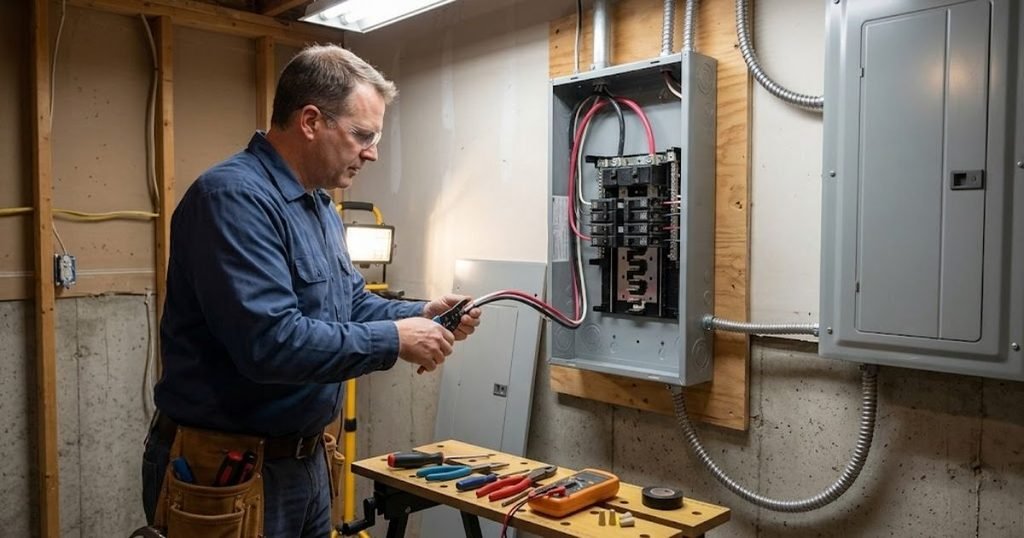
An electrical subpanel is a secondary breaker box that receives power from your home’s main electrical service panel via a dedicated feeder cable. It operates on the same core principles as your primary panel, housing individual circuit breakers that protect specific branch circuits supplying power to outlets, lights, and appliances.
Homeowners frequently choose adding a subpanel to an existing electrical panel as a practical alternative to replacing an entire main distribution panel. For example, if your main panel has plenty of available electrical service capacity such as a modern 200-amp service but has run out of physical breaker slots, a subpanel solves the space constraint without requiring a complete service overhaul.
It is vital to distinguish between adding breaker spaces and increasing overall electrical service capacity. A subpanel gives you more physical locations to install circuit breakers, but the total amount of electricity your home can draw remains limited by your main service entrance cable and utility meter rating.
| Feature | Main Electrical Panel | Electrical Subpanel |
| Primary purpose | Main service distribution and protection | Distributes power to selected circuits or areas |
| Power source | Utility service or approved service equipment arrangement | Feeder from the main distribution panel |
| Circuit breakers | Houses main and branch-circuit protection as applicable | Houses breakers for its branch circuits |
| Typical location | Main electrical service area | Garage, basement, addition, or workshop |
| Adds utility service capacity? | Depends on the service and equipment | No, not by itself |
Note: Actual configurations vary by electrical system, home layout, and local code mandates.
READ MORE: Emergency Electrician Near Me
When Should You Consider Adding an Electrical Subpanel?
Recognizing when to add an electrical subpanel can save you from inconvenient power limitations and overloaded circuits. Here are the most common scenarios where homeowners install secondary panels:
1. Your Main Electrical Panel Has No Available Breaker Spaces
As homes evolve, families add new appliances, smart home technology, and dedicated circuits. Eventually, every physical slot in the primary breaker panel fills up. If your electrical service load calculations indicate that your main service has adequate remaining capacity, a subpanel provides the extra physical slots needed for new branch circuits.
2. You Are Remodeling or Adding a New Room
Major home renovations such as finishing a basement, building a home addition, converting an attic, or remodeling a kitchen require numerous new lighting, refrigeration, and outlet circuits. Grouping these circuits into a dedicated subpanel for garage or basement applications keeps wiring organized, simplifies future troubleshooting, and avoids running dozens of long individual home-run cables back to the main panel.
3. You Need Power in a Garage or Workshop
Outbuildings, detached workshops, and attached garages often require multiple high-draw tool circuits, dedicated task lighting, and heavy-duty receptacles. Installing a secondary panel in these zones makes power management much more convenient and keeps heavy-use work zones cleanly isolated from your living spaces.
4. You Are Adding High-Demand Equipment
Modern electrification trends mean homeowners frequently add heavy electrical loads like Level 2 EV chargers, electric ranges, heat pump HVAC systems, hot tubs, and heavy workshop machinery. An electrician must evaluate your proposed loads and existing service capacity to determine if a subpanel is sufficient or if a full service upgrade is required.
5. Your Existing Electrical System Needs Professional Evaluation
Homeowners sometimes mistake chronic electrical symptoms such as frequently tripping breakers, flickering lights, buzzing sounds, overheating switches, or discolored outlets as simple space issues. A subpanel is not a universal fix for underlying electrical faults, damaged wiring, or an overloaded service. Professional diagnosis is always required.
How Much Does Adding an Electrical Subpanel Cost?
Budgeting for a project requires understanding realistic U.S. installation costs. Based on recent residential contractor data and published cost research, many standard installations fall between $400 and $1,750, with approximately $1,200 serving as a broad national planning average for standard projects. However, complex runs, outdoor trenching, or service alterations can drive costs significantly higher.
| Installation Type | Cost Information to Research |
| Small subpanel near main panel | Equipment, labor, and short feeder run |
| 60-amp subpanel | Panel, feeder, breakers, and installation |
| 100-amp subpanel | Panel size, wiring, labor, and circuit count |
| Subpanel in a finished basement | Access, routing, and wall repairs |
| Subpanel in an attached garage | Distance, circuit needs, and installation conditions |
| Subpanel in detached garage/workshop | Trenching, conduit, weather protection, and grounding requirements |
| Installation requiring main-panel upgrade | Additional service and panel replacement costs |
Disclaimer: National cost estimates are based on recent published industry research. Actual prices vary significantly depending on geographic region, labor rates, home age, and specific project conditions.
READ MORE: 400 Amp Service Panel: What U.S. Homeowners Need to Know
What Factors Affect Subpanel Installation Costs?
Several practical variables influence the final subpanel installation cost with labor. Reviewing these factors helps explain why estimates can vary widely between homes:
- Amperage and Panel Size: Larger equipment (such as a 100 amp subpanel installation compared to a 60 amp subpanel) requires heavier feeder conductors, larger breakers, and more robust enclosures, increasing material costs.
- Distance from the Main Panel: The physical distance between your main service panel and the new subpanel location dictates the length of the feeder cable run. Longer runs require more costly copper or aluminum wire and more labor to route through framing.
- Number of New Circuits: Integrating numerous new branch circuits requires additional circuit breakers, connectors, and labor hours for proper termination.
- Accessibility: Finished drywall, tight crawl spaces, concrete slabs, and complex framing routes increase the labor time required to safely run cables without damaging your home.
- Indoor Versus Outdoor Installation: Outdoor or damp-location installations require weather-resistant (NEMA-rated) enclosures and specialized sealing methods.
- Detached Structures: Running power to a detached garage or shed involves underground trenching, approved exterior conduit, weather protection, and specialized grounding electrode systems.
- Permits and Inspections: Local municipal permit fees and required electrical inspection costs are factored into professional project bids.
- Additional Electrical Work: If an inspection or evaluation reveals out-of-date wiring, unsafe grounding, or overloaded service equipment, necessary remediation will affect the total project cost.
How to Choose the Right Subpanel Size
Selecting the correct subpanel rating is a critical engineering step that requires professional calculation. Common residential subpanel ratings include 60 amp, 100 amp, and 125 amp options, but no single size fits every home. When planning an electrical subpanel installation, professionals evaluate several key variables:
- Existing Service Capacity: Your home’s main utility service limit (e.g., 100-amp, 150-amp, or 200-amp service) establishes the absolute ceiling for total power draw.
- Expected Connected Loads: Electricians analyze the wattage of all appliances, lighting, heating systems, and future additions you plan to power.
- Demand Calculations: Standardized electrical formulas account for simultaneous usage rather than assuming every appliance runs at maximum capacity at the exact same moment.
- Feeder Breaker and Conductor Sizing: The subpanel is protected by a double-pole breaker in the main panel, which must match the amp rating of the feeder cable and the subpanel bus bars.
- Future Expansion: Selecting a panel with extra breaker spaces ensures you have room for future circuits without needing another upgrade down the road.
- Equipment Compatibility: The subpanel must be manufactured by a reputable brand compatible with your electrical ecosystem and listed for residential use.
Important Note: Never rely on generic online wire-gauge charts or attempt to size feeder conductors yourself. Conductor ampacity depends heavily on wire material (copper versus aluminum), insulation temperature ratings, terminal temperature limitations, installation environment, temperature correction factors, and voltage drop over distance. Always defer to a licensed electrician for exact design specifications.
READ MORE: Electrical Breaker Box Installation: Costs & Permits
Electrical Subpanel Installation Requirements and Codes
Electrical work must strictly adhere to the locally adopted edition of the National Electrical Code (NEC), local municipal amendments, permitting rules, and inspection mandates. Professional electricians ensure compliance with essential electrical subpanel code requirements:
- Permits and Approvals: Securing a local electrical permit before work begins ensures your installation is legally recorded and inspected.
- Service Capacity Verification: Confirming that the main service can handle the additional calculated load without overloading utility equipment.
- Listed Equipment: Using only factory-listed, code-compliant panels, breakers, and fittings certified by recognized testing laboratories.
- Feeder Sizing: Properly matching conductor gauges, conduit sizes, and overcurrent protective devices.
- Grounding and Bonding: Establishing robust grounding electrode systems and ensuring equipment grounding conductors are correctly bonded.
- Neutral and Ground Separation: In a typical downstream subpanel (remote from the main service disconnect), neutral bus bars must be isolated from the enclosure, and equipment grounding bars must be bonded directly to the metal box. (Note: Main panels combine neutrals and grounds, but subpanels keep them strictly separated).
- Working Space Clearances: Maintaining mandatory working clearances in front of and around the panel (typically a 30-inch-wide by 36-inch-deep clear workspace extending from the floor to a height of 6.5 feet, free of storage).
- GFCI and AFCI Protection: Installing Ground-Fault Circuit-Interrupter and Arc-Fault Circuit-Interrupter protection wherever required by current local code for branch circuits.
- Manufacturer Instructions: Following all physical mounting and torque specifications outlined in the panel manufacturer’s official documentation.
Note on Code Adoption: Building codes and enforcement schedules vary widely across the United States. Never assume that the latest published NEC year is enforced in your specific municipality until you verify local requirements.
What Happens During Professional Subpanel Installation?
Hiring a qualified professional ensures your project progresses safely through every phase of construction:
- Initial Inspection: The electrician inspects your main electrical panel, existing wiring paths, proposed panel location, and planned electrical loads.
- Load Evaluation: A formal load calculation is performed to verify whether your existing service can safely support the new installation.
- Planning and Permitting: The electrician establishes the optimal wiring route, panel placement, equipment specifications, and submits permit applications to your local building department.
- Equipment Selection: Premium, code-compliant panel enclosures, breakers, conduit, and conductors are sourced for your specific project.
- Professional Installation: The electrician runs the feeder cables, mounts the enclosure, installs protective devices, establishes correct grounding and bonding, and hooks up branch circuits according to code.
- Testing and Labeling: Every newly installed circuit and breaker is rigorously tested for proper voltage, polarity, and trip functionality, followed by clear, legible circuit labeling.
- Inspection and Documentation: The local AHJ (Authority Having Jurisdiction) performs an official code inspection, and final paperwork or warranties are delivered to the homeowner.
Can You Add an Electrical Subpanel Yourself?
Attempting DIY electrical-panel work carries extreme risks, including severe electric shock, fatal electrocution, electrical fires, expensive equipment destruction, and severe code violations. Electrical service equipment remains energized even when standard branch breakers are switched off, meaning live utility service conductors inside the main panel present constant, life-threatening hazards.
Local legal permissions for homeowner DIY electrical work vary significantly by state, municipality, and property type. Some jurisdictions permit homeowners to perform basic wiring on their primary owner-occupied residence with strict permit and inspection requirements, while others mandate that all electrical work be performed exclusively by licensed contractors. Regardless of local legal allowances, working with a licensed electrician for subpanel installation is the safest, most reliable choice.
Essential Electrical Safety Checklist
- Do not assume switching off a main breaker makes every internal component safe; incoming utility service lugs remain live.
- Never touch exposed electrical conductors, bus bars, or terminals with bare hands or uninsulated tools.
- Do not bypass breakers, grounding connections, bonding jumpers, or required protective devices.
- Stop using electrical equipment immediately and call a professional if you notice a burning smell, buzzing, visible arcing, smoke, or unusual panel warmth. In the event of an active fire or immediate danger, evacuate and contact emergency services.
READ MORE: Cost to Upgrade Electrical Panel to 200 Amps
Subpanel vs. Main Electrical Panel Upgrade
Homeowners frequently debate whether they need a subpanel or a complete main service upgrade. These two options address entirely different electrical challenges.
| Comparison Feature | Electrical Subpanel | Main Electrical Panel Upgrade |
| Primary purpose | Provides extra breaker slots and distributes power to a specific zone | Replaces outdated or undersized main service equipment and increases total service amperage |
| When it makes sense | When main service capacity is sufficient, but physical breaker slots are full | When existing service is outdated (e.g., old fuse boxes, 60A/100A services), damaged, or overloaded |
| Effect on available breaker spaces | Adds a new bank of breaker slots | Can add breaker slots depending on the chosen panel size |
| Effect on overall service capacity | None by itself; constrained by main service limit | Directly increases total available home electrical capacity (e.g., upgrading from 100A to 200A) |
| Typical cost considerations | Generally lower cost due to targeted scope and fewer service entrance alterations | Higher cost due to utility coordination, meter socket replacement, and service drop updates |
| Permit and inspection needs | Required in almost all jurisdictions | Required in all jurisdictions with utility coordination |
When your existing service has ample capacity but lacks physical space, a subpanel is the ideal solution. Conversely, if your home operates on an outdated 100-amp or smaller service and frequently trips the main breaker under modern appliance loads, a main service upgrade is necessary.
Common Mistakes to Avoid When Adding a Subpanel
Avoiding common pitfalls ensures your electrical project remains safe, legal, and functional:
- Assuming more breaker spaces mean more available electrical capacity: Physical slots do not equal utility capacity. Always verify overall service loads.
- Choosing a panel without professional load calculations: Installing a subpanel blindly without calculating demand can overload your home’s service entry.
- Using improperly sized feeders or upstream protection: Mismatching wire gauges and breaker ratings creates severe fire hazards.
- Incorrect neutral and grounding arrangements: Failing to separate neutrals and grounds in a downstream subpanel violates safety codes and creates dangerous fault paths.
- Ignoring permits or inspections: Unpermitted electrical work can invalidate insurance policies and create major hurdles when selling your home.
- Installing equipment in an unsuitable location: Placing panels in forbidden zones (such as closets, bathrooms, or blocking working space clearances) violates the NEC.
- Forgetting required GFCI or AFCI protection: Omitting modern safety devices where mandated by local code leaves your family unprotected.
- Failing to label new circuits: Inaccurate or missing panel directory labels make future electrical maintenance hazardous and difficult.
- Hiring unqualified contractors based solely on price: Choosing the cheapest bid often results in poor workmanship, code violations, and safety risks.
How to Hire the Right Electrician for Subpanel Installation
Selecting a qualified professional protects your investment and ensures your home remains safe. When interviewing electricians, ask these key questions:
- Are you fully licensed, bonded, and insured to perform electrical work in my area?
- Will you perform a comprehensive load calculation on my existing service capacity before starting?
- Is the municipal electrical permit fee included in your project estimate?
- What panel rating and number of breaker spaces do you recommend for my needs, and why?
- Does your quote include the feeder cables, breakers, branch circuit wiring, and safety testing?
- Are wall repairs, trenching, or other related construction tasks included in the scope of work?
- Will you handle scheduling and managing the required municipal electrical inspection?
- Will I receive a detailed written estimate and workmanship warranty information?
Always compare at least two or three itemized professional estimates, prioritizing contractor credentials, licensing, safety records, and comprehensive scope over the lowest price.
READ MORE: Electrical Wiring Installation: Costs, Types & How to Plan
Is Adding an Electrical Subpanel Worth It?
Investing in an electrical subpanel offers tremendous practical advantages for growing households. The primary benefits include gaining convenient breaker spaces, organizing complex branch circuits for specific areas, and achieving easy access to local breakers in garages, workshops, or finished additions. It serves as a cost-effective alternative to full main panel replacements when your existing utility service capacity is already sufficient.
However, subpanels have clear limitations: they do not independently increase utility service capacity, they require precise professional design, and costs can escalate if extensive wiring upgrades or service adjustments are required. If you are planning a home renovation or need extra breaker slots, arranging a professional electrical assessment is the best first step toward a safe, reliable power upgrade.
Frequently Asked Questions
How much does it cost to add an electrical subpanel?
Most standard residential subpanel installations range between $400 and $1,750, with a national planning average around $1,200. Final costs depend heavily on panel amperage, feeder distance, labor rates, and whether complex trenching or wall repairs are required. Getting custom written estimates from local electricians provides the most accurate pricing.
Can I add a subpanel to an existing electrical panel?
Yes, you can add a subpanel to an existing panel as long as your main electrical service has enough remaining capacity to support the additional connected loads and your current panel can accommodate a feeder breaker. A licensed electrician must evaluate your system compatibility and local code requirements.
Does adding a subpanel increase electrical capacity?
No. An electrical subpanel adds physical breaker spaces and distributes power to specific areas, but it does not increase the total electrical service capacity supplied to your home by your utility company. Your total available power remains limited by your main service entrance rating.
Do I need a permit to install an electrical subpanel?
In the vast majority of U.S. jurisdictions, a building and electrical permit is legally required to install a subpanel or run new branch circuits. Permits ensure that a certified inspector reviews the work for compliance with local safety codes and protects your home’s resale value.
Should I install a subpanel or upgrade my main electrical panel?
If your home’s existing electrical service capacity is adequate for your household needs but your main panel has run out of physical breaker spaces, a subpanel is the right choice. If your main panel is outdated, damaged, or your entire home is starved for electrical capacity, a full service upgrade is necessary.
Sources and Further Reading
- Electrical Safety Foundation International (ESFI): Residential electrical safety guides and qualified electrician standards.
- National Fire Protection Association (NFPA): National Electrical Code (NEC) standards and resources.
- Local Building Department and Authority Having Jurisdiction (AHJ): Municipal permit guidelines, local code amendment schedules, and inspection requirements.
- Manufacturer Installation Instructions: Square D, Eaton, and Siemens residential panel technical documentation and listed equipment specifications.
- Recent U.S. Residential Contractor Cost Research: Industry pricing benchmarks and labor rate analyses.
Electrical Safety Disclaimer
Disclaimer: The information provided in this article is for general educational and informational purposes only and does not constitute professional engineering, legal, or licensed electrical advice. Electrical work involves severe hazards, including electric shock, electrocution, and fire. Never attempt to open energized electrical panels, handle service conductors, or perform unauthorized electrical installations. Always consult a qualified, licensed, and insured local electrician and your local building department regarding permits, code compliance, and on-site system assessments.