American homeowners are steadily moving away from traditional storage tank water heaters in favor of on-demand tankless systems. Nobody enjoys stepping into a cold shower because the previous person used all 40 gallons in the tank, and bulky steel cylinders eat up valuable garage, basement, or utility closet square footage.
However, two neighbors on the same street can receive wildly different quotes. Replacing an existing tankless unit with a similar model is a straightforward swap, whereas converting from an old storage tank often requires upsizing gas lines, installing new stainless-steel or PVC venting, or upgrading an electrical panel. While the upfront investment is higher than a standard tank, a properly sized tankless unit delivers continuous hot water, lower standby energy waste, and a lifespan that often reaches 15 to 20 years. Lets deep dive into “Cost of Tankless Water Heater With Installation”
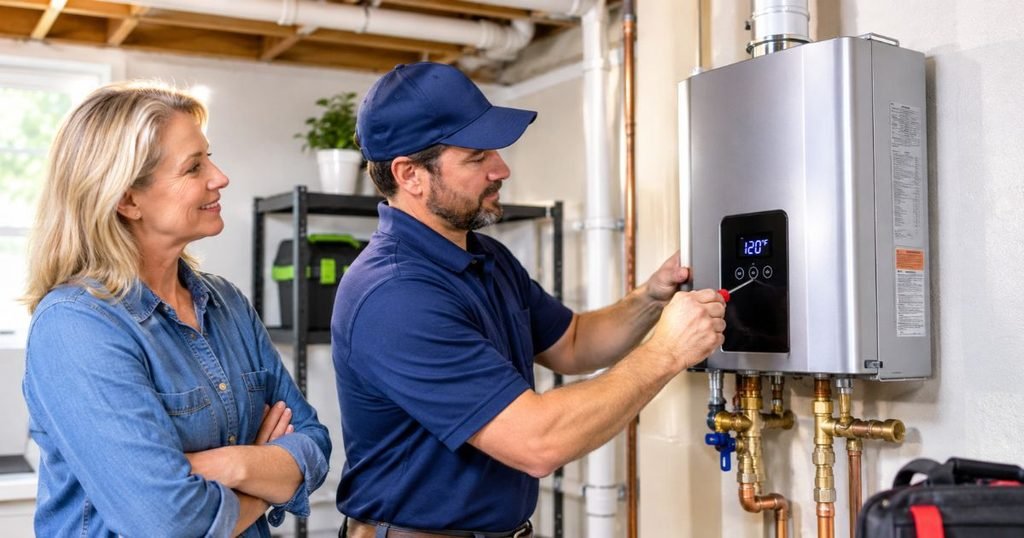
How Much Does a Tankless Water Heater Cost With Installation?
When researching tankless water heater installation cost, it helps to separate the price tag on the box from the complete turnkey project. National home improvement cost guides show a broad spread because some quotes reflect simple electric swaps while others account for high-efficiency condensing gas conversions.
Reconciling current pricing data across major industry benchmarks gives a realistic breakdown of what American homeowners actually pay:
| Cost Category | Estimated Cost |
| Tankless water heater unit | $500 – $2,600 |
| Professional installation labor | $600 – $2,500 |
| Additional materials (valves, fittings, piping) | $150 – $500 |
| Permits and inspections | $50 – $300 |
| Total installed cost | $1,400 – $5,600 |
Understanding the difference between equipment-only prices, labor-only estimates, and full project quotes prevents sticker shock:
- Equipment-only price: Buying the unit yourself at a supply house or home center generally runs $500 to $2,600 for a whole-house model. Small single-sink electric units start around $150 to $300.
- Labor-only estimate: A licensed plumber or technician typically charges $600 to $1,850 for standard labor, rising to $2,500 when complex gas, venting, or electrical modifications are necessary.
- Complete installed cost: A comprehensive quote bundles the heater, service valves, mounting board, venting or wiring adaptations, old tank haul-away, and municipal permit fees.
If your home already has a tankless water heater, a tankless water heater replacement cost falls toward the lower end of these ranges because the gas supply, exhaust vent, and water lines are already configured.
READ MORE: Best Rheem Electric Tankless Water Heater: Reviews, Cost & Comparison
Tankless Water Heater Installation Cost by Fuel Type
Your home’s existing utility connections heavily dictate which heater makes financial sense and what your final cost to install a tankless water heater will look like.
Natural Gas Tankless Water Heater Cost
Natural gas models are the most popular choice for whole-house installations in the U.S. because gas burners generate enough heat to warm cold incoming water rapidly.
- Equipment prices: Units cost between $750 and $2,600. Non-condensing units sit on the lower end, while high-efficiency condensing models with secondary heat exchangers cost more.
- Professional installation charges: Expect to pay $1,000 to $2,500 in labor and materials, bringing total installed costs to roughly $2,000 to $5,600.
- Gas line sizing and upgrades: A traditional 40-gallon tank uses about 40,000 BTUs, whereas a whole-house tankless unit burns 150,000 to 199,000 BTUs. If your home has a standard 1/2-inch gas pipe, a plumber will likely need to run a dedicated 3/4-inch gas line from the meter to prevent fuel starvation.
- Venting requirements: Tankless units cannot share an old atmospheric metal flue with your furnace. Non-condensing heaters require costly Category III stainless steel venting, while condensing models vent through schedule 40 PVC or polypropylene pipe.
- Typical household applications: Best suited for medium-to-large households running multiple showers, dishwashers, and washing machines simultaneously, especially in northern climates with cold winter groundwater.
- Advantages and disadvantages: High flow rates and lower monthly fuel bills are major advantages, while higher upfront installation expenses and annual descaling maintenance are the main drawbacks.
Electric Tankless Water Heater Installation Cost
Electric models heat water using high-wattage copper or stainless-steel heating elements rather than open flames.
- Unit prices: Whole-house electric units typically cost $500 to $1,500, making the tankless water heater cost per unit significantly lower than gas.
- Installation labor: Basic plumbing labor is lower, usually $300 to $1,000 because no gas piping or exhaust flues are required. Total installed costs average $1,400 to $3,500.
- Electrical wiring and dedicated circuits: A whole-house electric unit demands tremendous amperage. Most require two to four dedicated 240-volt double-pole breakers (often 40 amps each) wired with heavy-gauge copper cable.
- Electrical panel capacity: Your home generally needs at least a 200-amp main electrical service panel to support a whole-house electric tankless unit alongside air conditioning, an electric range, and a dryer. Upgrading an older 100-amp or 150-amp panel adds significant cost.
- Advantages and disadvantages: Compact size, zero combustion exhaust, and nearly 99% thermal efficiency are big benefits. However, electric units struggle to produce high flow rates in cold northern states and can strain older electrical panels.
Propane Tankless Water Heater Cost
For rural and suburban homes without municipal natural gas lines, liquid propane (LP) provides the same high-output heating performance as natural gas.
- Equipment and supply requirements: Propane units cost roughly $800 to $2,600. Many manufacturers sell convertible models or specific LP versions. Your plumber must verify that your outdoor propane tank and regulator are sized to supply enough vapor pressure during peak winter demand.
- Installation expenses: Total installed costs mirror natural gas at $2,000 to $5,600, depending on venting and piping distances.
- Suitability: Ideal for all-electric rural homes wanting high hot-water output without upgrading to a 300- or 400-amp electrical service. Keep in mind that propane generally costs more per therm than natural gas, resulting in higher annual operating expenses.
HomeAdvisor
| Fuel Type | Unit Cost | Typical Installed Cost | Venting Needed? | Utility Upgrade Risk |
| Natural Gas | $750 – $2,600 | $2,000 – $5,600 | Yes (Stainless or PVC) | Moderate to High (3/4″ gas pipe) |
| Electric | $500 – $1,500 | $1,400 – $3,500 | No | High (Breakers & 200A panel) |
| Propane (LP) | $800 – $2,600 | $2,000 – $5,600 | Yes (Stainless or PVC) | Moderate (Regulator & line sizing) |
READ MORE: Best Tankless Water Heater— Top Picks, Costs & Buyer’s Guide
Tankless Water Heater Cost by System Size and GPM
Unlike storage tanks measured in gallons of capacity, tankless water heaters are sized by water flow rate (GPM) gallons per minute at a specific temperature rise.
Temperature rise is the difference between your incoming cold groundwater temperature and your desired tap temperature (usually 120°F). In southern states like Florida or Texas, incoming groundwater hovers around 70°F, requiring only a 50°F temperature rise. In Minnesota or Maine, winter groundwater drops near 40°F, requiring an 80°F rise. The colder your incoming water, the slower a heater must move water across its heat exchanger to reach 120°F.
Never choose a tankless unit based solely on how many bedrooms your house has. Two three-bedroom homes can have completely different hot water demands depending on fixture flow rates and family habits. Instead, add up the GPM of every fixture you plan to run at the exact same time:
- Standard shower head: 1.5 to 2.5 GPM
- Kitchen faucet: 1.5 to 2.0 GPM
- Bathroom sink faucet: 1.0 to 1.5 GPM
- Dishwasher or washing machine: 1.5 to 2.0 GPM
If someone takes a shower (2.0 GPM) while the dishwasher runs (1.5 GPM) and someone washes hands (1.0 GPM), your system needs at least 4.5 GPM at your local winter temperature rise.
- Point-of-use tankless water heaters (1 to 3 GPM): Small electric units installed under a sink or near a remote bathroom to eliminate long waits for hot water.
HomeGuide - Small-capacity whole-house systems (4 to 6 GPM): Suitable for condos, apartments, or warm-climate homes running one or two fixtures at once.
- Medium-capacity systems (7 to 9 GPM): Fits most single-family homes running two showers and an appliance simultaneously.
- Large whole-house systems (9.5 to 11+ GPM): Built for large households with multi-head showers, soaking tubs, or cold northern climates where high BTU output is mandatory.
| System Capacity | Typical GPM Range | Estimated Unit Cost | Installation Considerations |
| Point-of-Use | 1.0 – 3.0 GPM | $150 – $500 | Usually electric; requires dedicated 120V or 240V circuit; no venting. |
| Small Whole-House | 4.0 – 6.0 GPM | $500 – $1,200 | Works well in warm southern climates; limited to 1–2 simultaneous fixtures. |
| Medium Whole-House | 7.0 – 9.0 GPM | $900 – $1,800 | Standard 160,000–180,000 BTU gas or 27–36 kW electric; requires utility sizing check. |
| Large Whole-House | 9.5 – 11+ GPM | $1,400 – $2,600 | High-BTU gas/propane (199,000 BTU); almost always requires 3/4″ gas line and dedicated venting. |
READ MORE: Gas Water Heater Replacement Cost— What Homeowners Pay & Why
Labor Cost to Install a Tankless Water Heater
The tankless water heater labor cost makes up roughly 35% to 50% of your total project bill. Across the United States, licensed plumbers typically charge between $75 and $150 per hour, though rates in major metropolitan areas on the East and West Coasts can reach $175 or more per hour.
Most reputable contractors price tankless installations using flat-rate project billing rather than open-ended hourly billing, giving you price certainty before work begins. A straightforward replacement takes a skilled technician 3 to 5 hours, while a first-time tank-to-tankless conversion typically requires 6 to 10 hours and occasionally a full day if a licensed electrician must coordinate panel work.
Several on-site factors directly push plumber charges higher:
- Replacement vs. first-time installation: Swapping a wall-mounted tankless heater in the exact same spot requires minimal piping modifications. Converting from a floor-standing tank means mounting a plywood backboard, extending copper or PEX water lines up the wall, and reconfiguring gas and exhaust connections.
- Difficult installation locations: Installing a unit inside a cramped attic, low crawlspace, or tight interior closet adds hours of labor compared to an open garage wall.
- Multi-trade coordination: Plumbers handle water, gas, and venting, while separate licensed electricians are often required by local code to pull new 240-volt circuits or upgrade service panels.
Additional Costs That Can Increase Installation Expenses
Many homeowners budget only for the water heater and basic labor, only to get surprised by infrastructure upgrades required to make the unit run safely and legally. Not every home needs these extras, but knowing their realistic price ranges helps you build an accurate contingency budget:
- Gas line upgrades ($350 – $850): Running a larger 3/4-inch black iron or corrugated stainless steel tubing (CSST) line from the gas meter to the heater ensures adequate fuel pressure. Long runs across finished basements cost more.
- Electrical panel upgrades ($1,000 – $2,500): Upgrading an outdated 100-amp main breaker box to a 200-amp panel is frequently necessary for whole-house electric tankless models.
- New electrical circuits ($200 – $600): Even if your main panel has spare amperage, an electrician must install new double-pole breakers and heavy-gauge wiring to the heater location.
- Venting system installation ($300 – $800): Drilling through exterior walls or roofs and installing sealed stainless-steel or PVC exhaust and intake pipes adds material and labor expense.
- Water pipe modifications ($150 – $500): Rerouting existing hot and cold supply lines, adding a pressure-reducing valve if home water pressure exceeds 80 PSI, or installing a thermal expansion tank when required by local code.
- Condensate drain installation ($100 – $300): High-efficiency condensing gas heaters produce acidic liquid condensation that must drain safely through a acid-neutralizing tube into a floor drain or condensate pump.
- Water treatment or scale prevention ($150 – $600): Homes with hard water need a scale-inhibitor cartridge or water softener to keep calcium from ruining the heat exchanger.
- Isolation and flushing valve kits ($75 – $150): Brass service valves with built-in hose ports are essential so you or a plumber can flush the heat exchanger annually.
- Old water heater removal and disposal ($100 – $300): Draining, hauling away, and recycling a heavy steel storage tank.
- Building permits and inspections ($50 – $300): Municipal fees required by most cities and counties to verify safe gas, electrical, and venting work.
- Relocating the water heater ($500 – $1,500+): Moving the heater from an interior closet to an exterior wall or garage to simplify venting requires extending water, gas, and electrical lines.
READ MORE: Best Temperature Setting for Water Heater
Tankless Water Heater Installation Cost by Home Type
Your home’s age, layout, and construction style play a major role in your final tankless water heater installation price.
- Small homes and apartments ($1,200 – $2,600): Lower hot-water demand allows for compact 4-to-6 GPM units. However, condos and townhomes often face strict HOA rules regarding where exhaust vents can exit exterior walls.
- Average single-family homes ($2,500 – $4,200): Most three-bedroom, two-bath homes install a 7-to-9 GPM gas or electric system in the garage or basement, occasionally needing minor gas or circuit work.
- Large family homes ($3,800 – $6,500+): Homes with four or more bathrooms often need a high-output 11 GPM unit or two smaller tankless units piped in parallel plus dedicated recirculation lines so distant bathrooms do not wait minutes for warm water.
- Older homes ($3,000 – $6,000+): Houses built before 1980 frequently have undersized 1/2-inch gas piping, 100-amp electrical panels, or corroded galvanized steel water pipes that must be updated during installation.
- Homes switching from traditional tank heaters ($2,500 – $5,600): Converting from a tank requires new wall mounting, dedicated venting, and utility upgrades that add $1,000 to $2,500 over a basic swap.
- New construction homes ($1,800 – $3,500): Installing a tankless heater while walls are still open is much cheaper because plumbers and electricians can run 3/4-inch gas lines, PVC vents, and circuits without cutting drywall.
Tankless Water Heater Replacement Cost vs. New Installation Cost
Understanding the gap between tankless water heater replacement cost and a brand-new conversion helps you evaluate contractor quotes accurately.
When replacing an older tankless unit that has reached the end of its service life, the heavy infrastructure work is already finished. If you replace a natural gas tankless heater with a model of similar BTU rating from the same manufacturer, your plumber can often reuse the existing 3/4-inch gas line, isolation valves, and mounting bracket.
Venting compatibility is the one catch during replacements. Different brands and even newer generations from the same brand sometimes use different vent diameters or proprietary flue collars. Mixing venting components from different manufacturers violates safety codes and voids warranties, meaning your installer may still need to replace the exhaust pipe.
For electric replacements, existing 240-volt breakers and wiring can usually be reused as long as the new unit requires the exact same amperage and wire gauge.
| Cost Factor | Tankless-to-Tankless Replacement | New Installation (Tank-to-Tankless) |
| Average Total Cost | $1,200 – $3,700 | $2,500 – $5,600 |
| Installation Time | 2 – 4 hours | 6 – 10 hours |
| Gas Line Work | Usually reuses existing 3/4″ line | Often requires upsizing from 1/2″ to 3/4″ |
| Venting | Reused if compatible; replaced if different brand/type | Brand-new dedicated stainless or PVC vent required |
| Electrical Work | Reuses existing outlet or dedicated breakers | Often requires new outlet, circuits, or panel upgrade |
| Wall Mounting & Piping | Minimal adjustments to existing connections | New mounting board and water line rerouting |
What Is Included in Professional Tankless Water Heater Installation?
Hiring a qualified specialist for professional tankless water heater installation protects your home from carbon monoxide leaks, gas hazards, and water damage. A thorough, code-compliant installation follows nine clear steps:
- Initial home inspection: The installer checks your existing water heater location, measures gas meter capacity or electrical panel amperage, and maps out safe venting routes.
- Hot water demand and GPM calculation: Your plumber calculates peak simultaneous fixture usage alongside your region’s winter groundwater temperature to recommend the right capacity.
- Equipment selection: You review indoor vs. outdoor models, condensing vs. non-condensing efficiency ratings, and optional built-in recirculation pumps.
- Removal of the old water heater: The technician shuts off water and fuel supplies, drains the old storage tank, disconnects the flue, and hauls the old unit away.
- Plumbing and utility connections: The installer mounts the new heater securely to the wall, connects cold and hot water lines, and installs brass isolation service valves and a pressure relief valve.
- Gas or electrical work: A properly sized gas line with a sediment trap is connected and pressure-tested, or dedicated 240-volt electrical circuits are wired into the unit.
- Venting installation when required: For indoor gas and propane models, sealed intake and exhaust pipes are routed outdoors with proper slope and clearance from windows and doors.
- System startup and safety testing: The plumber purges air from the water lines, tests gas connections for leaks, verifies proper exhaust draft, and runs multiple faucets to check temperature stability.
- Final inspection and homeowner instructions: The technician schedules the municipal building inspection, sets your target water temperature (typically 120°F), and shows you how to read error codes and flush the unit.
READ MORE: Best Energy-Efficient Tankless Water Heaters
Is a Tankless Water Heater Worth the Installation Cost?
Deciding whether a tankless upgrade makes sense requires looking honestly at both the perks and the compromises.
Advantages:
- On-demand hot water: As long as you stay within the unit’s GPM limit, you never run out of hot water even during back-to-back showers.
- Space-saving design: Wall-mounted units take up a fraction of the space of a 50-gallon tank, freeing up closet or garage floor area.
- Potential energy savings: According to the U.S. Department of Energy, homes using 41 gallons or less of hot water daily can be 24% to 34% more energy efficient with a demand water heater than a conventional storage tank.
- Longer expected service life: Most tankless water heaters last 15 to 20 years with proper care, compared to 8 to 12 years for standard tank models.
- Reduced standby heat loss: Because there is no tank of hot water sitting idle 24 hours a day, you stop paying to reheat water while you sleep or travel.
Disadvantages:
- Higher upfront installation cost: You will often pay $1,000 to $2,500 more upfront than you would for a standard tank replacement.
- Potential utility upgrades: Gas line upsizing, venting, and electrical panel upgrades add real expenses.
- Mineral buildup and maintenance requirements: Hard water minerals collect inside the narrow heat exchanger tubes, making annual descaling flushes mandatory to maintain efficiency and warranty coverage.
- Flow-rate limitations: If someone turns on three showers and a washing machine simultaneously on an undersized unit, water temperature will drop rather than running out completely.
- Cold-water sandwich effect: Briefly turning hot water off and back on can send a quick pocket of cool water down the pipe before the burner reignites.
Keep in mind that actual utility bill savings vary widely depending on your household size, local gas or electricity rates, system efficiency, and whether you install a continuous recirculation pump.
How to Save Money on Tankless Water Heater Installation
You do not need to overpay to get a safe, reliable installation. Use these practical strategies to keep your tankless water heater installation cost under control without cutting corners:
- Get at least three written estimates: Comparing itemized bids from three local licensed contractors reveals fair market pricing and flags unnecessary add-ons.
- Compare equipment and labor separately: Knowing the exact wholesale or retail price of the heater helps you evaluate what you are paying for installation labor and materials.
- Choose the correct system capacity: Buying an oversized 11 GPM heater for a two-person household wastes money on both equipment and gas line upgrades.
- Avoid unnecessary upgrades: If your home’s existing 3/4-inch gas line already supports the new unit’s BTU load, confirm you are not being billed for a full repipe.
- Ask about manufacturer warranties: Reputable brands typically offer 10- to 15-year heat exchanger warranties and 5-year parts warranties—provided a licensed professional installs the unit.
- Compare operating costs, not just purchase prices: A slightly more expensive condensing gas model with a 0.95 Uniform Energy Factor (UEF) uses less fuel every month than a cheaper 0.82 UEF non-condensing model.
- Check local utility rebates and incentive programs: Note that the federal Section 25C residential energy tax credit for water heaters expired at the end of 2025, meaning federal tax credits are generally unavailable for standard 2026 tankless installations. However, many local gas and electric utilities still offer $100 to $500 cash rebates for ENERGY STAR-certified models. Always confirm rebate rules before purchasing.
- Schedule installation before an emergency replacement: When your old tank bursts and floods the basement, you lose leverage to shop around for quotes or wait for utility rebate pre-approval.
- Ask whether old-unit removal and permits are included: Confirm these items are written into the base contract so they do not appear as surprise charges on the final invoice.
How to Choose the Right Tankless Water Heater Installer
Searching online for tankless water heater installation near me will bring up dozens of general plumbers, HVAC companies, and handymen. Because tankless systems combine high-BTU gas or high-amperage electricity with specialized venting, choose an installer who works with them every week.
Use this checklist before hiring a contractor:
- Proper plumbing or contractor licensing: Verify an active state or municipal plumbing license (and electrical license if wiring a whole-house electric model).
- Relevant tankless installation experience: Ask how many tankless units the technician installs each month, not just standard tanks.
- Insurance coverage: Confirm current general liability insurance and workers’ compensation coverage.
- Written estimates: Insist on a detailed, itemized quote listing the exact model number, GPM rating, venting material, valve kit, permit fees, and cleanup.
- Knowledge of local building codes: The installer should know local clearance rules for exhaust vents, seismic strapping requirements, and expansion tank mandates.
- Manufacturer-authorized installation: Top brands like Rinnai, Navien, Rheem, Noritz, and A. O. Smith offer factory training programs that protect full warranty coverage.
- Warranty coverage: Look for at least a 1- to 2-year contractor workmanship warranty alongside the manufacturer’s equipment warranty.
- References and customer reviews: Check recent local reviews specifically mentioning tankless water heater installations.
Before signing a contract, ask three direct questions: “Did you perform a load calculation on my gas line or electrical panel?”, “Are isolation service valves and permits included in this price?”, and “Who handles warranty service if the unit throws an error code next year?”
Frequently Asked Questions
How much does it cost to install a tankless water heater in the USA?
The total cost to buy and professionally install a tankless water heater in the United States ranges from $1,400 to $5,600, with most whole-house projects averaging $2,500 to $3,900. Point-of-use electric units for a single sink cost $500 to $1,600 installed, while whole-house natural gas or propane conversions cost $2,000 to $5,600 depending on venting and utility upgrades.
Is a tankless water heater cheaper to install than a traditional water heater?
No. A tankless water heater almost always costs more upfront than a standard storage tank water heater. Installing a conventional 40- or 50-gallon tank typically costs $900 to $3,100 total, whereas a whole-house tankless installation runs $1,400 to $5,600 due to higher equipment costs, dedicated venting, and gas or electrical upgrades.
How much does a plumber charge to install a tankless water heater?
Licensed plumbers typically charge $600 to $1,850 in labor for a standard installation, though complex conversions requiring extensive gas piping or venting can push labor to $2,500. Most plumbers charge $75 to $150 per hour or quote a flat project rate covering 4 to 8 hours of labor.
Does a tankless water heater require electrical or gas line upgrades?
Often, yes, especially when switching from a storage tank for the first time. Whole-house gas models frequently require upgrading a 1/2-inch gas pipe to a 3/4-inch line to supply 150,000 to 199,000 BTUs. Whole-house electric models usually require multiple dedicated 240-volt breakers and at least a 200-amp main electrical service panel.
How long does it take to install a tankless water heater?
Replacing an existing tankless water heater with a similar model generally takes 2 to 4 hours. Converting from a traditional storage tank to a new tankless system takes typically 6 to 10 hours because the installer must mount the unit, run new exhaust venting, modify water lines, and upgrade gas or electrical connections.
Final Thoughts:
For most American homeowners, budgeting $2,500 to $3,900 provides a realistic target for the cost of a tankless water heater with installation in 2026, with simpler electric setups costing less and full gas conversions with utility upgrades reaching $5,600. Your final bill comes down to three main factors: your chosen fuel type, the GPM capacity required for your climate and household habits, and how much gas, electrical, or venting work your home needs.
Disclaimer: The cost figures provided in this article are national estimates intended for informational and budgeting purposes only. Actual installation prices vary significantly based on regional labor rates, local building codes, equipment brand and capacity, fuel availability, and necessary home infrastructure upgrades. Always obtain written, itemized quotes from licensed local plumbing and electrical professionals before starting your project.