Finding the best temperature setting for your water heater is one of the easiest ways to protect your family, improve daily comfort, and manage household energy use. Most homeowners never look at their water heater’s thermostat until the shower turns lukewarm or a faucet suddenly blasts scalding water. Yet that single dial or digital control panel plays a major role in how safely and efficiently your plumbing system operates every day.
Choosing the right setting involves balancing four competing priorities: everyday comfort, energy efficiency, bacterial control inside the tank, and scald prevention at the tap. Set the temperature too high, and you risk severe tap water burns alongside higher utility bills.
Set it too low, and you may run out of hot water mid-shower, struggle to clean greasy dishes, or create an environment where harmful waterborne bacteria can multiply. Because every home has different plumbing layouts, water heater types, and household members, the ideal setting depends on how your specific home operates. Lets deep dive into “Best Temperature Setting for Water Heater”
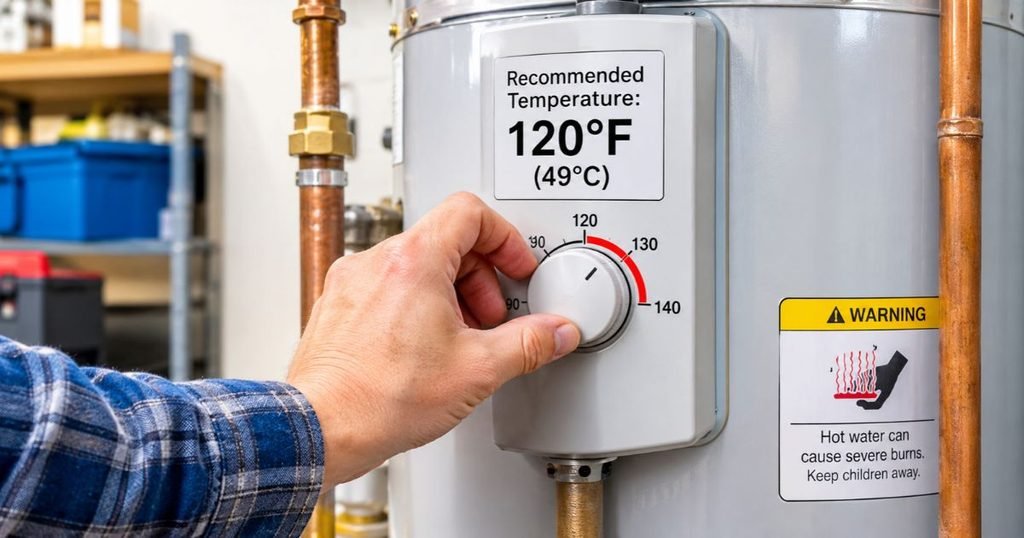
What Is the Best Temperature Setting for a Water Heater?
For most U.S. households, 120°F is the widely recommended starting point for a residential water heater. Safety organizations, energy agencies, and plumbing professionals frequently point to 120°F because it hits a practical middle ground for everyday living. At this temperature, water is plenty hot for comfortable showers, handwashing, laundry, and dishwashing, while still remaining cool enough to significantly reduce the risk of sudden, severe burns at the faucet.
Many homeowners choose a water heater temperature setting of 120 degrees simply because it works well right out of the box in fact, most manufacturers ship new residential units preset to around 120°F. However, there is no single universal setting that fits every home. A household with healthy adults and a modern dishwasher equipped with an internal booster heater will have very different needs than a multi-generational home with infants, older adults, or immunocompromised family members.
In certain situations, a higher storage setting typically between 130°F and 140°F may be appropriate. Homes with older dishwashers that lack internal heating elements, households with high simultaneous hot water demand, or plumbing systems managed to reduce bacterial growth risks often benefit from higher tank temperatures. When a water heater is set above 120°F, installing a point-of-use or whole-home thermostatic mixing valve becomes essential to keep tap water safe.
READ MORE: Why Is My Water Heater Temperature Fluctuating? Causes & Fixes
Why Is 120°F the Recommended Water Heater Temperature?
When homeowners ask, “What temperature should a water heater be set at?” 120°F is almost always the first number mentioned. Organizations like the U.S. Department of Energy (DOE) and the U.S. Consumer Product Safety Commission (CPSC) highlight 120°F for several practical reasons:
- Reduced risk of accidental scalding: Tap water at 140°F can cause a serious third-degree burn in less than five seconds, while water at 120°F takes several minutes of continuous exposure to cause similar skin damage. Those extra minutes give adults and children plenty of time to pull away from overly hot water.
- Improved energy efficiency: Heating water accounts for a substantial portion of a home’s utility costs. Maintaining a tank at 120°F requires less fuel or electricity than keeping that same volume of water heated to 140°F around the clock.
- Lower standby heat loss: Tank-style water heaters continuously lose heat through the tank walls into the surrounding garage, basement, or utility closet. Keeping the stored water at 120°F narrows the temperature gap between the water inside the tank and the surrounding air, slowing down standby heat loss.
- Sufficient heat for daily routines: For most people, a comfortable shower falls between 100°F and 105°F. A 120°F water heater temperature for a shower allows you to blend hot and cold water smoothly at the valve without exhausting your hot water supply too quickly.
- Extra protection for vulnerable family members: Young children have thinner, more sensitive skin than adults, and older adults may have slower reaction times or reduced sensitivity to heat. Keeping delivery temperatures at or below 120°F adds a critical margin of safety.
Water Heater Temperature and Legionella Bacteria:
While 120°F is ideal for scald prevention and energy savings, plumbing specialists also have to account for waterborne pathogens, specifically Legionella pneumophila, the bacteria responsible for Legionnaires’ disease. Legionella naturally exists in freshwater environments and can enter municipal water supplies or private wells in low numbers. Inside a residential plumbing system, stagnant, lukewarm water provides conditions where these bacteria can multiply.
Understanding how temperature affects Legionella is critical for making an informed decision:
- The bacterial growth zone: According to the Centers for Disease Control and Prevention (CDC) and the U.S. Environmental Protection Agency (EPA), Legionella bacteria multiply most rapidly in water temperatures between 77°F and 113°F (and can survive up to roughly 122°F).
- Higher storage temperatures: Storing hot water at 130°F to 140°F helps inhibit Legionella growth inside the water heater tank and distribution pipes. At 140°F, the bacteria die off rather than multiply.
- Storage temperature vs. delivery temperature: This is where many homeowners get confused by seemingly contradictory advice. Safety agencies recommend 120°F to prevent burns, while public health agencies note that 130°F–140°F controls bacteria. Both guidelines work together when you separate tank storage temperature from faucet delivery temperature.
- The role of thermostatic mixing valves: A thermostatic mixing valve (also called an anti-scald valve) blends cold water with hot water right as it leaves the water heater or at individual fixtures. This allows you to store water at 135°F or 140°F inside the tank to discourage bacterial growth while delivering a safe 120°F (or lower) at your faucets and showerheads.
It is important to remember that simply setting a residential water heater to 120°F or 140°F does not guarantee complete protection against Legionella. Pipe dead-ends, rarely used guest showers, sediment buildup at the bottom of the tank, and water quality all play a role. Households with individuals who have weakened immune systems, chronic lung disease, or other high-risk health conditions should consult both their healthcare provider and a licensed plumber about appropriate water management strategies.
READ MORE: How to Adjust the Temperature on a Water Heater: Step by Step
Best Water Heater Temperature for Different Household Needs
Because every household operates differently, matching your water heater setting to the people living under your roof is the smartest approach. The table below outlines how different household situations influence the ideal water heater temperature.
| Household Situation | Temperature Considerations |
| Families with young children | Keep tap delivery temperatures at or below 120°F to prevent accidental scalds. If storing water higher for bacterial control, use a thermostatic mixing valve and install anti-scald guards on tub spouts and showerheads. |
| Homes with older adults | Older adults face higher risks from both severe burns and waterborne illnesses. Storing water at 130°F–140°F paired with a professionally installed mixing valve set to 115°F–120°F addresses both concerns safely. |
| Homes with healthy adults | A 120°F setting is typically the best starting point, offering reliable comfort for showers and laundry while keeping energy costs reasonable and scald risks low. |
| Households with immunocompromised individuals | Consult a licensed plumber and healthcare provider. Storing water at 130°F–140°F (with mixing valves to keep taps at 120°F or below) is often recommended to minimize Legionella risks. |
| Large households | High simultaneous demand can drain a standard tank quickly. Raising the tank setting to 130°F–135°F (with a mixing valve) increases your effective hot water capacity because each shower requires less hot water blended with cold. |
| Vacation homes | Use the manufacturer’s “Vacation” or “Low” mode while away to save energy. When returning, raise the heater to 140°F for several hours and flush all faucets before returning to normal temperatures to clear stagnant water. |
READ MORE: Emergency Water Heater Repair: What to Do & When to Call
Best Temperature Setting for Different Types of Water Heaters
The type of equipment installed in your utility room affects how you set, monitor, and maintain your hot water temperature. Recommended settings and adjustment methods vary across models, so always verify your unit’s specific design.
Electric Water Heaters
Standard electric tank water heaters usually feature two heating elements (upper and lower), each controlled by its own thermostat hidden behind screwed-on metal access panels on the side of the tank. For most homes, setting both thermostats to 120°F is the standard electric water heater temperature setting.
If the upper and lower thermostats are set to different temperatures, the unit may heat unevenly or overwork one element. Because adjusting an electric thermostat requires removing cover plates near high-voltage 240-volt wiring, strict electrical safety precautions are mandatory.
Gas Water Heaters
Traditional gas tank water heaters use a gas control valve mounted near the bottom front of the tank. Instead of exact digital numbers, many gas dials display words like “Pilot,” “Warm,” “Hot,” “A,” “B,” “C,” and “Very Hot.” On most models, the “Hot” mark or the triangle indicator corresponds to roughly 120°F, while each letter increment above it raises the temperature by about 10°F. Because calibration varies slightly by brand, always check your owner’s manual before turning the dial.
Tankless Water Heaters
On-demand tankless units heat water directly as it flows through a heat exchanger, eliminating standby storage losses. Most homeowners set their tankless water heater temperature setting between 120°F and 125°F on the digital control pad.
Because tankless heaters do not store warm water in a tank, they carry a much lower risk of Legionella proliferation than storage tanks. Setting a tankless unit right at your desired delivery temperature (such as 120°F) means you rarely need to mix much cold water at the shower valve, which also helps prevent “cold water sandwiches” or flow-rate fluctuations on smaller units.
Heat Pump Water Heaters
Hybrid heat pump water heaters pull heat from the surrounding air and transfer it into the water tank, making them remarkably efficient. Most models feature a digital display with operating modes like “Efficiency” (heat pump only), “Hybrid,” and “High Demand.” Setting a heat pump water heater to 120°F in Efficiency or Hybrid mode maximizes energy savings. If you choose a higher storage setting like 135°F or 140°F for larger families or bacterial control, the unit may rely more frequently on its backup electric resistance elements, reducing overall efficiency.
How to Adjust Your Water Heater Temperature Safely
Adjusting a water heater thermostat is straightforward on modern units, provided you follow basic safety practices. Never open electrical panels without shutting off power, never bypass high-limit safety switches, and avoid touching gas supply lines or burner assemblies.
- Locate the thermostat or control panel: On gas tanks, look for the dial on the gas control valve near the bottom. On tankless and heat pump units, look for the digital keypad on the front cover. On standard electric tanks, look for the upper and lower access panels on the side of the jacket.
- Identify your water heater type: Confirm whether you have a gas, electric, tankless, or hybrid model, as the adjustment steps differ significantly.
- Read the manufacturer’s instructions: Check the label printed directly on the tank or consult your owner’s manual to see what the dial markings represent and whether your model has specific adjustment guidelines.
- Follow the safe adjustment procedure for your unit:
- For tankless and heat pump models: Simply press the up or down arrow buttons on the digital screen to select your target temperature (such as 120°F).
- For gas models: Turn the temperature dial gently to the recommended notch (typically “Hot” for 120°F) without forcing it past its stops.
- For electric models: Turn off the electricity to the water heater at your home’s main circuit breaker box first. Verify power is off, remove the outer access panels, and fold back the insulation carefully without touching any exposed wire terminals. Use a flathead screwdriver to turn the plastic thermostat dial to 120°F on both the upper and lower thermostats, then replace the insulation, screw the covers back on securely, and restore power at the breaker. (If you are uncomfortable working near electrical panels, hire a licensed electrician or plumber.)
- Keep hands clear of hazards: Never tamper with gas valves, pilot tubing, pressure relief valves, or exposed wiring.
- Allow the water temperature to stabilize: Give a tank-style heater at least 3 to 4 hours after an adjustment so the entire volume of water reaches the new target temperature.
- Measure the temperature at a faucet: Run the hot water at the faucet farthest from the heater and test it with a reliable thermometer.
- Recheck and fine-tune: If the tap reading is slightly higher or lower than expected, make a small adjustment and retest after a few hours.
READ MORE: Ultimate Guide to Hot Water High Pressure Cleaners
How to Check If Your Water Heater Temperature Is Correct
Never rely solely on the dial markings on an older water heater to judge your water temperature. Thermostats can drift out of calibration over time, and heat loss through uninsulated pipes can cool water before it reaches your bathroom. Testing the water directly at the tap gives you the real answer.
- Open a hot water faucet: Choose a sink or tub faucet that is a moderate distance from the water heater, and turn the hot water handle all the way on.
- Let the water run: Allow the water to flow for 2 to 3 minutes so all the cooled water sitting inside the pipes clears out and fresh water from the heater arrives.
- Use an accurate thermometer: Fill a glass or mug with the running hot water and insert a digital kitchen thermometer or candy thermometer. Avoid using a medical fever thermometer, as most stop reading around 108°F.
- Compare your reading: Check the thermometer reading against your target safe delivery temperature (around 120°F for most households).
- Account for system differences: Keep in mind that if you have a thermostatic mixing valve installed on your heater, the faucet temperature will naturally read lower than the tank’s internal thermostat setting which is exactly how it is designed to work.
If your thermometer shows water temperatures exceeding 125°F–130°F despite the thermostat being set to 120°F, or if the temperature swings wildly during testing, have a licensed plumber inspect the thermostat, dip tube, or mixing valve.
Signs Your Water Heater Temperature Is Too High or Too Low
Your plumbing fixtures usually give clear warning signs when your water heater temperature is out of balance. Recognizing these symptoms early helps you troubleshoot whether you simply need a quick thermostat tweak or a professional repair.
Signs Your Temperature Is Too High
- Excessively hot tap water: Water feels immediately uncomfortable or painful when washing your hands, forcing you to mix in large amounts of cold water.
- Increased scalding hazards: Steam rises quickly from faucets, and minor bumps to the shower handle cause sudden hot spikes.
- Unexplained spikes in utility bills: Your gas or electric usage climbs noticeably even though your household’s daily hot water habits haven’t changed.
- Mineral scale buildup: Higher temperatures accelerate calcium and magnesium scaling inside the tank and pipes, which can cause popping or rumbling noises during heating cycles.
Signs Your Temperature Is Too Low
- Lukewarm showers: Even with the shower handle turned all the way to hot, the water never feels warm enough.
- Running out of hot water fast: Your hot water supply disappears halfway through a normal shower because you have to use 100% hot water rather than blending it with cold.
- Greasy dishes or dingy laundry: Dishwasher detergent fails to dissolve properly, leaving film on glassware, or clothes come out looking dull.
- Bacterial growth concerns: Water consistently sitting below 120°F spends too much time in the temperature zone where Legionella can thrive.
Keep in mind that a water heater temperature that feels too hot or too cold isn’t always caused by the thermostat dial. A failing lower heating element in an electric tank, a broken dip tube that lets cold water mix at the top of the tank, heavy sediment buildup, or a worn-out shower cartridge can mimic thermostat issues. If adjusting the setting doesn’t solve the problem, review common troubleshooting steps for why your water heater is not getting hot enough or why your water heater temperature is fluctuating.
Does Lowering Your Water Heater Temperature Save Money?
Yes, lowering an excessively high water heater temperature can reduce your household energy consumption, though the exact dollar amount depends on your local utility rates, fuel type, and daily habits. Water heating is typically the second-largest energy expense in a U.S. home, right behind space heating and cooling.
When a storage tank is set to 140°F instead of 120°F, it burns more fuel or uses more electricity in two ways: first, by heating incoming cold groundwater an extra 20 degrees every time you use hot water, and second, through standby heat loss the heat that continuously escapes through the tank walls while the water sits idle in your basement or garage. Lowering a thermostat that was accidentally left at 140°F down to 120°F slows that heat loss and reduces how often the burner or heating elements kick on.
You can maximize your water heater temperature for energy efficiency by pairing a sensible 120°F setting with a few practical habits:
- Insulate exposed hot water pipes: Adding foam pipe sleeves to the first six feet of hot water piping leaving the tank reduces heat loss as water travels to your fixtures.
- Flush the tank annually: Draining sediment from the bottom of the tank keeps heat transfer efficient so the burner or element doesn’t have to work overtime. Learning how to flush a water heater takes less than an hour and helps extend equipment life.
- Use cold water for laundry: Modern detergents clean effectively in cold water for most everyday loads, saving your hot water for heavily soiled items and showers.
- Fix dripping hot water faucets: Even a slow hot water drip wastes dozens of gallons of heated water every month.
READ MORE: Rusty Water From Hot Water Heater: Causes, Fixes & Replacement
Common Water Heater Temperature Setting Mistakes to Avoid
Even well-intentioned homeowners make small mistakes when managing their hot water systems. Watch out for these common pitfalls:
- Cranking the dial all the way up for “more hot water”: Turning a thermostat to 150°F or “Very Hot” creates a severe scalding hazard and accelerates tank wear without fixing underlying plumbing problems.
- Dropping the temperature too low to save money: Setting a storage tank to 105°F or 110°F places your water squarely in the optimal growth range for Legionella bacteria.
- Overlooking children and older adults: Assuming healthy adults are the only ones using the taps puts young kids and older visitors at immediate risk of accidental burns.
- Confusing storage temperature with delivery temperature: Setting a tank to 140°F for bacterial control without installing a thermostatic mixing valve sends dangerously hot water straight to your bathroom sinks.
- Adjusting controls without reading the manual: Guessing what “A,” “B,” or “C” means on a gas valve—or adjusting only one thermostat on a two-element electric heater—leads to uneven heating.
- Ignoring sudden temperature swings: Treating erratic hot and cold bursts as normal instead of investigating a failing thermostat, mixing valve, or shower cartridge.
- Skipping routine maintenance: Letting years of mineral sediment accumulate at the bottom of the tank insulates the water from the burner, causing overheating and premature tank failure.
- Assuming all water heaters adjust the same way: Gas dials, electric screw-slots, and tankless digital pads each have distinct procedures and safety rules.
Final Thoughts
Selecting the best temperature setting for your water heater comes down to finding the safest, most efficient balance for the people who live in your home. For the vast majority of American households, 120°F remains the most reliable baseline delivering comfortable showers, dependable cleaning power, lower standby heat loss, and critical protection against accidental scalding.
At the same time, households with high hot water demand, older appliances, or immunocompromised family members may benefit from storing water between 130°F and 140°F alongside a properly calibrated thermostatic mixing valve.
Frequently Asked Questions
What is the best temperature setting for a water heater?
For most residential homes, 120°F is the best temperature setting for a water heater. Recommended by the U.S. Department of Energy and safety organizations, 120°F provides plenty of hot water for comfortable showers, laundry, and dishwashing while minimizing standby heat loss and significantly reducing the risk of accidental tap water scalding.
Is 120 degrees hot enough for a water heater?
Yes, 120°F is hot enough for everyday residential needs. Most people prefer showers between 100°F and 105°F, leaving plenty of room to blend hot and cold water comfortably. Modern dishwashers also include internal booster heaters that raise water temperatures during wash cycles, making 120°F fully sufficient for clean dishes.
Should I set my water heater to 120 or 140 degrees?
Set your water heater to 120°F if you want the safest direct tap temperature and better energy efficiency. Choose 130°F to 140°F only if you need extra hot water capacity or want to limit Legionella bacterial growth and always pair a 140°F tank setting with a thermostatic mixing valve to keep faucet temperatures at or below 120°F.
What temperature should my water heater be set at to prevent Legionella?
According to the CDC and EPA, Legionella bacteria multiply between 77°F and 113°F, while storing hot water at 130°F to 140°F helps inhibit bacterial growth inside the tank. Because 140°F water can cause severe burns within seconds, plumbers recommend pairing higher storage temperatures with a thermostatic mixing valve to deliver safe water at the tap.
Does lowering the water heater temperature save money?
Yes, lowering a water heater that is set too high (such as 140°F) down to 120°F can help lower your monthly gas or electric bills. Cooler stored water reduces standby heat loss through the tank walls and requires less energy to heat incoming cold water, though actual savings depend on your household usage and local utility rates.
Sources
- U.S. Department of Energy (DOE): Energy Saver: Do-It-Yourself Savings Project: Lower Water Heating Temperature (Energy.gov, accessed 2026).
- Centers for Disease Control and Prevention (CDC): Controlling Legionella in Potable Water Systems & Water Management Program Toolkit (CDC.gov, updated 2024–2025).
- U.S. Environmental Protection Agency (EPA): Technologies for Legionella Control in Premise Plumbing Systems: Scientific Literature Review (EPA.gov).
- U.S. Consumer Product Safety Commission (CPSC): Tap Water Scalds Safety Alert (CPSC.gov).
Disclaimer: Water heater temperature recommendations depend on your specific equipment type, plumbing configuration, household health needs, and state or local plumbing codes. Always follow your water heater manufacturer’s operating and safety instructions, and consult a licensed plumber before making plumbing modifications or adjusting settings for bacterial control and scald protection.

