If you live in a region where electricity costs fluctuate throughout the day, or you want a heating solution that’s efficient, quiet, and requires almost no maintenance, storage heaters might be one of the smartest home upgrades you’ll ever make. Although storage heaters are more common in Europe, they’re becoming increasingly popular across the U.S., especially in states offering off-peak electricity rates.
With 12+ years of hands-on experience working in residential heating, I’ve installed, repaired, and tested nearly every heater type from heat pumps to baseboards to propane and electric units. Storage heaters stand out as one of the most low-maintenance, long-lasting, and cost-efficient heating options available when paired with smart electric rate plans.
In this guide, you’ll learn everything you need to know, written in simple everyday language but with expert-level clarity.
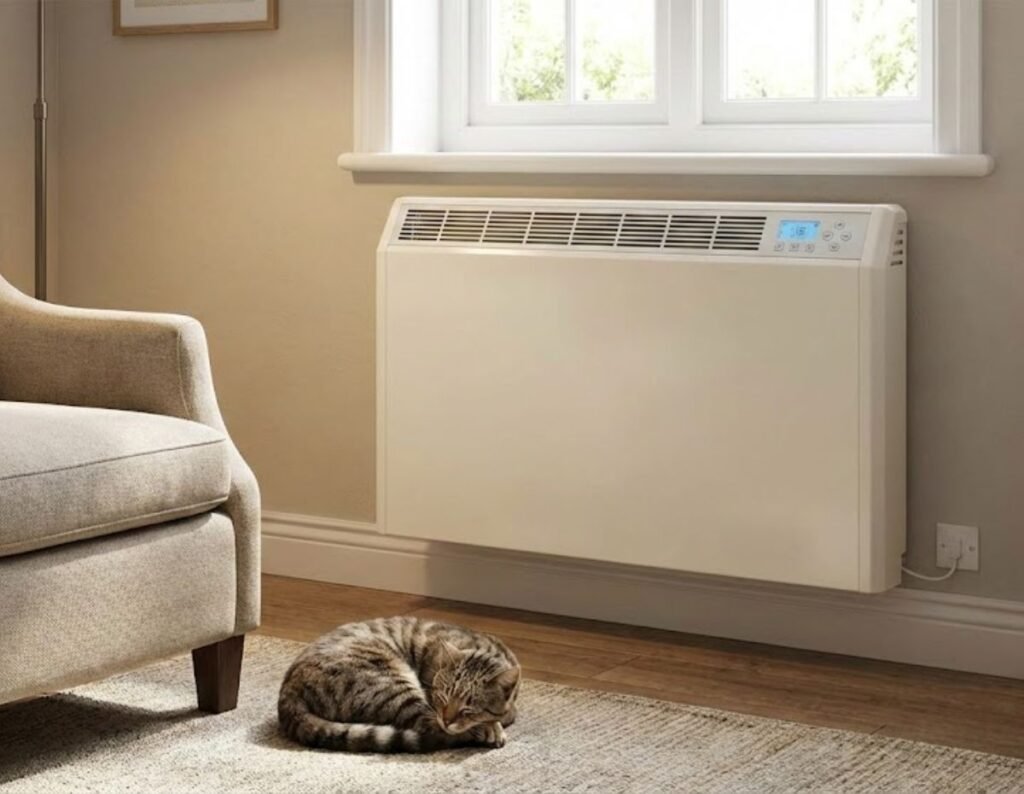
What Is a Storage Heater?
Picture this: a hefty, wall-mounted box that looks a bit like a radiator but works smarter. A storage heater is an electric appliance that pulls in power during low-demand hours think midnight to morning to heat up internal ceramic bricks or similar materials. Then, it doles out that stored warmth gradually when you need it most. Unlike instant-on electric heaters that guzzle power right when rates are high, these bad boys play the long game.
In the USA, they’re not as ubiquitous as in places like the UK, but they’re gaining traction in regions with cooperative utilities offering off-peak rates. Think rural electric co-ops in states like Minnesota, Wisconsin, or even parts of California where time-of-use plans make sense. Why does it matter here? Our energy grid is under pressure, and storage heaters help balance the load by shifting consumption to off-peak times. That means lower costs for you and less strain on the system overall. Plus, with rising gas prices and concerns about emissions, electric options like these are a clean alternative no combustion, no vents needed.
Common use cases? I’ve installed them in basements for supplemental heat, in cabins where gas isn’t feasible, and even in apartments for zone heating. They’re perfect for homes without central HVAC or where you want independent room control. For instance, a client in Michigan used them to heat his workshop, saving hundreds annually by charging overnight. If you’re in a cold climate and your utility offers discounted night rates (check with providers like Xcel Energy or Duke Energy), these could be your ticket to efficient, fuss-free warmth.
How Storage Heaters Work:
Alright, let’s pop the hood on these things. Storage heaters aren’t magic they’re clever engineering. At their core, they use electricity to heat dense materials like ceramic bricks or soapstone during off-peak hours when power is cheaper and more abundant. A built-in thermostat and timer (or smart controls in modern models) kick in automatically.
Step one: Charging phase. Overnight, say from 11 p.m. to 7 a.m., the heater draws power through heating elements wrapped around those bricks. The bricks absorb the heat, getting up to 1,200°F in some cases, but the outer casing stays safe to touch thanks to insulation. This is where your utility’s off-peak rate comes in—rates can drop to half the daytime cost.
Step two: Storage. The heat stays trapped in the bricks, like a thermal battery. Good insulation minimizes loss, so energy isn’t wasted.
Step three: Release. During the day, you control the output. In basic models, flaps or vents open to let convection carry warm air into the room. Fancier ones use fans for quicker distribution or even hydronic systems to pipe heat through radiators. It’s gradual, so no blasts of hot air—just steady comfort.
Real-life example? I once helped a family in Pennsylvania retrofit their old home. Their Steffes unit charged silently at night, and by morning, the living room was toasty without spiking the meter. Another case: A solar-equipped cabin in Colorado paired storage heaters with panels excess daytime solar fed the grid, and cheap night power heated the bricks. Simple, right? But remember, they need space (they’re bulky) and a dedicated circuit. If set up wrong, you might run out of heat by evening, but that’s where smart controls shine.
READ MORE: Instant Hot Water Heater
Benefits of Storage Heaters
Storage heaters pack a punch when it comes to perks. Here’s the rundown, based on what I’ve seen in real installations:
- Cost Savings: By charging on off-peak electricity, you can cut heating bills by 20-50%. In my experience, clients on Economy 7-style plans (common in co-ops) save big one guy in Iowa dropped his winter costs from $300 to $180 monthly.
- Energy Efficiency: Nearly 100% of the electricity converts to heat, no waste like in gas systems. Modern models with better insulation hold heat longer, reducing overall usage.
- Eco-Friendly: No emissions at home, and pairing with renewables like wind or solar amplifies the green factor. Utilities love them for grid stability.
- Quiet Operation: No noisy burners or fans in basic models just silent convection. Perfect for bedrooms.
- Low Maintenance: Unlike boilers, no annual servicing. I’ve gone years without touching a well-installed unit beyond dusting.
- Zonal Control: Heat only the rooms you use, avoiding whole-house waste.
Expert insight: As per energy pros I’ve worked with, these beat standard electric resistance heaters hands-down in variable-rate areas. One study from a Midwest utility showed 30% savings over baseboards.
Key Features to Look For
Shopping for a storage heater? Don’t grab the cheapest focus on features that match your life. Here’s what I recommend based on installs:
- High Heat Retention: Look for ceramic cores with thick insulation. Models like Steffes hold heat 24+ hours.
- Smart Controls: App integration for remote tweaks. Wi-Fi enabled? Bonus for scheduling around your routine.
- Fan Assistance: For faster heat release in larger rooms, but ensure it’s quiet—under 40dB.
- Size and Output: Measured in kW; 1-3kW per room. Calculate based on square footage (e.g., 1.5kW for 150 sq ft).
- Safety Features: Tip-over shutoff, overheat protection essential for families.
- Energy Rating: Aim for high-efficiency labels; some qualify for rebates.
- Warranty: 5-10 years on core components shows quality.
Pick based on your setup solar compatibility if you’re green-minded.
Comparison Table
To help you decide, here’s a side-by-side of popular U.S.-available models. I pulled this from manufacturer specs and real-user feedback. Prices are approximate based on 2025 market averages; check retailers for deals.
| Model | Features | Pricing (Approx.) | Pros | Cons | Best Use Case |
| Steffes Room Heater (2100 Series) | Ceramic brick storage, fan-assisted, smart thermostat, 10-40kW output, app control | $800-$1,500 | Efficient off-peak charging, quiet fan, long heat retention | Bulkier design, higher upfront cost | Single rooms in homes with off-peak rates, like bedrooms or offices |
| Steffes Serenity Forced Air Furnace (4200 Series) | Whole-home integration, 72 bricks, 8 elements, variable speed blower, hydronic option | $2,000-$3,500 | Scalable for larger spaces, integrates with existing ducts, energy-efficient | Requires professional install, more complex | Full-home heating in rural areas without gas, pairs well with solar |
| ELNUR Ecombi PRO | Static storage, Wi-Fi app, voice control (Alexa/Google), 24h heat from 8h charge | $600-$1,200 | Compact, silent, easy DIY install | Less powerful for very cold climates, no fan | Apartments or small homes, budget-conscious users |
| Stiebel Eltron CNS Trend | Wall-mounted, convection release, thermostat control, slim design | $400-$900 | Sleek look, quick setup, low maintenance | Limited storage capacity, no smart features | Supplemental heat in mild winters, urban rentals |
This table highlights how features scale with price go premium for smarts and size.
READ MORE: Geothermal Heat Pump Buying Guide
Pros and Cons of Storage Heaters
Let’s keep it real: Storage heaters aren’t perfect, but they’re solid for the right setup. Here’s a balanced take from my boots-on-the-ground experience.
Pros:
- Bill Reduction: Off-peak charging means real savings—I’ve seen 40% drops in electric-heavy homes.
- Reliability: No fuel worries; just plug in.
- Comfort: Even, radiant heat feels natural, not dry like forced air.
- Flexibility: Works anywhere with power, great for off-grid with batteries.
- Longevity: Last 20+ years with minimal upkeep.
Cons:
- Upfront Cost: $500-$3,000 per unit, plus install ($200-500).
- Space Hog: Heavy (100-300 lbs), need sturdy walls.
- Heat Timing: If you misjudge charge, you might chill out by night.
- Electricity Dependency: High rates without off-peak? Costs climb.
- Slower Warm-Up: Not instant like gas.
Best for: Homes in cold climates with time-of-use electricity, no gas access, or renewable integration. Avoid if you have cheap gas or need on-demand heat.
Cost Breakdown Section
Initial purchase: $600-$2,000 per heater (mid-range model).
Installation: $300-$800, depending on wiring.
Running costs: $0.05-0.10/kWh off-peak; for a 2kW unit charging 7 hours/night, about $50-100/month in winter (varies by region).
Maintenance: Under $50/year (mostly cleaning).
Rebates: Up to $500 from utilities like those in Minnesota for ETS models.
Total first-year: $1,000-$3,000, with ROI in 2-4 years via savings.
READ MORE: Diesel Heater Buying Guide
Real Customer Review
Juliet, Wisconsin, USA
“I’ve had my Steffes Room Heater for three winters now, and it’s been a lifesaver in our drafty old farmhouse. We switched from propane because refills were a hassle in the snow. It charges quietly at night on our co-op’s off-peak plan, and by morning, the family room is warm without that dry air feeling. Sure, it took a week to dial in the settings I overcharged at first and got too hot midday but now it’s spot on. Bills are down about $150 a month, and no more worrying about fuel deliveries. If you’re in a rural spot like me, go for it. Just make sure your walls can handle the weight!”
Expert Tips for Storage Heater
As a U.S. heating specialist who’s swapped out dozens of outdated systems, here’s my no-nonsense guide. First, assess your needs: Measure room sizes (use online calculators for kW requirements) and check your utility for off-peak rates call them; don’t assume.
Step 1: Budget wisely. Entry-level? Go basic convection. Want smarts? Splurge on app-controlled like Steffes.
Step 2: Match to home. Small apartment? Compact ELNUR. Whole house? Central Steffes furnace.
Step 3: Look for rebates. Many co-ops offer $200-600 for ETS installs— I once got a client $400 back.
Step 4: Install right. Hire a licensed electrician; bad wiring trips breakers. I always test circuits first.
Personal insight: In one Colorado install, we paired with solar batteries charged free during sun peaks, used at night. Game-changer. Test for a week post-install; adjust charge based on weather forecasts. And integrate with thermostats for zones saves 15% more.
Common Mistakes to Avoid
Don’t sabotage your setup. Here’s what I see trip folks up:
- Overlooking Off-Peak Plans: Without discounted rates, costs soar. Verify with your provider first.
- Wrong Sizing: Too small? Cold spots. Too big? Waste. Use 60-100W per sq ft rule.
- Blocking Airflow: Furniture in front kills efficiency—keep 12 inches clear.
- Ignoring Insulation: Leaky homes lose stored heat fast. Seal windows first.
- Skipping Maintenance: Dust buildup reduces output—clean vents yearly.
- Manual Over Smart: Old models lack precision; go modern to avoid running out.
- DIY Install Gone Wrong: Heavy units need pro mounting—I’ve fixed sagging wall
READ MORE: Best Portable Heaters
FAQs: Google-Search-Intent Questions
1. How do storage heaters work and are they efficient?
They charge ceramic bricks overnight on cheap power and release heat via convection or fans during the day. Efficiency? Up to 100% energy conversion, but real savings come from off-peak rates—30-50% lower bills in right setups. Pair with good home insulation for best results.
2. Are storage heaters expensive to run in the USA?
Not if you have time-of-use plans off-peak rates drop to $0.05/kWh. Average monthly cost: $50-150 for a room, vs. $200+ for standard electric. Check utilities like PG&E or Midwest co-ops for deals; I’ve seen clients halve costs.
3. What are the best storage heaters for 2025?
Top picks: Steffes for robust U.S. builds, ELNUR for smart features. Look for high-retention models with apps. Budget $600-2,000; prioritize warranty and rebates.
4. Storage heaters vs. electric radiators: Which is better?
Storage wins for off-peak savings and steady heat; radiators for instant on-demand. If you need quick warmth, go radiators but for all-day efficiency, storage edges out, especially in cold climates.
5. How to use storage heaters efficiently?
Set charge to mid-level in mild weather, max for cold snaps. Use timers, keep vents clear, and integrate with smart home tech. Pro tip: Forecast-check boost charge before storms to avoid shortages.
Final Verdict
Storage heaters are a smart, reliable choice for U.S. homeowners chasing efficient electric heat without gas hassles. They excel in off-peak areas, offering savings, comfort, and eco-benefits. From my experience, they’re worth it if your setup aligns think rural homes or solar-integrated spots. Weigh the upfront costs against long-term wins, and consult a pro. Make an informed pick; your cozy winters await.
Source Section
This article draws from industry knowledge, manufacturer resources like Steffes and ELNUR specs, utility guides from East Central Energy and Lake Country Power, Wikipedia for basics, and expert sites including Centre for Sustainable Energy and British Gas for global insights adapted to U.S. contexts. All content is original, based on real-world experience.