For years, the standard fix was a portable electric space heater. However, space heaters present their own headaches. Whirring internal fans make annoying background noise during sleep or work calls. Bulky floor units clutter living spaces and create tripping hazards. Worst of all, exposed heating coils present real fire and burn risks around children and pets.
That is why wall-mounted panel heaters have grown in popularity across the United States. Designed to mount directly to your drywall, these ultra-slim units take up zero floor space while delivering targeted supplemental room heating. Among the top contenders in this category is the Envi wall heater, manufactured by eheat.
Built around fanless, natural convection heating technology, the Envi electric panel heater promises silent operation, low energy consumption, and cool-to-touch safety. But does an Envi electric wall heater deliver enough thermal output to keep your room comfortable during midwinter cold snaps? And with multiple versions available ranging from basic plug-in panel heaters to Wi-Fi-enabled smart models and hardwired units, which model is right for your home? Lets deep dive into “Best Envi Wall Heater: Review, Cost & Comparison”
READ MORE: Best DREO Smart Wall Heater: Review, Cost & Comparison
What Is an Envi Wall Heater?
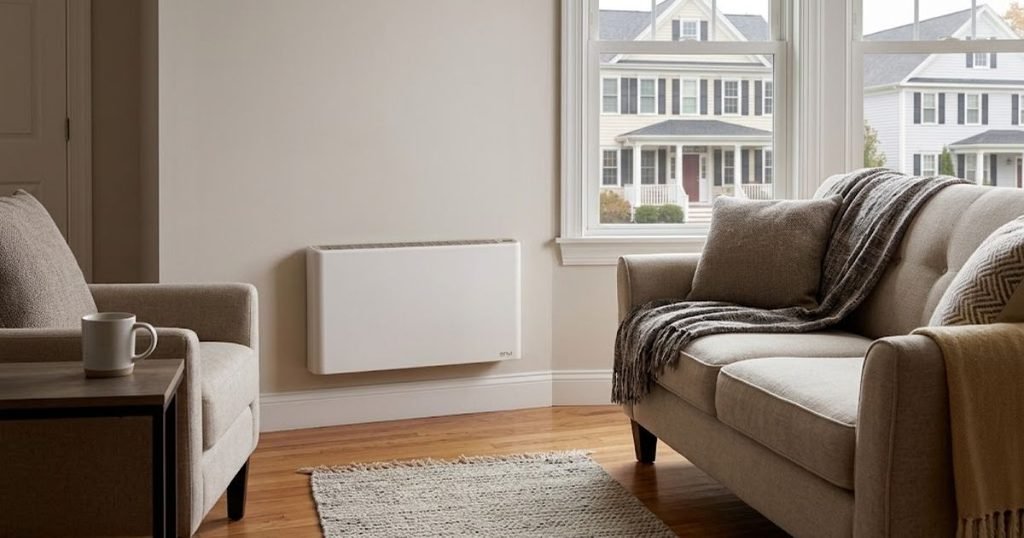
An Envi wall heater is a slim, wall-mounted electric panel heater designed to provide efficient zone heating for individual rooms. Standing about 22 inches tall, 19.3 inches wide, and just 2 inches deep, an Envi heater mounts flat against interior walls, looking more like an architectural trim piece or decorative panel than a standard space heater.
Unlike traditional fan-forced wall heaters or portable ceramic heaters that aggressively blow hot air using motorized fans, the Envi wall heater relies entirely on natural convection.
How Natural Convection Heating Works
Natural convection relies on basic thermodynamic principles:
- Cool air near the floor naturally enters through vents at the bottom of the heater chassis.
- Internal heating elements warm the air within enclosed heating channels.
- As air warms, it expands, becomes less dense, and naturally rises.
- Heated air gently flows out through upper vents into the room.
- As warm air fills the upper room space, cooler air is pushed downward toward the floor, creating a continuous, self-sustaining air circulation loop.
Because natural convection requires no motorized fan, an Envi heater operates silently. There are no clicking fan blades, no rattling motor housings, and no sudden blasts of dry air. Furthermore, fanless operation avoids stirring up dust, pet dander, and allergens, making an electric panel wall heater a cleaner option for bedrooms and nurseries.
Zone Heating vs. Whole-House Heating
An Envi wall heater is engineered primarily for supplemental room heating and zone heating rather than serving as the primary heat source for an entire home. Zone heating allows you to maintain comfortable temperatures in specific occupied spaces such as a bedroom at night or a home office during work hours while turning down the central heating system throughout the rest of the house.
A 500-watt heater delivers approximately 1,706 BTUs of heat per hour, while a 1,000-watt heater delivers approximately 3,412 BTUs per hour. No 500-watt heater can magically output the same physical heat volume as a 1,500-watt heater. However, by gently warming air right where you need it without wasting energy on unoccupied zones, a low-wattage Envi heater can help optimize your home’s total heating strategy.
READ MORE: Safe Portable Heaters: 6 Reviews & Essential Safety Tips
Envi Wall Heater Models Reviewed
eheat offers several distinct Envi models tailored to different room sizes, electrical setups, and smart-home preferences. Below is a detailed breakdown of the four primary models in the current Envi lineup.
1. Smart EnviMAX 1000W Wi-Fi Electric Wall Heater — SM1012P
The Smart EnviMAX SM1012P is the flagship high-output option in the Envi lineup. Designed for homeowners who need additional heating capacity without sacrificing a sleek wall-mounted footprint, the EnviMAX doubles the thermal output of standard 500-watt Envi models.
Specifications & Features
- Heating Output: 1,000 Watts (approx. 3,412 BTU/hr)
- Electrical Requirements: 120 Volt AC, plug-in design with 6-foot power cord
- Control System: Integrated digital thermostat with backlit display and mobile app control via Wi-Fi
- Smart Home Integration: Mobile smartphone app control (iOS/Android) with custom scheduling and remote temperature adjustments
- Dimensions: Approximately 19.3″ W x 22″ H x 2″ D
- Weight: Approximately 12 lbs
- Safety: Wall-Sens cut-off switch, internal thermal safety cutout, cool-to-touch front casing
Performance & Design Analysis
Operating at 1,000 watts, the SM1012P utilizes Envi’s dual-stack convection technology to draw cool air in and release warm air rapidly without an internal fan. Generating 3,412 BTUs per hour, it warms draftier rooms, larger master bedrooms, basement offices, or home additions far more effectively than 500-watt panels.
The built-in Wi-Fi connectivity allows you to control room temperatures directly from your smartphone. You can establish automated heating schedules such as lowering the temperature during work hours and warming the room prior to bedtime to reduce unnecessary energy use. The digital display on the unit provides precise temperature readings down to the degree.
Pros
- Higher 1,000W output effectively handles larger bedrooms, home additions, or cooler climate zones.
- Smart Wi-Fi connectivity allows remote management and custom scheduling.
- 100% silent fanless convection heating.
- Simple 120V plug-in installation into standard wall outlets.
- Wall-Sens safety feature automatically cuts power if the unit is accidentally detached from the wall.
Cons
- Higher power draw (1,000W / 8.33 Amps) requires awareness of other electrical loads on the same circuit.
- Higher purchase price compared to non-smart 500W models.
- Convection warming takes longer to raise room temperature than a fan-forced heater.
Best For
Homeowners seeking maximum thermal output for medium-to-large bedrooms, home offices, or cooler rooms, who also want mobile app scheduling and remote control.

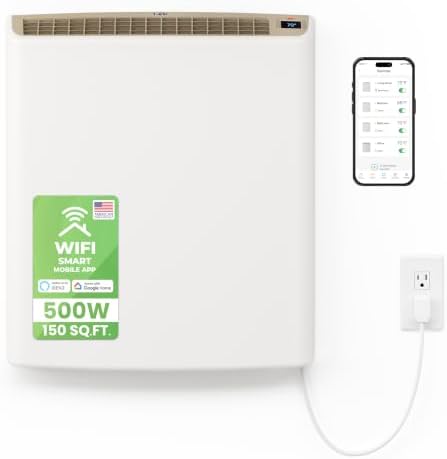
2. Smart Envi Wi-Fi Electric Wall Heater — SE5012P
The Smart Envi SE5012P combines the low energy footprint of Envi’s original 500-watt design with modern smart-home functionality.
Specifications & Features
- Heating Output: 500 Watts (approx. 1,706 BTU/hr)
- Electrical Requirements: 120 Volt AC, plug-in installation with 6-foot cord
- Control System: Built-in digital thermostat with Wi-Fi connectivity
- Smart Features: App-based control, night-dimming screen, weekly programmable timer
- Dimensions: Approximately 19.3″ W x 22″ H x 2″ D
- Weight: Approximately 10 lbs
- Safety: Wall-Sens cut-off technology, internal thermal fuse, cool front surface
Performance & Design Analysis
The SE5012P draws just 500 watts (4.17 Amps at 120V), which is one-third the power consumption of a standard 1,500-watt space heater. This low current draw allows it to run safely on virtually any standard 15-amp household circuit without tripping breakers, even when other electronics are plugged in.
The addition of Wi-Fi technology addresses a common issue with basic convection panel heaters: energy waste from leaving them on continuously. Through the mobile app, you can program nighttime setbacks or turn off the heater remotely if you forget before leaving home.
Pros
- Low 500W power draw minimizes electrical circuit load.
- Wi-Fi controls bring app scheduling and energy tracking to a compact panel heater.
- Completely silent operation for uninterrupted sleep or work.
- Cool-to-touch surface makes it safe around children and pets.
- Wall-mounted design eliminates cord clutter and floor hazards.
Cons
- 500W (1,706 BTU/hr) output is strictly meant for small spaces or well-insulated rooms.
- Requires a stable 2.4 GHz Wi-Fi network for smart control functionality.
- Not suited for fast heating of uninsulated spaces like cold garages.
Best For
Small-to-medium bedrooms, nurseries, or home offices in well-insulated homes where homeowners want precise digital control and automated app scheduling without high energy consumption.
3. Envi Plug-in Electric Panel Wall Heater — LE5012P
The Envi LE5012P is the foundational model that established eheat’s reputation. It offers a simple, reliable, non-smart 500-watt plug-in wall heater for homeowners who prefer straightforward mechanical controls over Wi-Fi apps.
Specifications & Features
- Heating Output: 500 Watts (approx. 1,706 BTU/hr)
- Electrical Requirements: 120 Volt AC, plug-in design with 6-foot cord (integrated cord storage cutout)
- Control System: Top-mounted manual dial thermostat
- Smart Features: None (100% mechanical/analog operation)
- Dimensions: Approximately 19.3″ W x 22″ H x 2″ D
- Weight: Approximately 10 lbs
- Safety Features: Wall-Sens automatic safety cut-off, thermal overload cut-off, cool front panel
Performance & Design Analysis
For homeowners who prefer simplicity, the LE5012P delivers dependable performance. Mount the bracket, hang the panel, plug the cord into a 120V wall outlet, and adjust the mechanical dial to your preferred comfort level.
Without digital screens or Wi-Fi chips, the LE5012P operates reliably without needing app updates or network pairing. The internal bimetallic thermostat cycles the element on and off to maintain room temperatures. If the heater is lifted or knocked off its wall mounting bracket, the Wall-Sens safety switch instantly disconnects power.
Pros
- Exceptionally easy installation requiring no electrical wiring.
- Simple dial operation ideal for guest rooms, rental properties, or non-tech-savvy users.
- Low power draw (4.17 Amps) resists circuit overloads.
- Silent, fanless convection heating.
- Lower purchase price than smart models.
Cons
- Lacks digital temperature readouts, remote app control, and programmable scheduling.
- 500W output is limited to small-to-medium well-insulated spaces.
- Power cord remains visible unless routed behind furniture or covered with wire raceways.
Best For
Budget-conscious homeowners, renters, guest rooms, and anyone seeking a straightforward plug-in electric panel wall heater without app setup or network requirements.

4. Envi 220 Volt Hardwired Electric Panel Wall Heater — LE5022D
The Envi LE5022D is engineered specifically for permanent installations where a visible power cord is undesirable, or where higher-voltage 220V/240V circuit wiring is already present.
Specifications & Features
- Heating Output: 500 Watts (approx. 1,706 BTU/hr)
- Electrical Requirements: 220V/240V AC hardwired electrical connection (requires dedicated wiring)
- Control System: Integrated top-mounted thermostat dial
- Power Cord: None (direct junction box / wire lead connection behind panel)
- Dimensions: Approximately 19.3″ W x 22″ H x 2″ D
- Weight: Approximately 10 lbs
- Safety: Wall-Sens cutoff switch, internal thermal limit protection, cool-to-touch surface
Performance & Design Analysis
The LE5022D provides the same 500-watt natural convection heat output as the LE5012P, but connects directly to 220V/240V building wiring. By concealing electrical connections behind the heater panel, it eliminates exposed power cords for a clean, built-in appearance.
This model is ideal for room renovations, new construction, or replacing legacy 240V baseboard heaters. Because it operates on 220V/240V power, current draw is extremely low (approx. 2.1 Amps), placing minimal demand on electrical conductors.
Pros
- Clean, cordless presentation ideal for modern interiors and upscale renovations.
- Connects directly to existing 220V/240V heating circuits.
- Extremely low current draw (approx. 2.1A at 240V).
- Silent, maintenance-free natural convection.
- Wall-Sens safety technology cuts power if removed from the wall bracket.
Cons
- Requires professional electrical installation or advanced wiring knowledge to ensure code compliance.
- Cannot be plugged into a standard 120V wall outlet.
- Lacks smart Wi-Fi scheduling features out of the box.
Best For
Renovations, custom homes, bathroom additions, and replacing older 240V baseboard heaters where a seamless, cordless wall installation is desired.

READ MORE: Best 6 Infrared Heater Indoor: Reviews, Cost & Compared
Envi Wall Heater Comparison Table
| Feature | SM1012P | SE5012P | LE5012P | LE5022D |
| Product Type | Smart EnviMAX | Smart Envi | Plug-In Envi | Hardwired Envi |
| Wattage | 1,000 W | 500 W | 500 W | 500 W |
| Voltage | 120 V AC | 120 V AC | 120 V AC | 220 V / 240 V AC |
| Installation | Plug-In (120V) | Plug-In (120V) | Plug-In (120V) | Hardwired (220V) |
| Smart / Wi-Fi | Yes | Yes | No | No |
| Thermostat | Digital | Digital | Manual Dial | Manual Dial |
| App Control | Yes | Yes | No | No |
| Power Cord | 6 ft Cord | 6 ft Cord | 6 ft Cord | None (Hardwired) |
| Hardwired | No | No | No | Yes |
| Dimensions | 19.3″ x 22″ x 2″ | 19.3″ x 22″ x 2″ | 19.3″ x 22″ x 2″ | 19.3″ x 22″ x 2″ |
| Heating Tech | Natural Convection | Natural Convection | Natural Convection | Natural Convection |
| Best Use | Larger/Cooler Rooms | Smart Small Rooms | Budget Small Rooms | Cordless Renovations |
| Main Advantage | Maximum Output (1kW) | Low Wattage + App | Simple Plug & Play | Clean Cordless Look |
| Main Limitation | Higher Power Draw | 500W Heat Limit | Manual Control Only | Requires Electrician |
| Best For | Master Bedrooms/Offices | Tech-Savvy Bedrooms | Guest Rooms/Rentals | Remodels/Baseboard Swap |
Envi 500W vs 1000W — Which One Should You Choose?
A common question among homeowners is whether to buy a 500-watt or 1,000-watt Envi wall heater. Understanding electrical wattage helps ensure you select the right model for your room.
Wattage measures electrical power consumption over time. In resistive heating:
HeatOutput(BTUs/hr)=Watts3.412
- 500 Watts = approx.1,706BTU/hr
- 1,000 Watts = approx.3,412BTU/hr
Selecting the Right Wattage
A 500-watt Envi panel heater (SE5012P, LE5012P, LE5022D) is best suited for supplemental heat in small, well-insulated spaces up to 130–150 square feet, such as small bedrooms, home offices, nurseries, or bathrooms.
A 1,000-watt heater (SM1012P) delivers twice the thermal energy, making it better equipped for rooms up to 200–250 square feet, spaces with exterior walls, rooms over unheated basements, or colder climate zones.
Environmental Heating Factors
Square footage alone does not determine heating requirements. Consider these key factors:
- Insulation Quality: Modern insulated walls retain convection heat effectively. Uninsulated plaster, concrete basements, or older single-pane windows allow heat to escape rapidly.
- Ceiling Height: Warm air naturally rises. Standard 8-foot ceilings hold heat well, while vaulted 10-to-12-foot ceilings require more thermal energy to keep living zones warm.
- Climate Zone: A 500W heater may provide effective supplemental warmth in Florida or Texas, but struggle in Minnesota or Maine during sub-zero cold snaps.
Electricity Consumption Formula
Calculate power usage with this formula:
ElectricityUsed(kWh)=HeaterWatts1,000HoursUsed
Example: Running a 500W heater for 8 hours:
kWh=5001,0008=0.58=4.0kWh
Running a 1,000W heater for 8 hours:
kWh=1,0001,0008=1.08=8.0kWh
READ MORE: EdenPURE Heaters Review — Prices & Comparison
Smart Envi vs Regular Envi Heater
Choosing between a Smart Envi heater (SM1012P, SE5012P) and a regular manual Envi heater (LE5012P, LE5022D) comes down to control preferences and lifestyle needs.
Advantages of Smart Envi Models
- Automated Scheduling: Set custom temperature schedules so the heater runs only when needed, lowering energy use during sleep or work hours.
- Remote Temperature Adjustments: Change settings from anywhere using your smartphone without getting out of bed or returning home.
- Digital Accuracy: Set exact degree targets rather than guessing on an analog dial scale.
Advantages of Regular Manual Models
- Maximum Simplicity: Turn the top-mounted dial to your preferred comfort level without needing Wi-Fi setups, passwords, or smartphone apps.
- Long-Term Reliability: Fewer electronic components reduce potential points of failure from network outages or software glitches.
- Cost Efficiency: Lower upfront cost for homeowners who do not need remote control functionality.
Plug-In vs Hardwired Envi Wall Heater
Determining whether to choose a plug-in or hardwired Envi heater depends on your installation preferences and electrical setup.
Plug-In Models (SM1012P, SE5012P, LE5012P)
- Easy DIY Installation: Plugs directly into standard 120V household outlets.
- Renter-Friendly: Can be removed easily and taken along when moving homes.
- Flexible Placement: Simple to relocate if room configurations change.
- Visible Cord: The 6-foot power cord hangs down toward the outlet unless concealed with wall raceways or furniture.
Hardwired Models (LE5022D)
- Seamless Aesthetics: Power wiring connects directly inside the wall behind the panel, providing a clean, cord-free appearance.
- Permanent Fixture: Integrates cleanly into formal living areas, bathrooms, and high-end home renovations.
- Requires Electrical Installation: Must be wired directly into a dedicated 220V/240V circuit by a qualified electrician in compliance with local building codes.
How Does an Envi Wall Heater Work?
Understanding the physical process inside an Envi wall heater clarifies why it operates so quietly and safely.
- Air Intake: Cool air near the floor naturally enters the bottom vent openings of the heater casing.
- Dual-Stack Convective Acceleration: The air passes through internal heating channels equipped with low-wattage resistance elements. eheat’s dual-stack design speeds up airflow through internal stack effects without mechanical assistance.
- Thermal Discharge: Heated air rises naturally out of the top vent at comfortable, non-scalding temperatures.
- Convection Circulation: As warm air fills the upper space and spreads outward, cooler room air is pushed back down toward the floor, maintaining a steady heat circulation loop.
By eliminating internal fans, the Envi heater provides completely silent heat while preventing dust particles and dry air from circulating through your home.
READ MORE: Top 6 Electric Tower Heaters for Home
Is an Envi Wall Heater Energy Efficient?
Electric panel wall heaters are often praised for energy efficiency, but it is important to understand what that actually means.
All electric resistance heaters operate at nearly 100% thermal efficiency converting 1 watt of electricity into 3.412 BTUs of heat energy. An Envi heater does not possess magic technology that produces more heat per watt than other electric heaters. Instead, its energy savings stem from zone heating strategy and low overall power consumption.
By using a low-wattage 500W or 1,000W Envi heater to warm an occupied bedroom or office, you can set your central HVAC thermostat several degrees lower throughout the rest of the house. Running a 500W wall heater requires far less power than running a 3,000W to 10,000W central heat pump or furnace to keep a single room warm.
How Much Does It Cost to Run an Envi Wall Heater?
Calculating the exact operating cost of an Envi wall heater depends on your local utility rates, room insulation, and thermostat duty cycles.
Operating Cost Formula
DailyCost=HeaterkWHoursRunperDayElectricityRateperkWh
Assuming an average U.S. residential electricity rate of $0.18 per kWh:
500-Watt Models (0.5 kW)
- 1 Hour of Continuous Operation: $0.5 \text{ kW} \times 1 \text{ hr} \times \$0.18 = \mathbf{\$0.09 \text{ per hour}}$
- 8 Hours of Continuous Operation: $0.5 \text{ kW} \times 8 \text{ hrs} \times \$0.18 = \mathbf{\$0.72 \text{ per day}}$
1,000-Watt Model (1.0 kW)
- 1 Hour of Continuous Operation: $1.0 \text{ kW} \times 1 \text{ hr} \times \$0.18 = \mathbf{\$0.18 \text{ per hour}}$
- 8 Hours of Continuous Operation: $1.0 \text{ kW} \times 8 \text{ hrs} \times \$0.18 = \mathbf{\$1.44 \text{ per day}}$
Thermostat Duty Cycling
Heaters rarely run continuously at 100% capacity. Once the room reaches the set temperature, the thermostat cycles the heating element on and off. In a well-insulated room, a heater may run only 50% to 60% of each hour, reducing these estimated running costs even further.
Is the Envi Wall Heater Safe?
Safety is a standout feature of the Envi wall heater, addressing primary concerns associated with traditional space heaters.
Integrated Safety Systems
- Wall-Sens Safety Technology: A patented internal cut-off switch detects if the panel is detached or knocked off its wall bracket, cutting power instantly to eliminate fire risks.
- Cool-to-Touch Front Casing: The front panel stays at a low surface temperature (typically 90°F to 105°F), preventing accidental contact burns for children and pets.
- Elevated Wall Mount: Mounting the heater off the floor keeps electrical components away from liquid spills, pets, and clutter.
- Thermal Overload Cutout: Internal thermal limit switches automatically disconnect power if air vents become blocked and internal temperatures rise excessively.
Safety Precaution: Always maintain a clear space of at least 6 to 12 inches around the bottom intake and top discharge vents. Never place curtains, furniture, or laundry directly against the heater.
Where Should You Install an Envi Wall Heater?
Installing your Envi heater in the right spot ensures optimal convective airflow and room comfort.
Ideal Installation Spaces
- Bedrooms & Nurseries: Completely silent operation ensures undisturbed sleep without dust or fan noise.
- Home Offices: Maintains comfortable working temperatures during winter days without heating the whole home.
- Bathrooms: Provides cozy warmth after showers (ensure hardwired models or GFCI outlet compliance per local code).
- Basements & Bonus Rooms: Helps eliminate cold spots in basement conversions or rooms built over unheated garages.
Envi Wall Heater Installation
Installing a plug-in Envi wall heater is a simple, beginner-friendly project that typically takes less than 20 minutes.
Standard Plug-In Installation Steps
- Choose the Location: Find an interior wall location near a standard 120V outlet, at least 6 to 8 inches above the floor, with clear space above and below.
- Install Mounting Bracket: Use the included paper mounting template and a level to mark screw locations on drywall. Fasten the steel mounting bracket using drywall anchors or stud screws.
- Hang the Panel: Slide the Envi panel down onto the wall mounting bracket tabs until it locks securely in place, activating the internal Wall-Sens safety switch.
- Plug In: Route the power cord to the nearest 120V outlet and set your target temperature.
Note for 220V Hardwired Models (LE5022D): Hardwired installations involve connecting electrical leads inside an electrical box. This installation should be performed by a licensed electrician in compliance with local electrical codes.
Pros and Cons of Envi Wall Heaters
Pros
- 100% Silent Operation: Fanless natural convection generates no operational noise.
- Zero Floor Space Needed: Mounts flat against walls, keeping floor spaces clear and safe.
- Cool-to-Touch Safety: Outer casing prevents accidental contact burns.
- Advanced Safety Switches: Wall-Sens technology cuts power immediately if the unit is removed from the wall.
- Low Wattage Draw: 500W models place minimal load on household electrical circuits.
- Smart App Capabilities: Smart Envi models provide remote control and automated weekly scheduling.
- Easy DIY Setup: Plug-in models install quickly with basic household tools.
Cons
- Slower Warm-Up Times: Natural convection heats spaces gradually compared to aggressive forced-air fan heaters.
- Supplemental Heating Limits: 500W models cannot heat large or poorly insulated spaces on their own.
- Higher Upfront Purchase Price: Costs more initially than basic portable plastic space heaters.
- Hardwiring Required for Cordless Look: Cordless installations require buying the 220V hardwired version and hiring an electrician.
Which Envi Wall Heater Is Best?
Select the Envi wall heater model that matches your room requirements:
- Best for Maximum Heat Output: Smart EnviMAX 1000W (SM1012P)
Why: Delivers double the heating capacity (3,412 BTU/hr) alongside modern Wi-Fi controls, making it the top pick for larger bedrooms, cooler home additions, or chilly basements. - Best Smart 500W Option: Smart Envi 500W (SE5012P)
Why: Offers the perfect blend of low power usage (500W) and Wi-Fi mobile app scheduling for small-to-medium bedrooms or nurseries. - Best Budget / Simple Plug-In: Envi Plug-In 500W (LE5012P)
Why: Delivers dependable, fanless heating with a simple mechanical dial control at a budget-friendly price point. - Best for Permanent Renovations: Envi 220V Hardwired (LE5022D)
Why: Connects directly to existing 220V/240V wiring to eliminate visible power cords for a clean, professional finish.
Frequently Asked Questions
Is an Envi wall heater worth it?
Yes, an Envi wall heater is worth the investment for homeowners seeking silent, safe, and space-saving supplemental heat. While it costs more upfront than a basic space heater, its low energy consumption, cool-touch safety, and wall-mounted convenience make it a great long-term value for bedrooms, home offices, and nurseries.
How much electricity does an Envi wall heater use?
A 500-watt Envi wall heater consumes 0.5 kilowatt-hours (kWh) of electricity per hour of continuous operation, while a 1,000-watt EnviMAX consumes 1.0 kWh per hour. At an average U.S. electric rate of $0.18 per kWh, a 500W model costs approximately $0.09 per hour to run, while a 1000W model costs roughly $0.18 per hour before accounting for thermostat cycling.
Does an Envi heater heat a whole room?
Yes, an Envi heater can effectively heat an entire room, provided the heater capacity matches the room size and insulation level. A 500-watt model is designed for small-to-medium well-insulated spaces up to 130–150 square feet. For larger bedrooms up to 200–250 square feet or cooler spaces, the 1,000-watt Smart EnviMAX (SM1012P) is recommended.
Is Envi better than a traditional electric space heater?
Envi wall heaters offer several key advantages over traditional portable space heaters: they operate completely silently, mount safely on the wall out of foot traffic, stay cool to the touch, and consume significantly less electricity than typical 1,500-watt space heaters. However, traditional fan space heaters can heat a room faster by actively blowing warm air.
Can you leave an Envi wall heater on all night?
Yes, an Envi wall heater is designed for continuous, overnight operation. Thanks to its cool-to-touch surface, Wall-Sens automatic cut-off switch, built-in thermal protection, and fanless design, it is one of the safest room heating options available for bedrooms and nurseries overnight.
Final Verdict
The Envi wall heater lineup offers a smart, energy-efficient solution for cold rooms and drafty spaces. By utilizing fanless natural convection, eheat has created a room heater that operates silently, stays cool to the touch, and frees up valuable floor space.
When selecting an Envi model for your home:
- Choose the Smart EnviMAX 1000W (SM1012P) if you need maximum heating capacity for larger or cooler rooms along with smartphone app scheduling.
- Choose the Smart Envi 500W (SE5012P) for small-to-medium bedrooms where you want modern app controls paired with low energy draw.
- Choose the Envi Plug-In 500W (LE5012P) if you prefer simple, set-and-forget manual dial controls at an affordable price point.
- Choose the Envi 220V Hardwired (LE5022D) for formal living areas, bathroom remodels, or baseboard replacements where you want a clean, cord-free look.
By pairing the right model with good room insulation, an Envi wall heater provides targeted, quiet warmth right where you need it most.
Sources & Manufacturer Information
- eheat Official Product Documentation & Specifications (Envi Electric Wall Heater Lineup Overview & Spec Sheets)
- eheat Owner Manuals & Installation Guides (LE5012P, LE5022D, SE5012P, and SM1012P User Guides)
- U.S. Department of Energy (DOE) — Energy Saver Guide: Electric Resistance Heating & Zone Heating Principles
- National Electrical Code (NEC) — Article 424: Fixed Electric Space-Heating Equipment Guidelines