To boost warmth without cranking up the main furnace for the whole house, many U.S. homeowners turn to an infrared heater indoor solution. These specialized devices offer localized, comfortable warmth right where you sit. Unlike traditional forced-air furnaces that blow warm air into a room, an indoor infrared heater uses radiant heat to warm people, furniture, and floors directly.
Before buying, it helps to understand what these heaters can and cannot do. A portable or wall-mounted indoor infrared heater is an excellent tool for supplemental zone heating, warming the room you are currently occupying so you can dial back your main central thermostat. However, they are not magical money-savers, nor do they eliminate electricity costs.
In this guide, we break down how infrared heating works, address essential safety guidelines, explain operating costs, and review six top models to help you choose the ideal option for your home, budget, and heating needs. Lets deep dive into “Best 6 Infrared Heater Indoor: Reviews, Cost & Compared”
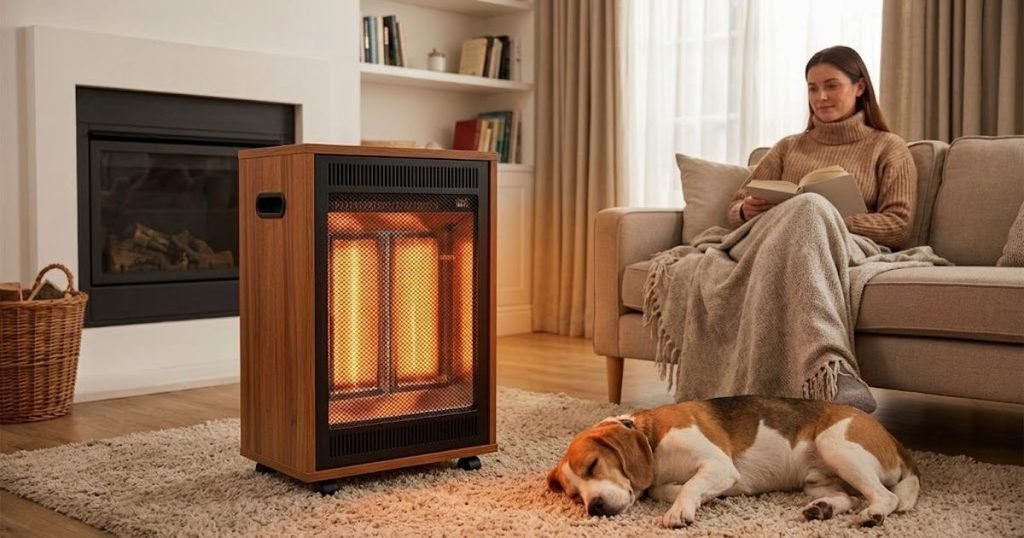
What Is an Indoor Infrared Heater?
Infrared heating is a form of radiant heat. It emits invisible light waves within the infrared spectrum that travel through the air until they strike an object, surface, or person. When those rays hit a target such as your armchair, the hardwood floor, or your clothing the energy is absorbed and converted into physical heat.
This direct absorption is why an infrared heater indoor setup feels warm almost instantly. With a conventional forced-air furnace or basic convection heater, cold air must be drawn in, heated over an element, and blown back into the room. You have to wait for all the air in the space to warm up, during which time hot air naturally rises toward the ceiling, leaving the floor level colder. Infrared heat skips the air-warming step and directly targets the objects in its line of sight.
By using an infrared heater for supplemental heating, you can employ a strategy called “zone heating.” Instead of setting your central furnace to 72°F for the entire house, you can set the central thermostat lower (for example, 64°F) and use a portable or wall-mounted infrared heater to keep your active living area comfortably warm.
READ MORE: Top 6 Electric Tower Heaters for Home
How Does an Infrared Heater Work?
The operation of an indoor electric infrared heater follows a straightforward, multi-stage physical process:
- Electrical Conversion: The unit is plugged into an appropriate power supply. Electric current flows into the internal heating element (quartz tube, carbon filament, or mica panel).
- Radiant Emission: As the element heats up, it emits electromagnetic energy in the infrared wavelength spectrum.
- Direct Absorption: The invisible infrared rays travel outward from the heater in a direct line of sight. When they strike dense objects, human skin, fabric sofas, rug fibers, or wooden desks, those objects absorb the energy and warm up.
- Secondary Warming: Once your furniture, floor, and walls absorb the radiant heat, they slowly re-radiate that warmth back into the surrounding environment. Over time, these warmed surfaces help stabilize the ambient room temperature.
- Supplemental Air Circulation: Many 1,500W indoor infrared heaters include a small internal fan. While the radiant waves warm solid objects, the fan gently pushes air across the hot internal components to circulate mild ambient warmth throughout the room.
To see the practical difference between heating methods, consider this comparison:
| Feature | Radiant (Infrared) Heating | Forced-Air / Convection Heating |
| Primary Target | Solid objects, floors, and people directly | Air molecules throughout the room |
| Warmth Perception | Almost instantaneous direct warmth | Delayed; must wait for room air to warm up |
| Draft Sensitivity | Less affected by minor cold drafts | High loss when warm air escapes through drafts |
| Air Movement | Minimal to none; doesn’t stir up dust | High air movement; can kick up dust/allergens |
| Temperature Profile | Uniform near objects; cooler near cold walls | Hot air rises to ceiling; floor stays cool |
READ MORE: Best Heater for Large Room: Top Picks, Reviews & Comparison
What to Look for When Buying an Indoor Infrared Heater
To choose the right model for your home, consider these essential buying factors:
1. Wattage and Electrical Compatibility
- 1,000 Watts (3,412 BTUs): Ideal for small bedrooms, compact home offices, or supplemental heat near a desk. Draws ~8.3 amps on a standard 120V household line.
- 1,500 Watts (5,118 BTUs): The industry standard for medium-to-large room supplemental heating. Draws ~12.5 amps on a standard 120V line. Must be used on a circuit without other high-draw appliances running simultaneously.
- 3,000 Watts (10,236 BTUs): Heavy-duty, high-output units. Requires a dedicated 240V electrical supply line (similar to an electric clothes dryer or stove circuit) and professional installation. Best for large basements, converted garages, or drafty sunrooms.
2. Heating Technology Types
- Quartz Tubes: High-intensity radiant rays; fast warmth; slight orange glow.
- Carbon Elements: Soft, deep-penetrating infrared rays; longer operational lifespan; low glare.
- Quartz + PTC Ceramic Hybrids: Combines radiant rays with fan-forced air delivery to balance direct comfort with room air circulation.
- Mica Radiant Panels: Broad surface heating; 100% silent operation; lightweight profile.
3. Controls and Smart Features
Look for an infrared heater with thermostat functions either digital or precise mechanical to maintain your desired room temperature. Remote controls, programmable 12-hour or 24-hour timers, multi-stage power modes (e.g., 750W Low / 1,500W High), ECO modes that automatically adjust wattage based on room temp, and Wi-Fi app integrations make day-to-day operation more convenient.
4. Noise Output
If you plan to use an infrared heater for bedroom use or in a home office during phone calls, pay attention to the decibel rating. Pure radiant panel heaters (like mica units) have no moving parts and produce zero decibels (0 dB). Fan-assisted units produce a soft white noise hum, typically between 35 dB and 48 dB.
6 Best Infrared Heaters for Indoor Use
To help you find the right model, we reviewed six popular indoor infrared heaters. These models represent distinct form factors, power capacities, control options, and price points.
1. DR. INFRARED HEATER DR-239 3000W
The DR-239 stands in a category of its own compared to standard portable space heaters. Operating at 3,000 watts on a 240-volt electrical supply, this unit delivers serious heat output (approximately 10,236 BTUs) designed to cover large, hard-to-heat indoor areas, drafty basements, or enclosed patio/workshop spaces.
Key Specs & Performance
- Power: 3,000W maximum (240V line required)
- Heat Output: ~10,236 BTUs
- Heating Element: Advanced carbon infrared element
- Mounting: Wall-mount or ceiling-mount installation brackets included
- Weather Rating: IP55 dust and water-resistance (indoor/outdoor rated)
- Controls: Included hand-held remote control; multi-stage power settings
Practical Evaluation
The DR-239 uses clean carbon infrared technology to produce deep, immediate radiant warmth over a substantial footprint. Because it emits heat outward from an elevated wall or ceiling mount, it does not occupy valuable floor space. Its IP55 weather resistance means it easily handles humidity in basements, sunrooms, or covered workshops.
However, homeowners must realize that this heater cannot be plugged into a standard 120V household wall outlet. It requires dedicated 240V wiring and appropriate circuit breaker capacity, making professional electrical installation necessary for most homes.
- Pros: Exceptional radiant heat output; heavy-duty build; IP55 moisture protection; space-saving overhead mounting.
- Cons: Requires dedicated 240V wiring; no internal fan for convective air distribution; higher installation costs.
Verdict: Best high-output commercial-grade indoor/outdoor option where a dedicated 240V circuit and wall mounting are available.

2. Dr Infrared Heater DR-968 Portable Space Heater, 1500-Watt
The Dr Infrared Heater DR-968 is one of the most recognizable and widely used cabinet-style portable space heaters on the market. Designed as a reliable infrared heater for living room and large bedroom supplemental heating, it pairs quartz infrared tubes with a PTC ceramic heating element in an insulated wooden cabinet.
Key Specs & Performance
- Power: 1,500W High / 1,000W Low / ECO Mode (120V)
- Heat Output: ~5,200 BTUs
- Heating System: Infrared Quartz Tube + PTC Ceramic element with high-surface aluminum heat exchanger
- Controls: Electronic thermostat (50°F to 86°F), digital display, remote control, 12-hour timer
- Safety Features: Tip-over cutoff, internal overheat protection, UL safety certified
- Noise Level: ~39 dB quiet low-noise blower
Practical Evaluation
The DR-968’s strength lies in its hybrid heating design. While the quartz tubes deliver radiant warmth to nearby objects, the PTC ceramic element and low-noise internal blower gently push warm air across the heat exchanger into the room. This dual action heats both you and the room’s ambient air faster than a pure radiant heater alone.
Its wood-grain style furniture cabinet remains cool to the touch during operation, making it a safe choice around pets and young children. Built-in caster wheels make it easy to roll across carpet and hardwood floor between rooms.
- Pros: Proven dual-heating technology; quiet blower fan; cool-touch exterior; sturdy caster wheels for easy mobility.
- Cons: Bulky traditional cabinet design takes up floor space; heavier than slim panel heaters.
Verdict: Best overall portable indoor infrared heater for medium-to-large living rooms and family spaces needing reliable supplemental heat.

3. Ballu Mica Infrared Space Heater Indoor Use — NCA2-4.4-WHITE
For homeowners seeking modern styling, whisper-quiet operation, and flexible installation, the Ballu NCA2-4.4-WHITE is a top contender. Utilizing mica panel technology, this unit emits gentle radiant waves combined with natural air convection completely eliminating the need for a fan.
Key Specs & Performance
- Power: 1,500W max with multi-power settings (120V)
- Heating Element: Micathermic / Mica mineral heating plate
- Mounting Flexibility: Includes removable floor feet with casters AND wall-mounting bracket kit
- Controls: Digital control panel, programmable thermostat, Wi-Fi smartphone app integration
- Safety Features: Tip-over sensor, overheat protection, child safety lock
Practical Evaluation
The Ballu Mica heater stands out for its 100% silent operation (0 dB). Because it contains no internal fan motors, it warms the room without any air noise or dry blowing air, making it an excellent infrared heater for bedroom environments where quiet sleep is essential.
The micathermic element radiates heat from both sides of its flat panel housing, warming solid objects in the room while gently drawing cool air up through the bottom to create natural convection currents. With built-in Wi-Fi controls, you can adjust temperatures or set schedules directly from your smartphone.
- Pros: Completely silent (no fan noise); slim, sleek aesthetic; Wi-Fi app compatibility; dual wall-mount or floor stand capability.
- Cons: Panel body gets warm during operation (requires clearance); wide footprint when used on floor feet.
Editorial Verdict: Best silent smart heater for bedrooms and quiet home offices.

4. Heat Storm Phoenix Infrared Space Heater — HS-1500-PHX
The Heat Storm Phoenix (HS-1500-PHX) is a versatile, space-saving infrared heater for home use that can be wall-mounted or used on freestanding feet (feet sold separately or included in bundles). It features Heat Storm’s patented HMS quartz infrared element technology in a compact form factor.
Key Specs & Performance
- Power: 1,500W High (5,200 BTUs) / 750W Low (120V)
- Heating Element: Quartz infrared tubes with patented thermal exchanger
- Mounting: Wall-mount ready (attaches over standard wall outlets); optional floor feet
- Controls: Digital LED display, remote control, Smart Wi-Fi enabled app options
- Safety Features: Overheat protection, internal tip switch, cool-touch exterior grill
Practical Evaluation
The Phoenix is engineered to solve a common space heater problem: taking up valuable floor space in small rooms. When wall-mounted directly over a standard household wall outlet, the unit hangs cleanly against the wall, keeping power cords hidden and tucked away.
Its internal air duct system keeps the exterior casing and front grill cool to the touch, minimizing burn risks for children or pets. At 1,500 watts, it delivers plenty of supplemental heat for bedrooms, home offices, or living areas, while its dual power setting (750W/1,500W) lets you conserve electricity on milder days.
- Pros: Excellent wall-mounting design saves floor space; cool-touch housing; smart Wi-Fi controls available; built-in cord storage.
- Cons: Floor feet are sometimes sold separately depending on the retail bundle; internal fan creates a light hum.
Editorial Verdict: Best space-saving wall-mounted 1,500W heater for bedrooms, hallways, and small-to-medium rooms.

5. Heat Storm Wall Gray HS-1000-WX Deluxe Indoor Infrared
If you need a dedicated infrared heater for small room applications such as a compact nursery, small home office, guest bathroom (outside splash zones), or walk-in space the Heat Storm HS-1000-WX offers a tailored 1,000-watt solution.
Key Specs & Performance
- Power: 1,000 Watts maximum (~3,412 BTUs) / 120V
- Heating Element: Quartz infrared heating tubes
- Mounting: Permanent wall-mount design
- Controls: Digital thermostat, LED display, remote control
- Safety Features: Overheat auto-shutoff, cool-touch wall casing, ETL safety listed
Practical Evaluation
Operating at 1,000 watts, the HS-1000-WX draws only about 8.3 amps of electricity substantially less than standard 1,500W space heaters. This lower power draw reduces the risk of tripping circuit breakers in older homes or on circuits shared with lighting and office electronics.
Its sleek gray housing mounts directly to wall studs or drywall anchors, lifting the unit off the floor entirely. While 1,000 watts is not intended for large, open-concept living rooms, it provides efficient supplemental heating for smaller enclosed spaces up to 150–200 square feet.
- Pros: Lower energy consumption (1,000W); ideal for small spaces; space-saving wall installation; cool-touch exterior.
- Cons: Not powerful enough for large or uninsulated rooms; fixed wall location only.
Verdict: Best low-wattage, wall-mounted choice for small rooms, home offices, and drafty nooks.

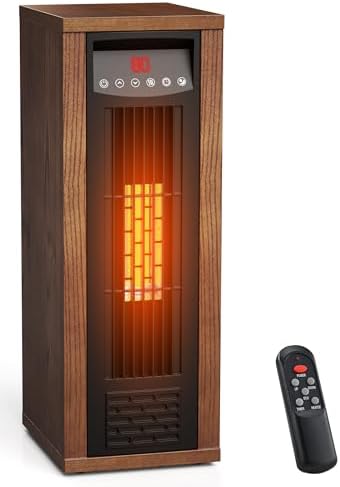
6. Air Choice Infrared Space Heater, 1500W
The Air Choice 1500W Indoor Infrared Heater (such as model IPH03 / standard tower unit) is a versatile budget-conscious option offering high heat output, digital controls, and safety protections in a portable tower profile.
Key Specs & Performance
- Power: 1,500W High / 750W Low / ECO Mode (120V)
- Heating Element: Fast-heating quartz infrared tubes
- Controls: Top panel digital controls, wireless remote, 12-hour timer, ECO temperature management
- Safety Features: 360-degree tip-over shutoff switch, overheat protection, child safety lock
- Portability: Lightweight frame with integrated carry handle (or convertible wall mount depending on package)
Practical Evaluation
The Air Choice 1500W heater delivers essential convenience features typically found on premium models at a budget-friendly price point. Its quartz heating elements deliver fast radiant warmth within seconds of startup.
The built-in ECO mode automatically adjusts heating output between high (1,500W) and low (750W) based on current ambient room temperature versus your setpoint, helping prevent unnecessary power usage. Added features like a 12-hour shutoff timer and child lock make it a functional choice for everyday household use.
- Pros: Affordable price point; fast quartz heating; user-friendly remote and timer controls; energy-saving ECO mode.
- Cons: Plastic casing feels less premium than wooden or metal cabinets; fan noise is noticeable on high mode.
Editorial Verdict: Best value-focused 1,500W infrared heater for budget-conscious homeowners wanting full control features.
READ MORE: Best Convector Heater Review: Best Models & Comparison
Infrared Heater Indoor Comparison Table
Compare specifications, mounting options, control systems, and ideal applications across all six reviewed models:
| Product Model | Max Power (Watts / Voltage) | Heating Technology | Mounting Form Factor | Primary Controls | Safety Features | Best Recommended For |
| DR. INFRARED DR-239 | 3,000W / 240V | Carbon Infrared | Wall or Ceiling Mount | Remote Control, 2 Power Levels | Overheat Cutoff, IP55 Weatherproof | High-output basements, sunrooms, 240V spaces |
| Dr Infrared DR-968 | 1,500W / 120V | Quartz Tube + PTC Hybrid | Portable Furniture Cabinet on Casters | Digital Thermostat, Remote, 12-Hr Timer | Tip-Over Switch, Overheat, Cool Cabinet | Large living rooms, family rooms, floor mobility |
| Ballu NCA2-4.4 | 1,500W / 120V | Micathermic Panel | Wall Mount or Floor Stand Feet | Digital Touch Control, Smart Wi-Fi App | Tip-Over, Overheat, Child Lock, 0 dB Silent | Bedrooms, quiet offices, modern decor |
| Heat Storm HS-1500-PHX | 1,500W / 120V | HMS Quartz Infrared | Wall-Mount (Optional Floor Feet) | Digital Display, Remote, Wi-Fi App | Overheat Cutoff, Tip Switch, Cool-Touch Grille | Medium bedrooms, saving floor space |
| Heat Storm HS-1000-WX | 1,000W / 120V | Quartz Infrared | Wall-Mount Exclusive | Digital Thermostat, Remote Control | Overheat Cutoff, Cool Casing, ETL Listed | Small rooms, nurseries, low-amp circuits |
| Air Choice 1500W | 1,500W / 120V | Fast Quartz Infrared | Portable Tower (Select Wall Mount) | Remote Control, 12-Hr Timer, ECO Mode | 360° Tip-Over, Overheat, Child Lock | Budget-conscious supplemental room heating |
Which Infrared Heater Is Best for Your Room?
Selecting the right heater requires matching the heater’s physical design and output to the specific room you plan to warm.
Best Infrared Heater for a Bedroom
For bedrooms, noise levels and night-time operation are primary concerns.
- Top Pick: Ballu Mica Panel (NCA2-4.4) or Heat Storm Phoenix (HS-1500-PHX).
- Why: The Ballu operates in 100% complete silence (0 dB) because it has no fan motor to disturb your sleep. If floor space is tight, the Heat Storm Phoenix mounts cleanly onto the wall over an outlet, keeping walkways clear. Always set a shutoff timer or ensure the thermostat is properly calibrated before sleeping.
Best Infrared Heater for a Living Room
Living rooms are typically larger, open-concept spaces with high foot traffic and seating arrangements positioned several feet apart.
- Top Pick: Dr Infrared Heater DR-968.
- Why: Living rooms benefit from a hybrid heating approach. The DR-968’s quartz tubes send direct radiant rays to people sitting on the sofa, while its internal PTC ceramic element and blower push warm air around the room to break up cold spots. Its caster wheels let you easily angle the unit toward your seating area.
Best Infrared Heater for a Small Room or Home Office
Small spaces under 150–200 square feet can overheat quickly with a standard 1,500W unit, leading to rapid cycling and higher power draw.
- Top Pick: Heat Storm Wall Gray HS-1000-WX.
- Why: Its 1,000-watt output provides just the right amount of supplemental heat without overloading small circuits. Its wall-mounted design keeps floor space open for office chairs, desks, or trash cans.
Best Infrared Heater for a Large Room or Basement
Large open basements or drafty sunrooms often exceed the capabilities of standard 120V portable space heaters.
- Top Pick: DR. INFRARED HEATER DR-239 (3,000W) or Dr Infrared DR-968 (for standard 120V outlets).
- Why: If your space is wired with a 240V circuit, the 3,000W DR-239 delivers over 10,000 BTUs of radiant heat double the output of standard wall-plug heaters. If you are limited to standard 120V wall plugs, use a 1,500W hybrid unit like the DR-968 and position it close to your primary seating area.
READ MORE: EdenPURE Heaters Review — Prices & Comparison
Are Infrared Heaters Safe for Indoor Use?
Yes, electric infrared space heaters are safe for indoor home use when manufactured to recognized standards and operated according to the owner’s manual. However, because they produce heat, they require careful placement and responsible electrical habits.
Essential Safety Features
When shopping for an indoor electric heater, look for these standard safety features:
- Tip-Over Protection: A mechanical switch or electronic sensor inside the unit that automatically cuts power if the heater is knocked over by a pet, child, or accidental bump.
- Overheat Protection: Thermal limit sensors that detect when internal components reach unsafe temperatures (for example, if an intake vent gets blocked). The sensor automatically shuts off the heating element to prevent damage or fire risks.
- Safety Certifications: Look for clear testing marks from nationally recognized testing laboratories (NRTLs) such as UL (Underwriters Laboratories) or ETL (Intertek). These marks confirm that the heater’s electrical design, wiring, and thermal cutoffs meet U.S. safety standards.
- Cool-Touch Exterior: Cabinet-style heaters often feature wooden, composite, or insulated plastic housings that remain cool to the touch while running, making them safer around curious children and pets.
Proper Placement and Operational Rules
To maintain a safe environment while using a space heater indoor, follow these guidelines established by safety organizations like the U.S. Consumer Product Safety Commission (CPSC):
- The 3-Foot Rule: Keep all flammable materials including furniture, throw blankets, bedding, drapes, paper, and clothing at least 3 feet (0.9 meters) away from the front, sides, and rear of the heater.
- Plug Directly into Wall Outlets: Always plug portable electric heaters directly into a heavy-duty wall outlet. Do not use extension cords or power strips. Space heaters draw high continuous current (up to 12.5 amps for a 1,500W unit). Standard power strips and thin extension cords can overheat, melt, or create serious electrical fire hazards.
- Avoid Wet Locations: Unless a model is specifically engineered and rated for wet environments (such as an outdoor/indoor IP55-rated infrared panel), do not use space heaters in bathrooms, laundry rooms, or near sinks where water contact or high humidity could cause electric shocks.
- Turn Off When Unattended: Portable space heaters are designed for supplemental heating while you are awake and present in the room. Turn off and unplug your heater when leaving the room or going to sleep.
- Keep Vents Clear: Ensure the air intake and discharge vents remain dust-free and unobstructed. Placing a heater on long-pile carpet can block bottom intake vents on certain models; place portable units on hard, level, non-flammable floor surfaces.
Safety Reality Check: Infrared waves themselves are simply low-frequency electromagnetic light similar to the heat emitted by a warm brick stove or the human body. Infrared light does not emit harmful ultraviolet (UV) radiation or carbon monoxide. Fire risks associated with space heaters stem from high internal temperatures or electrical misuse, not the infrared waves themselves.
Infrared vs Ceramic Heater: Which Is Better?
Homeowners often compare infrared heaters with ceramic space heaters. Both run on electricity and convert electrical energy to heat at near 100% efficiency, but they distribute that warmth differently.
Here is how the two technologies stack up across key categories:
| Feature / Aspect | Infrared Heater | Ceramic Space Heater |
| Primary Heating Mechanism | Electromagnetic radiant waves (absorbs into objects) | Convection airflow across ceramic heating plates |
| Warmth Sensation | Instant direct warmth on skin and clothes | Delayed slightly; warm air must circulate |
| Air Movement & Dust | Minimal air movement (or fan-free on panel models) | Active fan blowing continuously; can stir dust |
| Humidity Impact | Preserves ambient relative air humidity | Can feel drying over extended runtimes |
| Performance in Drafts | Excellent; radiant rays pass through cold drafts | Poor; warm air easily escapes through drafts |
| Cool-Down Speed | Objects stay warm briefly, but air cools fast when off | Room air retains heat briefly if insulated well |
| Noise Profile | Extremely quiet or 100% silent (panel models) | Moderate fan noise present on all models |
| Best Application | Zone heating where people sit in line-of-sight | Small enclosed spaces needing fast air circulation |
The Verdict: Choose an infrared heater if you want silent, instant direct warmth without drying out the air or blowing dust around. Choose a ceramic heater if you want to quickly raise the general air temperature in a small, well-insulated room.
READ MORE: Dyna-Glo Heater Review: Best Models for Homes, Garages & Cabins
Infrared vs Convection Heater
Understanding the difference between pure radiant heat and pure convection heat helps clarify how different space heaters perform in real homes.
- Radiant (Infrared) Heating: Operates like the sun or a campfire. It shoots energy rays directly across the room to warm solid mass. It does not waste energy heating the air space between the heater and you. This makes infrared exceptionally comfortable in open, drafty, or high-ceilinged spaces where warm air naturally rises and escapes.
- Convection Heating: Operates like a traditional oil-filled radiator or baseboard heater. It warms the air directly touching its heat fins. As that air gets hot, it naturally rises toward the ceiling, pushing cooler air down toward the floor to create a slow air circulation loop (convection current). Convection heating takes longer to feel, but it creates a uniform air temperature in tightly sealed, well-insulated rooms.
- Combination/Hybrid Systems: Many modern indoor infrared space heaters (such as cabinet or wall tower units) combine both principles. They use infrared tubes to project radiant heat directly at you while using a whisper-quiet internal fan to assist natural convection.
How Much Does It Cost to Run a 1,500W Infrared Heater?
To clear up confusion regarding operating costs, let’s break down the math using realistic usage scenarios.
The Math Formula
- Convert wattage to kilowatts: 1,500W ÷ 1,000 = 1.5 kW.
- Multiply by hours operated per day: 1.5 kW × 6 hours = 9.0 kWh per day.
- Multiply by your local utility rate per kWh: 9.0 kWh × $0.16 = $1.44 per day.
- Multiply by 30 days to estimate monthly cost: $1.44 × 30 = $43.20 per month (assuming 100% continuous element runtime).
Realistic Thermostat Adjusted Costs
In practice, space heaters equipped with digital thermostats do not run at full 1,500W power continuously. Once the set temperature is reached, the thermostat cycles the heating element off.
Assuming a 50% duty cycle (the heating element runs 30 minutes out of every hour):
| Daily Usage (Hours in Room) | Electricity Rate ($/kWh) | Continuous Max Cost (Monthly) | Real-World Thermostat Cost (50% Cycle) |
| 4 Hours / Day | $0.11 (Low Rate Area) | $19.80 / month | $9.90 / month |
| 4 Hours / Day | $0.16 (U.S. Average) | $28.80 / month | $14.40 / month |
| 4 Hours / Day | $0.30 (High Rate Area) | $54.00 / month | $27.00 / month |
| 8 Hours / Day | $0.11 (Low Rate Area) | $39.60 / month | $19.80 / month |
| 8 Hours / Day | $0.16 (U.S. Average) | $57.60 / month | $28.80 / month |
| 8 Hours / Day | $0.30 (High Rate Area) | $108.00 / month | $54.00 / month |
Key Takeaway: Using a 1,500W infrared heater for 4–8 hours a day will typically add $15 to $35 per month to your electric bill in average utility areas. However, if using that space heater allows you to lower your central thermostat for the rest of the house, your net overall heating bill (gas, oil, or heat pump) can decrease.
Frequently Asked Questions
Are infrared heaters safe to use indoors?
Yes, electric infrared space heaters are safe for indoor home use when manufactured with recognized safety certifications (such as UL or ETL) and operated according to the owner’s manual. Look for built-in tip-over switches, overheat cutoffs, and cool-touch cabinets.
Do infrared heaters use less electricity than regular heaters?
All electric space heaters convert electrical energy into heat at near 100% efficiency, meaning a 1,500W infrared heater uses the exact same amount of electricity as a 1,500W ceramic or oil-filled heater when running continuously.
What is the best infrared heater for indoor use?
The best indoor infrared heater depends on your room layout and heating needs. For general living room portable use, the Dr Infrared Heater DR-968 offers proven dual-heating performance. For silent bedroom heating, the fan-free Ballu Mica Panel (NCA2) is ideal. For saving floor space, the wall-mounted Heat Storm Phoenix (HS-1500-PHX) is a top choice.
Can an infrared heater heat a whole room?
An infrared heater primarily warms objects, surfaces, and people in its direct line of sight. Over time, those warmed objects re-radiate heat into the air, helping to warm the room. Models equipped with small internal fans or micathermic convection panels also circulate warm air to balance room temperatures.
How much does it cost to run a 1,500-watt infrared heater?
A 1,500-watt heater running continuously for one hour consumes 1.5 kilowatt-hours (kWh) of electricity. To find your hourly running cost, multiply 1.5 kWh by your local electric rate per kWh. At the national average rate of ~$0.16 per kWh, running a 1,500W heater at full power costs approximately $0.24 per hour.


Pingback: Best Baseboard Heater: The U.S. Homeowner’s Complete Guide - Plumbing Guider