A power vent water heater is a gas-fired storage tank water heater with a built-in electric blower that pushes exhaust gases out through a vent pipe, instead of letting them rise naturally up a chimney. That small fan changes a lot. It’s why power vent units can be installed in basements without a usable flue, why they can often vent out a side wall instead of straight up through the roof, and why homeowners choose them when a traditional atmospheric water heater simply won’t work in their home’s layout.
This guide walks through how power vent water heaters work, how they compare to atmospheric, direct vent, and tankless systems, what installation actually costs, common problems and troubleshooting, sizing guidance, maintenance, and the safety rules that should never be skipped. Lets deep dive into “Power Vent Water Heater | How It Works, Cost, Pros & Cons”
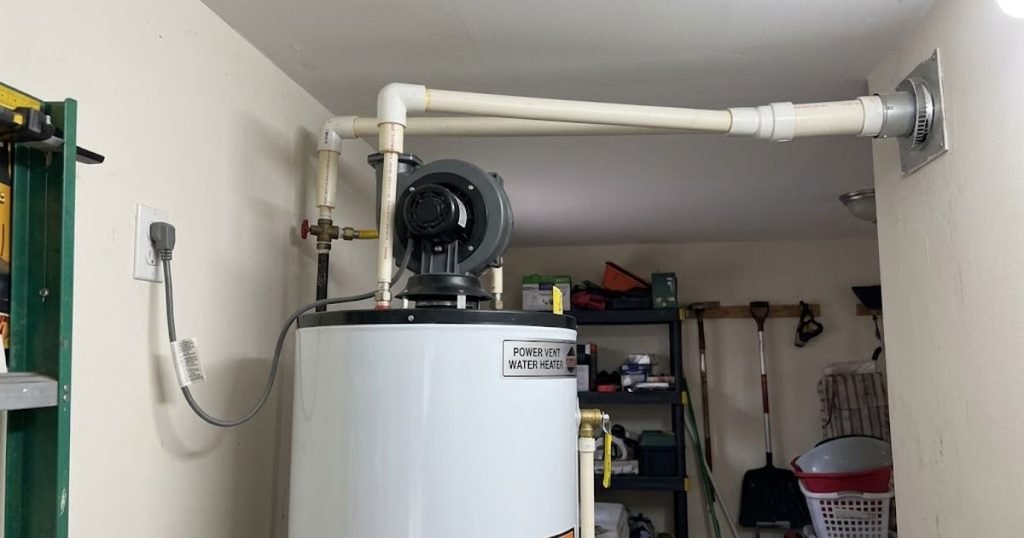
What Is a Power Vent Water Heater?
A power vent water heater is, at its core, a standard gas-fired storage tank. Cold water comes in, a gas burner heats it, and hot water is stored for later use. What sets it apart is the exhaust system.
On a conventional atmospheric water heater, hot combustion gases naturally rise (because heat rises) up through a vertical flue and out through a chimney. That works fine when a home has a straight, properly sized vertical chimney nearby. It doesn’t work well when the water heater sits far from any chimney, in a basement corner, or in a home where the old chimney has been removed or is shared with other appliances in a way that no longer meets code.
A power vent model solves that problem with a small electric blower motor mounted on or near the exhaust outlet. The blower actively forces combustion gases through the vent pipe, which means the vent doesn’t have to rely purely on natural draft. Depending on the manufacturer’s specific model and installation manual, this allows for:
- Horizontal (side-wall) venting in many cases
- Longer vent runs than an atmospheric flue would allow
- More flexibility in where the water heater itself can be located
Because the blower is an electrical component, the unit needs a dedicated power source, usually a standard 120-volt outlet in addition to its gas and water connections.
It’s worth being clear about one thing up front: exact venting distance, pipe material, and configuration are never “one size fits all.” They’re determined by the specific manufacturer’s installation manual and by local plumbing, mechanical, and fuel-gas codes. What’s approved for one brand or model isn’t automatically approved for another.
Here’s a side-by-side look at how power vent and atmospheric systems differ:
| Feature | Power Vent | Atmospheric Vent |
| Exhaust method | Electric blower forces exhaust out | Natural draft (heat rises through flue) |
| Blower | Yes, built-in | No |
| Electricity required | Yes | No |
| Typical venting flexibility | Often allows horizontal/side-wall runs, subject to manufacturer specs | Generally requires a straight, properly sized vertical flue |
| Installation cost | Higher (equipment, electrical, vent materials) | Generally lower |
| Installation location | More flexible — basements, interior rooms, homes without a chimney | Limited to locations near a suitable vertical flue |
| Operating considerations | Blower noise; power outage stops operation | Quieter; still requires gas but not electricity to vent |
READ MORE: AO Smith vs. Rheem Water Heaters: Comparison & Expert Reviews

How Does a Power Vent Water Heater Work?
The day-to-day operation of a power vent water heater follows a fairly predictable sequence:
- Cold water enters the tank through the dip tube.
- The thermostat senses the water temperature has dropped below the set point and calls for heat.
- The gas burner ignites, typically using an electronic ignition system.
- The burner heats the water inside the tank.
- Combustion produces exhaust gases that need to be safely removed from the home.
- The blower motor activates, usually confirmed by a pressure switch before the burner is allowed to fire; this is a safety check to make sure the vent path is actually clear and working.
- The blower pushes exhaust gases through the manufacturer-approved vent pipe.
- Exhaust exits the home through the vent termination point, whether that’s a side wall or roof penetration.
- Once the water reaches the set temperature, the burner shuts off and the blower cycles down.
A few components do most of the work behind the scenes:
- Burner – heats the water using natural gas or propane
- Thermostat/control board – monitors water temperature and manages the heating cycle
- Blower motor – forces exhaust through the vent system
- Pressure switch – confirms the blower is working and the vent isn’t blocked before allowing ignition
- Ignition system – lights the burner, usually electronically rather than with a standing pilot
- Vent pipe – carries exhaust to the outside termination point
- Safety controls – shut the system down if something isn’t operating correctly, such as a blocked vent or ignition failure
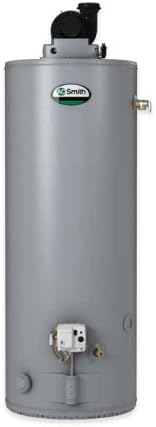
Power Vent vs Atmospheric Vent Water Heater
Choosing between a power vent water heater and an atmospheric vent water heater usually comes down to what your home’s existing venting can support.
Power Vent
- Uses a built-in blower for forced exhaust
- Offers more flexible vent routing, including horizontal runs in many cases
- Requires a dedicated electrical connection
- Generally has a higher equipment and installation cost
- Blower can introduce audible operating noise
- Often the practical choice when a home has no usable chimney
Atmospheric Vent
- Relies on natural draft — no blower involved
- Typically uses a vertical flue connected to a chimney
- Mechanically simpler, with fewer parts that can fail
- Doesn’t need an electrical connection to operate the vent
- Less flexible in homes without a suitable existing vertical vent
| Factor | Power Vent | Atmospheric Vent |
| Upfront cost | Higher | Lower |
| Venting | Flexible, often horizontal-capable | Vertical flue required |
| Electricity | Required | Not required for venting |
| Installation flexibility | High | Limited by chimney/flue location |
| Noise | Blower audible during operation | Quiet |
| Efficiency | Comparable to similarly rated atmospheric models; varies by unit | Comparable; varies by unit |
| Maintenance | Blower and controls add components to service | Fewer moving parts |
| Best use case | No usable chimney, basement installs, side-wall venting needed | Home already has a suitable vertical flue |
READ MORE: Cheapest 50-Gallon Electric Water Heater — Quick Buyer’s Guide

Power Vent vs Direct Vent Water Heater
These two terms get confused constantly, and they are not interchangeable.
A power vent water heater pulls combustion air from inside the room where it’s installed and uses a blower to push exhaust outside. It is not sealed combustion.
A direct vent water heater, on the other hand, uses sealed combustion it draws combustion air in from outside through one pipe and exhausts gases out through a second pipe, without pulling air from the room at all. Some direct vent models rely on natural draft; some newer designs also incorporate a blower.
| Consideration | Power Vent | Direct Vent |
| Combustion air source | Room air | Outside air, via dedicated intake pipe |
| Exhaust method | Blower-forced | Varies by model; sealed system |
| Sealed combustion | No | Yes |
| Electricity | Required | Depends on model |
| Installation flexibility | High | High, especially in tight or sealed mechanical spaces |
| Typical applications | Basements, homes without a chimney | Homes needing sealed combustion, e.g., tight mechanical closets |
Why this matters: if a contractor recommends “direct vent” because your water heater is in a small, enclosed mechanical closet with limited combustion air, a power vent unit isn’t necessarily an equivalent substitute, since it still draws air from the room. The right choice depends on the specific installation environment and the manufacturer’s requirements.
READ MORE: Best 30 Gallon Water Heater: Top Picks, Comparison & Buying Guide

Power Vent vs Tankless Water Heater
A power vent water heater is still a storage tank system; it just vents differently than an atmospheric model. A tankless (on-demand) water heater is an entirely different way of delivering hot water.
| Feature | Power Vent Tank | Gas Tankless |
| Water storage | Yes, tank holds a set volume | No, heats water as it flows |
| Hot water delivery | Limited by tank size and recovery rate | Continuous, limited by flow rate (GPM) |
| Energy use | Standby losses from stored hot water | Generally lower standby loss |
| Venting | Power-vented, often flexible routing | Usually requires specific venting (often PVC/CPVC or stainless, per manufacturer) |
| Installation complexity | Moderate | Can be higher, especially for retrofits |
| Upfront cost | Moderate | Generally higher equipment cost |
| Maintenance | Tank flushing, anode rod, blower/controls | Descaling (especially in hard water areas), venting checks |
| Best for | Homes wanting a familiar storage-tank setup with flexible venting | Homes wanting continuous hot water and potential long-term energy savings |
If you’re comparing the two mainly on efficiency or long-term operating cost, it’s worth getting numbers specific to the models you’re considering rather than assuming one category is always cheaper to run. Actual performance varies by unit, household usage, and local utility rates.
READ MORE: Tankless Water Heater vs Tank Water Heater: Which Is Better?
Power Vent Water Heater Cost
Here’s where homeowners usually feel some sticker shock, so let’s break it down honestly.
Equipment alone:
A power vent gas water heater typically runs somewhere around $700 to $1,800, depending on tank size, brand, and efficiency rating. Higher-capacity and higher-efficiency models sit at the upper end of that range.
Total installed cost:
This is where things vary a lot more, because it depends on labor, venting complexity, and any electrical or gas work needed. Many straightforward power vent replacements where the location and rough venting path stay similar land somewhere in the $1,500 to $3,500 range installed. More complex jobs, involving longer vent runs, new electrical circuits, gas line modifications, or difficult access, can push the total past $4,000.
Compared to swapping in another atmospheric unit, adding power venting itself commonly adds roughly $300 to $1,000 to the project, covering the blower-equipped unit and its electrical hookup.
| Cost Factor | Typical Range/Consideration |
| Power vent water heater (equipment) | ~700–1,800, varies by size/brand |
| Professional installation labor | Often 80–200 per hour; total labor hours vary by job complexity |
| Vent materials | Varies by length, diameter, and material specified by the manufacturer |
| Electrical work (new circuit/outlet) | Roughly 150–500 if new wiring is needed |
| Gas-line modifications | Varies; add cost if sizing or routing must change |
| Permit | Commonly 25–300 depending on locality |
| Removal/disposal of old unit | Often included in installation quotes, sometimes a separate fee |
| Possible additional work | Expansion tank, drain pan, code-required upgrades |
These are general planning ranges, not a guarantee for your specific home. Labor rates, permit fees, and material costs vary significantly by region, and the only way to get an accurate number is a quote based on your actual installation.
What Makes Power Vent Installation More Expensive?
A power vent swap isn’t always a simple like-for-like replacement, and here’s why:
- A new vent route. If the old atmospheric unit used a chimney and the power vent model will terminate through a side wall instead, that’s new pipe, a new wall penetration, and new termination hardware.
- Long vent runs and multiple elbows. Every elbow and extra foot of pipe has to fall within what the manufacturer’s manual allows and can add labor and material cost.
- Difficult exterior-wall access. Brick, stone, or finished walls make wall penetrations more labor-intensive.
- New electrical work. If there’s no outlet near the water heater’s location, an electrician may need to run a new circuit.
- Gas-line changes. Some replacements require resizing or rerouting gas piping to meet the new unit’s requirements.
- Condensate management. Higher-efficiency condensing units may produce condensate that needs a drain.
- Code upgrades. Homes with older installations sometimes need updates like a seismic strap, expansion tank, or drain pan to meet current code, even if those weren’t required when the old unit went in.
- Permits and inspections. Required in most jurisdictions for gas and venting work.
- Old vent removal. Disconnecting and capping an old chimney flue properly is its own task.
READ MORE: Best Tankless Water Heater — Top Picks, Costs & Buyer’s Guide
Can a Power Vent Water Heater Be Installed Horizontally?
In many cases, yes that’s one of the main reasons homeowners choose power vent in the first place. The blower gives the exhaust enough force to travel through a side-wall vent run rather than needing a straight vertical shot up a chimney.
That said, “can it vent horizontally” isn’t the same as “any horizontal configuration works.” The actual answer depends on:
- The specific model’s maximum vent length
- The number of elbows allowed
- Required pipe diameter and material
- Minimum slope back toward the water heater (to drain condensation)
- Required clearance at the termination point from windows, doors, and other openings
Never assume that PVC, CPVC, or any other pipe type is automatically approved for a given unit; some manufacturers specify particular materials, and using the wrong one can void a warranty or create a safety hazard. The manufacturer’s installation manual for your exact model, combined with local building, plumbing, and fuel-gas codes, is what determines what’s actually allowed.
Does a Power Vent Water Heater Need Electricity?
Yes. The blower motor requires electricity to operate, and depending on the model, the ignition system and control board may also run on electrical power.
That has a practical consequence: during a power outage, most power vent water heaters won’t operate, even though they’re gas-fired appliances. Without power to the blower and controls, the safety system won’t allow the burner to fire.
A few points worth knowing:
- Homeowners should never bypass safety controls to try to get hot water during an outage that defeats the systems designed to detect a blocked or malfunctioning vent.
- Some households run these units on a backup generator, but whether that works and what size generator is needed depends entirely on the manufacturer’s electrical specifications for that model.
- Exact voltage, amperage, and outlet requirements vary by brand and model, so check the installation manual or nameplate rating rather than assuming.
READ MORE: Best Under Sink Hot Water Heater 2026 — Mini-Tank & Tankless Buyer’s Guide & Prices
Pros and Cons of a Power Vent Water Heater
Pros
- Flexible venting, including horizontal routing in many cases
- Works well in homes without a usable chimney
- Expands where the water heater itself can be located
- A practical option for many basement installations
- Actively forces exhaust out, rather than relying on passive draft
- Useful for replacement projects where the old venting no longer meets code
- Reduces dependence on a traditional vertical flue
Cons
- Higher upfront equipment and installation cost
- Requires a dedicated electrical connection
- Blower motor introduces operating noise
- More components (blower, pressure switch, control board) that can eventually need repair
- Installation is generally more involved than a simple atmospheric swap
- Repair costs can run higher due to the added components
- Vent installation must be precise and code-compliant — it’s not a forgiving system to improvise
Who Should Consider a Power Vent Water Heater?
A power vent water heater tends to make the most sense for:
- Homes without a suitable chimney or flue
- Basement installations where running a vertical vent isn’t practical
- Homes that need side-wall venting because of the water heater’s location
- Replacement projects where the existing atmospheric venting no longer meets current code
- Homeowners who specifically want a gas storage tank (not tankless) but need more venting flexibility than an atmospheric model allows
On the other hand, if your home already has a good, code-compliant vertical flue near the water heater’s location, an atmospheric model may get the job done for less money and with one less mechanical component to maintain. And if your priority is long-term efficiency or continuous hot water rather than venting flexibility, it’s worth comparing tankless or heat pump options too.
Power Vent Water Heater Sizing Guide
Tank size matters, but it’s not the only number to look at. First Hour Rating (FHR) — how many gallons of hot water the unit can deliver in the first hour of use, starting from a full tank is often more useful for comparing gas storage water heaters, because it accounts for both tank capacity and recovery rate (how quickly the burner reheats the tank).
Rough starting points by household size:
| Household Size | Typical Tank Size Range | Notes |
| 1–2 people | 30–40 gallons | Lower usage; fewer simultaneous demands |
| 2–3 people | 40 gallons | Common for smaller households with moderate usage |
| 3–4 people | 50 gallons | Popular size for typical family usage patterns |
| 4–5+ people | 50–75 gallons | Higher simultaneous demand — multiple showers, laundry, dishwasher |
These are starting points, not guarantees. Actual sizing should also factor in:
- Number of bathrooms and simultaneous shower usage
- Bathtub usage, especially large soaking tubs
- Dishwasher and laundry habits
- How often multiple hot-water fixtures run at the same time
READ MORE: Best 5 High Efficiency Condensing Boiler: Review, Cost & Comparison
Power Vent Water Heater Maintenance
Routine maintenance goes a long way toward avoiding surprise breakdowns:
- Periodically inspect the area around the heater for moisture, rust, or unusual odors
- Pay attention to new or unusual noises from the blower or burner
- Keep the vent termination point clear of snow, ice, leaves, nests, or other debris
- Watch for signs of corrosion on the tank, fittings, or vent connections
- Check regularly for water leaks around connections and the base of the tank
- Follow the manufacturer’s recommended maintenance schedule, which often includes periodic tank flushing and anode rod inspection
- Have a professional inspect the unit periodically, and especially any time you notice a change in performance
- Only test safety devices according to the manufacturer’s instructions these systems are there to protect you, and they shouldn’t be disabled or bypassed
- Consider an annual professional inspection where appropriate, particularly for combustion and venting components
Power Vent Water Heater Venting Safety
This is the section that matters most, because improper venting on a gas appliance isn’t just a performance issue it’s a safety issue.
Combustion gases include carbon monoxide, a colorless, odorless gas that’s dangerous when it isn’t properly vented outdoors. A power vent system’s blower and pressure switch are designed to help ensure exhaust actually makes it outside but only when the vent is installed and maintained correctly.
Hazards to be aware of:
- Blocked vent termination — from snow, ice, debris, nests, or even landscaping growth over time
- Incorrect pipe materials — using unapproved pipe for a given model
- Improper vent length — exceeding what the manufacturer’s manual allows
- Incorrect slope — vent pipe needs proper slope to manage condensation
- Excessive elbows — each elbow adds resistance and must be counted against the manufacturer’s maximum
- Improper clearances — termination points too close to windows, doors, or air intakes
- Snow and ice obstruction — a real concern in cold-climate installations, where low side-wall terminations can get buried
- Incorrect termination locations — placement that doesn’t meet code distance requirements from property lines, structures, or openings
The rule here is simple and non-negotiable: the vent system must follow the specific appliance manufacturer’s installation instructions and all applicable local codes. This is not an area for improvisation, guesswork, or “it looked fine on another job.”
Can You Convert an Atmospheric Water Heater to Power Vent?
Generally, no — and this is a question worth asking a contractor directly if it comes up, because the answer matters for safety, not just cost.
A factory-built power vent water heater is engineered as a complete system: the burner, controls, safety switches, combustion characteristics, and vent design are all matched to work together with powered exhaust. Retrofitting a standard atmospheric water heater with an aftermarket power-vent blower changes the combustion and venting dynamics in ways the original appliance wasn’t designed or tested for.
Current technical guidance generally advises against simply adding a power-vent accessory to a conventional atmospheric water heater. The appropriate approach, when power venting is actually needed, is to replace the appliance with a factory-built power vent model designed for that purpose from the start.
Power Vent Water Heater Installation: What to Expect
Here’s roughly what a professional installation involves, at a high level:
- Inspect the existing water heater and its current venting.
- Confirm fuel type and the household’s hot-water demand.
- Verify the installation location works for the new unit and its venting.
- Determine the vent route and termination point.
- Confirm electrical requirements and whether new wiring is needed.
- Shut off gas, water, and power to the old unit and drain the tank.
- Remove the old water heater.
- Position the new unit in place.
- Connect the water lines.
- Connect the gas supply according to applicable code requirements.
- Install the approved vent system per the manufacturer’s manual.
- Connect electrical power to the unit.
- Test safety controls and confirm proper operation.
- Check all connections for leaks.
- Verify the exhaust system is venting correctly.
- Complete any required permits and inspections.
Gas connections and venting work should generally be handled by a qualified, licensed professional this isn’t a project where cutting corners is worth the risk.
How Long Does a Power Vent Water Heater Last?
Most gas storage water heaters, including power vent models, are commonly expected to last somewhere in the range of 8 to 12 years, though this varies quite a bit based on real-world conditions. It’s not a guarantee for any individual unit, some last longer, others fail sooner.
Factors that influence lifespan include:
- Water quality and hardness
- Quality of the original installation
- How consistently maintenance has been performed
- Sediment buildup inside the tank
- Condition of the anode rod
- Operating temperature settings
- Overall usage patterns
- Wear on the blower and control components over time
Signs that replacement may be approaching:
- Visible tank leakage
- Repeated system shutdowns
- Increasingly frequent repairs
- Rust around fittings or the tank itself
- Noticeably less hot water than before
- New or worsening unusual noises
- Older age combined with declining performance overall
Is a Power Vent Water Heater Worth It?
It depends on the home, honestly and that’s not a dodge, it’s the real answer.
A power vent water heater tends to be worth the extra cost when:
- The home doesn’t have suitable atmospheric venting
- Horizontal venting solves a real layout problem (like a basement without a nearby chimney)
- You specifically want a gas storage tank rather than tankless
- Installation flexibility outweighs the added upfront cost
It may be worth comparing other options first if:
- Your home already has a good vertical flue an atmospheric unit could use
- You’re open to a gas tankless system for continuous hot water
- A heat pump water heater fits your climate and electrical setup
- A standard electric tank would meet your needs without gas at all
Power vent isn’t automatically the most efficient or most cost-effective choice for every home it’s the right tool for a specific venting problem. Comparing atmospheric gas, direct vent, gas tankless, heat pump, and standard electric options against your home’s actual constraints is the way to land on the right call.
Power Vent Water Heater Buying Checklist
Before you buy, run through this list:
- Fuel type (natural gas vs. propane)
- Tank capacity
- First Hour Rating (FHR)
- Energy factor / efficiency information
- Venting requirements specific to the model
- Maximum allowed vent length
- Number of elbows permitted
- Electrical requirements
- Warranty coverage (tank vs. parts vs. labor)
- Availability of replacement parts
- Noise level during operation
- Installation requirements for your specific home
- Local code requirements
- Contractor’s experience with power vent installations specifically
Frequently Asked Questions
What is a power vent water heater?
A power vent water heater is a gas storage tank water heater with a built-in electric blower that forces combustion exhaust through a vent pipe to the outside, rather than relying on natural draft. This design allows for more flexible vent routing, including horizontal runs in many cases, which makes it a common choice for homes without a usable chimney.
Is a power vent water heater better than an atmospheric water heater?
Neither is universally “better” — it depends on your home. A power vent model offers more installation flexibility and works well without a chimney, but costs more upfront and needs electricity. An atmospheric model is simpler and less expensive when a home already has a suitable vertical flue in the right location. The right choice depends on your venting situation, budget, and installation constraints.
How much does it cost to install a power vent water heater?
Equipment alone commonly runs around $700 to $1,800, while total installed cost including labor, venting, electrical work, and permits typically falls between $1,500 and $3,500 for a straightforward replacement. More complex jobs involving longer vent runs, new electrical circuits, or gas line changes can push costs higher. Actual pricing varies significantly by region and installation complexity.
Does a power vent water heater need electricity?
Yes. The blower motor requires electricity, and depending on the model, the ignition and control systems may as well. This means most power vent water heaters won’t operate during a power outage, since the safety system needs power to confirm the vent is working before allowing the burner to ignite.
Can you replace an atmospheric water heater with a power vent water heater?
Yes, this is a common replacement, but it’s not always a simple swap. It may require installing new venting (especially if switching from vertical to horizontal routing), adding a dedicated electrical circuit, and meeting current local plumbing, mechanical, and fuel-gas code requirements even if the original installation predated those requirements.
The Bottom Line
A power vent water heater is a gas storage tank with a built-in blower that solves a specific problem: venting flexibility. It’s a strong option for homes without a usable chimney, basements where vertical venting isn’t practical, and replacement projects where the old venting no longer meets code. The tradeoffs are a higher upfront cost, a dependence on electricity, and one more mechanical component: the blower that can eventually need service.
If you’re replacing an old gas water heater, don’t choose a power vent model based on price alone. Have the existing venting, fuel supply, electrical requirements, household hot-water demand, and local code requirements evaluated before choosing the replacement. Getting that evaluation right upfront is what keeps a water heater replacement from turning into a bigger and more expensive project than it needed to be.