Buying a new heat pump is a big deal. It is one of the most expensive things you will ever buy for your home. You want it to keep you warm in the winter and cool in the summer. You also want it to keep your electric bills from hitting the roof. But here is the thing: a heat pump can only do its job well if it is the right size.
If you have started looking, you have probably heard people talk about “tons.” They aren’t talking about how much the unit weighs on a scale. They are talking about how much heating or cooling power it has. Getting that number right is the difference between a cozy home and a massive headache.
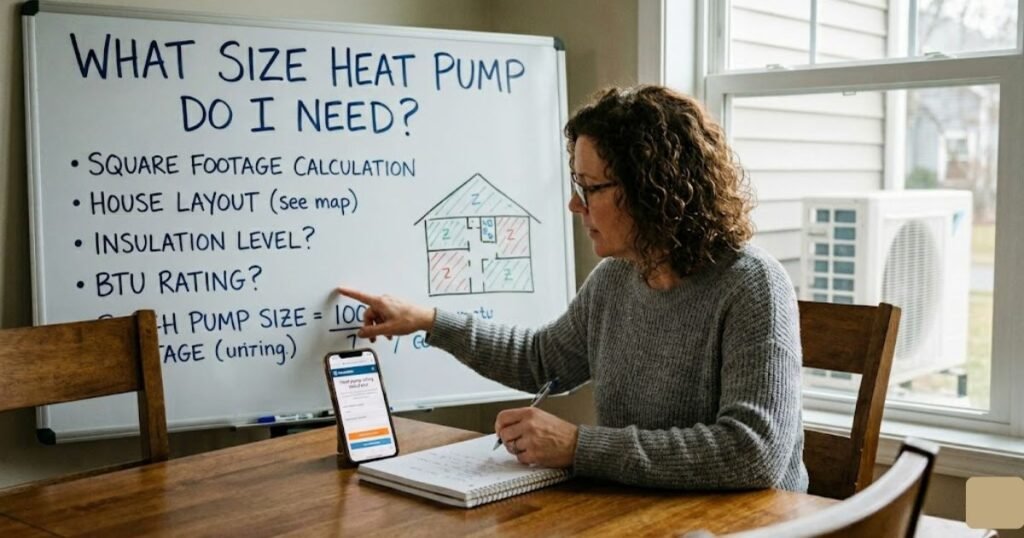
In this guide, we are going to break down exactly how to figure out what size you need. We will skip the complex math and stick to what actually matters for your wallet and your comfort. Lets deep dive into “What Size Heat Pump Do I Need? Homeowner Sizing Guide”
READ MORE: Best Heat Pump Air Conditioner Review | Costs, Benefits & Value
What Does Heat Pump Sizing Actually Mean?
When we talk about “sizing” a heat pump, we are talking about capacity. In the HVAC world, we use “tons” to measure this. One ton of air conditioning or heating can remove 12,000 BTUs (British Thermal Units) of heat from your home in one hour.
Think of it like an engine in a car. A tiny car does not need a massive V8 engine to move. But a huge truck definitely needs more power than a golf cart motor can provide. Your home is the same way. The “size” of the heat pump is just a measure of how much “heavy lifting” the system can do to move heat in or out of your house.
Why the Right Size is Everything
Most people assume that bigger is better. We think, “If a 3-ton unit is good, a 4-ton unit must be great!” In the world of HVAC, that is actually a mistake.
If your heat pump is too big, it will turn on, blast your house with air, and turn off in five minutes. This is called “short cycling.” It’s bad for the machine, and it’s bad for your comfort. If it’s too small, it will run 24/7 and never actually get your living room to the temperature you want.
Finding the “Goldilocks” size, the one that is just right is the secret to a happy home.
Why Bigger is Not Always Better
We live in a culture where “upsizing” feels like a win. We upsize our fries and our trucks. But an oversized heat pump is a recipe for trouble.
- The Humidity Problem: A heat pump needs to run long enough for its coils to pull moisture from the air. If the unit is too powerful, it cools the house instantly and shuts off before it can dehumidify. You end up with a “clammy” 70-degree house and a higher risk of mold.
- Short Cycling and Wear: Think of it like stop-and-go traffic versus a steady highway drive. An oversized unit constantly clicks on and off, which is brutal on the motor. This “short cycling” wears out parts fast and leads to expensive, early repairs.
- Noisy Operation: Larger systems move a lot of air. Shoving a 4-ton unit’s airflow through ducts built for a 2-ton system is loud. It can sound like a jet engine is taking off in your hallway every time the heat kicks on.
READ MORE: Carrier Heat Pump Reviews (2026) — Models, Costs, Pros & Cons
The Danger of a System That is Too Small
On the flip side, some people try to save money by getting a smaller unit. This usually backfires.
- Higher Bills: A small unit has to work much harder. If it’s 20 degrees outside, an undersized heat pump will run non-stop. Since it can’t keep up, it might have to rely on “emergency heat” or electric heat strips. Those are very expensive to run.
- Cold Spots: You might find that your bedroom stays chilly while the kitchen is okay. The air just doesn’t have enough “push” to get through the whole house.
- Early Failure: Just like the oversized unit, an undersized unit dies early because it never gets a break. It’s like running a marathon at a full sprint every single day.
Forget the Guesswork: The Manual J Standard
Back in the day, a contractor might walk into a house, look around, and say, “Yep, looks like a 3-ton house to me.” That is a guess, and it’s usually wrong.
Today, professional contractors use something called a Manual J load calculation. This is the industry standard created by the Air Conditioning Contractors of America (ACCA).
A Manual J isn’t just about square footage. It is a deep dive into your home’s “DNA.” It looks at:
- How many windows you have and which way they face.
- The type of insulation in your attic and walls.
- The local climate in your part of the U.S.
- The airtightness of your home.
When you are getting quotes, ask the contractor if they do a Manual J calculation. If they say they “just know” what size you need by looking at it, they aren’t the right pro for the job. You want data, not a hunch.
READ MORE: Fujitsu Heat Pump Reviews (2026): Models, Costs & Real-World Pros & Cons
Factors That Change Your Heat Pump Size
Every home is different. Even two houses built with the same floor plan on the same street might need different-sized heat pumps. Here are the things that change the math.
1. Home Square Footage
This is the starting point. More space usually means you need more capacity. However, a 2,000-square-foot house in Florida has very different needs than a 2,000-square-foot house in Maine.
2. Climate Zone
Do you live in the “Sun Belt” or the “Snow Belt”? If you live in a place with brutal winters, your heat pump needs enough “oomph” to pull heat out of very cold air. If you live in the desert, your cooling needs will dominate the sizing.
3. Insulation Levels
A well-insulated home holds onto its air. If you have thick insulation in the attic and high-quality spray foam in the walls, your heat pump doesn’t have to work as hard. You might be able to get away with a smaller, more efficient system.
4. Number and Type of Windows
Windows are basically holes in your insulation. If you have big, beautiful floor-to-ceiling windows, your home will lose heat faster in the winter and heat up faster in the summer. Older single-pane windows make the system work much harder than modern double-pane, low-E windows.
5. Ceiling Height
A 1,500-square-foot home with 8-foot ceilings has a lot less air to move than a 1,500-square-foot home with 20-foot vaulted ceilings. Volume matters just as much as floor space.
6. Ductwork Condition
If your ducts are leaky, old, or too small, they can’t move the air effectively. Sometimes, a “sizing” issue is actually a “ductwork” issue. A pro will check to see if your vents can actually handle the size of the unit you want to buy.
7. Sun Exposure
Does your house sit in the middle of a treeless lot, baking in the afternoon sun? Or is it tucked under a canopy of oak trees? Shaded homes stay naturally cooler, which can lower the ton capacity you need for the summer months.
8. Number of People
People give off heat. If you have a family of six and three big dogs, your home will stay warmer than a home with one person living alone. It sounds small, but it adds up!
9. Home Layout
An open-concept home is easier for air to circulate through. A “choppy” older home with lots of small rooms and doors might need a different setup perhaps a multi-zone system or a larger capacity to ensure every corner stays comfortable.
10. Air Leakage
If your home is “drafty,” you are essentially trying to heat the whole neighborhood. Leaks around doors, light fixtures, and outlets let your expensive conditioned air escape.
11. Existing Setup
Are you replacing an old gas furnace or an old AC? Sometimes your existing setup limits what you can do without expensive renovations. The size of your current indoor closet or outdoor pad matters, too.
READ MORE: Trane Heat Pump Review 2026 — Comparison, Pros, Cons & Costs
How to Estimate Heat Pump Size at Home
While you should always hire a pro for the final call, it is helpful to have a “ballpark” idea before you start making calls. This helps you know if a quote seems way off.
The Rough Estimate Formula
A very basic rule of thumb is that you need about one ton of capacity for every 500 to 600 square feet of living space.
- Take your total square footage (e.g., 2,000 sq. ft.).
- Divide by 500 or 600.
- In this case, you’d be looking at roughly 3.5 to 4 tons.
Important Note: This is only a starting point! Do not buy a system based on this math alone. Your home might have incredible insulation that allows you to drop down to a 3-ton unit, or it might be so drafty that you need a 5-ton unit.
The rule of thumb is just a way to start the conversation. The Manual J load calculation is what makes it official.
Best Heat Pump Size by Home Size (Quick Guide)
According to general industry standards from brands like Trane, here is how the numbers usually shake out for standard American homes. Remember, these are rough estimates.
- 500 sq. ft. — about 1 ton
- 1,000 to 1,200 sq. ft. — about 2 tons
- 1,500 sq. ft. — about 3 tons
- 1,800 to 2,400 sq. ft. — about 4 tons
- 2,400 to 3,000 sq. ft. — about 5 tons
If your home is larger than 3,000 square feet, you will often move into the territory of needing two separate heat pump systems—one for downstairs and one for upstairs. This is usually more efficient than trying to have one massive unit push air through a giant house.
READ MORE: Lennox Heat Pump Review: 2026 Prices, Pros, Cons & Comparison
When You Should Ask for a Bigger or Smaller System
Standard rules are meant to be broken when your home is unique. There are specific times when you might need to adjust your expectations.
When to go bigger:
- Poor Insulation: If your home was built in the 1920s and hasn’t had an insulation upgrade, it’s “leaky.” You’ll need more power to keep up with the loss.
- Lots of Glass: If your living room looks like a greenhouse, you have a high “solar gain.” You’ll need more cooling tons to combat that sun.
- Extreme Climates: If you live in a place where it stays below zero for weeks, you may need a larger cold-climate heat pump to ensure you stay warm without relying on backup heat.
- High Ceilings: If you have a “great room” with massive ceilings, you are heating and cooling a lot of “dead air” space at the top of the room.
When to go smaller:
- Modern Energy Star Homes: If your home is brand new and built to be “tight,” you might be shocked at how small of a system you need.
- Recent Upgrades: If you just installed triple-pane windows and added two feet of insulation to your attic, your old 4-ton system might be way too big for your “new” efficient home. You might be able to drop down to a 3-ton system and save money on the unit and the monthly bill.
Comparing the Top Brands: Carrier vs Goodman vs Trane vs Fujitsu vs Mitsubishi
Choosing the right size is half the battle. Choosing the right brand is the other half. Here is how the big players in the U.S. market compare.
| Brand | Best For | Main Strengths | Typical Price Range | Homeowner Notes |
| Carrier | Versatility | Huge range of sizes; very reliable dealer network. | $6,000 – $25,000 | Carrier emphasizes that proper sizing must be matched specifically to your home layout. |
| Goodman | Budget-Friendly | Affordable upfront cost; widely available parts. | Varies by dealer | Great for residential use; newer models include R-32 refrigerant and inverter tech. |
| Trane | Durability | Known for “tested” reliability; great pricing transparency. | $8,889 – $15,437 | Their 20 TruComfort model uses R-454B refrigerant for better efficiency. |
| Fujitsu | Ductless Options | Excellent for older homes without vents; advanced tech. | $3,000 – $10,000+ | Focuses on “ductless comfort” and advanced heating for cold climates. |
| Mitsubishi | Quiet Performance | Whisper-quiet operation; premium efficiency. | $4,000 – $12,000+ | Indoor units are as low as 19 dB(A). Outdoor units are around 46 dB(A). Very premium feel. |
READ MORE: Goodman Heat Pump Review 2026 | Efficiency, Cost, Pros & Cons
Pros and Cons of Heat Pumps
Before you commit to a size, make sure a heat pump is actually the right choice for your lifestyle. Most people love them, but they aren’t for everyone.
The Pros
- Energy Efficiency: Heat pumps move heat rather than creating it, which is much cheaper than electric baseboards or old furnaces.
- Two-in-One: You get a heater and an air conditioner in a single outdoor unit.
- Year-Round Comfort: Modern systems provide very steady, even temperatures without the “blasts” of hot or cold air.
- Humidity Control: They are excellent at dehumidifying your home during those sticky summer months.
- Potential Savings: Depending on what you are switching from, you could save hundreds of dollars a year on utility bills.
The Cons
- Upfront Cost: Installing a high-quality heat pump is usually more expensive than just putting in a cheap AC or a basic gas furnace.
- Ductwork Changes: If your home is old, your ducts might not be the right size for the air pressure a heat pump requires.
- Cold Weather Performance: While modern “hyper-heat” units work in the cold, some basic models struggle when it gets well below freezing.
- The Need for Precision: As we’ve discussed, if the sizing is off, the system won’t work right. You can’t just “guess” with these.
- Professional Install is Key: You cannot DIY a heat pump. It requires refrigerant handling and complex electrical work.
How to Know the Right Size: A Homeowner Checklist
Before you call a contractor, walk through your house and gather this info. It will help the pro give you a much more accurate quote.
- [ ] Square Footage: What is the total “conditioned” (heated/cooled) space?
- [ ] Climate Zone: Are you in a northern or southern state?
- [ ] Insulation Status: Do you know if your attic has blown-in insulation or batts?
- [ ] Ductwork: Are your vents in the floor or the ceiling? Do you even have ducts?
- [ ] Ceiling Height: Do you have any rooms with ceilings higher than 8 or 9 feet?
- [ ] Room Count: How many separate rooms need to be reached?
- [ ] Existing System: Are you currently using gas, oil, or electric heat?
- [ ] Zoning: Does your home have “hot spots” or “cold spots” that need extra attention?
- [ ] One or Two?: Does your home need one big system or two smaller ones (one for each floor)?
READ MORE: Mitsubishi Heat Pump Buying Guide 2026: Comparison, Models & Costs
Common Mistakes Homeowners Make
Don’t feel bad if you’re confused most people are! Here are the most common traps homeowners fall into when sizing a heat pump.
1. Choosing by square footage only
As we’ve said, square footage is just one piece of the puzzle. If you buy a 3-ton unit just because your house is 1,500 square feet, you might be ignoring the fact that your house is all glass or has zero insulation.
2. Buying the cheapest system
A cheap system that is the wrong size will cost you way more in the long run. Between higher monthly bills and early repairs, the “savings” disappear fast.
3. Ignoring insulation and leaks
Sometimes, the best way to get the “right size” heat pump is to fix your house first. If you spend $500 on weatherstripping and attic insulation, you might be able to buy a smaller, cheaper heat pump.
4. Skipping the load calculation
If a contractor refuses to do a Manual J, find a new contractor. It is the only way to be 100% sure of the size.
5. Assuming one brand fits all
A 3-ton Carrier might perform slightly differently than a 3-ton Goodman in your specific climate. Talk to your pro about which brand handles your local weather best.
6. Overpowering the home
Many people think, “I’ll just get the 5-ton to be safe.” This is the most common mistake. Overpowering leads to a “clunky” system that dies early and leaves you feeling damp and uncomfortable.
READ MORE: Best 3-Ton Heat Pumps of 2026: Reviews, Prices & Comparison
Heat Pump Cost Expectations in 2026
If you are shopping for a heat pump this year, you should know that prices have shifted a bit. Modern refrigerants (like R-32 and R-454B) and new efficiency standards have changed the market.
Generally, you should expect to see installed prices in these ranges:
- Standard Air-Source Heat Pumps: Most homeowners pay between $6,000 and $15,000 for a full installation.
- Ductless (Mini-Split) Systems: These are often $3,000 to $8,000 for a single zone, but can go much higher if you are doing the whole house.
- Premium or Large Systems: For very large homes or ultra-high-efficiency systems (like Carrier’s top tier), you may see quotes ranging from $15,000 to $25,000.
- Average 3-Ton System: A typical ducted 3-ton heat pump usually lands in the $9,000 to $13,000 range installed.
Remember, labor costs vary a lot depending on where you live. A contractor in New York City or San Francisco will likely charge more for labor than one in a rural area.
Frequently Asked Questions
What size heat pump do I need for a 1,500 square foot house?
In most cases, a 1,500 square foot house will need a 3-ton heat pump. However, if your home is very well-insulated or you live in a very mild climate, you might be able to use a 2.5-ton unit. Always confirm with a load calculation.
How do I know if my heat pump is too small?
If your heat pump is too small, it will run constantly without ever reaching the temperature on your thermostat. You might also notice that your electric bills are unusually high in the winter because the system is constantly using its “backup” heat strips to keep up.
What is the best heat pump size for a 2,000 square foot home?
A 2,000 square foot home usually requires a 3.5 to 4-ton heat pump. The exact size depends on your ceiling heights and how many windows you have.
Is it better to oversize or undersize a heat pump?
Neither is ideal, but oversizing is often worse for your comfort. An oversized unit won’t remove humidity, leading to a “sticky” house and mold risks. It also breaks down faster due to “short cycling.” An undersized unit is usually just a problem on the few coldest or hottest days of the year.
Do I need a Manual J calculation for a new heat pump?
Yes. You should absolutely insist on a Manual J calculation. It is the only scientific way to ensure you aren’t wasting money on a system that is too big or suffering with one that is too small.
Conclusion:
Choosing a heat pump doesn’t have to be a guessing game. While it’s tempting to just look at a chart and pick a size, your home is more complex than just its square footage.
The best thing you can do right now is find a reputable HVAC contractor who treats your home like a unique project. Tell them you want a Manual J load calculation. Tell them about your insulation, your windows, and your comfort goals.
Pingback: AC Not Blowing Cold Air? Causes, DIY Fixes & When to Call a Pro - Plumbing Guider