Whether you are dealing with an aging traditional tank water heater that can barely keep up with back-to-back morning showers, waiting minutes for lukewarm water to finally reach a master bathroom at the far end of the house, or simply looking for ways to trim mounting utility bills, upgrading your home’s water heating system is a major decision. In modern U.S. residential plumbing, few upgrades offer as much potential for energy savings and endless hot-water delivery as a .95 UEF tankless water heater.
Choosing the right high-efficiency gas tankless water heater requires looking past marketing claims to understand real-world performance, installation realities, and long-term ownership costs. This comprehensive guide will break down what a 0.95 Uniform Energy Factor (UEF) actually means, how condensing gas technology captures wasted heat, and how four of the industry’s leading residential models compare in everyday household use.
By examining official specifications, venting and drainage requirements, recirculation capabilities, and sizing guidelines, you will have all the information needed to make an informed, confident investment for your home. Lets deep dive into “Best .95 UEF Tankless Water Heater: Review, Comparison & Cost”
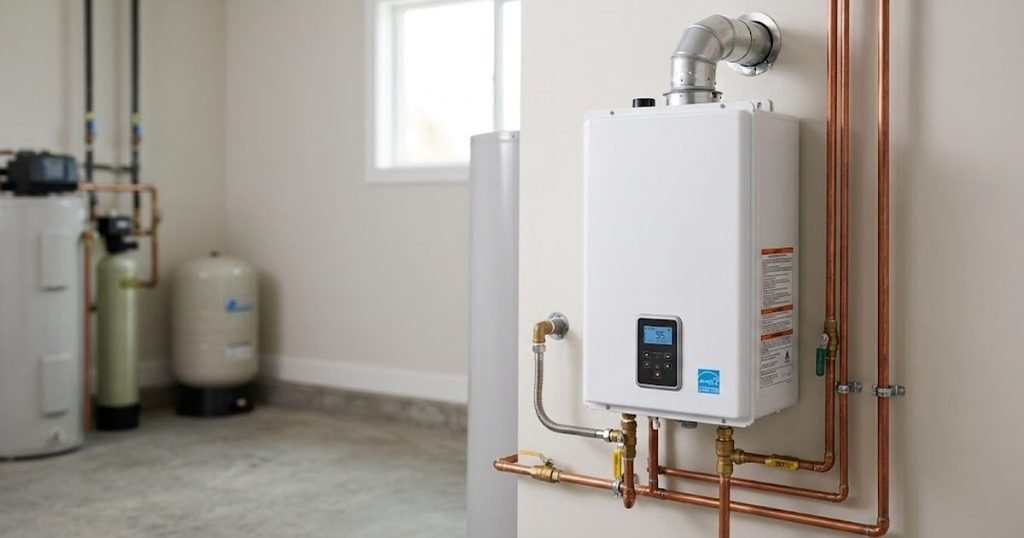
What Does a .95 UEF Tankless Water Heater Mean?
When shopping for a modern residential water heater, you will encounter the Uniform Energy Factor (UEF) rating prominently displayed on the yellow EnergyGuide label. Understanding this metric is essential for evaluating energy efficiency.
What UEF Measures and Why Manufacturers Use It
Established by the U.S. Department of Energy (DOE), UEF is a standardized metric used to evaluate the overall energy efficiency of residential water heaters. Unlike older metrics that only measured steady-state efficiency, UEF testing accounts for daily usage patterns, standby heat loss, cycling losses, and the recovery efficiency of the unit. Manufacturers use UEF because it provides a federally mandated, uniform benchmark allowing consumers to compare gas, electric, and tankless water heaters on an equal playing field.
What a 0.95 UEF Rating Tells Homeowners
A 0.95 Uniform Energy Factor rating indicates that 95% of the energy consumed by the unit is successfully transferred into heating the water during standardized DOE testing, while only 5% is lost through standby dissipation or exhaust gases. In the world of residential gas appliances, a 0.95 UEF rating places a unit in the upper echelon of thermal performance, representing elite condensing technology that extracts maximum heat from burned fuel before venting the exhaust outside.
UEF Is Not a 95% Reduction in Energy Bills
One of the most common misconceptions among homeowners is assuming that switching to a 0.95 UEF tankless water heater will slash their monthly gas bill by 95%. UEF measures the efficiency of the water heater itself, not the total energy consumption of your household. Your actual energy savings depend entirely on how much hot water your household uses, the temperature of the incoming groundwater, and the fuel efficiency of your previous water heater. While upgrading from an inefficient 0.60 UEF standard tank water heater to a high-efficiency condensing unit can yield noticeable savings, the reduction in your overall utility bill will reflect your household’s specific usage habits.
UEF vs. Thermal Efficiency and Older EF Ratings
It is easy to confuse UEF with thermal efficiency or older Energy Factor (EF) ratings. Thermal efficiency measures how much heat is transferred to the water while the burner is actively firing, often yielding higher percentages (such as 96% or 98%) because it ignores standby losses. Older EF ratings measured energy efficiency under different testing protocols that did not include modern daily usage models. UEF combines active heating, standby losses, and cycling into a single rigorous index, making it a more comprehensive reflection of real-world energy consumption.
READ MORE: AO Smith vs. Rheem Water Heaters: Comparison & Expert Reviews
How Condensing Gas Tankless Water Heaters Work
To appreciate why a high-efficiency condensing tankless water heater achieves such high performance ratings, it helps to understand the underlying thermodynamic process.
The Heating Process
Traditional non-condensing tankless water heaters pass cold water through a single primary heat exchanger fired by a high-capacity natural gas burner. While effective, the exhaust gases leaving this primary heat exchanger remain extremely hot often exceeding 300°F to 400°F. In older designs, this valuable thermal energy is simply vented straight out through the roof or wall, wasting a substantial amount of fuel.
Recovering Additional Heat Through Condensing Technology
Condensing water heaters solve this inefficiency by incorporating a secondary heat exchanger. After the exhaust gases pass through the primary heat exchanger, they are directed through a secondary stainless steel or corrosion-resistant heat exchanger where they pre-heat the incoming cold water. As these combustion gases cool down below their dew point (around 130°F), moisture in the exhaust condenses into liquid water releasing latent heat that is captured and transferred into your domestic water supply. This ingenious secondary recovery pushes thermal efficiency well past 90%, earning these units elite UEF ratings.
Condensate Management and Drainage
Because the exhaust gases condense during operation, these units produce acidic wastewater known as condensate (typically having a pH similar to vinegar or soft drinks). Consequently, every condensing tankless water heater requires an approved condensate drain connection. Plumbers must route this drain line to a floor drain, laundry standpipe, or an external neutralizer kit if local building codes prohibit discharging acidic water directly into residential sewer lines or cast-iron plumbing.
Venting and Installation Requirements
The cooler exhaust temperatures of condensing units change venting requirements entirely. Because the exhaust gas is no longer hot enough to create natural buoyancy in traditional metal B-vent chimneys, condensing tankless water heaters must use approved specialized venting materials, such as schedule 40 PVC, CPVC, polypropylene (PP), or specialized stainless steel approved by the manufacturer. Using unapproved venting materials poses severe safety risks and violates U.S. residential building codes.
Gas Input, Water Flow, and Temperature Rise
A tankless water heater’s output is governed by three interconnected factors: gas input (measured in BTU/h), water flow rate (measured in gallons per minute or GPM), and temperature rise (the difference between incoming groundwater temperature and desired output temperature). A standard 199,000 BTU natural gas water heater can modulate its firing rate dynamically, burning high amounts of gas when multiple fixtures are running and throttling down when only a single kitchen faucet is open. However, physics dictates that a tankless unit can only deliver continuous hot water within its rated heating capacity. If demand exceeds the unit’s maximum flow rate at your required temperature rise, output temperatures will drop.
READ MORE: Tankless Gas vs Electric Water Heater: Which Is Right for Your Home?
Best .95 UEF Tankless Water Heater: Review, Comparison & Cost
To help you navigate the market, we examine four leading high-efficiency residential gas tankless water heaters, detailing their specifications, strengths, and operational considerations.
1. Rinnai RX199iN Condensing Smart Sense Tankless Water Heater
The Rinnai RX199iN represents an advanced evolution in high-efficiency residential water heating, engineered for homeowners seeking elite performance, smart connectivity, and intelligent flow management.
- Official UEF Rating: Highly efficient condensing design rated up to approximately 0.93–0.95 UEF depending on specific configuration and official certification documentation.
- Gas Input & Flow Rate: Features a maximum natural gas input of 199,000 BTU/h and is capable of delivering high flow rates suitable for multi-bath American homes.
- Fuel & Installation: Configured for indoor natural gas installation (with propane conversion kits available). Uses approved PVC, CPVC, or polypropylene venting.
- Smart Features & Recirculation: Incorporates smart-sense technology and Wi-Fi compatibility (via available control modules), allowing homeowners to monitor system status, schedule operation, and receive maintenance alerts through mobile apps. Can be paired with external recirculation systems or dedicated return lines.
- Condensate & Electrical: Requires a dedicated condensate drain and standard 120V electrical outlet. Requires a 3/4-inch gas supply line matching its high BTU demand.
- Warranty: Features robust residential manufacturer warranties covering the heat exchanger, parts, and labor (refer to official Rinnai documentation for exact term lengths).
Verdict: The Rinnai RX199iN is best suited for tech-forward homeowners and larger families looking for reliable, high-capacity hot water with smart monitoring capabilities. Its primary limitation is the requirement for professional installation, specialized venting, and proper gas-line sizing.

2. Rheem Prestige High Efficiency 9.5 GPM Indoor Natural Gas Tankless Water Heater (RTGH-95DVLN)
The Rheem Prestige series is a staple in American plumbing, renowned for robust engineering and reliable high-volume hot-water delivery. Specifically, the indoor condensing model RTGH-95DVLN (or its direct model variations) is designed for continuous high-demand household use.
- Official UEF Rating: Condensing design with an official UEF rating reaching up to 0.93–0.95 depending on the specific suffix and current certification documentation.
- Gas Input & Flow Rate: Maximum gas input of 199,000 BTU/h, advertised with a maximum flow rate of up to 9.5 GPM at optimal temperature rises.
- Fuel & Installation: Indoor natural gas installation utilizing direct-venting configurations (PVC, CPVC, or approved polypropylene).
- Design & Recirculation: Features an advanced condensing heat exchanger design. This specific base model (RTGH-95DVLN) typically requires an external pump setup if a recirculation loop is desired, distinguishing it from built-in recirculation variants.
- Warranty: Backed by Rheem’s comprehensive residential warranty coverage for heat exchangers and parts.
Verdict: An excellent choice for mid-to-large American households seeking proven reliability and strong flow rates. Homeowners must remember that the headline 9.5 GPM rating represents maximum flow at a minimal temperature rise (e.g., 35°F–45°F); in northern climates with cold groundwater, actual achievable GPM will be lower.

3. Rinnai RUR199iN Condensing Tankless Hot Water Heater
For homeowners frustrated by waiting for hot water to travel through long plumbing pipes from the utility room to distant bathrooms, the Rinnai RUR199iN offers an integrated solution built around internal recirculation technology.
- Official UEF Rating: High-efficiency condensing model with an official UEF rating up to 0.93–0.95.
- Gas Input & Flow Rate: 199,000 BTU/h maximum natural gas input, delivering robust continuous flow rates.
- Indoor Installation & Recirculation: Designed for indoor natural gas installation. The standout feature is its integrated recirculation pump and thermal bypass valve, which allows the system to circulate hot water through the plumbing pipes on a schedule or on demand without requiring a dedicated return line in retrofit applications.
- Smart Controls: Compatible with Rinnai’s Control-R Wi-Fi module for remote smartphone operation and smart-home integration.
- Venting & Condensate: Requires approved PVC/CPVC/PP venting, condensate drainage, and a standard 3/4-inch gas line.
- Warranty: Backed by Rinnai’s tiered warranty coverage for heat exchangers, parts, and labor.
Verdict: The Rinnai RUR199iN is ideal for homes with distant plumbing runs where reducing water wait times is a top priority. While the built-in recirculation pump saves water down the drain, homeowners should note that continuous pump operation introduces some standby energy use and heat loss through uninsulated pipes.

4. Rheem Prestige Condensing Tankless Gas Indoor Water Heater With Built-In Recirculation — RTGH-RH11DVLN
Representing the pinnacle of Rheem’s residential tankless lineup, the RTGH-RH11DVLN combines ultra-high input capacity, elite condensing efficiency, and a factory-integrated recirculation pump.
- Official UEF Rating & Thermal Efficiency: Achieves high UEF ratings (around 0.93–0.95) and high thermal efficiency through advanced dual stainless-steel heat exchangers.
- Gas Input & Flow Rate: Engineered with a robust 199,000 BTU/h maximum gas input and an exceptionally high advertised flow rate (up to 11.1 GPM in certain high-capacity configurations depending on temperature rise).
- Built-In Recirculation: Equipped with a built-in, electronically controlled recirculation pump that can be configured for dedicated return lines or crossover valve operation, ensuring instant hot water at the tap.
- Indoor Installation & Venting: Requires indoor direct-venting using approved PVC, CPVC, or polypropylene materials, alongside a dedicated condensate drain and standard electrical supply.
- Warranty: Industry-standard Rheem residential warranty coverage protecting the primary and secondary heat exchangers and internal components.
Verdict: Best suited for large, multi-bathroom luxury homes where heavy simultaneous water demand and instant hot-water availability are required. The trade-offs include higher equipment cost, professional installation complexity, and careful configuration of the recirculation schedule to prevent unnecessary energy use.

READ MORE: Condensing vs Non-Condensing Tankless Water Heater
Comparison Table: Four .95 UEF Tankless Water Heaters
| Comparison Factor | Rinnai RX199iN | Rheem Prestige (RTGH-95DVLN) | Rinnai RUR199iN | Rheem Prestige (RTGH-RH11DVLN) |
| UEF Rating | Up to 0.93–0.95 (Verified by spec) | Up to 0.93–0.95 (Model specific) | Up to 0.93–0.95 (Verified by spec) | Up to 0.93–0.95 (Verified by spec) |
| Gas Input (BTU/h) | 199,000 | 199,000 | 199,000 | 199,000 |
| Max Advertised Flow | High-capacity GPM | Up to 9.5 GPM | High-capacity GPM | Up to 11.1 GPM (Config dependent) |
| Fuel Type | Natural Gas (Propane convertible) | Natural Gas (Propane convertible) | Natural Gas (Propane convertible) | Natural Gas (Propane convertible) |
| Installation | Indoor (Outdoor with enclosure) | Indoor direct-vent | Indoor direct-vent | Indoor direct-vent |
| Condensing Design | Yes (Dual heat exchanger) | Yes (Dual heat exchanger) | Yes (Dual heat exchanger) | Yes (Dual heat exchanger) |
| Built-In Recirculation | Requires external accessories | No (External pump needed) | Yes (Integrated pump & bypass) | Yes (Integrated pump & controls) |
| Smart Features | Wi-Fi compatible / Smart Sense | Standard digital controls | Wi-Fi compatible (Control-R) | EcoNet Wi-Fi compatible |
| Venting & Condensate | PVC/CPVC/PP + Condensate drain | PVC/CPVC/PP + Condensate drain | PVC/CPVC/PP + Condensate drain | PVC/CPVC/PP + Condensate drain |
| Warranty | Manufacturer residential terms | Manufacturer residential terms | Manufacturer residential terms | Manufacturer residential terms |
| Best Suited For | Tech-forward, high-demand homes | Standard high-efficiency multi-bath | Homes wanting quick hot water delivery | Large luxury homes with heavy demand |
| Main Trade-Off | Professional setup & venting cost | Lower flow at high temperature rise | Recirculation standby heat loss | Higher upfront cost & setup complexity |
Interpreting the Comparison
When evaluating these four elite models, keep in mind that all four offer exceptional condensing efficiency in the ~0.93–0.95 UEF range. The Rheem RTGH-RH11DVLN stands out for maximum advertised flow capacity and built-in recirculation, making it a powerhouse for large homes. The Rinnai RUR199iN excels for homeowners focused specifically on eliminating wait times at distant taps using integrated recirculation technology. Meanwhile, the Rinnai RX199iN and Rheem RTGH-95DVLN offer incredible reliability for standard multi-bathroom homes where built-in recirculation pumps may not be strictly necessary. Total installed cost and existing gas/venting compatibility should always outweigh minor differences in UEF ratings.
READ MORE: Tankless Water Heater vs Tank Water Heater: Which Is Better?
Which Model Is Best for Your Home?
Selecting the right unit depends heavily on your household size, plumbing layout, and lifestyle preferences. Consider these scenario-based recommendations:
- Smaller Household with Moderate Demand: If you live in a 1-to-2-bath home with modest simultaneous water use, the Rheem Prestige RTGH-95DVLN or Rinnai RX199iN provides ample, efficient hot water without paying extra for heavy-duty recirculation features you may not need.
- Large Family with Simultaneous Fixture Use: For homes running two showers, a dishwasher, and a washing machine at the same time, the high-flow capability of the Rheem RTGH-RH11DVLN ensures pressure and temperature remain steady.
- Home with Distant Bathrooms: If your master suite is located at the opposite end of the house from the utility room, the built-in recirculation systems of the Rinnai RUR199iN or Rheem RTGH-RH11DVLN will drastically cut down on wasted water down the drain.
- Homeowner Prioritizing Smart Monitoring: Tech-savvy homeowners who enjoy tracking energy use and managing appliance settings via mobile devices will appreciate the smart connectivity options on the Rinnai RX199iN and Rheem RTGH-RH models.
- Replacing an Existing Gas Tankless Heater: If you already have a 3/4-inch gas line and PVC venting in place, replacing an older condensing unit with a modern equivalent like the Rinnai RX199iN minimizes costly installation modifications.
How to Choose the Right Tankless Water Heater Size
Unlike traditional storage tank water heaters which are sized primarily by gallon capacity (e.g., 50 gallons) tankless water heaters are sized based on flow rate (GPM) and temperature rise.
Key Sizing Factors
- Simultaneous Fixture Count: Make a realistic list of how many hot-water fixtures might run at the exact same time during peak morning hours (e.g., two showers running simultaneously at 2.0 GPM each plus a kitchen faucet at 1.5 GPM equals 5.5 GPM total demand).
- Showerhead Flow Rates: Modern water-saving showerheads typically flow at 1.5 to 2.0 GPM, whereas older fixtures may draw 2.5 GPM or more.
- Incoming Groundwater Temperature: This is the hidden variable in tankless sizing. In northern U.S. states, winter groundwater can drop to 40°F, requiring a steep 80°F temperature rise to reach a comfortable 120°F tap temperature. In southern states, incoming water might be 65°F, requiring only a 55°F rise.
- Gas Supply Capacity: A 199,000 BTU water heater requires a substantial volume of natural gas. If your home’s existing gas meter or gas supply piping is undersized (e.g., 1/2-inch pipe feeding the old appliance), a licensed plumber must upgrade the line to 3/4-inch to prevent gas starvation and burner failure.
Illustrative Sizing Example: A tankless unit rated for 9.5 GPM at a modest 35°F temperature rise will experience a drop in maximum delivered GPM when installed in a northern climate where an 70°F temperature rise is required. At that steeper rise, the unit’s internal physics limit its flow output to protect water temperature. Always consult official manufacturer sizing charts and have a licensed plumber perform a professional gas load and flow calculation.
Installation Costs and Ongoing Ownership Costs
Upgrading to a high-efficiency condensing tankless water heater is an investment that goes well beyond the sticker price of the unit itself.
Cost Breakdown
- Equipment Purchase Price: High-efficiency condensing units typically range from $1,200 to $2,500 for the unit alone.
- Professional Labor: Certified plumbing installation ranges from $1,000 to $2,500+ depending on regional labor rates and the complexity of the retrofit.
- Gas-Line Upgrades: If your home requires upgrading existing 1/2-inch gas piping to 3/4-inch black iron gas pipe, expect additional material and labor costs.
- Venting and Condensate Drainage: Running dedicated PVC, CPVC, or polypropylene venting through walls or roofs, alongside routing an acidic condensate drain line with a neutralizer, adds to project costs.
- Water-Line Modifications & Isolation Valves: Professional installations require service valve kits (isolation valves) to make future maintenance flushes straightforward.
- Permits and Inspections: Local municipal building permits and safety inspections typically add $100 to $300.
Always request at least three written, itemized quotes from licensed, insured plumbing contractors who specialize in tankless water heater installations to ensure local building codes and manufacturer warranty requirements are fully met.
READ MORE: Best Tankless (Non-condensing) Gas Water Heater Reviews & Comparison
Maintenance Tips for a High-Efficiency Tankless Water Heater
Unlike “set-and-forget” traditional tanks, tankless water heaters require routine preventative maintenance to ensure longevity and preserve their elite 0.95 UEF efficiency.
- Follow the Manufacturer Schedule: Review the user manual for required maintenance intervals. Most manufacturers recommend annual flushing in standard water conditions and biannual flushing in hard-water regions.
- Descaling and Flushing: Mineral scale (calcium and magnesium) builds up on the primary heat exchanger over time. Using a submersible utility pump, vinegar or approved descaling solution, and isolation service valves to flush the unit for 45–60 minutes removes scale buildup.
- Inspect Air Intake and Venting: Regularly check outdoor venting terminals and indoor intake pipes to ensure leaves, snow, or debris do not obstruct airflow.
- Keep Condensate Drains Clear: Verify that condensate lines drain freely and that neutralizer cartridges (if installed) are replaced according to schedule.
- Monitor Error Codes: Modern digital displays and smart apps flag minor operational issues before they cause system lockouts. Note error codes when troubleshooting.
- Professional Servicing: Always rely on licensed technicians for gas adjustments, combustion analysis, electrical repairs, or internal component replacements.
Common Buying Mistakes to Avoid
- Assuming All Advertised Units Have a 0.95 UEF Rating: Never assume a manufacturer’s entire lineup shares a single efficiency rating. Check the EnergyGuide label for the exact model number.
- Comparing Maximum GPM Without Temperature Rise: Looking only at a headline “9.5 GPM” figure without calculating your local groundwater temperature rise leads to undersized systems.
- Ignoring Incoming Groundwater Temperature: Failing to account for cold winter groundwater in northern U.S. climates will result in lukewarm showers during peak months.
- Assuming Every Model Includes a Recirculation Pump: Standard models require external plumbing or specialized recirculation variants (like the RUR199iN or RTGH-RH) to achieve instant hot water at the tap.
- Overlooking Gas and Venting Constraints: Neglecting to check whether your home’s gas meter, gas pipe diameter, and wall structure support PVC/CPVC condensing venting leads to costly change orders mid-installation.
- Comparing Equipment-Only Prices to Installed Quotes: Shopping solely for the cheapest unit online without factoring in mandatory professional installation, venting, and permits leads to unpleasant financial surprises.
- Ignoring Warranty Requirements: Many manufacturers void their heat exchanger warranties if the unit is installed by an unlicensed homeowner rather than a certified professional or if water quality standards are ignored.
- Skipping Local Building Codes: Ignoring municipal plumbing and fuel-gas codes can result in failed building inspections and safety hazards.
Are .95 UEF Tankless Water Heaters Worth It?
Investing in a high-efficiency condensing tankless water heater involves balancing distinct advantages against notable upfront and operational considerations.
Potential Benefits
- High Tested Energy Efficiency: Advanced dual heat exchangers squeeze maximum thermal energy from every cubic foot of natural gas, lowering energy waste.
- Space-Saving Wall-Mounted Design: Removing a bulky 40- or 50-gallon floor storage tank frees up valuable utility room or garage space.
- Endless Hot Water: Unlike traditional storage tanks that eventually run cold during heavy use, tankless units heat water on demand for as long as needed, provided flow limits are respected.
- Optimized Energy Consumption: Electronic modulation ensures the burner only ignites when water flows, eliminating standby storage losses.
- Smart Technology and Recirculation: Many high-end models offer Wi-Fi connectivity, app-based monitoring, and integration with dedicated or built-in recirculation loops.
Potential Drawbacks
- Higher Initial Investment: Equipment purchase prices and professional installation labor are generally higher than standard tank replacements or non-condensing tankless units.
- Complex Installation Demands: Specialized PVC/CPVC/PP venting, dedicated condensate lines, electrical connections, and potentially upgraded gas supply lines (such as sizing up to a 3/4-inch gas line) increase installation complexity.
- Electrical and Gas Dependency: Modern tankless units require standard 120V electrical power for internal microprocessors, fans, and igniters. During a power outage without a backup generator, the unit will not operate.
- Simultaneous Flow Limitations: Large households running multiple showers, dishwashers, and washing machines simultaneously may push a single unit to its flow limit.
- Maintenance Requirements: To safeguard the heat exchanger against mineral scaling in hard-water regions, annual or biannual flushing with a descaling kit is recommended.
For most American homeowners replacing an aging system, comparing total installed cost, local utility rates, and household water consumption habits against long-term operational savings provides the clearest path to determining value.
Frequently Asked Questions
What does 0.95 UEF mean on a tankless water heater?
A 0.95 Uniform Energy Factor rating means that 95% of the energy consumed by the water heater during standardized DOE testing is successfully transferred into heating your domestic water, while 5% is lost through standby dissipation or exhaust. It is a federally mandated efficiency index, not a guarantee of a 5% reduction in your monthly utility bill.
Which tankless water heater has a 0.95 UEF rating?
Energy efficiency ratings depend entirely on the exact model number, fuel type, and manufacturing specifications. High-efficiency condensing units from brands like Rinnai and Rheem achieve ratings in the 0.93 to 0.95 UEF range. Always verify the specific EnergyGuide label and official documentation for the exact unit you are purchasing.
Is a 0.95 UEF tankless water heater worth the extra cost?
For most households with moderate to high hot-water usage, the energy savings, endless hot-water supply, and space-saving design make high-efficiency condensing units well worth the investment. However, value depends on your local natural gas rates, installation expenses, and how long you plan to stay in your home.
How many gallons per minute does a 199,000 BTU tankless water heater provide?
A 199,000 BTU gas water heater can modulate to deliver high flow rates, but the exact GPM depends entirely on your required temperature rise. In warm southern climates with a 45°F temperature rise, output GPM will be significantly higher than in northern climates requiring an 80°F temperature rise. Always check the manufacturer’s flow-rate chart for your specific climate zone.
Is a tankless water heater with built-in recirculation better?
Units with built-in recirculation pumps (such as the Rinnai RUR199iN or Rheem RTGH-RH series) offer exceptional convenience by eliminating the wait for hot water at distant taps and saving water down the drain. However, they require proper plumbing configuration and can introduce slight standby heat loss or energy use, making them ideal primarily for homes with long plumbing runs.
Final Verdict
Upgrading to a high-efficiency condensing gas tankless water heater is one of the most effective ways to modernize your home’s plumbing infrastructure, eliminate cold-water bottlenecks, and reduce energy waste. Whether you choose the smart connectivity of the Rinnai RX199iN, the proven reliability of the Rheem Prestige RTGH-95DVLN, the built-in recirculation convenience of the Rinnai RUR199iN, or the high-capacity performance of the Rheem RTGH-RH11DVLN, success lies in matching the unit to your household’s unique size, climate, and plumbing layout.
Take time to verify official manufacturer specifications, evaluate your local groundwater temperature and gas-line capacity, and secure professional installation quotes from licensed plumbing experts to ensure your new tankless water heater delivers dependable, efficient hot water for decades to come.