When you start browsing models from industry leaders like Rinnai, Navien, Rheem, or Noritz, you will quickly hit a critical decision point: Should you choose a condensing or a non-condensing tankless water heater?
For many homeowners, this technical distinction creates immediate confusion. Both options mount on your wall and provide hot water on demand, but they differ significantly in their internal mechanical engineering, fuel efficiency, venting requirements, installation complexity, and upfront price tags.
In this comprehensive guide, we will break down the engineering behind both systems, compare real-world installation costs, analyze long-term energy savings, and outline exact scenarios so you can confidently select the best unit for your household’s budget and hot water demands. Lets deep dive into “Condensing vs Non-Condensing Tankless Water Heater”
Key Takeaways
- Condensing units are more efficient (UEF 0.90–0.98) but cost more upfront; non-condensing units are less efficient (UEF 0.80–0.85) but cheaper to buy.
- Condensing units use inexpensive PVC venting; non-condensing units require pricier stainless steel venting.
- Both types typically last 15–20+ years with proper maintenance.
- Condensing units need a condensate drain; non-condensing units don’t.
- The right choice depends on household size, hot water demand, climate, and how long you plan to stay in the home.
READ MORE: AO Smith vs. Rheem Water Heaters: Comparison & Expert Reviews
Condensing vs Non-Condensing Tankless Water Heater
| Feature | Condensing | Non-Condensing |
| Efficiency (UEF) | 0.90–0.98 | 0.80–0.85 |
| Initial Unit Cost | Higher ($1,000–$2,200) | Lower ($500–$1,500) |
| Installation Cost (total, installed) | ~$2,400–$5,300 | ~$1,800–$4,200 |
| Venting Material | PVC, CPVC, or polypropylene | Category III stainless steel |
| Condensate Drain | Required | Not required |
| Lifespan | 15–20+ years | 15–20+ years |
| Maintenance | Annual flush + condensate trap check | Annual flush only |
| Energy Savings | Higher — recovers exhaust heat | Lower — exhaust heat is lost |
| Best For | Large households, cold climates, long-term owners | Budget buyers, small households, simple replacements |
What Is a Tankless Water Heater?
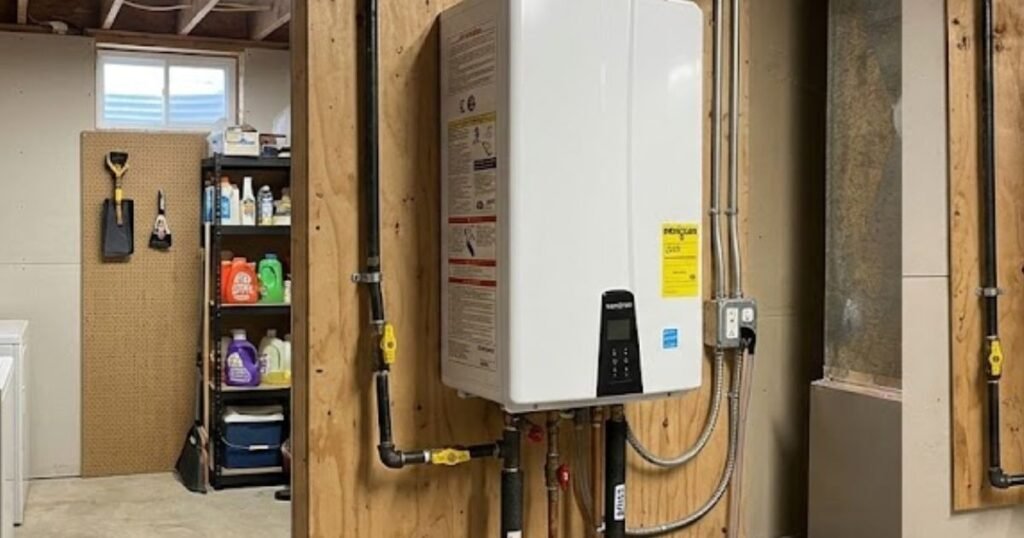
A tankless water heater also called an on-demand or instantaneous water heater doesn’t store hot water at all. Instead, cold water runs through a heat exchanger and gets heated instantly as it flows toward your faucet or showerhead. When you turn off the tap, the unit shuts off too.
That’s a big departure from a traditional storage tank heater, which keeps 40 to 80 gallons of water hot around the clock, whether you’re using it or not. All that “standby” heating adds up on your gas or electric bill.
Homeowners typically upgrade to tankless for three reasons:
- Continuous hot water, even for back-to-back showers
- Lower standby energy losses
- A compact wall-mounted unit that frees up floor space
Once you’ve decided tankless is the way to go, the next decision condensing or non-condensing determines how efficient, how expensive to install, and how much maintenance your system will need.
READ MORE: Best Tankless Water Heater— Top Picks, Costs & Buyer’s Guide
What Is a Condensing Tankless Water Heater?
A condensing tankless water heater uses two heat exchangers instead of one. After the burner heats water in the primary heat exchanger, the still-hot exhaust gas passes through a second exchanger, where it transfers additional heat to the incoming cold water before it leaves the unit.
As those exhaust gases cool, water vapor inside them condenses into liquid hence the name “condensing.” That condensation process is what allows the unit to squeeze extra efficiency out of fuel that a non-condensing model would simply vent outside as waste heat.
Key traits of condensing models:
- Secondary heat exchanger for heat recovery
- Exhaust gases exit much cooler (often under 100°F)
- Higher Uniform Energy Factor (UEF), typically 0.90–0.98
- Can be vented with PVC, CPVC, or polypropylene pipe instead of metal
- Requires a condensate drain line to remove the acidic water byproduct
- Most ENERGY STAR-certified gas tankless models use condensing technology, since ENERGY STAR’s efficiency thresholds are difficult to hit without a secondary heat exchanger
What Is a Non-Condensing Tankless Water Heater?
A non-condensing tankless water heater relies on a single heat exchanger. The burner heats the water, and the hot exhaust gas is vented straight outside no second pass to recapture leftover heat.
Because that exhaust gas is still very hot when it leaves the unit (often 300°F to 400°F+), non-condensing models need venting materials that can handle serious heat, like Category III stainless steel. That’s the trade-off for a simpler design and a lower sticker price.
Key traits of non-condensing models:
- Single heat exchanger, more straightforward internal design
- Exhaust exits hot, requiring metal venting
- Lower UEF, typically 0.80–0.85
- No condensate drain needed
- Common in replacement projects where stainless venting already exists, or in homes with lower hot water demand
READ MORE: Tankless Water Heater vs Tank Water Heater: Which Is Better?
Key Differences Between Condensing and Non-Condensing Tankless Water Heaters
1. Efficiency
The extra heat exchanger in a condensing unit is the whole ballgame. By recovering heat that would otherwise be lost, condensing models reach UEF ratings of roughly 0.90 to 0.98, compared to about 0.80 to 0.85 for non-condensing units.
In practical terms, that’s a 10–15% difference in how much of your fuel dollar actually turns into hot water rather than escaping through the vent. Over a year, that gap can translate into meaningful gas savings, especially for households that use a lot of hot water.
2. Installation Cost
Sticker price tells only part of the story. A condensing unit typically costs more upfront, but it can use inexpensive PVC venting (roughly $3–$6 per linear foot). A non-condensing unit costs less to buy, but its required stainless steel venting can run $18–$100 per linear foot depending on length and routing.
On a home where the water heater sits far from an exterior wall or has to vent through a roof, that venting cost difference alone can close much of the price gap between the two technologies or even flip it. Fully installed, homeowners can expect roughly $2,400–$5,300 for a condensing system and $1,800–$4,200 for a non-condensing one, though these ranges vary a lot by region, labor rates, and how much rerouting the job requires.
3. Venting Requirements
- Condensing: PVC, CPVC, or polypropylene — lightweight, inexpensive, and flexible to route
- Non-condensing: Category III stainless steel — durable but pricier, heavier, and less forgiving to install
Because condensing exhaust cools to under 100°F, it doesn’t need the same heat-resistant materials that non-condensing exhaust (300°F–400°F+) demands. That’s a major reason condensing installations have become more common in tight retrofits and multi-story homes.
4. Maintenance Requirements
Both types need an annual flush to clear mineral scale from the heat exchanger, which matters a lot in hard-water regions. Condensing units have one extra task: the condensate trap and drain line need periodic inspection, since condensate is mildly acidic and can corrode unprotected drain materials over time if ignored. Non-condensing units skip that step entirely, which some homeowners see as a maintenance advantage.
5. Lifespan
Both condensing and non-condensing tankless water heaters typically last 15 to 20 years, and well-maintained units especially in areas with soft water can push past 25 years. The type of heat exchanger doesn’t change the expected lifespan much; what matters more is water hardness, installation quality, and how consistently the unit gets serviced.
6. Performance in Cold Climates
In regions where incoming groundwater is cold, a tankless unit has to work harder to raise the temperature to your setpoint. Condensing units have an edge here: the secondary heat exchanger recovers extra heat that helps offset the added burner workload, which can mean better efficiency and more consistent output for large or high-demand households running multiple fixtures at once (shower, dishwasher, and washing machine simultaneously, for example).
7. Environmental Impact
Because condensing models burn less fuel for the same amount of hot water, they produce fewer combustion byproducts per gallon heated. For homeowners focused on reducing their household’s fuel consumption and emissions, the efficiency edge of condensing technology adds up over the appliance’s 15–20+ year life.
Pros and Cons
Condensing Tankless Water Heater
Pros
- Highest efficiency available in gas tankless (UEF up to ~0.98)
- Lower-cost PVC venting can offset the higher unit price
- Lower annual gas bills
- Frequently ENERGY STAR-certified
- Well suited to large households and cold climates
Cons
- Higher upfront equipment cost
- Requires a condensate drain and periodic trap maintenance
- Condensate is mildly acidic and needs proper drainage materials
- More internal components can mean a pricier repair if something fails
READ MORE: Carrier Heat Pump Reviews — Models, Costs, Pros & Cons
Non-Condensing Tankless Water Heater
Pros
- Lower purchase price
- Simpler design, fewer components to maintain
- No condensate drain to manage
- Straightforward for like-for-like replacements where stainless venting already exists
Cons
- Lower efficiency, higher ongoing fuel costs
- Stainless steel venting can be expensive per foot
- Exhaust runs hot, limiting some installation locations
- Rarely qualifies for the top-tier efficiency rebates
Installation Cost Comparison (USA)
| Cost Category | Condensing | Non-Condensing |
| Equipment | $1,000–$2,200 | $500–$1,500 |
| Professional Installation (labor) | $500–$1,500 | $500–$1,500 |
| Venting | $3–$6/ft (PVC) | $18–$100/ft (stainless steel) |
| Condensate Drain | $100–$300 | Not applicable |
| Annual Maintenance | $150–$300 | $150–$250 |
| Estimated Total Installed Cost | $2,400–$5,300 | $1,800–$4,200 |
Actual pricing varies widely by ZIP code, local labor rates, home layout, existing gas line capacity, and whether the fuel is natural gas or propane. Always get at least two or three quotes from licensed local installers before committing.
Energy Savings Comparison
Condensing gas tankless models recover extra heat from exhaust gases that a non-condensing unit simply loses, which typically translates to $200–$400 or more in annual gas savings for a household with average-to-high hot water use, depending on local utility rates and usage patterns. Over a 15- to 20-year lifespan, that gap can add up to a substantial return on the higher upfront investment.
For homeowners deciding whether to pay more upfront, a condensing unit tends to make the most financial sense when:
- You plan to stay in the home long-term (7+ years)
- Your household uses a lot of hot water daily
- Local utility or state rebates are available for high-efficiency equipment
- The venting run is long enough that PVC’s lower cost meaningfully offsets the unit price
READ MORE: Best Honeywell Thermostat Models: Buyer’s Guide & Comparison
Which Homeowners Should Choose a Condensing Tankless Water Heater?
- Large families who run multiple hot water fixtures at once
- High hot water demand households, including those with soaking tubs or multiple bathrooms in regular use
- Cold climate homes, where incoming water temperatures are low for much of the year
- Long-term homeowners who’ll stay in the house long enough to recoup the higher upfront cost through fuel savings
- Energy-conscious buyers who prioritize lower utility bills and reduced fuel consumption over the lowest sticker price
Who Should Choose a Non-Condensing Tankless Water Heater?
- Budget-conscious buyers who want the lowest possible upfront cost
- Small households with modest, predictable hot water use
- Vacation or seasonal homes where usage is occasional and payback time on efficiency is less relevant
- Replacement projects where compatible stainless steel venting is already in place from a previous unit
- Homes with moderate hot water demand that don’t need maximum efficiency to stay comfortable
Real-Life Examples
Family of Five: With five people showering, doing laundry, and running the dishwasher on overlapping schedules, this household uses a lot of hot water every single day. A condensing unit’s higher efficiency and consistent output make it the better long-term fit, even with the higher upfront cost.
Retired Couple: Two people with lighter, more predictable hot water use may not need top-tier efficiency to stay comfortable. If their existing venting is already stainless steel from a prior unit, a non-condensing replacement can be the more cost-effective choice.
Rental Property Owner: For a landlord prioritizing low upfront cost and simple maintenance across multiple units, a non-condensing model is often easier to budget for and service, especially if tenants have moderate usage patterns.
First-Time Homeowner: Someone planning to stay in their home for many years, and looking to keep long-term utility bills predictable, is a strong candidate for a condensing unit — the fuel savings compound over a decade-plus of ownership.
Common Installation Mistakes
Mistakes to Avoid
- Undersized gas lines — Tankless units have high peak gas demand; an undersized line can starve the burner and hurt performance.
- Improper venting — Wrong venting material, incorrect slope, or termination too close to windows or intakes can cause code violations and safety issues.
- Ignoring water hardness — Hard water accelerates scale buildup in the heat exchanger, shortening lifespan if left unaddressed.
- Skipping annual maintenance — Deferred flushing is one of the most common causes of early heat exchanger failure.
- Incorrect unit sizing — An undersized unit can’t keep up with simultaneous fixtures; an oversized one wastes money.
- DIY installation risks — Gas line work, venting, and electrical connections generally require a licensed professional to meet code and keep warranties valid.
Expert Buying Tips
- Compare UEF ratings side by side, not just brand names.
- Size the unit to your home’s peak simultaneous hot water demand, not just average use.
- Factor in long-term utility savings, not just the sticker price.
- Check warranty coverage on both the heat exchanger and parts/labor.
- Budget for annual maintenance from day one.
- Evaluate your home’s venting path before choosing a type.
- Ask your installer about local rebates for high-efficiency models.
- Consider your water hardness and whether a softener makes sense alongside the new unit.
- Think about how long you plan to stay in the home before committing to the higher-efficiency option.
- Get at least two or three quotes from licensed local installers.
READ MORE: Best Navien Tankless Water Heaters: Reviews & Pricing
Condensing vs Non-Condensing Tankless Water Heater: Side-by-Side Verdict
| Category | Condensing | Non-Condensing |
| Efficiency | ★★★★★ | ★★★☆☆ |
| Installation | ★★★☆☆ | ★★★★☆ |
| Maintenance | ★★★☆☆ | ★★★★☆ |
| Upfront Cost | ★★☆☆☆ | ★★★★☆ |
| Durability | ★★★★☆ | ★★★★☆ |
| Cold-Climate Performance | ★★★★★ | ★★★☆☆ |
| Best Value | Long-term homeowners | Budget-focused buyers |
| Best Long-Term Investment | Condensing | — |
| Best for Small Homes | — | Non-Condensing |
| Best for Large Homes | Condensing | — |
Final Verdict
There’s no single “best” answer — it depends on your household and your priorities. If you plan to stay in your home for years, use a lot of hot water, or live somewhere with cold winters, a condensing tankless water heater’s higher efficiency and PVC venting savings usually pay for themselves over time. If you’re working with a tighter budget, have modest hot water needs, or already have compatible stainless steel venting in place, a non-condensing unit is a perfectly reasonable, lower-cost choice that will still outlast a traditional tank heater by years.
FAQs
Is a condensing tankless water heater worth the extra cost?
For most households, yes — especially if you plan to stay in the home long-term. The higher UEF (often 0.90–0.98) means lower monthly gas bills, and the ability to use inexpensive PVC venting instead of stainless steel can offset a good chunk of the higher equipment price.
What is the difference between condensing and non-condensing tankless water heaters?
The core difference is heat exchanger design. Condensing units use two heat exchangers to recover extra heat from exhaust gases, pushing efficiency up to 0.90–0.98 UEF. Non-condensing units use a single heat exchanger, run at roughly 0.80–0.85 UEF.
Which tankless water heater lasts longer?
Both types typically last 15 to 20 years with proper maintenance, and some well-cared-for units reach 25 years or more. Heat exchanger type doesn’t significantly affect lifespan on its own water hardness, installation quality. Consistent annual maintenance matters far more than whether the unit is condensing or non-condensing.
Can I replace a non-condensing unit with a condensing model?
Usually, yes, but it typically requires re-venting. Condensing units need PVC, CPVC, or polypropylene venting rather than the stainless steel used for non-condensing systems, so your installer will likely need to run new venting and add a condensate drain line.
Which type of tankless water heater saves the most money over time?
Condensing models generally save more over the long run because of their higher efficiency — often $200–$400 or more per year in fuel costs for an average-to-high-use household.
Maintenance Checklist
- [ ] Flush the unit annually to remove mineral scale
- [ ] Inspect and clean the condensate trap (condensing units only)
- [ ] Clean the inlet water filter every 6 months
- [ ] Test the pressure relief valve annually
- [ ] Visually inspect venting for damage or blockages
- [ ] Schedule a professional inspection once a year
Buying Checklist Before Installation
- [ ] Confirm your home’s peak simultaneous hot water demand
- [ ] Check your existing gas line capacity
- [ ] Evaluate the venting path and material needed
- [ ] Compare UEF ratings across shortlisted models
- [ ] Get 2–3 quotes from licensed local installers
- [ ] Check manufacturer warranty terms
- [ ] Research current local and utility rebates
- [ ] Test your water hardness and consider a softener if needed