A Bosch on demand water heater commonly known as a tankless water heater heats water directly as it flows through the unit without storing a single gallon in a massive tank.
For over a century, Bosch Thermotechnology has stood as a hallmark of precision engineering and long-term durability. American homeowners and seniors increasingly turn to Bosch tankless systems because they free up valuable basement or closet square footage, cut energy waste, and deliver continuous hot water on demand.
In this guide, we’ll walk through how Bosch tankless systems work, review five of the brand’s most popular models, compare Bosch to competitors and answer the questions homeowners ask most before buying. Lets deep dive into “Bosch On Demand Water Heater | Cost, Review & Comparison“
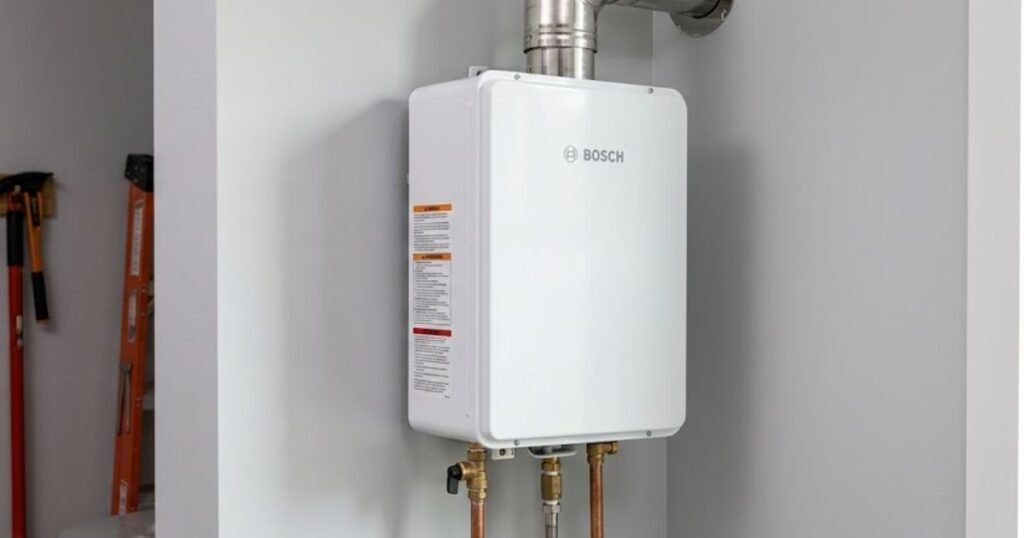
What Is a Bosch On Demand Water Heater?
A Bosch on demand water heater, sometimes called a tankless or instantaneous water heater heats water only when a tap is opened. Cold water travels through a heat exchanger, is warmed almost instantly by a gas burner or electric element, and comes out the other side at your set temperature. When you shut the faucet off, the unit shuts off too.
How it’s different from a tank water heater:
- No 40–50 gallon tank sitting full of hot water 24/7
- No standby heat loss, since nothing is heated until you ask for it
- Continuous hot water instead of a fixed supply that runs out
- A wall-mounted footprint about the size of a small suitcase
- Typically 15–20+ years of service life versus 8–12 years for tank units
Gas vs. electric Bosch models, in brief:
- Gas tankless (Therm series): Higher flow rates, better suited for whole-house use in larger homes, requires venting and a gas line
- Electric tankless (Tronic series): Simpler installation with no venting, available in both whole-house and point-of-use sizes, but needs significant electrical capacity for larger units
READ MORE: AO Smith vs. Rheem Water Heaters: Comparison & Expert Reviews
Why Choose Bosch?
Bosch built its reputation on German engineering standards, and that shows up in the tankless lineup in a few concrete ways:
- Reliability and lifespan. Bosch backs Therm gas models with up to a 15-year heat exchanger warranty for single-family, non-recirculating installs, and advertises a 20+ year expected service life on several models.
- Compact design. From a wall-mounted whole-house gas unit to a shoebox-sized electric point-of-use heater, Bosch units save space versus a bulky storage tank.
- Low maintenance. No tank means no large-reservoir sediment buildup, just periodic heat exchanger descaling, especially in hard-water regions.
- Energy efficiency. Non-condensing gas models run around 82–83% thermal efficiency; electric tankless units run 95–96%, since nearly all the electricity goes directly into heating water.
- Warranty backing. Coverage generally includes a long-term heat exchanger warranty, a shorter parts warranty (commonly 5 years on gas models), and 1 year of labor terms vary by model, so confirm before buying.
- Whole-house and point-of-use options. Bosch competes seriously in both categories a 199,000 BTU gas unit for a large family, or a 3.5–6.5 kW electric unit for a single sink or RV.
How Bosch On Demand Water Heaters Work
Every Bosch tankless unit follows roughly the same sequence:
- A flow sensor detects water movement the moment you turn on a hot tap, and signals the unit to activate typically at a minimum flow of around 0.5 GPM.
- The heat exchanger takes over. In gas models, a modulating burner heats water as it passes through a copper or stainless heat exchanger. In electric models, one or more heating elements do the same job.
- Temperature modulation kicks in. Bosch units continuously adjust burner output or element power to hold your set output temperature steady, even if flow rate changes mid-shower.
- Hot water flows out on demand for as long as the tap stays open there’s no tank to run dry.
- The unit shuts off automatically the instant flow drops below the activation threshold, so no energy is wasted once you turn off the faucet.
READ MORE: Best Tankless Water Heater— Top Picks, Costs & Buyer’s Guide
Top 5 Bosch On Demand Water Heater Reviews
1: Bosch Therm 940 ES NG Tankless Water Heater (Natural Gas)
The Bosch Therm 940 ES NG is a heavy-duty, high-efficiency natural gas tankless water heater engineered for whole-house residential demand. Delivering a maximum output of up to 9.4 GPM and an input rating of 199,000 BTU, this unit can comfortably support 2 to 3 simultaneous hot water applications in moderate climates.
Key Performance Features & Specifications
- Max Heating Capacity: 199,000 BTU/hr
- Max Flow Capacity: 9.4 GPM at a 35°F rise; 6.0 GPM at a 55°F rise
- Ignition Type: Electronic ignition (no standing pilot light)
- Venting: 3-inch direct vent stainless steel system
Performance & Energy Efficiency
Operating at a 0.83 Energy Factor, the Therm 940 ES modulates gas consumption dynamically. It drops fuel consumption down to 19,900 BTU during low demand, ensuring minimal fuel usage for small tasks.
Installation Considerations
Requires a 3/4-inch natural gas supply line and dedicated stainless steel direct venting. Professional plumbing and HVAC installation is strongly recommended due to gas line pressure and safety requirements.
Final Verdict
The best choice for larger families and mid-to-large American homes seeking non-condensing gas reliability and massive hot water output.

2: Bosch Therm 830 ES LP Tankless Water Heater (Liquid Propane)
Designed specifically for rural homes, cabins, and properties relying on propane tanks, the Bosch Therm 830 ES LP provides up to 8.3 GPM of continuous hot water at a 35°F temperature rise. Driven by a 175,000 BTU propane burner, it easily supplies 2 to 3 fixtures at once.
Key Performance Features & Specifications
- Max Heating Capacity: 175,000 BTU/hr
- Max Flow Capacity: 8.3 GPM at 35°F rise; 5.3 GPM at 55°F rise
- Activation Rate: Low 0.5 GPM minimum activation flow
- Dimensions: 17.88″ W x 31.5″ H x 11.25″ D
Performance & Energy Efficiency
Featuring built-in freeze protection and electronic safety controls, this unit delivers consistent output temperatures within +/- 2°F across varying water pressures.
Installation Considerations
Propane supply lines require precise pressure regulation (3/4-inch NPT connections). Can be installed indoors or outdoors using an optional Bosch outdoor kit.
Final Verdict
An excellent, durable option for homeowners outside municipal natural gas service zones who need high-flow liquid propane heating.
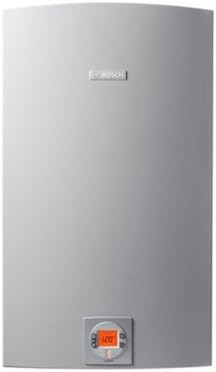
3: Bosch Tronic 6100 Electric Tankless Water Heater (27 kW)
The Bosch Tronic TR6100C-27 is a whole-house electric tankless solution that operates at 95%+ thermal efficiency. Generating 27 kW of heating power, it is designed to replace traditional electric water heaters in small-to-medium single-family homes or condominiums.
Key Performance Features & Specifications
- Power Output: 27 kW at 240 Volts
- Thermostatic Modulation: Maintains constant output temperatures (adjustable 86°F–125°F)
- Compact Footprint: Mounts flat against walls, completely eliminating tank space requirements.
- No Venting: Requires zero exhaust pipes or outdoor flues.
Performance & Energy Efficiency
With no standby heat loss and a UEF rating of ~0.94, this unit ensures almost every watt of electricity translates directly into hot water.
Installation Requirements
Electrical panel capacity is vital. The 27 kW model typically requires three dedicated double-pole breakers at 240V with heavy-gauge copper wiring. Always check panel capacity with a licensed electrician before purchase.
Final Verdict
Ideal for all-electric homes seeking to reclaim utility room space while enjoying smooth, thermostatically controlled hot water.

4: Bosch Tronic 6100 Electric Tankless Water Heater (18 kW)
The Bosch Tronic TR6100C-18 delivers 18 kW of heating capacity, making it a targeted fit for 1-bathroom homes, townhouses, annexes, or warm-climate apartments. It provides up to 3.51 GPM at a 77°F rise with 95% thermal efficiency.
Key Performance Features & Specifications
- Power Output: 18 kW at 240 Volts
- Electrical Requirement: 3 x dedicated double-pole 30-amp breakers (10 AWG wire)
- Connections: 3/4-inch MNPT inlet and outlet
- Weight: Lightweight design (~14.8 lbs)
Performance & Efficiency
Eliminates standby loss entirely. Integrated dynamic modulation scales power down when demand drops or incoming water is warmer.
Advantages & Drawbacks
- Advantages: Compact size, zero emissions, easy electronic controls, precise temperature control.
- Drawbacks: Flow rate is constrained in cold northern winter climates where incoming groundwater temperatures drop significantly.
Final Verdict
An outstanding replacement choice for small electric tank heaters in 1-bathroom residences.
5: Bosch Tronic 4000 Electric Tankless Water Heater (6.5 kW)
The Bosch Tronic 4000 (TR4000C-6) is a point-of-use electric tankless water heater built specifically for under-sink or single-fixture installations. Delivering 6.5 kW of targeted heating, it supplies instant hot water directly to kitchen sinks, commercial wash basins, powder rooms, or RV/outbuilding setups.
Key Performance Features & Specifications
- Power Output: 6.5 kW at 230V AC
- Thermal Efficiency: 96% efficient
- Low Flow Activation: Fires up at just 0.55 GPM
- Flexible Mounting: 360-degree wall mounting orientation
Performance & Application
Installed directly beneath a sink, the Tronic 4000 eliminates the frustrating 60-second wait for hot water to travel from a basement heater through long pipe runs.
Final Verdict
The ultimate point-of-use solution for isolated sinks, senior powder rooms, garage workshops, or commercial restrooms.

READ MORE: Best Bosch Boiler Review: Greenstar Models Rated
Comparison Table: Top 5 Bosch Water Heater
| Model | Fuel Type | Power / BTU | Flow Rate | Ideal Home Size | Installation | Warranty (Heat Exchanger) | Best For |
| Therm 940 ES | Natural Gas | 199,000 BTU | Up to 11 GPM | 4+ bedrooms | Professional, vented | Up to 15 years* | Large families |
| Therm 830 ES | Propane/LP | 175,000 BTU | Up to 11.6 GPM | 2–4 bedrooms | Professional, vented | Up to 15 years* | Mid-size, propane homes |
| Tronic 6100 (27 kW) | Electric | 27 kW | ~5.3 GPM | 1–2 bath, smaller homes | Professional, 200A service | 5 years | No-gas whole-house |
| Tronic 6100 (18 kW) | Electric | 18 kW | ~3.5 GPM | Small homes, 1 bath | Professional, lower amperage | 5 years | Smaller households |
| Tronic 4000 (6.5 kW) | Electric | 6.5 kW | ~1.26 GPM | Single fixture | DIY-friendly, licensed wiring | 5 years (canister) | Point-of-use, RVs, apartments |
*Full 15-year heat exchanger coverage applies to single-family, non-recirculating installations; recirculating or non-residential installs carry shorter terms — confirm current warranty language with Bosch before purchase.
Bosch Water Heater Advantages and Disadvantages
| Pros | Cons |
| Endless hot water — no more “who used it all” arguments | Higher upfront cost than a tank water heater |
| Compact, wall-mounted design saves closet or utility space | Large electric models need serious electrical capacity |
| Long service life (15–20+ years) versus 8–12 for tank units | Gas models require proper venting and gas line sizing |
| No standby energy loss; lower monthly operating costs | Annual descaling is required in hard-water areas |
| Strong heat exchanger warranties (up to 15 years, gas models) | Flow rate can be a limiting factor if oversized demand hits at once |
| Wide range of sizes, from single-sink units to whole-house systems | Professional installation is strongly recommended |
READ MORE: Tankless Water Heater vs Tank Water Heater: Which Is Better?
Gas vs Electric Bosch Tankless Water Heaters
| Factor | Gas (Therm Series) | Electric (Tronic Series) |
| Installation | More involved — gas line, venting, combustion air | Simpler — no venting, but often needs electrical upgrades |
| Unit Cost | Roughly $1,000–$2,600 | Roughly $150–$750 depending on size |
| Operating Expense | Depends on natural gas/propane rates | Depends on local electricity rates; can be higher per gallon in many markets |
| Maintenance | Annual descaling, filter cleaning, vent inspection | Minimal — descaling only, no venting to inspect |
| Flow Rate | Up to about 11 GPM (whole-house capable) | 1.2–5.3 GPM depending on model |
| Best Application | Whole-house use, larger or multi-bathroom homes | Point-of-use, smaller homes, or supplemental heating |
| Lifespan | 15–20+ years with maintenance | 15–20+ years with maintenance |
| Venting | Required — 3″ or 4″ stainless steel vent pipe | Not required |
| Electrical Needs | Standard 120V for controls | 240V; larger units may need 200A service and multiple breakers |
Water Heater Brand Comparison
| Factor | Bosch | Navien | Stiebel Eltron | Rheem | AO Smith |
| Reliability | Very good | Very good | Very good (electric) | Good–very good | Good–very good |
| Technology | Strong, app-connected models | Leading condensing/recirculation tech | Precision electric engineering | Strong smart-home features | Broad product range |
| Energy Efficiency | 82–83% gas, 95%+ electric | Often 95%+ condensing | 95%+ electric | Varies by line | Varies by line |
| Warranty | Up to 15 yrs gas HX; 5 yrs electric | Often up to 15 yrs HX | Model-dependent, generally strong | Model-dependent | Model-dependent, often long on premium lines |
| Maintenance | Annual descaling recommended | Annual descaling recommended | Minimal (electric) | Annual descaling recommended | Annual descaling recommended |
| Price Range | $150 (point-of-use) to ~$2,600 (whole-house gas) | Mid-to-premium | Mid-to-premium (electric) | Budget to premium | Budget to premium |
| Installation Cost | Moderate–high (gas); low–moderate (electric) | Moderate–high | Low–moderate (electric) | Moderate–high | Moderate–high |
| Smart Features | Wi-Fi app on newer gas models | Strong app/recirculation control | Limited smart features | Strong smart-home integration | Growing smart features |
| Best For | Balanced gas + electric lineup | High-efficiency, tech-forward households | Electric-only households, point-of-use | Wide availability, tank + tankless | Broad service network, tank + tankless |
| Overall Value | Strong | Strong, premium-leaning | Strong for electric-only needs | Strong | Strong |
Ratings here reflect general market positioning based on published specifications and industry reporting; always compare specific model numbers, since performance varies within each brand’s lineup.
READ MORE: Carrier Heat Pump Reviews — Models, Costs, Pros & Cons
Bosch On Demand Water Heater Cost
- Purchase price: Point-of-use electric units like the Tronic 4000 typically run $150–$300. Whole-house electric units (Tronic 6100 series) run roughly $500–$800. Gas whole-house units (Therm 830 ES/940 ES) typically run $1,000–$2,600 for the unit alone.
- Installation: Electric tankless installation commonly runs $1,200–$3,000 total (unit plus labor), while gas tankless installation commonly runs $2,000–$5,600 total, largely because of venting and gas line work.
- Maintenance: Annual professional flushing and descaling typically costs $100–$350 per year, more often needed in hard-water regions.
- Repair: Costs vary widely depending on the part, but many common issues (filters, sensors, igniters) are inexpensive compared to a full unit replacement.
- Annual operating costs: Depend heavily on local utility rates and household hot water usage, but tankless systems generally run lower than storage tank equivalents because there’s no standby loss.
Costs vary significantly by region, home layout, and whether your existing gas line, vent, or electrical panel needs upgrading — always get a written, itemized quote from a licensed local installer.
Bosch On Demand Water Heater Installation Guide
- Gas requirements: Adequate gas line sizing to supply the unit’s maximum BTU draw; undersized lines are a common cause of poor performance.
- Electrical requirements: Electric tankless units, especially the Tronic 6100 (27 kW), often require a dedicated high-amperage circuit and may require a panel upgrade.
- Venting: Gas models need 3″ or 4″ stainless steel venting, installed per manufacturer clearance requirements — this is not a place to improvise.
- Water pressure: Confirm your home’s water pressure and flow rate meet the unit’s minimum activation threshold (typically around 0.5 GPM).
- Permits: Most jurisdictions require a permit and inspection for gas line, venting, or electrical work skipping this can void your warranty.
- Professional installation: Strongly recommended for all whole-house models, both gas and electric.
- DIY considerations: Small point-of-use electric units (like the Tronic 4000) are more DIY-accessible, but hardwiring should still be done by, or verified by, a licensed electrician.
Bosch On Demand Water Heater Maintenance Tips
- Annual flushing: Circulate a descaling solution through the unit once a year to clear mineral buildup from the heat exchanger.
- Descaling: More frequent in hard-water areas consider a water softener if you’re seeing scale buildup faster than expected.
- Filter cleaning: Clean the inlet water filter screen periodically to maintain flow and activation performance.
- Water quality: Bosch’s documentation recommends monitoring water hardness, since scale buildup is a leading cause of reduced performance and premature wear.
- Winter protection: Built-in freeze protection helps, but homes in cold climates should still follow manufacturer guidance for freeze-prone installations.
READ MORE: Gas vs Electric Water Heater Running Costs
Common Problems & Troubleshooting
| Problem | Likely Cause | Practical Fix |
| No hot water | Gas supply interrupted, tripped breaker, or clogged filter | Check gas/power supply; clean inlet filter; call a technician if it persists |
| Temperature fluctuation | Flow rate too low or too high for the set temperature | Clean the filter, check for crossover plumbing, adjust set temperature |
| Low flow | Clogged filter, mineral scale buildup, or fixture-side blockage | Clean filter/aerators; schedule a descaling flush |
| Error codes | Varies — ignition, fan, or sensor fault | Consult Bosch’s model-specific troubleshooting guide or call a certified technician |
| Mineral buildup | Hard water without regular descaling | Annual flushing; consider a water softener |
| Ignition problems | Gas supply issue, dirty igniter, or venting blockage | Check gas valve and vent clearance; professional service if unresolved |
| Electric heating issues | Tripped breaker, loose wiring, or failed element | Check breaker and connections; contact a licensed electrician |
Who Should Buy a Bosch On Demand Water Heater?
- Seniors: Lower monthly utility costs and a “set it and forget it” design with minimal upkeep.
- Families: Whole-house gas models like the 940 ES handle back-to-back showers and laundry without running cold.
- Large homes: The 940 ES or cascaded units cover high simultaneous demand.
- Apartments: Point-of-use electric models like the Tronic 4000 are easy to fit in tight utility spaces.
- Vacation homes: No standby loss means no wasted energy heating water in a home that sits empty much of the year.
- Small homes: The Tronic 6100 (18 kW) or Therm 830 ES right-size capacity without overspending.
- Rental properties: Long warranty coverage and low maintenance reduce landlord callbacks over time.
Bosch On Demand Water Heater Buying Guide
Work through these factors in order when narrowing down a model:
- Household size — more bedrooms/bathrooms means you need higher GPM capacity.
- Fuel type — gas offers higher whole-house flow; electric is simpler but flow-limited without major upgrades.
- Groundwater temperature — colder climates need a bigger BTU/kW cushion for the same output GPM.
- Peak demand — count how many fixtures might run hot water simultaneously on a typical morning.
- Flow rate (GPM) — match rated GPM to peak demand, not average demand.
- Electrical capacity — confirm your panel supports a large electric unit before committing.
- Gas availability — natural gas, propane, or none steers you toward gas or electric respectively.
- Budget — factor in installation and infrastructure upgrades, not just the unit’s sticker price.
- Warranty — compare heat exchanger, parts, and labor coverage across the models you’re considering.
- Maintenance needs — hard-water homes should plan for more frequent descaling regardless of brand.
FAQ Section
Are Bosch on demand water heaters reliable?
Yes, Bosch on-demand water heaters are highly reliable. Engineered with premium copper heat exchangers, precise modulating electronic controllers, and built-in diagnostic safety monitors, Bosch tankless units routinely operate for 15 to 20 years with basic annual maintenance.
How long does a Bosch tankless water heater last?
A Bosch tankless water heater typically lasts between 15 and 20 years. This is nearly double the average 8 to 12-year lifespan of standard storage tank water heaters, making it a sound long-term home investment.
Is Bosch better than Navien?
Bosch and Navien are both premier brands. Bosch excels in durable non-condensing gas and wide-ranging electric tankless options, offering outstanding value and German engineering. Navien focuses primarily on high-efficiency condensing gas units with built-in recirculation pumps. Bosch is often more cost-effective upfront and offers a broader electric product lineup.
What size Bosch tankless water heater do I need?
For a 3 to 4-bedroom home in colder climates, choose a gas model like the Bosch Therm 940 ES (199,000 BTU / up to 9.4 GPM). For 1 to 2-bathroom homes in moderate climates, a Bosch Tronic 6100 electric model (18 kW or 27 kW) is generally sufficient.
How much does it cost to install a Bosch on demand water heater?
Installation costs range from $1,500 to $5,200 total, including the unit purchase, plumber labor, permits, and any necessary electrical or gas venting modifications.
Bosch Warranty Overview
Warranty terms vary by product line, so confirm current coverage for your specific model before buying:
- Therm gas models: Up to 15 years on the heat exchanger for single-family, non-recirculating installs (shorter for recirculating or non-residential use), commonly 5 years on parts and 1 year on labor.
- Tronic electric models: Generally shorter — around 5 years on the heat exchanger/canister and 2 years on parts, varying between the point-of-use and whole-house electric lines.
- Bosch typically requires warranty registration after installation, and coverage is usually non-transferable to a future homeowner.
Conclusion
A Bosch on demand water heater is a strong choice whether you need a whole-house gas system for a busy family or a small electric unit to fix a slow-to-warm-up sink. The lineup covers a wide range of household sizes and budgets, backed by warranties that hold up well against the competition. Match the model to your home’s actual hot water demand, budget for professional installation, and stay on top of annual maintenance — and a Bosch tankless system should deliver reliable, endless hot water for well over a decade. If you’re ready to move forward, get quotes from two or three licensed local installers so you can compare both equipment and installation costs before you buy.


Pingback: Plumbing Repair Cost (2026 Guide): How Much Does a Plumber Cost? - Plumbing Guider