For a single bathroom, a guest suite, a detached office, or a kitchen sink too far from the main water heater, a small tankless electric unit can solve a real problem in a tight space. But “small” doesn’t mean “right for your situation.” Getting the size correct kilowatts, amps, and GPM (gallons per minute) matters far more than grabbing the smallest box on the shelf. Undersize it and you’ll get lukewarm water halfway through a shower; oversize it and you may trigger electrical work you didn’t need.
Below, we cover how these heaters work, how to size one, and review seven small electric tankless water heaters ranging from single-sink point-of-use units to models that can support a shower. Lets deep dive into “Best 7 Small Electric Tankless Water Heater | Review, Cost & Comparison”
What Is a Small Electric Tankless Water Heater?
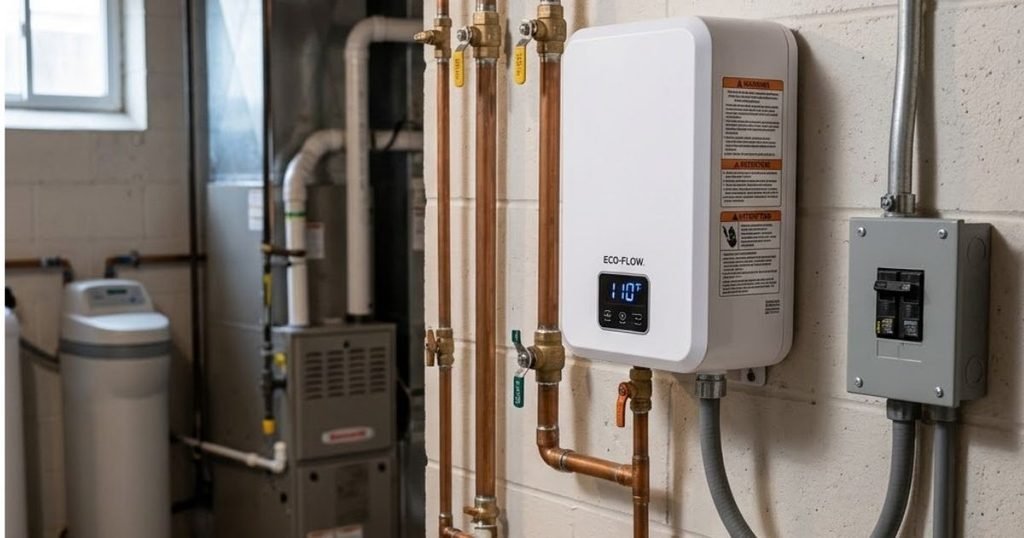
A small electric tankless water heater is an on-demand water heating system designed to deliver hot water instantly without storing it in a tank. Measuring roughly the size of a briefcase or a shoebox, these units mount directly to a wall near the point of use or in a small mechanical space.
How It Works
- Demand Detection: When you open a hot water tap, cold water flows into the inlet pipe.
- Activation: A built-in flow sensor detects the moving water and signals the internal control board.
- Instant Heating: High-powered bare-wire or copper heating elements energize within seconds.
- Modulation: The unit measures incoming water temperature and flow rate, adjusting power draw to hit your target output temperature.
- Shut Off: As soon as you close the fixture, flow stops, and the heating elements instantly turn off.
Advantages:
- Compact footprint for a closet, wall, or under-sink space
- No tank, so no standby heat loss between uses
- Hot water on demand instead of a finite supply
- No combustion or flue venting required
- Can sit close to the fixture it serves, cutting wait time
Limitations:
- Significant power draw — often 30-75+ amps depending on kW rating
- Actual GPM depends heavily on how much the water needs heating
- Cold incoming groundwater reduces usable flow
- Many installs need a dedicated 240V circuit, sometimes a panel upgrade
- Small point-of-use models won’t automatically cover a whole house
READ MORE: AO Smith vs. Rheem Water Heaters: Comparison & Expert Reviews
How to Choose the Right Small Electric Tankless Water Heater
Sizing an electric tankless water heater requires a clear understanding of power, flow rate, incoming water temperature, and your home’s electrical capacity.
1. Kilowatt Rating (kW)
The kilowatt rating measures the electrical heating capacity of the unit.
- 8kW Models: Designed primarily for single point-of-use sinks or low-flow showers in warm southern climates.
- 11kW to 14kW Models: Suitable for bathroom sinks and single-shower applications in mild-to-warm regions.
- 18kW Models: Capable of running a standard shower and a sink simultaneously in warmer areas, or a single shower in moderate climates.
2. Flow Rate (Gallons Per Minute / GPM)
Every plumbing fixture requires a specific volume of water per minute:
- Bathroom Sink Faucet: 0.5 to 1.5 GPM
- Water-Saving Showerhead: 1.5 to 1.75 GPM
- Standard Showerhead: 2.0 to 2.5 GPM
- Kitchen Faucet: 1.5 to 2.0 GPM
Add together the GPM of the fixtures you plan to operate at the same time to establish your required target flow rate.
3. Temperature Rise
Temperature rise is the difference between the cold incoming water entering your home and your desired hot water output (typically set to 105°F–120°F).
Ground water temperatures vary drastically across the United States. Northern regions (40°F–50°F ground water) require far more kilowatt capacity to heat the same GPM than southern regions (65°F–75°F ground water).
4. Voltage and Electrical Requirements
Most electric tankless water heaters require a 240V single-phase electrical supply. Smaller 120V models exist, but they are limited to warm-water handwashing at very low flow rates.
Key electrical parameters to verify before purchasing include:
- Amperage Draw: Total current required at max load (e.g., 33A to 75A+).
- Breaker Size: Requires dedicated double-pole breakers (e.g., 40A, 60A, or multiple double-pole breakers).
- Wire Gauge: Heavy copper wiring (e.g., 8 AWG, 6 AWG, or 4 AWG) based on amperage draw and distance to the electrical panel.
- Main Panel Capacity: Most 14kW to 18kW units require at least a 150-amp or 200-amp main service panel.
Always follow the specific manufacturer installation manual and consult a qualified electrician to ensure compliance with the National Electrical Code (NEC) and local codes.
5. Activation Flow Rate
The activation flow rate is the minimum water movement required for the heating elements to turn on (often between 0.25 GPM and 0.5 GPM). If your sink uses an ultra-low-flow aerator (like 0.3 GPM), pick a heater with a low activation threshold so it activates reliably.
6. Installation Location & Clearance
Select a clean, dry, indoor wall location close to the target fixtures to minimize pipe heat loss. Ensure sufficient clearance around the cabinet for plumbing connections, electrical conduit, and future servicing or filter cleaning.
READ MORE: Best Tankless Electric Water Heaters: Top 5 Models for U.S. Homes
7 Best Small Electric Tankless Water Heaters
These seven span the category, from single-sink units to compact 18kW heaters. The “best” one depends entirely on what you’re asking it to do.
1. Rheem 8kW Multi Fixture Tankless Electric Water Heater
Rheem’s 8kW unit is built as a reliable, point-of-use workhorse for tight spaces. It is best suited for dedicated single-sink stations, powder rooms, or a single low-flow shower in warm southern climates.
| RHEEM 8kW SPECIFICATIONS | |
| Power Output: 8 kW | Voltage: 240V |
| Max Current Draw: 33.3A | Recommended Breaker: 1x 40A double-pole |
| Wire Gauge: 8 AWG | Plumbing Connections: 1/2″ NPT |
| Dimensions: 12.6″ x 7.4″ x 3.6″ | Key Feature: Self-modulating copper elements |
Performance & Operation
The unit incorporates electronic self-modulation to adjust power consumption based on real-time flow rate and setpoint targets. Its front panel features a digital display with degree-by-degree temperature adjustment. Dual copper heating elements ensure high thermal conductivity and straightforward serviceability. Installing this unit close to the fixture delivers near-instant hot water, reducing line purge waste.
Real-World Limitations
In northern regions where groundwater drops into the 40°F range, an 8kW output cannot maintain shower-level temperatures; its utility is strictly limited to handwashing and sink faucets.
- Pros: Established manufacturer support and warranty; precise digital temperature setting; compact under-sink footprint; single 40A breaker setup.
- Cons: Insufficient flow for colder climates; cannot support simultaneous fixtures.
- Ideal For: Bathroom vanity sinks, powder rooms, or low-flow showers in warm-climate states.

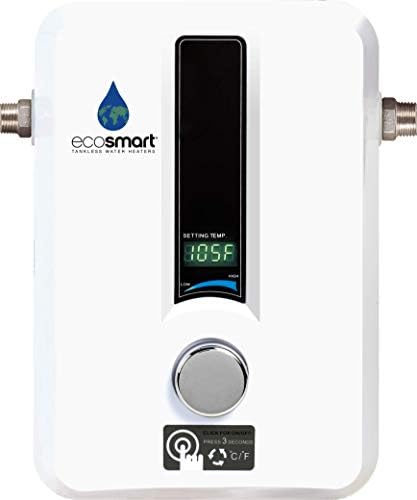
2. EcoSmart ECO 8 Tankless Water Heater
The ECO 8 is a specialized point-of-use model optimized for low-flow activation and energy efficiency in single-fixture environments.
| ECOSMART ECO 8 SPECIFICATIONS | |
| Power Output: 8 kW | Voltage: 240V |
| Max Current Draw: 33A | Recommended Breaker: 1x 40A double-pole |
| Wire Gauge: 8 AWG | Plumbing Connections: 1/2″ NPT CF |
| Activation Flow: 0.3 GPM | Key Feature: Low-flow activation threshold |
Performance & Operation
Equipped with a low 0.3 GPM activation threshold, the ECO 8 engages reliably even when paired with water-saving aerators. An integrated digital thermostat with a turn-knob interface allows accurate 1-degree temperature adjustments. Self-modulating technology dynamically scales power draw relative to demand.
Real-World Limitations
While it handles one sink or faucet anywhere in North America, its continuous flow rate drops significantly with groundwater temperatures below 50°F, restricting shower applications to warm southern regions.
- Pros: Activates under minimal water flow (0.3 GPM); standard replaceable heating elements simplify maintenance; intuitive digital knob control; low standby loss.
- Cons: Strictly limited to single point-of-use or single low-flow demand; performance drops sharp in cold climates.
- Ideal For: Point-of-use bathroom sinks, commercial handwashing stations, or single-fixture applications.

3. ThermoMate 8kW Tankless Water Heater
Engineered as an entry-level point-of-use heater, the ThermoMate 8kW offers a compact, cost-effective solution for low-demand fixtures.
| THERMOMATE 8kW SPECIFICATIONS | |
| Power Output: 8 kW | Voltage: 240V |
| Max Current Draw: ~33.3A | Recommended Breaker: 1x 40A double-pole |
| Wire Gauge: 8 AWG | Plumbing Connections: 1/2″ NPT |
| Max Claimed Flow: Up to 1.94 GPM | Key Feature: Cast-aluminum heating module |
Performance & Operation
This model utilizes a cast-aluminum heating module that separates the water channel from the heating elements. This design reduces direct scale buildup and mineral corrosion on the element surfaces. It includes digital temperature readouts, auto-modulating logic, and over-temperature safety cutoffs.
Real-World Limitations
The rated 1.94 GPM flow rate reflects performance with warm incoming groundwater (70°F+). In standard or colder installations, real-world flow rates for hot water drop considerably.
- Pros: Highly economical price point; isolated water paths reduce mineral scaling; compact casing; straightforward single-circuit installation.
- Cons: Real-world flow drops rapidly with cooler incoming water; unsuitable for home showers in northern states.
- Ideal For: Budget-conscious sink retrofits, wet bars, or utility sinks.
4. APUS 14kW Tankless Water Heater
The APUS 14kW unit serves as a bridge between point-of-use sink units and whole-home systems, generating sufficient thermal output for single-shower setups or small apartments in moderate climates.
| APUS 14kW SPECIFICATIONS | |
| Power Output: 14 kW | Voltage: 240V |
| Max Current Draw: ~58.3A | Recommended Breaker: 1x 60A double-pole |
| Wire Gauge: 6 AWG | Plumbing Connections: 1/2″ NPT |
| Max Claimed Flow: Up to 3.3 GPM | Key Feature: Electronic self-modulation |
Performance & Operation
Capable of delivering up to 3.3 GPM under optimal warm-water conditions, the APUS 14kW maintains consistent outlet temperatures via automated power modulation during pressure shifts. A digital display screen allows straightforward thermostat management.
Real-World Limitations
Drawing up to ~58.3 amps on a single circuit, this heater demands heavy 6 AWG copper wire and a dedicated 60A double-pole breaker. Homeowners must ensure their primary service panel has sufficient headroom (150A to 200A main recommended).
- Pros: Higher thermal output supports a continuous 1.5–2.0 GPM shower in mild zones; clear digital interface; compact wall-mount profile.
- Cons: High single-circuit amp draw (59A peak); flow rate declines noticeably under cold winter ground temperatures.
- Ideal For: Studio apartments, guest houses, or single-shower retrofits in moderate-to-warm climates.

5. Westinghouse 14kW Tankless Water Heater
Combining mid-range power with smart home integration, the Westinghouse 14kW model provides continuous hot water alongside digital monitoring options.
| WESTINGHOUSE 14kW SPECIFICATIONS | |
| Power Output: 14 kW | Voltage: 240V |
| Max Current Draw: 59A | Recommended Breaker: 1x 60A double-pole |
| Wire Gauge: 6 AWG | Plumbing Connections: 1/2″ NPT |
| Max Claimed Flow: Up to 3.4 GPM | Key Feature: Integrated Wi-Fi app monitoring |
Performance & Operation
The unit features built-in Wi-Fi connectivity, enabling users to adjust setpoints, track energy usage, and monitor diagnostics via a smartphone app. Its internal heating assembly is designed to guard against scale accumulation and dry-fire risks. Operating off a single 60A breaker, it simplifies panel wiring relative to dual-breaker 18kW models.
Real-World Limitations
The Wi-Fi interface requires a stable 2.4GHz network signal near the installation site. Peak operation relies on a full 59-amp capacity, making proper wire sizing (6 AWG copper) essential.
- Pros: Smart Wi-Fi app connectivity for control and metrics; runs off a single 60A breaker; integrated dry-fire and scale protection safeguards.
- Cons: Requires a reliable local 2.4GHz Wi-Fi signal for smart features; heavy single-breaker electrical load.
- Ideal For: Tech-focused setups, single-shower suites, or modern small apartments.
6. SIVUATEK 18kW Tankless Water Heater
The SIVUATEK 18kW model is designed for higher flow demands and colder incoming water supply temperatures, delivering substantial heating capacity for small homes and condos.
| SIVUATEK 18kW SPECIFICATIONS | |
| Power Output: 18 kW | Voltage: 240V |
| Max Current Draw: 75A | Recommended Breakers: 2x 40A double-pole |
| Wire Gauge: 2x 8 AWG | Plumbing Connections: 3/4″ NPT |
| Control Logic: Micro-processor modulation | Key Feature: Larger 3/4″ NPT fittings |
Performance & Operation
Generating 18kW of power, this unit can run a standard shower and a sink simultaneously in warmer zones, or maintain a reliable full shower in colder regions. Smart microprocessor controls adjust heating output in real time to minimize temperature fluctuations during flow variations. Larger 3/4″ NPT plumbing connections reduce internal flow restriction.
Real-World Limitations
An 18kW load draws up to 75 amps total, requiring two separate 40A double-pole breakers and two independent 8 AWG wire runs. This setup demands significant available slot capacity in the main electrical panel.
- Pros: High output handles colder incoming water; 3/4″ NPT fittings improve water flow; capable of powering a shower plus an adjacent sink in mild climates.
- Cons: Complex electrical hookup (dual 40A double-pole breakers); requires substantial electrical panel capacity.
- Ideal For: Small homes, condos, or cabins requiring full shower capability in mixed or cold climates.

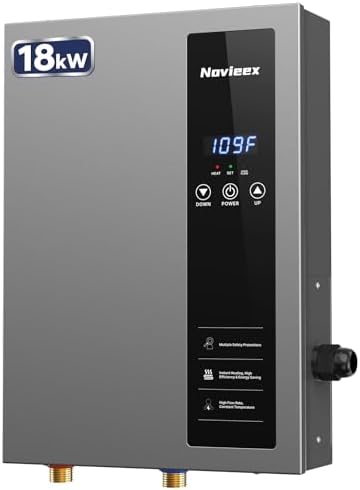
7. NOVIEEX 18kW Tankless Water Heater
The NOVIEEX 18kW is engineered for whole-unit or multi-fixture hot water supply in small homes, apartments, and guest suites needing higher peak flow capacity.
| NOVIEEX 18kW SPECIFICATIONS | |
| Power Output: 18 kW | Voltage: 240V |
| Max Current Draw: ~75A | Recommended Breakers: 2x 40A double-pole |
| Wire Gauge: 2x 8 AWG | Plumbing Connections: 3/4″ NPT |
| Display Type: Real-time LED | Key Feature: Corrosion-resistant water channels |
Performance & Operation
Utilizing micro-computer modulation, the NOVIEEX system regulates real-time power draw based on flow rates and target output settings. The front-panel LED interface displays real-time outlet temperatures for clear operational tracking. Constructed with corrosion-resistant heating channels, it is built to resist internal degradation over extended use.
Real-World Limitations
Installation requires dual 40A double-pole breakers on a 240V supply. Total household electrical service must be evaluated prior to purchase to prevent panel overloading.
- Pros: High 18kW continuous output; digital LED monitoring of outlet temperatures; corrosion-resistant fluid path design; 3/4″ NPT port sizing.
- Cons: Requires two dedicated double-pole breaker slots; substantial panel load (~75A peak).
- Ideal For: Whole-unit coverage in apartments, cabins, or 1-to-2 fixture applications in southern and central regions.
READ MORE: Best Under Sink Hot Water Heater — Mini-Tank & Tankless Buyer’s Guide & Prices

Comparison Table: Small Electric Tankless Water Heaters
Note: Flow rates vary significantly based on your regional incoming ground water temperature.
| Model | Power | Voltage | Approx. Max Flow | Best For | Key Feature | Electrical Demand |
| Rheem 8kW | 8 kW | 240V | ~1.5–1.9 GPM | Sink / Warm Shower | Self-Modulating, Brand Reliability | 1x 40A Breaker / 8 AWG Wire |
| APUS 14kW | 14 kW | 240V | Up to 3.3 GPM | Shower / Small Apt | High Flow relative to Size | 1x 60A Breaker / 6 AWG Wire |
| EcoSmart ECO 8 | 8 kW | 240V | ~1.5–1.9 GPM | Point-of-Use Sink | Low 0.3 GPM Activation | 1x 40A Breaker / 8 AWG Wire |
| SIVUATEK 18kW | 18 kW | 240V | Up to 3.8 GPM | Small Home / Shower + Sink | Higher Output for Cold Climates | 2x 40A Breakers / 2x 8 AWG Wire |
| NOVIEEX 18kW | 18 kW | 240V | Up to 3.8 GPM | Apartment / Condo | Micro-computer Modulation | 2x 40A Breakers / 2x 8 AWG Wire |
| Westinghouse 14kW | 14 kW | 240V | Up to 3.4 GPM | Modern Bath / Apt | Wi-Fi App Control | 1x 60A Breaker / 6 AWG Wire |
| ThermoMate 8kW | 8 kW | 240V | Up to 1.94 GPM | Sink / Utility Room | Separated Water/Heating Channels | 1x 40A Breaker / 8 AWG Wire |
How We Evaluated These 7 Models
Our assessment of these 7 electric tankless water heaters is based on published technical specifications, manufacturer documentation, engineering standards, and real-world feedback from homeowners and trade professionals. Key criteria evaluated include:
- Thermal Performance: Heat output capability relative to kilowatt rating and temperature-rise curves.
- Electrical Demands: Voltage, amperage draw, breaker configurations, and wire gauge requirements.
- Build Quality & Safety: Heating element material (copper vs. bare wire vs. cast aluminum), internal safety cutoffs, and moisture protection.
- Control Features: Accuracy of self-modulating control boards, digital display clarity, and ease of setpoint adjustments.
- Value & Application Fit: Overall performance relative to product price for intended homeowner installations.
READ MORE: EcoSmart Tankless Water Heater: Reviews, Comparison & Buyer Guide
8kW vs 14kW vs 18kW Tankless Water Heater
Choosing between an 8kW, 14kW, or 18kW model comes down to matching your fixture requirements with your home’s electrical capacity.
| Power Tier | Target Application | Electrical Demand | Limitations |
| 8kW Models | Single point-of-use sinks, powder rooms, or low-flow showers in warm southern zones. | Low: 1x 40A double-pole breaker, 8 AWG wire, ~33A draw | Cannot support a standard shower in cold climates; cannot handle multiple fixtures simultaneously. |
| 14kW Models | Dedicated bathroom shower suites, studio apartments, or small guest houses. | Moderate-to-High: 1x 60A double-pole breaker, 6 AWG wire, ~58A–59A draw | Can run one standard shower comfortably in mild climates, but running a shower and dishwasher at the same time will cause temperature drop. |
| 18kW Models | Small homes, larger apartments, or single-shower applications in colder northern states. | High: 2x 40A double-pole breakers, 2x 8 AWG wire runs, ~75A total draw | Requires adequate space in your electrical service panel and a 150A–200A main service. |
How Many GPM Do You Need for a Shower?
- Low-flow shower: about 1.5-1.75 GPM
- Standard shower: about 2.0-2.5 GPM
- High-flow/rain shower: 2.5 GPM and up
The lower your showerhead’s GPM, the more realistic it becomes to run it off a smaller electric tankless unit with less water to heat per minute. Swapping to a water-saving showerhead is often the simplest way to make a small unit work for you.
READ MORE: Best Honeywell Thermostat Models: Buyer’s Guide & Comparison
Small Electric Tankless Water Heater Electrical Requirements
Most of these units run on a dedicated 240V circuit, with amperage draw climbing quickly by kW rating roughly 33 amps for an 8kW unit up to 75+ amps for an 18kW model. Breaker size and wire gauge vary by product: EcoSmart’s ECO 8 calls for a 40-amp breaker and 8 AWG wire, while Westinghouse’s 14kW model calls for a 60-amp breaker and 6 AWG wire.
Confirm your panel has capacity for a new dedicated circuit before buying — many higher-kW units effectively assume at least 150-amp total service. Follow the specific product’s manual and local code, and have the circuit installed or verified by a licensed electrician rather than doing 240V wiring yourself unless you’re qualified.
Installation Cost of a Small Electric Tankless Water Heater
Costs vary by unit, existing electrical infrastructure, and local labor rates, so treat any single national figure as a rough guide only. Factors include:
- Unit cost — roughly $150-$500+ depending on kW rating and features
- Plumbing labor — supply lines, hot-water connections, shutoff valves
- Electrical labor — often the largest cost if a dedicated 240V circuit doesn’t already exist
- Panel upgrade — needed if your existing panel lacks capacity
- Permits — many jurisdictions require electrical or plumbing permits
- Incidental repairs — drywall or finish work disturbed during installation
Get quotes from local licensed electricians and plumbers for numbers specific to your home and code requirements.
How to Install a Small Electric Tankless Water Heater
This is a high-level overview, not a substitute for the manual or a qualified professional:
- Choose a location close to the fixture(s) it will serve.
- Confirm water and electrical requirements against your home’s setup.
- Shut off water and power to the work area.
- Mount the heater per the manufacturer’s instructions.
- Connect water supply lines and required shutoff valves.
- Have electrical connections completed to code, ideally by a licensed electrician.
- Restore water and check all connections for leaks.
- Restore power, set your desired temperature, and test the fixture(s).
If you’re not qualified for 240V electrical work, or local code requires licensed installation, hire a professional for that portion.
Maintenance Tips for a Small Electric Tankless Water Heater
- Descale periodically, especially with hard water, since mineral buildup can reduce efficiency and flow
- Clean or replace inlet filters on the manufacturer’s recommended schedule
- Inspect connections occasionally for slow leaks or corrosion
- Follow manufacturer maintenance intervals, which vary by model and local water hardness
- Consider a water softener or scale inhibitor in hard-water areas, since scaling is a common cause of reduced performance
Small Electric Tankless vs Traditional Tank Water Heater
| Feature | Small Electric Tankless | Traditional Electric Tank |
| Size | Compact | Larger |
| Hot Water | On demand | Stored |
| Standby Loss | Minimal at point of use | Yes, ongoing |
| Installation | Can require significant electrical work | Usually a simpler replacement |
| Simultaneous Demand | Limited by kW output | Limited by tank size and recovery |
| Venting | Not required for electric | Not required for standard electric |
| Best Use | Point-of-use or small demand | General household storage |
Final Verdict — Which Small Electric Tankless Water Heater Is Best?
There’s no single “best” — the right pick depends on your GPM needs, incoming water temperature, and available electrical capacity.
- Best Overall: Rheem RTEX-08 — established brand, straightforward point-of-use specs, easy parts availability
- Best 8kW Point-of-Use: EcoSmart ECO 8 — clear sizing guidance and a low activation flow
- Best for a Small Bathroom: ThermoMate 8kW — budget-friendly specs comparable to bigger-name brands
- Best Higher-Capacity Option: SIVUATEK 18kW or NOVIEEX 18kW — multi-fixture small-home use, with substantial electrical requirements
- Best Smart-Home Features: Westinghouse 14kW — Wi-Fi and voice control on solid core specs
- Best for Budget-Minded Homeowners: ThermoMate 8kW or Rheem RTEX-08
Whatever you’re considering, the sizing formula is the same: GPM needs + temperature rise + available electrical capacity + intended fixture use. Get those right, and a small electric tankless water heater can deliver reliable, space-saving hot water.
Frequently Asked Questions
What is the best small electric tankless water heater for a bathroom?
For a single sink or a low-flow shower, an 8kW point-of-use model like the Rheem RTEX-08, EcoSmart ECO 8, or ThermoMate 8kW is typically the right fit — these are built by their manufacturers for one or two applications, on a smaller electrical circuit than higher-kW units. If you want a shower and sink running together, especially in a colder climate, a 14kW model usually serves better.
Is an 8kW tankless water heater enough for a shower?
It depends on incoming water temperature and showerhead flow. In a warm climate with a low-flow showerhead, an 8kW unit can often handle a shower alone. In a cold climate with a standard or high-flow showerhead, the same unit may struggle, since a bigger temperature rise reduces the flow any heater can deliver.
How many amps does a small electric tankless water heater use?
It varies by kW rating. Manufacturer specs generally show 8kW units around 33 amps, 14kW units around 59 amps, and 18kW units around 75 amps, all on 240V. Breaker requirements typically run from a single 40-amp double-pole breaker for 8kW units up to two 40-amp breakers, or one 60-amp breaker, for 14-18kW models.
Are small electric tankless water heaters cheaper to run than traditional water heaters?
They can reduce energy use by eliminating standby heat loss — the constant reheating a storage tank does even when nobody’s using hot water. Manufacturers often cite energy savings, but actual bill impact depends on your household’s usage patterns, local electricity rates, and correct sizing, so we won’t promise a specific dollar figure.
What size electric tankless water heater do I need for a small house?
Low-flow shower: about 1.5-1.75 GPM
Standard shower: about 2.0-2.5 GPM
High-flow/rain shower: 2.5 GPM and up


Pingback: What Size Tankless Water Heater Do I Need? - Plumbing Guider
Pingback: Best Energy-Efficient Tankless Water Heaters - Plumbing Guider
Pingback: Best Rheem Electric Tankless Water Heater: Reviews, Cost & Comparison - Plumbing Guider