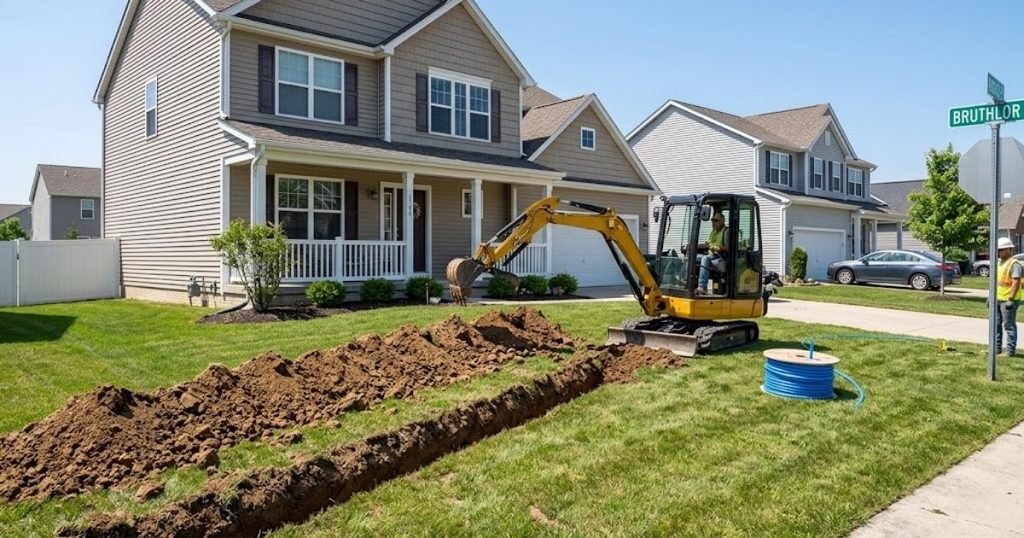
How much does main water line replacement cost? Most U.S. homeowners spend between $2,000 and $5,000 for a full main water line replacement, with a national average landing right around $3,500. Simple, short replacement jobs in accessible soil can cost as little as $1,000 to $2,000, while complex projects involving long distances, deep frost lines, heavy hardscaping, or specialized trenchless equipment can reach $5,000 to $10,000 or more.
On a unit level, expect to pay $50 to $200 per linear foot for traditional trenched replacement, or $70 to $250 per linear foot for trenchless water line replacement. While trenchless techniques carry higher upfront equipment costs per foot, they frequently save thousands of dollars in overall project costs by leaving driveways, sidewalks, and mature landscaping intact.
- Average National Cost: $3,500
- Typical Cost Range: $2,000 – $5,000
- Per-Linear-Foot Range: $50 – $250 / ft
Every property is unique. A 30-foot straight pipe through a soft front lawn will cost dramatically less than a 90-foot line buried beneath a concrete driveway. This guide breaks down updated 2026 pricing, labor factors, material choices, repair versus replacement decisions, and practical steps to avoid overpaying. Lets deep dive into “Main Water Line Replacement Cost: 2026 Price Guide”
READ MORE: Toilet Replacement Cost in USA: Prices, Labor & More
How Much Does Main Water Line Replacement Cost?
Published pricing estimates can feel confusing because different quotes factor in different scopes of work. Some estimates cover only the raw plumbing labor and piping, while others reflect the full “turnkey” price including utility markouts, permits, excavation, backfilling, pressure testing, and surface restoration.
Here is a breakdown of typical 2026 costs for residential main water line replacements across the United States:
| Project Scope / Cost Factor | Typical Cost Range | Notes |
| National Average Replacement | $2,000 – $5,000 | Based on a typical 30-to-60-foot service line. |
| Simple / Short Line Replacement | $1,000 – $2,000 | Shallow depth, soft soil, open access, short pipe run. |
| Complex / Long Line Replacement | $5,000 – $10,000+ | Deep frost line, rocky soil, crossing concrete or driveways. |
| Traditional Trench Method | $50 – $200 per linear foot | Lower pipe labor, higher excavation and yard restoration. |
| Trenchless Method (Boring/Bursting) | $70 – $250 per linear foot | Higher equipment cost, minimal surface disruption. |
| Permits & Municipal Inspections | $150 – $500 | Varies by city, county, and local plumbing code. |
| Landscaping & Hardscape Restoration | $300 – $3,000+ | Lawn repair, re-paving driveways, fixing sidewalks. |
Main Water Line Replacement Cost Per Foot
Contractors typically use cost per linear foot as a baseline when estimating main service lines. However, paying $100 per foot for a 50-foot line does not automatically mean your final invoice will be exactly $5,000. Plumbing contractors must account for minimum mobilization fees, heavy equipment transit, local permitting, and tie-in connections at both ends.
- Traditional Trenching: $50 – $200 per foot
- Trenchless Boring: $70 – $250 per foot
Why Cost Per Foot Varies
- Mobilization Base Rate: Most licensed plumbers charge a minimum base fee ($500–$1,200) just to get crew and heavy equipment to the site, regardless of how short the pipe is.
- Methodology: Traditional trenching ($50–$200/ft) uses heavy excavators to open the earth. Trenchless replacement ($70–$250/ft) uses specialized pneumatic hydraulic rigs.
- Obstructions: A straight shot through dirt costs far less per foot than forcing a line beneath a slab, retaining wall, or brick patio.
Real-World Pricing Scenarios
- Example 1: 40-Foot Line in Accessible Open Lawn
- Method: Traditional Trenching
- Conditions: Standard 36-inch depth, soft soil, grass surface, easy street access.
- Cost Breakdown: Pipe and fittings ($150), excavation/labor ($2,400), permit ($200), lawn reseeding ($250).
- Total Installed Cost: $3,000 ($75/ft total finished project cost).
- Example 2: 75-Foot Line Through Mature Landscaping
- Method: Trenchless Pipe Bursting
- Conditions: Preserving mature trees, flower beds, and a custom stone pathway.
- Cost Breakdown: Mobilization & setup ($1,000), trenchless pull ($6,000), meter connection ($500), permit ($250).
- Total Installed Cost: $7,750 ($103/ft total finished project cost).
- Example 3: 100-Foot Line Crossing a Concrete Driveway
- Method: Directional Drilling / Boring
- Conditions: Deep 48-inch frost line requirement, boring under a 20-foot concrete driveway to avoid cracking the slab.
- Cost Breakdown: Boring equipment & labor ($8,500), heavy fittings & pressure reduction valve ($600), permit & city inspection ($400).
- Total Installed Cost: $9,500 ($95/ft total finished project cost).
READ MORE: How Much Does Main Water Line Leak Repair Cost
What Is a Main Water Line?
Your home’s plumbing network is divided into public and private infrastructure. Understanding where municipal responsibility ends and homeowner responsibility begins prevents unexpected financial surprises.
- Municipal Water Main: The high-pressure public pipe running beneath the street or utility easement, owned and maintained by your local water utility.
- Water Service Line: The underground pipe connecting the municipal main to your home. In most U.S. jurisdictions, the homeowner owns and is financially responsible for the section running from the water meter or curb stop valve all the way into the house.
- Interior Plumbing: The distribution pipes running through walls, crawlspaces, or basements past the main shut-off valve.
Pro Tip: Before signing a contract, call your local water authority. Ask exactly where your property’s responsibility begins. In some municipalities, the city owns everything up to the property line; in others, the homeowner owns all piping from the main tap in the middle of the street.
What Factors Affect Main Water Line Replacement Cost?
No two water line jobs are identical. Plumbers evaluate several physical variables before providing a binding quote.
Cost Factors: Depth + Distance + Soil + Obstructions + Material + Permits
1. Length of the Water Line
The distance from your home’s entry point to the meter directly scales labor time, equipment needs, and raw material volume. A suburban home set back 100 feet from the street requires significantly more labor and piping than a home set back 25 feet.
2. Depth of the Pipe
Local climate governs burial depth. In warm southern states like Georgia or Florida, service lines are often buried just 18 to 24 inches underground. In northern states like Minnesota or Maine, pipes must sit 4 to 6 feet deep below the frost line to prevent winter freezing. Deeper pipes demand heavy excavators, longer digging time, and strict trench shoring protocols, raising total costs.
3. Pipe Material
Materials vary in price, flexibility, and longevity. While raw pipe materials account for only 10% to 20% of the overall invoice, local plumbing codes dictate what materials you can use.
- PVC (Polyvinyl Chloride): $0.50 – $5.00 / ft. Rigid, affordable, but susceptible to cracking in freezing temperatures or shifting ground.
- HDPE (High-Density Polyethylene): $0.75 – $4.00 / ft. Seamless, extremely durable, highly flexible, ideal for trenchless pulls.
- PEX (Cross-linked Polyethylene): $0.50 – $3.00 / ft. Flexible, expands without bursting in freezing conditions, easy to maneuver through small openings.
- Copper (Type K Underground): $2.00 – $10.00+ / ft. Traditional gold standard, highly durable, but expensive and subject to soil acidity corrosion.
- Galvanized Steel / Lead: Legacy materials found in older homes. No longer installed by modern code and should be replaced immediately due to rust, low flow, or severe health risks.
4. Soil Conditions
Digging through soft, sandy loam takes minutes. Digging through dense clay, ledge rock, heavy shale, or root-choked soil requires heavy machinery like hydraulic breakers or backhoes. Wet, high-water-table soil may require continuous pumping equipment during installation.
5. Landscaping Disruption
If the service line runs directly under manicured lawns, flower beds, ornamental trees, or retaining walls, excavating will destroy those features. Restoring custom landscaping can easily add $1,000 to $4,000 above the plumbing bill.
6. Driveways, Sidewalks, and Patios
When a service line passes under hardscaping, contractors must either cut through concrete/asphalt with specialized saws or use underground directional drilling. Cutting and patching asphalt or concrete adds substantial labor and material costs.
7. Labor Rates
Plumbing labor costs range from $45 to $200+ per hour depending on region and licensing tier (Journeyman vs. Master Plumber). High-cost-of-living metropolitan areas command significantly higher labor rates than rural communities.
8. Permits and Inspections
Almost every U.S. municipality requires an official plumbing permit and a site inspection before a buried line can be covered back up with dirt. Municipal permit fees range from $150 to $500.
9. Water Meter & Valve Work
If your main shut-off valve, pressure regulator, or meter vault is outdated or leaking, your contractor will recommend replacing them while the system is exposed. Installing a modern ball-valve main shut-off typically adds $200 to $500.
READ MORE: Sewer Line Replacement Cost: Pricing Guide
Trench vs. Trenchless Water Line Replacement
Choosing between traditional open-trench excavation and modern trenchless replacement is one of the biggest cost decisions you will make.
| Feature | Traditional Trenching | Trenchless Replacement |
| Excavation Level | Extensive (full length of pipe open) | Minimal (1–2 small access pits) |
| Landscaping Damage | Severe across the trench path | Very low; preserves surface lawns |
| Initial Plumbing Cost | $50 – $200 / ft | $70 – $250 / ft |
| Restoration Cost | Potentially high ($1,000 – $5,000+) | Usually low ($200 – $800) |
| Best Used For | Open yards, shallow lines, collapsed pipes | Under driveways, patios, structures |
| Equipment Needed | Excavators, backhoes, trenchers | Boring rigs, hydraulic bursting units |
Traditional Trenching
Traditional trenching uses an excavator or trencher to dig up the entire earth along the pipe’s path. The crew lifts out the old line, places a new pipe on a sand bedding, connects fittings, and backfills the soil.
- Pros: Allows clear visual inspection of the entire channel; ideal if the old line has completely collapsed or if ground rocks make trenchless equipment bind up.
- Cons: Destroys everything along the trench line, including turf, plants, and pavement. The backfilled dirt will settle over 6–12 months, creating a sunken ditch that requires regrading.
Trenchless Water Line Replacement
Trenchless replacement uses specialized machinery to install a new pipe underground with minimal surface digging. Crews dig two small entry/exit pits—one near the street meter and one near the home’s entry wall.
- Pros: Saves lawns, prized gardens, walkways, and concrete driveways. Projects often wrap up in a single day.
- Cons: Higher initial equipment charge; cannot be used if the existing pipe is severely back-pitched, bellied, or packed in solid underground rock.
Pipe Bursting vs. Pipe Lining for Water Lines
When exploring trenchless options, you will hear contractors mention pipe bursting and pipe lining. Understanding the structural differences is crucial.
Pipe Bursting
Pipe bursting uses a heavy hydraulic pull-rig to drag a conical steel wedge (the “bursting head”) directly through the old water line. As the head moves, it breaks the old pipe (cast iron, galvanized, or clay) outward into the surrounding soil. Simultaneously, it pulls a seamless, brand-new HDPE flexible pipe into the exact same space.
- Best For: Replacing small or medium main water service lines. It allows you to maintain or even expand your pipe diameter (e.g., upgrading from a 3/4-inch line to a 1-inch line for better volume).
Pipe Lining (Cured-In-Place Pipe / CIPP)
Pipe lining involves inserting an epoxy resin-soaked flexible tube inside the existing pipe, inflating it like a balloon, and letting it cure into a hard lining.
- Best For: Large municipal sewer mains or large-diameter drain pipes.
- Important Note for Water Lines: CIPP lining is rarely used for small residential main water lines (3/4″ to 1″). Because drinking water pipes operate under high continuous pressure (40 to 80 PSI), pipe bursting or directional boring is almost always preferred for potable water line replacement.
READ MORE: Tankless Water Heater Installation Near Me USA
Main Water Line Repair vs. Replacement
Not every water leak requires digging up your entire yard. Deciding whether to patch a section or replace the entire line comes down to age, material, and leak history.
When Repair Makes Sense ($350 – $1,700)
- Isolated Damage: A tree root or utility worker damaged a single, localized section of an otherwise pristine copper or PEX pipe.
- Young Pipe Age: The service line is less than 15–20 years old with no history of previous leaks.
- Good Flow & Pressure: Home water pressure and volume remain strong throughout the rest of the residence.
When Replacement Makes Sense ($2,000 – $5,000+)
- Repeated Leaks: You have patched the line before, and a new leak has formed nearby. Patching deteriorated pipe creates high-pressure focus points that trigger new leaks nearby.
- Severe Pipe Degradation: The line is constructed of aging galvanized iron, polybutylene (“Quest” piping), or lead.
- Widespread Corrosion: Thin, corroded copper walls are developing multiple pinhole leaks.
- Economic Crossing Point: If a complex repair quote exceeds $1,500–$2,000, paying slightly more for a full replacement with a 50-year warranty is the smarter investment.
Signs You May Need to Replace Your Main Water Line
Buried water line leaks start subtly before escalating into major property damage. Watch for these key warning indicators:
Warning Signs: Sudden Pressure Drop | Unusually High Water Bills | Wet Lawn Spots | Discolored Water
- Unexplained Water Bill Spikes: A sudden jump in your monthly utility bill without increased household usage usually signals a continuous underground leak.
- Soggy, Unusually Green Lawn Patches: A leaking service line fertilizes and waters the soil directly above it. Look for abnormally bright, fast-growing grass or squishy spots in the yard during dry weather.
- Low Water Pressure Across Multiple Fixtures: If shower heads, sinks, and washing machines lose pressure simultaneously, the main supply entering the house may be failing or restricted.
- Rusty or Discolored Water: Brownish or reddish water coming from the cold water tap indicates severe internal corrosion inside galvanized steel pipes.
- Hissing or Running Water Sounds: Hearing water constantly running near the basement floor or main shut-off valve when every faucet inside is turned off.
- Pavement Cracks or Foundation Dampness: Water accumulating near foundation walls or bubbling up through driveway cracks.
How Long Does a Main Water Line Last?
The lifetime of an underground service line depends on material, soil acidity, water chemistry, and climate conditions.
- Copper: 50–100 years. Highly durable, though acidic soil (pH below 6.5) can shorten its lifespan.
- HDPE / PEX: 50–75 years. Immune to electrochemical soil corrosion; expands under freeze cycles.
- PVC: 40–70 years. Excellent chemical resistance, but becomes brittle in cold environments.
- Galvanized Steel: 20–50 years. Highly prone to internal rust accumulation, scale buildup, and structural failure over time.
READ MORE: Honeywell Water Heater Control: Settings, Fixes & Reset
Cost to Replace Main Water Line by Pipe Material
Here is how common line materials compare on cost, longevity, and practical application:
| Material | Relative Material Cost | Expected Longevity | Best Practical Application | Key Considerations |
| PVC | Low ($0.50 – $5 / ft) | 40–70 Years | Warm climates, shallow open trenches | Rigid; prone to cracking in freeze zones. |
| HDPE | Moderate ($0.75 – $4 / ft) | 50–75 Years | Trenchless bursting & directional boring | Continuous roll; zero underground joints. |
| PEX | Low-Moderate ($0.50 – $3 / ft) | 50–70 Years | Direct burial pull-throughs | Flexible; high freeze resistance; code-restricted outdoors in some cities. |
| Copper | High ($2.00 – $10+ / ft) | 50–100 Years | Traditional high-durability installations | Excellent strength; vulnerable to acidic soil. |
| Galvanized | N/A (Obsolete) | 20–50 Years | Older legacy homes | High failure rates; replace immediately. |
| Lead | N/A (Obsolete) | Replace Immediately | Pre-1986 homes | Severe toxic health hazard. |
Lead Water Service Line Replacement
Lead service lines pose serious public health risks, particularly for young children and pregnant women. Millions of older U.S. homes built before 1986 still receive drinking water through full or partial lead service lines.
Lead Line Detection Test:
1. Locate line entering through basement wall/floor.
2. Gently scratch the pipe with a key or coin.
3. Lead shines shiny silver and attracts NO magnet.
Identifying Lead Lines
- Visual Test: Lead pipes are dull gray, soft enough to scratch easily with a key (revealing shiny silver underneath), and non-magnetic.
- Utility Verification: Contact your local water utility; many cities maintain public inventories of known lead service lines.
Federal Funding & Utility Assistance
Under Environmental Protection Agency (EPA) initiatives and federal infrastructure funding programs, hundreds of municipalities across the United States are actively replacing lead service lines at low or zero cost to the homeowner.
Before paying out-of-pocket for private lead line removal, call your municipal water department to ask:
- “Does the city have a Lead Service Line Replacement Program?”
- “Are grant funds or utility rebates available for my address?”
- “Will the city replace the public side if I hire a plumber for the private side?”
READ MORE: AO Smith vs. Rheem Water Heaters: Comparison & Expert Reviews
Who Is Responsible for Replacing the Main Water Line?
Understanding property boundaries prevents boundary disputes and unnecessary spending.
- Utility-Owned Portion: The water provider owns and maintains the main street distribution line and the connection leading up to the utility curb stop or water meter box.
- Homeowner-Owned Portion: The homeowner owns the entire underground pipe starting from the water meter or curb stop valve up into the home’s interior shut-off valve.
- Shared Lines: In older row houses, townhomes, or multi-family properties, two homes may share a single service line branch. Shared lines require legal coordination and split-cost agreements before replacement work begins.
How Much Does Landscaping Restoration Cost?
Most licensed plumbing estimates cover excavating, laying pipe, pressure testing, and backfilling dirt. They do not cover fine landscaping or masonry restoration unless explicitly stated in the contract.
Budget for these post-installation restoration expenses:
- Lawn Reseeding or Sod Patching: $300 – $1,200.
- Concrete Driveway or Sidewalk Repairs: $500 – $2,500.
- Asphalt Apron Patching: $400 – $1,500.
- Shrub, Tree, and Flower Bed Replanting: $300 – $1,500+.
Can Homeowners Replace a Main Water Line Themselves?
Replacing a main water service line is not a recommended DIY project. Underground utility work carries severe legal, financial, and physical safety risks:
DIY Risks: Unmarked Gas Lines + Trench Cave-ins + Code Violations = High Danger
- Utility Strike Hazards: Accidental strikes on buried high-voltage electric conduits or gas lines can cause catastrophic injuries or massive municipal fines.
- Permitting & Code Non-Compliance: Unpermitted installations will fail municipal inspections, blocking future property sales.
- Excavation Cave-in Dangers: Working inside un-shored trenches deeper than 4 feet carries deadly soil collapse risks.
- Contamination Risks: Improper tie-ins can back-siphon dirty groundwater directly into your household drinking supply.
Safe DIY Contributions: Homeowners can reduce costs safely by clearing surface vegetation, moving porch furniture, or handling seed and sod restoration after the plumbers finish.
How to Save Money on Main Water Line Replacement
You do not have to accept the first high quote you receive. Use these proven strategies to manage costs:
- Obtain 3 Itemized Estimates: Compare detailed quotes from licensed, insured utility plumbing contractors. Ensure quotes separate labor, piping, and permit fees.
- Evaluate Total Installed Costs: A $2,500 traditional trenching quote may cost $5,500 once driveway patches and lawn sod are factored in. A $4,000 trenchless quote that leaves your driveway untouched may be cheaper overall.
- Call 811 Before Digging: Ensure your plumber coordinates free utility line markouts (811) before digging to avoid costly line cuts.
- Inquire About Utility Rider Policies: Check if your home insurance policy offers an optional Service Line Coverage Add-on. For $20–$50 per year, this add-on covers $5,000 to $10,000 in sudden utility pipe failures.
- Ask About Lead Grant Funding: Check if your local city municipality offers subsidized replacement grants for health-hazardous lines.
- Avoid the Dangerously Low Bid: If a quote is $1,500 below competitors, confirm whether the contractor carries worker’s compensation, plans to pull official permits, and provides a long-term warranty.
Questions to Ask a Water Line Replacement Contractor
Ask these questions before hiring a plumbing contractor:
- What specific installation method do you recommend for my yard, and why?
- Will you pull a municipal permit and coordinate the required city inspection?
- Is the quote a guaranteed fixed price or an estimate subject to change orders?
- What material options (HDPE, Copper, PEX) meet local code in our city?
- Does this quote include complete backfilling and rough soil grading?
- Who coordinates 811 utility markouts prior to excavation?
- How long will my home’s water supply be shut off during installation?
- What specific warranty do you offer on labor and piping materials?
- Are you fully licensed, bonded, and insured for heavy underground excavation?
- Will you provide references for similar service line projects in this city?
Main Water Line Replacement Cost Examples
To help you visualize real-world conditions, here are three typical scenario profiles:
Scenario A: Suburban Single-Family Home (Open Lawn)
- Scope: 45-foot replacement from sidewalk meter to basement wall.
- Method: Open trenching through grass.
- Piping Material: 1-inch HDPE pipe.
- Total Project Cost: $2,800 (Plumbing + Permit) + $400 (Lawn Reseeding) = $3,200 Finished Cost.
Scenario B: Urban Property (Under Concrete Walkway)
- Scope: 60-foot line passing beneath a custom paver path and driveway apron.
- Method: Trenchless Pipe Bursting.
- Piping Material: 1-inch continuous HDPE.
- Total Project Cost: $5,200 (Plumbing, Permit, & Trenchless Rigging) + $300 (Pit Repair) = $5,500 Finished Cost.
Scenario C: Deep Frost Zone Home with Heavy Rock
- Scope: 80-foot replacement at a 5-foot burial depth through rocky, hard-packed clay.
- Method: Heavy Excavator Trenching.
- Piping Material: Type K Heavy Copper.
- Total Project Cost: $7,800 (Plumbing, Heavy Equipment, Permit) + $1,200 (Major Hardscape Patching) = $9,000 Finished Cost.
FAQs
How much does it cost to replace a main water line?
Most U.S. homeowners pay between $2,000 and $5,000 to replace a main water service line, with the national average around $3,500. Simple, shallow jobs can cost as little as $1,000 to $2,000, while complex jobs requiring trenchless equipment, deep excavation, or concrete cutting can reach $5,000 to $10,000+.
How much does it cost to replace a main water line per foot?
Main water line replacement costs $50 to $200 per linear foot for traditional trenched excavation. Trenchless replacement methods (like pipe bursting or directional boring) average $70 to $250 per linear foot due to specialized equipment fees.
How much does it cost to replace a water line from the street to the house?
Replacing the service line from the street meter to the house typically costs $2,000 to $6,000. Total pricing depends on total pipe length, burial depth required for your climate, soil conditions, and hardscaping obstacles like driveways or sidewalks.
Is it cheaper to repair or replace a main water line?
Spot repairs ($350 to $1,700) are cheaper upfront if the pipe is relatively new and damaged in only one accessible spot. However, if the pipe is older than 40 years, corroded, or experiencing repeated leaks, full replacement ($2,000 to $5,000) is more cost-effective long term.
Does homeowners insurance cover main water line replacement?
Standard homeowners insurance policies usually exclude wear-and-tear, age, or corrosion on underground pipes. Insurance may cover repairs if the damage was caused suddenly by an insured peril (like a covered falling object or explosion). Many insurers offer an optional “Service Line Endorsement” ($20–$50/year) that covers utility line failures.
Conclusion
A failing main water line is a high-priority repair, but you do not need to navigate it blindly. When facing water line issues, follow this step-by-step approach:
- Diagnose the Issue: Hire a licensed plumber to perform leak detection and verify pipe condition.
- Determine Ownership: Confirm with your local water utility exactly where your private ownership responsibility starts.
- Compare Quotes: Gather 2 to 3 detailed, itemized quotes that compare traditional trenching against trenchless options.
- Evaluate Total Costs: Account for both plumbing expenses and landscaping restoration before making your decision.
Investing in a modern HDPE or copper water line restores water pressure, protects your home’s foundation, and gives you peace of mind for decades to come.


Pingback: Plumbing Repair Cost (2026 Guide): How Much Does a Plumber Cost? - Plumbing Guider
Pingback: How Much Does a Slab Leak Cost to Repair? - Plumbing Guider