There is nothing quite like taking a shower in the middle of winter, only to have the water suddenly turn ice-cold because someone started the dishwasher downstairs. If you are tired of scheduling shower times around laundry cycles or watching your monthly energy bills climb, you are not alone. Across the United States, millions of homeowners are searching for tankless water heater installation near me USA to upgrade their home plumbing, increase energy efficiency, and secure an endless supply of hot water.
I’ve spent years installing and servicing water heaters in homes across all kinds of climates, house ages, and budgets, and I can tell you the tankless conversation always comes back to the same three questions: What is this thing actually going to cost me? Is it worth it for my house? And how do I find someone I can trust to install it correctly?
This guide answers all three. We’ll walk through what a tankless water heater actually is, real installation costs, gas versus electric trade-offs, how to vet a licensed installer, and the mistakes that turn a good investment into an expensive headache. No fluff, no sales pitch — just what I’d tell a neighbor. Lets deep dive into “Tankless Water Heater Installation Near Me USA (2026 Guide)”
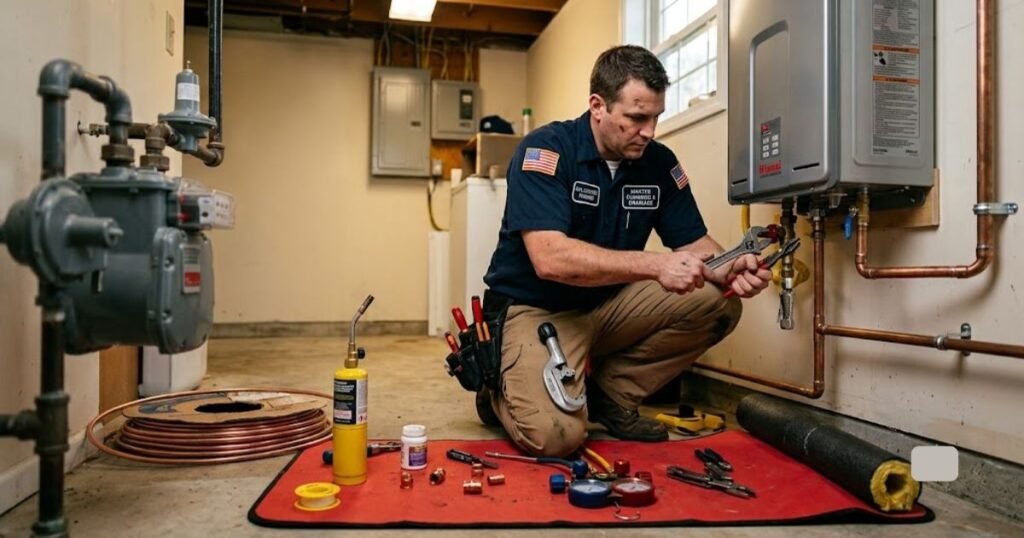
What Is a Tankless Water Heater?
A tankless water heater also called an on-demand or instantaneous water heater heats water only when you need it, instead of storing 40 to 80 gallons of hot water around the clock in a tank.
Here’s the basic idea: cold water enters the unit, flows across a heat exchanger, and comes out the other side hot all within seconds. There’s no tank sitting in your garage or closet slowly losing heat and running up your utility bill 24/7.
A few things that set tankless units apart from traditional storage tank heaters:
- Endless hot water — as long as the unit is sized correctly, you won’t run out mid-shower, even with the dishwasher and washing machine running.
- Energy efficiency — because the unit isn’t reheating stored water all day, most households see a meaningful drop in standby energy loss.
- Compact footprint — tankless units mount on a wall and take up a fraction of the space of a 50-gallon tank, which matters in smaller homes, condos, and utility closets.
- Longer service life — a well-maintained tankless unit typically lasts 15 to 20 years, compared to 8 to 12 years for a standard tank.
None of that means tankless is automatically the right call for every home we’ll get into that later but it’s the reason so many homeowners start researching an upgrade.
READ MORE: AO Smith vs. Rheem Water Heaters: Comparison & Expert Reviews
Benefits of Professional Tankless Water Heater Installation
I get it YouTube makes this look simple. But tankless installation involves gas lines, electrical circuits, venting, and water pressure calculations that genuinely aren’t forgiving of mistakes. A licensed professional brings:
- Correct sizing based on your home’s peak flow rate (measured in gallons per minute) and incoming groundwater temperature
- Code compliance with local and state plumbing, gas, and electrical codes
- Safe gas connections, sized and pressure-tested properly to avoid leaks or insufficient fuel supply
- Proper electrical work for units that need dedicated circuits or 240-volt service
- Manufacturer warranty protection — most brands void the warranty on self-installed or unlicensed installs
- Better real-world efficiency, since a poorly installed unit often runs harder than it should
- Longer equipment lifespan, thanks to correct venting, water pressure, and connections
- Peace of mind, knowing the job passed inspection and won’t come back to bite you later
Did You Know? Many manufacturers require proof of professional installation and annual maintenance to keep the warranty valid — even a 12-year warranty can become worthless if the unit was self-installed.
Tankless Water Heater Installation Cost in the USA
This is the question everyone actually wants answered, so let’s get into real numbers. Costs vary by region, contractor, and home setup, but here’s what homeowners are generally paying nationwide.
| System Type / Component | Equipment Unit Cost | Professional Labor & Upgrades | Total Estimated Installed Cost |
| Point-of-Use Electric (Single Sink/Shower) | $150 – $500 | $200 – $500 | $350 – $1,000 |
| Whole House Electric (2–3 Bathrooms) | $500 – $1,200 | $600 – $1,800 (Panel dependent) | $1,100 – $3,000 |
| Whole House Gas (Non-Condensing) | $800 – $1,800 | $1,000 – $2,500 | $1,800 – $4,300 |
| Whole House Gas (Condensing) | $1,200 – $2,600 | $1,200 – $3,000 | $2,400 – $5,600 |
| Gas Line Upsizing / Conversion | N/A | $400 – $800 | $400 – $800 |
| Dedicated Venting Installation | N/A | $400 – $900 | $400 – $900 |
| Electrical Panel Upgrade (100A to 200A) | N/A | $1,200 – $2,500 | $1,200 – $2,500 |
| Local Municipal Permit Fees | N/A | $50 – $300 | $50 – $300 |
Most homeowners land somewhere between $1,200 and $5,500 total, with a national average around $2,600 to $3,000 for a fairly standard replacement. Larger whole-home gas systems with venting or gas line work commonly run higher sometimes $5,000 to $7,000 all-in when a home needs several upgrades at once.
A Quick Note on Tax Credits: The federal Energy Efficient Home Improvement Credit (Section 25C), which previously offered up to $600 back on qualifying ENERGY STAR® gas tankless units, expired for equipment installed after December 31, 2025, following the One Big Beautiful Bill Act. As of 2026, there’s no federal credit for gas tankless installations but it’s still worth checking with your utility company and state energy office, since local rebate programs come and go throughout the year.
READ MORE: Best Tankless Water Heater— Top Picks, Costs & Buyer’s Guide
Factors That Affect Installation Cost
Your neighbor’s quote and yours can differ by thousands of dollars, and it’s almost never because one contractor is ripping someone off. Real variables include:
- Home size and number of bathrooms/fixtures needing hot water simultaneously
- Existing plumbing layout — how far the unit needs to be from fixtures
- Existing gas line capacity — undersized lines need upgrading for tankless demand
- Venting requirements — exterior wall access is cheaper than routing through the roof
- Water quality — hard water areas may need a water softener or scale filter added
- Permit fees, which vary widely by city and county
- Local labor rates, which are higher in major metro areas
- Heater brand and flow rate (GPM) — higher-capacity units cost more upfront
- Additional plumbing work, like relocating the unit or replacing old shutoff valves
Gas vs Electric Tankless Water Heater Installation
This is usually the first fork in the road. Here’s how they stack up.
| Factor | Gas Tankless | Electric Tankless |
| Installation cost | Higher (venting, gas line) | Lower (simpler hookup) |
| Energy efficiency | High, but standby pilot/ignition draws some fuel | Very high, no combustion loss |
| Maintenance | Annual flushing + venting checks | Annual flushing only |
| Lifespan | 18 – 20 years | 15 – 18 years |
| Installation complexity | Higher — gas line, venting, combustion air | Lower — mainly electrical |
| Performance in cold climates | Strong, higher flow rate capability | Can struggle without high-amp service |
| Operating cost | Often lower where natural gas is cheap | Depends heavily on local electricity rates |
| Best use case | Larger homes, multiple bathrooms | Smaller homes, apartments, mild climates |
Neither option is “better” across the board it really depends on your home’s existing utilities, your climate, and your household’s hot water demand.
READ MORE:Gas Water Heater Replacement Cost — What Homeowners Pay & Why
How to Choose the Best Tankless Water Heater Installer Near You
Not every plumber who advertises “tankless installation near me” has real experience with these systems. Use this checklist before you sign anything:
- ✅ Licensed in your state for plumbing (and gas work, if applicable)
- ✅ Bonded and insured — ask to see proof
- ✅ Manufacturer-certified for the brand you’re considering
- ✅ Strong local reviews (Google, Yelp, Nextdoor)
- ✅ Good standing with the Better Business Bureau
- ✅ Several years in business specifically with tankless systems
- ✅ Offers a written labor warranty, separate from the manufacturer’s product warranty
- ✅ Provides emergency or same-day service
- ✅ Offers financing options if needed
- ✅ Willing to give a free, written estimate before starting work
Questions to Ask Before Hiring an Installer
Bring this list to every quote — a good contractor won’t mind answering any of it.
- Are you licensed and insured in this state?
- Do you pull permits, and is that included in the quote?
- How will you size the unit for my household?
- Will my existing gas line or electrical panel need upgrading?
- What brand do you recommend, and why?
- What’s the manufacturer’s warranty, and does professional install keep it valid?
- Do you offer a separate labor warranty?
- How long will the installation take?
- Will you remove and dispose of my old water heater?
- What venting method will you use?
- Do I need a water softener or scale filter for my water quality?
- What maintenance will I need to do annually?
- Is the price you’re quoting today final, or could it change once work starts?
- Can you provide references from recent tankless installs?
- What happens if something goes wrong during or after installation?
READ MORE: Carrier Heat Pump Reviews — Models, Costs, Pros & Cons
Signs It’s Time to Replace Your Old Water Heater
If you’re seeing any of these, it’s worth getting ahead of a full breakdown:
- Visible leaks around the tank base or fittings
- Rusty or discolored hot water
- A unit older than 10–12 years
- Running out of hot water faster than you used to
- Noticeably rising utility bills
- Frequent repair calls
- Popping, rumbling, or banging noises (often a sign of sediment buildup)
Real example: A homeowner I worked with kept “topping off” a 14-year-old tank heater with small repairs a new thermocouple here, a pressure valve there until it finally failed overnight and flooded part of a finished basement. The tankless replacement ended up costing less than the water damage repair alone. Catching the warning signs early saves real money.
Installation Process Step by Step
Here’s roughly what a professional installation looks like from start to finish:
- Home inspection — the installer checks your gas line, electrical service, water pressure, and venting options
- Sizing — calculating the right flow rate (GPM) for your household’s peak demand
- Removing the old heater — draining, disconnecting, and hauling away the old tank
- Plumbing updates — adjusting water lines to connect to the new unit
- Gas or electrical work — upgrading lines, circuits, or panels as needed
- Vent installation — running proper venting for gas units
- Pressure testing — checking gas and water connections for leaks
- System startup — powering on and calibrating the unit
- Final inspection — required in many municipalities before the job is signed off
- Homeowner walkthrough — the installer shows you how to operate and maintain the unit
READ MORE: Best Honeywell Thermostat Models: Buyer’s Guide & Comparison
How Long Does Installation Take?
- Standard replacement (tank-to-tankless, existing utilities adequate): 4–8 hours, often same-day
- New construction: 1–2 days, depending on other trades’ schedules
- Major upgrades (new gas line, electrical panel work, rerouted venting): 1–3 days
- Emergency replacement: Many companies offer same-day or next-day service for no-hot-water emergencies
Maintenance After Installation
Tankless units need far less babysitting than a tank, but they’re not maintenance-free.
- Annual flushing — clears mineral scale from the heat exchanger; typically $100–$350 depending on your area
- Descaling — especially important in hard water regions
- Filter cleaning — inlet screens should be checked periodically
- Water softeners — worth considering if you’re in a hard water zone, since scale buildup is the #1 cause of premature tankless failure
- Professional inspections — an annual check catches small issues before they become expensive ones
- Warranty maintenance — some manufacturers require documented annual service to keep the warranty active
If you’re in a hard water area, don’t skip this. I’ve seen units fail years early simply from scale buildup that a $150 annual flush would have prevented.
Common Installation Mistakes to Avoid
- DIY installation without a permit or gas/electrical licensing
- Wrong sizing — undersized units can’t keep up with real household demand
- Poor venting — improper venting is a safety hazard, not just a performance issue
- Incorrect gas pressure — leads to inefficient operation or unsafe combustion
- Ignoring permits — can create problems when selling your home later
- Cheap materials — corners cut on fittings or venting often fail early
- Skipping maintenance — the fastest way to void a warranty and shorten lifespan
READ MORE: 8 Best DREO Smart Tower Fans: Review & Comparison
Tank vs Tankless: Quick Comparison
| Factor | Storage Tank | Tankless |
| Upfront cost | Lower | Higher |
| Hot water supply | Limited by tank size | Continuous |
| Energy efficiency | Lower (standby loss) | Higher |
| Lifespan | 8–12 years | 15–20 years |
| Space needed | Larger footprint | Compact, wall-mounted |
| Installation complexity | Simpler | More involved |
DIY vs Professional Installation
| Factor | DIY | Professional |
| Upfront savings | Lower cost on labor | Higher cost, but code-compliant |
| Safety risk | Higher (gas/electrical hazards) | Low, done to code |
| Warranty | Often voided | Typically preserved |
| Permit/inspection | Frequently skipped | Handled by contractor |
| Long-term reliability | Inconsistent | Backed by workmanship warranty |
Popular Tankless Brands Comparison
| Brand | Known For | Fuel Types |
| Rinnai | Wide model range, strong reputation | Gas |
| Navien | Condensing technology, high efficiency | Gas |
| Rheem | Broad availability, smart features | Gas & Electric |
| A.O. Smith | Long-standing manufacturer, solid warranties | Gas & Electric |
| EcoSmart | Budget-friendly electric options | Electric |
Brand availability and pricing shift throughout the year, so ask your installer which models they’re currently certified to service and warranty in your area.
READ MORE: Best 10,000 BTU Portable Air Conditioner: Reviews & Comparison
Is Tankless Water Heater Installation Worth It?
Advantages:
- Endless hot water on demand
- Lower long-term energy bills for most households
- Frees up floor or closet space
- Longer lifespan than tank units
- Can be a selling point that adds to home value
Disadvantages:
- Higher upfront installation cost
- Requires annual maintenance to perform well
- May need gas line, venting, or electrical upgrades
Tankless isn’t automatically the right call for everyone. A small household with an aging but functional gas line and moderate hot water needs might be perfectly served by a high-efficiency tank unit at a lower upfront cost. Larger households with multiple bathrooms and long-term plans to stay in the home tend to see the strongest return from going tankless. A good installer will walk you through the real numbers for your specific house rather than pushing one option for everyone.
Expert Tips for Saving Money
- Get at least three written quotes before deciding
- Ask about off-season scheduling — installers are often less booked in shoulder seasons
- Check for local utility or state rebates, since federal credits for gas tankless units are no longer available
- Bundle other plumbing work into the same visit to save on labor trips
- Ask about financing if the upfront cost is a stretch
- Choose ENERGY STAR® certified models where it makes sense for your household size
- Schedule that annual maintenance — it’s cheap insurance against expensive repairs
Conclusion
Tankless water heater installation makes the most sense for homeowners who want continuous hot water, are ready to invest a bit more upfront, and plan to stay in their home long enough to benefit from the lower operating costs and longer lifespan. It’s less of a fit if your household is small, your existing gas or electrical infrastructure would need major upgrades, and budget is the primary concern.
Whichever direction you go, the installer matters as much as the equipment. A licensed, experienced professional will size the system correctly, handle permits and code compliance, and protect your manufacturer warranty all things that are nearly impossible to get right without the right training. Get a few local quotes, ask the questions above, and you’ll be in a strong position to make a confident decision for your home.
Frequently Asked Questions
How much does tankless water heater installation cost near me?
Most homeowners pay between $1,200 and $5,500 total, with a national average landing around $2,600 to $3,000 for a standard replacement. Costs run higher when gas line upgrades, new venting, or electrical panel work are needed.
How long does it take to install a tankless water heater?
A standard replacement typically takes 4 to 8 hours and can often be completed the same day. Installations requiring gas line, electrical, or venting upgrades may take 1 to 3 days.
Can I replace my tank water heater with a tankless system?
Yes, in most homes. The process usually involves removing the old tank, updating plumbing connections, and adding proper venting or electrical capacity if your home doesn’t already have it.
Is a permit required for tankless water heater installation?
In most U.S. municipalities, yes permits are typically required for plumbing, gas, and electrical work involved in a tankless installation. A licensed contractor will pull these on your behalf.
How do I find the best tankless water heater installer near me?
Look for a licensed, bonded, and insured plumber with manufacturer certification, strong local reviews, and a willingness to provide a free written estimate. Ask for references and confirm they’ll handle permits and inspections.
This article reflects U.S. installation practices and cost data as of 2026. Prices and incentive programs vary by state and municipality — always confirm current details with a local licensed contractor.