Choosing between a heat pump vs tankless water heater comes down to balancing performance capabilities, installation challenges, upfront pricing, and long-term utility expenses. Both technologies modernise how residential hot water is produced, yet they function on fundamentally different mechanical principles.
The key to choosing the right option is understanding that the cheapest equipment off the shelf isn’t always the cheapest to run over a ten-year span.
Evaluating your household’s daily hot-water consumption, existing utilities, ambient climate, and available space will reveal which unit delivers the best long-term value for your property. Lets deep dive into “Heat Pump vs Tankless Water Heater: Which Is Better?”
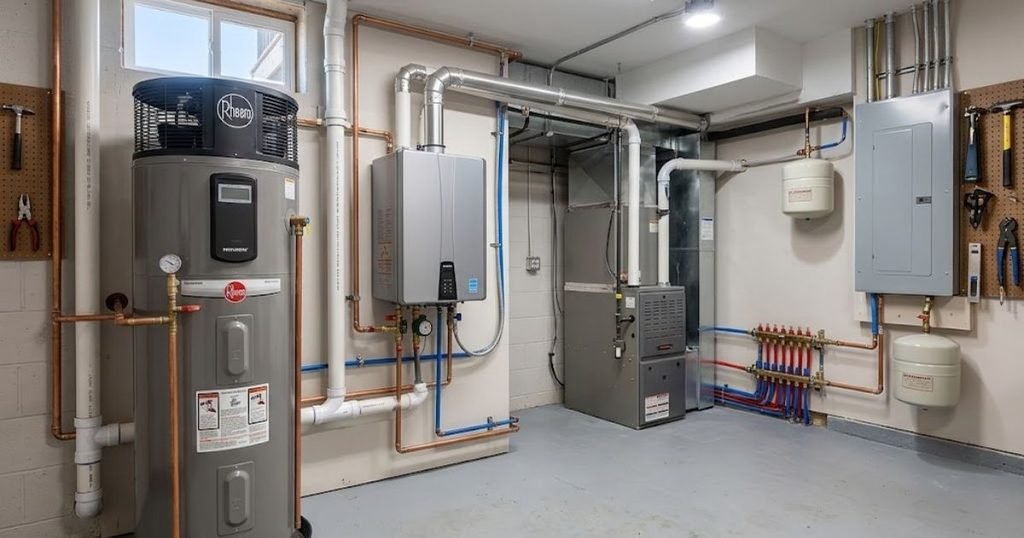
Heat Pump vs Tankless Water Heater at a Glance
The table below summarizes how heat pump water heaters compare directly against tankless options across key operational criteria:
| Feature | Heat Pump Water Heater | Tankless Water Heater (Gas or Electric) |
| Primary Operating Mechanism | Transfers heat from surrounding air into a storage tank via a compressor cycle. | Heats water instantly on demand using high-powered gas burners or electric heating elements without a storage tank. |
| Fuel / Energy Source | Electricity (208V–240V dedicated circuit). | Natural gas, propane, or high-amp electricity. |
| Energy Efficiency Metric | High UEF (typically 3.3 to 4.0+ UEF). | Moderate-to-High UEF (Gas: 0.81 to 0.96 UEF; Electric: ~0.95 to 0.99 UEF). |
| Hot-Water Delivery Style | Stored volume; delivery limited by tank capacity and First Hour Rating (FHR). | Continuous flow; delivery limited by continuous rate in Gallons Per Minute (GPM). |
| Approximate Equipment Cost | $1,500 – $3,200 | $800 – $2,500 (Gas units often cost more than electric units). |
| Typical Total Installed Cost | $2,500 – $4,500+ | $2,200 – $5,500+ (Gas retrofits and electrical panel upgrades increase total cost). |
| Estimated Annual Operating Cost | Lowest for electric homes ($100 – $250/year average). | Moderate to low ($180 – $450/year depending on local gas/electric rates). |
| Physical Space Requirement | Requires floor space for a tall tank plus ~700–1,000 cu. ft. of unconditioned air space. | Wall-mounted, compact footprint; frees up floor space entirely. |
| Electrical Infrastructure | 30-amp, 240V dedicated circuit (standard replacement for electric tanks). | Gas: 120V outlet. Electric: Requires up to 3 or 4 dedicated 40-amp 240V breakers (100–160+ total amps). |
| Gas Infrastructure | None required. | Gas models require a dedicated supply line (typically 3/4-inch line with sufficient BTU capacity). |
| Routine Maintenance Needs | Annual filter cleaning, condensate line clearance, safety valve testing, anode rod check. | Annual system descaling/flushing, intake filter cleaning, vent inspecting (for gas models). |
| Expected Equipment Lifespan | 10 to 15 years | 15 to 20+ years |
| Optimal Household Application | Electric homes with basement/garage space looking for maximum energy savings. | Homes with high simultaneous hot-water demand, limited floor space, or accessible gas lines. |
Understanding Efficiency Ratings (UEF): The U.S. Department of Energy (DOE) and ENERGY STAR evaluate residential water heaters using the Uniform Energy Factor (UEF). A higher UEF indicates greater overall energy efficiency during daily standard usage patterns.
Conventional electric tanks hover around 0.90 to 0.93 UEF. Heat pump models achieve UEF ratings between 3.30 and 4.0+, meaning they transfer three to four times more energy in heat than they absorb in electrical wattage.
READ MORE: AO Smith vs. Rheem Water Heaters: Comparison & Expert Reviews
What Is a Heat Pump Water Heater?
Unlike traditional water heaters that burn through electricity using simple heating coils, a hybrid heat pump water heater operates like a refrigerator in reverse.
A top-mounted compressor draws in ambient air from the surrounding room, extracts its heat using a refrigerant loop, and transfers that thermal energy directly into the water tank. Because moving heat takes far less power than creating it, ENERGY STAR® certified units use up to 70% less energy than standard electric models delivering massive annual utility savings.
To handle heavy water usage, these systems feature backup resistance elements and 5 smart operational modes:
- Heat Pump / Efficiency: Maximum savings. Uses only the compressor to heat water with peak efficiency.
- Hybrid / Auto (Recommended): Uses the heat pump by default, but automatically kicks in backup coils during sudden, high-draw demands.
- High Demand / Boost: Runs the heat pump and heating elements simultaneously for ultra-fast recovery.
- Electric / Standard: Bypasses the heat pump entirely, relying only on traditional coils (ideal for extreme cold or maintenance).
- Vacation: Lowers the tank temperature to freeze-proof levels, cutting energy use while you’re away.
What Is a Tankless Water Heater?
A tankless water heater often called an on-demand water heater eliminates the traditional 40- to 80-gallon storage tank entirely. Instead, the unit remains in standby mode until a hot-water valve opens inside the home (such as a running shower, kitchen faucet, or washing machine).
- Opening a hot fixture triggers an internal flow sensor.
- The flow sensor signals the control board to ignite high-output gas burners or energize heavy-duty electrical heating elements.
- Cold groundwater circulates through a compact heat exchanger, absorbing energy instantly.
- Hot water flows directly to the open fixture at the desired temperature.
- Closing the fixture shuts off the burners or heating elements, placing the system back into standby mode.
Because water is only heated when actively requested, standby thermal loss, the gradual heat loss that occurs while water sits idle in a standard storage tank is completely eliminated.
Tankless systems are categorized by fuel type:
- Gas Tankless Systems (Natural Gas or Liquid Propane): These use high-BTU burners (ranging from 120,000 to 199,000+ BTUs) to heat water rapidly. Non-condensing gas units push high-temperature exhaust through specialized venting, while high-efficiency condensing units extract additional thermal energy from exhaust gases before venting cooler exhaust via standard PVC pipes.
- Electric Tankless Systems: These units pass water over high-wattage electric heating elements. Because heating cold water instantly with electricity requires significant energy, these systems draw massive electrical current, often requiring multiple high-amp circuits.
READ MORE: Carrier Heat Pump Reviews— Models, Costs, Pros & Cons
Heat Pump vs Tankless Water Heater — How They Differ
Understanding the operational differences between these technologies helps clarify how performance, installation, and ongoing ownership costs play out in a residential setting.
1. Energy Efficiency
Comparing efficiency between heat pump and tankless systems requires examining energy transfer versus energy creation.
- Heat Pump Water Heaters: Transferring existing thermal energy from surrounding air into water is inherently more efficient than generating new thermal energy from scratch. A heat pump operating in pure efficiency mode delivers performance ratings upwards of 300% to 400% (3.30 to 4.00+ UEF).
- Tankless Water Heaters: Eliminate standby losses by heating water only on demand. A premium condensing gas tankless unit reaches an efficiency range of 0.90 to 0.96 UEF, while an electric tankless unit operates around 0.98 UEF.
While electric tankless models show high basic efficiency figures (converting nearly all electrical input to heat), they draw significant instantaneous electrical power during operation.
Meanwhile, heat pump models achieve high total efficiency by utilizing ambient air heat, reducing overall kilowatt-hour consumption over time.
2. Upfront Installation Cost
The purchase price of the water heater represents only a portion of the total installation investment. Adapting a home’s existing utility infrastructure to accommodate a new water-heating technology often drives the total installed price.
- Heat Pump Water Heater Installation: Swapping a standard electric tank for a heat pump water heater is often straightforward if electrical connections are already present. However, installation costs increase if the room requires ducting for cold exhaust air, new condensate drain lines, or structural expansion to satisfy air volume requirements.
- Gas Tankless Installation: Transitioning from a gas tank to a gas tankless system often requires significant infrastructure updates. Standard gas tanks typically use a 1/2-inch gas pipe and basic metal chimneys, while high-output gas tankless systems usually require a 3/4-inch gas line to feed up to 199,000 BTUs of burner capacity. They also require dedicated PVC/polypropylene venting out an exterior wall and dedicated electrical outlets for control boards.
- Electric Tankless Installation: Replacing a standard electric tank with an electric tankless system usually requires substantial electrical upgrades. A standard electric tank relies on a single 30-amp, 240V circuit. An electric tankless unit capable of supplying a whole house may require three or four 40-amp 240V double-pole breakers, demanding 120 to 160 amps of dedicated capacity. Many homes require a total main electrical panel upgrade (e.g., upgrading from 100-amp or 150-amp service to 200+ amp service) to support this load safely.
Cost Breakdown Table
The table below outlines average costs for equipment, labor, and potential infrastructure modifications across all three primary replacement categories:
| Cost Component | Heat Pump Water Heater | Gas Tankless Water Heater | Electric Tankless Water Heater |
| Basic Equipment Cost | $1,500 – $3,200 | $1,200 – $2,500 | $700 – $1,500 |
| Base Plumbing Labor | $800 – $1,500 | $1,000 – $1,800 | $600 – $1,200 |
| Electrical Upgrades | $0 – $500 (Usually standard 30A circuit) | $200 – $500 (120V outlet required) | $1,200 – $3,000+ (Panel upgrade/heavy wiring) |
| Gas Line Modification | Not Applicable | $500 – $1,500 (Upgrading to 3/4″ line) | Not Applicable |
| Venting Adjustments | $0 – $400 (Ducting optional) | $400 – $1,200 (Category III stainless or PVC venting) | Not Applicable |
| Permits & Inspection | $100 – $300 | $100 – $300 | $100 – $300 |
| Estimated Total Installed Cost | $2,500 – $4,500+ | $2,800 – $5,500+ | $2,000 – $4,500+ |
Note: All values represent general U.S. national estimates. Regional labor rates, utility access, and building code enforcement vary locally.
3. Long-Term Operating Cost
While upfront installation costs catch your attention first, operating costs determine a water heater’s true lifetime value. Annual running expenses depend on three main factors: local utility rates (cents per kWh for electricity vs. therms for natural gas), your regional climate, and household hot-water demand.
- Heat Pump (Hybrid): Delivers the lowest operating costs for electric homes. Because its compressor simply moves existing ambient heat rather than generating it, it consumes far fewer kilowatt-hours than traditional tank or electric tankless systems.
- Gas Tankless: Highly cost-effective in areas where natural gas is significantly cheaper than electricity.
- Electric Tankless: While it eliminates standby heat loss, its massive spike in instantaneous power draw often makes it more expensive to run than a heat pump unit.
4. Hot-Water Capacity and Daily Performance
How these systems deliver hot water determines daily comfort for occupants:
- Heat Pump Water Heater Performance: Delivery relies on storage capacity and the unit’s First Hour Rating (FHR). A 66-gallon heat pump unit provides a large volume of hot water upfront, allowing multiple showers and appliances to run simultaneously without immediate drops in water pressure or temperature. However, once that stored thermal volume is depleted, the unit requires recovery time to bring cold replacement water up to temperature.
- Tankless Water Heater Performance: Delivers a continuous stream of hot water indefinitely, provided total simultaneous usage does not exceed its maximum GPM capacity. If incoming groundwater is cold or multiple high-flow fixtures open at once (e.g., two showers and a washing machine operating concurrently), the unit may reach its thermal threshold, reducing output flow or causing mild temperature fluctuations.
5. Installation Requirements
Installation feasibility often depends on the physical layout and structural utility features of your home.
Heat Pump Water Heater Installation Requirements
- Air Space Volume: Heat pumps extract energy from the surrounding room. ENERGY STAR recommends installing these units in unconditioned or open spaces providing at least 700 to 1,000 cubic feet of surrounding air space (equivalent to a 10′ x 10′ room or larger basement area). Installing one inside a small closet restricts air circulation, forcing the system to fall back on less efficient resistance heating elements unless the closet is louvered or ducted to adjacent rooms.
- Ambient Air Operating Temperature: Compressor operation is most effective in spaces where ambient temperatures remain consistently between 40°F and 90°F year-round. Unheated garages in extreme northern climates can lower performance efficiency during winter months.
- Condensate Management: As heat pumps extract warmth from moist ambient air, water vapor condenses inside the unit. Installations require a dedicated drain line, condensate pump, or floor drain to manage moisture safely.
- Clearance and Noise Considerations: Hybrid units are generally taller and heavier than traditional electric tanks due to the top-mounted compressor assembly. The compressor also produces a modest fan humming sound (typically 45–55 decibels, similar to a modern refrigerator or dishwasher).
Tankless Water Heater Installation Requirements
- Gas Line BTUs: High-output gas tankless water heaters require significant fuel flow upon demand. Existing gas supply lines must deliver 120,000 to 199,000 BTUs per hour, which often necessitates running dedicated 3/4-inch gas lines back to the main meter.
- Specialized Exhaust Venting: Non-condensing gas tankless units require high-temperature Category III stainless steel exhaust venting routed through exterior wall penetrations or roof lines. High-efficiency condensing units can use specialized PVC or polypropylene venting to handle cool, acidic exhaust gases.
- Electrical Panel Capacity: Electric tankless models require multiple dedicated high-amp double-pole breakers. Homes with 100-amp or 150-amp electrical panels usually require comprehensive service upgrades to support whole-house electric tankless operation safely.
- Water Quality and Filtration: Incoming groundwater with high mineral content (hard water) can lead to limescale buildup inside the compact channels of a tankless heat exchanger. Installing a water softener or dedicated inline pre-filter helps maintain system efficiency and prevent internal flow restrictions.
READ MORE: Best Tankless Water Heater— Top Picks, Costs & Buyer’s Guide
Heat Pump Water Heater Pros and Cons
| Pros / Advantages | Cons / Limitations |
| High Operational Efficiency Achieves efficiency ratings of 3.30 to 4.0+ UEF, using a fraction of the electricity required by traditional heating systems. | Physical Size Requirements Hybrid units are taller and heavier than standard tanks, requiring sufficient floor space and overhead clearance. |
| Lower Utility Bills Saves typical households substantial money annually on electrical power compared to traditional resistance tanks. | Air Volume Needs Needs a large volume of ambient air (~700–1,000 cu. ft.) or proper room ducting to operate efficiently without reverting to electric resistance mode. |
| Dehumidification Benefits The top-mounted compressor acts as a localized dehumidifier, removing excess ambient moisture from damp basements or utility spaces. | Ambient Cooling Effects Emits cool exhaust air into the immediate room during operation, which can slightly lower room temperatures in unheated basements during winter. |
| Straightforward Electric Replacement Usually connects directly to existing 30-amp, 240V wiring, avoiding the need for main electrical panel upgrades. | Compressor Sound Output Operates with a low humming sound from the compressor and fan assembly during heating cycles. |
| Incentive Eligibility Frequently qualifies for federal tax credits, regional utility rebates, and local energy program incentives. | Slower Recovery Rate Takes longer to reheat cold replacement water when operating strictly in pure efficiency/heat pump mode. |
Tankless Water Heater Pros and Cons
| Pros / Advantages | Cons / Limitations |
| Continuous Hot Water Supplies hot water continuously without running out, provided overall usage remains within the unit’s GPM flow limit. | Complex Retrofit Upgrades Frequently requires upgrading gas line sizes, installing non-metallic vent lines, or executing main electrical panel expansion. |
| Space Savings Mounts directly to structural wall studs, freeing up floor space in utility rooms or basements. | Flow-Rate Limitations High simultaneous usage across multiple fixtures can drop water delivery rates or trigger thermal fluctuations. |
| Extended Service Life Typically lasts 15 to 20+ years with regular maintenance, outlasting standard storage tanks. | “Cold-Water Sandwich” Effect Brief pauses between usage cycles can allow a small pocket of unheated water to pass through the system, creating a momentary drop in water temperature. |
| Zero Standby Energy Losses Eliminates the continuous thermal loss of storing hot water by heating water only on demand. | Minimum Flow Rate Requirement Low-flow fixtures drawing less than ~0.5 GPM may fail to trigger the internal ignition sequence, resulting in unheated water. |
| Replaceable Internal Components Key modular components (such as internal heat exchangers, flow sensors, and control boards) can be replaced individually if needed. | Maintenance Needs in Hard Water Areas Requires periodic descaling flushes using specialized acid solutions to prevent internal mineral scaling in hard water areas. |
READ MORE: Ecobee vs Honeywell vs Nest: Which Smart Thermostat Is Best?
Heat Pump vs Tankless: Which Is More Energy Efficient?
When evaluating primary energy transfer, heat pump water heaters are more energy efficient overall than tankless water heaters.
Tankless systems achieve high internal efficiency by operating only when water is actively running, eliminating standby heat losses.
However, because a heat pump moves existing ambient thermal energy into stored water rather than generating heat from scratch, its effective energy output exceeds the electrical power consumed to run the compressor.
With UEF ratings frequently exceeding 3.30, a certified heat pump water heater delivers up to three to four times more energy than it consumes in electricity.
By contrast, an electric tankless water heater operates at ~0.98 UEF, while a condensing gas tankless unit operates between 0.90 and 0.96 UEF.
Heat Pump vs Tankless Water Heater: Which Costs Less to Run?
Calculating annual water heating expenses comes down to four key variables: household size, local utility rates, installation climate, and daily hot-water usage habits.
Cost Comparison Example
Based on standard household averages:
| System Type | Estimated Annual Consumption | Standard Rate | Estimated Annual Cost |
| Heat Pump (Electric) | 1,000 kWh / yr | $0.16 / kWh | $160 / yr |
| Gas Tankless (Natural Gas) | 180 Therms / yr | $1.25 / Therm | $225 / yr |
| Electric Tankless | 3,200 kWh / yr | $0.16 / kWh | $512 / yr |
Heat Pump vs Tankless Water Heater Lifespan
Equipment longevity depends heavily on water quality, installation precision, and regular routine maintenance.
- Heat Pump Water Heater: Average expected lifespan is 10 to 15 years. The internal storage tank remains vulnerable to corrosion over time, though maintaining the sacrificial anode rod can help extend tank integrity.
- Tankless Water Heater: Average expected lifespan is 15 to 20+ years. Because tankless systems store no standing water, the structural shell is less susceptible to internal storage corrosion. Most individual internal sub-assemblies (flow sensors, heat exchangers, igniters) can be serviced or replaced independently.
READ MORE: EcoSmart Tankless Water Heater: Reviews, Comparison & Buyer Guide
Maintenance Comparison
Both technologies require routine preventive maintenance to maintain operational efficiency and preserve factory warranty coverage.
| Maintenance Task | Heat Pump Water Heater | Tankless Water Heater |
| Air Filter Cleaning | Required (Wash or vacuum washable intake filter every 3–6 months). | Required (Inspect and clear fresh air intake filter annually). |
| Tank / Exchanger Flushing | Required (Flush bottom tank sediment once annually). | Required (Flush heat exchanger with vinegar or descaling solution annually). |
| Descaling Treatment | Rarely required for tank interior (unless in extreme hard water areas). | Essential (Perform annual flushing in areas with hard mineral water). |
| Condensate Line Inspection | Required (Clear condensate drain trap line annually to prevent backup). | Required (Inspect trap on condensing gas models annually). |
| Anode Rod Inspection | Required (Check and replace sacrificial anode rod every 3–5 years). | Not Applicable (No standing storage tank anode rod required). |
| Burner & Vent Inspection | Not Applicable | Required (Inspect gas burner orifices and venting pipes annually). |
| Professional Servicing | Recommended every 2–3 years to check refrigerant charge and electrical connections. | Recommended annually to check combustion, gas pressure, and heat exchangers. |
Which Is Better for Specific Home Scenarios?
1. Which Is Better for a Small Home?
- Best Choice:Tankless Water Heater
- Why: Wall-mounted units free up valuable floor space in compact utility closets, condos, or tight mechanical rooms.
- Alternative:Heat Pump Water Heater
- Why: Ideal for all-electric small homes with an available garage or basement, providing ultralow running costs without needing an expensive electrical panel upgrade.
2. Which Is Better for a Large Family?
The ideal option depends on how your household uses hot water:
- Simultaneous Usage (Multiple showers & appliances running at once)
$\rightarrow$ Large Heat Pump Unit (66–80 Gal): Delivers a strong initial volume of hot water without sudden pressure or temperature drops. - Staggered Usage (Back-to-back showers taken continuously)
$\rightarrow$ High-Capacity Gas Tankless System (9–11+ GPM): Provides an endless supply of hot water without waiting for a tank to reheat.
3. Which Is Better for a Cold Climate?
Both technologies work well in cold climates, but installation strategy is critical:
| System | Cold Climate Impact | Installation Requirement |
| Heat Pump | Cold ambient air forces the unit onto inefficient backup resistance heating. | Install in a conditioned basement or insulated utility space. |
| Gas Tankless | Cold groundwater reduces flow rate capacity (e.g., a 9 GPM unit may drop to 4.5–5.5 GPM in winter). | Upsize to a higher BTU unit to maintain target GPM during winter. |
4. Which Is Better for Homes with Solar Panels?
- Clear Winner: Heat Pump Water Heater
- Why It Pairs Perfectly: Operating at a modest power draw (~400–600 watts), a heat pump effectively acts as a thermal battery. Homeowners can run the unit during peak daytime solar production to store hot water for evening use, maximizing solar self-consumption.
Heat Pump vs Electric Tankless Water Heater
| Feature | Heat Pump Water Heater | Electric Tankless Water Heater |
| Power Draw | Moderate (~500W) | Massive peak (18kW–36kW+) |
| Electrical Circuit | Standard 30A, 240V circuit | Requires 100–160+ dedicated amps (3–4 breakers) |
| Panel Upgrades | Typically uses existing wiring; no upgrade needed | Frequently requires a major electrical panel upgrade |
| Efficiency (UEF) | High (3.3 – 4.0+) | Moderate (~0.98) |
| Ongoing Utility Cost | Lowest (uses up to 70% less energy) | Higher (relies on high-wattage resistance) |
Heat Pump vs Gas Tankless Water Heater
| Feature | Heat Pump Water Heater | Gas Tankless Water Heater |
| Fuel Source | All-electric operation | Natural gas or liquid propane |
| Venting Requirements | None (zero on-site emissions) | Dedicated venting through an exterior wall |
| Hot Water Delivery | Stored hot water; strong simultaneous flow up to tank capacity | Continuous, on-demand supply; ideal for back-to-back usage |
| Space & Placement | Requires floor space & ~700–1,000 cu. ft. room air (basements, garages) | Compact wall-mounted frame; frees up floor space |
| Annual Operating Cost | $100 – $250 / yr (at ~$0.16/kWh) | $180 – $350 / yr (where natural gas rates are low) |
| Best Home Fit | All-electric homes, solar PV setups, or homes eliminating gas | Homes with existing gas connections and high sequential demand |
7 Questions to Ask Before Buying
Before purchasing a new system, evaluate these key infrastructure questions:
- What is my home’s existing fuel source?
Is the current system powered by electricity, natural gas, or liquid propane? - Where will the new unit be physically located?
Is there sufficient floor space and room air volume for a heat pump, or wall space with exterior venting access for a tankless unit? - What is the current capacity of my main electrical panel?
Does your panel support 200-amp service, or will an electric tankless unit require a costly electrical service upgrade? - Is the existing gas supply line sized appropriately?
Does your gas branch measure 1/2-inch or 3/4-inch, and can it supply up to 199,000 BTUs per hour? - How does your family draw hot water daily?
Do household members run multiple fixtures simultaneously, or take long back-to-back showers? - What is your local groundwater temperature during winter?
Cold incoming groundwater reduces effective GPM delivery on tankless units, requiring proper sizing adjustments. - Which local utility rebates and federal tax credits apply?
Are there rebates available that offset the initial price difference between equipment options?
Common Mistakes Homeowners Make
- Comparing Purchase Prices Only: Selecting a cheap standard water heater can lead to higher utility bills over time, offsetting upfront equipment savings.
- Underestimating Tankless Retrofit Installation Expenses: Assuming a tankless unit drops into an old tank’s footprint without considering gas line, venting, or electrical upgrades can cause unexpected installation costs.
- Under-Sizing Tankless GPM Capacity: Installing a small tankless unit in a cold climate can result in low water pressure or lukewarm temperatures during peak winter months.
- Installing a Heat Pump in a Small Enclosed Closet: Enclosing a heat pump water heater in a small, unvented space starves the compressor of warm air, forcing the unit to rely on less efficient electric resistance mode.
- Skipping Regular Maintenance: Neglecting to descale a tankless unit in hard water regions or failing to clean a heat pump’s air filter can cause premature component failure and void factory warranties.
Final Verdict — Heat Pump or Tankless?
There is no single water heater that is perfect for every home. The ideal choice depends on your existing home infrastructure, utility rates, and hot water needs.
Frequently Asked Questions
Is a heat pump water heater cheaper to run than a tankless water heater?
In electric-powered homes, a heat pump water heater is generally cheaper to run than an electric tankless unit. By extracting thermal energy from surrounding air, heat pumps achieve UEF ratings of 3.3 to 4.0+, consuming significantly less electricity annually. In homes with natural gas, a gas tankless unit can also achieve low operating costs, depending on local natural gas prices versus regional electricity rates.
Can a heat pump water heater run out of hot water?
Yes, a heat pump water heater can run out of hot water if daily consumption exceeds its total tank storage volume and First Hour Rating (FHR). Once drained, the unit requires recovery time to bring cold replacement water back to set temperatures. However, modern hybrid models include backup electric resistance elements that activate during high demand to speed up recovery times.
Why are tankless water heater installations often more expensive?
Tankless installation costs are often driven by infrastructure updates required to support high energy draw. Gas tankless systems frequently require upgrading standard 1/2-inch gas lines to 3/4-inch lines and installing specialized exterior venting. Electric tankless systems require substantial electrical power, often necessitating main panel upgrades to provide multiple 40-amp 240V circuits.
Do heat pump water heaters cool down the room they are installed in?
Yes. As a heat pump water heater extracts warmth from surrounding ambient air, it exhausts cooler, drier air into the immediate space during active compressor cycles. This provides a helpful cooling and dehumidifying benefit in damp basements or warm garages, but may require venting considerations in smaller unconditioned rooms in cold climates.
How many years does a heat pump water heater last compared to a tankless?
A heat pump water heater typically lasts 10 to 15 years, similar to traditional storage tank designs. A tankless water heater generally lasts 15 to 20+ years because it lacks a central water storage tank, reducing internal corrosion risk when regularly descaled and maintained.