Choosing between a gas and an electric tankless water heater is one of the most significant utility decisions a homeowner can make. Switching to “on-demand” hot water eliminates standby energy losses, the energy wasted keeping 40 to 50 gallons of water piping hot 24 hours a day. However, deciding which fuel source to use involves far more than simply checking which utility bill is currently lower.
The right choice depends on a matrix of factors unique to your property:
- Household size and the number of bathrooms running at the same time
- Simultaneous hot-water demand (gallons per minute, or GPM)
- Incoming groundwater temperature (which varies sharply by region and season)
- Existing utility infrastructure (gas line diameter vs. main electrical panel amperage)
- Venting pathways and structural installation locations
- Local electric vs. natural gas utility rates
- Upfront equipment and labor costs versus long-term operational costs
Below, we’ll compare how each type works, what they cost, how to size them, and how six popular models stack up. Look past the sticker price. A cheap unit that needs a gas-line upgrade or a new electrical panel isn’t cheap. Lets deep dive into “Tankless Gas vs Electric Water Heater: Which Is Right for Your Home?”
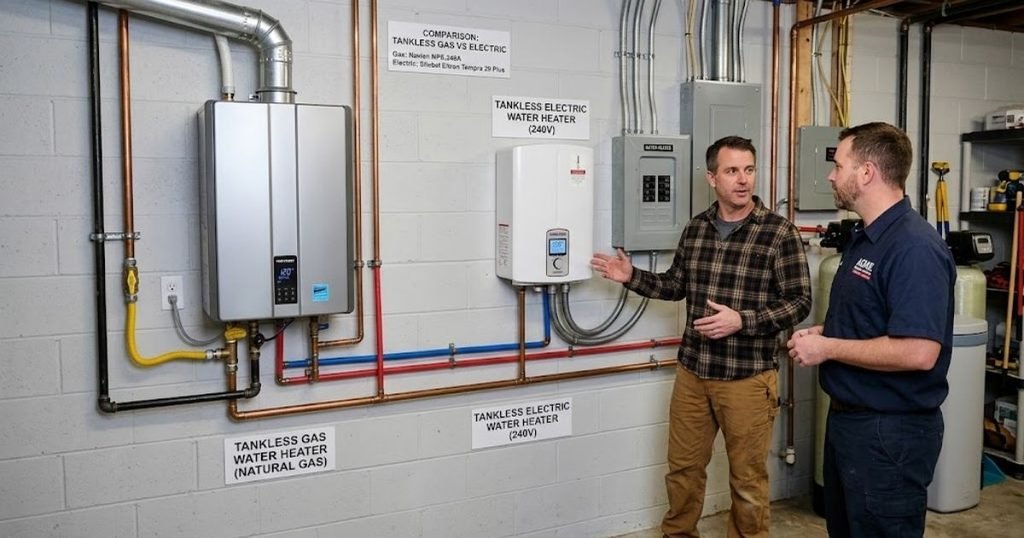
Tankless Gas vs Electric Water Heater at a Glance
The following comparison summarizes how gas and electric tankless water heaters perform across core mechanical, operational, and structural categories.
| Feature | Tankless Gas Water Heater | Tankless Electric Water Heater |
| Primary Fuel Source | Natural Gas or Liquid Propane (LP) | Electricity (240V Dedicated Circuits) |
| Hot-Water Output (GPM) | High to Very High (up to 9.0–11.0+ GPM) | Moderate to High (typically 2.5–6.0 GPM max) |
| Cold Climate Performance | Strong; handles severe temperature drops | Limited; output drops noticeably in cold climates |
| Venting Requirements | Required (Category III or IV stainless steel / PVC / CPVC) | None required (no combustion) |
| Electrical Demand | Low (120V connection for ignition/controls) | Heavy (often requires 100A to 150A+ dedicated draw) |
| Energy Efficiency (UEF) | 0.81 – 0.98 UEF (Condensing units reach ~0.98) | 0.92 – 0.99 UEF (Near-total energy conversion) |
| Average Equipment Lifespan | 20+ years with regular maintenance | 15–20 years with regular maintenance |
| Maintenance Needs | Annual descaling, burner & vent inspection | Regular descaling, heating element check, filter cleaning |
| Typical Installation Complexity | High (gas lines, venting, condensate drain) | Moderate to High (heavy panel/wiring upgrades) |
| Best Suited For | Large households, cold climates, high simultaneous demand | Smaller homes, warmer climates, point-of-use, low demand |
Note: Individual performance specifications, flow rates, and electrical draws vary significantly between manufacturers, model series, and installation conditions. Always consult current manufacturer documentation prior to equipment selection.
READ MORE: AO Smith vs. Rheem Water Heaters: Comparison & Expert Reviews
How Does a Tankless Gas Water Heater Work?
A gas tankless water heater is a compact burner and heat exchanger. Here’s the sequence:
- A hot-water tap opens.
- The unit’s sensor detects water flow.
- The burner ignites.
- Gas combustion heats the heat exchanger.
- Incoming cold water passes through the heat exchanger.
- Heated water travels to the fixture.
- The burner modulates up or down to match demand.
A few terms are worth knowing:
- BTU input: how much fuel energy the burner can use per hour. Higher input generally means more heating capacity.
- GPM (gallons per minute): how much hot water the unit can deliver.
- Temperature rise: the difference between incoming water temperature and the temperature you want. A bigger rise means lower GPM.
- Condensing vs non-condensing: condensing models capture extra heat from exhaust gases, so they’re more efficient, but they produce acidic condensate that must be drained and typically use different vent materials. Non-condensing models are simpler but less efficient.
- Natural gas vs propane: many models are built for one or the other, so confirm the fuel before buying.
Gas units also need correct gas-line sizing, a vent path, and adequate combustion air. That’s why they can deliver high flow rates but are often more involved to install.
How Does an Electric Tankless Water Heater Work?
An electric tankless water heater uses high-amperage electrical resistance heating elements to warm water almost instantly as it passes through small copper or stainless steel heating chambers.
The Heating Sequence Step-by-Step
- Flow Sensing: Opening a faucet pushes water through an internal flow meter, activating the unit’s microprocessor once threshold flow is reached.
- Power Activation: The main control module uses Solid-State Relays (SSRs) to send high-amperage electrical current to internal heating elements.
- Conduction: Water flows directly across single or multiple heavy-duty resistance heating elements (often layered in series inside bare-element or direct-immersion heating channels).
- Self-Modulation: Temperature sensors at the inlet and outlet continuously monitor performance. The control module rapidly scales electrical wattage (kilowatts) up or down to keep output temperatures stable without overheating.
Electrical Realities & Panel Capacities
Electric tankless units convert 100% of electrical energy into thermal heat without producing combustion gases. Because of this, they require no venting, chimneys, or gas connections, making structural installation simple.
However, claiming electric units are easy to install overall can be misleading. Converting kilowatts into instantaneous thermal energy requires massive electrical currents.
- Kilowatt (kW) Ratings: Whole-house electric tankless units draw between 18 kW and 36 kW under full load.
- Dedicated Circuitry: A 24 kW electric unit often requires two to three double-pole 40A or 50A 240V breakers running on heavy-gauge copper wiring (such as 8 AWG or 6 AWG).
- Main Service Panel Draw: For example, manufacturer specifications for the Stiebel Eltron Tempra 24 Trend (a 24 kW, 240V model) list a 100-amp maximum current draw and recommend a minimum 150-amp to 200-amp main electrical service panel.
Installing a whole-house electric unit in an older residence with an existing 100-amp or 125-amp service panel often requires a full electrical service upgrade, which can add significant cost to the installation.
READ MORE: Tankless Water Heater vs Tank Water Heater: Which Is Better?
Tankless Gas vs Electric: Which Is More Energy Efficient?
Evaluating energy efficiency requires distinguishing between energy conversion efficiency and actual operating cost.
Uniform Energy Factor (UEF) Explained
The UEF rating measures overall efficiency during daily hot-water production.
- Electric Tankless Units: Typically carry UEF ratings between 0.92 and 0.99. Nearly all electrical energy entering the resistance element is converted directly into heat in the water, resulting in almost zero local thermal waste.
- Gas Tankless Units: Non-condensing units average 0.81 to 0.82 UEF, losing thermal energy through high-temperature flue exhaust. Condensing gas units reach 0.95 to 0.98 UEF by extracting heat from exhaust vapor.
Efficiency vs. Utility Costs
While electric tankless systems achieve higher thermal conversion efficiency, energy efficiency does not always translate to lower operating costs.
- Fuel Costs: In most U.S. regions, electricity costs significantly more per unit of thermal energy delivered (measured in BTUs or kilowatt-hours) than natural gas.
- Climate Impact: In colder climates, incoming groundwater temperatures can drop below 40°F in winter. An electric tankless unit must work at max capacity to achieve an 80°F temperature rise. This can increase residential peak electrical loads and raise utility costs during winter months.
- Usage Dynamics: Homes with high daily consumption often achieve lower monthly utility bills with high-efficiency condensing gas units even though electric units carry higher baseline UEF metrics.
Tankless Gas vs Electric: Which Costs More?
Purchase Price
Equipment-only prices vary based on capacity, internal components, controls, and technology:
- Gas Tankless Units: Equipment costs range from $800 to $2,200+ for residential models. Condensing models with built-in recirculation pumps sit at the higher end of that scale.
- Electric Tankless Units: Equipment costs are generally lower, ranging from $500 to $1,200+ for whole-house models.
Installation Cost Breakdown
Total installation costs depend heavily on your home’s existing utility setup:
Gas Tankless Installation
- Equipment: 800–2,200
- Category III/IV Sealed Venting: 300–900
- Gas Line Upgrades to 3/4″ or 1″: 400–1,200
- Condensate Drain Line & Neutralizer: 150–350
- Professional Plumbing Labor: 1,000–2,500
- Total Estimated Cost: 2,655–7,150
Electric Tankless Installation
- Equipment: 500–1,200
- Electrical Service Upgrade / Subpanel: 1,500–3,500+
- Multiple 240V Breakers & Heavy Copper Wiring: 400–1,000
- Plumbing Connections & Valves: 250–600
- Professional Electrical & Plumbing Labor: 800–2,000
- Total Estimated Cost (If Service Upgrade Required): 3,450–8,300+
- Total Estimated Cost (If Electrical Panel Supported): 1,150–2,800
Long-Term Operating Costs
Calculating total cost of ownership requires looking beyond equipment prices and evaluating:
AnnualOperatingCost=AnnualEnergyConsumptionLocalUtilityRate
Because utility rates vary across North America, verify local energy costs (cents per kWh for electricity vs. dollars per therm or CCF for natural gas) before committing to a fuel source.
READ MORE: Condensing vs Non-Condensing Tankless Water Heater
Tankless Gas vs Electric: Which Provides More Hot Water?
Hot-water output comes down to GPM and temperature rise.
A rule of thumb: raising 1 gallon per minute of water by 1°F takes about 500 BTU per hour of useful heat. Say your target is 105°F and your winter groundwater is 45°F. That’s a 60°F rise. In a warmer region where water arrives at 65°F, it’s only 40°F.
Now picture a busy morning, using illustrative flow rates (check your actual fixtures’ labels):
- Shower: about 2 GPM
- Kitchen faucet: about 1.5 GPM
- Washing machine: about 1.5 GPM
- Bathroom sink: a fraction of a gallon per minute
That’s roughly 5 GPM. At a 60°F rise, you need about 150,000 BTU/hr of useful heat, or roughly 44 kW of electric heating. At a 40°F rise, it’s about 100,000 BTU/hr, or roughly 29 kW. A single 24 kW electric unit can’t cover that in either case, while a high-input gas unit may be able to.
This is why a unit’s maximum GPM rating can mislead. It’s typically achievable only at a modest temperature rise. In northern states, winter groundwater can be quite cold, so the same heater delivers noticeably less flow than it would in the South. Multiple simultaneous showers and large families make the gap bigger.
Tankless Gas vs Electric for Household Size
There’s no “gas is always best” answer. Here’s a rough guide:
- 1–2 people: one bathroom and light overlap usually fit either type, and a smaller electric unit may be enough in warmer climates.
- 3–4 people: this is where simultaneous demand starts to matter. Count how often two showers, or a shower and the dishwasher, overlap.
- 5+ people or multiple bathrooms: gas generally has an advantage here, but multiple electric units or a hybrid plan can also work if your electrical service supports them.
- Large soaking tubs: these draw high flow for a long time, so check both GPM and the unit’s sustained output.
- Several showers at once: size to the worst-case overlap and your coldest winter water.
A mild-climate home with sufficient electrical service can be better served by electric than a cold-climate home with the same family size. Incoming water temperature can flip the answer.
READ MORE: Heat Pump vs Tankless Water Heater: Which Is Better?
Tankless Gas vs Electric Installation Requirements
Gas Installation Requirements
- Dedicated Gas Line: High-capacity burners often require upgrading from a standard 1/2-inch line to a dedicated 3/4-inch or 1-inch supply line to supply enough fuel during peak operation.
- Sealed Venting: Must use Category III stainless steel or Category IV plastic piping (PVC/CPVC/polypropylene for condensing units) terminating through an exterior sidewall or roof.
- Combustion Air: Requires an adequate room volume or dedicated intake piping to supply fresh air for combustion.
- Condensate Management: Condensing models produce acidic wastewater that must route through a neutralizer before discharging into household drains.
- Outdoor Installation: In southern climates, outdoor-rated gas units can eliminate indoor venting and condensate routing requirements.
Electric Installation Requirements
- High Electrical Capacity: Requires an adequate main electrical panel (often 150A to 200A+ total service).
- Dedicated Breakers: Demands multiple dedicated double-pole 240V circuit breakers (often two to four 40A, 50A, or 60A breakers depending on kW rating).
- Wire Sizing: Requires heavy copper wiring (such as 8, 6, or 4 AWG) routed directly from the service panel to the unit.
- No Venting Needed: Operates without combustion, requiring zero exhaust venting, combustion air intakes, or gas supply lines.
Tankless Gas vs Electric Maintenance
Gas units:
- Descaling or flushing the heat exchanger
- Burner inspection
- Vent and exhaust inspection
- Combustion-related checks by a qualified technician
- Water-quality management
Electric units:
- Descaling
- Heating-element inspection
- Cleaning inlet filters where applicable
- Water-quality management
- Checking electrical connections (by a qualified electrician)
Hard water leaves scale on heat exchangers and elements, which reduces performance and efficiency. Maintenance intervals depend on your water hardness and the manufacturer’s requirements, so follow the manual. Skipping maintenance can also affect warranty coverage.
READ MORE: Tankless Water Heater vs. Combi Boiler: Which Is Right for You?
Tankless Gas vs Electric Lifespan
With regular maintenance and proper descaling, a tankless water heater can last significantly longer than a traditional tank-style unit:
- Tankless Gas Water Heater: [ 20 to 25 Years Expected Lifespan ]
- Tankless Electric Water Heater:[ 15 to 20 Years Expected Lifespan ]
- Traditional Tank Water Heater: [ 8 to 12 Years Expected Lifespan ]
Key factors affecting actual equipment lifespan include:
- Water Hardness: Unfiltered hard water accelerates scale buildup and causes thermal stress on heat exchangers and heating elements.
- Routine Descaling: Flushing the system annually helps maintain optimal heat transfer efficiency and extends service life.
- Installation Quality: Proper pipe sizing, electrical installation, and gas/venting setups prevent premature component wear.
Pros and Cons Comparison
Tankless Gas Water Heaters
- Pros:
- High hot-water flow rates (up to 9.0–11.0+ GPM max)
- Strong performance in cold climates with low incoming water temperatures
- Capable of supporting multiple simultaneous fixtures in large homes
- Long service life (up to 20+ years with proper maintenance)
- Cons:
- Higher upfront equipment purchase cost
- Complex installation requiring dedicated gas piping and sealed venting
- Requires annual combustion and venting system inspections
- Standby power required for internal electronics, freeze protection, and ignition
Tankless Electric Water Heaters
- Pros:
- Highly compact design with simple wall-mounting options
- No combustion, gas lines, or exhaust venting required
- Near 100% conversion efficiency (0.92–0.99 UEF)
- Generally lower upfront equipment purchase price
- Cons:
- Heavy electrical demand; often requires major panel or service upgrades
- Lower total hot-water flow rate (GPM) compared to gas models
- Performance drops significantly in cold climates
- High electricity rates can lead to higher monthly operating costs in some regions
Reviews: Best Tankless Gas Water Heaters
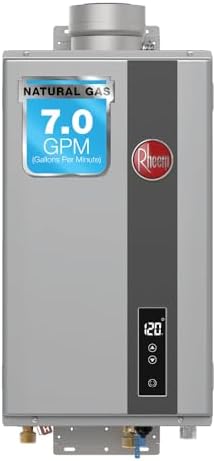
1. Rheem RTG Series 7.0 GPM Natural Gas Tankless Water Heater (RTG-70DVLN-3)
- • Fuel: Natural Gas (Indoor Direct Vent)
- • Capacity: 7.0 GPM Max
- • Thermal Rating: 160,000 BTU
- • Efficiency: 0.82 UEF (Non-Condensing)
Detailed Breakdown
The Rheem RTG-70DVLN-3 is an indoor, non-condensing natural gas tankless water heater designed for small-to-medium homes. Delivering up to 7.0 GPM under optimal conditions, it provides a balance of capacity, reliability, and compact design.
Performance & Sizing
Powered by a 160,000 BTU burner, this unit handles up to two simultaneous showers in warm climates. In northern climates with colder groundwater, available flow drops to roughly 3.2 to 4.0 GPM—enough to power a shower and a faucet at the same time.
Key Features & Warranties
- Hot-Start Programming: Keeps the heat exchanger warm during short off-and-on uses to eliminate the cold-water sandwich effect (a sudden blast of cold water between hot water uses).
- Direct-Vent Design: Pulls outside air directly into a sealed combustion chamber via dual-pipe venting.
- Warranty: 15-year limited warranty on the heat exchanger, 5-year on parts, and 1-year on labor.
Assessment
- Strengths: Proven non-condensing reliability, compact form factor, and low standby power consumption.
- Drawbacks: Requires Category III stainless steel venting; lower efficiency than condensing units.
- Ideal Use Case: 2-to-3 bathroom homes in moderate climates with existing gas service looking for a reliable, mid-tier gas tankless unit.
2. Rinnai RX180iN Condensing Smart Sense Tankless Water Heater
- • Fuel: Natural Gas (Convertible to Propane)
- • Capacity: Up to 10.0 GPM Max
- • Thermal Rating: 15,000 – 180,000 BTU
- • Efficiency: 0.98 UEF (Super-High Efficiency)
Detailed Breakdown
The Rinnai RX180iN features high-efficiency condensing performance with integrated smart features. With an Ultra-High Efficiency Factor (0.98 UEF), it captures latent heat from flue exhaust to deliver high hot water flow rates with minimal energy waste.
Performance & Sizing
Modulating from 15,000 to 180,000 BTUs, the RX180iN delivers up to 10.0 GPM maximum flow. It comfortably powers three simultaneous showers in warm climates and two showers plus a washing machine in cold northern winters.
Key Features & Warranties
- SmartSense Gas Valve: Automatically adjusts for natural gas or liquid propane installation without requiring manual conversion kits.
- Category IV Plastic Venting: Works with low-cost Schedule 40 PVC, CPVC, or polypropylene vent piping.
- Wi-Fi Connectivity: Smart control enables remote monitoring, temperature adjustments, and service diagnostic alerts.
- Warranty: 15-year limited warranty on the heat exchanger, 5-year on parts, and 1-year on labor.
Assessment
- Strengths: 0.98 UEF rating, flexible venting options, smart app integration, and strong high-flow capacity.
- Drawbacks: Higher upfront purchase price; requires dedicated condensate drainage and neutralizer.
- Ideal Use Case: Large households in cold climates seeking low monthly operating costs and smart home integration.

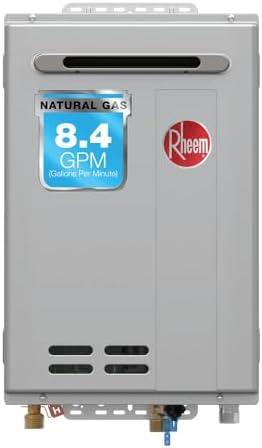
3. Rheem RTG Series Outdoor Tankless Water Heater (RTG-84XLN-3)
- • Fuel: Natural Gas (Outdoor Installation Only)
- • Capacity: 8.4 GPM Class
- • Thermal Rating: 180,000 BTU
- • Efficiency: 0.82 UEF (Non-Condensing)
Detailed Breakdown
The Rheem RTG-84XLN-3 is an outdoor-mounted natural gas tankless water heater designed for Southern and Western homes. Installing the unit on an exterior wall eliminates the need for indoor exhaust venting and wall penetrations.
Performance & Sizing
With a high-output 180,000 BTU burner, this unit produces up to 8.4 GPM, easily powering two to three simultaneous hot-water fixtures in warm-to-moderate groundwater regions.
Key Features & Warranties
- Outdoor Design: Built with a weather-resistant cabinet and integrated freeze protection down to -20°F.
- Zero Indoor Footprint: Mounts to external walls, saving indoor mechanical room space.
- Warranty: 15-year limited warranty on the heat exchanger, 5-year on parts, and 1-year on labor.
Assessment
- Strengths: Eliminates indoor venting costs, simplifies installation, and saves interior storage space.
- Drawbacks: Outdoor installation only; unsuitable for cold northern climates prone to sustained hard freezes.
- Ideal Use Case: Sunbelt homeowners looking to save space and avoid expensive indoor venting installations.
Reviews: Best Tankless Electric Water Heaters
1. Rheem RTEX-24 24kW 240V Electric Tankless Water Heater
- • Fuel: Electricity (240V / 24 kW)
- • Capacity: Up to 4.3 GPM Max
- • Current Draw: 100 Amps Peak
- • Efficiency: Up to 0.94 UEF
Detailed Breakdown
The Rheem RTEX-24 is an electric tankless water heater designed for small-to-medium single-family homes or apartments. It provides precise temperature control using self-modulating power technology.
Performance & Sizing
Under ideal warm-groundwater conditions (70°F inlet temp), the RTEX-24 delivers up to 4.3 GPM enough to power a shower and a sink at the same time. However, in cold climates (42°F inlet temp requiring a 75°F rise), output drops to approximately 2.0 to 2.2 GPM (suited for a single shower fixture).
Key Features & Electrical Requirements
- Self-Modulating Power: Dynamically adjusts energy draw based on real-time hot-water demand.
- Digital Temperature Control: Thermostatic control knob allows adjustments in 1°F increments.
- Electrical Demand: Requires a 240V connection with two 60-amp double-pole circuit breakers and 6 AWG copper wiring (drawing up to 100A peak).
- Warranty: 5-year heat exchanger warranty and 1-year limited parts warranty.
Assessment
- Strengths: Compact form factor, high thermal conversion efficiency, no venting required.
- Drawbacks: Flow rate drops in cold climates; requires a minimum 150-amp main electrical service panel.
- Ideal Use Case: Small-to-medium homes in warmer southern climates with adequate electrical panel capacity.

2. Stiebel Eltron Tempra 24 Trend Electric Tankless Water Heater
- • Fuel: Electricity (240V / 24 kW)
- • Capacity: 3.0 – 4.5 GPM Range
- • Current Draw: 100 Amps Peak
- • Efficiency: 0.99 UEF
Detailed Breakdown
Engineered in Germany, the Stiebel Eltron Tempra 24 Trend is built with solid copper heating chambers and heavy-duty electrical components to deliver reliable, silent performance without temperature swings.
Performance & Sizing
The Tempra 24 Trend operates at 24 kW (240V) to deliver roughly 4.0 GPM in southern climates and 2.2 GPM in northern climates. Stiebel Eltron’s Advanced Flow Control system automatically modulates water flow if demand exceeds heating capacity, maintaining a consistent output temperature.
Key Features & Electrical Requirements
- Silent Microprocessor Technology: Uses solid-state switches instead of mechanical relays for quiet operation.
- Solid Copper Heat Exchanger: Durable copper cylinders protect against mineral corrosion and thermal wear.
- Electrical Demand: Requires two 50A 240V double-pole circuit breakers, 6 AWG wire, and a recommended 150A minimum main service panel.
- Warranty: 7-year leakage warranty and 3-year parts warranty.
Assessment
- Strengths: German-engineered durability, silent operation, and reliable temperature control.
- Drawbacks: Requires high electrical panel capacity; lower peak flow rates in northern winters.
- Ideal Use Case: Quality-focused homeowners without gas access seeking a long-lasting electric tankless unit.

3. Rheem 18kW 240V Tankless Electric Water Heater (RTEX-18)
- • Fuel: Electricity (240V / 18 kW)
- • Capacity: Up to 3.5 GPM Max
- • Current Draw: 75 Amps Peak
- • Efficiency: 0.94 UEF
Detailed Breakdown
The Rheem RTEX-18 is a compact 18 kW electric tankless water heater designed for point-of-use setups, small apartments, cabins, or single-bathroom homes.
Performance & Sizing
The RTEX-18 supplies up to 3.5 GPM in warm climates—enough for one main shower and a bathroom sink. In colder northern climates, flow rates drop to roughly 1.5 to 1.8 GPM, limiting output to a single running fixture at a time.
Key Features & Electrical Requirements
- Compact Footprint: Easily mounts inside closets, under cabinets, or near point-of-use fixtures.
- Digital Display: Simple LED interface for precise temperature monitoring.
- Electrical Demand: Requires two 40-amp double-pole 240V circuit breakers with 8 AWG copper wiring (75A peak draw).
- Warranty: 5-year heat exchanger warranty and 1-year limited parts warranty.
Assessment
- Strengths: Lower electrical demand than 24 kW+ units, easy to conceal, and affordable equipment cost.
- Drawbacks: Limited total flow rate; unsuitable for simultaneous multi-fixture use in large homes.
- Ideal Use Case: Small condos, annexes, warm-climate 1-bath homes, or targeted point-of-use installations.

Tankless Gas vs Electric — 6 Water Heater Comparison Table
| Product Model | Fuel Type | Model Type | Approx Capacity (GPM) | Efficiency (UEF) | Venting Needed | Electrical / Gas Specs | Best Suited For | Main Advantage | Main Drawback |
| Rheem RTG-70DVLN-3 | Natural Gas | Non-Condensing Indoor | Up to 7.0 GPM | 0.82 UEF | Yes (Category III Metal) | 160,000 BTU / 1/2″ or 3/4″ line | 2–3 Bath Homes (Moderate Climate) | Proven, reliable non-condensing design | Requires specialized Category III vent pipe |
| Rinnai RX180iN | Natural Gas (LP convertible) | Condensing Smart Indoor | Up to 10.0 GPM | 0.98 UEF | Yes (Category IV PVC/CPVC) | 180,000 BTU / SmartSense Valve | Large Families & Cold Climates | Super-high 0.98 UEF; works with PVC vent pipe | Higher initial equipment & install cost |
| Rheem RTG-84XLN-3 | Natural Gas | Non-Condensing Outdoor | Up to 8.4 GPM | 0.82 UEF | No (Outdoor Exhaust) | 180,000 BTU / Outdoor Cabinet | Southern Homes with Space Constraints | Saves interior floor space; no indoor venting needed | Outdoor only; vulnerable to sustained freezes |
| Rheem RTEX-24 | Electric | Whole-House Electric | Up to 4.3 GPM | ~0.94 UEF | None | 24 kW / 240V / 2x60A Breakers (100A) | 1–2 Bath Homes (Southern Climates) | Simple digital control; zero combustion venting | Limited flow rate in cold climates |
| Stiebel Eltron Tempra 24 Trend | Electric | Premium Whole-House | 3.0–4.5 GPM | 0.99 UEF | None | 24 kW / 240V / 2x50A Breakers (100A) | Quality-Minded Electric-Only Homes | Durable copper construction; silent operation | Requires a 150A+ main electrical service panel |
| Rheem RTEX-18 | Electric | Compact / Point-of-Use | Up to 3.5 GPM | ~0.94 UEF | None | 18 kW / 240V / 2x40A Breakers (75A) | Condos, Cabins, & 1-Bath Residences | Moderate electrical draw; low purchase price | Cannot support multiple simultaneous fixtures |
Which Is Better: Tankless Gas or Electric?
Choose Tankless Gas If…
- You have a large family or multi-bathroom home: High-BTU gas burners deliver higher hot-water flow rates (GPM) during peak demand.
- You live in a cold northern climate: Gas systems handle low winter groundwater temperatures without severe drops in hot water output.
- Your home already has natural gas or propane infrastructure: Existing gas lines make upgrading to a gas tankless system easier.
- You want lower monthly utility bills in regions where natural gas is inexpensive: Lower per-BTU gas prices often mean lower annual operating costs.
Choose Tankless Electric If…
- Your home does not have natural gas access: Adding gas service or propane tanks can be cost-prohibitive compared to an electric installation.
- You want to eliminate indoor combustion venting: Electric units require zero vent piping, wall penetrations, or makeup air intakes.
- You have adequate electrical service panel capacity: Homes with 200A+ panels can often support a whole-house electric tankless unit with minimal electrical work.
- You live in a warmer climate with low-to-moderate hot-water demand: Higher groundwater temperatures allow electric units to maintain comfortable flow rates for 1 to 2 fixtures.
Tankless Gas vs Electric Water Heater: Final Verdict
There is no universal “winner” between gas and electric tankless water heaters. The right choice depends on your home’s existing infrastructure, regional climate, and hot-water demand.
- Gas tankless water heaters are ideal for large families, cold climates, and homes with high simultaneous hot-water needs—provided natural gas or propane infrastructure is available.
- Electric tankless water heaters are well-suited for smaller homes, warmer southern climates, point-of-use setups, or homes without gas lines where the main electrical panel can support high amperage draws without expensive upgrades.
Before purchasing, calculate your total installed cost including equipment, utility line upgrades, venting, and labor and consult a licensed professional to ensure your new system meets your home’s hot water needs safely and efficiently.
Frequently Asked Questions
Is a gas or electric tankless water heater better?
Neither technology is universally better. Gas tankless units generally deliver higher flow rates (GPM) and perform better in cold climates or large homes with multiple bathrooms running simultaneously. Electric tankless units offer vent-free operation, compact sizing, and high thermal conversion efficiency, making them well-suited for small-to-medium homes in warm climates or homes without gas service.
Is it cheaper to run a gas or electric tankless water heater?
In most parts of the United States, natural gas costs less per unit of energy (BTU) than electricity. Even though electric tankless units carry higher conversion efficiency ratings (up to 0.99 UEF), a high-efficiency condensing gas tankless unit (0.95–0.98 UEF) often delivers lower monthly operating costs in regions where electric rates are high.
What are the main disadvantages of an electric tankless water heater?
The primary disadvantages are high peak electrical demands and lower hot-water flow rates in cold climates. Whole-house electric tankless units often draw 100 to 150 amps of electrical current, which may require upgrading your home’s main electrical service panel to 150 or 200 amps. Additionally, cold groundwater reduces their output, making them less suited for multi-bathroom homes in northern states.
Do gas tankless water heaters provide more hot water than electric?
Yes, gas tankless water heaters generally deliver higher gallons-per-minute (GPM) output than electric units. Gas burners generate between 130,000 and 199,000 BTUs of thermal energy quickly, allowing them to heat cold incoming water faster and supply multiple hot-water fixtures at the same time.
How do I choose the right size tankless water heater for my home?
Identify all hot-water fixtures you plan to run at the same time (e.g., two 2.0 GPM showers = 4.0 GPM total).
Determine your region’s coldest winter groundwater temperature.
Calculate the required temperature rise (Target Temp of 120°F minus groundwater temperature).
Select a tankless model that delivers your required GPM at that specific temperature rise.