If your Rheem water heater is not heating, you are dealing with one of the most common and annoying household plumbing issues. The good news is that a lack of hot water does not automatically mean you need to spend thousands of dollars on a brand-new system.
Whether your unit is completely cold, producing lukewarm water, or shutting off unexpectedly, identifying the root cause is the first step toward getting your home’s hot water back. Because Rheem manufactures a wide variety of electric, natural gas, propane, hybrid heat pump, and tankless models, the exact cause often depends on the power source and design of your specific appliance.
In this practical guide, we will walk you through the diagnostic process step by step, just as an experienced plumbing technician would explain it over the phone. You will learn how to safely inspect your water heater, perform basic DIY checks, understand diagnostic codes, and recognize the critical point when it is time to put down the tools and call a licensed professional. Lets deep dive into “Rheem Water Heater Not Heating? Simple DIY Fixes & Tips”
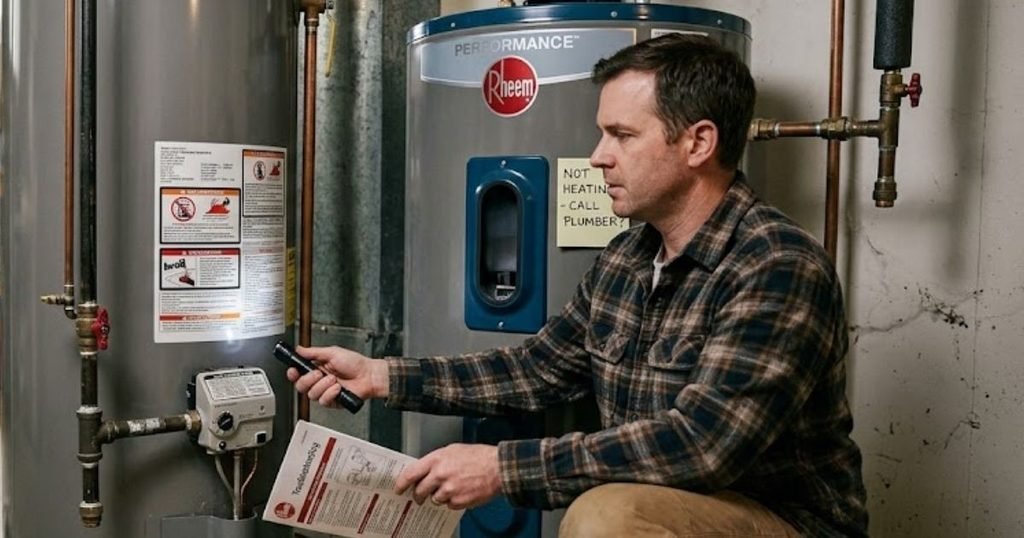
Common Reasons a Rheem Water Heater Is Not Heating
Before grabbing a flashlight or opening your electrical panel, it helps to understand how your system operates and what typically goes wrong.
1. Power Supply Problems
Electric water heaters require a dedicated 240V circuit to power their heating elements. If the circuit breaker in your home’s main electrical panel trips or if there is a local power outage the unit loses all heating capability immediately. Breakers can trip due to power surges, aging electrical components, or an internal short circuit inside the water heater. While resetting a tripped breaker once is a standard initial check, a breaker that repeatedly trips indicates a serious electrical fault that needs professional evaluation.
2. Tripped High-Limit Reset or Safety Cutoff
Electric Rheem water heaters feature a high-temperature safety switch, often referred to as the Emergency Cut Off (ECO) or high-limit control. Located on the upper thermostat assembly behind the upper access panel, this thermal switch trips automatically if the water temperature inside the tank exceeds safe operating limits (typically around 170F to 180F). When activated, it cuts power to both heating elements to prevent dangerous scalding or excessive tank pressure.
3. Faulty Heating Element
Standard electric tank water heaters feature two electric heating elements: an upper element and a lower element.
- Upper Element Failure: If the upper element burns out, the unit usually stops heating water entirely because power flows through the upper thermostat before energizing the lower assembly.
- Lower Element Failure: If the lower element fails, you will typically experience lukewarm water or run out of hot water much faster than usual, as only the top portion of the tank is being heated.
4. Thermostat Problems
Thermostats regulate the water temperature inside the tank by cycling power or gas flow to the heating source. If an electric thermostat misreads water temperature, fails mechanically, or loses calibration, the water heater will fail to turn on or shut off prematurely. Similarly, gas units rely on a thermopile or temperature sensor integrated into the gas control valve; a malfunction here prevents the main burner from igniting.
5. Gas Supply Problems
For natural gas or liquid propane (LP) models, an uninterrupted fuel supply is required. If the manual gas shutoff valve installed on the line leading to the unit is accidentally closed, or if your local gas utility service is interrupted, your Rheem gas water heater not heating issue will persist. Additionally, air trapped in newly installed gas lines or improper gas pressure can prevent proper ignition.
6. Pilot Light or Ignition Failure
Older gas Rheem models rely on a continuous standing pilot light, whereas newer energy-efficient models utilize electronic ignition systems (such as direct spark ignition or hot-surface igniters).
- Standing Pilot Issues: Dirt buildup on the pilot orifice, a worn thermocouple, or drafty installation spaces can cause the pilot flame to blow out or fail to remain lit.
- Electronic Ignition Issues: A faulty igniter, damaged flame sensor, or failed control board will prevent the main burner from lighting, even if gas is flowing.
7. Sediment Buildup
Over time, naturally occurring minerals in hard water primarily calcium and magnesium settle at the bottom of storage tanks. As this sediment layer thickens, it forms an insulating barrier between the heat source and the water. In gas units, sediment leads to popping, rumbling noises, and severe thermal efficiency loss. In electric units, sediment can completely bury the lower heating element, causing it to overheat and burn out prematurely.
8. Water Heater Leak or Internal Component Failure
An active leak from the inner storage tank or cold water inlet pipe can dilute the hot water faster than the heating elements or burners can warm it up, making it seem like the heater is failing. Furthermore, if water leaks directly onto electrical controls, gas valves, or sensors, internal safety features will trigger an automatic system shutdown to prevent short circuits or fires.
9. Error Codes or Electronic Control Problems
Modern Rheem water heaters including Performance, Performance Plus, Gladiator, and tankless lines are equipped with self-diagnostic electronic control boards or smart status lights. These diagnostic systems use LED flash codes or digital displays to signal specific faults, such as fan pressure switch failures, gas control valve errors, thermistor faults, or leak detection alerts.
READ MORE: Rheem Water Heater Repair: Fixes, Costs & When to Call a Plumber
Troubleshooting Before Calling a Plumber
If you find your Rheem water heater not producing hot water, perform these basic diagnostic steps before scheduling a service call.
Step 1: Confirm the Type of Rheem Water Heater
Locate the rating label on the side of your water heater tank or tankless cabinet. Note down the exact Model Number, Serial Number, and Fuel Type (Electric, Natural Gas, LP Gas, or Hybrid/Heat Pump). Troubleshooting a Rheem gas water heater not heating involves completely different steps than resolving an issue with an electric or tankless model.
Step 2: Check Whether All Hot-Water Fixtures Are Affected
Go to multiple sinks, tubs, and showers throughout your house.
- If only one faucet delivers cold water while others receive hot water, the water heater is operating correctly. The problem lies in a faulty mixing valve, clogged shower cartridge, or local plumbing branch.
- If every fixture in the home receives cold or lukewarm water, the water heater system itself requires attention.
Step 3: Check the Power Supply on Electric Models
Walk to your home’s main circuit breaker panel and locate the double-pole circuit breaker labeled “Water Heater” or “Dryer/Water Heater.” Check if the breaker switch has tripped to the middle or “OFF” position.
- If tripped, firmly push the switch to the full “OFF” position, then flip it back to “ON.”
- Safety Warning: If the breaker immediately trips again upon resetting, do not reset it a second time. A recurring trip indicates a direct short circuit or grounded heating element that requires professional electrical diagnosis.
Step 4: Check the Temperature Setting
Inspect the temperature setting dial on your water heater. For gas units, this dial is located on the front of the gas control valve near the bottom of the tank. For electric units, thermostats are located behind removable access panels on the side of the tank.
- Ensure the thermostat is set to a safe, functional temperature. Rheem and the U.S. Consumer Product Safety Commission (CPSC) recommend a default setting of 120°F (49°C) to balance comfort, energy efficiency, and scald prevention.
Step 5: Observe the Status Light or Error Display
Many contemporary Rheem gas and electric units feature a green LED status light on the gas control valve, an electronic control panel, or an integrated EcoNet smart display.
- Normal Operation: A steady single flash every few seconds on a gas control valve indicates normal operation (pilot lit, temperature satisfied).
- Fault Indication: A rapid blinking pattern (e.g., 2 flashes, 4 flashes, or 7 flashes) or an alphanumeric code on a digital display (e.g., A101, A102, E1) signifies a specific diagnostic fault. Note down the exact flash count or code.
Step 6: Check the Gas Supply Only When Safe
For gas models, visually inspect the manual gas shutoff valve installed on the yellow or black iron gas supply pipe leading to the unit. The valve handle should sit parallel to the pipe (OPEN). If the handle is perpendicular (CLOSED), gas cannot flow to the burner.
CRITICAL GAS SAFETY WARNING: If you smell gas (a skunk-like or rotten-egg odor), DO NOT attempt to light the pilot, touch any electrical switch, or operate household appliances. Immediately evacuate all occupants from the building and call your local gas utility provider or emergency services (911) from a safe distance outside the residence.
Step 7: Decide Whether Professional Service Is Needed
Review your findings against this quick reference guide to decide your next course of action:
| Diagnostic Finding | Potential Root Cause | Recommended Action |
| Breaker trips immediately upon reset | Shorted heating element or damaged wiring | Turn off power; call a licensed electrician or plumber |
| Status light flashes specific code pattern | Sensor fault, pressure switch, or ignition failure | Consult model manual; contact technician with code |
| Gas smell detected around unit | Fuel line leak or unburned gas accumulation | Evacuate immediately; call gas company / 911 |
| Unit works fine after single breaker reset | Nuisance power surge | Monitor performance closely over next 48 hours |
| Water heater leaking from bottom tank body | Internal tank corrosion / rust-through | Turn off water supply; arrange full unit replacement |
READ MORE: How to Increase Heat Setting on Tankless Rheem Water Heater
Rheem Electric Water Heater Not Heating
Electric storage water heaters rely on electrical components working together to maintain water temperature. When troubleshooting a Rheem electric water heater not heating, understanding how these components function sequentially will help isolate the failure.
Symptom and Diagnostic Overview for Electric Models
| Symptom | Possible Cause | Safe DIY Next Step | Professional Action Needed |
| No hot water at all (Water completely cold) | Tripped circuit breaker, tripped ECO safety switch, burned-out upper element, or faulty upper thermostat. | Check and reset main circuit breaker once. | Perform continuity/voltage testing on thermostats and elements. |
| Lukewarm water or short hot water supply | Burned-out lower element, failed lower thermostat, sediment build-up, or broken dip tube. | Verify temperature setting dial is at 120°F. | Drain tank sediment; test and replace lower heating element. |
| Breaker trips repeatedly | Grounded heating element (casing split), shorted wiring, or failing breaker switch. | Leave breaker OFF; do not attempt additional resets. | Inspect internal wiring harnesses; replace defective elements. |
| High-limit reset button trips repeatedly | Malfunctioning thermostat stuck in “ON” position, extreme sediment layer, or loose wiring. | Turn off circuit breaker; leave panels closed. | Replace defective upper/lower thermostat assemblies. |
If you suspect internal electrical component failures, learn more about how to evaluate failing water heater symptoms to avoid unnecessary part replacements.
Rheem Gas Water Heater Not Heating
Gas storage water heaters utilize natural gas or propane burners positioned underneath the tank, venting exhaust gases through a central vertical flue pipe or powered side-vent system.
Common Failure Points on Gas Models
- Pilot Light Extinguished: Drafts, dirt accumulation on the pilot orifice, or temporary gas line pressure fluctuations can extinguish the flame. Follow the specific lighting instructions printed on the label inside your water heater’s access door to attempt relighting.
- Faulty Thermocouple or Flame Sensor: If your Rheem water heater pilot light won’t stay lit after releasing the pilot knob, a dirty or failed thermocouple is usually responsible.
- Dirty Flammable Vapor Ignition Resistance (FVIR) Arrester: Rheem gas units feature sealed combustion chambers with a flame arrestor plate at the bottom. If dust, lint, or pet hair blocks this screen, the burner starves for oxygen, causing the flame to shut off or trip the thermal switch.
- Defective Gas Control Valve: The main gas control valve houses the internal thermostat and electronic safety solenoids. Internal component wear requires replacing the complete valve body.
| Gas Unit Symptom | Likely Underlying Cause | Action & Safety Boundary |
| Pilot light won’t stay lit | Worn thermocouple, clogged pilot orifice, or tripped thermal switch | Clean pilot assembly; replace thermocouple if needed |
| Status light flashes 4 or 7 times | High temperature limit reached or thermal switch open | Call licensed gas technician to diagnose venting/combustion |
| Burner ignites then shuts off after seconds | Dirty flame sensor rod or inadequate combustion air | Clean air intake screen; check for room ventilation blockage |
| Popping or banging noises while heating | Hard water sediment insulating bottom tank head | Flush tank sediment according to Rheem guidelines |
READ MORE: How to Drain a Rheem Water Heater — Step-by-Step Guide
Rheem Tankless Water Heater Not Heating
Rheem tankless water heaters (such as the Performance or RTEX/RTGH series) provide continuous hot water by heating water on demand as it flows through high-efficiency copper or stainless steel heat exchangers. When a Rheem tankless water heater stops heating, the diagnostic approach differs significantly from tank-style models.
Key Differences and Diagnostic Checks for Tankless Units
- Minimum Flow Rate Activation: Tankless units require a minimum water flow rate typically 0.26 to 0.40 gallons per minute (GPM) to trigger the internal flow sensor and start the burner or heating elements. If you turn on a faucet at a slow trickle, or if your faucet aerator is clogged with debris, the water heater will not turn on.
- Inlet Water Filter Clogging: Tankless units contain a cold-water inlet filter screen designed to catch sediment and pipe debris. A clogged filter screen starves the unit of flow, preventing heating activation.
- Mineral Scale Accumulation: Because water is heated instantly inside narrow heat exchanger tubes, hard water minerals scale up inside tankless systems much faster than in storage tanks. Heavy scale buildup insulates the heat exchanger, causing overheating errors, efficiency loss, or sudden shutdowns.
- Error Code Lockouts: Tankless models display two-digit numeric error codes (e.g., Code 11 for ignition failure, Code 12 for flame loss, Code C2/13 for cold water sandwich/sensor fault, Code 29 for neutralizer issue).
For complex tankless disruptions, consult our detailed troubleshooting guide on tankless water heater shutdowns for step-by-step diagnostic workflows.
Why Is My Rheem Water Heater Only Producing Lukewarm Water?
Experiencing lukewarm water instead of a cold shutoff is a distinct plumbing issue. When your Rheem water heater is lukewarm water only, use this diagnostic matrix to trace the underlying cause:
1. Broken or Broken Off Dip Tube
The plastic dip tube directs incoming cold water straight to the bottom of the storage tank so the heating elements or gas burners can warm it up. If the dip tube cracks or disintegrates, incoming ice-cold water mixes directly with the hot water sitting at the top of the tank. This results in warm water at your faucets, even though the heating elements are working normally.
2. Failed Lower Heating Element (Electric Units)
As noted earlier, if the lower heating element burns out, only the upper portion of the tank (roughly 30% of total volume) reaches operating temperature. Water starts out hot for two to three minutes, but quickly fades to lukewarm as cold water enters the tank.
3. Plumbing Line Crossover or Bad Mixing Valve
Single-handle shower valves, commercial faucets, and washing machine connections use internal mixing cartridges. If an internal valve cartridge fails, high-pressure cold water can cross over into the hot water supply lines inside your walls, diluting hot water throughout the home.
4. Excessive Household Water Demand
If family members run the dishwasher, washing machine, and two showers at the same time, the hot water demand will exceed the recovery capacity of your storage tank, leading to lukewarm water delivery.
READ MORE: How to Flush a Rheem Tankless Water Heater: Step-by-Step Guide
How to Reset a Rheem Water Heater Safely
Searching for the Rheem water heater reset button is one of the most common troubleshooting steps for homeowners. However, reset procedures vary significantly based on your model’s fuel source and design.
Electric Models: Locating the Red ECO Button
Electric storage water heaters feature a physical red button built into the upper high-limit thermostat switch.
Safe Electric Reset Procedure:
- Disconnect Power: Go to your home’s main electrical breaker box and turn the double-pole water heater circuit breaker completely OFF. Verify power is disconnected using a non-contact voltage tester if available.
- Remove Access Panel: Unscrew and remove the upper metal access panel cover located on the side of the water heater tank. Fold back the insulation blanket to reveal the protective plastic thermostat shield.
- Press Reset: Locate the red button on the upper thermostat control. Firmly press the button inward until you feel or hear a distinct click.
- Reassemble & Power On: Replace the plastic protective cover, reposition the insulation, screw the metal access door back on securely, and turn the circuit breaker back ON.
SAFETY WARNING: Never touch thermostat wiring terminals, electrical leads, or internal metal components with your bare hands or tools while performing a reset. If the red button pops out again shortly after resetting, do not force it down; contact a professional technician to replace the failing thermostat or shorted heating element.
Gas and Tankless Models: Electronic Controls Reset
Gas storage units and electronic tankless models do not possess a physical red button on the tank.
- Gas Control Valve Reset: To reset an electronic gas valve control, turn the main temperature selection dial to “OFF”, wait 5 full minutes for unburned gas to dissipate from the combustion chamber, and then return the dial to your desired temperature setting or follow the lighting sequence.
- Tankless Digital Reset: Turn off power to the tankless unit using its external electrical switch or by unplugging the cord from the wall outlet. Leave it disconnected for 60 seconds, then restore power to clear non-persistent error code lockouts.
READ MORE: How to Reset Rheem Tankless Water Heater Error Codes
When Should You Call a Professional?
While basic breaker checks, temperature dial adjustments, and visual inspections are well within the capabilities of most homeowners, certain water heater failure points pose significant safety hazards.
Stop troubleshooting immediately and contact a licensed plumber or technician if:
- The Circuit Breaker Trips Repeatedly: A breaker that trips a second time after being reset indicates an active short circuit, charred wiring, or grounded element casing that presents a house fire risk.
- You Smell Gas or See Soot: Strong gas odors, black soot marks around the draft hood or burner access door, or melting plastic caps indicate improper combustion, gas leaks, or dangerous carbon monoxide buildup.
- The Storage Tank Is Actively Leaking: Water pooling around the base of the tank due to a rusted or cracked inner steel shell cannot be repaired. The tank must be isolated and replaced immediately.
- You Lack Electrical / Gas Tools and Safety Training: Testing live 240V electrical circuits with a multimeter, measuring gas line pressure (w.c. inches), or disassembling gas combustion assemblies requires formal trade certification and specialized equipment.
Rheem Water Heater Repair Cost
When deciding whether to repair your existing unit, understanding typical plumbing repair costs helps you budget effectively. Below are estimated ranges for common Rheem water heater repairs across the United States.
| Repair Service Category | Typical Total Cost (Parts + Labor) | Primary Cost Factors |
| Diagnostic Visit / Service Call | $80 – $180 | Geographic region, emergency/after-hours scheduling, service provider type |
| Heating Element Replacement | $175 – $350 | Number of elements replaced, element type (watt-density), drain difficulty |
| Thermostat Replacement | $150 – $300 | Single vs. dual thermostat replacement, electrical harness condition |
| Thermocouple / Igniter Repair | $150 – $275 | Standing pilot vs. electronic hot-surface ignition system, accessibility |
| Gas Control Valve Replacement | $300 – $600 | OEM valve cost, gas line re-piping needs, combustion calibration |
| Tankless Descaling & Servicing | $150 – $300 | Severity of scale build-up, isolation valve availability, flushing chemical kit |
| Complete Water Heater Replacement | $1,200 – $3,500+ | Capacity (40 vs 50 gallon), fuel conversion, code upgrades, expansion tank |
Note: Cost figures reflect nationwide U.S. average estimates for residential service work as of 2026. Local labor rates and municipal permit fees will cause actual pricing to vary.
Repair or Replace: Which Option Makes More Sense?
Deciding whether to repair your non-heating Rheem water heater or replace it entirely comes down to three key factors: Age, Repair Cost, and Tank Condition.
- Age of the Appliance: Standard storage tank water heaters have an average operational lifespan of 8 to 12 years. Tankless units typically last 15 to 20 years with regular maintenance. If your tank unit is over 10 years old and facing a major component failure (such as a gas control valve or dual heating element overhaul), replacement is often the more cost-effective long-term choice.
- The 50% Rule: If the estimated cost of repairing your current unit exceeds 50% of the cost of buying and installing a new water heater, invest those funds into a new unit backed by a full manufacturer warranty.
- Leaking Tank Shell: If water is leaking directly from the tank body, repair is not an option. Structural rust and metal fatigue cannot be patched safely. The unit must be replaced.
How to Prevent Future Rheem Water Heater Heating Problems
Preventative maintenance protects your water heater, ensures peak energy efficiency, and prevents sudden cold-water surprises.
- Flush the Storage Tank Annually: Connect a garden hose to the drain valve at the base of the tank once a year to flush out accumulated sediment. This prevents lower element burnout on electric units and thermal barrier noises on gas units.
- Descale Tankless Units Regular: If you own a Rheem tankless water heater and live in a hard-water area, flush the heat exchanger with food-grade white vinegar every 12 to 18 months using a portable pump kit to clear mineral scale.
- Inspect the Anode Rod Every 2 to 3 Years: The sacrificial anode rod protects the tank’s inner steel wall from corrosion. Replacing a worn anode rod can double the lifespan of your storage tank. Learn more about extending system life with proper water heater anode rod maintenance.
- Maintain Clear Air Clearances: For gas and tankless units, ensure the surrounding space remains free of dust, paper, chemicals, and storage boxes. Keep exterior intake and exhaust venting pipes clear of bird nests, leaves, and snow accumulation.
Frequently Asked Questions
Why is my Rheem water heater not heating?
A Rheem water heater can stop heating due to power supply failures, a tripped circuit breaker, or a tripped high-limit safety reset button. On gas units, extinguishing pilot lights, faulty thermocouples, or gas control valve issues are primary causes. Tankless units typically fail to heat due to insufficient water flow rates, clogged inlet filters, or mineral scale build-up inside the heat exchanger.
Where is the reset button on a Rheem water heater?
On Rheem electric tank-style water heaters, the red reset button is located on the upper high-limit thermostat assembly behind the top metal access panel on the side of the tank. Gas water heaters and electronic tankless units do not feature a physical red button; they are reset by adjusting the gas control dial or cycling the electrical power source off and on.
Why is my Rheem electric water heater not producing hot water?
Electric units fail to produce hot water when the main circuit breaker trips, the red ECO safety cutoff switch activates, or the upper heating element or thermostat burns out. Because power flows through the upper thermostat to the rest of the unit, a failed upper element or upper thermostat prevents the entire water heater from functioning.
Why is my Rheem gas water heater not heating the water?
Rheem gas units will not heat if the manual gas supply valve is closed, the pilot light blows out, or the thermocouple fails to detect the pilot flame. Modern gas units will also lock out heating if the electronic igniter fails, the flammable vapor sensor trips, or the draft inducer blower cannot vent exhaust gases properly.
Why is my Rheem water heater only producing lukewarm water?
Lukewarm water usually points to a broken internal dip tube mixing cold and hot water inside the tank, a burned-out lower heating element on electric models, or severe hard-water sediment accumulation. On plumbing lines, a failed mixing valve cartridge in a shower or faucet can also allow cold water to cross over into the hot water line.
Sources
Cites and Technical Sources
- Rheem Manufacturing Company: Residential Electric and Gas Water Use & Care Manuals, Official Technical Support & Diagnostic Documentation.
- U.S. Department of Energy (DOE): Office of Energy Efficiency & Renewable Energy, Residential Water Heating Systems and Safety Guidelines.
- U.S. Consumer Product Safety Commission (CPSC): Scalding Prevention and Home Water Heater Temperature Safety Standard Guidelines.
Disclaimer
This troubleshooting article is provided for general educational and informational purposes only and does not replace official Rheem manufacturer product manuals, local plumbing codes, or professional trade service. Working with high-voltage electricity (240V) and natural gas/propane presents inherent risks of severe injury, electrical shock, explosion, or property damage. If you are uncertain about performing diagnostic checks safely, turn off power and fuel supplies to your appliance and contact a licensed plumbing or electrical contractor.