When replacing an aging water heater, homeowners often experience a moment of sticker shock coupled with frustration over how quickly standard steel tanks fail. Conventional glass-lined steel water heaters typically need replacement every 8 to 12 years, frequently succumbing to internal tank corrosion, anode rod exhaustion, or bottom-seam leaks. For property owners tired of this recurring cycle, the Rheem Marathon electric water heater presents an intriguing, premium alternative.
While the Marathon offers exceptional resistance to aggressive water conditions and features an impressive limited lifetime tank warranty for qualifying residential installations, it is not an entirely maintenance-free appliance, nor is it the cheapest route for every budget. This comprehensive review examines specifications, key features, pricing, installation considerations, and real-world value to help you decide if a Rheem Marathon electric water heater belongs in your home. Lets deep dive into “Rheem Marathon Electric Water Heater Review”
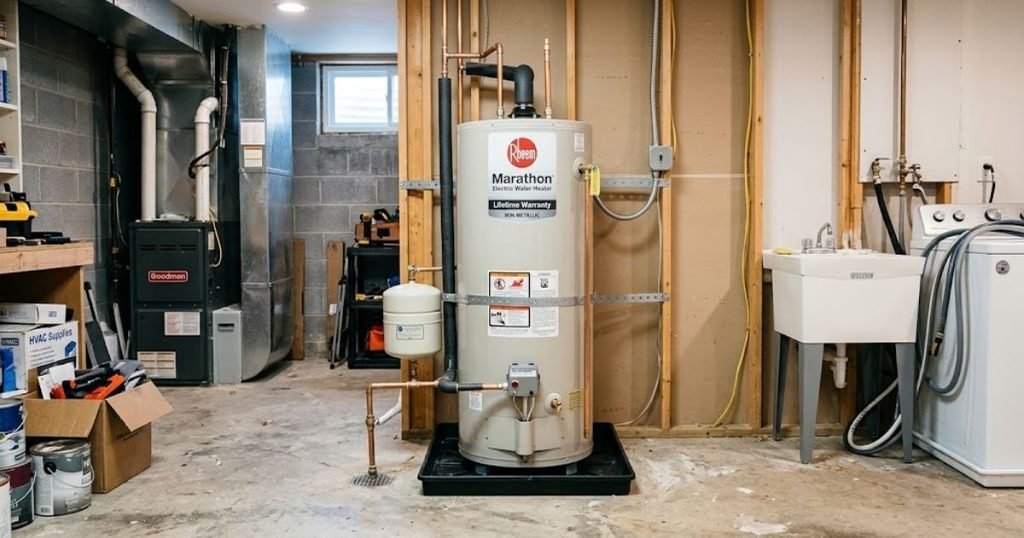
What Is the Rheem Marathon Electric Water Heater?
To understand why the Marathon stands out in the residential plumbing market, it helps to look at conventional design. Standard electric storage-tank water heaters use a steel tank lined with glass enamel to keep water away from the metal. Because glass-lined steel is still vulnerable to micro-cracks and chemical attack, manufacturers insert a sacrificial anode rod to attract corrosive minerals away from the tank walls. Once that anode rod depletes, rust takes over, leading to leaks and eventual tank failure.
The Rheem Marathon water heater approaches water heating differently. Its distinguishing feature is its nonmetallic tank design. Instead of steel, the inner tank consists of a seamless, blow-molded polybutene plastic liner wrapped entirely in filament-wound fiberglass. This nonmetallic construction means there is no steel to rust, no glass lining to crack, and crucially no anode rod to inspect or replace.
The water is still heated using standard electric elements controlled by thermostats, meaning the method of heating water is familiar, but the vessel holding the water is fundamentally unique. Available in various configurations including standard tall models, short models for tight vertical clearances, and larger-capacity units, residential Marathon models are built for single-family homes, multi-unit residential properties, and locations plagued by hard or aggressive well water.
(Note: While Rheem also manufactures Marathon thermal storage tanks designed to integrate with solar thermal or geothermal systems, standard residential Marathon models function as standalone electric water heaters powered by household electrical supplies.)
READ MORE: AO Smith vs. Rheem Water Heaters: Comparison & Expert Reviews
Rheem Marathon Electric Water Heater Specifications
Evaluating technical data is essential before selecting any water heater. Because specifications vary significantly by tank capacity and electrical configuration, reviewing model-specific data sheets prevents sizing mistakes.
The table below outlines representative residential models within the Marathon product line:
| Specification | Information / Typical Residential Models |
| Manufacturer | Rheem Manufacturing Company |
| Product Series | Marathon Non-Metallic Electric Water Heater |
| Fuel Type | Electricity (240V standard single phase) |
| Tank Construction | Seamless blow-molded polybutene inner tank with filament-wound fiberglass outer shell |
| Available Capacities | 15, 20, 30, 40, 50, 75, 85, and 105 gallons (plus 50-gallon short configurations) |
| Heating Elements | Dual copper or copper-sheathed upper and lower elements (typically 4500W standard for 40/50 gal) |
| Uniform Energy Factor (UEF) | Varies by model (generally ranges from approximately 0.88 to 0.93 depending on capacity and insulation thickness) |
| First-Hour Rating | Model-dependent (measures maximum hot water delivery in the first hour of heavy use) |
| Recovery Rate | Model-dependent (gallons heated per hour at a 90°F temperature rise, typically around 21 gallons per hour for 4500W elements) |
| Physical Dimensions | Varies by capacity (e.g., 50-gallon tall units average approximately 60–65 inches in height and 21–24 inches in diameter) |
| Residential Tank Warranty | Limited lifetime warranty for as long as the original purchaser owns the home |
| Parts Warranty | Typically 6-year limited warranty on electrical components, thermostats, and elements |
Understanding these metrics impacts daily household performance. Tank capacity determines how much hot water is stored at once, while the first-hour rating helps gauge whether the unit can handle simultaneous demands like running a dishwasher while someone takes a shower. The recovery rate dictates how fast the heating elements can reheat incoming cold water after the stored supply is depleted.
READ MORE: Best Rheem Electric Tankless Water Heater: Reviews, Cost & Comparison
Key Features of the Rheem Marathon Water Heater
1. Nonmetallic Tank Designed to Resist Rust and Corrosion
The core engineering achievement of the Rheem Marathon electric water heater is its 2-ply PermaGuard design. The inner polybutene tank is completely nonmetallic, making it immune to rust, scale adhesion, and chemical degradation. This design shines in regions with aggressive well water, high mineral content, or acidic water conditions that routinely chew through standard steel tanks in just a few years. Furthermore, because there is no anode rod, homeowners never have to deal with the sulfur-induced “rotten-egg” odors common in municipal or well water systems interacting with traditional magnesium or aluminum anodes. However, corrosion resistance in the tank does not mean the entire water heater is indestructible; external fittings, valves, and electrical elements remain subject to standard wear.
2. Fiberglass-Reinforced Outer Construction
Wrapped tightly around the polybutene core is a thick layer of filament-wound fiberglass. This outer shell provides immense structural integrity, allowing the tank to withstand high operating pressures (tested well beyond standard residential working pressures of 150 PSI). This fiberglass wrapping also contributes to a surprisingly lightweight physical profile compared to heavy steel-tank counterparts of equivalent capacity, making positioning during installation easier for professional technicians.
3. Insulation and Standby Heat Loss
Energy retention is a major design focus for the Marathon. The unit features approximately 2.5 inches of Envirofoam insulation encasing the tank, which significantly reduces standby heat loss as water sits idle between uses. Lower standby heat loss means the water heater cycles on less frequently to maintain water temperature. It is important to distinguish this high-efficiency insulation from overall household electricity savings; actual monthly electric bills depend heavily on personal hot-water usage habits, incoming groundwater temperatures, and local utility electricity rates.
4. Heating Elements and Dry-Fire Protection
The Marathon utilizes standard electric heating elements to warm water inside the tank. To prevent catastrophic failure, these units incorporate design measures and installation protocols to guard against “dry-firing”—a situation where elements are energized before the tank is completely filled with water, instantly burning them out. Professional installers must always ensure the tank is fully purged of air and completely filled before connecting power.
5. Drainage and Routine Maintenance
Unlike flat-bottomed steel tanks where sediment accumulates in dead corners, the Marathon features a bowl-shaped tank bottom paired with a brass drain valve located at the absolute lowest point. This geometry promotes self-cleaning action, allowing mineral sediment to sweep toward the drain opening during flushing. While this makes maintenance simpler, routine flushing and safety inspections remain necessary to ensure longevity.
READ MORE: Tankless Gas vs Electric Water Heater: Which Is Right for Your Home?
Rheem Marathon Electric Water Heater Pros and Cons
A balanced evaluation requires weighing the distinct advantages against the real limitations of the product.
| Pros | Cons |
| Nonmetallic tank completely eliminates internal tank rust and corrosion. | Higher upfront purchase price compared to conventional steel-tank electric water heaters. |
| No anode rod required, meaning zero anode inspection and no sulfur odor issues. | Electricity costs still vary based on local utility rates and household hot-water consumption habits. |
| Thick Envirofoam insulation (2.5 inches) effectively reduces standby heat loss. | Physical dimensions and diameter can be slightly wider, potentially complicating tight closet replacements. |
| Limited lifetime tank warranty provides long-term peace of mind for original homeowners. | Parts warranty is separate (typically 6 years) and does not cover labor or service fees. |
| Lightweight construction compared to heavy glass-lined steel tanks of similar capacity. | Internal components (elements, thermostats) can still fail over time and require replacement. |
| Bowl-shaped tank bottom aids in more complete sediment draining. | Professional installation is recommended, adding to the total project cost. |
Rheem Marathon Electric Water Heater Review
Analyzing the Rheem Marathon water heater review landscape requires looking closely at real-world performance criteria rather than marketing claims.
- Tank Durability: This is where the Marathon excels. By removing steel from the water-contact equation, it avoids the most common mode of water heater failure: tank perforation. For homes with harsh water, this can double or triple the practical lifespan of the vessel.
- Hot-Water Performance: Delivered water temperature and flow consistency match standard electric storage tanks. With proper capacity selection (such as a Rheem Marathon 50 gallon electric water heater for an average family of three to four), hot water availability for back-to-back showers and appliances is robust and reliable.
- Energy Efficiency: Thanks to thick foam insulation, standby losses are kept minimal. While it behaves similarly to standard electric tanks in active heating efficiency, its ability to hold heat longer when idle saves incremental kilowatt-hours over time.
- Installation Convenience: The unit’s lighter dry weight makes it easier to maneuver into basements or utility rooms. However, technicians must verify exact dimensions, as outer insulation thickness can make Marathon models slightly wider than standard steel tanks.
- Long-Term Ownership Value: While the initial cash outlay is higher, the value materializes over a 15-to-20-year horizon, where the homeowner avoids purchasing, hauling, and installing a second conventional replacement unit.
READ MOR:E Cheapest 50-Gallon Electric Water Heater — Quick Buyer’s Guide
Rheem Marathon Electric Water Heater Price
When budgeting for a water heater replacement, looking strictly at the sticker price is a mistake. The total financial investment involves several distinct components:
- Purchase Price: The retail cost of the water heater tank itself.
- Professional Installation Labor: The cost for a licensed plumber to remove the old unit and install the new one.
- Disposal Fees: Hauling away and recycling the heavy old tank.
- Code-Compliance Upgrades: Modern building codes frequently require adding or replacing a thermal expansion tank, a drain pan, updated shut-off valves, or seismic straps.
- Permits: Local municipal permit and inspection fees where required.
Verified Retail Pricing Reference
| Tank Model / Capacity | Typical Retail Price Range (Before Tax/Shipping) | Primary Cost Drivers |
| Rheem Marathon 40 Gallon | $1,150 – $1,300 | Regional availability, retail markup |
| Rheem Marathon 50 Gallon (Tall) | $1,300 – $1,450 | High demand, nationwide distribution |
| Rheem Marathon 50 Gallon (Short) | $1,380 – $1,500 | Specialized footprint for low overhead spaces |
| Rheem Marathon 85 Gallon | $2,100 – $2,400 | Large residential capacity, heavy-duty build |
Total installed costs typically range between $2,000 and $3,500, depending heavily on regional labor rates and whether plumbing or electrical lines require modification to fit the new unit. Two homeowners in different states replacing identical water heaters often see vastly different installation quotes due to local labor markets and regional building code mandates.
Rheem Marathon Water Heater Installation
Replacing an electric water heater involves navigating critical safety protocols. Homeowners should never treat electric water heater replacement as a casual DIY project unless they possess advanced plumbing and electrical skills.
Key installation steps and requirements include:
- Site Assessment: Ensuring adequate clearance around the unit, proper flooring support, and compliance with local earthquake or flood elevation codes.
- Electrical Verification: Checking that the existing 240-volt circuit breaker, wiring gauge, and conduit match the electrical draw requirements of the Marathon model selected.
- Plumbing Alignment: Inspecting cold water inlet and hot water outlet connections, dielectric unions, and ensuring proper pipe alignment to avoid structural stress on fittings.
- T&P Relief Valve Setup: Installing and piping the Temperature-and-Pressure (T&P) relief valve downward to an open drain or safe discharge point in accordance with local plumbing codes.
- The Golden Rule—Filling Before Power: The tank must be completely filled with water, with all air purged by opening hot water faucets in the house, before turning on the electrical breaker. Energizing dry heating elements destroys them instantly.
Rheem Marathon Electric Water Heater Warranty Explained
One of the primary selling points of the product is the Rheem Marathon lifetime warranty. However, understanding the exact fine print prevents unrealistic expectations.
- Limited Lifetime Tank Coverage: For qualifying single-family residential installations, Rheem warrants that the nonmetallic inner tank will not leak for as long as the original purchaser owns the home. If the tank itself fails due to leakage, Rheem provides a replacement tank.
- The “Limited” Distinction: The warranty is tied to the original registered owner and residential property. It does not cover commercial, industrial, or multi-family applications under the lifetime term (those carry separate, shorter commercial warranties).
- Separate Parts Warranty: Electrical components, thermostats, and heating elements are not covered under the lifetime tank warranty. They typically carry a separate 6-year limited parts warranty.
- Registration and Proof of Purchase: Homeowners must register their unit promptly following installation and retain original purchase receipts and professional installation invoices to validate claims.
- Exclusions: The warranty covers the equipment parts only; it explicitly does not cover plumbing labor costs, removal fees, disposal charges, or consequential water damage to the home resulting from a leak.
READ MORE: 40 vs 50 Gallon Water Heater: Which Size Is Best for Your Home?
Rheem Marathon vs. Conventional Electric Water Heaters
To visualize how the Marathon compares against standard alternatives on the market, review the comparison below:
| Feature / Criteria | Rheem Marathon Electric Water Heater | Conventional Steel Electric Water Heater |
| Tank Material | Nonmetallic polybutene liner with fiberglass shell | Glass-lined heavy carbon steel |
| Corrosion Resistance | Excellent; zero metal in contact with water | Moderate; relies entirely on sacrificial anode rods |
| Initial Purchase Cost | Premium / Higher upfront investment | Budget-friendly / Lower entry cost |
| Insulation & Efficiency | Thick Envirofoam (2.5 inches); low standby loss | Standard foam or fiberglass jacket; moderate loss |
| Maintenance Needs | Minimal; no anode rod replacement required | Regular anode rod inspection and replacement required |
| Parts Availability | Readily available standard electrical components | Universally stocked plumbing and heating parts |
| Warranty Coverage | Limited lifetime tank / 6-year parts | Typically 6 to 12 years total coverage |
| Expected Replacement Cycle | Built for extended long-term service life | Typically replaces every 8 to 12 years |
| Best Suited For | Long-term homeowners and corrosive water areas | Short-term property owners or tighter budgets |
Choosing between them depends on your timeline. If you plan to live in your home for 15 to 20 years, investing in a Marathon avoids a second replacement cycle. If you are prepping a rental property for a quick sale or operating under strict upfront budget limits, a standard conventional steel model may be more appropriate.
Common Rheem Marathon Water Heater Problems
While the Rheem Marathon water heater problems are relatively rare concerning the tank vessel itself, electric storage water heaters share common operational hiccups over time. Separating general electric water heater troubleshooting from Marathon-specific concerns ensures clear diagnostics.
- Water Not Getting Hot or Inconsistent Temperature: Usually caused by a tripped upper/lower thermostat, a tripped high-limit reset button, or a failed heating element.
- Tripped Circuit Breakers: A shorted element or faulty internal wiring can cause breakers to trip. Homeowners should never reset breakers repeatedly on a failing circuit without professional electrical diagnosis.
- Leaks at Fittings: While the tank resists rust, threaded plumbing connections, dielectric nipples, or the T&P valve can develop slow drips due to improper thread sealing or thermal expansion pressure surges.
- Insufficient Hot Water Capacity: Often traced to heavy simultaneous household usage, sediment buildup, or a failed upper heating element forcing the tank to rely solely on the lower element.
Safe homeowner action: Check breaker panels and verify thermostat settings. If electrical components require testing or replacement, always shut off power at the breaker box and call a licensed electrician or plumber.
Maintenance Tips for Rheem Marathon Water Heaters
Proper upkeep ensures your water heater operates safely and efficiently throughout its service life:
- Annual Visual Inspection: Check around the base, water connections, and relief valve for any signs of moisture or weeping joints.
- Test the T&P Relief Valve: Lift the test lever on the temperature-and-pressure relief valve periodically to ensure water discharges freely through the discharge pipe, then snaps securely shut.
- Flush the Tank: Although the bowl-shaped bottom aids self-cleaning, draining a few gallons through the brass drain valve annually helps flush out loose mineral debris.
- Monitor Electrical Connections: Ensure wiring junction box covers remain secure and free from moisture or corrosion.
- Keep Records: File your purchase invoice, installation record, and warranty registration details together in a safe place for future reference.
Is the Rheem Marathon Electric Water Heater Worth Buying?
Deciding whether the Rheem Marathon electric water heater is worth buying comes down to evaluating your personal housing timeline and water quality.
The Marathon is worth buying if:
- You plan to stay in your current home for many years and want to avoid the hassle and expense of a second water heater replacement.
- Your home suffers from harsh, aggressive well water or high mineral content that destroys standard steel tanks prematurely.
- You dislike the chore of inspecting and replacing sacrificial anode rods.
- You value strong manufacturer warranty backing and maximum physical durability.
You might prefer another option if:
- You are working with a tight immediate budget and need the lowest possible upfront installation cost.
- You plan to sell or move out of the property within the next few years.
- Your installation space or electrical configuration requires a specialized hybrid heat pump or tankless setup.
Frequently Asked Questions
How long does a Rheem Marathon electric water heater last?
The Marathon is engineered for exceptional longevity, often outlasting standard steel tanks by many years due to its nonmetallic construction. While the inner tank carries a limited lifetime warranty for original owners, peripheral electrical components like elements and thermostats will typically require service or replacement during extended ownership.
Is the Rheem Marathon water heater worth the money?
For homeowners committed to long-term residency, the higher initial purchase price is often offset by eliminating a future replacement cycle. However, buyers on a strict short-term budget may find conventional steel-tank water heaters more financially practical for their immediate situation.
Does the Rheem Marathon water heater have a lifetime warranty?
Yes, it features a limited lifetime residential tank warranty for the original purchaser, guaranteeing the tank against leaks. Note that this applies specifically to the tank vessel; parts and electrical components carry a separate 6-year limited warranty, and labor costs are excluded.
How much does a Rheem Marathon electric water heater cost?
The unit itself typically ranges from $1,100 to $1,500 depending on capacity (such as a 40 or 50 gallon electric water heater model). Total installed costs generally run between $2,000 and $3,500 after factoring in professional labor, local code updates, and disposal fees.
What is the difference between a Rheem Marathon and a regular electric water heater?
The primary difference is tank construction. Regular electric water heaters use glass-lined steel tanks that rely on sacrificial anode rods to prevent rust, whereas the Marathon uses a seamless polybutene plastic inner tank wrapped in fiberglass that completely resists rust without an anode rod.
Final Verdict
The Rheem Marathon electric water heater stands out as an elite choice for residential homeowners seeking maximum durability and freedom from tank corrosion. While its higher upfront price tag requires a larger initial investment than conventional steel-tank models, its innovative nonmetallic engineering and strong warranty backing deliver unmatched peace of mind especially for homes battling aggressive water conditions.
Before making your final purchase, consult with a licensed local plumbing professional to review your home’s electrical capacity, verify local building code requirements, and obtain an itemized installation quote tailored to your property.